Family adversity, characterized by unresolved hostility, aggression, and emotional detachment in parent–child and interparental relationships, increases adolescent vulnerability to internalizing and externalizing symptoms (Buehler & Gerard, Reference Buehler and Gerard2013; Harold & Sellers, Reference Harold and Sellers2018). To address why family adversity poses a risk for adolescents, conceptual models have proposed that children's short-term negative emotional responses to family stressors mediate the association between family adversity and adolescent psychological problems (Davies, Martin, & Sturge-Apple, Reference Davies, Martin, Sturge-Apple and Cicchetti2016; Labella & Masten, Reference Labella and Masten2018; Morris, Houltberg, Criss, & Bosler, Reference Morris, Houltberg, Criss, Bosler, Centifanti and Williams2017; Repetti, Robles, & Reynolds, Reference Repetti, Robles and Reynolds2011). Building on this literature, the first aim of this paper was to test whether adolescent negative emotional reactivity to family conflict mediated the path between family adversity and their psychological problems. Moreover, although studies indicate that there is wide variability across children in the power of emotional reactivity to mediate family adversity, little is known about the biological sources of heterogeneity in this family risk cascade (Beauchaine & Zalewski, Reference Beauchaine, Zalewski, Dishion and Snyder2016). Thus, our second aim was to test whether the mediational pathway involving family adversity, youth distress responses to family conflict, and their psychological symptoms varied depending on the number of genetic susceptibility alleles adolescents were carrying. Guided by differential susceptibility theory, we specifically examined whether genes that are posited to heighten children's sensitivity to socialization contexts magnify associations between family functioning and adolescent emotional reactivity to family conflict. At another level of analysis, biological sensitivity to context theory proposes that greater adrenocortical activity operates in a similar manner as a plasticity factor that sensitizes youth to family characteristics. Therefore, as our third aim, we explored whether the moderating effects of cortisol activity and reactivity to family conflict mediated the moderating role of the plasticity genes in the link between family adversity and teen negative emotional reactivity.
Adolescent Emotional Reactivity to Family Conflict as a Mediator of Family Adversity
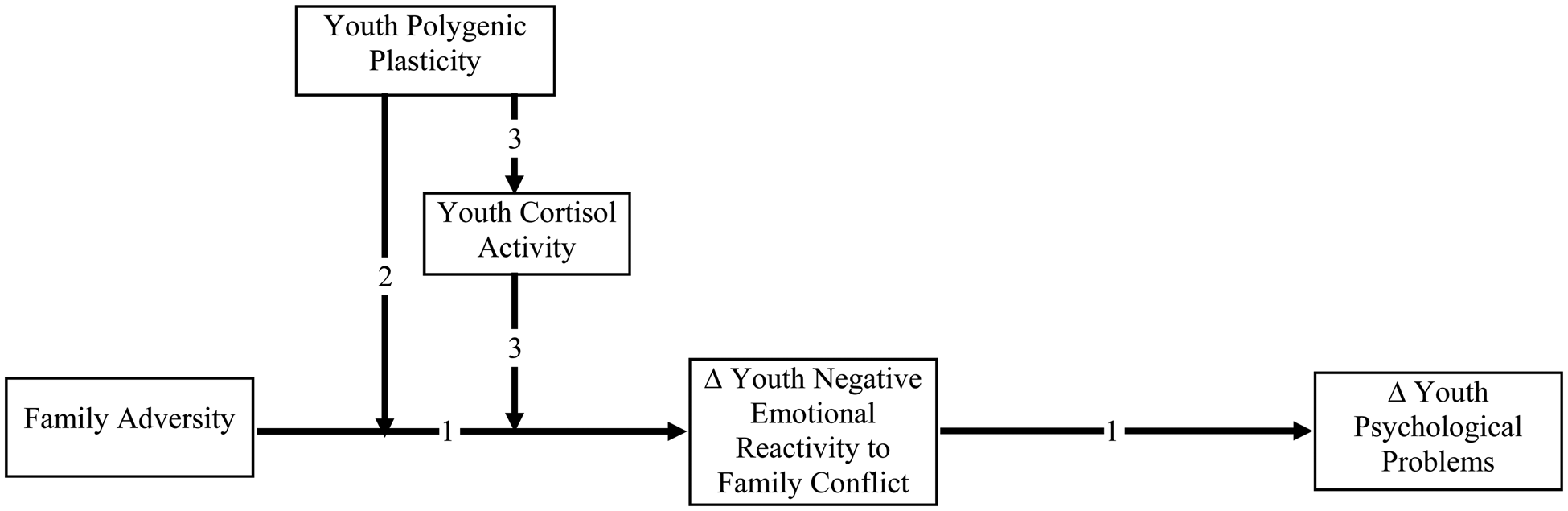
Figure 1 provides an overview of the hypothesized cascade involving adolescent's experiences with family adversity, emotional reactivity to conflict, and psychological problems in the context of their genetic attributes and cortisol functioning. As illustrated by Path 1 of the figure, our model proposes that elevated negative emotional reactivity to family stressors mediates the link between family adversity and adolescent vulnerability. For example, according to the risky family process model (Repetti, Taylor, & Seeman, Reference Repetti, Taylor and Seeman2002; Repetti et al., Reference Repetti, Robles and Reynolds2011), repeated exposure to family discord gradually sets in motion children's distress responses to family challenges, which, in turn, progressively increase their vulnerability to psychopathology over time. Likewise, emotional security theory proposes that exposure to family discord increases the likelihood of youth psychopathology by increasing their emotional insecurity. Emotional reactivity, defined by intense, prolonged negative affective (i.e., fear, distress, and anger) responses to family disputes, is conceptualized as a key sign of emotional insecurity and a risk mechanism in the transmission of problems from the family to the children (Davies et al., Reference Davies, Martin, Sturge-Apple and Cicchetti2016).
A conceptual model of the interplay between youth polygenic plasticity and cortisol activity in moderating a developmental cascade in which family adversity increases youth psychological problems through its association with progressively greater negative emotional reactivity to family conflict over time.

In support of these theories, research has repeatedly shown that children's emotionally dysregulated displays of distress, defensiveness, and anger in response to family stress account for links between various forms of family adversity (i.e., parenting and interparental difficulties) and youth psychopathology (e.g., Buehler, Lange, & Franck, Reference Buehler, Lange and Franck2007; Davies, Cicchetti, & Martin, Reference Davies, Cicchetti and Martin2012; Lindahl, Bregman, & Malik, Reference Lindahl, Bregman and Malik2012; McLaughlin et al., Reference McLaughlin, Kubzansky, Dunn, Waldinger, Vaillant and Koenen2010). However, to our knowledge, all existing empirical tests of emotional reactivity to family stress as a mediator have utilized cross-sectional or limited longitudinal designs that assess one or more of the endogenous variables (i.e., offspring emotional reactivity or mental health outcomes) at a single time point. Use of static snapshots of key constructs in the proposed cascade have been shown to produce biased estimates of mediation (Maxwell & Cole, Reference Maxwell and Cole2007). Therefore, based on quantitative recommendations for authoritatively testing mediation (Maxwell & Cole, Reference Maxwell and Cole2007), our first aim was to test the mediational role of adolescent negative emotional reactivity to family conflict in an analytic framework that models successive change in both the mediator and the outcome (i.e., psychological problems). According to several family process models (e.g., Davies et al., Reference Davies, Martin, Sturge-Apple and Cicchetti2016; Labella & Masten, Reference Labella and Masten2018; Repetti et al., Reference Repetti, Taylor and Seeman2002, Reference Repetti, Robles and Reynolds2011), adversity expressed across multiple family (i.e., interparental, mother–child, and father–child) subsystems is postulated to be a particularly potent antecedent of cascading difficulties in emotional reactivity and psychological difficulties. Accordingly, our assessment of family adversity is designed to capture children's cumulative experiences with perturbations across interparental, mother–child, and father–child relationships.
Genetic Moderation of the Mediational Role of Adolescent Emotional Reactivity
Although multiple theories have postulated that adolescent negative emotional reactivity is a key mechanism accounting for their vulnerability to family adversity, they also acknowledge that there is substantial variability between children in the strength of emotional reactivity as an explanatory mechanism (Bai & Repetti, Reference Bai and Repetti2015; Beauchaine & Zalewski, Reference Beauchaine, Zalewski, Dishion and Snyder2016; Davies et al., Reference Davies, Martin, Sturge-Apple and Cicchetti2016). Thus, a critical next step is to identify the sources of heterogeneity in children's sensitivity to family adversity. Given the documented role of genes as possible moderators of socialization factors (Belsky & Pluess, Reference Belsky and Pluess2009), a primary goal in this study was to examine whether the allelic variation in a selective set of genes may account in part for the variability in the strength of the first part of the mediational cascade involving family adversity and subsequent change in adolescent emotional reactivity to family conflict (see Path 2 of Figure 1).
Early Gene × Environment (G × E) studies commonly interpreted genetic moderation of environmental factors as supporting diathesis-stress models. In these models, specific alleles are conceptualized as carrying risk that becomes increasingly pronounced with greater exposure to adverse socialization contexts. However, differential susceptibility theory argues that many G × E findings more readily support the operation of specific alleles as plasticity factors. Consistent with diathesis-stress models, differential susceptibility theory proposes that children who carry specific alleles of genes may be at greater risk for experiencing distress when they are faced with heightened family adversity. However, as a key source of differentiation between the models, differential susceptibility theory also posits that the alleles confer greater sensitivity to the environment in ways that manifest in better than expected adjustment of children when socialization contexts are supportive.
Guided by differential susceptibility, we specifically examined whether a polygenic composite consisting of putative plasticity alleles moderated the association between family adversity and adolescent emotional reactivity. In a comprehensive review of the literature, Belsky et al. (Reference Belsky, Newman, Widaman, Rodkin, Pluess, Fraley and Roisman2015) designated variants of three genes as the top “tier” plasticity candidates: (a) the short allele of the serotonin transporter (5-HTTLPR) gene; (b) the 7-repeat variant of the dopamine D4 receptor (DRD4) variable-number random repeat (VNTR) exon III polymorphism; and (c) the Met allele of the brain-derived neurotrophic factor (BDNF) Val66Met gene. First, with its function of regulating transcriptional activity of the serotonin transporter, the 5-HTTLPR polymorphism has been consistently documented as a moderator of associations between family factors and offspring well-being. The short allele of the 5-HTTLPR gene is associated with diminished efficiency in regulating levels of serotonin in the brain (e.g., Heinz, Mann, & Weinberger, Reference Heinz, Mann, Weinberger and Goldman2001). Meta-analyses have shown that socialization adversity more strongly predicts psychological distress and problems for individuals carrying the short allele than counterparts carrying the long allele (e.g., Karg, Burmeister, Shedden, & Sen, Reference Karg, Burmeister, Shedden and Sen2011; Sharpley, Palanisamy, Glyde, Dilllingham, & Agnew, Reference Sharpley, Palanisamy, Glyde, Dillingham and Agnew2014; van IJzendoorn, Belsky, & Bakermans-Kranenburg, Reference van IJzendoorn, Belsky and Bakermans-Kranenburg2012). Although analyses designed to systematically delineate the form of moderation are relatively rare, the findings are largely consistent with differential susceptibility theory and its hypothesis that children possessing the short allele are sensitive to socialization contexts in a for better and for worse manner (van IJzendoorn et al., Reference van IJzendoorn, Belsky and Bakermans-Kranenburg2012).
Second, the DRD4 VNTR gene encodes for the expression of the DRD4 receptor and its function of regulating signaling events in dopaminergic pathways (Turic, Swanson, & Sonuga-Barke, Reference Turic, Swanson and Sonuga-Barke2010). DRD4 receptors are densely expressed in the mesocortical pathway linking the ventral tegmentum with the prefrontal cortex and, as a result, may be involved in the enactment of inhibitory control, planning, and the regulation of emotions and impulses (Pappa, Mileva-Seitz, Bakermans-Kranenburg, Tiemeier, & van IJzendoorn, Reference Pappa, Mileva-Seitz, Bakermans-Kranenburg, Tiemeier and van IJzendoorn2015; Sweitzer et al., Reference Sweitzer, Halder, Flory, Craig, Gianaros, Ferrell and Manuck2013). In comparison to other variants, the 7-repeat carriers evidence lower dopamine activity in these pathways and exhibit greater vulnerability to socialization adversity (e.g., Carver, LeMoult, Johnson, & Joormann, Reference Carver, LeMoult, Johnson and Joormann2014). Although these findings have commonly been interpreted as supporting diathesis-stress models, an increasing body of research has shown that the 7-repeat allele may operate as a plasticity factor that is more consistent with differential susceptibility theory. More specifically, qualitative and quantitative reviews have revealed that offspring carrying the 7-repeat allele are more likely to experience better psychological adjustment than their counterparts under harmonious family conditions (Bakermans-Kranenburg & van IJzendoorn, Reference Bakermans-Kranenburg and van IJzendoorn2011; Belsky & Pluess, Reference Belsky, Pluess and Cicchetti2016; Boyce, Reference Boyce2016; Pluess, Reference Pluess2017; Weeland, Overbeek, de Castro, & Mathys, Reference Weeland, Overbeek, de Castro and Matthys2015).
Third, the BDNF polymorphism encodes for BDNF protein activity in the brain and plays a critical role in the health, growth, and differentiation of neurons. Relative to the BDNF Val allele, the Met allele of the polymorphism is associated with diminished BDNF protein expression in the brain (Chen et al., Reference Chen, Patel, Sant, Meng, Teng, Hempstead and Lee2004; Egan et al., Reference Egan, Kojima, Callicott, Goldberg, Kolachana, Bertolino and Weinberger2003). Despite some empirical inconsistencies in the identification of the BDNF gene as a moderator of environmental factors, findings from many studies have shown that socialization histories and offspring psychological functioning are heightened for Met allele carriers (Clasen, Wells, Knopik, McGeary, & Beevers, Reference Clasen, Wells, Knopik, McGeary and Beevers2011; Koss, Cummings, Davies, Hetzel, & Cicchetti, Reference Koss, Cummings, Davies, Hetzel and Cicchetti2016; Kretschmer, Vitaro, & Barker, Reference Kretschmer, Vitaro and Barker2014). Although the findings from these studies are commonly interpreted within diathesis-stress models, follow-up analyses directly examining the relative correspondence between the BDNF moderating findings and the diathesis-stress and differential susceptibility models are rarely conducted. Thus, given that many of the graphical plots from the findings depict disordinal (i.e., crossover) interactions that at least partially resemble the form of moderation proposed in differential susceptibility theory (Belsky et al., Reference Belsky, Newman, Widaman, Rodkin, Pluess, Fraley and Roisman2015), questions remain about whether the Met allele is a risk or plasticity factor in family process models.
In summary, our second aim was to examine whether a polygenic composite consisting of the top-tier plasticity genes identified by Belsky et al. (Reference Belsky, Newman, Widaman, Rodkin, Pluess, Fraley and Roisman2015) moderated the mediational association among family adversity, adolescent emotional reactivity to family conflict, and their psychological problems. Despite the designation of 5-HTTLPR, DRD4 VNTR, and BDNF genes as plasticity factors (Belsky et al., Reference Belsky, Newman, Widaman, Rodkin, Pluess, Fraley and Roisman2015), null and more complex findings in G × E analyses are not uncommon (e.g., Weeland et al., Reference Weeland, Overbeek, de Castro and Matthys2015; Zhao et al., Reference Zhao, Chen, Chen, Yang, Yang, Yang and Pan2018). However, inconsistencies in the literature may be attributable to the target sequelae in tests of genetic moderation. Studies have predominantly focused on internalizing and externalizing symptoms as outcomes in G × E models. By contrast, prevailing family process models share the assumption that family adversity gradually increases psychological difficulties by progressively sensitizing children to stressful family events (Davies et al., Reference Davies, Martin, Sturge-Apple and Cicchetti2016; Harold & Sellers, Reference Harold and Sellers2018; Repetti et al., Reference Repetti, Robles and Reynolds2011). If individual differences in sensitivity to environmental parameters underpin the 5-HTTLPR, DRD4 VNTR, and BDNF polymorphisms as both differential susceptibility and diathesis-stress theories suggest, then children's susceptibility or plasticity to family adversity should be more precisely and consistently evident in their heightened distress reactivity to family difficulties than their overall psychological symptoms. Guided by these models, we tested whether the polygenic composite moderates the first link in the proposed mediational chain involving family adversity, adolescent negative emotional reactivity to family conflict, and their psychological problems. Based on Belsky et al.’s (Reference Belsky, Newman, Widaman, Rodkin, Pluess, Fraley and Roisman2015) taxonomy of plasticity alleles, we specifically hypothesized that children who carried more of the susceptibility alleles in the polygenic composite would experience heightened sensitivity to family climate such that they would exhibit (a) greater negative emotional reactivity to family conflict following exposure to family adversity and (b) lower negative emotional reactivity in the aftermath of more supportive family relationships.
Adrenocortical Activity as an Endophenotype Underlying Genetic Moderation
Although our second aim of more precisely characterizing how the polygenic composite may sensitize children to family relationship quality is an important empirical step, it does not specifically address how or why it may heighten children's susceptibility. In the multilevel expansion of differential susceptibility theory (Belsky & Pluess, Reference Belsky and Pluess2013; Ellis, Boyce, Belsky, Bakermans-Kranenburg, & van IJzendoorn, Reference Bakermans-Kranenburg and van IJzendoorn2011), genetic plasticity is posited to be instantiated at a physiological level in the heightened sensitivity of the hypothalamic–pituitary–adrenal (HPA) axis. With its product of cortisol, the HPA axis serves to mobilize energy (e.g., glucose and oxygen), increase alertness (e.g., vigilance), and modulate the processing, encoding, and memory consolidation of emotionally significant events (e.g., Barsegyan, Mackeznie, Kurose, McGaugh, & Roozendaal, Reference Barsegyan, Mackenzie, Kurose, McGaugh and Roozendaal2010; Flinn, Reference Flinn2006; Gunnar & Vazquez, Reference Gunnar, Vazquez, Cicchetti and Cohen2006). If cortisol is an endophenotype of genetic plasticity as differential susceptibility theory suggests, then findings must support that it is significantly associated with the polygenic composite of 5-HTTLPR, DRD4 VNTR, and BDNF plasticity alleles. At this early stage of research, the limited studies do not definitively support or discount this hypothesis. For example, in a sample of young adults, the DRD4 7-repeat carriers evinced lower, rather than higher, cortisol reactivity to a stressful laboratory task and the 5-HTTLPR polymorphism was a negligible predictor of cortisol (Armbruster et al., Reference Armbruster, Mueller, Moser, Lesch, Brocke and Kirschbaum2009). In contrast, findings from a meta-analysis indicate that the short allele of the 5-HTTLPR gene is related to heightened cortisol reactivity to stress (Miller, Wankerl, Stalder, Kirschbaum, & Alexander, Reference Miller, Wankerl, Stalder, Kirschbaum and Alexander2013). Moreover, in a rare study that simultaneously examined two of the genes in the plasticity composite, Dougherty, Klein, Congdon, Canli, and Hayden (Reference Dougherty, Klein, Congdon, Canli and Hayden2010) found that young children carrying both BDNF Met allele and two 5-HTTLPR short alleles exhibited a greater increase in cortisol during a laboratory visit. To further address the limited, inconsistent, and piecewise findings in the literature, we used differential susceptibility theory as a guide to testing the hypothesis that adolescents carrying more of the 5-HTTLPR, DRD4 VNTR, and BDNF plasticity alleles in a polygenic composite would exhibit heightened cortisol levels.
However, simply documenting a significant bivariate association between the polygenic composite and youth cortisol levels is a necessary, but not sufficient, condition for identifying cortisol as an endophenotype of genetic moderation. If cortisol is a mechanism underpinning plasticity (or risk) alleles, then it should function as a moderator of associations between family adversity and adolescent emotional reactivity in the same way as the genetic composite. Consistent with a moderator-mediated-moderation model (Davies, Cicchetti, & Hentges, Reference Davies, Cicchetti and Hentges2015), the moderating role of cortisol should also mediate the significant association between the family adversity and the genetic composite interaction and youth negative emotional reactivity to family conflict. That is, as a putative endophenotype of genetic plasticity, cortisol should serve in a similar role to the genetic composite in sensitizing children to family contexts and account for its moderating effects.
Although research has yet to test each of these conditions, there is some piecewise support for the viability of our multiple-levels-of-analysis hypotheses. For example, biological sensitivity to context theory proposes that the HPA axis is a stress-sensitive physiological system that modulates sensitivity to socialization contexts (Ellis, Essex, & Boyce, Reference Ellis, Essex and Boyce2005; Ellis et al., Reference Ellis, Boyce, Belsky, Bakermans-Kranenburg and van IJzendoorn2011). Consistent with the proposed moderator role of the genetic plasticity composite, heightened cortisol levels are specifically proffered to sensitize children to both adverse and supportive family climates. In support of this hypothesis, research has shown that cortisol activity and reactivity to stress moderate associations between family adversity and children's psychological adjustment in a context-dependent fashion that corresponds with a plasticity effect (e.g., Laurent et al., Reference Laurent, Leve, Neiderhiser, Natsuaki, Shaw, Fisher and Reiss2013; Obradović, Bush, Stamperdahl, Adler, & Boyce, Reference Obradović, Bush, Stamperdahl, Adler and Boyce2010; Steeger, Cook, & Connnell, Reference Steeger, Cook and Connell2017). That is, children with heightened cortisol levels have been shown to experience greater difficulties in adverse family contexts but also fare better in more benign family environments. Drawing on the preliminary evidence that both cortisol activity and reactivity may serve as endophenotypes of children's genetic sensitivity, we specifically examined whether the moderating role of the genetic composite was further mediated by the moderating role of these two cortisol factors in the association between family adversity and adolescent emotional reactivity to family conflict.
The Present Study
In summary, our study is designed to break new ground by examining the genetic factors and their associated physiological manifestations (i.e., cortisol levels) as sources of heterogeneity in pathways among family adversity, youth negative emotional reactivity, and their internalizing and externalizing symptoms during early adolescence. Our decision to focus on early adolescence was rooted in several developmental considerations. In highlighting the public health significance of this developmental period, early adolescence is marked by increased vulnerability to risk-taking behaviors (e.g., delinquency), anxiety, and depressive symptoms (Doremus-Fitzwater, Varlinskaya, & Spear, Reference Doremus-Fitzwater, Varlinskaya and Spear2010; Odgers et al., Reference Odgers, Caspi, Nagin, Piquero, Slutske, Milne and Moffitt2008; Schriber & Guyer, Reference Schriber and Guyer2016). During this time, youth experience increases in the frequency and intensity of conflicts with their parents, stronger impulses to mediate broader family disagreements, and greater proficiency in identifying more subtle expressions of constructive and destructive conflict tactics (Branje, Reference Branje2018; Davies et al., Reference Davies, Martin, Sturge-Apple and Cicchetti2016; Harold & Sellers, Reference Harold and Sellers2018). This developmental window is also regarded as a sensitive period in the life span due to the rapid development of neurological systems that code for appetitive and threat cues and organize approach and defensive behaviors (Del Giudice, Ellis, & Shirtcliff, Reference Del Giudice, Ellis and Shirtcliff2011; Ernst, Romeo, & Anderson, Reference Ernst, Romeo and Andersen2009; Steinberg, Reference Steinberg2010). Significant alterations in neurobiological circuitry, in turn, are proposed to heighten adolescent sensitivity to both aversive and supportive environments (Galván & Tottenham, Reference Galván, Tottenham and Cicchetti2016; Monahan, Guyer, Silk, Fitzwater, & Steinberg, Reference Monahan, Guyer, Silk, Fitzwater, Steinberg and Cicchetti2016). Accordingly, preexisting individual differences in the genetic and biological (i.e., HPA axis) substrates of plasticity to environmental experiences may play a particularly critical role in modulating the impact family relationship qualities have on adolescents’ emotional reactivity to family conflicts.
To test our mediational hypothesis illustrated in Path 1 of Figure 1, we examined whether observational ratings of family adversity across multiple interactions at Wave 1 predicted subsequent intraindividual change in a multimethod assessment of youth emotional reactivity to a family disagreement across a 1-year period from Wave 1 to Wave 2. In addressing the second link in the mediational chain, we further examined whether increases in youth emotional reactivity, in turn, were associated with greater youth behavioral and emotional problems over a 2-year period from Waves 1 to 3. For our second hypothesis (see Path 2 of Figure 1), we specifically examined whether a polygenic composite reflecting first tier plasticity alleles (see Belsky et al., Reference Belsky, Newman, Widaman, Rodkin, Pluess, Fraley and Roisman2015) moderated the association between family adversity and youth emotional reactivity in a manner that favored differential susceptibility theory over diathesis-stress theory. To provide a balanced test of the relative viability of the two forms of genetic moderation, we specifically followed recommendations to incorporate both harsh and supportive (i.e., reverse-scored) environmental parameters into the family adversity measurement (Belsky & Pluess, Reference Belsky and Pluess2009). This approach increases the power of the analyses to examine whether youth with more genetic plasticity alleles are not only sensitized to family disagreements under adverse family conditions but also evidence lower than expected distress when they are raised in more harmonious family climates. Finally, as illustrated in Path 3 of Figure 1, we tested the hypothesis that youth cortisol reactivity and activity in the period surrounding the family disagreement interaction at Wave 1 functioned as an endophenotype of genetic plasticity. Our multistage approach to the endophenotype analysis culminated in a moderator-mediator-moderation analysis that examined whether the adolescent cortisol moderated family adversity in the same way as the polygenic plasticity composite and accounted for its role as a susceptibility factor.
Method
Participants
Participants were 279 adolescents and their parents who were recruited from local school districts and community centers in a moderately sized metropolitan area in the Northeastern United States and a small city in the Midwestern United States. Because assessing the quality of interparental and parent–child relationships was a key focus of the study, inclusionary criteria required that mothers, fathers, and adolescents have regular contact with each other as a triad, defined by an average of 3 days per week during the previous year (Mean = 6 days per week). Adolescents were in seventh grade at Wave 1 and, on average, 13 years old (SD = 0.24; range 12 to 14). Girls comprised 51% of the sample. Median household income of the families was between $55,000 and $74,999 per year. Median education level of mothers and fathers was some college education. Most parents (i.e., 86%) were married at the outset of the study. For racial background, 73% of adolescents identified as White, followed by smaller percentages of African American (17%), multiracial (8%), and other races (2%). In terms of US ethnicity designations, 7% of youth were Latino. Adolescents lived with their biological mother in most cases (94%), with the remainder living with an adoptive mother or a stepmother (3%) or a female guardian (3%). Children also lived with their biological father in most cases (79%), with the remainder of the sample living with either an adoptive father or a stepfather (16%) or a male guardian (5%). The longitudinal design of the study consisted of three annual measurement occasions. Retention rates were 93% across each of the two contiguous waves of data collection. Data were collected between 2007 and 2011.
Procedures
At each of three waves of data collection, families visited the laboratory twice at one of two data collection sites. Laboratories at each site included (a) an observation room that was designed to resemble a living room and equipped with audiovisual equipment to capture family interactions and (b) interview rooms for completing confidential interview and survey measures. The study was approved by the institutional review board at each research site. Families were compensated monetarily for their participation.
Interparental problem-solving task (IPST)
At Wave 1, mothers and fathers participated in an interparental interaction task in which they discussed two common, intense interparental disagreements that they viewed as problematic in their relationship. Following similar procedures in previous research (Du Rocher Schudlich, Papp, & Cummings, Reference Du Rocher Schudlich, Papp and Cummings2004), couples selected two problematic topics of disagreement in their relationship that they felt comfortable discussing from independent lists of topics that each partner generated. Couples were asked to address the topics in a way they normally would at home and subsequently discussed each topic for 7 min while they were alone in the laboratory room. The IPST was video recorded for subsequent coding of maternal and paternal interparental conflict tactics.
Triadic family problem-solving task (FPST)
At Waves 1 and 2, mothers, fathers, and youth engaged in a 7-min problem-solving task. Each family member generated a list of problematic topics to discuss and then conferred for 2 min to select one topic to discuss for the FPST. Families were instructed to discuss the topic as they normally would at home. Discussions were videotaped for later coding of mother–child and father–child relationship quality at Wave 1 and adolescent emotional reactivity to the family conflict task at Waves 1 and 2. Immediately following the FPST, mothers, fathers, and youth completed a questionnaire to assess adolescent emotional reactivity to the family conflict.
Salivary cortisol collection
At Wave 1, adolescents provided one pretask and three posttask saliva samples to assess cortisol levels in the context of the FPST. Youth rinsed their mouths with water 10 min prior to providing the three samples. Samples were collected through passive drool with the aid of a straw. A pretask saliva assessment was obtained approximately 40 min after the start of the visit to allow for sufficient time for cortisol to return to baseline levels following their arrival to the laboratory. To capture youth cortisol levels in response to the family conflict, posttask samples were collected 10, 20, and 30 min after the midpoint of the FPST, resulting in the collection of saliva samples at 14, 24, and 34 min after the start of the task. Family visits took place in the late afternoon and evening hours to minimize the effects of diurnal cortisol patterns (Mean pretask sampling time = 5:10 p.m.; SD = 1 hr 43 min).
DNA collection, extraction, and genotyping
Trained experimenters obtained DNA samples from the adolescents at Wave 3 through whole saliva collected using the Oragene DNA collection kits (DNA Genoteck Inc., Ontario, Canada). DNA was purified from 0.5 ml of Oragene DNA solution using the DNA Genotek protocol for manual sample purification with prepIT-L2P. Sample concentrations were determined using the Quant-iT PicoGreen dsDNA Assay Kit (P7589, Invitrogen). DNA was whole-genome amplified using the Repli-g kit (Qiagen, Catalog No. 150043) per the kit instructions. Amplified samples were subsequently diluted to a working concentration for genotyping. Single nucleotide polymorphism (SNP) genotyping was conducted using Applied Biosystems Custom Taqman SNP Genotyping Assays. The products of these analyses were analyzed using endpoint allelic discrimination. Human DNA from cell lines were purchased from Coriell Cell Repositories for each genotype and used as control samples. Genotypes were confirmed using dye terminator sequencing chemistry on an ABI 3130xl. All control samples were genotyped twice for quality control. Study samples that were not genotyped to a 95% confidence level or greater were repeated under the same procedures for a maximum of four times.
Youth psychological problem surveys
At Waves 1 and 3, youth and their mothers, fathers, and teachers completed questionnaires to assess adolescent psychological functioning.
Measures
Family adversity
The measurement battery for family adversity at Wave 1 was designed to capture maternal and paternal relationship qualities in the interparental and parent–child dyads. As the first set of indicators of family adversity, trained coders rated maternal and paternal conflict behaviors in the IPST on four dimensional scales from the System for Coding Interactions in Dyads (SCID; Malik & Lindahl, Reference Malik, Lindahl, Kerig and Baucom2004). Each SCID scale was rated along a 5-point scale ranging from 1 (very low) to 5 (high). To assess destructive dimensions of conflict, coders rated mothers and fathers separately for levels of verbal aggression, defined as the level of hostile or aggressive behaviors and verbalizations during the interaction, and negativity and conflict, reflected in the level of tension, frustration, and anger displayed by each partner. To provide a complementary assessment of supportiveness in the interparental conflicts, coders also rated mothers and fathers on two constructive conflict dimensions: support, characterized by attempts to validate, listen, and understand the perspective of the partner, and positive affect, indexed by positivity and warmth in tone of voice (e.g., happy, cheerful, or satisfied), behaviors (e.g., physical affection or laughter), and facial expressions (e.g., genuine smiles). Interrater reliability coefficients, which were calculated based on coders’ independent ratings on 20% of the interactions, ranged from .72 to .92 across codes (Mean intraclass correlation; ICC = .86). Constructive ratings were reverse scored, so their scaling was consistent with the destructive forms of interparental conflict. Ratings were subsequently averaged together to form composites of maternal (α = 0.81) and paternal (α = 0.79) destructive interparental conflict behaviors.
For the second set of indicators of family adversity, separate teams of trained coders rated mother–child and father–child relationship quality during the FPST using six codes adapted from the Iowa Family Interaction Rating Scales (Melby & Conger, Reference Melby, Conger, Kerig and Lindahl2001). Each code was rated on a 9-point scale (1 = not at all characteristic; 9 = mainly characteristic). Coders rated destructive properties of maternal–child and paternal–child relationship using three scales: hostility, defined by the reciprocation of critical, angry, and rejecting behaviors between the target parent and child; intrusiveness, reflecting parental coerciveness and control over the interaction in ways that promote a parent-centered agenda; and psychological control, defined as parental attempts to control the adolescent by negatively manipulating the parent–child relationship through methods that include lecturing or dominating the conversation, discounting feelings, blaming, inducing guilt, interrogating, and love withdrawal. As complementary assessments, constructive features of mother–child and father–child dyads consisted of coder ratings on three codes: warmth, defined by expressions of affection, support, and appreciation between the target parent and child; positive reinforcement, characterized by parental use of praise, approval, or rewards in response to positive teen behavior; and relationship quality, reflected in unity, synchrony, openness, and validation in the dyad. ICCs, based on independent coder ratings of over 20% of the videos, ranged from .75 to .87 for the father–child relationship codes and .85 to .92 for the mother–child relationship codes. After reverse scoring constructive relationship codes to be consistent with the scaling of the destructive codes, the six scales were averaged together to obtain composites of paternal–child (α = 0.82) and maternal–child (α = 0.90) relationship adversity. To create a parsimonious composite of family adversity for the primary analyses, the four resulting composites (i.e., maternal and paternal conflict tactics in the IPST; mother–child and father–child difficulties in the FPST) were standardized and aggregated together (α = 0.77).
Youth emotional reactivity to conflict
Indices of youth emotional reactivity to family conflict at Waves 1 and 2 were derived from multiple methods and informants. First, adolescents provided self-reports of their emotional reactions to the FPST on a questionnaire immediately following the task. Youth specifically rated the intensity of their angry, upset, and happy feelings on a 6-point Likert scale, ranging from 0 (not at all) to 5 (a whole lot). To form a single indicator capturing youth report of negative emotional reactivity, we averaged the emotion ratings together after reverse scoring the happy rating (α = 0.70 and 0.66 at Waves 1 and 2, respectively).
Second, mothers and fathers also reported on youth emotional reactions to the conflict task on a questionnaire after the FPST. Following the same format as the youth self-report questionnaire, parents reported on their perceptions of their teen's angry, upset, and happy feelings using a six-point scale (0 = not at all; 5 = a whole lot). Happy ratings were reverse scored to be consistent with the scaling of the negative emotions. The three emotion ratings provided by mothers and fathers were subsequently averaged together to form a parsimonious, parent-report composite of adolescent emotional reactivity at Waves 1 (α = 0.65) and 2 (α = 0.73).
Third, coders rated youth emotional reactivity to the FPST at each wave using five dimensional codes: comfort, indexed by verbal, facial, and postural displays of comfort, satisfaction, confidence, and positive affect; hostility, defined as overt expressions of aggression, anger, and frustration through facial expressions, posture, or verbalizations; affected behavior, characterized by intense and demonstrative displays of distress, whining, and fretting; affective indifference, reflected in unresponsive, condescending, uncooperative, and passive aggressive behaviors that challenge parental authority; and mobilizing reactivity, characterized by a pattern of responding that reflects high sensitivity to interpersonal threat through blatant, unvarnished expressions of distress and proactive efforts to regulate the conflict through avoidance and/or intervention (e.g., alliance formation with one parent) behaviors. ICC values, indexing interrater reliability based on independent coder ratings of over 20% of the videos, ranged from .77 to .92 (Mean ICC = .85) across the two waves. The five observational codes were averaged together to form a composite of youth emotional reactivity at Waves 1 (α = 0.77) and 2 (α = 0.73). Child, parent, and observer ratings were specified as indicators of a latent construct of youth emotional reactivity at Waves 1 and 2.
Polygenic plasticity composite
We performed genetic assays on the Oragene saliva samples for DRD4 VNTR, 5-HTTLPR, and BDNF genes based on their designations as the top three plasticity alleles by Belsky et al. (Reference Belsky, Newman, Widaman, Rodkin, Pluess, Fraley and Roisman2015). Genotyping was performed using established protocols. The DRD4 exon 3 VNTR length was determined by polymerase chain reaction (PCR) amplifying DNA with primers DRD4 F3 (50 CGGCCTGCAGCGCTGGGA30) and DRD4 R2 D4 (50 CCTGCGGGTCTGCGGTGGAGT30) on a MasterCycler Gradient (Eppendorf, Inc.). Using a CEQ8000 (Beckman Coulter, Inc.), the resulting products were analyzed for length. Consistent with recommendations by Belsky et al. (Reference Belsky, Newman, Widaman, Rodkin, Pluess, Fraley and Roisman2015), allelic variation in the DRD4 exon 3 VNTR was coded based on the (1) presence (35% of sample) or (0) absence (65% of sample) of the 7-repeat variant in its role as a plasticity allele.
In genotyping the triallelic 5-HTTLPR polymorphism, human genomic DNA was PCR amplified with Hot Star Taq PCR Mix (Qiagen Catalog No. 203205) and previously described primers (Gelernter, Kanzler, & Cubells, Reference Gelernter, Kranzler and Cubells1997), followed by fragment analysis using a CEQ 8000 (Beckman-Coulter Inc., Fullerton, CA). The SNP located with the 5-HTTLPR L/S region, rs25531 (NC_000017.11:g. 30237328T.C), was genotyped using previously reported TaqMan probes (Lesch et al., Reference Lesch, Bengel, Heils, Sabol, Greenberg, Petri and Murphy1996). Individual allele determinations were made using TaqMan Genotyping Master Mix (Life Technologies, Catalog 4371357) with amplification on a GeneAmp 9700 (Applied Biosystems) and analyzing the endpoint fluorescence using a Tecan M200 and data analyzed with JMP 10.0 (SAS, Inc.). An A > G substitution in a SNP upstream from the promoter region has shown that the LG allele, relative to the LA, functions similarly to the short allele in its regulation of serotonin (Reimold et al., Reference Reimold, Smolka, Schumann, Zimmer, Wrase, Mann and Heinz2007). Thus, following the additive coding of the 5-HTTLPR in the genetic plasticity taxonomy of Belsky et al. (Reference Belsky, Newman, Widaman, Rodkin, Pluess, Fraley and Roisman2015), we quantified the triallelic polymorphism as (2) two functional short alleles (18% SS; 9% LGS; 1% LG LG); (1) one functional short allele (41% LAS; 9% LALG); or (0) no functional short alleles (22% LALA).
Genotyping for the rs6265 BDNF polymorphism (C_000011. 10:g.27658369 C.T) was conducted using TaqMan Genotyping Master Mix (Life Technologies, Catalog 4371357) with amplification on a GeneAmp 9700 (Applied Biosystems) and analyzing the endpoint fluorescence using a Tecan M200 and JMP 10.0 (SAS, Inc.). The BDNF gene was quantified based on the (1) presence (26%) or (0) absence (74%) of the Met allele in accord with its identification as a dominant plasticity allele (see Belsky et al., Reference Belsky, Newman, Widaman, Rodkin, Pluess, Fraley and Roisman2015). Call rates based on the 198 teens who provided saliva samples were 97%, 100%, and 100% for DRD4 exon 3 VNTR, 5-HTTLPR, and BDNF genes, respectively. Genetic distributions were in Hardy–Weinberg equilibrium for the three genes (all ps > .31). Following a candidate gene approach, we summed the three gene variables into a single composite (range = 0 to 4) for a more powerful assessment of polygenic plasticity.
Cortisol
Saliva samples were assayed for cortisol using a highly sensitive immunoassay at Salimetrics Inc. (State College, PA). The test uses 25 μl of saliva per determination, and assays were conducted in duplicate form. The assay has a lower test sensitivity of 0.007 μg/dl and an upper test sensitivity of 3.00 μg/dl. The average intra-assay coefficient of variation is 5.75%. Method accuracy, determined by spike and recovery, and linearity, determined by serial dilution, are 100.8% and 91.7%, respectively. The values from matched serum and saliva samples show the expected strong linear relationship, r = .91. To normalize their distributions, youth cortisol values that were higher than 3 SD above the mean were Winsorized to 3 SD from the mean. We calculated two indices of cortisol activity: area under the curve with respect to ground (AUCG), which is an index of the total cortisol output across the four assessments; and area under the curve with respect to increase (AUCI), indexing the degree of change from the pretask value to the three posttask assessments (see Pruessner, Kirschbaum, Meinlshmid, & Hellhammer, Reference Pruessner, Kirschbaum, Meinlschmid and Hellhammer2003). Consistent with previous research (e.g., Pagliaccio et al., Reference Pagliaccio, Luby, Bogdan, Agrawal, Gaffrey, Belden and Barch2014), we controlled for time of day by regressing time of the pretask cortisol assessment on the AUCG and AUCI values. The resulting unstandardized residuals for AUCG and AUCI were used in subsequent analyses.
Youth psychological problems
Parents, teachers, and children completed assessments of youth psychological problems at Waves 1 and 3. First, mothers and fathers completed an overall psychological symptoms measure consisting of the sum of the internalizing (e.g., “nervous, high-strung, or tense” and “unhappy, sad, or depressed”) and externalizing symptoms scales (e.g., “lying or cheating” and “gets in many fights”) from the Child Behavior Checklist (Achenbach, Dumenci, & Rescorla, Reference Achenbach, Dumenci and Rescorla2003). Alpha coefficients for the mother- and father-report measures of total problems across the two waves ranged from 0.91 to 0.93. Second, we obtained teacher reports of youth psychological problems using comparable internalizing (e.g., “worries” and “unhappy, sad, or depressed”) and externalizing (e.g., “lying or cheating” and “gets in many fights”) symptoms scales from the Teacher Report Form of the Child Behavior Checklist (Achenbach et al., Reference Achenbach, Dumenci and Rescorla2003). Internal consistencies for teacher reports of total problems were .94 at Wave 1 and .91 at Wave 3. Third, adolescents reported on their total psychological problems using the emotional problems (5 items; e.g., “I am often unhappy, depressed, or fearful”) and conduct problems (5 items; e.g., “I fight a lot”) scales of the youth self-report version of the Strengths and Difficulties questionnaire (Goodman & Scott, Reference Goodman and Scott1999). Alpha coefficients indexing reliability were 0.77 at Wave 1 and 0.70 at Wave 3. Mother-, father-, teacher-, and child-report measures of symptoms were specified as indicators of a latent construct of psychological problems at each wave.
Covariate: Demographic characteristics
Two covariates were assessed, including (a) adolescent gender (0 = Male; 1 = Female) and (b) parent report of annual household income based on a 13-point ordinal scale ranging from 1 (<$6,000) to 13 ($125,000 or more).
Results
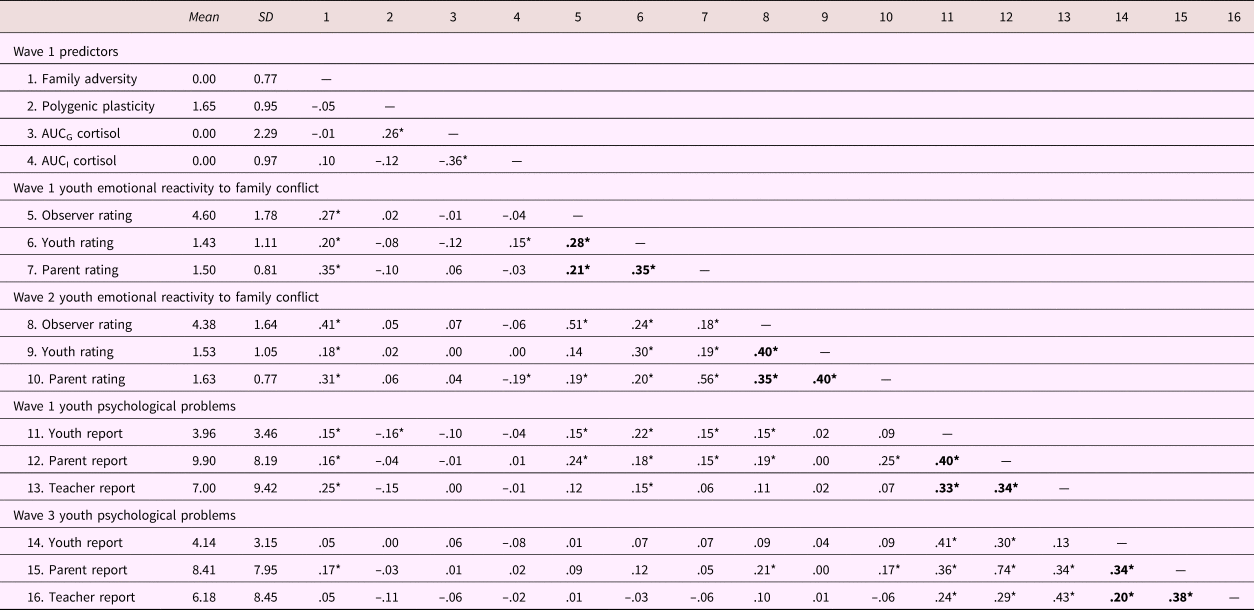
The means, standard deviations, and correlations among the primary variables in the study are presented in Table 1. Consistent with previous research, Wave 1 family adversity was associated with indices of greater emotional reactivity at Waves 1 and 2 and some measures of their psychological problems at Waves 1 and 3. Indices of youth emotional reactivity to family conflict, in turn, were also related to greater youth problems at Waves 1 and 3. In accord with previous findings, differential stability coefficients for youth emotional reactivity and their psychological problems were moderate to high in magnitude.
Means, standard deviations, and correlations among the primary variables in the study

*p ≤ .05.
Data for the variables in the primary analyses were missing for 16% of the values. To test whether data for the primary variables were missing completely at random (MCAR), we examined the patterns of missing data using Little's MCAR test (Little, Reference Little1988; Schlomer, Bauman, & Card, Reference Schlomer, Bauman and Card2010). Because the findings indicated that the data were MCAR (χ2 = 780.33, df = 784, p = .53) and the amount of missing data was under 20%, we followed quantitative recommendations by estimating missing data using full-information maximum likelihood (see Schlomer et al., Reference Schlomer, Bauman and Card2010). All primary analyses were conducted using structural equation model (SEM) analyses with Amos 25.0 software (Arbuckle, Reference Arbuckle2017).
Analytic Aim 1: Youth emotional reactivity as a mediator of family adversity
In testing the mediational role of youth emotional reactivity in the association between family adversity and their psychological problems, we used latent difference score (LDS; McArdle, Reference McArdle2009) analyses to capture individual differences in intraindividual change in adolescent: (a) emotional reactivity to family conflict from Waves 1 to 2; and (b) their psychological problems from Waves 1 to 3. Following recommended practices for LDS analyses, we specifically regressed the later assessment of each target construct onto the previous assessment of the variable and the latent difference score while constraining both paths to 1 (see Burt & Obradović, Reference Burt and Obradović2013; McArdle, Reference McArdle2009). Using the standard approach for estimating the proportional change components in the LDS analyses, we also specified a structural path between the initial level of the variable and the latent growth parameter for teen emotional reactivity and psychological problems constructs (e.g., Sbarra & Allen, Reference Sbarra and Allen2009). To test the mediational hypotheses, we specified paths running from: (a) family adversity to LDS changes in adolescent emotional reactivity and psychological problems and (b) LDS changes in adolescent emotional reactivity and their psychological problems. As covariates, adolescent gender and family income were also estimated as predictors of LDS change in the two endogenous variables.
Factor loadings of the manifest indicators of the latent variables of emotional reactivity and psychological problems were constrained to be equal. Preliminary tests of measurement invariance supported this more conservative and parsimonious approach. Comparisons of the fit of a model in which indicators of each of the primary latent variables were constrained to be equal over time with a model in which the indicators of each of the primary latent variables supported the comparability of the constrained model over the free-to-vary model for all three evaluative criteria: (a) chi-square difference is nonsignificant (i.e., χ2 = 8.52, df = 4, p = .07); (b) the decrease in comparative fit index (CFI) is no more than .01 (ΔCFI = .006); and (c) the increase in root mean square error of approximation (RMSEA) is no more than .01 (ΔRMSEA = .001). Finally, correlations were also specified among all exogenous variables in the analyses and between residual errors of the same manifest indicators of adolescent emotional reactivity and psychological problems across time to account for stability in measurement error for each indicator. However, for clarity, only significant correlations among the exogenous variables are presented in the figure.
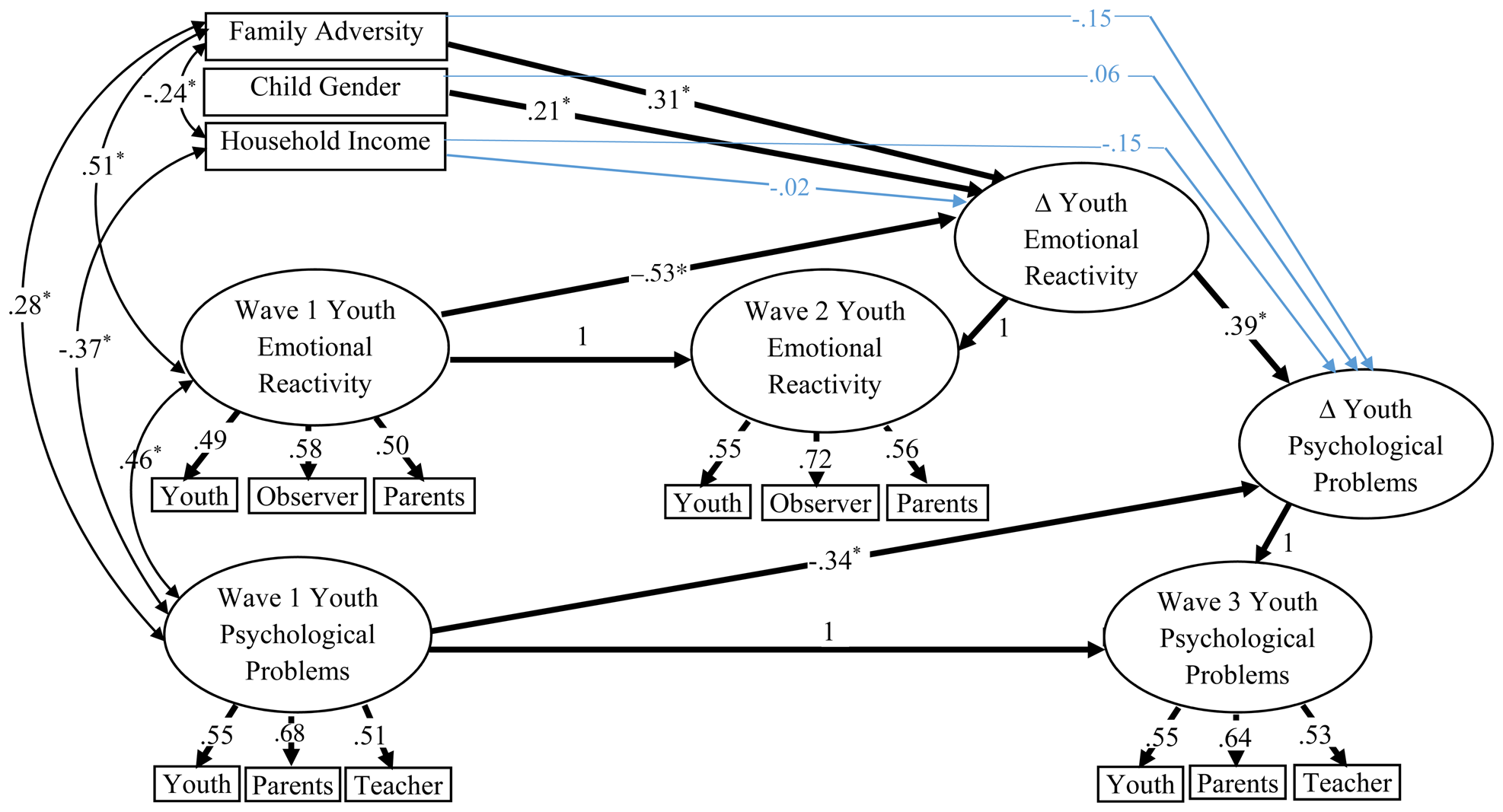
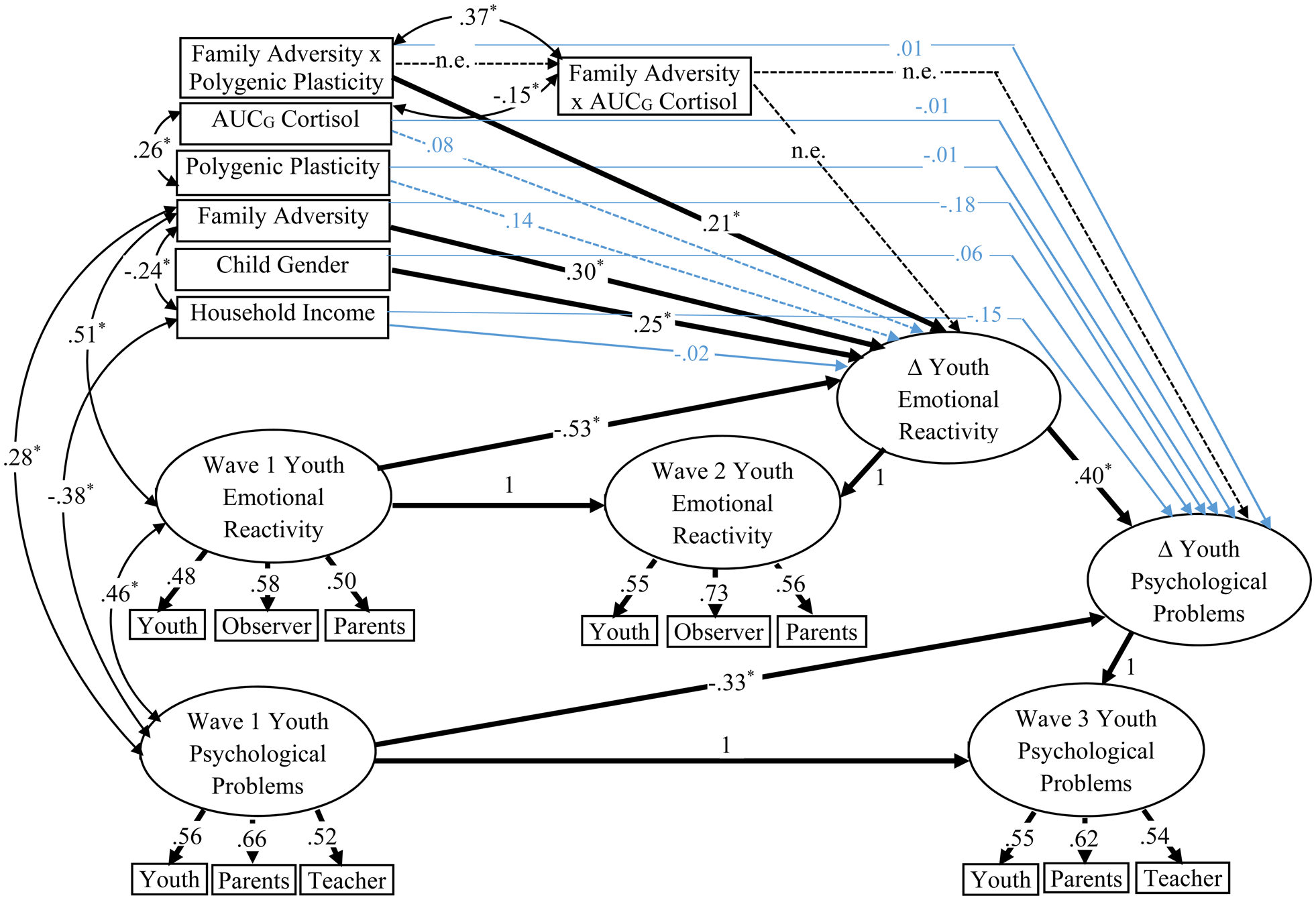
The resulting model, which is depicted in Figure 2, provided a satisfactory representation of the data, χ2 (72, N = 279) = 124.32, p = .0001, RMSEA = .05, CFI = .93, and χ2/df ratio = 1.73. Supporting the measurement model, loadings of the manifest indicators for the latent constructs were significant (p < .001) and, on average, moderate in strength (Mean loading = .57). For the covariates, the only significant path involving adolescent gender as a predictor of emotional reactivity indicated that girls exhibited greater increases in emotional reactivity to conflict over the 1-year period than did boys, β = .21, p = .01. Consistent with the mediating role of emotional reactivity, Wave 1 family adversity predicted LDS change in youth negative emotional reactivity to conflict from Waves 1 to 2, β = .31, p = .01. Increases in negative emotional reactivity from Waves 1 to 2, in turn, were associated with LDS increases in psychological problems from Waves 1 to 3, β = .39, p = .01. In further support of mediation, our calculation of asymmetrical confidence intervals (CIs) for the indirect path involving family adversity, change in youth emotional reactivity, and change in their psychological problems yielded a significant finding, 95% CI [0.064, 1.226] (MacKinnon, Fritz, Williams, & Lockwood, Reference MacKinnon, Fritz, Williams and Lockwood2007; Preacher & Hayes, Reference Preacher and Hayes2008).
Structural equation model testing our first aim of examining whether adolescent negative emotional reactivity to family conflict mediates the prospective association between family adversity and their psychological problems using latent difference score analyses. * p < .05.

Aim 2: Polygenic plasticity as a moderator of the mediational role of emotional reactivity
To examine genetic plasticity as a moderator of the first link in a mediational pathway between family adversity and adolescent emotional reactivity, we included the same specifications as the model in Aim 1 while also adding the polygenic composite variable and the cross-product of the Wave 1 family adversity and the polygenic composite as predictors of LDS changes in youth emotional reactivity and psychological problems. As a rigorous test of the polygenic composite as a moderator, we incorporated AUCG cortisol in the model based on previously established analytic procedures for testing moderator-mediated moderation (e.g., Davies et al., Reference Davies, Cicchetti and Hentges2015). AUCG (overall output), but not AUCI (i.e., reactivity), was included in the model because it was the only cortisol dimension that met the precondition for an endophenotype of plasticity. As shown in the first row of Table 2, the polygenic composite was significantly associated with the AUCG cortisol measure, r = .26, p < .001, but not the AUCI cortisol assessment, r = –.12, p = .12. Because AUCI did not meet the first criterion for serving as an endophenotype, it was dropped from subsequent analyses to maximize analytic parsimony. Therefore, in the final specifications of our model, paths running from AUCG cortisol to the two endogenous variables were also estimated. To obtain an estimate of the moderating effects of the polygenic plasticity composite prior to testing the moderating role of AUCG, the following structural paths for the mediational links were constrained to 0: (a) Family Adversity × Polygenic Plasticity and Family Adversity × AUCG; (b) Family Adversity × AUCG and LDS change in adolescent emotional reactivity; and (c) Family Adversity × AUCG and LDS change in adolescent psychological problems. Predictors were centered prior to the calculation of interaction terms.
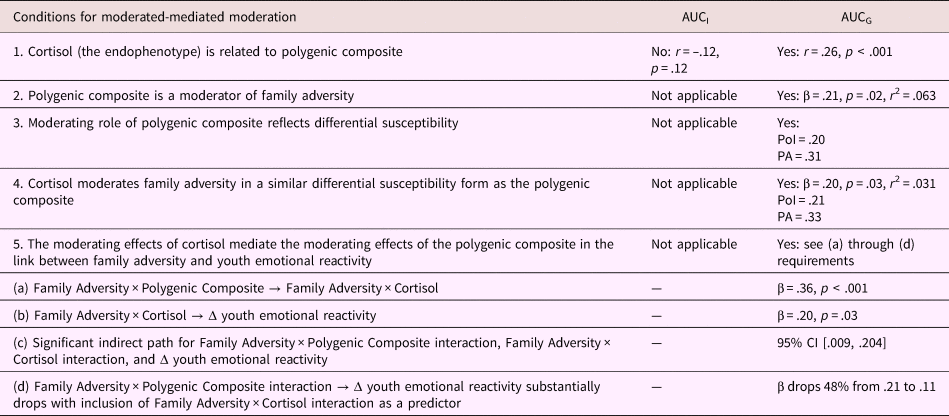
Synopsis of analytic steps and findings for testing moderated-mediated moderation for the polygenic plasticity composite and cortisol indices in the association between family adversity and adolescent emotional reactivity to family conflict

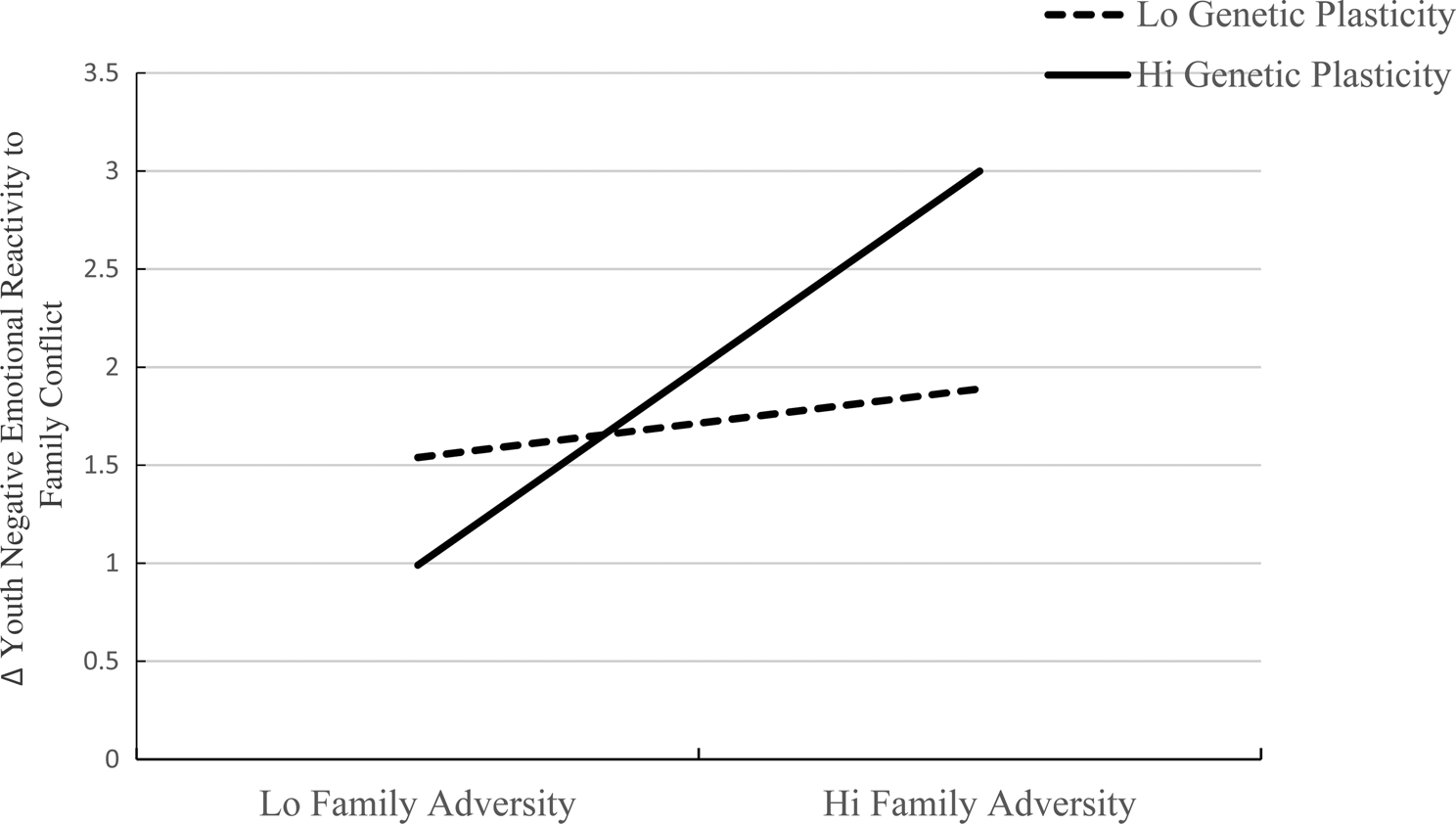
The resulting model, which is depicted in Figure 3, provided a satisfactory representation of the data, χ2 (106, N = 279) = 166.11, p = .0002, RMSEA = .05, CFI = .93, and χ2/df ratio = 1.57. In support of the second condition necessary for supporting our multilevel model (see second row of Table 2), the results indicated that the Family Adversity × Polygenic Plasticity composite significantly predicted LDS change in youth emotional reactivity to family conflict, β = .21, p = .02, r 2 = .063. Further supporting the role of genetic plasticity as a moderator of the mediational role of youth emotional reactivity, the results of the asymmetrical confidence interval analyses indicated that the indirect path involving the Family Adversity × Polygenic Plasticity interaction, adolescent emotional reactivity, and psychological problems was significantly different from 0, 95% CI [.027, .908]. Following statistical recommendations (Del Giudice, Reference Del Giudice2017; Roisman et al., Reference Roisman, Newman, Fraley, Haltigan, Groh and Haydon2012), we calculated graphical plots and simple slope analyses at +/– 2 SD from the mean of interparental conflict to capture a comprehensive range of the proposed predictor (i.e., 95%). As shown in Figure 4, the graphical plot revealed a disordinal interaction, reflecting a crossover of the two regression lines. Simple slope analyses revealed that Wave 1 family adversity significantly predicted LDS increases in youth negative emotional reactivity at high (+ 1 SD) levels of genetic plasticity, b = .66, p = .001, but not low (– 1 SD) levels of genetic plasticity, b = .11, p = .55.
Structural equation model examining the interaction between family adversity and the polygenic plasticity composite in predicting subsequent latent difference score changes in adolescent negative emotional reactivity and psychological problems. ne = structural path not estimated. *p < .05.

Although the disordinal (i.e., crossover of regression lines) form of the interaction in Figure 4 appears to be consistent with differential susceptibility, inspection of graphical plots and simple slopes does not provide a sufficient test of whether the moderating role of the genetic plasticity composite corresponds more closely with differential susceptibility or diathesis-stress theories (Roisman et al., Reference Roisman, Newman, Fraley, Haltigan, Groh and Haydon2012). Therefore, following analytic guidelines (Del Giudice, Reference Del Giudice2017; Roisman et al., Reference Roisman, Newman, Fraley, Haltigan, Groh and Haydon2012), we calculated two additional quantitative indices to more authoritatively test the two forms of moderation: the proportion of interaction (PoI) and the proportion affected (PA) values. First, PoI consists of the ratio of the area of the interaction reflecting the relatively better functioning of adolescents with high levels of genetic plasticity (i.e., area of the interaction to the left side of the crossover of the regression lines in Figure 4) relative to the overall area of the interaction (i.e., area of both left and ride sides of the crossover interaction). Whereas PoI values below .20 provide support for diathesis-risk models, and values within the .20 and .80 range are consistent with differential susceptibility. Second, PA is defined as the proportion of children within the hypothesized “for better” region in differential susceptibility theory or, more specifically, children who were below (i.e., to the left) the point along the family variable in Figure 4 where the two regression slopes intersect. PA indices above .16 are regarded as providing support for differential susceptibility, whereas values on these two indices that fall at or below .16 are interpreted as yielding evidence for diathesis stress (Del Giudice, Reference Del Giudice2017; Roisman et al., Reference Roisman, Newman, Fraley, Haltigan, Groh and Haydon2012). The resulting PoI and PA values of .20 and .31, respectively, favored differential susceptibility theory over the diathesis-stress model. Thus, as summarized in the third row of Table 2, the results provided support for the second and third preconditions necessary to proceed to our third aim of testing a moderator-mediated-moderation model.
A graphical plot of the interaction between Wave 1 family adversity and the polygenic composite predicting subsequent latent difference score change in adolescent negative emotional reactivity to family conflict from Waves 1 to 2.

Aim 3: AUCG cortisol as an endophenotype of polygenic plasticity
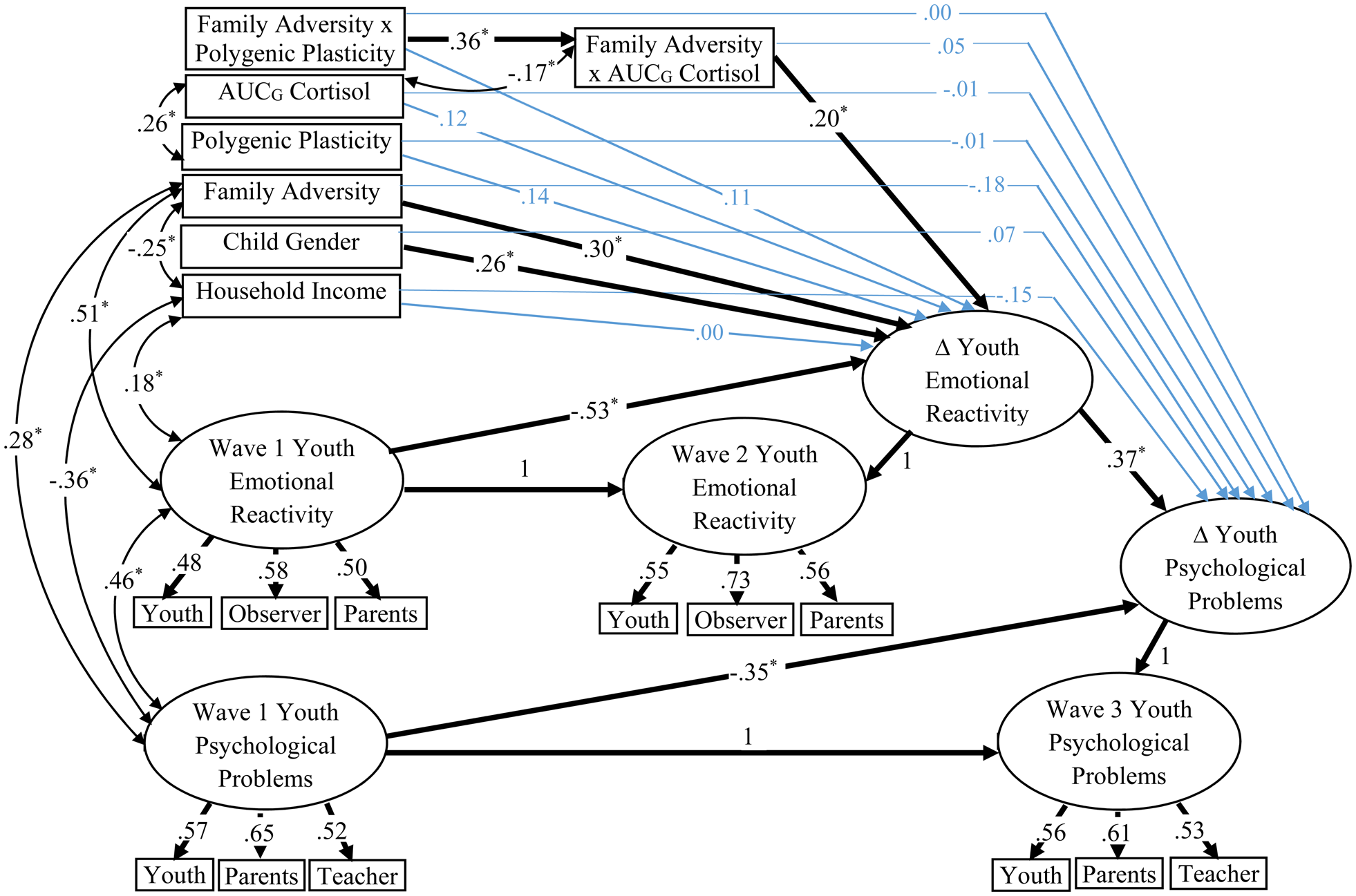
Following prior moderator-mediated-moderation approaches (e.g., Davies et al., Reference Davies, Cicchetti and Hentges2015), we specified a SEM model designed to examine if: (a) AUCG moderated family adversity in a similar differential susceptibility manner as the polygenic plasticity composite, and (b) the moderating effects of AUCG mediated the moderating effects of polygenic plasticity in the prospective link between family adversity and change in adolescent emotional reactivity (i.e., Conditions 4 and 5 in Table 2). We specified the same structural paths as the model in Aim 2 while also freely estimating the paths that were previously constrained to 0. Thus, the new paths estimated included (a) Family Adversity × Polygenic Plasticity and Family Adversity × AUCG; (b) Family Adversity × AUCG and adolescent negative emotional reactivity; and (c) Family Adversity × AUCG and adolescent psychological problems. The resulting model, which is depicted in Figure 5, provided a satisfactory fit with the data, χ2 (104, N = 279) = 160.62, p = .004, RMSEA = .04, CFI = .93, and χ2/df ratio = 1.54.
Structural equation model testing whether the moderating role of polygenic plasticity in the interaction between family adversity and subsequent change in adolescent negative emotional reactivity to family conflict is further mediated by the moderating role of AUCG cortisol. * p < .05.

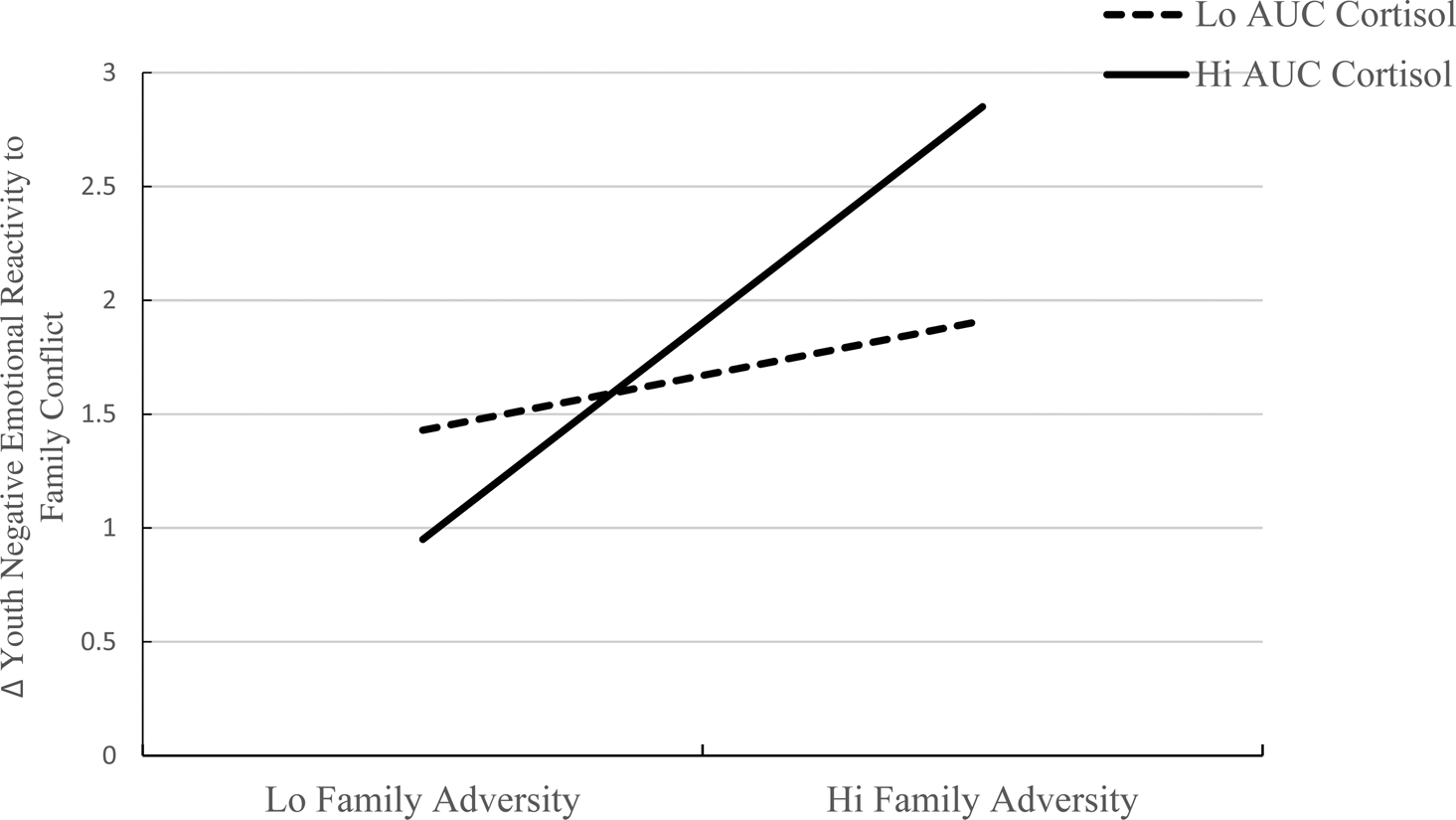
In support of the fourth condition for delineating moderated-mediated-moderation (see Table 2), the Family Adversity × AUCG cortisol interaction significantly predicted LDS changes in youth negative emotional reactivity, β = .20, p = .03, r 2 = .031, even after the inclusion of the predictors, covariates, and the Family Adversity × Polygenic Plasticity interaction. Negative emotional reactivity, in turn, continued to predict greater adolescent psychological problems, β = .37, p = .04. In further support of this mediational chain, findings from the asymmetrical confidence interval analyses indicated that the indirect path involving the Family Adversity × AUCG cortisol, youth emotional reactivity, and psychological problems was significantly different from 0, 95% CI [.001, .315]. As shown in Figure 6, visual inspection of the graphical plot of the relation between family adversity (at 2 SD above and below the mean) and youth emotional reactivity at high (1 SD above the mean) and low (1 SD below the mean) levels of AUCG further revealed a similar disordinal form of moderation to the Family Adversity × Polygenic Plasticity interaction. Consistent with the moderating effects of polygenic plasticity, simple slope analyses indicated that family adversity significantly predicted LDS increases in youth negative emotional reactivity at high levels of AUCG cortisol, b = .62, p = .002, but not low levels of AUCG cortisol, b = .15, p = .41. The PoI value of .21 and the PA index of .33 for the AUCG cortisol closely corresponded with the values obtained for the polygenic plasticity interaction and provided similar support for differential susceptibility (Del Giudice, Reference Del Giudice2017; Roisman et al., Reference Roisman, Newman, Fraley, Haltigan, Groh and Haydon2012).
A graphical plot of the interaction between Wave 1 family adversity and the AUCG cortisol predicting subsequent latent difference score change in adolescent negative emotional reactivity to family conflict from Waves 1 to 2.

Building on the support for the fourth condition, findings from the SEM in Figure 5 also support the requirements of the fifth and final set of requirements for demonstrating that the moderating role of AUCG cortisol mediates the moderating effects of polygenic plasticity. First, not only did the family adversity and AUCG cortisol interaction predict youth emotional reactivity as noted previously, it was also predicted by the Family Adversity × Polygenic Plasticity interaction, β = .36, p < .001 (see Figure 5). Second, in further support of mediation, the asymmetrical confidence intervals for the resulting indirect path involving the Family Adversity × Polygenic Plasticity interaction, the Family Adversity × AUCG Cortisol interaction, and the change in adolescent emotional reactivity did not include 0, 95% CI [.009, .204]. Finally, after the inclusion of the Family Adversity × AUCG Cortisol interaction as a predictor of youth emotional reactivity, the magnitude of the standardized path between Family Adversity × Polygenic Plasticity interaction and youth emotional reactivity dropped by 48% from β = .21 (see Figure 3) to .11 (see Figure 5). Therefore, as summarized in the third column of Table 2, the results met all the conditions for supporting the hypothesis that the moderating role of polygenic plasticity in the relation between family adversity and adolescent emotional reactivity to family conflict is further mediated by the moderating role of adolescent AUCG cortisol activity.
Discussion
Guided by a synthesis of family process and differential susceptibility theories (Ellis et al., Reference Ellis, Boyce, Belsky, Bakermans-Kranenburg and van IJzendoorn2011; Morris et al., Reference Morris, Houltberg, Criss, Bosler, Centifanti and Williams2017; Repetti et al., Reference Repetti, Robles and Reynolds2011), the goal of this paper was to examine the biological sources of variability in mediational pathways among family adversity, youth negative emotional reactivity to family conflict, and their internalizing and externalizing symptoms. Consistent with previous family process theory and research, our longitudinal results indicated that adolescent negative emotional reactivity to family conflict mediated the association between family adversity and adolescent psychological problems. In accord with differential susceptibility theory (Belsky et al., Reference Belsky, Newman, Widaman, Rodkin, Pluess, Fraley and Roisman2015; Ellis et al., Reference Ellis, Boyce, Belsky, Bakermans-Kranenburg and van IJzendoorn2011), moderated-mediation analyses revealed that a composite of genetic variants identified as top-tier plasticity alleles moderated the association between family adversity and youth negative emotional reactivity to family conflict in a for better or for worse manner that is consistent with a differential susceptibility interpretation. More specifically, adolescents carrying more plasticity alleles exhibited relatively greater negative emotional reactivity under adverse rearing conditions but also lower negative emotional reactivity in the face of a more supportive family climate. Finally, toward identifying the physiological mechanisms underlying genetic plasticity, our moderator-mediated-moderation analyses indicated that adolescent cortisol activity moderated family adversity in the same manner as the genetic composite and accounted for a significant part of its role as a plasticity factor.
Our first step in advancing an integrative, multilevel analysis of antecedents and sequelae of adolescent affect regulation difficulties was to test the role of youth negative emotional reactivity as a mediator of the association between family adversity and their internalizing and externalizing symptoms. Previous research has found some preliminary support for children's negative emotional responding to stressors as an explanatory mechanism in links between specific types (e.g., interparental conflict and parental difficulties) of family factors and their psychological adjustment (e.g., Buehler et al., Reference Buehler, Lange and Franck2007; Davies et al., Reference Davies, Cicchetti and Martin2012; Kim & Cicchetti, Reference Kim and Cicchetti2010; Suveg, Shaffer, Morelen, & Thomassin, Reference Suveg, Shaffer, Morelen and Thomassin2011; Yap, Schwartz, Byrne, Simmons, & Allen, Reference Yap, Schwartz, Byrne, Simmons and Allen2010). Although assessments of socialization adversity that encompass multiple family relationships are rarer in the literature, the findings from this work are also consistent with the hypothesis that youth negative emotional reactivity may contribute to the vulnerability they experience in discordant homes (e.g., Lindahl et al., Reference Lindahl, Bregman and Malik2012; Luebbe & Bell, Reference Luebbe and Bell2014; McLaughlin et al., Reference McLaughlin, Kubzansky, Dunn, Waldinger, Vaillant and Koenen2010). However, no studies, to our knowledge, have followed quantitative guidelines for accurately testing mediational pathways by examining whether family factors predict successive, lagged changes in youth emotional reactivity and, in turn, their psychological problems (Maxwell & Cole, Reference Maxwell and Cole2007). In addressing this gap, our study showed that adolescent exposure to family adversity predicted increases in a multimethod, multi-informant assessment of adolescent negative emotional reactivity to family conflict over a 1-year period. Greater negative emotional reactivity, in turn, was associated with increases in a multi-informant measure of adolescent psychological problems over a 2-year period.
Several mechanisms may explain why adolescent negative emotional reactivity to family conflict mediates family adversity. At a broad level, our findings fit with the risky family process proposal that the risk posed by family adversity to children is caused by their increasing tendency to experience vigilance and distress to threats in ways that disrupt their ability to regulate negative emotions (Repetti et al., Reference Repetti, Taylor and Seeman2002, Reference Repetti, Robles and Reynolds2011). In elaborating on the possible processes underpinning emotional reactivity to conflict, emotional security theory postulates that recurring exposure to antagonistic, detached, and discordant family interactions increases children's concerns about their safety and security in the family unit. Thus, the increasing prioritization of identifying and defending against threats in the family is proposed to be expressed in progressively higher levels of children's distressing reactions to family challenges that, over time, undermine their mental health. Addressing another set of possible processes, the tripartite theory of emotion regulation proffers that discordant family climates shape children's psychological adjustment through their recurrent negative emotional experiences in the family (Morris, Silk, Steinberg, Myers, & Robinson, Reference Morris, Silk, Steinberg, Myers and Robinson2007). According to their model, child distress intensifies from histories of family adversity through vicarious learning, social referencing, and emotion contagion characterized by the reflexive tendency to experience the emotions of others.
Although our longitudinal results provide support for offspring negative emotional reactivity as a risk mechanism underlying family adversity, differential susceptibility theory highlights that children's genetic attributes may confer significant individual differences in their sensitivity to family difficulties (Belsky & Pluess, Reference Belsky and Pluess2009). To test this theoretical proposition, our second step was to examine whether a polygenic composite moderated the first part of the mediational pathway between family adversity and adolescent emotional reactivity. Our selection of the alleles of three genes (i.e., 5-HTTLPR short allele, DRD4 VNTR 7-repeat variant, and BDNF Met allele) for the polygenic composite was specifically based on their designation in differential susceptibility theory as the top three candidates for conferring environmental sensitivity (Belsky et al., Reference Belsky, Newman, Widaman, Rodkin, Pluess, Fraley and Roisman2015). In support of differential susceptibility theory, our significant moderated-mediation findings indicated that the association between family adversity and subsequent increases in emotional reactivity to family conflict was significant only for adolescents who carried a high number of the sensitivity alleles. Moreover, the follow-up tests designed to examine the relative viability of differential susceptibility and diathesis-stress theories revealed that the teens with elevated plasticity alleles exhibited not only greater than expected increases in negative reactivity to family conflict when exposed to previous family adversity but also relatively steeper decreases in negative emotional reactivity following supportive family experiences.
These findings beg the question of why 5-HTTLPR, DRD4 VNTR, and BDNF sensitivity alleles cumulatively magnify adolescent sensitivity to family relationship quality. Consistent with calls in the literature for a new generation of research to identify the physiological and neuroendocrine mechanisms underlying genetic plasticity (Belsky & Pluess, Reference Belsky and Pluess2009, Reference Belsky and Pluess2013; Ellis et al., Reference Ellis, Boyce, Belsky, Bakermans-Kranenburg and van IJzendoorn2011; Moore & Depue, Reference Moore and Depue2016), the final step in our sequential analytic approach was to examine whether the moderating effects of the polygenic plasticity composite were further mediated by the moderating role of youth adrenocortical activity (see Path 3 of Figure 1). This hypothesis was specifically rooted in the synthesis of differential susceptibility and biological sensitivity to context theories and the resulting proposal that genetic plasticity is instantiated in heightened sensitivity of the HPA axis (Ellis et al., Reference Ellis, Boyce, Belsky, Bakermans-Kranenburg and van IJzendoorn2011). The results supported the hypothesis that the moderating role of genetic plasticity in the family adversity model was further accounted for by the sensitizing role of children's overall cortisol output. As a key condition for identifying endophenotypes of genetic plasticity, we specifically found that the genetic plasticity composite predicted overall cortisol output (i.e., AUCG), but not cortisol reactivity (i.e., AUCI), in the period surrounding a family disagreement at Wave 1. Building on the preconditional support for cortisol activity as an endophenotype, the results of the moderator-mediated-moderation analyses indicated that overall cortisol output significantly moderated associations between family adversity and adolescent negative emotional reactivity to family conflict in the same manner as the genetic plasticity composite. Thus, family relationship quality was only a significant predictor of negative emotional reactivity for youth with higher cortisol activity. Follow-up tests further indicated that adolescents with greater cortisol levels experienced heightened distress in the aftermath of adverse family experiences but also markedly reduced distress following supportive family conditions. Moreover, the interaction between family adversity and cortisol output was a significant mediator of the Family Adversity × Polygenic Composite interaction in predicting subsequent change in adolescent negative emotional reactivity to family conflict.
Questions remain as to why the overall cortisol output, rather than cortisol reactivity, operated as an endophenotype. Based on the limited research in the area, it is plausible to entertain the possibility that cortisol reactivity may be a stronger candidate for a plasticity mechanism than cortisol activity. For example, there is some evidence in the literature suggesting that the associations between family adversity and children's psychological problems are magnified for children who exhibit greater cortisol reactivity to stressors (Barrios, Bufferd, Klein, & Dougherty, Reference Barrios, Bufferd, Klein and Dougherty2017; Obradović et al., Reference Obradović, Bush, Stamperdahl, Adler and Boyce2010; Steeger et al., Reference Steeger, Cook and Connell2017). However, the scant work in this area has yet to systematically examine the moderating roles of cortisol reactivity and activity in response to family stressors or examine its implications for children's emotional reactivity in the family. Thus, consistent with conclusions of frameworks addressing multiple levels of analysis, the interplay between genetic factors and neurobiological functioning is likely to vary as a function of the context (e.g., social vs. cognitive challenge; familial or extrafamilial stressor) and the dimension (e.g., reactivity vs. activity) of the physiological assessment (e.g., Belsky & Pluess, Reference Belsky and Pluess2013; Ellis et al., Reference Ellis, Boyce, Belsky, Bakermans-Kranenburg and van IJzendoorn2011; Obradović, Bush, & Boyce, Reference Obradović, Bush and Boyce2011). Given cortisol levels are associated with the enhanced processing, learning, and memory consolidation of emotionally arousing events (de Quervain, Schwabe, & Roozendaal, Reference de Quervain, Schwabe and Roozendaal2017; Gunnar & Vazquez, Reference Gunnar, Vazquez, Cicchetti and Cohen2006), our results may reflect a process whereby tendencies to exhibit greater cortisol output during stressful family events may enhance adolescents’ processing of family relationship qualities in ways that magnify their emotional sensitivity.
If our results are replicated, an important direction for future research will be to identify the intermediary neurobiological processes that account for the links between cortisol and the polygenic plasticity composite. On the one hand, there is evidence that the 5-HTTLPR short allele and the DRD4 7-repeat variant are associated with greater sensitivity to brain regions that process rewarding and aversive emotional stimuli. Likewise, glucocorticoid activity interacts with dopaminergic and serotonergic functioning within neural pathways (for a review, see Moore & Depue, Reference Moore and Depue2016). On the other hand, little is known about the specific neurological cascades that account for the greater cortisol activity of carriers of the 5-HTTLPR and DRD4 sensitivity alleles. Similarly, although the BDNF Met allele has been linked with greater cortisol output in response to psychosocial stressors and stronger activation of limbic brain regions associated with HPA axis functioning (Armbruster et al., Reference Armbruster, Müller-Alcazar, Strobel, Lesch, Kirschbaum and Brocke2016; Lonsdorf et al., Reference Lonsdorf, Golkar, Lindström, Haaker, Öhman, Schalling and Ingvar2015; Montag, Weber, Fliessbach, Elger, & Reuter, Reference Montag, Weber, Fliessbach, Elger and Reuter2009), more research is needed to identify how and why, at a neurological level, the moderating effects of genetic sensitivity are instantiated in greater cortisol activity.
Several limitations of our study warrant discussion in interpreting the results. First, although the relatively diverse economic backgrounds of our largely working- and middle-class sample of families may have allowed us to more comprehensively capture both supportive and harsh family climates necessary to powerfully test differential susceptibility, the findings may differ for samples of families experiencing greater economic impoverishment or privilege. Second, given that some genetic polymorphisms may function in different ways across races (Davies & Cicchetti, Reference Davies and Cicchetti2014; Ellis et al., Reference Ellis, Boyce, Belsky, Bakermans-Kranenburg and van IJzendoorn2011), caution should be exercised in generalizing our findings beyond the predominantly White sample of families in our study. Third, although the coherency of our results across multiple levels of analysis and statistical steps may bolster confidence in our findings, replication is an important next step given the modest to moderate effect sizes, our relatively small sample size for G × E research, and the complex set of statistical conditions required to identify cortisol as an endophenotype of genetic plasticity. Fourth, the moderating role of adolescent cortisol levels accounted for about half of the variance in the association between the Family Adversity × Polygenic Composite interaction and their emotional reactivity to family conflict. Thus, identifying other mechanisms operating as endophenotypes of genetic plasticity is an important direction for future research. For example, neurobiological models of environmental sensitivity have identified putative endophenotypes of genetic plasticity in several other neurological and physiological (e.g., sympathetic nervous system activity) systems (Moore & Depue, Reference Moore and Depue2016; Schriber & Guyer, Reference Schriber and Guyer2016; Telzer, van Hoorn, Rogers, & Do, Reference Telzer, van Hoorn, Rogers and Do2018).
In summary, our aim was to advance an understanding of the nature of pathways among family adversity, adolescent emotional reactivity to family conflict, and their psychological problems within a multiple-levels-of-analysis framework. Consistent with several family process theories, longitudinal analyses of our multimethod, multi-informant measurement indicated that family adversity was associated with subsequent increases in adolescent negative emotional responses to family conflict. Change in negative emotional reactivity, in turn, predicted increases in their internalizing and externalizing problems over a 2-year period. To further identify the biological sources of diversity in this mediational cascade, we utilized differential susceptibility theory to identify a composite of genetic sensitivity alleles (5-HTTLPR short allele, DRD4 7-repeat variant, and BDNF Met allele) that may increase adolescent sensitivity to family climate in a for better or for worse manner (Belsky et al., Reference Belsky, Newman, Widaman, Rodkin, Pluess, Fraley and Roisman2015; Ellis et al., Reference Ellis, Boyce, Belsky, Bakermans-Kranenburg and van IJzendoorn2011). Supporting differential susceptibility theory, family adversity was a significantly stronger predictor of negative emotional reactivity for adolescents with more plasticity alleles such that they fared worse after exposure to elevated family adversity but better following more supportive family experiences. Finally, to address the question of how or why this genetic composite confers sensitivity to the family environment, we examined whether adolescent adrenocortical functioning was an endophenotype of the genetic plasticity. In support of this hypothesis, our moderator-mediated-moderation analyses indicated that adolescent cortisol levels in the period surrounding a family disagreement interaction at Wave 1 moderated the association between family adversity and their subsequent emotional reactivity in the same manner as the genetic plasticity composite. Moreover, the interaction between family adversity and adolescent cortisol mediated the moderating role of genetic plasticity in the prediction of teen negative emotional reactivity to family conflict.
Acknowledgments
We are grateful to the children, parents, teachers, and school administrators who participated in this project. Our gratitude is expressed to the staff on the project and the graduate and undergraduate students at the Universities of Rochester and Notre Dame.
Financial support
This research was supported by the National Institute of Mental Health Grant 2R01 MH57318 awarded to Patrick T. Davies, E. Mark Cummings, and Dante Cicchetti.