Introduction
Compared to the contemporaneous lowland Khmer cultures, little is known about the fifteenth- to seventeenth-century AD highland communities of the Cardamom Mountains of southern Cambodia. Archaeologically, they are characterised by unique mortuary rituals, comprising the interment of individuals within exposed mortuary jars and log coffins. The absence of stratigraphic contexts for these exposed mortuary vessels, and the general paucity of associated occupation deposits, has, until recently, limited our understanding. New studies, however, are improving our knowledge of the geographic extent and duration of the jar/coffin mortuary ritual (Beavan et al. Reference Beavan2012, Reference Beavan, Hamilton, Sokha and Sayle2015), the cultural practices and health of the individuals interred in the burial containers (Halcrow et al. Reference Halcrow, Harris, Beavan and Buckley2014), and the mercantile activity of these communities, as evidenced from trade-sourced grave goods such as metal rings, glass beads and ceramics (Carter et al. Reference Carter, Dussubieux and Beavan2016; Grave et al. Reference Grave, Kealhofer, Beavan, Tep, Stark and Ea2019).
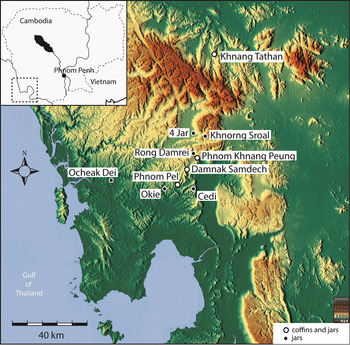
The site of Phnom Pel is located at 11°19.0″43.0′ north, 103°31.0″26.4′ east at 197m asl, in the Cardamom Mountains of southern Cambodia. It is one of ten known jar-and-coffin burial sites within the highland region, with exposed mortuary jars containing secondary, and often multiple, human interments, and one of the few sites that also features log coffins with single inhumations (Beavan et al. Reference Beavan2012, Reference Beavan, Hamilton, Sokha and Sayle2015) (Figure 1). The Cardamom Mountains mortuary tradition examined here differs from contemporaneous practices of lowland Khmer cultures, for whom burial rituals comprised predominantly inhumation, sub-aerial exposure and cremation from the Iron Age (c. 500 BC–AD 500) through to historical times (e.g. Higham Reference Higham2002; Beavan et al. Reference Beavan2012; O'Reilly & Shewan Reference O'Reilly, Shewan, Oxenham and Buckley2016). Although the first mention of these sites is found in an ethnographic account of Cardamom highland groups describing “bones in caves” (Martin Reference Martin1997: 22), the jar-and-coffin burial sites differ from the known funerary rituals of modern highland groups, which typically involves the construction of funerary towers to house cremated human remains following a period of initial burial (Zucker Reference Zucker2007: 167).
The location of Phnom Pel and other jar-and-coffin sites in the Cardamom Mountains (map by the authors using relief map from maps-for-free.com).

While there is a growing body of research on the jar-and-coffin burial traditions (Beavan et al. Reference Beavan2012, Reference Beavan, Hamilton, Sokha and Sayle2015; Halcrow et al. Reference Halcrow, Harris, Beavan and Buckley2014; Carter et al. Reference Carter, Dussubieux and Beavan2016), little else is known about these Cardamom highland groups. How, for example, did these communities interact with their lowland contemporaries during the transformative post-Angkorian period (from the late fourteenth/early fifteenth centuries AD to the seventeenth or eighteenth centuries AD (cf. Carter et al. Reference Carter, Stark, Quintus, Zhuang, Wang, Heng and Chhay2019)), a period characterised by shifting power bases and expanding trade networks? While the presence of maritime trade wares and glass beads attests to the participation of these groups in broader contact and exchange systems, here we seek to understand more about the mobility of the individuals from these jar and coffin burials. We therefore make use of strontium isotope ratio (87Sr/86Sr) measurements of human dental enamel to investigate whether the individuals in the Phnom Pel jar and coffin mortuary vessels represent an isotopically homogeneous group or, potentially, a more diverse group of individuals, perhaps indicating migrants into the Cardamom Mountains. A greater understanding of the residential mobility of the people who created the Cardamom Mountains funerary sites will not only increase our knowledge of peripheral cultures in the late post-Angkorian period, but also contribute to the extensive scholarship on jar-and-coffin sites across Mainland and Island Southeast Asia.
Background
Mainland and Island Southeast Asia
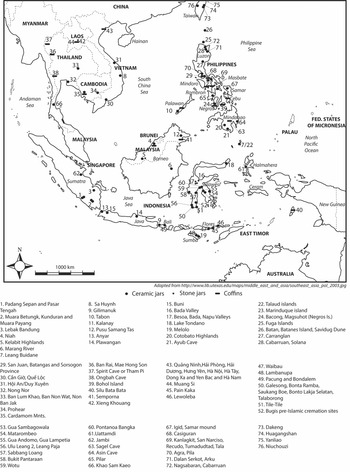
The tradition of using ceramic jars and log coffins as receptacles for human remains was rare in both prehistoric and historic Cambodia. The practice, however, was widespread in other regions of Mainland and Island Southeast Asia throughout prehistoric and historic times (Figure 2). Jar burials, as they are commonly known, involve the placement of human remains in exposed or interred ceramic jars, and are found throughout Island and Mainland Southeast Asia in the littoral environments of Sumatra, Java, Sulawesi, Bali, Eastern Sabah, Borneo, Taiwan, the Philippines, mainland Vietnam, Thailand and Lao PDR. These burials may contain primary (immediately following death) or secondary (reburial of remains following initial burial or other forms of decomposition) interments of adults and children. In some cases, jar burials hold cremated remains (see Bulbeck Reference Bulbeck, Piper, Matsumura and Bulbeck2017 and references therein).
Distribution of mortuary jars and coffins throughout Southeast Asia (map by the authors).

Carved stone jars associated with mortuary activity can also be found throughout the region, although they are significantly less common than ceramic vessels (Colani Reference Colani1935; Sayavongkhamdy & Bellwood Reference Sayavongkhamdy and Bellwood2000; Shewan & O'Reilly Reference Shewan and O'Reilly2019). The earliest recorded use of exposed or interred ceramic burial jars in Mainland or Island Southeast Asia comes from Taiwan. Beginning c. 2000 BC (Bellwood Reference Bellwood2017: 238), the practice continued as late as the nineteenth century AD in some areas, such as Sulawesi (Bulbeck Reference Bulbeck, Piper, Matsumura and Bulbeck2017). The wooden coffin tradition is similarly widespread and long-lived, with the earliest known exposed coffins coming from Neolithic contexts at Niah Cave (Sarawak) in Island Southeast Asia (Lloyd-Smith Reference Lloyd-Smith2013), and a single Neolithic-period (buried) coffin recorded at Ban Non Wat (Thailand) in Mainland Southeast Asia (Harris et al. Reference Harris, Buckley, Halcrow, Kinaston, Foster, Simanjanuk, Galipaud, Oxenham and Buckley2016: 294). Other examples dating from mid first millennium BC to the early twentieth century AD are reported from sites in Indonesia, the Philippines, Malaysia, Vietnam, Thailand, Lao PDR and Myanmar (Horr Reference Horr1959; Harrisson Reference Harrisson1962; Sørensen Reference Sørensen1973; Mouret Reference Mouret and Gunn2004; Hotchkis et al. Reference Hotchkis1994; Bulbeck Reference Bulbeck, Piper, Matsumura and Bulbeck2017).
Several locations in the region also provide evidence for a mixed mortuary ritual featuring the use both of exposed and buried jars (some sites with both ceramic and stone vessels), and sites with evidence for the use of ceramic jars (interred and/or exposed) and exposed or buried log coffins. The ‘mixed rite’ sites with both jars and coffins include Niah Cave, Cagrary Island (Luzon Island), Lake Towuti (Sulawasi), Marinduque Island (Philippines), Ban Non Wat and the Cardamom Mountains sites (Cambodia) (Tenazas Reference Tenazas1973; Beavan et al. Reference Beavan2012, Reference Beavan, Hamilton, Sokha and Sayle2015; Harris et al. Reference Harris, Buckley, Halcrow, Kinaston, Foster, Simanjanuk, Galipaud, Oxenham and Buckley2016; Bulbeck Reference Bulbeck, Piper, Matsumura and Bulbeck2017).
Cambodia
As already observed, documented cases of jar burial and the use of log coffins as mortuary containers in prehistoric and historic Cambodia are limited. The earliest known examples include seven jar burials containing the skeletal remains of sub-adults from the Iron Age site of Prohear (c. 500–100 BC; Reinecke et al. Reference Reinecke, Vin and Heng2009). Buried jars containing cremated remains are recorded at the site of Srah Srang (eleventh century, and possibly the fifteenth century AD; Courbin Reference Courbin, Dumarcay and Courbin1988), and at the post-Angkorian (c. mid seventeenth century AD) temple site of Kuk Patri (Beavan et al. Reference Beavan2012: 4). The presence of burial jars containing un-cremated human bone at Prohear is of particular note due to the rarity of this practice in lowland Cambodian archaeological contexts. Although this dearth may be due to limited research and poor preservation, the only other known occurrence of mortuary jars containing un-cremated human bone can be found in the fifteenth- to seventeenth-century AD Cardamom Mountains funerary tradition explored in this article. The known sites in this region include Ocheak Dei, Okie, Cedi, Damnak Samdech, Rong Damrei, Phnom Khnang Peung, ‘4 Jar’, Khnorng Sroal, Khnang Tathun and Phnom Pel (Figure 1). Four of these sites also contain log coffins, with both forms of burial containers placed on exposed natural rock ledges (Beavan et al. Reference Beavan2012, Reference Beavan, Hamilton, Sokha and Sayle2015). The sites are distributed over a distance of 70km in a north-east to south-west line in the eastern range of the Cardamom Mountains, and all are located between 147 and 700m asl.
Despite the wide geographic distribution of these jar-and-coffin sites in the Cardamom Mountains, they display remarkable uniformity in terms of the type of interment (secondary), as well as the same types of ceramic jar, log coffins and associated grave goods. Most of the ceramic vessels selected for use as burial jars at these highland sites are consistent with those from the production complexes of Maenam Noi in Singburi Province, Thailand (Cort Reference Cort2017). An exception to the use of Maenam Noi jars is found in the presence of brown glazed ceramic ‘Angkorian-style’ jars in each site in the Cardamom Mountains, which were produced at Angkorian-period kilns, such as Torp Chey (Hendrickson Reference Hendrickson2008; Grave et al. Reference Grave, Kealhofer, Beavan, Tep, Stark and Ea2019). Given the use of the Torp Chey-type jars at these highland sites beyond the fourteenth century, Grave et al. (Reference Grave, Kealhofer, Beavan, Tep, Stark and Ea2019: 5023 & 5033) suggest that they may be heirlooms. Completing the suite of ceramics found at every site were thirteenth- to fourteenth-century AD Si Satchanalai-type bowls and small jars, and locally produced earthenware vessels (Beavan et al. Reference Beavan2012, Reference Beavan, Hamilton, Sokha and Sayle2015). Evidence for the participation of these highland groups in exchange networks is thus provided by the presence of these imported Ayutthayan (Thai, c. 1350–1767) ceramics (Brown Reference Brown2004; Beavan et al. Reference Beavan2012; Cort Reference Cort2017) that have been shown to be compositionally similar to wares found in Gulf of Thailand shipwreck cargoes (Grave et al. Reference Grave, Kealhofer, Beavan, Tep, Stark and Ea2019), and of other exotic goods including copper finger rings and glass beads. The latter of these are geochemically consistent with bead types circulating around the maritime trade networks of Southeast Asia of the fifteenth century AD (Carter et al. Reference Carter, Dussubieux and Beavan2016).
Phnom Pel
In 2010, the Australian Research Council funded the first archaeological investigation of the burials at Phnom Pel. The research involves the bioarchaeological assessment of the human skeletal material contained in the mortuary vessels, isotopic analysis of human, faunal, floral and coffin wood remains, radiocarbon dating of human remains and wooden coffins, a regional geological survey and ceramic conservation.
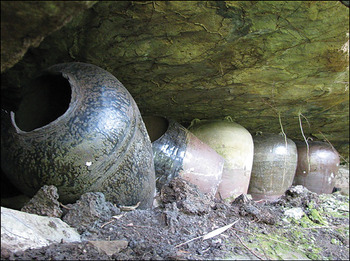
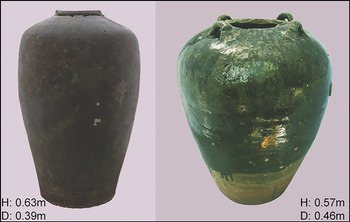
The site of Phnom Pel comprises three rock ledges. Seven Maenam Noi ceramic storage jars, two local earthenware vessels and fifteenth-/sixteenth-century AD celadon-glazed ceramics (Figures 3–4) were placed on two of these ledges (Beavan et al. Reference Beavan2012; see Brown Reference Brown2004: 146 & 149). The Maenam Noi kilns, located in Singburi Province, produced vast numbers of storage jars in various standard shapes and sizes from the fifteenth to the seventeenth centuries. The jars, found in shipwrecks, inland archaeological sites and heirloom collections, were widely distributed and frequently re-used to fulfil a variety of purposes, including as secondary burial vessels (Cort Reference Cort2017: 267–68).
Angkorian storage jar (far left) and four Mae Nam Noi storage jars on ledge 1 at Phnom Pel (photograph by S. Tep).

Typical Mae Nam Noi storage jars from Phnom Pel (photograph by S. Tep).

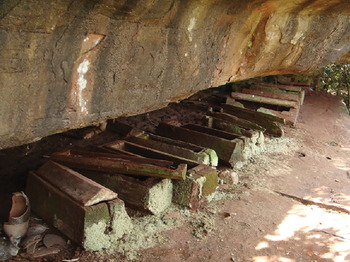
Twelve intact log-coffins and the remains of two additional coffins were found on a third rock ledge at Phnom Pel (Figure 5; Beavan et al. Reference Beavan2012: 12). The coffins were made from sections of whole logs, with planed sides, hollowed interiors and triangular-shaped lids. They range in length from 0.78–0.87m, and most correspond to timbers of the botanical family Dipterocarpaceae, genus Hopea spp., with wood anatomical structures analogous with the Hopea helferi and Hopea odorata species (Gerald Koch pers. comm.). Bayesian modelling to determine the ‘age of felling’ provides a date range for coffin use at Phnom Pel beginning in cal AD 1385–1445 (95% probability) and ending in cal AD 1480–1625 (95% probability; Beavan et al. Reference Beavan2012: 18). The earliest start date for the coffins suggests that they may have been the first vessel type to be used at the site, possibly representing an earlier manifestation of the highland jar-and-coffin mortuary ritual. The jar burials at the site had poor bone preservation that limited dating to a single sample of tooth enamel from jar 7. The jar 7 date of cal AD 1500–1650 (Beavan et al. Reference Beavan2012: 16–19) tentatively suggests that the use of imported ceramic vessels as mortuary containers perhaps occurred later than, or overlapped with, log-coffin use.
Phnom Pel log coffins (photograph by S. Tep).

Materials and methods
Human skeletal material
Phnom Pel yielded a minimum number of individuals (MNI) of 21, as well as some skeletal remains found outside the jars and coffins. Termite activity had destroyed many of the osseous landmarks, making it difficult to estimate age and sex from typical skeletal markers. For the better preserved bone, age-at-death estimations for the infants and children (younger than 15 years of age) were assessed, giving priority to dental development (Moorrees et al. Reference Moorrees, Fanning and Hunt1963a & Reference Moorrees, Fanning and Huntb), followed by skeletal growth and development (Scheuer & Black Reference Scheuer and Black2000). An infant is defined as aged from birth to less than one year (Halcrow & Tayles Reference Halcrow, Tayles, Agarwal and Glencross2011). A multifactorial approach was used to estimate age-at-death for adults using epiphyseal fusion, auricular surface morphology and dental wear (Buikstra & Ubelaker Reference Buikstra and Ubelaker1994). Adults were classified in relative age groups of young, middle and old (Buikstra & Ubelaker Reference Buikstra and Ubelaker1994). The estimation of sex for adults was based on standard morphological observations of the pelvis and cranium, where present (Buikstra & Ubelaker Reference Buikstra and Ubelaker1994), but was not attempted for infants and children due to the general lack of pre-pubertal skeletal sexual dimorphism. Some of the jars contained multiple individuals, including infants, children and adults. The MNI from each coffin suggests a different type of burial ritual compared to the jars, as most coffins contained a single individual. Notably, while most of the individuals buried within the coffins presented with long bones, along with hand and foot bones, there was comparatively very little cranial material present.
Strontium isotope ratios
Strontium isotope ratios (87Sr/86Sr) are routinely used in archaeological studies to investigate mobility patterns and resource-exploitation strategies of past populations (Bentley Reference Bentley2006). Strontium isotope ratios vary in bedrock according to age and composition of the material. This signature is carried through to the soil via weathering, taken up by plants and absorbed into the teeth and bones of animals and humans through food and water intake. 87Sr/86Sr preserved in human enamel reflects bioavailable strontium (local strontium available to living organisms), which may vary from bedrock and soil ratios due to differential weathering, atmospheric deposition and mixing processes (Sillen et al. Reference Sillen, Hall, Richardson and Armstrong1998; Bentley Reference Bentley2006; Maurer et al. Reference Maurer, Galer, Knipper, Beierlein, Nunn, Peters, Tütken, Alt and Schöne2012). While consideration of geological maps can be useful to infer general expected 87Sr/86Sr ranges, we have sought to assess the spatial variability of bioavailable strontium through the analysis of modern floral and faunal specimens, river water and soil leachates.
Strontium isotope ratios (87Sr/86Sr) were measured in human tooth enamel from nine individuals placed in log coffins (n = 4) and exposed ceramic jars (n = 5). Samples were selected based on availability and preservation, and includes a mix of first, second and third permanent molars. Teeth mineralise at different ages, and the strontium isotope signature preserved within enamel provides information on the geological environment in which the individual obtained their food during the period of enamel mineralisation (Montgomery Reference Montgomery2010). The first permanent molar begins to form in utero, with crown formation complete at around three years of age. Strontium isotope ratios measured in permanent first molars may, therefore, partially reflect maternal strontium intake. Enamel is mineralised in the second molar between approximately 3 and 8 years, and in the third molar between approximately 8 and 16 years of age (Hillson Reference Hillson1996; Montgomery Reference Montgomery2010). Modern faunal reference samples analysed in the study include bat bone, rat bone and teeth, gecko egg shell and land-snail shell. Plant samples (a direct measure of bioavailable strontium) and soil leachates (a proxy measure of the bioavailable strontium fraction) sourced from the same location were also included. Plant and soil leachate samples should yield similar 87Sr/86Sr values, although some variation is expected (Willmes et al. Reference Willmes, Bataille, James, Moffat, Mcmorrow, Kinsley, Armstrong, Eggins and Grün2018). Finally, 87Sr/86Sr was also measured in small samples of coffin wood to explore potential harvest locales for coffin manufacture.
Geological setting
The surface geology of the southern Cardamom region comprises mainly terrestrial Mesozoic-era sedimentary rocks of the Phuquoc Group, also referred to as the Grès Supérieurs or ‘Upper Sandstones’ of the Phuquoc-Kampot Som Basin (Vysotsky et al. Reference Vysotsky, Rodinikova and Li1994; Tsuchiyama et al. Reference Tsuchiyama2016). Substantial outcrops of aphyric, fine-grained basalts are present in some valleys and plains and occur as boulder ‘float’ (loose pieces of rock other than outcrops) in the streams that cut through the steep-sided, sandstone-dominated valleys. Jurassic to Cretaceous ages have been assigned to these formations (Vysotsky et al. Reference Vysotsky, Rodinikova and Li1994), and new uranium-lead geochronological provenance data on the sediments, along with geochemical data on the basalts obtained as part of this study, will be presented in a separate publication. Strontium isotope ratios (87Sr/86Sr) measured in skeletal material ultimately derive from the underlying geology. These ratios vary according to the age and composition of the material analysed. Although strontium is released into soils and water before entering the food cycle, several factors may complicate the direct relationship between bulk geological values and ‘bioavailable’ strontium, as stored in biological apatite (as discussed above).
Analytical procedures
Human enamel, rat bone and teeth, gecko egg shell and snail shell
Enamel samples were mechanically cleaned using a dental drill to remove any adhering residue before being ground using an agate mortar and pestle. All samples (5–15mg) were placed in microcentrifuge tubes and leached in five per cent acetic acid for eight hours. Samples were rinsed three times with Milli-Q deionised water and then placed in Teflon beakers and dissolved in ultrapure concentrated nitric acid (15M HNO3) and evaporated to dryness.
Plants, soil and coffin wood
Samples were placed in porcelain crucibles and ashed overnight at 800°C. 10–20mg from each sample was placed in an acid-cleaned Teflon beaker and digested in ultrapure concentrated 15M HNO3 (with hydrofluoric acid (HF) used for the soil and wood samples). For soil leachates, 1g of soil was placed in a centrifuge tube with 1–2ml 1M ammonium nitrate (NH4NO3), with the suspension then subjected to overnight shaking. Samples were then centrifuged and 1–2ml of the supernatant was extracted and evaporated to dryness.
All samples were dissolved in 2M HNO3 and the strontium was separated and concentrated using Sr-Spec ion-exchange columns. The samples were analysed over a number of years using two different thermal ionisation mass spectrometers, both located at the Research School of Earth Sciences at the Australian National University. Most of the early analyses were performed on a Finnigan Mat 261 mass spectrometer, with the samples loaded onto Ta filaments. The later analyses were performed on a Thermo Finnigan Triton mass spectrometer, with the samples loaded with TaF onto Re filaments. All analyses were corrected for mass fractionation using 86Sr/88Sr = 0.1194, and the 87Sr/86Sr ratios were monitored by frequent analyses of the NBS standard SRM987. The average values over the relevant periods for the two mass spectrometers were 0.71023±0.00003 (2 SD; n = 30) for the Mat 261 and 71025±0.00002 (2 SD; n = 74) for the Triton. All reported values are normalised to a value 0.71023. Analyses were corrected using the SRM987 dataset for the MAT261 as this instrument was used for the majority of the work including the baseline dataset. Individual sample values are presented ±2SE (Tables S1–3 in the online supplementary material); grouped sample values are presented as the mean ±SD.
Results
Rock, soil, leachates, water, fauna and plants
The area proximal to the site (within ~500m) is characterised by sandstone ridges and steep slopes, with basalt outcrops on the plain and boulder float in the river. Isotopically, this generally presents as a bimodal geological environment, with sandstone 87Sr/86Sr yielding a value of 0.73545 (n = 1) and basalt 87Sr/86Sr values ranging from 0.70343–0.70493 (n = 5) (Table S1). 87Sr/86Sr values of vegetation associated with the sandstone range between 0.71432 and 0.71589 (n = 4), and 0.70449 for basalt (n = 1). The differences between the sandstone whole-rock 87Sr/86Sr values and the associated soil, soil leachate and vegetation 87Sr/86Sr values can probably be attributed to the combination of low strontium concentrations recorded in the sandstone and weathered soil (5ppm and 3ppm, respectively) and the input of atmospheric strontium derived from rainfall (modern rainfall ~0.709). The Cardamom Mountains receives substantial annual precipitation of around 5000mm in some areas (Asian Development Bank 2012). Conversely, a less marked 87Sr/86Sr disparity was recorded between whole-rock basalt 87Sr/86Sr values (0.70374±0.00066), river water (0.70474) and vegetation growing in basaltic areas on the plain (0.70449). Basalt outcrops in the region have higher strontium concentrations (between 952 and 1440ppm) than sandstone, and thus dominate the strontium isotope budgets of the groundwater feeding the streams and nearby plants during non-monsoonal periods. The 87Sr/86Sr values from small, modern faunal samples (teeth, bone, shell) obtained from within the ceramic jars and nearby sandstone slopes range from 0.71422–0.71498 (n = 4). Enamel from larger modern fauna, sourced from contiguous conservation areas and incorporating strontium from a wider catchment area, ranged from 0.70982–0.71578 (unpublished data).
Log coffins
87Sr/86Sr ratios in the coffin wood samples (Table S2) range from 0.70767–0.71264 (mean value ±SD, 0.71117±0.00140), a span suggesting that the trees were harvested from across the wider region, rather than exclusively from the immediate vicinity of the site. The 87Sr/86Sr values obtained from the log coffins fall between those values recorded for the sandstone and basalt geological units in the region. Tree 87Sr/86Sr values probably, however, also reflect varying atmospheric input (rainwater) and groundwater contribution (with deeper roots than surface vegetation), in addition to the weathering of primary soil minerals.
Human dental enamel
87Sr/86Sr ratios in dental enamel from individuals placed within the jars range from 0.71187–0.71334 (0.71256±0.00057, n = 5), and from 0.70976–0.71144 (0.71067±0.00078, n = 4) in dental enamel from individuals placed within the coffins (Table S3). Although the sample sizes are very small, the human enamel samples from the jars and coffins comprise discrete isotopic groups (p = 0.004). It is also notable that the individuals in coffins tend to align more closely with the range of the coffin wood 87Sr/86Sr values than do the individuals in jars (Figure 6). The mean difference between ‘coffin’ individuals and coffin wood is 0.0005 (p = 0.51), whereas the mean difference between ‘jar’ individuals and coffin wood is 0.0014 (p = 0.053, a borderline significant difference).
87Sr/86Sr of all samples (figure by the authors).

The higher 87Sr/86Sr values of the dental material from the ceramic jars suggest that these individuals obtained their childhood diet from a geological area similar to that surrounding the site—a hypothesis supported by the 87Sr/86Sr values of the vegetation grown on the sandstone slopes and ridges and the small local animals found on or near the sandstone ledge. The strontium isotope values preserved in the dental material from individuals interred in the coffins suggest broader regional resource utilisation; these 87Sr/86Sr values are lower than those measured in the skeletal assemblage from the jar burials, although not as depleted as the 87Sr/86Sr values obtained from vegetation associated with the basalt outcrops or the river water (Figure 6). It should be noted, however, that in periods of high rainfall, such as during the monsoon season, the 87Sr/86Sr composition of river water may be elevated due to increased rainfall input (~0.709) (Raiber et al. Reference Raiber, Webb and Bennetts2009) and the reduced strontium contribution from the geological formations through which the water has passed.
Discussion
Although the radiocarbon dating programme undertaken for the Cardamom Mountains locations provides a timespan of site usage ranging from the mid fifteenth to mid seventeenth centuries AD (Beavan et al. Reference Beavan2012, Reference Beavan, Hamilton, Sokha and Sayle2015), it is difficult to discern whether there was a chronological overlap in the use of jars and coffins in the mortuary ritual at Phnom Pel, or whether the use of coffins was an earlier practice eventually replaced by a preference for jars as mortuary vessels. It is interesting to note that jar burials outnumber the use of coffins at every Cardamom Mountains site except for Phnom Pel, where there are more coffins than jar burials (Beavan et al. Reference Beavan2012, Reference Beavan, Hamilton, Sokha and Sayle2015). When we consider paired samples from Phnom Pel (where both the container and the associated human remains have been dated), the assessment of any overlap in the use of coffins and jars is complicated by instances for which there are later ages for bone as compared to the wood from their respective coffin. Using the example of one pair of coffin and bone dates, the average of duplicate dates (using OxCal R_Combine function; https://c14.arch.ox.ac.uk/oxcal3/arch_cmb.htm) for PP Coffin-7 wood is 387±21 BP (cal AD 1455–1630; ANU17536/ SUERC-39001), when compared to PP Coffin 7_bone at 160±30 BP (cal AD 1670–1950; ANU17332), which suggests that the bones were interred in an older coffin. In another paired coffin wood and bone example, the PP Coffin-9 wood R_Combine average date is 565±21 BP (cal AD 1395–1440; ANU17538/SUERC-39003), while the single bone date for PP Coffin 9_ bone is much later, at 175±30 BP (cal AD 1660–1950; ANU17333) (Beavan et al. Reference Beavan2012, tab. 1). These paired samples could suggest that older coffins were re-used for later interments.
Given the disparity of the highland mortuary ritual with the prevailing traditions of contemporaneous lowland Khmer, we sought, using strontium isotope analysis, to explore the potential mobility of this group. Were the people using the jars and coffins indigenous to the highlands, or were they immigrants to the region who brought with them a distinctive funerary tradition and exotic goods? Moreover, did the use of coffins and jars reflect a change in practice, or was the preference for jars and coffins particular to separate highland groups?
The answer to these questions, however, is not easily discernible from the isotopic data. Our collection of baseline data revealed significant geographic variation in bioavailable 87Sr/86Sr across the Cardamom region, with values in vegetation and modern faunal samples ranging from 0.70449–0.71589. This 87Sr/86Sr variability reflects not only the underlying geology, but also influencing factors such as variable atmospheric input and topographic diversity. Compared to the baseline data, the most parsimonious interpretation of the skeletal data is that the individuals interred in the jars and coffins represent separate groups who appear to have spent their childhoods in different geographic areas of the Cardamom Mountains. The range of 87Sr/86Sr values for the coffin wood also suggests that the constituent logs were brought to Phnom Pel from across the Cardamom Mountains. Notwithstanding the small sample size, coffined individuals had 87Sr/86Sr values more closely aligned with the coffin wood values than the individuals interred in the jars, whose 87Sr/86Sr values more closely resembled the immediate surroundings. Pinpointing specific childhood residential locations for those interred in the vessels, however, is beyond the scope of the current data, and requires further high-resolution mapping of bioavailable strontium around the other known Cardamom Mountains burial sites.
The concept of distinct groups occupying the Cardamom Mountains region coming to use Phnom Pel gains ancillary support from other observations, including the different burial ritual treatment associated with each of the burial vessels at the site. Here, the jars house multiple, secondary interments of adults, infants and children, while the coffins predominantly contain single adult inhumations, with hand and foot bones represented. Furthermore, given that there are multiple jar-and-coffin burial sites located throughout the Cardamom Mountains—including the site of Phnom Khnang Peung with over 40 such burials (Beavan et al. Reference Beavan, Hamilton, Sokha and Sayle2015)—it is possible that these ritual sites represent important central places dedicated solely to funerary processing and placement rather than habitation, similar to a scenario for jar burial sites in the Sumatra highlands (Bonatz Reference Bonatz2012).
The strontium isotope data obtained from the Phnom Pel individuals do not, however, obviate the potential for extensive residential mobility within areas of similar isotopic variability, or between areas of spatially disparate but similar isotopic environments, such as the Kulen Mountains (north of Angkor) or east of the Cardamom Mountains (Shewan et al. Reference Shewan, O'Reilly and Armstrong2020). We also consider the relevance of residential mobility within the Cardamom region in the context of trade practices. Recent geochemical analyses comparing Cardamom burial ceramics and contemporaneous Gulf of Thailand shipwreck ceramics (Grave et al. Reference Grave, Kealhofer, Beavan, Tep, Stark and Ea2019) suggest that the exotic ceramics found in the Cardamom burial sites originated from the Maenam Noi and Si Satchanili production centres in central and northern Thailand. Thus, the imported grave goods in the Cardamom sites, such as the Maenam Noi jars and the Si Satchanili dishes, are linked to the contemporaneous Ayutthaya maritime trade system in the Gulf of Thailand (Grave et al. Reference Grave, Kealhofer, Beavan, Tep, Stark and Ea2019). The appearance of these ceramics in the Cardamom highlands indicates either long-distance overland trade with Ayutthaya or, more likely, previously undocumented intermediary contact with the southern Cambodian coast. The 40–60km between the Cardamom sites and potential coastal trading sites suggest that such maritime goods arrived either via highland people travelling between the mountains and the coast or by coastal traders in intermediate upstream-downstream trade exchanges (cf. Bronson Reference Bronson and Hutterer1977).
Conclusions
The fifteenth- to seventeenth-century AD Cardamom Mountains jar-and-coffin burial sites represent a highland burial ritual unrelated to contemporaneous lowland Khmer funerary practices. While an extensive programme of radiocarbon dating has defined the chronology of this highland funerary practice (Beavan et al. Reference Beavan2012, Reference Beavan, Hamilton, Sokha and Sayle2015), questions remained as to how this practice developed in the Cardamom highlands in the late fourteenth century AD. To explore whether the mortuary sample indicated immigrants to the Cardamom Mountains or highland groups with a distinctive mortuary tradition, we combined strontium isotope analyses of skeletal material from Phnom Pel with the development of a bioavailable 87Sr/86Sr baseline map.
The 87Sr/86Sr analyses suggest that the individuals interred in the jars and coffins were not a homogeneous sample, but rather represented isotopically distinct groups, probably originating from different geographic areas of the Cardamom Mountains. Although the sample size was small, the slight isotopic distinction between coffin burials and jar burials suggests that discrete groups in the Cardamom Mountains region preferred different mortuary vessels. Future research could target other known highland jar-and-coffin sites with skeletal material, in conjunction with higher-resolution bioavailable strontium mapping of the region.
The outcomes of this study of residential mobility, and previous radiocarbon dating to establish the start and duration of these highland sites (Beavan et al. Reference Beavan2012, Reference Beavan, Hamilton, Sokha and Sayle2015), have enhanced our understanding of the lesser-known cultures contemporaneous with, but socially distant from, the lowland polity of the late- and post-Angkorian era. While the reasons for, or sources of, the unusual funeral practice in the Cardamom Mountains require further investigation, the results from these sites have provided an important contribution to our understanding of the chronology and geographic extent of jar-and-coffin mortuary practices across Southeast Asia.
Supplementary material
To view supplementary material for this article, please visit https://doi.org/10.15184/aqy.2020.201.
Acknowledgements
The authors extend their gratitude to the Cambodian Ministry of Culture and Fine Arts for their collaboration on this research. We are especially grateful to H.E. Ham Kamsan, Voeurn Vuthy, Ouk Sokha and Cheeang Vuthy. We also thank the reviewers for their constructive comments and advice, and Robert Turnbull for assistance with the photographs.
Funding statement
This work was supported by the Australian Research Council (DP0984968 and DP110101997).