


“Top posts at the Defense and Justice departments went vacant for months. Inspector general jobs in several agencies are still empty. The National Labor Relations Board came close to dysfunction because of empty chairs. […] Empty chairs make rotten policy.”
The Washington Post Editorial BoardINTRODUCTION
Presidents have the power to unilaterally set the direction of policy outcomes. Yet, to exercise that power, presidents must rely on the appointees who design and then implement those policies. Appointees are therefore vital components of any successful presidential policymaking, especially those in leadership positions whose authority requires Senate confirmation (known as PAS positions). Yet, in the past few years, the Trump administration persistently left one third of PAS positions without a Senate-confirmed appointee, despite a Republican Senate majority that would seem eager to confirm his choices. Given these seemingly “empty chairs,” The Washington Post excerpt above would likely surprise no one today—except that it was published on March 14, 1994.
The fact is that deliberate vacancies in agency leadership are nothing new. From Carter to Obama, Executive department PAS positions were vacant, on average, 25% of the time (O’Connell Reference O’Connell2009). These vacancies are only further prolonged when presidents eschew the formal nomination process. Most recently, just one in six positions that were vacant between 2017 and 2020 had a nomination submitted within three months. Critically, though, these vacancies do not remain entirely unfilled; interim appointments are also strikingly common. Between 1996 and 2016, nearly 40% of vacant PAS positions reported to the Government Accountability Office went without subsequent nominations, and 60% of those vacant positions were temporarily filled by interim appointees.
Nor are these vacancies among minor positions that capture only the attention of finicky micromanagers. For example, when President Obama launched an ambitious new U.S. counterterrorism policy to prevent violent extremism with humanitarian engagement,Footnote 1 it was his Under Secretary for Civilian Security, Democracy, and Human Rights at the Department of State, Sarah Sewall, who oversaw the policy’s development and implementation. Upon entering office, President Trump outlined his own counterterrorism policy priorities, which nearly eliminated humanitarian efforts.Footnote 2 Given this stark shift in policy, we would have expected his Under Secretary to be tasked with designing and implementing a radically different policy approach—except Sewall’s position was left empty for most of the administration’s first year.
Why do presidents choose to leave certain positions vacant while seeking the Senate’s advice and consent for others? Why might they choose to leave certain vacant positions empty while filling others with interim appointees? Unfortunately, our existing theories of appointment strategy provide few answers. Indeed, they render vacancies mere aberrations and expect presidents to unfailingly pursue formal nominations. These theories are certainly correct in that appointments to PAS positions—the 1,200 cabinet secretaries, agency directors, general counsels, and other personnel whose day-to-day actions determine the actions of the government—are the president’s most effective means of controlling the path of policy. What they miss is that presidents may strategically use vacancies in PAS positions to achieve their policy priorities, whether by deliberately leaving a position empty or installing an interim appointee rather than seeking Senate confirmation for a formal nominee.
Part of the problem is that current theories treat “vacancies” as merely the absence of Senate-confirmed appointees.Footnote 3 Inevitably then, we need to correct how we define vacancies because PAS positions without confirmed appointees could be empty or filled with interim appointees, temporary officials exercising the authority of the position without Senate confirmation. In other words, a president’s choice to not nominate or the Senate’s choice to not confirm does not exclusively create “empty chairs.” Instead, the reversion point includes empty positions and interim appointees.
Without this distinction, existing theories miss how the duality of vacancies offers the president a remarkable opportunity to circumvent the Senate. Presidents unilaterally choose to leave positions empty or to fill them with interim appointees. The Senate enters the appointment calculus only after a president, again unilaterally, chooses to submit a nominee. Ultimately, despite its veto power, the Senate’s inability to compel an appointment or nomination grants presidents considerable power to not appoint and not nominate.
Furthermore, I argue that the president’s decision to keep a position empty requires an appointment strategy that centers on the characteristics of the position itself. That is, the crucial question for a president is not as much whether a potential appointee might be confirmed but how much the president’s specific policy priorities can be advanced without a formal appointment. This strategy, then, offers the president an additional degree of flexibility to consider whether an open position requires an appointee before devoting resources to identify potentially Senate-confirmable nominees.
Recognizing that we have long confounded empty positions and interim appointees—when we have not been ignoring them altogether—reshapes how we represent the strategic considerations of the president and the Senate when they are faced with an appointment opportunity. In particular, it focuses our attention on two intertwined decisions that presidents alone make: whether to nominate someone to fill a vacant position and, first, whether to leave it empty or fill it with an interim appointee. In this article, I develop a new theory of appointments that explains both these choices as a function of the capacity of vacant positions to achieve presidents’ policy priorities. Critically, this theory incorporates the Senate’s leverage to veto a nomination and the president’s power to choose not to submit one in the first place. It also relies on a conceptual innovation: since there is no appointee to examine when presidents choose to maintain empty positions, I develop a new measure of the capacity of positions themselves to advance policy priorities to expand or contract the reach of an agency—which I call their Position Value. This position value, which is independent of a particular nominee or appointee, determines whether and when rational presidents strategically forgo appointments and nominations.
To assess this theory, I develop a new dataset that identifies when a president leaves a position empty by design or unilaterally fills it with an interim appointee. These originally collected data capture the status of PAS positions (e.g., empty, interim appointee, permanent appointee), the positions’ capacity to control policy outcomes, and the Senate’s and president’s policy priorities, across all fifteen Executive departments from 1977 to 2016. This new dataset is the most comprehensive in political science to date and covers a total of 11,043 position-year observations. The empirical results provide support for my theory, suggesting that presidents leverage vacancies to set the direction of policy output from agency actions. Specifically, I find, in keeping with expectations, that when presidents prioritize expansion,Footnote 4 vacant positions with high levels of capacity to control their agency’s policy outputs are more likely to be filled with interim appointees.
Altogether, this article makes three notable contributions. First, by explicitly differentiating between empty positions and those filled by interim appointees, the theory presented here identifies the more accurate choice set available to presidents for maintaining political control of the bureaucracy. Second, I present the first dataset of its kind on empty and interim appointees in PAS positions and harness that data to test the theory’s implications. Last, and more generally, this research challenges the dominant perspective that presidential appointment power operates only through formal channels like nominations or recess appointments, which does not leave room to consider the informal power of unilateral presidential inaction. As this article demonstrates, for our theories of institutions and separation of powers to be complete, they need to consider how deliberate sidestepping of formal powers affects interbranch bargaining, agenda-setting, and policy-making strategies.
The next section briefly reviews work on presidential appointments and the mechanics of vacancies, followed by a presentation of the basic theoretical model. I then present my key empirical findings. The final section discusses these these key findings and the direction of future work.
VACANCIES, APPOINTMENTS, AND ADVICE AND CONSENT
Scholars, understanding the importance of appointees for policy and agency performance, have modeled the nomination and confirmation process (e.g., Chiou and Rothenberg Reference Chiou and Rothenberg2014; Hollibaugh, Horton, and Lewis Reference Hollibaugh, Horton and Lewis2014; Kaufman Reference Kaufman1981; Lewis Reference Lewis2008; Nixon Reference Nixon2001). As they examine the balance of executive and congressional control of the bureaucracy, these current theories of appointments maintain that presidents’ choices over agency leadership are constrained by the extent to which Senate preferences deviate from those of the president. These theories assume that presidents will always make appointments, through the nominations process, to head agencies. Presidents, in fact, do not.
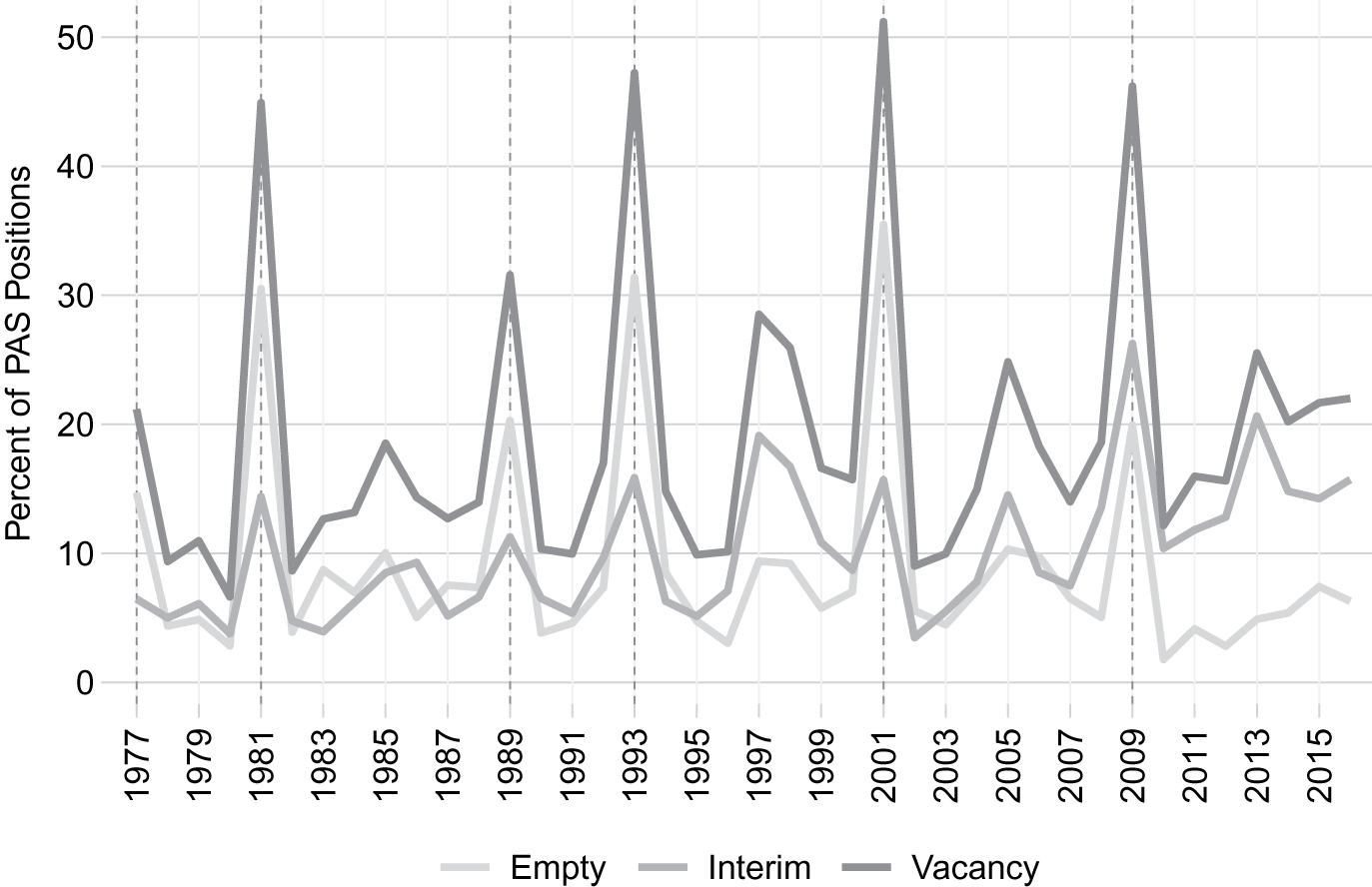
Presidents maintaining vacancies without submitting nominations deny the Senate its advice and consent Constitutional prerogative. Yet, scholars typically frame threats to separation of powers in terms of presidents usurping power not provided by the Constitution or congressional delegation (e.g., Chiou and Rothenberg Reference Chiou and Rothenberg2017; Moe and Howell Reference Moe and Howell1999) rather than presidents sidestepping that power. Indeed, existing research examines expansions of presidential policy-making power through executive orders (e.g., Howell Reference Howell2003), proclamations (Rottinghaus and Maier Reference Rottinghaus and Maier2007), signing statements (Sievert and Ostrander Reference Sievert and Ostrander2017), and presidential memoranda (Lowande Reference Lowande2014) as strategic tools that can unilaterally achieve policy goals without legislation (Ouyang and Waterman Reference Ouyang and Waterman2015). Others address how presidents influence policy by unilaterally constructing more controllable agencies (Howell and Lewis Reference Howell and Lewis2002) or adjusting the number of political appointees within agencies (Lewis Reference Lewis2005). Few consider how not exercising formal powers consolidates influence over outcomes, particularly when presidents choose not to submit nominees for Senate confirmation or choose not to appoint at all. This omission is surprising, as empty posts and interim appointees have been in the president’s toolbox for decades. As shown in Figure 1, the percentage of PAS positions filled with interim appointees or left empty varies across and within administrations. This variation provides a first look at the necessity of differentiating between interim appointees and empty positions, as well as the opportunity for presidents to use vacancies strategically.
Percentage of Executive Department PAS Positions: Empty, Interim, Vacant (1977–2016)
Note: “Vacancy” indicates the conventional definition of all positions without a Senate-confirmed appointee, which encompasses “Empty” positions and “Interim” appointments.

While scholars have made important progress in illuminating key aspects of the appointment process, the interbranch politics of vacancies remains understudied and untested. Instead, extant research cites vacancies as unfortunate consequences of turnover in a large administrative bureaucracy (e.g., Chang, Lewis, and McCarty Reference Chang, Lewis and McCarty2001), confirmation delays (e.g., Binder and Maltzman Reference Binder and Maltzman2002; Madonna and Ostrander Reference Madonna and Ostrander2017; Ostrander Reference Ostrander2016) that are prolonged by nominee ideologies (e.g., Bonica, Chen, and Johnson Reference Bonica, Chen and Johnson2015; Chiou and Rothenberg Reference Chiou and Rothenberg2014), periods with divided government (e.g., McCarty and Razaghian Reference McCarty and Razaghian1999), or presidential delays in nomination due to the vetting process (O’Connell Reference O’Connell2009). Just a handful of studies explicitly considers how presidents contribute to the accumulation of vacancies (O’Connell Reference O’Connell2009; Hollibaugh Reference Hollibaugh2015; Hollibaugh and Rothenberg Reference Hollibaugh and Rothenberg2017; Resh et al. Reference Resh, Hollibaugh, Roberts and Dull2020), with a notable exception being Hollibaugh (Reference Hollibaugh2015), who does explore sustained vacancies as a deliberate strategy within a president’s larger nomination strategy space. However, more work still needs to be done, as Hollibaugh’s theoretical model considers only the timing of nominations and does not set them within a larger bargaining game over Senate confirmation. Furthermore, until very recent work from O’Connell (Reference O’Connell2020), studies of how presidents unilaterally appoint interim officials to vacant posts, often in lieu of a nominee, have been missing from executive politics research. Consequently, since previous theories focus on the subgame of choosing a nominee, we have yet to consider the full choice set available to presidents within a more complete, extended model of appointments. The theory presented in this article does exactly that.
The Mechanics and Implications of Vacancies
In an effort to limit prolonged empty positions, encourage continuity in agency leadership, and maintain agency productivity in the absence of a confirmed appointee, Congress conferred interim appointment power to the president through the Vacancies Act of 1868 and its reforms. Under the Vacancies Act, the tenure of an interim appointee was limited to 30 days until 1988, when it was increased to 120 days by the Presidential Transition Effectiveness Act. The Federal Vacancies Reform Act (FVRA) of 1998 further extended this tenure and added a set of guidelines for who can serve as an interim appointee. Currently, an interim appointee can typically fill the position for 210 days after the vacancy began and upwards of 720 days if the respective nominations are withdrawn, rejected, or returned, and these limits are suspended if the Senate does not return the nomination. Under these conditions, an interim can serve for almost two years or even indefinitely, which makes interim appointments a potentially powerful strategy.Footnote 5 While it was intended to reaffirm the power of the Senate’s confirmation prerogative by establishing clearer constraints on interim appointees (Hogue Reference Hogue2017), the FVRA appears to have been less than successful in limiting presidential use of temporary officials. The FVRA extensions to interim tenures ultimately created a set of vacant positions for which timing considerations encourage presidents to forgo nominations entirely.Footnote 6
Notably, as agency leadership, PAS positions are essential links in the chain of command for administrative policy making. Their responsibilities—ranging from managing agency operations, liaising with Congress and the White House, supervising policy development and rule-making, and crafting communications to overseeing enforcement and implementation, among others—facilitate the accountability, efficiency, and responsiveness of government to its citizens. Consequently, each type of vacancy has distinct and important implications for policy and agency performance. Foremost, vacancies left empty and those filled with an interim appointee differ on one visible dimension: the presence of a designated person with the authority to perform the duties of the position.
On the one hand, empty positions typically reduce the responsiveness of the administrative state to stakeholder needs, limit the generation of public policy, and stall enforcement activities. For instance, when the Administrator of the Office of Information and Regulatory Affairs (OIRA) is empty, regulatory review periods are significantly longer and, more generally, OIRA is less responsive to the president’s policy agenda (Bolton, Potter, and Thrower Reference Bolton, Potter and Thrower2015). The absence of leadership can also make careerists feel “rudderless,” and “thwarted for months or even years from doing the government jobs they were hired to do” (Leonnig Reference Leonnig2008, 1), decreasing the morale and trust that reinforces careerist compliance with the administration’s larger agenda. Moreover, empty PAS positions will generally make agencies less able to handle time-sensitive crises that require swift decision making. For example, the Assistant Secretary for Occupational Safety and Health at the Department of Labor, head of the Occupational Safety and Health Administration (OSHA), remained empty from the start of the Trump administration. Consequently, still without leadership during the COVID-19 pandemic, OSHA was unable to craft new standards to address airborne infectious diseases, unresponsive to the urgent concerns for the safety of healthcare workers, and slow to enforce antiretaliation protections for workers who spoke out about the lack of protective equipment.Footnote 7
Alternatively, interim appointees likely increase responsiveness to the president’s preferences since they are not subject to Senate confirmation. In reference to his affinity for interim appointees, Trump remarked as much: “I like acting [appointees] because I can move so quickly, gives me more flexibility.”Footnote 8 Viewing their authority as similar to that of confirmed appointees (O’Connell Reference O’Connell2020), interim appointments offer presidents the flexibility to select individuals who the Senate might not otherwise confirm. For example, Obama appointed Vanita Gupta as Acting Assistant Attorney General for Civil Rights, without submitting a nomination during her two-year tenure as the Republican-led Senate was expected to reject it. Gupta, whose leadership was praised by her colleagues, successfully spearheaded the administration’s criminal justice reform efforts. Furthermore, if drawn from long-term agency employees, interim appointees may have more competence and expertise than do their Senate-confirmed alternatives (Mendelson Reference Mendelson2014; O’Connell Reference O’Connell2009). For instance, in 1996, Clinton appointed one of the Treasury’s leading tax experts, Donald Lubick, as Acting Assistant Secretary of Tax Policy. Having served in various positions throughout Treasury, including as Assistant Secretary under Carter, Lubick successfully navigated negotiations with House Republicans over taxes and balancing the budget. The conflicting realities of positions without confirmed appointees—where empty posts promote inaction and interim appointees offer more effective reactions—further indicate that our theories of appointments need to incorporate a more nuanced definition of vacancies.
A THEORY OF VACANCIES AND FILLED APPOINTMENTS
Vacancies offer presidents an opportunity to pursue diverging policy goals. Starting from this assumption, I present a theory of appointments based on a model that formalizes the president’s choice to fill a position or leave it empty in an interbranch bargaining context. Here, due to space constraints, I offer a stylized version of the model and its intuition; the Online Appendix A presents the formal treatment of the model and its solutions.
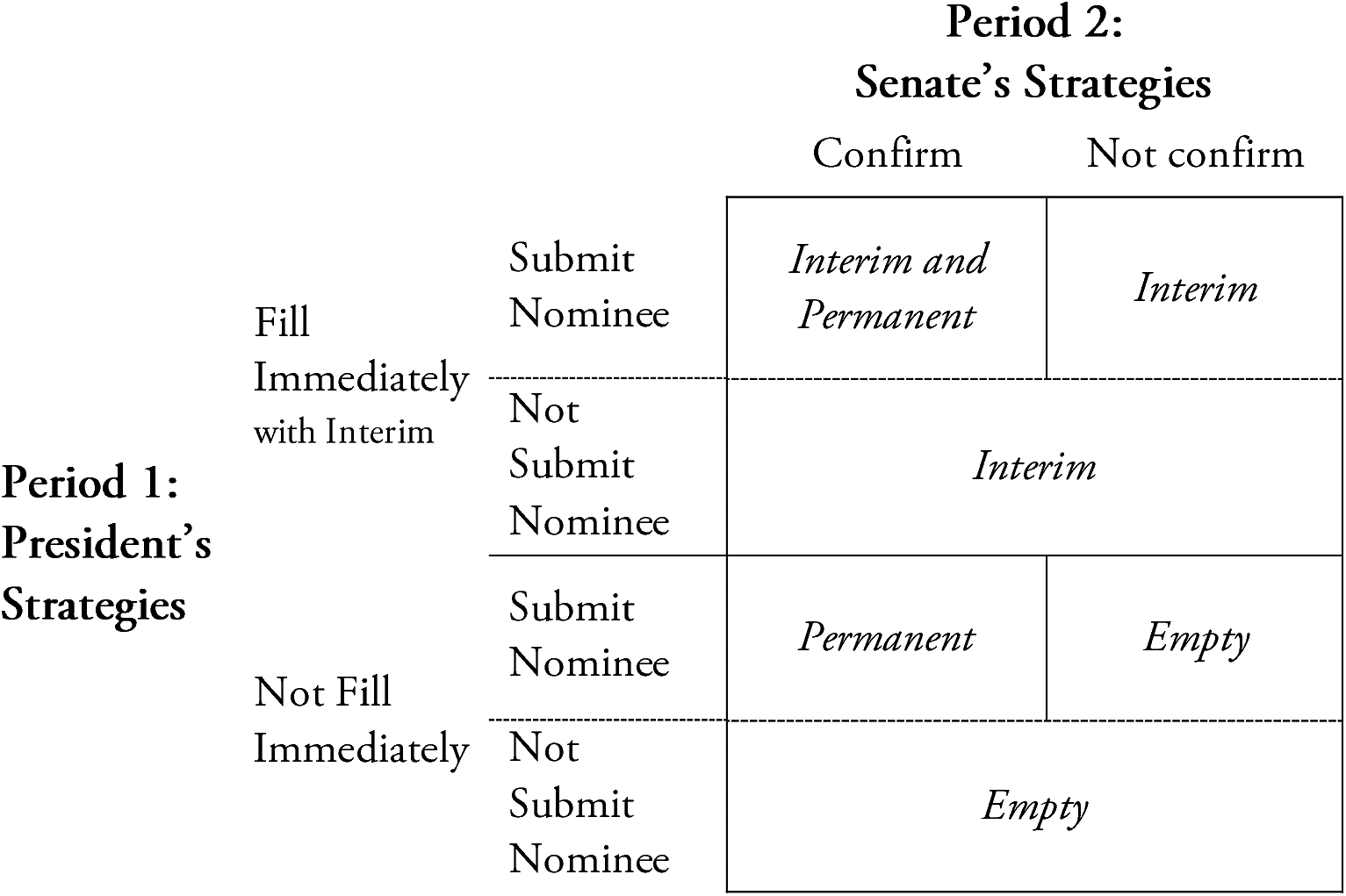
The model begins with a vacancyFootnote 9 and has two stages and two players, the president and the Senate. The first stage mimics a decision-theoretic model as the president makes a sequence of decisions: first whether to immediately fill the empty post with an interim and then whether to submit a nominee for Senate confirmation. With the advantage of a first-mover, the president sets the reversion point for the Senate’s confirmation strategy. In response, the Senate confirms when the cost of that empty post or interim outweighs any gains from returning a president’s nominee, albeit only if one is submitted. In these decisions, both players maximize utility in terms of Position Value (Viy ), which is exogenously determined and represents each PAS position’s capacity to advance a player’s priorities for the agency’s policy-making activities. Ultimately, Position Value and the anticipation of Senate confirmation or rejection shape the president’s best response: maintain the vacancy as an empty position or interim appointment or seek the Senate’s advice and consent.
Formally, the generalized utility functions for each player i reflect the payoff for filling the position immediately (βτViy ), the payoff for filling the position for the long-term (βτγViy ), and the bargaining cost (ci ) of the confirmation process such that uy = βτ (f,¬f) Viy + βτ (f,¬f) γViy − ci .Footnote 10 The sequence of game play is as follows:
-
1. The president is presented with an empty position, with value to the Senate ViS and to the president ViP . The president observes ViS and ViP , chooses a strategy to fill with an interim appointee or leave empty, and then to nominate or not.
-
2. If the president does not nominate, the game ends with an interim appointee or empty position. Payoffs are then allocated to both players.
-
3. If the president does nominate, the Senate chooses a strategy to confirm or not. If the Senate chooses to confirm, the game ends with a permanent appointee. If the Senate chooses to not confirm, the game ends with the reversion point from the president’s move in the first stage, either an interim appointee or empty position. Payoffs are then allocated to both players.
Position Value, the key parameter that indicates the capacity of the position in terms of controlling the policy output of the position’s parent agency, is a composite of Position Capacity and Policy Priorities. First, the Position Capacity to control policy-making activities institutionally constrains the extent to which that position can advance each player’s policy priorities. Low-capacity positions are administrative or routine in nature, have little to no latitude, and generally provide few opportunities to reach larger political goals. Alternatively, positions with high policy-control capacity require more expertise, have more room to influence policy outcomes, and advance a larger political agenda. Second, Policy Priorities capture whether the player prefers to expand, contract, or neutrally maintain the agency’s status quo implementation, regulation, or policy-generating activities. Non-neutral, expansion- or contraction-branded priorities, inherently require that the agency’s policy jurisdiction be salient to the player’s larger policy agenda and classify the player’s ideal direction of the agency’s actions.
Traditionally, when we theorize about appointees, we begin with ideology and frame the choice of nominee in terms of ideological alignment with the president and the Senate. Previous work did not require a position-centric approach as the focus was on the individuals filling the positions. Yet, we cannot attribute appointee characteristics, like ideology, to empty positions. To examine the decision to leave a position empty on the same footing as the decision to nominate, we need to consider how the characteristics of positions themselves lead to the outcomes of the appointment process. Policy Priorities parallel policy preferences captured by ideology, but at the agency level and in terms of the actions necessary to move toward the preferred new policy status-quo. To simplify this action orientation, I classify Policy Priorities as falling into three alternative categories: expansion, neutral, and contraction. Though closely related to ideology, this expansion-contraction dimension better captures the central question that presidents face when deciding on appointments: whether to expand an agency’s policy making or constrict it.Footnote 11 Thus, this new concept not only allows us to think about how a position itself advances the president’s or the Senate’s agenda; it does so in a way that does not require the measures of appointee ideology that are commonly used in studies that do not look at presidents’ full range of strategic options in the face of vacancies.
Interacting Position Capacity and Policy Priorities, a position with high Position Value has a high capacity to advance expansion and contraction policy priorities; otherwise, the position has low value.Footnote 12 Position Value (“High Value [expansion],” “High Value [contraction],” “Low Value”) creates the incentives that drive the Senate’s choice to confirm a nominee, and the president’s strategic choice to submit one, given the Senate’s confirmation strategy. The combinations of these strategies lead to any one of four outcomes, as depicted in Figure 2: an empty position, a position filled by an interim appointee with no action toward a permanent appointee, a position filled by a permanent appointee, or a position filled by an interim and then a permanent appointee. I employ subgame perfect Nash equilibrium and solve the game via backwards induction. The game follows a straightforward sequential structure and has a unique equilibrium.
Theory of Vacancies and Filled Appointments Outcomes

Empirical Predictions
Critically, the conditions under which the president’s best response is to leave vacant positions empty or fill them with interim appointees must be examined in the context of the alternative confirmed appointees. This requires simultaneously identifying the conditions under which the Senate confirms a nominee. While the full set of optimal strategies for the Senate and the president are detailed at length in Appendix A, this section outlines the features that produce the empirical expectations for our inquiry of why presidents choose to leave certain vacant positions empty while filling others with interim appointees.
To that end, we begin with the Senate’s confirmation set.Footnote 13 First, when the president and Senate both have expansion Policy Priorities and the position has high Position Capacity—a high-value (expansion) position—the Senate will confirm the president’s nominee, in equilibrium, irrespective of the reversion point. Second, if the Senate prioritizes contraction and the president prioritizes expansion for a high-capacity position, the Senate will confirm if the position is filled with an interim appointee. Under these circumstances, the Senate is better off with the oversight from confirmation than with the appointee in an interim capacity without it. Alternatively, when the Senate faces an empty post as the reversion point, there is also an oversight incentive to confirm, in equilibrium, if the nominee is ineffective and the potential tenure is sufficiently long to allow for oversight activities; otherwise, the Senate will confirm a relatively effective nominee only if the potential tenure is sufficiently short.Footnote 14 Fourth, if the Senate supports policy expansion while the president prioritizes contraction and the high-capacity position is empty, the Senate will confirm if the potential tenure is sufficiently small given a relatively effective nominee. Lastly, the Senate confirms nominees to low Position Value positions, indicating either low Position Capacity or neutral Policy Priorities.
Next, we consider the Senate’s rejection set.Footnote 15 First, the Senate prefers to not confirm the president’s nominee, in equilibrium, when the position is high capacity and its contraction priorities align with those of the president.Footnote 16 Alternatively, if the president prioritizes contraction while the Senate seeks expansion for a high-capacity position, the Senate does not confirm when facing an interim appointee.Footnote 17 Lastly, if the reversion point is an empty post and the president offers a relatively effective nominee, the Senate does not confirm the nominee when prioritizing contraction while the president seeks expansion.
Given the Senate’s confirmation and rejection sets, the president chooses the best response strategy for vacancies and nominations.Footnote
18
First, the president seeks to submit a nominee only for high-value (expansion) positions, but the choice to nominate hinges on the cost to bargain with the Senate.Footnote
19
As expected, the president’s first-mover advantage manifests as dictatorial control over each type of vacancy. Importantly, empty positions occur either when the president chooses not to appoint an interim and not nominate or when the president chooses to nominate without appointing an interim but the Senate does not confirm. Anticipating that, when the president prioritizes contraction, the Senate will confirm a nominee for high-capacity positions if and only if it has neutral Policy Priorities (
 $ {V}_{yS}=0 $
) and will reject nominees otherwise; the president prefers to avoid the bargaining cost by forgoing a nomination and maintaining the empty position. That is, when a president prioritizes policy contraction, positions with high levels of capacity will stay empty, in equilibrium, as the president will neither appoint an interim nor nominate a permanent appointee. Alternatively, interim appointees occur when the president chooses to appoint one either without submitting a nominee or with a nominee that the Senate does not confirm. In equilibrium, a president with expansion Policy Priorities will fill all vacant positions with interim appointees, no matter the Senate’s priorities. In other words, the president’s choice to fill a position immediately with an interim appointee (or not) does not explicitly depend on the Senate’s confirmation choice.Footnote
20
From this, we arrive at two empirical predictions of when presidents leave vacant positions empty or fill them with interim appointees, in terms of Position Value:
H1. Empty Position Hypothesis: A president is more likely to leave high-value positions empty when prioritizing policy contraction.
H2. Interim Appointee Hypothesis: A president will always immediately fill low-value positions with interim appointees and is more likely to immediately fill high-value positions with interims when prioritizing policy expansion.
ANALYZING VACANCIES IN PRESIDENTIAL APPOINTMENTS
To evaluate these expectations, I collected data on positions’ statuses and their levels of capacity to control policy output, as well as congressional and administration’s policy priorities, from 1977–2016 for PAS positionsFootnote 21 in all 15 Executive departments (Agriculture, Commerce, Defense, Education, Energy, Health and Human Services, Housing and Urban Development, Homeland Security, Interior, Justice, Labor, State, Transportation, Treasury, and Veterans Affairs). To identify whether a position is filled or empty, and specifically to differentiate between interim and permanent appointees, I rely on government published directories of PAS positions. Together with a research assistant, I digitized data from archived editions of the quadrennial publication United States Government Policy and Supporting Positions (the Plum Book) and archived annual editions of the United States Government Manual using optical character recognition software. Each of the government reports lists who is occupying the position and whether they are an interim appointee, or the position is empty, at the time of publication.
Using these data, I constructed the three-category Position Status to identify whether the PAS position is empty, filled with an interim appointee, or filled with a confirmed appointee.Footnote 22 Of the 11,043 position-year observations, 8,889 (80.5%) were filled by permanent appointees, 1,165 (10.6%) were filled by interim appointees, and 989 (8.96%) were left empty. Importantly, Position Status varies by partisanship and institutional control,Footnote 23 which suggests that there are other considerations beyond our traditional explanations—perhaps, as I posit, differences in the value of the position to the president and Senate—that influence the decision to fill a position.
Policy Priorities. To operationalize Policy Priorities, I need to identify whether the president and Senate prefer to expand or contract the reach of an agency in the year of the observed position status. There are various opportunities for each actor to reveal their preferences. Scholars often control for the salience of policy priorities in terms of mentions in the State of the Union (e.g., Krause and O’Connell Reference Krause and O’Connell2016) or frame these priorities in terms of a legislative agenda (e.g., Beckmann Reference Beckmann2010), but this theory requires a measure of the direction of priorities for agency policy output vis-à-vis the status quo.
Fortunately, the annual budget process requires administrations and Congresses to take stock of each agency’s current position relative to their ideal agency activities, determine areas for change, and create quantitative measures of desired shifts in budgetary authority. Thus, I am able to identify expansion and contraction policy priorities by using administration budget requests and final appropriation levels. I compiled the requisite data on annual presidential budget requests and previous years’ budget authority, for each agency from 1977 to 2016, from the historical summary tables that are located in the appendices of every fiscal year edition of The Budget of the United States Government, archived by FRASER.Footnote 24 I structure Policy Priorities as a categorical variable identifying expansion, contraction, or neutral (maintaining the status quo funding level given inflation) presidential and congressional policy priorities.
I measure presidential expansion priorities as budget requests to increase an agency’s budget authority from the average of the previous two fiscal years by an amount that exceeds what would be required to maintain current levels given the annual rate of inflation. The average of the previous two appropriations smooths fluctuations in budget authority due to irregular spending from stimulus packages or new program roll-outs or reductions from agency reorganizations or program terminations. Conversely, presidential contraction priorities are budget requests to decrease an agency’s budget authority from the average of the previous two fiscal years. Similarly, congressional expansion priorities are increases, larger than inflation, in the congressionally approved budget authority from the average of the previous two fiscal years, and congressional contraction priorities are decreases to an agency’s budget authority from the average of the previous two fiscal years.Footnote 25 The remaining category of neutral priorities indicates requests or approved budget authority that maintains the same level of agency funding within the range of inflation.
Position Capacity. To construct a measure of Position Capacity, I identified whether the responsibilities of each PAS position in each agency were for agency operations, policy development, policy implementation, inter- or intra-agency coordination, legislation development, agency management and communications, or public relations, using position and agency descriptions published in annual editions of the Government Manual.
The positions that have clear responsibilities for policy development, implementation, or explicit coordination among policy implementers carry the lion’s share of the success or failure in achieving policy goals. These positions include: agency heads (e.g., secretaries, administrators, directors), general counsels, inspectors general, and deputy or assistant secretaries that have jurisdiction and responsibilities for policy direction and implementation. Consequently, each of these position’s Position Capacity level is high. Alternatively, positions with low policy-control capacity are responsible for an agency’s internal management or policies governing agency operations, like assistant secretaries of administration. These roles certainly have important functions with respect to internal management and operations, but they are coded here as low capacity given the position’s low level of influence on the policy direction of the agency. Similarly, positions with responsibilities for relating information or maintaining public relations (e.g., assistant secretaries for communication) and positions responsible only for research and data collection without grant-making or policy-recommendation responsibilities (e.g., director of the Bureau of Mines at the Department of the Interior) also have little opportunity to influence the promulgation, enforcement, or implementation of the substantive rules that guide policy outcomes. Consequently, these positions’ Position Capacity level is low.
Position Value. Lastly, I construct the categorical variable, Position Value, as a function of Position Capacity and Policy Priorities. Specifically, a position is “Low Value” when its level of Position Capacity is low or Policy Priorities are neutral. A position is “High Value (contraction)” or “High Value (expansion)” when its Position Capacity is high and Policy Priorities are contraction or expansion, respectively.
To examine the role that Position Value plays in a president’s calculus to fill or not fill vacant positions and test whether my theoretical expectations bear out empirically, I rely on a discrete choice model of Position Status as a function of Position Value. First, however, it is important to establish the empirical consequences of the keystone of my research: differentiating between vacancies that are left empty and those that are filled with interim appointees. The distributions reported in Table 1 clearly demonstrate the significance of this distinction. Here, under the conventional definition, vacancies appear to be similarly distributed, accounting for, on average, 19% of PAS positions in each category of president Position Value. Moreover, we cannot statistically differentiate among the distributions of permanent appointees and vacancies across those categories. However, when we define vacancies more precisely, substantively and significantly different distributions emerge.
Distributions of Permanent Appointees and Vacancies

* Note: N includes permanent appointees, empty positions, and interim appointees.
Specifically, empty positions and interim appointees vary considerably across the categories of president Position Value. In particular, 11.2% of “High Value (expansion)” positions are filled with interim appointees compared with 8.1% left empty, and 10% of “High Value (contraction)” positions were left empty compared with 9.3% with interims. In other words, 58% of vacancies in “High Value (expansion)” positions and 52% of those in“Low Value” positions were filled with interim appointees, whereas 52% of “High Value (contraction)” positions were left empty, and we can statistically differentiate between these percentages at a less than a 1% level. Recall, the Empty Position Hypothesis predicts that presidents are more likely to leave positions empty that are “High Value (contraction)” and the Interim Appointee Hypothesis posits that they are more likely to appoint interims to positions that are “Low Value” and “High Value (expansion).” Thus, without controlling for any other factors, the distributions presented in Table 1 align with my theoretical expectations.
To analyze the patterns that emerged from this nonparametric analysis in the context of a parametric likelihood model, which allows for formal statistical inference, I estimate multinomial probit (MNP) modelsFootnote 26 of Position Status, with robust standard errors, and the key predictor variables: Position Value for the president and for Congress and the interaction between them. I control for whether the administration is new and in transition or it is established—that is, Established Administration indicates that the administration is no longer in its first year.Footnote 27 Although the months between election and inauguration are traditionally focused on assembling the top leadership in a new administration, the sheer volume of vacant PAS positions due to structural turnover likely explains at least some of the variation in empty positions and interim posts, outside of presidential strategic behavior. Additionally, I control for whether the Senate majority is the same party as the president (Co-Partisan Control), which likely affects the ease of confirmation that makes permanent appointees more valuable. Lastly, I control for vacancy procedural regimes,Footnote 28 department, and administration fixed effects.Footnote 29 Specifically, as per Greene and Hensher (Reference Greene and Hensher2010), the structural equation for the multinomial probit model is the following:
 $$ {\displaystyle \begin{array}{c}{U}_{y_{jt}}={\alpha}_{y_{jt}}+{\beta}_{V_P}{V}_{Py_{jt}}^{\prime }+{\beta}_{V_C}{V}_{Cy_{jt}}^{\prime }+{\beta}_{V_{PxC}}{V}_{Py_{jt}}^{\prime }{V}_{Cy_{jt}}^{\prime }+\\ {}{\gamma}_1E{A}_t^{\prime }+{\gamma}_2C{P}_t^{\prime }+{\gamma}_3{R}_t^{\prime }+{\gamma}_4{D}_j^{\prime }+{\gamma}_5{A}_t^{\prime }+\varepsilon, \end{array}} $$
such that
 $$ \mathit{\Pr}\left({y}_{jt}={S}_m\right)=\mathit{\Pr}\left({u}_{S_m}>{u}_{S_k}\forall m\ne k\right) $$
for
 $$ {S}_{1m}\left\{\begin{array}{ll}0\Rightarrow & Empty\\ {}1\Rightarrow & Interim\hskip0.5em Appointee\\ {}2\Rightarrow & Permanent\hskip0.5em Appointee,\end{array}\right. $$
where
S 1 is the status of a position yjt in department j for year t, which indicates whether it is empty, filled with an interim appointee, or filled with a permanent appointee;
 $ {V}_{Py_{jt}} $
is Position Value for the president;
 $ {V}_{Cy_{jt}} $
is Position Value for Congress;
 $ {V}_{Py_{jt}}{V}_{Cy_{jt}} $
is the interaction between the Position Value for the president and Congress, as driven by my theoretical expectations;Footnote
30
EAt and γ 1 represent Established Administration and its effects;
CPt and γ 2 represent Co-Partisan Control of the Senate and its effects;
Rt is procedural regime fixed effects;
Dj is department fixed effects;
At is administration fixed effects;
and ε represents the multivariate normally distributed errors.
FINDINGS
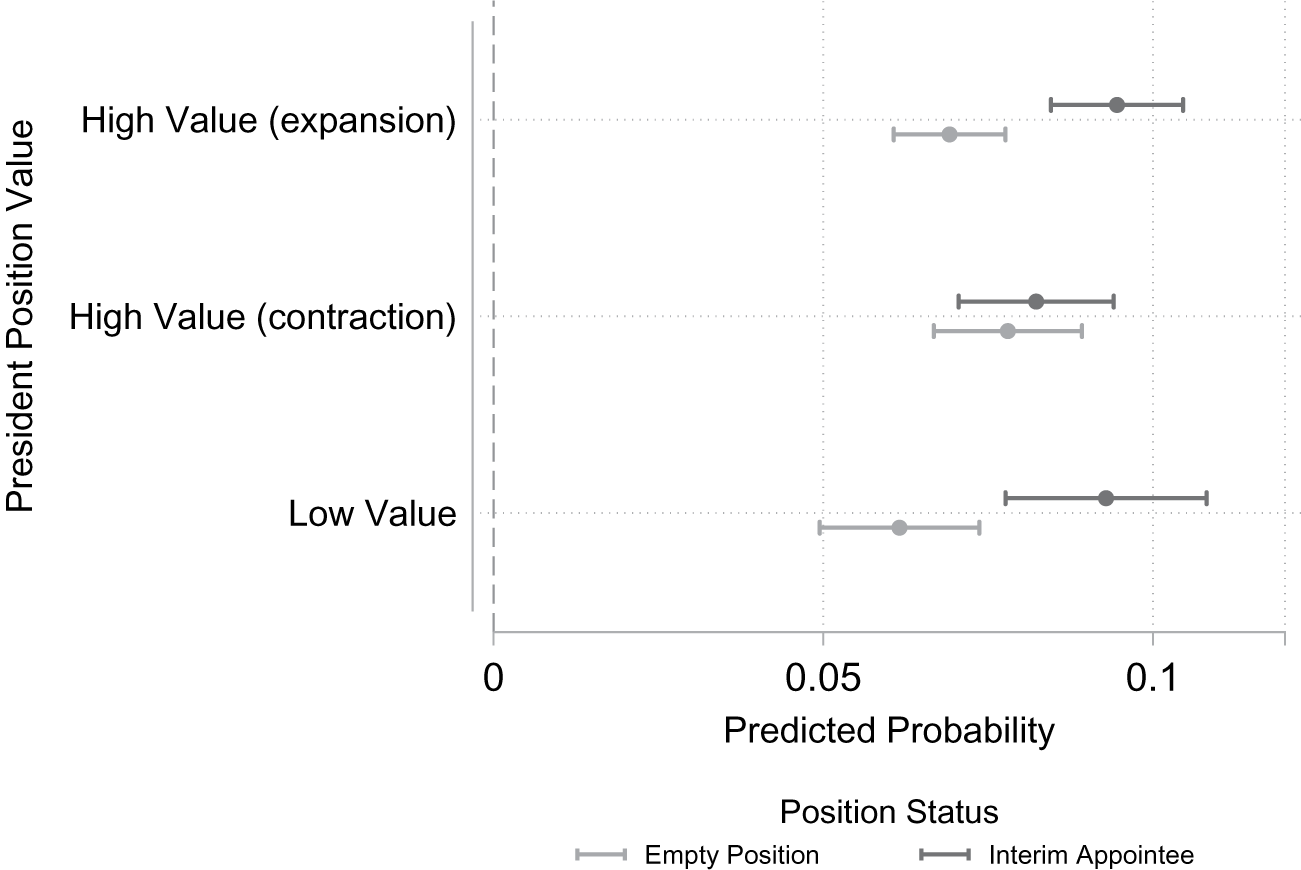
Overall, the results indicate that Position Value significantly contributes to the likelihood of both an empty position and interim appointee. However, since parameter estimates from MNP models display the multinomial log odds relative to the base category and coefficients for categorical variables are relative to the omitted category, their interpretation can be a bit onerous. Thus, I center the discussion and results presentation on the substantively interpretable predicted probabilities, with full results reported in Appendix B. Table 2 reports the predicted probabilities of each position status for each category of the explanatory variables, with all other variables at their means. For visual ease, Figure 3 presents the predicted probabilities of empty positions and interim appointees for each category of president’s Position Value, the variable at the core of each hypothesis.
Predicted Probabilities of Position Status Outcomes

Note: Table entries are the predicted probabilities of each position status given the specified row variables. Standard errors in parentheses. Explanatory variables were held constant at their mean values.
Adjusted Predictions of the Probability of Empty Positions and Interim Appointees, Given President Position Value

H1. Empty Position Hypothesis
Given the Empty Position Hypothesis, we would expect to find a higher predicted probability of empty positions when president Position Value is “High Value (contraction)” than otherwise. As the last column in Table 2 reports, indeed, empty “High Value (contraction)” positions are more likely, with a predicted probability of 7.8%, than empty “High Value (expansion)” positions (6.9%) and even more likely than empty “Low Value” positions (6.2%). However, we cannot statistically differentiate between them,Footnote 31 which is evident from their overlapping confidence intervals, displayed in Figure 3. Consequently, these comparisons within Position Status categories offer little support for the Empty Position Hypothesis. Importantly, however, if we simultaneously consider the general expectations of the Empty Position and Interim Appointee Hypotheses, as discussed below, we then turn to examine comparisons across Position Status which ultimately present more supportive results.
H2. Interim Appointee Hypothesis
Given the Interim Appointee Hypothesis, we would expect to find higher predicted probabilities of interim appointees when president Position Value is “Low Value” and “High Value (expansion),” than “High Value (contraction).” And this is indeed what we find. The second column in Table 2 reports, as expected, interim appointees are more likely in “High Value (expansion)” positions, with a predicted probability of 9.5%, than in “High Value (contraction)” positions, with a predicted probability of 8.2%.Footnote 32 Also as expected, interim appointees have a higher predicted probability of filling “Low Value” positions (9.3%) than “High Value (contraction)” positions; however, we cannot statistically differentiate between the predicted probabilities (p = 0.277).
Critically, when we turn our attention to differences across Position Status, an even clearer picture emerges. Taken together, the Interim Appointee and Empty Position Hypotheses produce the expectation that vacant positions are more likely to be filled by interim appointees than left empty when president Position Value is “High Value (expansion)”or “Low Value.” As Figure 3 clearly illustrates, this is exactly what we find. Namely, interim appointees are significantly more likely than are empty positions under the “High Value (expansion)” category of president Position Value.Footnote 33 In fact, when presidents prioritize expansion, high-capacity vacant positions are over 37% more likely to be filled by interim appointees than left empty. Also as expected, “Low Value” positions are over 52% more likely to be filled with interim appointees than left empty.Footnote 34
Additional Findings
The controls included in this analysis also offer three interesting findings. First, permanent appointees are not significantly more likely under co-partisan control than under divided control.Footnote 35 This result is surprising because we would expect from previous work on appointees, ideology, and confirmation delay (e.g., McCarty and Razaghian Reference McCarty and Razaghian1999) that confirmed appointees would be significantly less likely under divided control. Instead, when we account for vacancies and include the capacity of the position to achieve policy priorities, permanent appointees are not any more likely when the Senate majority party is the same as the president’s party than when it is not. Second, interim appointees are significantly more likely in new administrations in their first year, with a predicted probability of 14%, than in established ones (8.2%).Footnote 36 But established administrations are significantly more likely to have interim appointees than empty positions.Footnote 37 Recall that Figure 1 shows that presidents inherently experience fewer vacancies outside of their first, transition year. These results suggest that experienced presidents are more likely to fill those fewer vacant positions with interim appointees than to leave them empty.
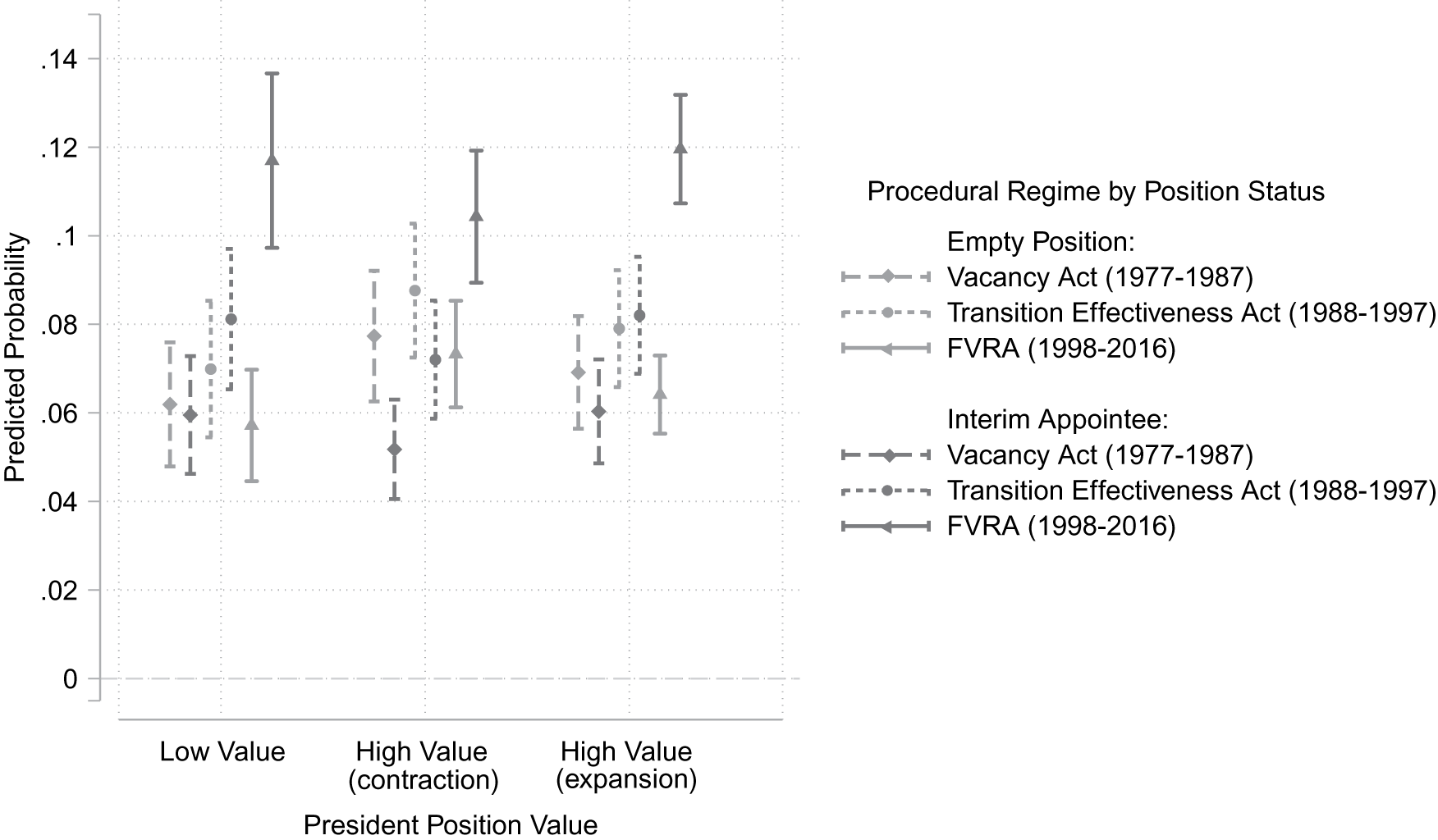
Lastly, with each reform to the procedural regime governing vacancies, vacant positions are increasingly more likely to be filled with interim appointees than left empty. Under the Vacancy Act, interim appointees and empty positions are equally likely, as their predicted probabilities are statistically indistinguishable. After the Presidential Transition Effectiveness Act of 1988, interim appointees are marginally more likely than under the Vacancy Act; however, they become even more likely than empty positions. Moreover, under the FVRA, interim appointees are more likely than under previous regimes and significantly more likely than empty positions.Footnote 38 Critically, however, when we evaluate the predicted probabilities over these vacancy procedural regimes given president Position Value, as displayed in Figure 4, important variation emerges. While interim appointees and empty positions are, overall, equally likely before 1988, we can statistically differentiate them within “High Value (contraction)” positions—which have a significantly higher predicted probability of being left empty (7.7%) than filled with an interim (5.2%).Footnote 39 Similarly, interim appointees are more likely than empty positions under the FVRA, but the differential is much starker for “High Value (expansion)” and “Low Value” positions than “Low Value (contraction)” ones. Clearly, these dimensions warrant additional consideration, particularly given the pronounced patterns before and after the FVRA, and the next section details this examination.
Adjusted Predictions of the Probability of Empty Positions and Interim Appointees, Given President Position Value and Vacancy Procedural Regime

Examining Position Status, Before and After the FVRA
Each appointee—no matter their effectiveness—is constrained by the limited time they are able to serve. Ultimately, each additional day presents appointees with a wider window of time to achieve the administration’s policy and political objectives. As outlined previously, interim appointees after the passage of the FVRA can serve nearly six times longer than those before. If we suppose that these extended terms make interim appointees a more attractive option for advancing policy priorities, then we would anticipate the FVRA to amplify our expectations of when presidents choose to fill vacant positions with them. That is, we would expect higher likelihoods of interim appointees in “High Value (expansion)” and “Low Value” positions in the post-FVRA regime than in the pre-FVRA regime. I estimate the MNP model specified aboveFootnote 40 separately on the set of position-year observations from the pre-FVRA regime (1977–1997) and those from the post-FVRA regime (1998–2016).Footnote 41
H1. Empty Position Hypothesis
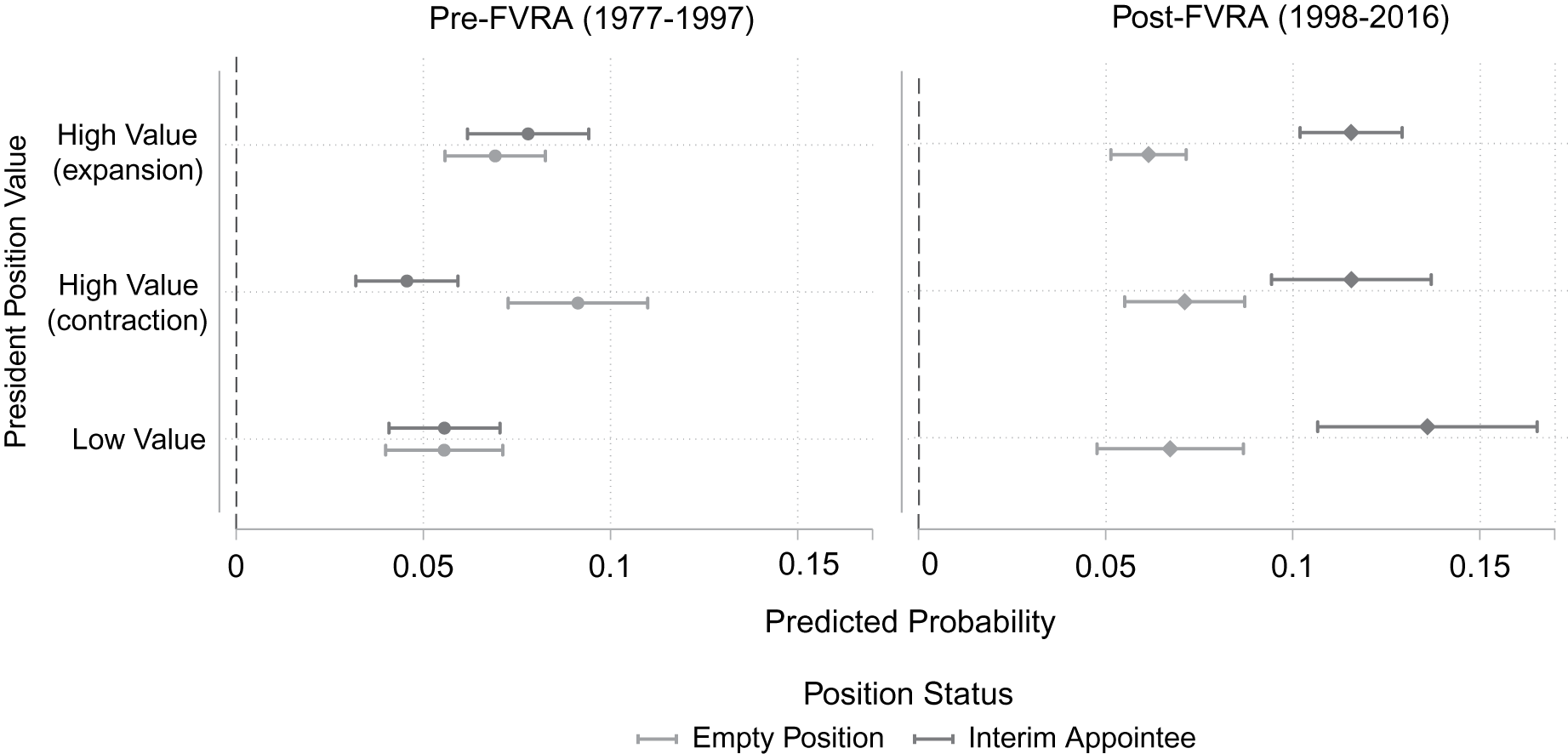
Given the Empty Position Hypothesis, we expect higher predicted probabilities of empty positions under “High Value (contraction)” than otherwise, which is exactly what we find under the pre-FVRA regime. As Figure 5 clearly illustrates, before the FVRA “High Value (contraction)” positions have the highest predicted probability of being empty (9.1%) and are statistically distinguishable from “Low Value” and “High Value (expansion)” positions.Footnote 42 More striking, however, is a comparison between the predicted probabilities of interim appointees and empty positions within the “High Value (contraction)” category. Here, empty positions are significantly more likely than interim appointees (4.6%).Footnote 43 While the patterns reverse under the post-FVRA regime, these results show that there is strong support for the Empty Position Hypothesis under the pre-FVRA regime.
Adjusted Predictions of the Probability of Empty Positions and Interim Appointees, given President Position Value
Note: The predicted probabilities are estimated using the MNL regression results reported in Appendix Table B4, which model the likelihood of Position Status as a function of Position Value separately on the observations in the pre-FVRA period (1977–1997) and the post-FVRA period (1998–2016).

H2. Interim Appointee Hypothesis
Given the Interim Appointee Hypothesis, we expect higher predicted probabilities of interim appointees for “High Value (expansion)” and “Low Value” positions than otherwise. Figure 5 presents strong evidence for the Interim Appointee Hypothesis under both the pre- and post-FVRA regimes—a result foreshadowed by the robust results from the earlier likelihood analysis. Clearly, under the pre-FVRA regime, the likelihood of interim appointees is significantly higher for “High Value (expansion)” positions—with a predicted probability of 7.8%—than for “High Value (contraction)” positions—with a predicted probability of 4.6%.Footnote 44 In other words, before the FVRA, interim appointees are 70% more likely in vacant high-capacity positions under expansion priorities than under contraction ones.
Notably, again, Figure 5 displays a more striking result for interim appointees and empty positions within Position Value categories. Although we cannot statistically differentiate between the likelihoods of interim appointees across the categories of president Position Value under the post-FVRA regime, we can very clearly differentiate between them within these categories. Specifically, after the FVRA, the predicted probabilities of an interim appointee are significantly higher than those of empty positions within “High Value (expansion)” and “Low Value” categories—11.5% and 13.6% compared with 6.1% and 6.7%, respectively.Footnote 45 That is, when presidents have expansion priorities, high-capacity positions are more than twice as likely to be filled by interim appointees than left empty—which offers very strong evidence for the Interim Appointee Hypothesis. Figure 5 also shows that interim appointees have higher predicted probabilities than empty positions within “High Value (contraction),” which does not align with expectations from the Empty Position Hypothesis or the Interim Appointee Hypothesis. Even so, the higher likelihoods of interim appointees under the post-FVRA regime—higher still than the likelihoods under the pre-FVRA regime—emphasize the influence, as expected, of the Federal Vacancies Reform Act on how Position Value captures the strategic value of interim appointees.
CONCLUSION
In this article, I show that frequent and sustained vacancies are not by chance or the mechanical byproduct of an elaborate appointment process. Rather, they result from strategic choices that presidents make to advance their policy agenda. Specifically, interim appointees are significantly more likely to fill high-capacity positions when presidents seek to expand an agency’s policy reach, as predicted by the theoretical framework also discussed here. Also as predicted, the empty positions are significantly more likely among high-capacity positions when presidents prioritize contracting agency action, albeit only in the pre-FVRA period. While the likelihood of a position left empty is not as strongly correlated with the president’s contraction priorities across the entire period, this result could be driven by the concentration of empty positions within departments. These likelihood models estimate the probability that any one position is empty; they do not address the incidence of empty positions within a department. Furthermore, the generality of the theoretical hypotheses allow for considerations of both likelihood and incidence of empty positions and interim appointees within departments. Since congressional and presidential policy priorities correspond to each department, we would expect a larger number of empty positions when presidents prioritize contraction and a larger number would be filled with an interim when the president prioritizes expansion. In fact, an analysis outside the scope of this paper—of the aggregated counts of position status—shows that contraction policy priorities do increase the number of empty high-capacity positions.
The broadest implication of this research stems from its correction of the standard view that vacancies are simply arbitrary miscalculations within the appointment process. By treating vacancies as footnotes, rather than as marked features of presidential appointment strategy, existing research and policies have fundamentally disregarded the role that each type of vacancy has to play. This research illustrates that scholars and politicians have misunderstood the realities of PAS positions without Senate-confirmed appointees. In particular, our previous understanding completely overlooked the fact that empty positions and interim appointees are two different outcomes and each presents distinct opportunities to pursue diverging policy priorities. Furthermore, we mistakenly have assumed that presidents would unfailingly pursue formal nominations and that, however stalled by institutional forces, PAS positions would always be filled by Senate-confirmed appointees. This study clearly documents that vacancies are not the aberration we thought they were, demonstrates that empty positions and interim appointees are separate consequences of strategic decisions, and presents the first error correction of its kind on the politics of vacancies.
Now that we have a more precise picture of vacancies and permanent appointments, we can more accurately consider the implications of those outcomes for bureaucratic performance and accountability. Since we had not previously differentiated between empty positions and interim appointees, our understanding has been restricted to the effects of different characteristics of permanent appointees (e.g., Gallo and Lewis Reference Gallo and Lewis2011; Lewis Reference Lewis2008) or the organization of those appointments (e.g., Krause, Lewis, and Douglas Reference Krause, Lewis and Douglas2006; Wood and Lewis Reference Wood and Lewis2017) on performance. We now know that the prevalence of interim appointees and empty positions offers considerable opportunities for each to shape agency performance. Thus, while we have evidence that the absence of confirmed appointees clearly shapes agencies’ ability to accomplish certain objectives (e.g., Bolton, Potter, and Thrower Reference Bolton, Potter and Thrower2015), future work might explore how agency performance differs under each type of vacancy.
Altogether, there is clear evidence that presidents are strategically using interim appointees to advance their policy priorities. These findings, and the theory motivating the analysis, suggest some important considerations for future work on the politics of presidential appointments and separation of powers. First, this research motivates expanding beyond ideology. Ideological alignment is just one element in the basket of what presidential appointments, bureaucratic and judicial alike, can deliver. When we entertain what the president and the Senate are looking to achieve from agency actions more broadly, we can generalize to consider the value of the position itself for advancing that policy agenda and how effectively appointees can deliver the positions’ full value. Moreover, the more nuanced definition of vacancies motivates new considerations of whether oversight of agency (in)action varies with vacancies. Examining whether presidents suffer political costs for their decisions to not nominate and not appoint, and how Congress seeks to control an Executive Branch led without Senate confirmation, would be valuable for understanding the balance of power in the policy-making process. Ultimately, this study seeks to shift our focus toward the opportunities to consolidate political power by avoiding—or even perhaps “voluntarily relinquish[ing]”Footnote 46 —formal, institutionalized ones.
Lastly, this paper draws new attention to how empty positions and interim appointees did not dissipate in the period after the passage of the FVRA. Critically, the FVRA was intended to create incentives for presidents to submit nominees for Senate confirmation. The stipulations of who can legally serve as an interim appointee were designed to restrict the use of interims, while the tenure extensions were intended to ensure continuity in leadership and agency productivity (Hogue Reference Hogue2017). The results presented here—while they do not allow for causal inference—suggest that the FVRA has not achieved its objectives. Instead, we can easily imagine that if presidents intend to use interim appointees exclusively, they might take full advantage of the deadlines that extend the interim tenures under the FVRA.Footnote 47 In recognizing the strategic potential of vacancies and explicitly incorporating empty positions and interim appointees into presidential appointment strategy, the findings presented here urge consideration of how future reforms might ultimately encourage these outcomes. In doing so, this research has widespread implications for our understanding of whether reforms to the nomination process—which are necessary to safeguard the Senate’s constitutional prerogative of advice and consent—will achieve their desired results. Executive politics scholars claim that the Senate’s refusal to confirm appointments damages the president’s ability to exercise his authority and execute the law. However, this study reveals that, when presidents use interim appointments, they capitalize on their first-mover advantage to subvert the Senate’s power to refuse confirmation.
SUPPLEMENTARY MATERIALS
To view supplementary material for this article, please visit http://dx.doi.org/10.1017/S000305542000115X.
DATA AVAILABILITY STATEMENT
Replication materials can be found on Dataverse at: https://doi.org/10.7910/DVN/GYEGW4.
ACKNOWLEDGEMENTS
Previous versions of this article were presented at the 2018 annual meeting of the American Political Science Association and the 2019 annual meeting of the Southern Political Science Association. I would like to thank Charles Shipan, Jacob Hacker, Anne Joseph O’Connell, Arthur Lupia, Rocìo Titiunik, Richard Hall, John Jackson, David Lewis, George Krause, Jon Rogowski, Lawrence Rothenberg, Sean Gailmard, Kenneth Lowande, Nina Mendelson, Elizabeth Mann Levesque, Alexander Furnas, Kiela Crabtree, Jesse Crosson; workshop and seminar participants at the University of Michigan, University of Chicago Harris School of Public Policy, Harvard University, and Yale University; and four anonymous reviewers for their helpful comments and suggestions. Special thanks to Jacob Wellner for his outstanding research assistance as well as Cory Hendrickson for his help with the project.








Comments
No Comments have been published for this article.