Siento una voz que me llama de lo profundo del mar.
—Afro-Cuban folk song “Mamá Francisca”Footnote 1
In June of 2023, a libreta de Palo Footnote 2 was gifted to me by an elder, Tata Nkisi Riguito Bustamonte iba e.Footnote 3 We had just finished a misa espiritual, a séance, and sat sipping cool orange sodas in my aunt Tomasa’s dining room that doubles as a spiritual center. It was hot, and I was thrilled to catch a bit of the breeze being generated by the ceiling fan. Upon presenting the libreta to me he whispered, “Es un regalo para ti, míralo bien, guárdalo” (This is a gift for you, look at it carefully, keep it safe). I quickly took the lined pages of intricate designs and glossaries of Kikongo and Spanish terms with me to my cousin’s bedroom and put them in a secure location as instructed.Footnote 4
I was heartbroken when a few months later Tomasa told me that Riguito passed away from the throat cancer he had been battling for years. He was a son of the trickster deity Elegua and hailed from a household of several generations of Afro-Cuban Espiritistas, Santeras, and Palo priests and priestesses in Mantilla, a neighborhood located about five miles southeast of central Havana. Riguito’s sense of humor and ritual knowledge stood out. Upon many occasions his gentle whisper of a voice and penetratingly firm stare instructed others on how to prepare sacred objects and communicate with entities using proper form. He always gave huge hugs and often told people that he loved them: “te quiero.”
This essay is inspired by Riguito’s love and care for AfrolatineFootnote 5 divinities and the ways in which they activate presence, materiality, and spatiality with the dead. He was always present at important rituals that brought the community in Tomasa’s house together: ita (cowry shell divinations), ebo (offerings), and especially misas. During those impactful events and in private conversations, Riguito instructed me on how to listen, watch, and haptically perform tasks for deities and the dead with humility. Now an ancestor, Riguito serves as my guide for other kinds of exchanges with the dead that I want to pay attention to in this work, rooted in mourning and loss, but also in the hope of establishing connections. By actively feeling Riguito’s presence in my life, I hear the call of the voice from under the sea illustrated in the song “Mamá Francisca”Footnote 6 noted in the epigraph.
And so, I write this piece in acknowledgement that the dead are the material substance of community in the water we drink and shed as tears and sweat. In this article, mediums, entities, and saints create historical, cultural, and ritual intersections that elucidate an ongoing worlding that carry potent political strategies for sustenance through an enactment of the waters, especially the sea. As a meditation on these spaces of intimate engagement between divinities and ancestors, I put the Afro-Cuban spirit guide Mamá Francisca, the Palo beings Baluande-La Virgen de Regla, and the oricha Footnote 7 Yemayá in conversation with each other. I do so by looking at how bodily acts like the singing of the song “Mamá Francisca,” the drawing of Palo signatures for Baluande-La Virgen de Regla, and altar creation in honor of Yemayá generate routes to the waterways that house the dead and the divinities that work with them. The result is a complex and fluid understanding of spiritual practices and relationships that resist flattening, slip through taxonomic rendering, and allow for an inspired world-making that connect communities to their dead.Footnote 8
The sea serves as an epistemological orientation for understanding the Afro-Cuban entities of Mamá Francisca, Baluande-LaVirgen de Regla, and Yemayá. Literally and figuratively, from the bottom of the ocean to the edge of the shore, these maternal entities connect the worlds of the living and the dead through seascapes that are informed by a range of Afro-Atlantic mythologies and practices. In Afro-Cuban traditions inspired by Kongolese, Lukumí,Footnote 9 and Afro-Catholic frameworks, communications with ancestors are vital elements to ensuring the efficacy and ethical appropriateness of ceremonies like initiations and divination.Footnote 10 Appealing to Afrolatine figures who work with water allows for the opening of currents to the dead in ways that are auspicious, cleansing, and commemorative of those who perished during slave trade.Footnote 11 Furthermore, the practices discussed in this work show how entities, symbols, and rituals are retooled in an intimate continuum of religious unorthodoxy to serve community needs in ways that illuminate the Black poetics of African diaspora and Afrolatine feminist organizational structures.Footnote 12 By continually accessing afterlives that are porous and action-oriented, communities work with Mamá Francisca, Baluande-Virgen de Regla, and Yemayá to create spatial and temporal conduits between the living and the dead that are full of a radical social purpose that speak to gendered and racial violence.Footnote 13
As indicated, Mamá Francisca, Baluande-La Virgen de Regla, and Yemayá Asesu are feminine figures with unique spiritual and social visions of how to understand the relationship between the living and the dead through their association with maritime worlds. Practitioners of Afro-Cuban religions re-construct these seascapes in multiple acts of creation to access specific ways of becoming with divinities and the dead to reinforce group solidarity and produce healing. These various modes of cohabitation illuminate how a particular kind of closeness between ancestors and divinities occurs within such aquatic terrains. That is, because the sea holds a vast array of life, forms a substantial mass on our planet, and offers a resting place for multiple kinds of remains in its unfathomable depths, it creates an important site for contemplating the relationship between the dead and deities for practitioners. It is a substance and a destination that is also part of our very materiality, our bodies, and this foundation allows for an exploration of multiple modes of becoming and relationality through seawater.
We can see this oceanic relationality in how spirit mediums construct methods for arriving at locations of commingling between humanFootnote 14 and more-than-human actors in rituals of communication. A potent example comes from the misa I mentioned at the start of the article, where attendees began singing the song “Mamá Francisca,” in hopes of reaching spirit guides through a plegaría, a prayer.Footnote 15 We called out,

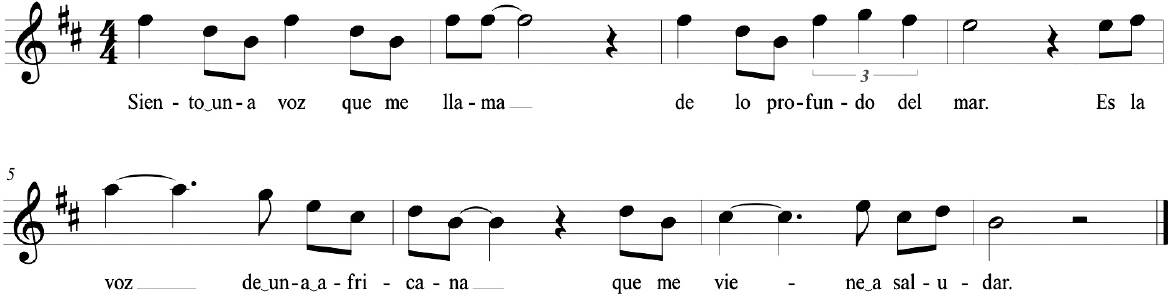
“Mamá Francisca” is a song about the symbiosis between spiritual and amniotic waters. It begins with the description of a feeling, a presentment of the sound of a voice that manifests mutually from the bottom of the oceanFootnote 17 and deep within a medium’s consciousness. The melody resonates emotively with yearning (see Fig. 1). In a parallel search, mothers and children call out for each other in hopes of reaching a point of connection: “Cuando una madre llama a sus hijos. . . Cuando los hijos llaman a su madre.” The mothers in the verses are Afro-Cuban manifestations of Black Atlantic feminine divinities: Mamá Francisca, La Virgen de Regla, and Yemayá. The mediums seek to reach their watery realms through spiritual work, and through the persistent call, “te estoy llamando, ay Dios,” that mimics the rhythm of a crying child, as well as the pattern of breaking waves. As such, the voices in the song’s text and performance illustrate how spiritual and aquatic currents are intimately linked in modes of navigation and in their source: “Corre el agua, corre el agua, corre el agua, Yemayá. . . Corre el agua, corre el agua, con tu correntie espiritual.” The repeating of the words, “corre el agua,” emanates a sonic pattern that conjures Yemayá’s energy, and allows for a sympathetic rhythm and flow of energy running through our bodies in performing the song. The physicality of this work comes to light as both the mediums and Yemayá are asked to remar, to row repeatedly through the spiritual and watery domains that are produced in the ritual labor, work of the misa.
Musical Notation of “Mamá Francisca.” Courtesy of Robin Moore, used with permission.Footnote 18

Fig. 1: Long description
The image displays a musical notation of the song Mam Francisca. The notation is written in the treble clef and includes lyrics in Spanish. The lyrics are divided into two lines, with the first line reading 'Sien-to-un-a voz que me lla-ma de lo pro-fun-do del mar. Es la' and the second line reading 'voz de-un-a-a fri-ca-na que me vie-ne a sal-u-dar.' The notation includes various musical symbols such as quarter notes, eighth notes, and rests, indicating the rhythm and timing of the song.
Mamá Francisca is a spirit guide often associated with communicating with the dead in Afro-Cuban Espiritismo.Footnote 19 She may also be referred to as “Francisca Siete Sayas,” (Francisca of the Seven Skirts), which deepens her connection to the seven seas and to Yemayá. Her manifestation in the song suggests an intimacy with longing, with the ways in which Afro-Atlantic communities find modes of interaction with ancestors, even in the face of the loss of proper burials at sea that is the context of unritual for many who perished during slavery.Footnote 20 The misa’s participants call on Mamá Francisca as an orienting maternal energy who can be named as an opening. Since she adeptly navigates the spaces between religious registers, calling out first to Mamá Francisca in the song, who does not answer right away, creates a conduit for the mediums to move towards Yemayá’s spiritual current in the ocean. The phrase, “reina Africana te estoy llamando,” can refer to either Mamá Francisca or to Yemayá as honorific markers that, like oriki, can name beings into manifestation through praise. Further, another layer of celestial and oceanic royalty is invoked in calling for everyone to row because, “La Virgen nos va a acompañar.” This is an appeal to La Virgen de Regla (Our Lady of Regla), the Afro-Cuban Marian entity whose chapel is found on the island of Regla and is associated with a long history of shared devotional congregations of worshippers with Yemayá.Footnote 21 The song’s movement, like rowing, creates an energy where those gathered sonically swim through the spiritual currents of the seaside worlds of the dead and divinity.
As I have discussed elsewhere, the transmigration of souls through time and materiality in Espiritismo occurs through a kind of transphysical poetics that allows for multiple kinds of entities to journey together, almost as palimpsests, to reach the living in rituals like the misa.Footnote 22 In the song’s end that acts as a crescendo, “rema, pero rema, mi Yemayá,” there is an imploration for all to row, even or maybe especially Yemayá, so that the community can become one in the flesh, in communication, in healing. This mutual movement through ancestral waters is tied to Yoruba concepts of journeying, iranjo, as foundational to many kinds of becoming and to the acquisition of knowledge.Footnote 23 In asking Yemayá to be a participant in the aquatic journey that is the spiritual work at hand, espiritistas are creating conjoined waterly bodies made of voice and movement that allow for the vibration of the spiritual current to move through them. This “corriente espiritual” (spiritual current), like any vast body of water, holds countercurrents, whirlpools, and undertows that can contain Mamá Francisca, Yemayá, and La Virgen de Regla at specific touchpoints. As with the creation of cartographies of the ocean, sound and motion are vital to locating destinations with any kind of accuracy. Thus, the song “Mamá Francisca” allows for espiritistas to participate in contemplating, searching for, and finding their dead in ways that reaffirm Black indigenous knowledges of becoming and place-making. In performing the song, then, Cuban espiritistas create potent routes of connection that commemorate Afrolatine knowledges, experiences, and memory.
There are a variety of African-inspired cosmologies at play in how Afro-Cuban espiritistas conceive of and experience spiritual sojourns to the watery, metaphysical realms where the dead reside. Ras Michael Brown offers an important characterization of Kongolese spiritual cartographies that are foundational to Black hemispheric ritual work in the Americas. In describing the mountains that connect the worlds of the living and the dead, he writes: “The two mountains connect at a shared base resembling mirrored image, as the two realms of the land of the living and the land of the dead, and forming complementary inversions of each other. The journey from one to the other requires passage through the water (n’langu, m’bu, or kalunga), which serves as both a window or door and a great barrier between the two lands.”Footnote 24 It is significant that Brown elucidates an understanding of sacred Kongo topographies centered upon an environmental ecology. The mountains of differential existence are submerged in the waters of kalunga and create mirrored dimensions that one must swim through as a portal.Footnote 25 As in the song, “Mamá Francisca,” these waters resemble amniotic fluid in its density, and in its ability to sustain being and becoming between births. The births I refer to here are transitional modes of existence between life and death that operate in cyclical rhythms, like waves or sunrises and sunsets. Indeed, Brown describes these movements as celestial patterns, and finds that the path through kalunga, “establishes connections between the realms of the living and the dead and represents processes of transformation.”Footnote 26 Thus, access to these different worlds is mutually achieved through the interaction of the living and the dead. As such, practitioners of Kongo-inspired religions in the Americas, like paleros in Cuba, understand and perform these transformations in ways that are carefully constructed, thoroughly mapped out, and with clearly marked consent from the dead.Footnote 27 And, like the singing of “Mamá Francisca,” other kinds of ritual work with the dead in Afro-Cuban religions require swimming through their waters using deliberate yet fluid gestures.
Intuitive registers of communication provide significant ways of navigating the worlds between the living and the dead, as in the song verse “siento una voz que me llama” (I feel a voice calling me). Muertero/as are spiritual workers that specialize in cultivating the multiple ways in which intuition and perception can be honed through work with the dead. Whether trained as espiritistas, paleros, and/or santeros, individuals are recognized as muerteros by a spiritual community through the dead’s emergence in multiple forms of ritual practice, including dilogun and Ifa divination, as well as bodily cohabitation, dreamwork, and knowledge acquired through interaction with plants and animals.Footnote 28 Muerteros offer valuable connections to the portals of transformation described above by Brown by creating kinships with the dead that allow them to perform necessary rites that precede divinations, offerings, and initiations.
Scholar and creative writer Lydia Cabrera discusses and interacts with Afro-Cuban religious practices of transformation in many of her works.Footnote 29 In her studies of Palo traditions from the La Regla Kimbisa del Buen Viaje in 1959, she comments on how supernatural beings and practitioners work together to speak to and through one another using “la inspiración.” She writes,
La “inspiración” o toma de posesión por un Santo o por una Nganga del Padre o Mayordomo o de otro miembro del Templo, es el medio de comunicación más directo que existe entre los seres sobrenaturales y los hombres que acuden a ellos. Por boca del médium el Santo habla, pronostica, amonesta; los instruye, e indica en ocasiones y dirige el “trabajo” que cada caso es necesario realizar para auxiliarlos o salvarlos: se le mete un crucifijo en la boca para que hable.Footnote 30
“Inspiration” or possession by a priest’s or Mayodermo’s, or another temple member’s Saint or Nganga, is the most direct mode of communication that exists between supernatural beings and the humans that they come to. It is through the medium’s mouth that the Saint speaks, prognosticates, admonishes; they instruct, and on occasions indicate and direct the “work” that needs to be realized to help or save them on a case-by-case basis: a crucifix is placed in their mouths so that they speak.
Inspiration here is closely tied to the embodiment of an entity by a priest or a member of the community at a Palo temple. That is, the transmutations in the experience of the self physically and psychically occur in both a communal and specified manner that grows out of the ability to hear, hold, and carry the dead. In this example provided by Cabrera, the locus of the mouth and the formation of words create the routes that allow for Brown’s transformational portals through kalunga to manifest. The manifestation in the flesh of the dead and/or a saint is a resource for healing, for acquiring knowledge, and for battling against negative forces directed at a religious family.
Practitioners of Espiritismo, Santería, and Palo, though culturally and ritualistically unique in most contexts, share an analogous relationship with the dead by making space in their bodies and homes to commune with them and expand notions of subjectivity beyond the human form. For santeros, espiritistas and paleros, this intimate cohabitation is supported by a community that has developed meticulous ritual procedures for tending the assemblages that make up the dead and the living.Footnote 31 Inspiration of the kind Cabrera is describing above is central to constructing and navigating sites of encounter that are open yet protected. For example, ngangas,Footnote 32 bóvedas (spiritists’ tables), and altars for egun are orienting and oriented assemblages of beings, of natural and prepared objects that heal and guide precisely because they facilitate the flow of the currents that connect life and death. As intoned in the verse, “corre el agua, corre el agua,” spiritual energy runs through these prepared spaces very much like a waterfall, river, or sea. Due to this fluidity and motion, the navigation of inspired territories relies on intention and a considerable knowledge of the potentialities of intertextual and inter-corporeal work with Yoruba, Kongolese, and Afro-Catholic symbolism in Afro-Cuban rites that resourcefully connect a variety of entities.
As an example of the kinds of cultural and metaphysical openings and crossings I am referring to, I return to Cabrera’s example of the placement of the crucifix in the mouth of the kimbesero getting ready to speak with the muerto’s voice. The use of the cross re-tools African, European, Latin American, and Caribbean symbols of the crossroads and other axis mundi, as Kimbisa Paleros are known for their robust creolization of culturally diverse imagery in their ritual practices.Footnote 33 Add to this observation that the dead and saints are conjured in polysemous environments in Afro-Cuban rituals of spirit mediumship, which includes the song “Mamá Francisca” previously discussed. Thus, the placement of a crucifix or the manifestation of a Black Marian figure, like La Virgen de Regla, can operate within a range of significations that allow practitioners to navigate what may seem to be disparate spiritual worlds into a confluence of associations.Footnote 34
As Cabrera asserts above, the crucifix is placed en la boca, in the mouth of a medium so that they may speak. The mouth thus becomes a portal between the living and the dead, an opening to communication through kalunga. This vital meeting point is fleshed out when the tongue and the crucifix connect and effectively construct the crossroads, a central framework for accessing different worlds in African and African diasporic contexts. The mouth here is simultaneously the site of ingestion of the body of Christ as in Catholic communion, and the source of the sound and breath that heals through utterances offered by the dead and other entities. Therefore, the placement of the crucifix in the mouth during Cabrera’s depiction of inspired mediumship in Cuban Palo reconfigures the notion of communion through the very image of life and death represented by the crucifix and the crossroads.
Speaking between worlds requires a script and a path, and the cross’s design allows for the activation of such words from the weight of its European, Indigenous, and African significations. In this manner, the power to move between the worlds of life and death does not operate within a binary paradigm rife with “good” and “evil” energies. Rather, the key to mobility in liminal spheres is cultivating the ability to sit, be, and become at the crossroads. Such work is understood as an artful mechanism that can be operated through meticulous preparation. For example, rituals for entities of the crossroads—like Lucero, Tata Legua, Eshu, Elegba, and Papa Legba in Palo, Lukumí, and Vodou traditions—offer excellent opportunities for developing skills for moving between kinds of space, time, and consciousness.Footnote 35 As such, we encounter repeatedly dikenga, the Kongolese four cardinal points sometimes encompassed with a circle that signifies a connection with Nzambi (God) as a vital touchpoint in sacred landscapes, objects, and writing.Footnote 36 In practices where the location of a cross signals a three or four dimensional sphere of activity, directionality takes on specific purposes and qualities that are not unlike other forms of tracking that can be condensed, referred to, and rearticulated. As Ras Michael Brown observes, the cross is a “core design in Kongo iconography,”Footnote 37 because of how it maps the cardinal points for the lands and waters connecting the living and the dead, and as such, become a map to worlding. Further, he ties these apexes to moments of encounter and development in the worlds of the living and the dead that I argue are marked by rituals like the misa and co-produced by the singing of songs like “Mamá Francisca.”Footnote 38
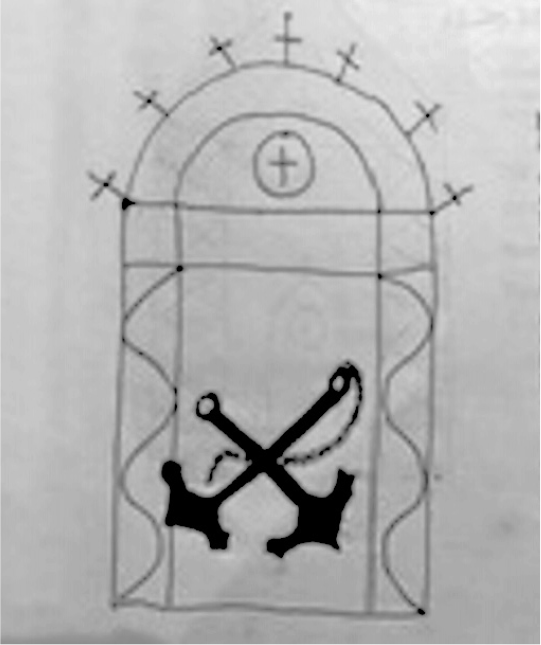
Firmas, or signatures drawn by practitioners of Cuban Palo, are maps that locate and vivify Africana presences in hemispheric contexts. These figures can be drawn in chalk, gunpowder, or corn meal in various spaces and objects (like the ground or on the back of a mirror) and can be displayed publicly or secretly kept among a spiritual household (see Figs. 2 and 3). Their goal is to evoke an assemblage of natural and supernatural forces through their very design. Firmas often place Christian characters into African ritual worlds by transforming their iconography into a unique form of communication open mainly to practitioners of Palo. By including symbolism, like crosses, and by naming Catholic entities as the energy fueling the design, firmas affirm an African-inspired orientation towards the representation of Cuban saints. Consider the firma for Baluande-La Virgen de Regla (Our Lady of Regla) which illustrates a confluence of Kongo and Catholic symbolism (see Fig. 2). This firma is found in a libreta in Cabrera’s archival collection of fieldnotes from her work with paleros in Cuba.Footnote 39 The notebook where it appears consists of a collection of designs that describe Palo entities, songs, and associated herbal remedies from the 1940’s. The libreta’s encyclopedia-like framing of detailed quotidian and eclectic information is a common trait of Afro-Cuban religious practitioners’ notebooks, as well as Cabrera’s oeuvre. As will be discussed, information found in libretas can often be reproduced for educational and healing purposes within spiritual households.Footnote 40
“Firma for Maluande (Baluande) Virgen de Regla.” The Lydia Cabrera Papers, Cuban Heritage Collection, Courtesy of the University of Miami Libraries, Coral Gables, Florida.

Fig. 2: Long description
The icon features a stylized window with an arch at the top. The arch is adorned with small crosses. Inside the window, there are two large anchors crossed over each other. The design is simple and uses basic geometric shapes.
“Kalunga.” Excerpt of a Libreta de Palo from Havana, Cuba. Photo by the author, in personal collection of the author.

Fig. 3: Long description
The image shows a handwritten note with the text 'KALUNGA (MAR)' prominently displayed. An arrow points to a drawing above the text, which appears to be a zigzag line with a curved end. The note is written on a piece of paper with visible creases and slight discoloration.
The firma constitutes a conglomeration of the Palo deity of the ocean, Baluande, and La Virgen de Regla, a Black Madonna whose temple resides in the municipality of Regla across the Bay of Havana. The intersection of these two figures through the elements of water and death are represented visually. In the image, we see an arch-shaped structure resembling a sepulcher with elaborate borders that is crowned by seven crosses. The crosses, as discussed, hold deep meanings in both Kongo and Christian symbolism and ritual associated with death and sacrifice. The seven crosses are indicative of an association with the seven seas, as well as for the number seven attributed to the entities Baluande, La Virgen de Regla, Madre de Agua (another Kongo-inspired water deity), and the Yoruba deity of the ocean, Yemayá.Footnote 41 The encircled cross at the top center of the arch locates a crossroads that is indicative of Lucero and/or Papa Legba, Afro-Atlantic deities of the crossroads. The two anchors in the center of the firma refer to maritime symbolism, specifically to implements that are put into containers that house Cuban entities, like Yemayá and Madre de Agua, associated with the sea. Finally, the connection to water is elaborated upon by the curved lines adorning the vertical columns of the design, as these express Kongolese-inspired marks that indicate the element of water, especially the ocean, and the ambient dead in firmas in general, and in prendas, or vessels that hold these oceanic maternal entities, in particular.Footnote 42 The proxemics of the symbolic elements in the firma illustrate a worlding where the dead in the sea emerge and can be called upon as a specific configuration of presences to do ritual work. Part of this work is to sharpen practitioners’ sense of the connections between the ocean and land through a contemplation on the materiality of the body as a recycled and holistic presence on this planet.
Contemplations of firmas suggest a recalibration in how to understand the atmosphere in which one moves and breathes. For example, a comparison of the wavy lines that mark the movement of water in the “Baluande-La Virgen de Regla” signature to contemporary Palo signs illustrates a further connection between the ocean and the ambient dead, kalunga. The design of the firma works well as a spatial reference to Regla, a barrio reached mainly through a ferry ride across the Bay of Havana. Once one gets off the boat, the main road takes one to the Virgen de Regla’s shrine which sits upon a hill. Afro-Cuban legacies that celebrate maritime deities like Madre de Agua and Yemayá in ritual work, dance, and sacred art have deep roots in Regla’s community.Footnote 43 The church, thus, like La Virgen de Regla, can serve as a point of orientation that can lead to other kinds of Afro-Cuban spiritual work.
It is at this juncture that I want to return to Tata Riguito’s gift of a libreta. Libretas serve as important vehicles for passing on Afro-Cuban religious knowledge of ritual and divination, and provide opportunities to recognize what Martin Tsang calls, “[the] under-studied traditions of Afro-Cuban practitioners writing their own religious and cultural histories.”Footnote 44 Riguito’s libreta contains multiple firmas which are elaborate and complicated, as well as pages full of glossaries for smaller fragments of signs that convey meanings, actions, and intentions. The following analysis of the firma for “kalunga” is of one of these stand-alone fragments. Like any major work dealing with Afro-Cuban spiritual traditions, the cross-referencing of entities and symbols is copious in the notebook.Footnote 45
Upon consultation with Riguito, I received confirmation that I could share aspects of the libreta and the following firma for the purposes of my research.Footnote 46 It is bittersweet to think about how Riguito’s generosity is playing a role in this very work that illustrates how pain is central to learning with love. This commentary on ethnographic encounters of gain and loss shows the profoundly relational nature of knowledge, as well as how its preservation is enforced by a perpetual regime of presentation and omission represented by the cycles of life and death.
This design shows a wavy line with an arrow pointing in a downwards arc encircling a crescent moon with the words “KALUNGA (MAR)” in KiKongo and Spanish written next to it. The snippet of signs and words create an efficient and dense conglomeration of meanings. The spaces between their significations indicate movements in multiple epistemic, cultural, and linguistic directions. One possible interpretation is that the energized arrow indicates the protection given to godchildren by the dead who dwell in ngangas, and that the crescent moon represents situations of importance like initiations.Footnote 47
The phrasing “KALUNGA (MAR)” supports an interpretation of how the amalgam of the firma works to create a specific religio-cultural location where an expression of Kongolese density is anchoring the Spanish translation that is rendered in a parenthesis. Here, I am thinking of density in conversation with how Édouard Glissant understands the term, as a measure of the weight of poetics to consolidate cultural forms.Footnote 48 Indeed, the firma for kalunga acts as a graphic iteration of the poetics of relation, that upon its re-rendering in ritual, operates as a “relation that is a product that in turn produces.”Footnote 49 As the ambient dead and the ocean, kalunga is in a constant state of regeneration and remaking in spiritual, cultural, and material ways. The firma’s reproducibility and portability, through the distribution of libretas and in the enactment of rites, allows for the presence of a Kongo-inspired field of knowing that creates opportunities for remaking the world in profound ways. By rendering the sea of the dead as a central, dense context for experience, paleros and espiritistas recalibrate certain foundations of power. For if life is a transitional and relational form of existence, then social and political dilemmas can and should be addressed in contiguous worlds. Violence and physical erasure are no longer considered the ultimate forms of dominance nor necessarily the most effective modes of affecting change in the world.
The Kikongo word “kalunga” takes prominence over the Spanish word “(mar)”—especially if we read them from left to right and see the parenthetical notation as constitutive of the primary term being offered to explain the firma. That is, the understanding of kalunga has as an accepted valence of the sea embedded in it, and this assists in the unpacking of both the firma and the concept of the ambient dead. Adding to this symbolic relationality is the belief that kalunga acts as an oceanic atmospheric element. Ochoa affirms this correlation when he observes, “this is a distinctly central African motif. . . the realm of the dead residing in the depths of Kalunga, the sea, for BaKongo people.”Footnote 50 Thus, kalunga is a seascape of spirits that can be referred to and invoked through signs as designs and words, as well as ritual acts that include the drawing and writing involved in inscribing firmas.
Due to the qualities of these confluences, it would be a mistake to read solely on a horizontal and linear basis the above firma. The multiple scripts and languages reflected also provide opportunities to read back and forth and between the lines in terms of cultural, spiritual, and linguistic code-switching in Afro-Cuban contexts where kalunga manifests. In doing so, the space where the specificities of and connections between individual signs also can be navigated with a fluidity that resembles kalunga’s own sea of associative currents. This firma from Riguito, now an ancestor himself, shows that the dead are (of course) the sea, and are the very substance of presence in matters of becoming in artistic rendition, scholarship, and in ritual work.Footnote 51 As I discuss below, this powerful association that links atmosphere to ancestor is also marked across Afro-Cuban ethnic lines and spiritual traditions in how the oricha Yemayá Asesu works with the dead in the ocean.
The porous nature of work with the dead in Afro-Cuban religions affects how distinct practices cannot be completely policed.Footnote 52 It is not rare in Santería divination rituals like dilogun (cowrie shell) readings, Espiritista misas, as well as in the Kimbisa Palo ceremonies alluded to above, for ancestors to appear in ethnic and religious crossings.Footnote 53 The dead thus become enmeshed in all aspects of ritual work because they can move between the cracks of human taxonomies of spiritual systems through the ether (we can call it kalunga), and in doing so they signify the suppleness found in the relationship between materiality and presence, the proximities present in being and becoming. No other element demonstrates this more clearly than water, especially the ocean, whose very essence retains history and mystery in ways that are ungovernable by human beings.
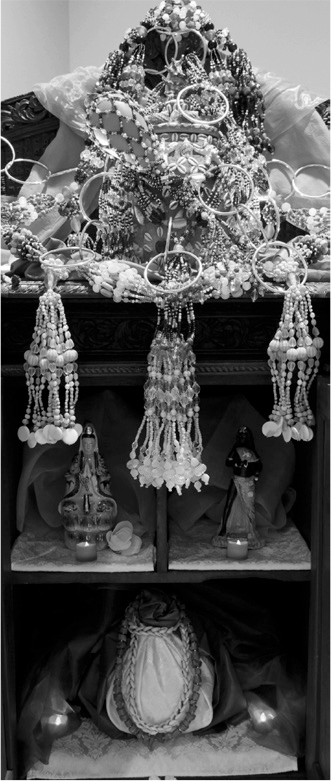
One way to navigate the waters where the dead and divinities reside is through creative activities like beading and altar-making. Afro-Cuban bodily practices that produce art in honor of seascapes do so by creating topographies of encounter through textures of touch. Thus, the spatial dimension of proximity in ritual and artistic work is an important way to understand how humans, deities, saints, and the dead comingle and for what ends. Following Kristina Wirtz, then, the scopic registers that organize and create routes of activation between different kinds of Afrolatine entities on sites like altars, spirit tables, and the shore communicate a complex technology of conjure.Footnote 54 Take, for example, how the sacred art made for a Yemayá altar (see Fig. 4) creates specific conduits to the sea entity’s energy through an aesthetic and affective orientation of beadwork, shells, metal, wood, and cloth.
Detail of Altar for Yemayá, Olokun, and Egun, created by Martin Tsang and Alexander Fernández. Photo by Charles Exdell, in the personal collection of the author.

Fig. 4: Long description
The altar is adorned with elaborate beading and various decorative items, creating a rich texture of touch. It includes multiple tiers with hanging bead curtains and ornate centerpieces. The lower section features a large, beaded pouch and other ritualistic objects. The overall design reflects a deep cultural and spiritual significance, honoring the deities and the spirits of the ancestors.
Altar for Yemayá, Olokun, and Egun was created by scholars-priests Martin Tsang and Alexander Fernández to express an aesthetics of oceanic deities and the dead.Footnote 55 It was mounted on the feast day of Our Lady of Regla, 8 September 2023, and was commissioned by the Latino Studies Program at Indiana University, Bloomington for educational purposes. Tsang beaded the mazos, the elaborate, thick necklaces that adorn Yemayá, who is encased in a blue tinaja (vessel) covered with shells at the top of the cabinet. Waves of light blue cloth of different hues and textures, one satin and one lace, create the backdrop for her to float upon.Footnote 56 A maraca enveloped in dark blue and white beads, and accented with red ones, lays across the oricha. The design of the beads that fall upon the tinaja indicates roads or avatars of Yemayá with their distinct color coding. The beaded roads respective placement next to each other creates the sensation of flow from one kind of Yemayá to another, illustrating the multiple nature of subjectivity for deities in ways that also mirror conceptions of the dividual self for humans and for the dead in Espiritismo.Footnote 57
In the photo, the vibrant mazo that is layered onto the tinaja serves as an artistic manifestation of the seven roads of Yemayá. These roads for Yemayá are referred to as ibús in Santería, which translates to “a large expanse of water” in Yoruba.Footnote 58 This makes sense as each beaded road carries a vast array of semiotic, narrative, and aesthetic markers that encompass a specific kind of oceanic expanse that is Yemayá. Essentially, the mazo illustrates that there are many kinds of sea ecologies that can be generated into being through condensation, which is connected to Glissant’s understanding of “the reflected density of existences” in the poetics of relation.Footnote 59 By elaborating on the multiple existences of Yemayá through colors, beads, and shells, Tsang is illustrating how revelation and opacity can simultaneously generate slippery forms of becoming. As he explains,
The ibús chosen for the mazo are a reflection of the actions and fluid representations of Yemayá. The seven Yemayás are represented in the mazo in the following order: Ibú Okoto, Ibú Agana, Ibú Okuti, Ibú Ashaba, Ibú Mayelewu, Ibú Asesu, and Ibú Konlá. I designed the mazo so as to reflect the transition from the deepest-hued Yemayá of Okoto, which takes an almost black-blue color, to Ibú Konlá, who takes the lightest shades of white and jabón or “soapy water” colored beads. Ibú Konlá represents the seafoam. . . and calm waters at the shore. There is an oriki that Pierre Verger recorded in one of his books that speaks of Yemoja as “sipping effervescence” and that has stuck with me ever since.Footnote 60 It reminds me of Konlá. At the other end of the spectrum, Ibú Okoto, is often called the underwater assassin, the red in her mazo represents the eponymous okoto shell which is bright red. Okoto shells can wash up in great numbers on the shore, and when that happens, it looks like the sand is drenched in blood.Footnote 61
Tsang’s rich statement on his creative process fleshes out the different Yemayás that the patterning of the mazo creates, inspires, and communicates. The making of a mazo that includes more than one road of an oricha is unusual, and this innovation is a physical example of the “relational sacred” that Valérie Loichot finds in Glissant’s understanding of the interactions between poetics, nature, and African diasporic cultures in the Caribbean.Footnote 62 Sacred relational art, like the mazo and the altar for Yemayá, create epistemological routes towards witnessing, testifying, and social action. It is important that multiple ways of knowing Yemayá—like narrative, text, and divination—are revived through the mazo in Tsang’s description. All these enactments provide modalities of community work that rely on enmeshment and variability that are also seen in the signing of “Mamá Francisa” and the conjuring of the firmas of “Baluande-La Virgen de Regla” and “Kalunga.” As such, performing multiple subjectivities through work that co-produces orichas, saints, and the dead become defiant acts not because they are reacting to colonial taxonomies, but because these transfigurations blatantly exist in such an expansive symbolic realm, like an ibú or ocean, that the flattening of their ontological potential is impossible.
It is worth wading further into the details of Tsang’s depiction of the multidimensional Yemayá. He connects the roads of Ibú Konla and Ibú Okoto, whose aquatic attributes range from peaceful to warlike, in a continuum that allows for an array of expressions of Yemayá. The colors and patterns in the mazo are linked to the affective vibrations of certain traits, and this creates openings for interpretative work by the viewer. Whether it be through narrative or haptic recognition, the ibús of Yemayá in the mazo materially generates potent epistemologies for the community engaged with its presence.Footnote 63 Tsang notes how beads colored like “soapy water” create a portal to sensing Ibú Konla’s acts of effervescent care, while Ibú Okoto’s bright red okoto shells recall a bloody beach painted by this “underwater assassin.” These two flow into each other and through the other Yemayás beaded into the mazo to illustrate a larger pattern of natural and supernatural geographies that allow for re-existence through cyclical re-making.Footnote 64 Here, I understand re-existence to encompass modes of becoming that include more-than-human agents whose collective boundaries resemble the shores in their moveability, but whose recognizability, like the patterns in Yemaya’s mazo, are undeniable to those who can see them.
The mazo’s sacred relationality situates Yemayá in an “ecological solidarity”Footnote 65 with oceanic ecospheres. For example, Alexander Fernández, the co-designer of the altar and the mazo, notes how the caminos (roads) of Yemayá illustrate the variability of seascapes on our planet. He comments that, “Each camino represents a different geological encounter/era with the sea, and some Yemayás are directly connected to specific oceans. The layout and design of a mazo—color schemes, numerical patterns, strands—all play into a weaving of divine interactions between the creative mind and ritual knowledge.”Footnote 66 Fernández offers that specific oceans are linked to the different roads of Yemayá beaded onto the mazo. A cartography is thus mapped out onto the strands that can be physically and directionally referenced. This mode of orientation towards the environment is not unlike Brown’s own discussion of kalunga that resemble the natural modalities that govern this supernatural seascape. In Fernández’s estimation, creativity, temporality, and place come together in the mazo as points of encounter that can chart plural oceans and the Yemayás present in them.
In providing these touchpoints, art like Altar for Yemayá becomes a call to action, one where the divinities and the dead offer routes to existence and social action that counteract violence and heal trauma in an ecological solidarity.Footnote 67 As music scholar Titus Olusegun observes about popular music and ritual activity made for YemojaFootnote 68 in Nigeria, “worship of Yemoja shows how, if one cares about the deity, one must also care about the environment.”Footnote 69 Speaking about flooding and climate change in Ibadan, Olusegun makes it clear that care-based and ecologically-based activity, like cleaning waterways, fulfills sacred and social obligations. As such, water is at the heart of how one engages with life and death, especially in terms of the character of action and inaction regarding historical and environmental catastrophes, like slavery.Footnote 70
The ocean carries a heavy burden in terms of processing human-made pollution,Footnote 71 as well as birthing and sustaining ecosystems that display variant and vibrant forms of existence. In the very physicality of the Atlantic Ocean lie many kinds of Africana dead, among other kinds of ancestors, whose forms transmit material evidence of removal, torture, and defiance. The ocean, thus, as a conglomeration of living, dead, natural, and toxic substances, creates opportunities for contemplating co-habitation expansively. In terms of thinking with Afro-Cuban traditional religions that mark the sea of the dead as the ocean, the material remains that mark the affliction and loss due to slavery and colonialism becomes a poignant flash point for marking a history that cannot be erased due to death, destruction, and burial. The resurgence of the dead through biological and chemical transformations that signal a view of existence that is expansive, more-than-human, and ongoing illustrates an important distinction as to understanding the end results of destruction.
A major presence that accompanies Yemayá is Olokun, the Yoruba deity of the deep waters. In Cuba, he is a primordial entity associated with egun, the dead, and holds a prominent place for keeping the secrets and mysteries of the deep.Footnote 72 Many of the Yemayás I have been discussing hold unique relationships with Olokun.Footnote 73 And, as elemental points of engagements, recognition of both water and the egun open efficacious and volatile portals, as with the singing of “Mamá Francisca” in the misa, with which to encounter orichas and other dead. Further, it is no accident that the roads of orichas who work directly with the dead, like Yemayá Asesu and Olokun, are also described in terms that emphasize their potency in relation to ecological life cycles beyond the human. In doing so, these entities cross spiritual and natural terrains in ways that create troubling yet healing ashe, or vital force. The ashe of the waterways serves as an elemental energy of recognition and re-materialization that can be disconcerting yet provides a polyvocal and cross-fertilized Black Atlantic resonant arc of knowing.
Thinking through the avatar of Yemayá Asesu affords opportunities to more specifically contemplate the materiality and the ephemerality of the sea, life, and death. Cabrera describes her in this way:
Yemayá Asesu: mensajera de Olokun, el agua turbia, sucia. Muy seria. Va al caño, a las letrinas y cloacas. Come pato. Recibe las ofrendas en compañía de los Muertos.Footnote 74
Yemayá Asesu: messenger of Olokun, [the] cloudy waters, dirty. She is very serious. She goes to the spouts, the latrines, and the sewers. She eats duck. She receives her offerings in the company of the Dead.
Yemayá Asesu is thus situated in spaces where the waters are murky, where waste is deposited, where remains of the deceased are found. Sharing her offerings in the company of the dead crosses supernatural boundaries of cleanliness and illustrates her comfort with inhabiting borderlands when it comes to different kinds of entities. She is an orisha of “a different kind of sweetness,” one tinged with the sweet and sour aspect of her favorite offering, that of melao, molasses, a by-product of sugar production and Black labor.Footnote 75 As Asesu, Yemayá acts as, “the queen of the dead and aids Olokun in transitioning the souls of the departed from heaven to the bottom of the sea.”Footnote 76 Thus, her realms also include the bottom of the ocean, a dark and mysterious place where she presides over transformation of the dead in their afterlives. Her intimacy with the dead, in terms of proximity and in terms of consumption, makes her a formidable manifestation of Yemayá. This road of the orisha reminds one of the necessary and inevitable transmutations of life into other forms of energy and matter.
The materiality of Yemayá Asesu has another, effervescent side, sea foam. Sea foam is a phenomenon that has a fleeting yet pointed affective presence when it appears. The sounds of sea foam from a breaking wave sizzle in the ear. Cool droplets of moisture kiss the skin as the foam evaporates. The white, bubbly fizz fades into the air as the water recedes. The smell of salt and the essence of water are felt in the back of the throat, and eyes may sting, and ears may ring. These sensations of witnessing sea foam illustrate that the transmutations of elements from one form to another are fundamentally felt. The experience is very much like the refrain, “siento una voz que me llama de lo profundo del mar.” Through the sea foam, Yemayá Asesu can bring Olokun’s deep oceanic presence to the shore and into the air.Footnote 77 Thus, the contemplation of sea foam illustrates how what seems hidden leaves palpable spiritual and ecological traces that are rooted in cultural and historical realities.Footnote 78
Thinking about the ways in which natural sites bear witness allows us to attend to material remains within those ecologies. As Yemayá Asesu’s attributes of transfiguration through sea foam suggests, we can begin to understand multiple kinds of materiality and spirituality as present in the environment. As Sharpe observes about the ocean in relation to Black bodies lost at sea,
The amount of time it takes for a substance to enter the ocean and then leave the ocean is called residence time. Human blood is salty, and sodium, Gardulski tells me, has a residence time of 260 million years. And what happens to the energy that is produced in the waters? It continues cycling like atoms in residence time. We, Black people, exist in the residence time of the wake.Footnote 79
The temporality of “residence time” evokes an everlasting presence, one where Sharpe quotes Toni Morrison to illustrate that in the wake, “everything is now.”Footnote 80 The ways in which remains of the dead can travel and enter bodies are thus varied and lasting. Residence time here generates legacies of spiritual troubling that are imbibed perpetually. Sea foam here meets kalunga, and thus the dead maintain opaque origins and expansive trajectories in their interactions with the living. The songs, altars, and firmas discussed in this article condense oceanic elements that can also be understood as invitations, openings for considering a defiant kind of world-making through transformed presences. Black presences supposed erasure created conditions for empire, yet they are called upon and are reanimated in creative work that teaches through density. As kinds of embodied art, songs, firmas, and altars can spiritually locate remains at sea and serve as methodologies to co-activating African and African diasporic afterlives. The search for connection is difficult, as is my own desire to hold Riguito’s memory close, as the effects of loss, mourning, and suffering become transformed into palpable exchanges that include the water one imbibes and the air one breathes.
Yemayá Asesu’s tending to the dead is connected to the restorative potentials of interacting with the oceanic figures of Mamá Francisca and Baluande-La Virgen de Regla. These entities work in the context of the transformation of the dead in spirit and matter within the spatial terrain of the sea where boundaries between material worlds are literally stretched, as Brown’s previous observation of kalunga reminds us. The ocean’s density, pressure and currents create unique conditions for life and death that are pronounced in their intimacy. Though different in name, these maternal sea figures work in analogous Afro-Cuban world-making rituals that engage with this space of becoming and unbecoming to speak of their children’s troubles, through the flow of water. For Yemayá is, “the regal matriarch: the sovereign mother, whose dignity transcends all human afflictions. . . in song, she is said to fashion her crown from the woes and tragedies of her children.”Footnote 81 This oricha’s crown of woes centers the historical reality of suffering and death among her children for generations to encounter. She also lets the waters run, to revive and refresh and transform all beings in life and death.
Yet, Yemayá’s dignity carries this past with a defiant presence that echoes Sharpe’s oceanic ambient dead. That is, the persistent materialities generated by the beading of mazos, the drawing of firmas, and the singing of plegarías complement Yemayá’s crown of tears to create unique openings as assemblages of associations that trouble tragedy through proximity. Such intimacy with the remains of the dead provokes recognition through an inhabitation of space, especially if that space is within the imagination—in the mind’s eye or in one’s ear—a realm where subjectivity is co-constructed and negotiated. In breathing in the dead, as Yemayá Asesu’s sea foam allows us to do, we ingest the very histories we are told to ignore.
The visual arts, stories, and performances I have been discussing are active ritual processes that engage in manifesting water worlds as seascapes. These sites are affectively constructed through the material interaction of the senses with sound, sight, and touch that in turn offer inspiration and model intention. These oceanic worlds where the dead, saints, and divinities reside are rife with a power that is conceived alongside ecological cycles and an articulation of human responsibilities towards the earth and each other. Thus, inspiration is a valuable mechanism whereby intention can be honed and manifested in social worlds that include humans, nature, and other beings. Inspiration and intention are interwoven into the processes of self-making and social accountability that appear in moments of cohabitation with the dead, divinity, and saints through art as ritual work. As such, these modalities illustrate how kin-making is a capacious practice that also includes connections to other life forms, time frames, and spatial orientation.
The manifestations of Mamá Francisca, Baluande-La Virgen de Regla, and Yemayá in this essay point us towards the morphogenic relationship between mediumship, sacred drawing, altar-building, and the persistent presences that are generated from them. By morphogenesis, I mean the process by which organic matter creates patterns and structures that influence the creation of cultural processes. In paying attention to how form, place, and subjectivities are vivified through cantos, firmas, and mazos, an understanding of the generative nature of tending to the dead is produced. The contexts of the horrors of transatlantic slavery and its afterlives put the Afrolatine, feminist nature of this work with the dead into historical and political focus.Footnote 82 As Sharpe reminds us, defending the dead is “to tend the Black dead and dying.”Footnote 83 In the ocean’s ecology, physical remains and spiritual practices make up the residual transcriptionsFootnote 84 that historically, culturally, and onto-politically show the entanglement of entities from diverse religious cultures. These beings offer unique examples of what wake work may look like materially and spiritually. Songs, firmas, and altars create vital axis of orientation that activate the dead and produce the presence of entities.Footnote 85 Reconfigured onto bodies, paper, and beads, these points of contact with seascapes are reproduceable.Footnote 86 In this manner, the dead through ritual and sacred art exude an “aliveness” that takes on “a quality of being, a term of habitat, a manner and aesthetic, a feeling—or many of them, circuits in an atmosphere. . . like breath.”Footnote 87 Air and water, mountains and sea—elemental domains to emerge from and return to—to witness, to toil, and to become.