1 Introduction: natural and unnatural phonology
Phonological interactions typically ‘make sense’ phonetically, meaning that there is a clearly discernible synchronic phonetic motivation behind them. Such interactions are generally called ‘natural’. One question which has occupied phonologists for many years is why there is a strong tendency for phonological processes to be natural. One common approach has been to appeal to what I will call the ‘diachronic model’ of phonology. This model posits that synchronic phonological alternations are most typically the result of sound changes in earlier stages of the language. Sound changes tend themselves to be phonetically motivated, because most of them originate from misperception of the acoustic signal and from errors due to the inherent physiological limitations of the human articulatory and perceptual systems. Since these explanations make direct reference to the nature of acoustics, articulation and perception, it follows that the resulting synchronic processes will be motivated by phonetic properties (see e.g. Ohala Reference Ohala1971, Reference Ohala1972, Reference Ohala1974). In this way, it is not necessary to appeal to ‘grammar’ in order to explain why natural processes are so common. As a result, most proponents of the diachronic model see no need to assign any special value to natural processes inside grammar itself (see e.g. Barnes Reference Barnes2006: 2).
Phonetically motivated sound changes do not, however, necessarily lead to synchronically natural interactions. As is particularly well known in the case of ‘telescoping’, a series of chronologically ordered natural sound changes sometimes happens to give an ‘unnatural’ alternation, i.e. one which lacks any synchronic phonetic motivation (Kenstowicz & Kisseberth Reference Kenstowicz and Kisseberth1977: 64f). Nor are synchronic alternations always the result of phonetically motivated sound changes, as they sometimes arise from factors such as morphophonological analogy and language contact. In these cases, too, then, the resulting alternation might be synchronically ‘unnatural’ (Buckley Reference Buckley2000, Garrett & Blevins Reference Garrett, Blevins, Hanson and Inkelas2009). What such unnatural processes have in common, however, is that they all have a discernible historical explanation. Within the diachronic model, the same applies to natural processes: they, too, have a discernible historical explanation. In sum, then, there is no principled distinction between natural and unnatural interactions in the diachronic model.
According to a very different approach, natural interactions are assumed to be favoured by the cognitive system. I will call this approach ‘naturalness theory’. In this theory, it is typically said that natural interactions are more ‘highly valued’ by the grammar (e.g. Schane Reference Schane1973: 115ff, Keating Reference Keating1985: 129), or that there is a ‘bias’ in favour of such interactions (e.g. Wilson Reference Wilson2006: 947), but it is often not clear or made explicit what this means in practice. According to a very strict interpretation of naturalness theory, unnatural processes simply cannot exist in a synchronic grammar. If they were to arise historically, they would lose productivity and become lexicalised or morphologised (Hooper Reference Hooper1976: 90, 133f). In other words, the grammar would by design be incapable of expressing or learning unnatural phonology. Another and perhaps more reasonable claim is that unnatural processes should be harder to learn than natural processes (e.g. Schane et al. Reference Schane, Tranel and Lane1974–75). If this were the case, we would expect unnatural interactions to be in a steady decline in languages across the world, since language learners should have difficulties acquiring them. Several phonologists have pointed out that no such tendency can be found (Buckley Reference Buckley2000: 24, Barnes Reference Barnes2006: 221). More importantly, the idea that unnatural interactions are harder to learn finds little support in the many learning experiments designed to test this (cf. Jusczyk et al. Reference Jusczyk, Smolensky, Arnold, Moreton, Houston, Seidl, Hollich, Johnson and Jusczyk2003, Pycha et al. Reference Pycha, Nowak, Shin and Shosted2003, Saffran & Thiessen Reference Saffran and Thiessen2003, Seidl & Buckley Reference Seidl and Buckley2005, Pycha et al. Reference Pycha, Shin and Shosted2006, Kuo Reference Kuo2009, Skoruppa & Peperkamp Reference Skoruppa and Peperkamp2011). Presumably for these reasons, another approach within naturalness theory has been to claim that unnatural processes are not necessarily harder to learn (Wilson Reference Wilson2006: 947). Instead, the difference between naturalness and unnaturalness is manifested primarily in the design of the grammar, such that natural processes are innate, whereas unnatural processes need to be learned (Donegan & Stampe Reference Donegan, Stampe and Dinnsen1979: 143f, Hayes Reference Hayes, Darnell, Moravcsik, Newmeyer, Noonan and Wheatley1999: 270).Footnote 1 One obvious problem with this approach is that two distinct mechanisms are posited for what is essentially one task – learning the phonology of the ambient language.Footnote 2
The diachronic model posits that synchronic alternations, whether they are natural or unnatural, look the way they do because of history, with no need for a ‘naturalness bias’. Naturalness theory, on the other hand, suggests that synchronically natural alternations exist primarily due to a cognitive bias for naturalness. In contrast, synchronically unnatural alternations are said to be caused by quirks of history (Donegan & Stampe Reference Donegan, Stampe and Dinnsen1979: 127f, Hayes Reference Hayes, Darnell, Moravcsik, Newmeyer, Noonan and Wheatley1999: 269, Kawahara Reference Kawahara2008). In this way, naturalness theory posits two distinct explanations for the origin of synchronic alternations. Taken together, there is a clear difference between the diachronic model and naturalness theory. The diachronic model claims that phonological alternations are the result of history, and need to be learned. Naturalness theory claims that phonologically natural alternations stem from an innate cognitive bias and need only be ‘internally induced’, whereas phonologically unnatural alternations are the result of history and need to be learned. Put differently, naturalness theory simply refers to the diachronic model in order to account for unnatural processes. A methodological issue that arises in this connection is that every time a diachronic account needs to be added to the naturalness theory in order to explain the presence of unnatural processes encountered in the data, the naturalness theory will look more and more like the diachronic model itself, in which no principled distinction is made between natural and unnatural processes (Mielke Reference Mielke2008: 6f). In short, adding diachronic accounts to the naturalness theory makes it look more like the diachronic model. Since there are no alternative ways of explaining unnatural phonology than with diachronic accounts, it has always been an important endeavour for supporters of the diachronic model to document unnatural processes in languages. The larger the number of such unnatural interactions there can be found in languages around the world, the stronger their argument against naturalness theory will be (for examples of such unnatural processes, see Blevins Reference Blevins2004: 67ff, Reference Blevins, Willems and Cuypere2008).
This paper continues this tradition by highlighting an unnatural process which has not been mentioned in this debate yet: Norwegian retroflexion. In Standard East Norwegian, an alveolar /ɾ/ causes a following alveolar /t d n s/ to become postalveolar, without any obvious source for the postalveolar articulation. In other dialects, the same change is triggered by a uvular /ʁ/, after which the change from an alveolar to a postalveolar seems even more mysterious.
Since unnatural processes need to be explained with reference to their historical origin, I adopt the diachronic model in accounting for the properties of Norwegian retroflexion that seem phonetically unmotivated from a synchronic perspective. A comparative and historical analysis shows that in Standard East Norwegian, alveolar /t d n s/ originally assimilated to the apical alveolar /ɾ/ to become apical alveolar [


 ], and assimilated to the apical postalveolar /ɽ/ to become apical postalveolar [ʈ ɖ ɳ ʂ]. Apical alveolar [] and apical postalveolar [ʈ ɖ ɳ ʂ] later merged as postalveolars. After this merger, alveolar /t d n s/ seemingly ‘assimilate’ to alveolar /ɾ/ to become postalveolar [ʈ ɖ ɳ ʂ].
In the Frogner dialect of Norwegian, the alveolar /ɾ/ underwent a sound change to uvular /ʁ/, but retroflexion nevertheless remained. The outcome of this change is that the alveolar /t d n s/ ‘assimilate’ to a uvular /ʁ/ to become postalveolar [ʈ ɖ ɳ ʂ]. Finally, the original non-retroflexing dialect of Arendal with uvular /ʁ/ has adopted the retroflexion process from neighbouring dialects, where retroflexion is triggered by /ɾ/, made possible by the consistent correspondence of /ʁ/ and /ɾ/ across these dialects. The result is that the Arendal dialect now exhibits a process in which the uvular /ʁ/ causes a following alveolar coronal to become postalveolar. In both the Frogner and Arendal dialects, no synchronic phonetic motivation exists for having a uvular /ʁ/ trigger postalveolarisation. In both cases, however, the process originates in the older retroflexion process triggered by /ɾ/, which still exists in Standard East Norwegian today.
This paper is organised as follows. §2 introduces retroflexion in Standard East Norwegian and shows that it has no synchronic articulatory motivation. §2.1 provides a diachronic account of this retroflexion process. §3 shows that there is a productive retroflexion process in the uvular /ʁ/-dialect of Frogner, and that this process, too, cannot be articulatorily motivated. §3.1 explains how this situation has arisen from historical changes in the phonology of this dialect. §4 demonstrates that retroflexion is active also in the uvular /ʁ/-dialect of Arendal, and §4.1 shows how it has emerged as a result of language contact. §5 argues that retroflexion in Norwegian cannot be analysed as a natural process with a perceptual motivation, and §6 argues against a proposal that retroflexion in Standard East Norwegian was unnatural from the outset (i.e. that it has not become unnatural as a result of later historical changes). §7 concludes the paper.
2 Retroflexion in Standard East Norwegian
Retroflexion in Standard East Norwegian involves the three sets of sounds in (1).Footnote 3, Footnote 4
(1)


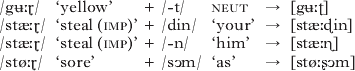
When the alveolar tap /ɾ/ is followed by a morpheme beginning with an alveolar coronal /t d n s/, the alveolar coronal becomes a retroflex, and the /ɾ/ deletes (first described by Brekke Reference Brekke1881: 18ff, Storm Reference Storm1884: 96f and Western Reference Western1889: 275; cf. Kristoffersen Reference Kristoffersen2000: 96f for a recent treatment).
(2)
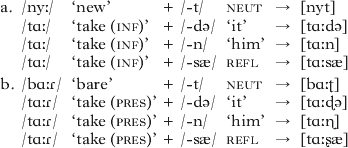
This process is traditionally described as a synchronic articulatory assimilation or articulatory merger of /ɾ/ and /t d n s/ (Borgstrøm Reference Borgstrøm1958: 46, Hovdhaugen Reference Hovdhaugen1969: 146f, Kristoffersen Reference Kristoffersen1980: 72, Eliasson Reference Eliasson and Andersen1986: 277ff, Bradley Reference Bradley2007: 965f).
(3)
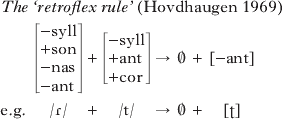
In (3), the [−anterior] feature of /ɾ/ causes an immediately following [+anterior] coronal to become [−anterior], in the style of a typical progressive place assimilation. This solution, however, is not descriptively correct, since both the trigger /ɾ/ and the targets /t d n s/ are [+anterior] (alveolars), whereas the output is [−anterior] (postalveolar) (Endresen Reference Endresen1974: 73). Focusing on the place specification of these segments, the process needs to be described as in (4).
(4)

The somewhat puzzling aspect of retroflexion in Standard East Norwegian is that a sequence of two alveolars results in a postalveolar segment. There is, however, a relatively straightforward historical account for this property, which is given in §2.1.
2.1 A diachronic account of retroflexion in Standard East Norwegian
Standard East Norwegian also has an apical postalveolar flap /ɽ/Footnote 5 (Larsen Reference Larsen1907: 70, 75), which contrasts both with the tap /ɾ/ and with the laterals /ɭ/ and /l/.Footnote 6
(5)

The flap /ɽ/ triggers the same process as the tap /ɾ/ does (Storm Reference Storm1884: 101ff, Larsen Reference Larsen1907: 76, Næs Reference Næs1979: 69). In other words, when the postalveolar flap /ɽ/ is followed by a morpheme beginning with an alveolar coronal /t d n s/, the alveolar coronal becomes a retroflex, and the /ɽ/ deletes (cf. Kristoffersen Reference Kristoffersen2000: 96f).
(6)
Unlike the postalveolarisation process triggered by /ɾ/ in (4), this process is a typical place assimilation.
(7)

From the evidence in Standard East Norwegian alone, it is reasonable to assume that the two postalveolarisation processes in (2) and (6) are not independent of each other. Comparative evidence from other eastern dialects immediately confirms this assumption.
As first noted by Storm (Reference Storm1884: 98, 100), the alveolar /ɾ/ and the postalveolar /ɽ/ trigger two distinct processes in many eastern and northern dialects of Norwegian.Footnote 7
(8)

In these dialects, the apical alveolar /ɾ/ causes a following laminal alveolar coronal to become an apical alveolar coronal, and the apical postalveolar /ɽ/ causes a following laminal alveolar coronal to become an apical postalveolar coronal, as seen in (8). Unlike Standard East Norwegian, the processes in these dialects can be straightforwardly understood as phonetically motivated assimilations, in which the laminal alveolar coronal takes on the place of articulation of the immediately preceding rhotic segment, which itself deletes.
Given the wide presence of eastern and northern dialects with these phonetically motivated assimilations, it is a natural assumption that all eastern dialects of Norwegian once behaved as in (8), and that some of these dialects, among them Standard East Norwegian, later merged the apical alveolar [] with the apical postalveolar [ʈ ɖ ɳ ʂ] (cf. Hoff Reference Hoff1949: 56f, 1978: 156f). This merger has also been observed in real time in many eastern dialects (Larsen Reference Larsen1908: 11f, 243f, Midtsian Reference Midtsian1951: 212f, Dalen Reference Dalen and Leirfall1970: 151, Iversen Reference Iversen1976: 67ff, Skjekkeland Reference Skjekkeland1980: 41, Killingbergtrø Reference Killingbergtrø and Steen1981: 25, Haugen Reference Haugen1982: 41, Sandøy Reference Sandøy1982: 11, Jenstad Reference Jenstad1985: 98, Donali Reference Donali1988: 46).Footnote 8
The typical cause of phonological merger is when the categories are perceptually so similar that listeners can no longer reliably distinguish them from one another. Under this scenario, the merger originates with the listener failing to recognise the distinction intended by the speaker. The perceptual distinction between apical alveolar [] and apical postalveolar [ʈ ɖ ɳ ʂ] is fairly small, and there is an observed tendency for listeners with such a contrast to asymmetrically misperceive apical alveolars as apical postalveolars (Anderson Reference Anderson1997). The contrast between apical alveolars and apical postalveolars is therefore more likely to merge as apical postalveolars than as apical alveolars, since apical alveolars are more often misperceived as apical postalveolars than the other way around. Norwegian fits this expectation perfectly, since the vast majority of Norwegian dialects that merge apical alveolars and apical postalveolars merge them as apical postalveolar [ʈ ɖ ɳ ʂ] (see §5 for exceptions).
Retroflexion in Standard East Norwegian is therefore a textbook example of ‘rule telescoping’, as succinctly explained by Kenstowicz & Kisseberth (Reference Kenstowicz and Kisseberth1977: 64):
It often happens that the intermediate steps in a series of historical changes are lost … in a synchronic grammar of the resulting language. If a language changes As to Bs in the environment X at a certain point in history, and then later changes Bs to Cs, the result may be that some As will alternate with Cs synchronically. If the intermediate stage of B cannot be motivated in a synchronic description, there will have to be a rule taking As directly to Cs. Such a rule can be said to have ‘telescoped’ … the two historical changes, A > B and B > C. Although each of the historical steps may be phonetically motivated, the telescoped rule will not necessarily be.
In the history of Standard East Norwegian, Kenstowicz & Kisseberth's environment X is the tap /ɾ/, A the laminal alveolar /t d n s/, B the apical alveolar [] and C the apical postalveolar [ʈ ɖ ɳ ʂ].
(9)
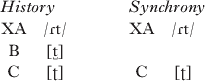
In the left column of (9), the apical /ɾ/ (X) takes a following alveolar /t/ (A) to an apical alveolar [] (B), which later merges with the apical postalveolar [ʈ] (C). Synchronically, as seen in the right column, the apical /ɾ/ (X) takes an alveolar /t/ (A) directly to an apical postalveolar [ʈ] (C), since speakers have no evidence of the historically intermediate apical alveolar [] (B).
According to the scenario described so far, /ɾ/ can cause a following alveolar /t d n s/ to become a postalveolar [ʈ ɖ ɳ ʂ] only if the language already had postalveolar [ʈ ɖ ɳ ʂ] as the result of assimilations with the postalveolar flap /ɽ/. This makes the prediction that /ɾ/ does not trigger postalveolarisation in dialects which do not have the flap /ɽ/ in their inventory. This prediction is borne out.
The postalveolar flap /ɽ/ is an innovation in East Norwegian (Storm Reference Storm1884: 106f). It is absent in North Norwegian (Storm Reference Storm1884: 106, Larsen Reference Larsen1897: 20), the Dano-Norwegian sociolect in Oslo (Western Reference Western1889: 272, Larsen Reference Larsen1907: 26) and Risør (Hødnebø Reference Hødnebø2005: 32ff, 102), yet these are all dialects where the tap /ɾ/ changes a following alveolar /t d n s/. As predicted, in these dialects /ɾ/ assimilates with a following alveolar /t d n s/ to an apical alveolar [], and not to apical postalveolar [ʈ ɖ ɳ ʂ], as in Standard East Norwegian (see Brekke Reference Brekke1881: 18f, Western Reference Western1889: 271f, Larsen Reference Larsen1907: 72, Alnæs Reference Alnæs1910: xii–xiii, Iversen Reference Iversen1913: 8, 67f, Christiansen Reference Christiansen1933: 165ff, Ingebrigtsen Reference Ingebrigtsen1942: 7f, Tømmerås Reference Tømmerås1964: 0f, 15ff, Paulsen Reference Paulsen1971: 87ff, Hatlebrekke Reference Hatlebrekke1976: 41ff, 1981: 13, Elstad Reference Elstad1982: 73f, Martinussen Reference Martinussen1984: 16f, 20f, Hødnebø Reference Hødnebø2005: 37, 108).
(10)

3 Retroflexion in the Frogner dialect
Some dialects of Norwegian have a dorsal uvular /ʁ/ instead of the tap /ɾ/ (Aasen Reference Aasen1848: 21, 1864: 25). It has repeatedly been claimed that retroflexion cannot exist in such dialects, since the articulatory properties of the uvular /ʁ/ would render the retroflexion process unnatural and phonetically implausible (Torp Reference Torp1983: 73f, Eliasson Reference Eliasson and Andersen1986: 291, Sandøy Reference Sandøy1993: 142). As will be shown in this and following sections, such ‘unnatural’ retroflexion does in fact exist in dialects with a uvular /ʁ/. The unnatural character of /ʁ/-retroflexion lies in the fact that there is no clear relation between the articulatory properties of the trigger /ʁ/ and the structural change applied to the target /t d n s/.
(11)
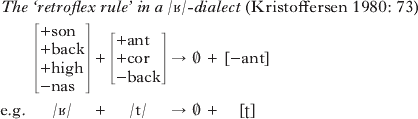
In (11), the [+anterior] (alveolar) feature of /t d n s/ changes to [−anterior] (postalveolar) in the position after /ʁ/, but there does not seem to be any phonetic link between this change from [+anterior] to [−anterior] and the feature values of the dorsal uvular /ʁ/.
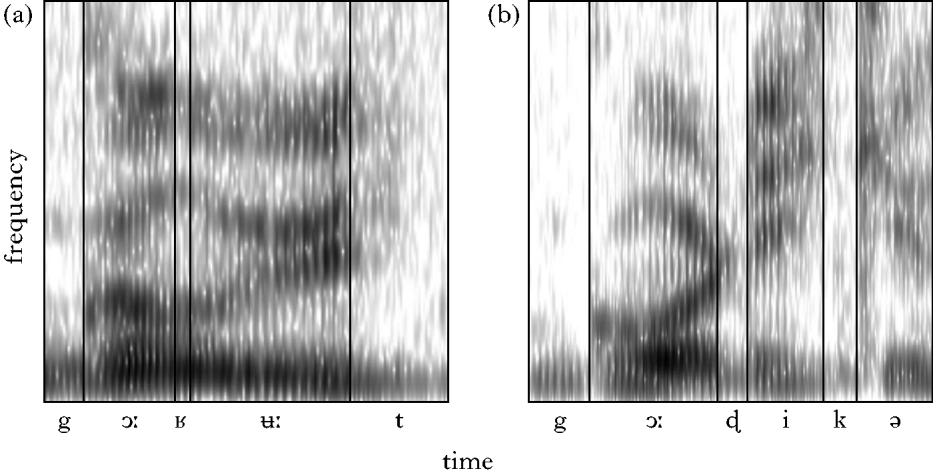
One of these Norwegian /ʁ/-dialects is the Frogner dialect of Oslo (Torp Reference Torp, Kotsinas and Helgander1994: 292).Footnote 9 Both Larsen (Reference Larsen1907: 28) and Torp (Reference Torp, Kotsinas and Helgander1994: 292) briefly mention that the Frogner dialect has retroflex segments in its inventory, and this opens up the possibility that the dialect also has the retroflexion process in (11). The dialect is now relatively rare, so an acoustic analysis was performed of a recorded 1964 interview with a particularly well-known speaker of the Frogner dialect, the late philosopher Arne Næss (1912–2009).Footnote 10 Many instances of retroflexion can be identified in this interview, exemplified in the spectrograms in Fig. 1 for the forms in (12).
(12)

Spectrograms of recordings of the forms in (12), produced by Arne Næss, a speaker of the Frogner dialect, in a 1964 interview. (a) [gɔːʁʉːt] ‘go out’; (b) [gɔːɖikə] ‘if it's not possible’.

In the spectrogram in Fig. 1a, the final uvular /ʁ/ of /gɔːʁ/ surfaces before the initial vowel of the morpheme /ʉːt/. The formant trajectories leading into /ʁ/ show the characteristic rising third formant associated with the uvular /ʁ/ (Lindau Reference Lindau1985: 164f). In the spectrogram in Fig. 1b, the final uvular /ʁ/ of /gɔːʁ/ has been deleted before the alveolar consonant of the morpheme /də/, and the alveolar /d/ surfaces as a retroflex [ɖ]. This consonant is not only clearly identified as a retroflex [ɖ] by native speakers of Standard East Norwegian, but the formant trajectories leading into [ɖ] also show the characteristic falling third formant indicative of retroflex consonants (Stevens & Blumstein Reference Stevens and Blumstein1975: 219f, Hamilton Reference Hamilton1996: 47f). In sum, there is clear evidence that this speaker of the Frogner dialect exhibits retroflexion of alveolars triggered by /ʁ/.
A recording session with another speaker of the Frogner dialect, born in the 1930s, was also conducted.Footnote 11 This speaker productively applied retroflexion to nonce formations, thereby confirming that /ʁ/-retroflexion is an active phonological process in the Frogner dialect.
(13)

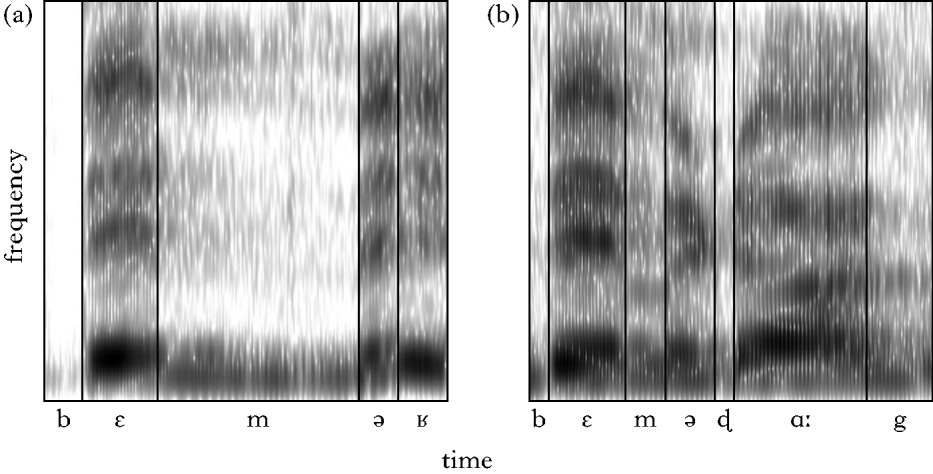
An acoustic illustration of /ʁ/-retroflexion for this speaker is given in Fig. 2, showing the same acoustic characteristics of /ʁ/ and retroflex [ɖ] as explained above in connection with Fig. 1.
Spectrograms of recordings of a speaker of the Frogner dialect, born in the 1930s. (a) [bεməʁ] (nonce); (b) [bεməɖɑːg] (nonce + ‘day’).
The acoustic and phonological evidence from speakers of the Frogner dialect show that the dorsal uvular /ʁ/ triggers retroflexion in this dialect, despite the unnatural character of such a process. As will be shown in §3.1, retroflexion in the Frogner dialect originally behaved in a more ‘natural’ manner, and the modern unnatural interaction between the uvular /ʁ/ and retroflexion is the result of a recent sound change in the language.
3.1 A diachronic account of retroflexion in the Frogner dialect
Retroflexion is a very old process in East Norwegian, dating back as far as the 14th century (Seip Reference Seip1955: 177, 289). The Frogner dialect in Oslo is an East Norwegian dialect, and with the exception of /ʁ/ shares all its features with the Dano-Norwegian sociolect of Oslo (Torp Reference Torp, Kotsinas and Helgander1994: 292). It is safe to assume, therefore, that retroflexion in the Frogner dialect is as old as it is elsewhere in Oslo and East Norwegian.Footnote 12
Uvular /ʁ/, on the other hand, cannot be very old in the Frogner dialect. It was brought to this region by immigrant families from South Norway and Denmark, where /ʁ/ is used in the place of /ɾ/ (Larsen Reference Larsen1907: 27), and the uvular /ʁ/ is itself a recent innovation for /ɾ/ in South Norway and Denmark, dating back no further than the middle of the 18th century (Nielsen Reference Nielsen1950). Retroflexion must therefore have existed in Oslo long before /ɾ/ was replaced by a uvular /ʁ/ in the Frogner dialect. So when /ʁ/ was introduced into the dialect, the retroflexion process already existed by which /ɾ/ triggered retroflexion of a following alveolar. The change of /ɾ/ to /ʁ/ apparently had no influence on this retroflexion process – it simply remained, now triggered by /ʁ/.
Retroflexion in the Frogner dialect is therefore another instance of rule telescoping (cf. §2.1), only this time it is the trigger /ɾ/ that underwent an independent sound change. Using the example from (12), this is illustrated in (14).
(14)
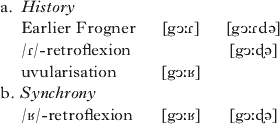
/ɾ/-retroflexion was introduced into the language at a very early stage, leading to alternations such as [gɔːɾ]∼[gɔːɖə]. Only much later was the alveolar tap /ɾ/ uvularised to /ʁ/, which in the modern Frogner dialect leads to alternations such as [gɔːʁ]∼[gɔːɖə], which are phonetically unmotivated from a synchronic perspective.
4 Retroflexion in the Arendal dialect
The town of Risør mentioned at the end of §2.1 is located in the eastern part of South Norway, and has /ɾ/ as its only rhotic segment (Hødnebø Reference Hødnebø2005: 37f, 102). About 25 kilometres further south-west along the coast lies the town of Tvedestrand, and another 25 kilometres south-west is the town of Arendal. Both the Tvedestrand and Arendal dialects have a uvular /ʁ/ as their only rhotic segment (Larsen Reference Larsen1891: 225, Voss Reference Voss1940: 72).Footnote 13Moen (Reference Moen2001: 69f) finds that retroflexion across word boundaries is prevalent in today's Tvedestrand dialect, and Kristoffersen observed as long ago as 1977 that retroflexion across morpheme boundaries occurred to some degree among young speakers of the Arendal dialect (1980: 119ff, 147). In order to confirm Kristoffersen's finding that retroflexion occurs as far south-west as Arendal, a recording session was conducted with a native speaker of the Arendal dialect, born in 1982. As seen in (15), this speaker applied retroflexion in both real and nonce words, thus confirming that young speakers of the Arendal dialect have retroflexion triggered by uvular /ʁ/.
(15)
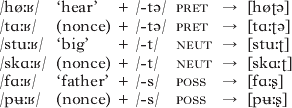
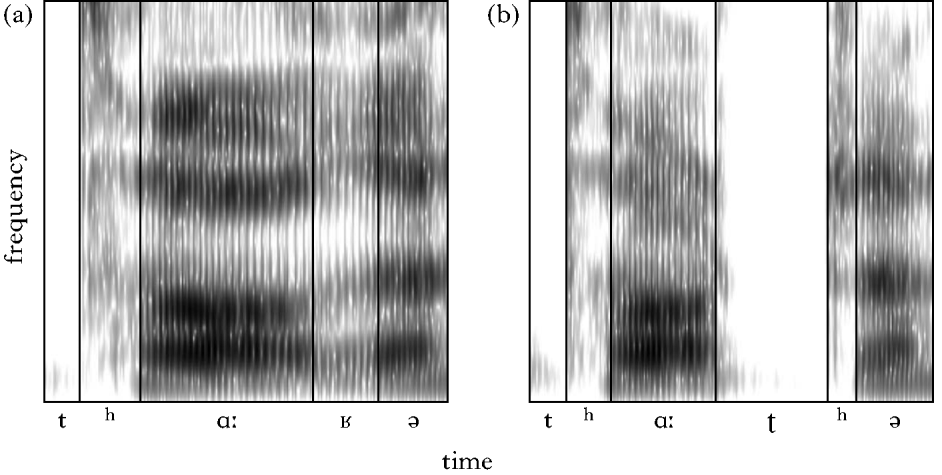
An acoustic illustration of /ʁ/-retroflexion for this speaker for the forms in (16) is given in Fig. 3, and shows the same acoustic characteristics of /ʁ/ and retroflex [ʈ] as explained in §3.
(16)

The next section will show that retroflexion has gradually spread from eastern /ɾ/-dialects into the /ʁ/-dialects of South Norwegian, undeterred by the fact that this spreading crossed the /ɾ/–/ʁ/ isogloss.
Spectrograms of recordings of the forms in (16), produced by a speaker of the Arendal dialect, born in 1982. Aspiration is indicated. (a) [tɑːʁə] (nonce+inf); (b) [tɑːʈə] (nonce+pret).
4.1 A diachronic account of retroflexion in the Arendal dialect
As explained in §3.1, the uvular /ʁ/ is an innovation for /ɾ/ in South Norway. The isogloss between the innovated /ʁ/ and the original /ɾ/ is only a few kilometres east of Tvedestrand, i.e. around 30 kilometres east of Arendal (Larsen Reference Larsen1891: 225, Holen Reference Holen1929: 17, Foldvik Reference Foldvik1988: 61). Since /ʁ/ is an innovation for /ɾ/, the forms with /ɾ/ in the nearby dialects to the east have /ʁ/ in the Arendal dialect.
Retroflexion and retroflex segments are traditionally not features of the Arendal dialect (Voss Reference Voss1940), nor is /ɾ/-retroflexion a traditional feature in the neighbouring /ɾ/-dialects east of Tvedestrand and Arendal (Larsen Reference Larsen1891: 227, Holen Reference Holen1929: 30, Hødnebø Reference Hødnebø2005: 37, 110, Torp Reference Torp2005: 34f). Over the years, however, it has been reported that retroflex segments (Vintermyr Reference Vintermyr1983: 45f, Torp Reference Torp, Kotsinas and Helgander1994: 294, Winje Reference Winje1994: 18, Moen Reference Moen2001: 69, Nyjordet Reference Nyjordet2006: 115) and the retroflexion process (Kristoffersen Reference Kristoffersen1980: 72, Moen Reference Moen2001: 69f, 111ff, Torp Reference Torp2005: 34f) have advanced into these dialects from East Norwegian, a finding confirmed for the Arendal dialect in §4 above.
In other words, retroflex segments and the retroflexion process spread westwards from East Norwegian into the /ɾ/-dialects east of Arendal, and eventually also into the /ʁ/-dialects of Tvedestrand and Arendal, despite the fact that /ʁ/-retroflexion is an unnatural process. The westward spread of these features is primarily conditioned by sociolinguistic factors, as Standard East Norwegian is the prestige and normative language in Norway. The spread of retroflexion into Tvedestrand and Arendal shows that this diffusion process is not sensitive to the fact that /ʁ/ is an unnatural trigger of retroflexion, thereby providing empirical support for Hale's claim that phonological diffusion is only constrained by sociolinguistic conditions (2007: 39).
As mentioned above, since /ʁ/ is an innovation for /ɾ/ in South Norwegian, the forms with /ɾ/ in the nearby dialects to the east have /ʁ/ in the Arendal dialect. The fact that speakers of the Tvedestrand dialect and the Arendal dialect adopted /ɾ/-retroflexion as /ʁ/-retroflexion indicates that these speakers treat /ɾ/ and /ʁ/ as the same phonological segment, despite the fact that they are phonetically quite different from each other. This is not surprising, considering that /ɾ/ and /ʁ/ have the same lexical and phonological distribution across these dialects, but it is surprising if we take the traditional view that there is a direct link from the phonetic properties of a segment to its phonological representation (Postal Reference Postal1968: 53ff, Hale et al. Reference Hale, Kissock and Reiss2007: 647ff). The spread of retroflexion into these dialects can therefore be taken as support for a theory in which phonological segments are abstract entities devoid of phonetic content, and where the link between phonological representations and their phonetic realisations is constructed during language learning (cf. Dolbey & Hansson 1999: 66f, Barnes Reference Barnes2006: 10, Mielke Reference Mielke2008: 98f). Under the latter view, two segments that are phonetically distinct can still be treated as the same phonological segment by speakers, as long as they behave phonologically as one and the same entity.
5 Naturalness accounts of Norwegian retroflexion
The previous sections have argued that retroflexion as it is manifested in Standard East Norwegian, the Frogner dialect and the Arendal dialect is ‘unnatural’ in that it lacks a synchronic phonetic motivation. Yet it is not uncommon to see that phonological processes which some phonologists classify as ‘unnatural’ are later reanalysed as ‘natural’ by others (cf. Schane Reference Schane, Stockwell and Macaulay1972: 216 vs. Johnson Reference Johnson1973; Blevins Reference Blevins and Roca1997: 229ff vs. Uffmann Reference Uffmann2007; Hyman Reference Hyman, Hume and Johnson2001vs. Solé et al. Reference Solé, Hyman and Monaka2010), particularly in that phonological processes which seem unmotivated from an articulatory point of view can be analysed as having a perceptual motivation instead. It should be clear that the retroflexion processes discussed in the previous sections have no synchronic articulatory motivation, as the postalveolar articulation in the surface form seems to appear out of nowhere. Some studies have therefore tried to analyse these retroflexion processes as being perceptually motivated instead. This section will briefly review these accounts and point out some of the problems associated with them.
5.1 Perceptual contrast
The merger of apical alveolars with apical postalveolars into postalveolars in many eastern dialects of Norwegian seems to indicate that apical alveolars in some sense are ‘weak’ (Steblin-Kamenskij Reference Steblin-Kamenskij1965: 26) or ‘marked’ (Endresen Reference Endresen1974: 76) in relation to apical postalveolars. Flemming (Reference Flemming2003: 353ff) analyses this pattern as perceptually conditioned, suggesting that retroflexion is motivated by the need to enhance the distinctiveness of the contrast between apical and laminal coronals. In other words, the contrast between a laminal alveolar /t/ and an apical alveolar // is less distinct than the contrast between a laminal alveolar /t/ and an apical postalveolar /ʈ/, so in a language where apicality is contrastive in coronals, it will prefer apical postalveolars over apical alveolars. In Flemming's Optimality Theory analysis, this preference is formalised with a constraint Apical → Retroflex, which is defined as ‘contrastively [apical] coronals must be [−anterior]’ (2003: 354). There are, however, four problems with this analysis.
The first problem, shared with most accounts within naturalness theory, is that the specific assumptions made to explain the pattern are redundant. The fact that naturalness theory was created to explain is that most phonological processes are phonetically motivated. But since it is possible to explain this fact without assuming a cognitive bias for naturalness, there is no need to introduce such an assumption into phonological theory at all (Blevins Reference Blevins2004: 5ff). In the case of Norwegian retroflexion, perceptual experiments have shown that there is an asymmetric misperception of apical alveolars as postalveolars (see §2.1). There is therefore no need to add a stipulation that grammars prefer apical coronals to be postalveolar, since this tendency can be explained without reference to the grammar. Although it is possible that grammars redundantly restate facts from outside the grammar (cf. Flemming Reference Flemming2001: 26, Kiparsky Reference Kiparsky and Good2008: 25), this possibility should be entertained only when the evidence points in that direction. In the case of retroflexion, I know of no such evidence.
Another question is how to account for languages that do not abide by the principle that contrastively apical coronals should be postalveolar. According to Endresen (Reference Endresen1974: 76), such languages do not seem to exist, which is therefore taken as support for a grammatical preference for the contrast /t/–/ʈ/ over the contrast /t/–//. But as shown in §2.1 above, such languages abound, even within Norway. In terms of a formal Optimality Theory analysis, this pattern can be described with the use of faithfulness constraints protecting the specification of the alveolar articulation in the input, but this completely misses the typological generalisation that these dialects are exactly those dialects without a postalveolar flap /ɽ/ in their inventory, a fact which has nothing to do with faithfulness to the input. One could in turn describe this observation with the use of a universally present markedness constraint against apical postalveolars (Flemming Reference Flemming2002: 43f, 2003: 354), which prevents both /ɽ/ and other retroflexes from surfacing in these dialects,Footnote 14 but this would still miss the typological generalisation that postalveolarisation triggered by an alveolar /ɾ/ depends on the prior existence of a postalveolar /ɽ/. In Standard East Norwegian and other eastern dialects, Flemming's constraint Apical → Retroflex needs to be ranked above a markedness constraint against retroflexes, in order to capture the fact that retroflex outputs surface from alveolar inputs. The same ranking would allow for the many Norwegian dialects with an alveolar /ɾ/ as their only rhotic segment to also derive retroflexes, yet such dialects are curiously absent (see §2.1), and there is nothing within this framework to capture this typological fact.
The third issue is that Flemming's analysis effectively bars the possibility of a language with an inventory of laminal alveolars, apical alveolars and apical postalveolars, and at the same time merges the apicals as apical alveolars. This prediction could be a good thing if it were true, as Endresen (Reference Endresen1974: 76) claims, that ‘there are no dialects where the neutralisation product is an alveolar’. But this is not the case. Again, even within the boundaries of Norway, there are dialects that do just that. One is the dialect of Vang in Valdres. In contrast with the other dialects in the Valdres region (and Standard East Norwegian), the laminal alveolars /t d n s/ in the Vang dialect become apical alveolars when preceded by both an apical alveolar /ɾ/ and an apical postalveolar /ɽ/, with deletion of /ɾ/ and /ɽ/ (Beito Reference Beito and Hermundstad1958: 248, 252f).
(17)

A markedness constraint against retroflexes will not do the trick here, since this dialect exhibits retroflexes in non-derived environments (/dɑːɽ/ ‘valley’) and in derived environments for both native words (/εŋgɽɑ/, /gɑmbɽe/; plural forms of /εŋil/ ‘angel’, /gɑːmɑl/ ‘old’) and loanwords (/stεmpɽɑ/; plural form of /stεmpil/ ‘stamp’) (Beito Reference Beito and Hermundstad1958). Nor will it suffice to resort to faithfulness constraints preserving the alveolar articulation in input forms such as the definite marker /-n/ in (17) above, because the merger of apical alveolars and apical postalveolars into apical alveolars also took place in monomorphemes where the input segment was already postalveolar, as in */εːɳ/ → /εː/ ‘ell’, */myːɳɑɾ/ → /myːɑɾ/ ‘miller’, */œɖøɾ/ → /œøɾ/ ‘alder’ and */hεʂ/ → /hε/ ‘neck’.Footnote 15 In the Froan dialect, this exact merger is currently taking place (Midtsian Reference Midtsian1951: 212f, Bye Reference Bye1979: 28), and Bye is careful to note that this also applies to monomorphemes with underlying postalveolars: /boɖə/ → /boə/ ‘boil’.Footnote 16 Within Flemming's framework, this seems to require at the time of the merger between these categories a phonetically unmotivated constraint Apical → Alveolar (‘contrastively [apical] coronals must be [+anterior]’) outranking Flemming's phonetically motivated constraint Apical → Retroflex. Such a ranking is, however, not only in direct conflict with the primary claim in Flemming's theory, which is that the constraint ranking invariably reflects the distinctiveness of the perceptual contrasts (cf. 2002: 26, 2004: 239), but also undermines the central premise of naturalness theory that the grammar favours natural interactions.Footnote 17
Finally, Flemming's account cannot explain retroflexion as it is manifested in the /ʁ/-dialects. In Standard East Norwegian, the problem is to explain why a sequence of an apical alveolar and a laminal alveolar would surface as an apical postalveolar (see §2). Flemming's account is well suited to explain this articulatorily unmotivated property, as it points out that the articulatorily expected apical alveolar would not be sufficiently distinct from the laminal alveolar. In the /ʁ/-dialects, however, there is no motivation for the apical articulation in the retroflex output, since there is nothing apical in the input sequence. Some other explanation needs to be applied in order to make retroflexion in /ʁ/-dialects perceptually motivated. An attempt at providing such an explanation is addressed in the next section.
5.2 Perceptual assimilation
In §3 and §4, acoustic and phonological analyses of the Frogner and Arendal dialects showed that speakers productively apply retroflexion of alveolar coronals after a uvular /ʁ/. Hamann (Reference Hamann2003) suggests that /ʁ/-retroflexion is a phonetically motivated synchronic process, by which the low third formant (F3) of the uvular /ʁ/ is associated with the following coronal. Since retroflex coronals are characterised by a low F3, the association of a low F3 with a coronal leads to a surfacing retroflex (2003: 128, 174f). There are two problems with this analysis.
First, providing a motivation for the existence of a phonological process implies that this is the explanation for its origin. In other words, analysing retroflexion in /ʁ/-dialects as a synchronic perceptual assimilation implies that this is an internal development in these dialects. In doing so, this account therefore misses the generalisation that retroflexion in /ʁ/-dialects only exists when they are in direct contact with /ɾ/-dialects with retroflexion. This generalisation is captured by the diachronic explanations in §3.1 and §4.1, where it is shown that in an /ʁ/-dialect retroflexion can either exist through a sound change in which a dialect within the /ɾ/-retroflexion area becomes an /ʁ/-dialect or arise by phonological diffusion across neighbouring dialects.
More importantly, however, the uvular /ʁ/ is not characterised by a low F3, but by a high F3, a property found in other languages (Lindau Reference Lindau1985: 164f, Engstrand et al. Reference Engstrand, Frid, Lindblom, Solé, Beddor and Ohala2007: 177), as well as in the Frogner and Arendal dialects (cf. the spectrograms in §3 and §4). Hamann's account can therefore not explain retroflexion in /ʁ/-dialects, since the property that is claimed to trigger the perceptual assimilation, the low F3 of the uvular /ʁ/, does not in fact exist.
6 Has retroflexion in Standard East Norwegian always been ‘unnatural’?
In (8), it was illustrated how a range of eastern and northern dialects of Norwegian exhibit both an alveolarisation process triggered by the alveolar /ɾ/ and a postalveolarisation process triggered by the postalveolar /ɽ/. It was further argued that all eastern dialects of Norwegian, including Standard East Norwegian, must once have behaved in the same way, with a later merger of apical alveolars and apical postalveolars into apical postalveolars. Since these (post)alveolarisation processes are not, and never have been, reflected in the writing system, there is no direct evidence that all eastern dialects of Norwegian once had these two distinct processes. Endresen (Reference Endresen1974: 76) suggests, therefore, that Standard East Norwegian might have behaved as it does today from the outset, i.e. that the alveolar /ɾ/ always triggered postalveolarisation. As will be explained in what follows, there are good reasons to reject this possibility.
The diachronic explanation provided in §2.1 points to the experimental finding that there is a tendency for apical alveolars and apical postalveolars to be asymmetrically misperceived as apical postalveolars. This finding provides a perceptual explanation for the historical merger of these two categories as apical postalveolars in Norwegian dialects, and this tendency is further supported by the fact that many eastern dialects of Norwegian have been observed to merge these two categories in exactly this fashion in the last 100 years. From this diachronic explanation, postalveolarisation triggered by the alveolar /ɾ/ presupposes the prior existence of a postalveolarisation process triggered by the postalveolar /ɽ/. If, however, as Endresen suggests, /ɾ/ always triggered postalveolarisation, then there is no such presupposition, since it would not be necessary for the /ɾ/-postalveolarisation process to have come into existence from a previous merger with an already existing postalveolarisation process. Under this latter view, though, an important generalisation is missed: postalveolarisation triggered by /ɾ/ exists only in dialects with postalveolarisation triggered by /ɽ/ (see the end of §2.1). This fact is reduced to a mere coincidence under this alternative view, as there is no necessary link between the two postalveolarisation processes. Under the diachronic merger theory, on the other hand, this generalisation is actually predicted to arise.
If it were the case that postalveolarisation triggered by /ɾ/ did not come into existence from a merger of apical alveolars and apical postalveolars, then a perceptual explanation for /ɾ/-postalveolarisation is lost (i.e. the asymmetric misperception of these two categories). As a result, this alternative view must provide another motivation for why the apical alveolar /ɾ/ should cause a following alveolar to become apical postalveolar. The suggestion by Endresen (Reference Endresen1974: 76), fleshed out in greater detail by Flemming (Reference Flemming2003: 353ff), is that the grammar prefers apical coronals to be postalveolar. As reviewed in §5.1 above, this stipulation rules out dialects that seemingly ‘prefer’ apical coronals to be alveolar instead. As a result, the alternative motivation provided under this view is falsified. All in all, the alternative view that retroflexion in Standard East Norwegian has always been as it is today misses a crucial generalisation found across Norwegian dialects, and cannot offer a competing explanation that is coherent with facts from other dialects. In conclusion, it is more likely that retroflexion in Standard East Norwegian originates from a merger between apical alveolars and apical postalveolars, as suggested in §2.1.
7 Conclusion
The data reported in this paper shows that Norwegian retroflexion exhibits some phonetic properties that do not seem to be synchronically motivated. In Standard East Norwegian, an alveolar /ɾ/ causes a following alveolar coronal to become postalveolar. There is no clear synchronic articulatory source for this postalveolar articulation, and attempts to analyse this process as the result of a universal perceptual preference for contrastively apical coronals to be postalveolar not only fail to capture important typological patterns of retroflexion in Norwegian dialects, but also incorrectly rule out dialects where contrastively apical coronals have an alveolar articulation. In the Frogner and Arendal dialects of Norwegian, the postalveolarisation process is triggered by a uvular /ʁ/, a process which lacks any synchronic motivation, whether articulatorily or perceptually based. All of these retroflexion processes are shown to be productive and regular, and they are not limited to specific morphological categories – retroflexion applies whenever the phonotactic conditions are met. As such, it satisfies Blevins' criteria for being an ‘extreme case’ of unnaturalness (2008: 137).
The existence of unnatural phonology is important for the evaluation of two different approaches to phonology, dubbed ‘naturalness theory’ and ‘the diachronic model’ in this paper. According to the former, the phonetic motivation for a phonological process is encoded in the cognitive grammar as a ‘naturalness bias’, and natural phonology exists as a direct result of this synchronic bias. Under the diachronic model, on the other hand, phonetically motivated processes are seen as mere facts of history. Their original motivation does not need to be repeated in the synchronic grammar, and the ‘naturalness’ of such processes are posited to be irrelevant to the speaker and to the synchronic grammar. The diachronic model analyses unnatural processes in the same manner. They, too, are mere facts of history, whose original motivation and level of ‘naturalness’ are irrelevant to the synchronic grammar. For naturalness theory, however, unnatural processes pose a problem, since they cannot be explained with reference to the assumed bias for naturalness. In contrast with natural processes, these unnatural processes are explained as facts of history, and it is assumed that synchronic speakers acquire them differently from natural processes.
For a theory where a bias for naturalness is assumed, it therefore becomes necessary to operate with these two modes of explanation for synchronic patterns, as it can be demonstrated that both natural and unnatural phonology exist in synchronic grammars. Since naturalness theory is thus a more complicated model than the diachronic model, the burden of proof lies on the naturalness theory to justify the need for the assumption that the cognitive bias for naturalness exists, either by demonstrating with experiments that unnatural processes are in fact acquired differently from natural processes or by showing that no truly unnatural processes exist in spoken languages. A range of learning experiments have failed to find any evidence that speakers treat unnatural processes any differently from natural processes (see §1), and this paper has demonstrated that, at least in the case of Norwegian retroflexion, unnatural phonological interactions do exist. Unless future studies should show otherwise, it would be methodologically appropriate to conclude that the simpler model is a better model, and thus dispense with the assumption that synchronic grammars are biased in favour of natural phonology.