Introduction
Total body radiotherapy is an important pillar of conditioning regimen used in many hematopoietic stem cell transplant protocols. Apart from its role as myeloablative conditioning regimens aimed to eradicate tumour cells, it is also a powerful tool for immunosuppression and prevention of donor stem cell rejection. Reference Sabloff, Tisseverasinghe, Babadagli and Samant1–Reference Abugideiri, Nanda and Butker3
In total body radiotherapy, the whole body is irradiated with the dose of 2–14·4 Gy. A multi-institutional survey conducted in 2014 to explore clinical practices in total body radiotherapy showed marked variation and heterogeneity in total body radiotherapy both in doses and dose delivery methodology. Most used techniques were ‘with two fields and were using two patient positions per fractions’. Reference Giebel, Miszczyk, Slosarek, Moukhtari, Ciceri and Esteve4
In myeloablative conditioning regimens, a total dose of 10–16 Gy in 1·5–2 Gy per fraction twice a day with 4–6 h gap between fractions was used. Reference Sorror, Storer, Maloney, Sandmaier, Martin and Storb2–Reference Giebel, Miszczyk, Slosarek, Moukhtari, Ciceri and Esteve4 Radiation pneumonitis is one of the most harmful toxicities of total body radiotherapy which account for 25–50% non-relapse deaths in post-bone marrow transplant. Lung shielding was used in most of the centres to achieve the median lung doses of 8–10 Gy, which has been scientifically proven to decline the incidence of pneumonitis Reference Kelsey, Horwitz and Chino5–Reference Gogna, Morgan, Downs, Atkinson and Biggs8
Many reports are available which explain about planning and delivery. Reference Kim, Khan and Galvin9 Basic principles on simulation, treatment planning, delivery of treatment and quality assurance protocols used in total body radiotherapy are recommended by the American College of Radiology and the American Society for Radiation Oncology, but final consensus has yet to be established as continuous improvement in radiotherapy techniques and development in machines. Reference Wolden, Rabinovitch and Bittner10
Most frequently, total body radiotherapy is performed with the conventional source to skin distance (SSD) of approximately 4 m with use of one fixed beam arrangement AP/PA or lateral fields and manual calculation of doses and patient dimensions. Differences in patient separation due to patient’s length can lead to dose heterogeneity of about 10–20%. Reference Labar, Bogdanic and Nemet11 Cerrobend fabricated blocks are used to reduce lung doses with no standard protocols of manufacture, dose calculation and verification of placement. Reference Labar, Bogdanic and Nemet11–Reference Ravichandran, Binukumar and Davis13
To improve the uniform dose homogeneity, organ sparing and accuracy in dose calculation, different institutions across the globe have started using CT-based planning including tomotherapy, IMRT and volumetric modulated arc therapy (VMAT). Reference Sun, Cuenca and Itti14–Reference Springer, Hammer and Winkler17 These techniques also offer a potential advantage for patients in terms of ease of delivery and reproducibility.
At our hospital, we established a multicentric VMAT technique for total body radiotherapy. This technique requires no additional equipment cost used for planning and delivery of standard VMAT radiotherapy. We describe our VMAT technique, planning, dosimetric data and toxicity for first nine patients treated at Shaukat Khanum Memorial Cancer Hospital.
Methods and Materials
CT acquisition
Before commencement of CT scanning process, measurements were carried out to accurately determine the length of CT scan, fusion process of CT images, QA, placement of isocentres from midplane to avoid collision and treatment delivery limitations on a dummy manikin.
Due to limitation of couch longitudinal movement, we cannot treat whole body in single position, so two scans were acquired, one in headfirst position and second with feet first.
CT simulation was performed on a computed tomography scanner (Toshiba, 16 slice CT, wide bore) having setting of 120 kVp at 5 mm slice thickness. Patients were positioned supine with upper limbs placed by sides of the body and immobilised by two vacuum bags or a single whole body vacuum bag. Head and neck thermoplastic mask were used, and additional 0·5 cm thickness gel bolus was used to wrap entire body to ensure adequate skin dose. Patients were aligned and three sets of fiducial markers were placed first at head level, second at chest and third at the level of iliac blades. Radiopaque markers placed at head region and iliac blades were marked as zero coordinates for isocentre shift for headfirst scan and feet first scan, respectively. The junction of two scans was marked with a series of radiopaque markers. First CT simulation was performed in a headfirst position and thereafter patient was rotated 180° to a feet first position for another CT scan, each at 5 mm slice thickness. 5 cm overlap region between both CT data were acquired, to guide about the fusion of the images in planning software (Aria V15·6).
Contouring and planning
The planning target volume (PTV) is contoured with the help of outer body counter excluding the gel bolus. Lung and bilateral kidneys are outlined as critical organ at risks (OARs). PTV was excluded from both lung and kidneys with 3 mm margin. Brain and lens were also contoured for documentation of doses.
The total body radiotherapy treatment plans were generated using the Rapid Arc™ technique, provided within the Eclipse™ treatment planning system, version 15.6 (Varian Medical Systems).
The overall PTV contoured in both headfirst and feet first scans had to be split into three PTVs, to make three plans due to limitation of maximum five isocentres in one plan. Total number of isocentres in each patient was 12; moreover, we had to draw help contours and control regions to control hotspots in overlapping regions between different plans. We also used ‘convert isodose level to structure’ feature of the Eclipse planning system to control hotspots of more than 120 and 130% of the prescribed dose.
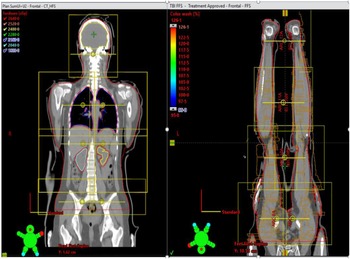
The region of chest, abdomen and pelvis each had two isocentres placed within 4 cm of midline to avoid collision during delivery, and each isocentre is planned with two full arc rotations. The maximum field width was 25 × 30 cm with 90° collimation to allow better beam modulation and dose homogeneity with full MLC (multileaf collimator) motion. Minimum 2 cm overlap region was set between adjacent fields to ensure adequate coverage (Figure 1).
Field (yellow rectangles) and isocentre (yellow dots) for headfirst CT with one isocentre in head and neck, and with two coplanar isocentres in chest/abdomen and pelvis.

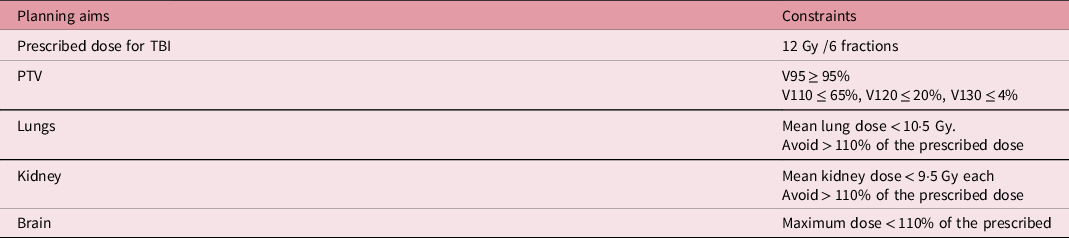
The planning aim was to deliver a homogeneous dose of 12 Gy to the PTV while limiting the mean lung dose to less than 10·5 Gy, and the mean dose to kidney below 10 Gy additional helping structures inside the lungs with low constraint values to steer the optimiser for lung sparing. The dose rate at lungs region was reduced to 60–80 cGy/minute, head and neck and limbs region was maintained at 600 MU/minute and pelvis region was maintained at 300 MU/minute (Table 1).
Planning parameters/aims for 12 Gy dose

Plan quality assurance was performed using a Portal Vision (Electronic Portal Imaging Device [EPID]) built-in with the machine and QA plans were then evaluated using gamma evaluation tool with a dose difference of 3% and distance to agreement of 3 mm for each arc.
During dose delivery, the patient position was verified using bony alignment that was acquired by orthogonal PORT films on EPID for each isocentre separately at first fraction and for following fractions by acquiring only setup isocentres marked at midline for each two isocentres having same Y coordinates using the Varian On-Board Imager™ (OBI) kilovoltage imaging system (for lateral films only). Patient position was accurate in most of the cases (±2·5 mm), except for feet position, which was corrected approximately 2 times. For patients comfort and ease, a 30-minute interval was included between headfirst supine position and feet first supine position treatments.
Results
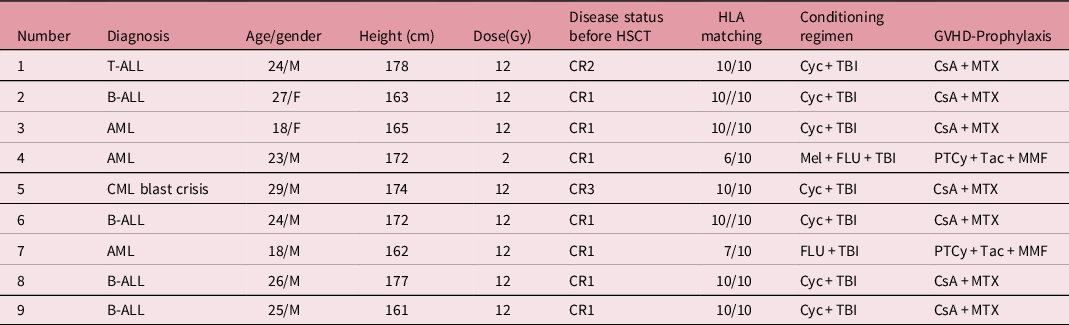
Totally, nine patients between July 2019 till May 21, treated at Shaukat Khanum Hospital, were evaluated. The mean age was 23 years with range 18–29 and male to female ratio 7:2. Patient and disease characteristics are summarised in Table 2. Five patients had acute lymphoblastic leukaemia (ALL), three had acute myeloid leukaemia and one had chronic myeloid leukaemia (CML). Out of nine patients, eight received 12 Gy in six fractions treated twice daily with minimum of 6-hour gap as part of myeloablative regimen while one patient was planned for single fraction of 2 Gy due to reduced intensity conditioning regimen.
Patient and disease characteristics

ALL, acute lymphoblastic leukaemia; AML, acute myeloid leukaemia; CML, chronic myeloid leukaemia; CR, complete remission; CsA, cyclosporine; TAC, tacrolimus, HLA, human leukocyte antigen; M, male; MTX, short-term methotrexate; Cyc, cytarabine; Mel, melphalan; FLU, fludarabine.
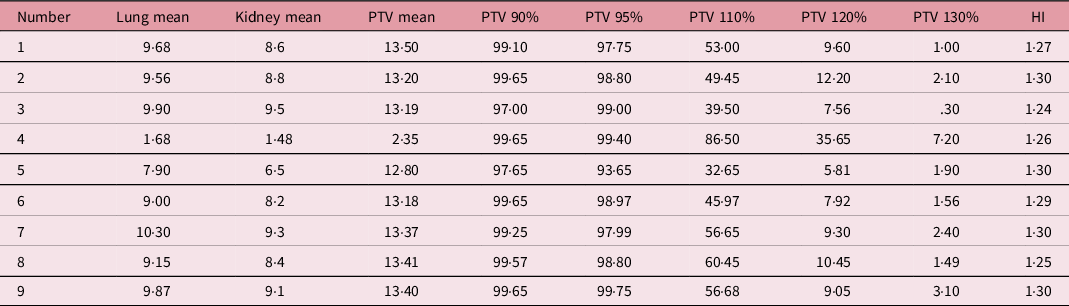
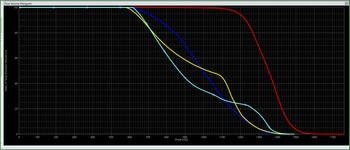
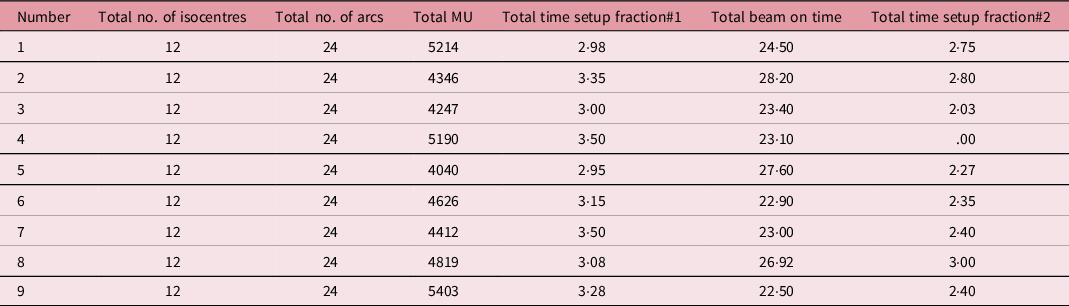
Table 3 shows the doses to the PTV. The mean PTV dose and the V95% of the PTV, for 8 patients receiving 12 Gy, were 13·2 and 98%, respectively, whereby mean D95%, the dose covering the 95 % volume of the PTV, was 11·9 Gy. The mean volumes of PTV exceeding 110, 120 and 130 % of the prescribed PTV doses were 49·2% range (32·65–86·50%), 8·9% (range 5·81–35·65%) and 1·73% (range 0·3–7·20%) respectively (Figure 2). The areas receiving more than 120% of the prescribed dose were outside the main OAR lungs. However, small areas outside the OARs with a maximum dose of 130% were accepted. Mean doses for both kidneys and lungs were 8·5 and 9·4 Gy, respectively (Figure 3). Total number of isocentre was 12 in all the plans with two full arcs at each isocentre. Mean monitoring units were 4638·375, and mean beam on time was 24·87 minutes (Table 4).
Planning parameters and doses to PTV and OARs

HI, heterogeneity index.
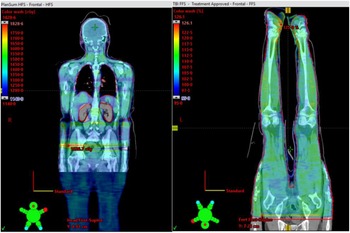
Dose distribution of patient no. 4 showing colour wash for 1140 cGy in sagittal view. Sparing of kidneys and lungs. Irregular dose distribution in overlapping areas.

Dose volume histograms of the primary target volume (red) and lung (blue) and kidneys (yellow and cyan).

Monitor units and time required for delivery

MU, monitor units.
During the first fraction, KV images were acquired at all isocentres and verified before proceeding with treatment, but in subsequent fractions KV images were required at midline setup in thorax and abdomen regions with two isocentres at each to save time. The mean fraction delivery time was 2·3 hours.
The mean heterogeneity index (HI) was 1·27, which is a tool to measure the dose gradients within PTV was calculated used the formula below. Reference Dominello, Kaufman, McSpadden, Snyder, Zaki and Maier18
HI = D1/D95.
D1 refers to the dose encompassing 1% of PTV, whereas D95 is the dose encompassing 95% of PTV.
We also calculated HI to quantifying dose homogeneity in the target volume by using the formula as per ICRU − 83. 19
HI = D2% - D98%/D50%
where D2% is the dose received by 2% of planning volume, D98% is the dose encompassing 98% of PTV and D50% is the dose encompassing 50% of PT. Our mean value was 0·27.
The mean follow-up of patients after total body radiotherapy is 4 months (2–9 months). During the entire course of radiotherapy, all patients had moderate fatigue and Grades 1–2 nausea requiring antiemetics. No other side effects were observed during the treatment. Immediately after total body radiotherapy, eight patients had Grade 3 nausea and mucositis requiring IV analgesics, antibiotics and antiemetics. And 5 patients had Grade 1 skin inflammation and redness. No acute symptoms suggesting pneumonitis were seen during the follow-up period. Out of nine patients, two patients died, one patient who had CML with blast crisis died at 4·3 months due to refractory disease and other with pre-B ALL died at 1 year due to disease relapse at 10 months. Remaining seven patients at last follow-up are alive, free of disease and without any severe symptoms.
Discussion
It is a foremost reported study to our knowledge that is looking at the flow process and clinical essence of VMAT-based total body radiotherapy in Pakistani population in which patients receiving allogeneic-hematopoietic stem cell transplantation. VMAT based total body radiotherapy offers an advantage of accurate dose verification and appropriate adjustment compared with conventional extended SSD total body radiotherapy methods and is well accepted by patients. The plan evaluation for all cases achieved required dose constraints both of PTVs and OAR. Most importantly, all these complex plans were delivered without observing any technical glitches. These findings conclude that VMAT-total body radiotherapy using standard linac is a practical option for Pakistani population with no additional resource requirement. Regarding complications, total body radiotherapy dose rate is one of the most important predictors of lung and renal complications in conventional total body radiotherapy Reference Cheng, Scheltheiss and Wong26–Reference Chretien, Cote and Blais31 . The maximum dose rate for HT total body radiotherapy (600 Mu/minute) is higher than conventional total body radiotherapy. Ouyang et al. reported no acute lung toxicity for eight patients treated with VMAT-total body radiotherapy on a linac achieving mean lung dose to 8 Gy. Reference Ouyang, Folkerts and Zhang27 Another study reported results of patients treated with VMAT-total body radiotherapy. The lung mean dose was 9·7 Gy and achieved mean kidney dose was 9·6 Gy with no Grade 3 toxicity or higher. Reference Tas, Durmus and Okumus28 Another report on linear accelerator-based VMAT in seven patients by Springer et al showed no severe pulmonary toxicities, and they were able to reduce renal doses by 7–8 Gy in patients with underlying renal comorbidities, thus lowering renal complication. Reference Springer, Hammer and Winkler29 In our study, the mean lung dose was 9·4 Gy and we did not observe any clinically significant lung toxicity. Since dose rate is crucial for the lungs and gastrointestinal tract, we kept our the dose rate on the thorax (< 80cGy/min) and pelvic region (300 MU/min), while in head and neck and extremities had normal dose rate of (600 MU/min), based on a published data on total body radiotherapy using a 300 MU/min dose rate Reference Kirby, Held, Morin, Fogh and Pouliot30–Reference Jahnke, Jahnke and Molina-Duran32
Grade 3 toxicity was observed in few of our patients which included nausea, mucositis and diarrhoea, but there were no Grade 4 toxicities, implying that a VMAT-based total body radiotherapy-associated toxicities are comparable to that of a conventional TBI-based regimen.
Conclusion
TBI with VMAT is feasible without any significant increase in the rate of early toxicity, but further follow-up is necessary for long-term efficacy and late side effects. It offers a discrete advantage of starting this service reliably in already existing linac bunkers at no additional cost and ensures a uniform dose to the body and reduction of dose to OAR. Nonetheless, it is the complex and time-consuming process with significant learning curve.
Acknowledgements
We thank Hospital Information department and data management department for providing the data and helping in analysis.