Heart murmurs are common in children and constitute the second most common reason for referral from primary care to paediatric secondary care after asthma.Reference Thompson, Todd and Ni Bhrolchain 1 The majority of murmurs are found incidentally and will be innocent flow murmurs. Up to 6 in every 1000 children born will have congenital heart disease that requires cardiology intervention, and a further 13 in 1000 will have bicuspid aortic valves that may eventually need care.Reference Hoffman and Kaplan 2 Many of these conditions are first diagnosed following detection of a heart murmur. Identifying this small group of children is important, as congenital heart disease can cause significant morbidity and may even lead to death without prompt and appropriate treatment.Reference Morgan 3 , Reference Wren, Richmond and Donaldson 4
A number of studies have identified clinical predictors of pathologic murmurs,Reference McCrindle, Shaffer, Kan, Zahka, Rowe and Kidd 5 , Reference Frank and Jacobe 6 but the absence of abnormal signs does not always guarantee that the diagnosis of congenital heart disease can be excluded.Reference Burton and Cabalka 7 Echocardiography remains the gold standard of formal diagnosis. Current local primary care practice is to refer children with a heart murmur to a paediatrician with expertise in cardiology for assessment and echocardiography in a one-stop clinic. Currently, general practitioners are under increasing pressure to reduce referrals to secondary care across all specialities. This study reviews the outcomes of general practitioner referrals of children with heart murmurs to the local paediatrician with expertise in cardiology, with the aim of providing data to develop evidence-based referral pathways.
Materials and methods
Study design and patient selection
We conducted a retrospective observational study of the hospital records of all children under 17 years of age who were referred by their general practitioner to a paediatrician with expertise in cardiology clinic during 2011. Children were identified from the hospital outpatient database and their electronic records were reviewed. Children previously observed in the cardiology service and those with incomplete records were excluded. New patient referrals to the outpatient clinic from the emergency department were also screened to identify children who were referred there initially for assessment of their heart murmur. This allowed us to identify all children seen with a murmur.
Study setting
The paediatrician with expertise in the cardiology clinic serves the local population of Cambridge and surrounding areas. All referrals for children with suspected congenital heart disease received by other consultants in the department are directed to the paediatrician with expertise in cardiology who carries out screening investigations, including an echocardiogram. The service is run as part of a network with paediatric cardiologists from Great Ormond Street Hospital. There are no direct general practitioner referrals to the specialist outreach clinic.
Data collection and analysis
Data were collected from the electronic hospital records for all children using a standard proforma. Information collected included: age, gender, reason for referral, any additional symptoms the child had at presentation, family history of cardiac disease, hospital investigations carried out, and clinic outcome. Children were included in the study if they were referred for assessment of a heart murmur.
Except where otherwise stated, data are presented as percentages. Comparison between groups was performed using Fisher’s exact test with a significance level of p<0.05.
Results
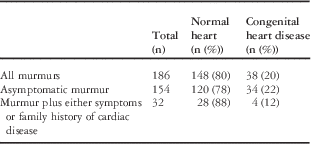
A total of 313 children were newly referred during 2011 and complete records were available for 310. Of those, 186 (60%) were referred for investigation of a murmur and were seen at a median age of 1.43 years, ranging from 2 weeks to 15.83 years, and 53% were male. 154 (83%) of the 186 were referred for an asymptomatic incidental murmur alone and 32 (17%) for a murmur plus other symptoms or a family history of cardiac disease. All children underwent echocardiography, and 38 (20%) of them had some form of congenital heart disease (Table 1). In all, 148 (80%) children with normal echocardiograms were immediately discharged back to the care of their general practitioner.
Outcomes of all children referred for investigation of a murmur.

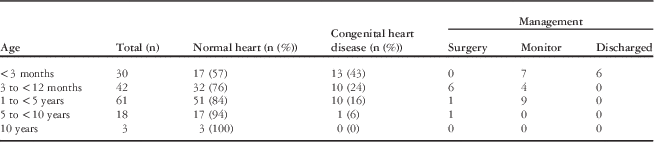
Table 2 shows a detailed breakdown of the outcomes of the 154 children with an asymptomatic murmur. Congenital heart disease was detected in 34 children. Almost all pathology, 33 of 34 (97%), occurred in children under 5 years of age. The highest incidence was seen in children under the age of 3 months (13 of 30 (43%)) and the incidence decreased with age. Congenital heart disease was not detected in any child with a murmur over 10 years of age. Of the 34 children referred with an asymptomatic murmur and found to have congenital heart disease, eight (24%) required either a surgical or a catheter-based intervention (five patent ductus arteriosus, one pulmonary valve stenosis, one atrial septal defect, and one coarctation of the aorta). Of these 34 children, six have been discharged as their pathology resolved without intervention, and the remaining 28, including those who had interventions, are still being monitored in the specialist outreach clinic with the visiting paediatric cardiologist. Children aged between 3 and 12 months were most likely to need intervention with 6 of the 10 (60%) children requiring surgery.
Variation in incidence and subsequent management of congenital heart disease in children referred with an asymptomatic murmur by age at appointment.

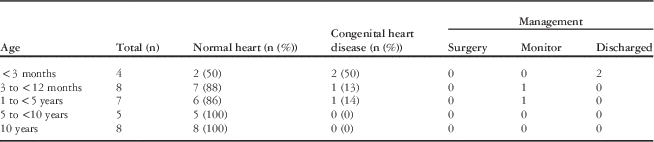
Of the 32 children who were referred with a murmur plus either symptoms or family history of cardiac disease, four children had pathology. Of those, three children were under 6 months of age (one ventricular septal defect, one patent foramen ovale, and one bicuspid aortic valve), and one child between 1 and 2 years of age had a functionally bicuspid and dysplastic aortic valve. Two of these children were subsequently discharged as their pathology had resolved and the others are being monitored in the outreach clinic. None have required intervention at this stage (Table 3). The presence of family history or symptoms did not significantly increase the chances of congenital heart disease (p=0.33, Fisher’s exact test).
Incidence and outcome of congenital heart disease in referrals of murmur plus either symptoms or family history by age at appointment.

Three children with heart murmurs were newly referred to the clinic via the emergency department over this time period, of whom two presented with an incidental murmur alone, and one with an incidental murmur in association with concerns about Kawasaki’s disease. All had normal echocardiographic evaluations and were subsequently discharged from follow-up.
Discussion
Summary
To the best of our knowledge, this is the first report of the outcomes of children with heart murmurs referred by general practitioners to a paediatrician with expertise in cardiology clinic in the United Kingdom. It shows that one in five children with a murmur were found to have some form of congenital heart disease, increasing to almost one in two children under 3 months of age. Symptoms or a family history of congenital heart disease were not helpful when distinguishing between children with and without congenital heart disease. This study suggests that murmurs in children, particularly those under 5 years of age, should raise a high index of suspicion and supports current general practitioner referral practice from a clinical perspective. It is important to recognise that congenital heart disease will be detected both antenatally and postnatally pre-hospital discharge, and over the study period 11 children were diagnosed with cardiac problems before they were seen in primary care.
Strengths and limitations
This study included data collected systematically on over 99% of children referred by general practitioners to the clinic over a 12-month period. All children were seen by the same paediatrician with expertise in cardiology and all underwent echocardiography. Although this provides robust data on the outcomes of children referred to the clinic, it may not include data on children with heart murmurs that general practitioners did not refer. It is unlikely that children would have been referred to other hospitals as the local service is well established. The fact that only three children with murmurs were identified following attendance in the emergency department further suggests that referral pathways to the outpatient service are well organised.
This study is retrospective and relies on what is documented in hospital letters. The extent of any information bias resulting from this is reduced as all children were seen by the same paediatrician. The standardised format for all letters including: reason for referral, presenting symptoms, signs, family history of heart disease, diagnosis, and outcome allowed an accurate review of this cohort.
Comparison with existing literature
Our finding that 20% of children referred with a murmur have congenital heart disease is consistent with published data from the United States of America, where 24% of children referred by primary care physicians without first ordering echocardiography had trivial congenital heart disease, and a further 13% potentially significant disease.Reference Danford, Gumbiner and Nasir 8 The decreasing prevalence of congenital heart disease with increasing age is also consistent with other studies.Reference Frank and Jacobe 6 , Reference Sánchez, Rubio and Vera 9 , Reference Kwiatkowski, Wang and Cnota 10 The finding that almost 50% of children seen in clinic with a murmur up to 3 months of age have congenital heart disease is within the previously reported range of 31–86%.Reference Bansal and Jain 11 – Reference Ainsworth, Wyllie and Wren 13
Although the numbers are small, our study shows that additional symptoms and family history of congenital heart disease were not helpful in this population in distinguishing which children have a pathological murmur. This challenges guidance from a recent American review,Reference Frank and Jacobe 6 which included both a history of congenital heart disease and systems review in recommendations to help distinguish between innocent and pathological heart murmurs. They suggested that the diagnosis of an innocent murmur can be made in children over 1 year if four criteria are met: absence of abnormal examination findings, except for murmur; a negative review of symptoms, that is, child is asymptomatic; a history that is negative for features that increase the risk of congenital heart disease; and characteristic auscultatory features of a specific innocent heart murmur. Although this study does not take into account the auscultatory features of the murmur, general practitioners have been shown not to be skilled at distinguishing innocent and pathological murmurs clinically.Reference Marek, Skovránek and Hucín 14 Although clinical examination by paediatric cardiologists has a sensitivity and specificity of over 90%,Reference McCrindle, Shaffer, Kan, Zahka, Rowe and Kidd 5 , Reference Smythe, Teixeira, Vlad, Demers and Feldman 15 asking general practitioners to make a diagnosis of an innocent murmur based on clinical examination findings and the presence of symptoms and family history would likely miss a number of children with otherwise detectable congenital heart disease. In this cohort of 186 children, 11 children with congenital heart disease over 1 year of age may have been missed, including two who required intervention.
The clinical significance of missing this small number of children with congenital heart disease, particularly those who do not require intervention, is beyond the scope of this study. Just as important, however, are the consequences of over-diagnosis and routinely providing echocardiography for all children with a murmur. With recent guidelines for endocarditis antibiotic prophylaxis in children with congenital heart disease now recommending that treatment is no longer required when undergoing dental, respiratory tract, gastrointestinal, and genitourinary procedures, 16 a specific echocardiographic diagnosis in a child with an asymptomatic murmur, which does not affect the child physically is perhaps no longer necessary. At the same time, providing specialist-led echocardiography services for all will have health-care resource implications and potentially further deskill general practitioners and general paediatricians. For parents, however, being told that their child has a heart murmur is understandably an emotive issue and can generate high levels of anxiety,Reference Giuffre, Walker, Vaillancourt and Gupta 17 and many seek a definitive diagnosis. A small number of children with murmurs may also require surgery under a general anaesthetic, and an accurate cardiac diagnosis will be important for the anaesthetist and surgeon when planning care. Anaesthetists will often not proceed with surgery until a heart murmur has been assessed, resulting in last minute cancellation of the surgery with disruption for the family and the surgical waiting list. Justifying not referring children with murmurs for further assessment may therefore be a challenge for general practitioners. Given that echocardiography now approaches near-perfect sensitivity and specificity with colour DopplerReference Marek, Skovránek and Hucín 14 , Reference Saraçlar, Cil and Ozkutlu 18 referral to a one-stop clinic would seem appropriate and cost-effective. Organising services in this way benefits the health economy, a definitive diagnosis is made, and children do not return for further follow-up by inexperienced doctors unnecessarily.
Implications for research and practice
This study suggests that current referral practice to refer otherwise asymptomatic children under 5 years of age with a heart murmur that persists after an acute illness is not unreasonable. The development of a one-stop clinic for murmur assessment with echocardiography allows early diagnosis of congenital heart disease and equally importantly the discharge of children with normal hearts back to the care of their general practitioner. Further research into the presenting features and outcomes of all children with heart murmurs detected in primary care and subsequent economic analyses in the United Kingdom are, however, needed to determine whether echocardiography for all is a both safe and cost-effective referral strategy for general practitioners in the United Kingdom.
Acknowledgements
We would like to thank Stuart Wills for providing information on clinic attendees. We also thank Ari Ercole for statistical support.
Financial Support
J.U.S. was supported by a National Institute of Health Research Academic Clinical Fellow post at the time of this study. However, this research received no specific grant from any funding agency, commercial, or not-for-profit sectors.
Conflicts of Interest
None
Ethical Standards
As this study was a retrospective review of medical records by the clinical team, no ethical approval was required.