Hospitals and health care centers are complex and potentially vulnerable establishments, dependent on external support. Medical care organizations play a critical role in providing communities with necessary medical care to avoid disasters in all forms. Depending on their scope and nature, disasters can lead to a quickly increasing service demand that may break down the functional capacity and safety of hospitals and the health care system on a large scale. 1 - Reference Deen 4 The turmoil of September 11, 2001, and the devastation from Hurricanes Katrina and Rita highlight the importance of hospital disaster preparation and response. The former disasters have provided perspective on current challenges in evidence-based disaster management. Confusion over roles and responsibilities, weak communication, lack of planning, suboptimal education, and a lack of hospital coalition in planning for community disasters are some formerly recognized major problem areas.Reference Kaji and Lewis 5 , Reference Kaji, Koenig and Lewis 6 A disaster may be defined as a natural or man-made event that results in an imbalance between supply and demand for resources.Reference Noji 7 - Reference China, Waswa and Kundu 9
Globally, in 2012, there were 357 reported natural disasters affecting 123 million people and causing US$157 billion of economic damage.Reference Guha-Sapir, Vos and Below 10 This estimate of the human complication of disasters is likely a coarse underestimate due to remarkable under-reporting.Reference Buston and Smith 11
The World Health Organization (WHO) Regional Office for Europe has designed the hospital emergency response checklist to assist hospital and emergency managers in responding impressively to the most likely disaster scenarios. This tool comprises current hospital-based emergency management principles and best practices and integrates the superior action needed for a quick and effective response to a critical event based on an all-hazards approach. 1 , Reference Sorensen, Zane and Wante 12 The tool is structured according to 9 key domains including command and control, communication, safety and security, triage, surge capacity, conjunction of essential services, human resources, logistics and supply management, and post-disaster recovery.Reference Sorensen, Zane and Wante 12
Hospital emergency management is a continuous process requiring the monolithic integration of planning and response attempts with local and national schemes. The recommendations predetermined in this instrument are common, applicable to a range of possibilities, and based on an all-hazards approach. 1
In the Bam earthquake, the city was destroyed, leaving over 40,000 dead and around 30,000 casualties, as well as ~20,000 homes were devastated, leaving more than 45,000 people homeless.Reference Montazeri, Baradaran and Omidvari 13 Although the earthquake in Bam caused the devastation of 2 hospitals, it spared the frame of a new facility under construction at the time. 14 Within 36 hours, almost 8000 injured were evacuated to hospitals within the country’s 13 provinces. Restoring critical health services, at an expenditure of US$10.7 million, is expected to take several years. 14 , Reference Von Schreeb, Riddez and Samnegård 15
The 1999 earthquake in Turkey injured more than 44,000 people.Reference Kılıç and Ulusoy 16 The 2001 earthquakes in El Salvador caused 1159 mortalities and 8122 people were injured. In all, 19 hospitals (63%) were destroyed and 6 were completely evacuated.Reference Wisner B. 17 Hurricane Ivan struck the small Caribbean nation of Grenadain in the West Indies in September 2004. In Gujarat, India, a massive earthquake, 7.9 in magnitude, killed 20,000 and injured 30,000 people in 2001. In the most affected region, Kutch, all health facilities crumbled. 14
In the 1971 San Fernando, California, earthquake, almost 90% of deaths occurred in hospitals. In every district in Syria, health care issues were recognized and mentioned as the number one priority among all philanthropic needs in surveys carried out in 2013 and 2014. When Mount Merapi in Central Java, Indonesia, exploded in October 2010, the flowing lava and plumes of ash hit many unprepared people. Because many people refused to leave their settlements, or returned while the eruptions were still continuing, over 300 people died. 14 , Reference Von Schreeb, Riddez and Samnegård 15 , Reference Wisner B. 17
Also, the earthquake in Costa Rica (1990), Typhoon Haiyan in the Philippines (2013), and the Great East Japan Earthquake and Tsunami (2011) can be considered as notable recent events. 14 Therefore, assessing hospital emergency response against disaster seems to be necessary, with the emphasis being on an approach of evidence-based management of disasters. The aim of the present study was to assess the emergency response of hospitals against disasters in Tabriz, north-west Iran.
METHODS
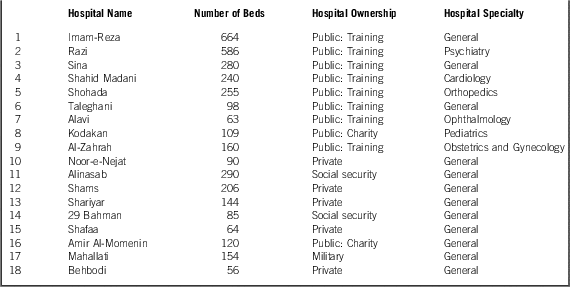
A cross-sectional study was conducted in the city of Tabriz, Iran, during 2016. The study population included all hospitals in Tabriz. The following hospitals were assessed: Imam-Reza, Razi, Sina, Shahid Madani, Shohada, Taleghani, Alavi, Kodakan, Al-Zahrah, Noor-e-Nejat, Alinasab, Shams, Shariyar, 29 Bahman, Shafaa, Amir Al-Momenin, Mahallati, and Behbodi (Table 1).
Characteristics of Studied Hospitals

Of the 18 hospitals, 5 were private, 8 were public, 2 were social-security, 2 were charity, and 1 was a military hospital.
A hospital emergency response checklist was used to collect data. This checklist was developed by the WHO Regional Office for Europe. The instrument was designed to assist hospital administrators and emergency managers to respond effectively to disasters.Reference Sorensen, Zane and Wante 12 The following checklist components were identified:
1. Command and control (7 questions).
2. Communication (9 questions).
3. Safety and security (10 questions).
4. Triage (10 questions).
5. Surge capacity (13 questions).
6. Conjunction of essential services (8 questions).
7. Human resources (15 questions).
8. Logistics and supply management (10 questions).
9. Post-disaster recovery (8 questions).
Checklist validity was measured using indicators of content validity ratio (CVR) and content validity index (CVI). CVI was found to be 87% and CVR to be 85%. Data collection was conducted by 2 researchers. The researchers were members of the Road Traffic Injury Prevention Research Center and the Iranian Center of Excellence in Health Management (IceHM) in Tabriz University of Medical Sciences (TUOMS). Besides, they were experts in hospital accreditation. They conducted interviews with hospital administrators and emergency and disaster managers, as well as assessed documentation, evidence, and observations.
The checklist rating scale included 3 options (action review, progress, and completed). Descriptive statistics were utilized to present quantitative and qualitative variables. Data entry and analysis were carried out using SPSS software (Version 20). Hospitals’ emergency response was rated between 0% and 100% (action review=0, progress=50, and completed=100). Names of hospitals are shown in a coded manner from α 1 to α 18.
Ethical Considerations
The project proposal was presented to the Road Traffic Injury Prevention Research Center at TUOMS and was approved by the latter’s ethical committee.
RESULTS
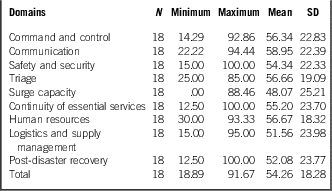
In the present investigation, 18 hospitals from Tabriz were assessed .The obtained results showed that the mean emergency response rate of hospitals was 54.26% (18.28). The maximum and minimum rates of emergency response were 91.67% and 18.89%, respectively. Emergency response rates of hospitals, according to domains, were between 48.07% (25.21) and 58.95% (22.39), which were accordingly related to surge capacity and communication, respectively. Other results are shown in Table 2.
Emergency Response Rate of Hospitals, According to Domains in Tabriz City

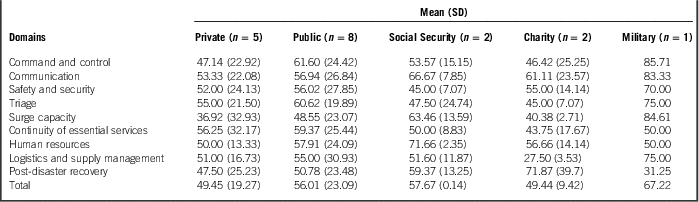
According to ownership, it was seen that the maximum and minimum rates of emergency response among hospitals were for the military (67.22%) and charity hospitals (49.44±9.42%), respectively. For charity hospitals, post-disaster recovery was 71.87% (39.7). The surge capacity of private hospitals was very low (36.92±32.93%). The logistics and supply management of charity hospitals was also at a very low level of 27.50% (3.53). Other results are shown in Table 3.
Emergency Response Rate of Hospitals According to Ownership

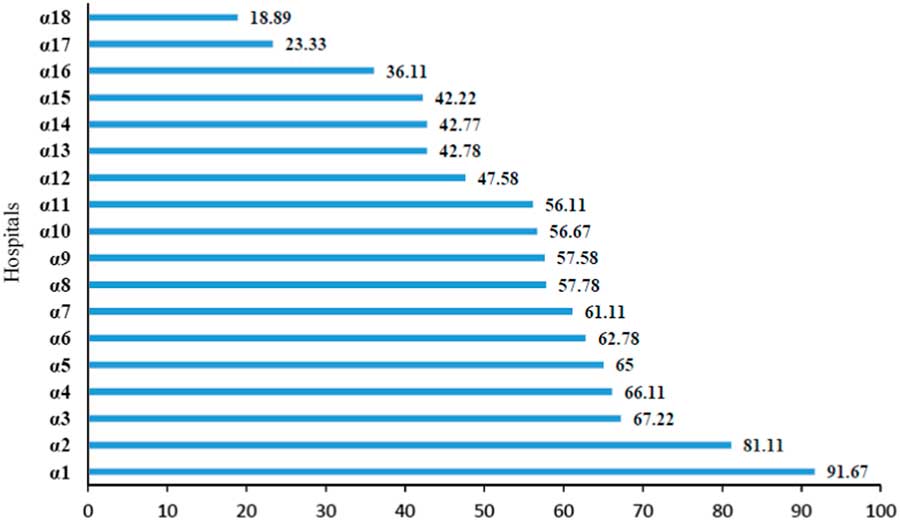
Figure 1 shows the emergency response rates of hospitals. They were less than 50% in 7 hospitals. The emergency response of the hospital α 18 was 18.89%, implying a potential of only 18.89% for emergency response against disasters. In the case of the other categories, there was a 55% (4 hospitals) potential for emergency response. The emergency response rate of 5 hospitals was between 61% and 67%. Finally, 2 hospitals showed very good rates (α 1 and α 2) compared with other hospitals.
The Emergency Response Rate of Hospitals.

DISCUSSION
In many cases, the occurrence of a disaster is inevitable.Reference Yamamura 18 Likewise, subsequent injuries from the disaster are also common and sometimes out of control.Reference Kouadio, Aljunid and Kamigaki 19 In addition, regarding the vitality of disaster prevention arrangements, it is very important to prepare for meeting requirements during the incident. One of the main requirements at the time is to deal with victims and treat their injuries. The hospital emergency department is known to be the main source that encounters these needs and provides effective disaster relief.Reference Tang, Fitzgerald and Hou 20 The study findings showed that the mean hospital emergency response rate was 54.26%. The results from similar studies in Iran do not match our findings. Among them, 1 (2015) was conducted in 6 training hospitals affiliated to Qazvin University of Medical Sciences based on the same instrument. The results showed that the mean hospital emergency response rate was 71.90%.Reference Asefzadeh, Varyani and Gholami 21 Moreover, Hasanpoor et al,Reference Hasanpoor, Zahmatkesh and Nazari 22 performed a similar investigation in 13 hospitals in Alborz province. According to their findings, the hospital emergency response rate was reported to be only 44.17%.Reference Hasanpoor, Zahmatkesh and Nazari 22 Despite the differences, study results were similar in that the rate of readiness was low. As there is a probability of occurrence of 31 out of 40 known cases of disaster in Iran (Tabriz, especially, is a disaster-prone area), the low level of preparedness to response against disaster is alarming and dangerous.Reference Jahangiri, Izadkhah and Lari 23
The lower average emergency response rates in Karaj and Tabriz compared with Qazvin are due to the hospitals’ geographic location. Besides, the type of hazard is a matter of significance. Qazvin is vulnerable to floods, and Alborz and Tabriz are at a risk for earthquakes.
Djalali et al conducted a comparative study aimed at comparing Iranian and Swedish hospitals’ readiness in terms of functional capacity. Their results indicated that Iranian hospitals were categorized as level B (functional capacity: 36%-65%). They stated that low preparedness was due to the lack of a contingency plan and a limitation in resource availability. Further, they concluded that the level of hospital preparedness is related to socioeconomic characteristics of the research setting.Reference Djalali, Castren and Khankeh 24 The instrument used in this study has several dimensions such as surge capacity, human resources, logistics and supply management, and post-disaster recovery. These dimensions may be affected by the amount of resources, organizational structure, human resources, transportation, etc.Reference Troy, Carson and Vanderbeek 25
In fact, the mismatch between findings from different studies can be justified according to the specific research setting and its features. The least and highest mean values between dimensions were for surge capacity (48.07±25.21) and communication (58.95±22.39), respectively. The term surge capacity connotes a hospital’s ability to manage a sudden influx of patients.Reference Kaji, Koenig and Bey 26 Kaji and Roger carried out a study to determine disaster preparedness among hospitals in Los Angeles County. They found that only 29% of hospitals had a surge capacity of 20 beds. In Kaji and Roger’s study, hospital preparedness and surge capacity were limited because of a failure to integrate training and planning and because of a harshly limited surge capacity, whereas there was no limitation in available equipment and supplies.Reference Kaji and Lewis 5 Another study was conducted in the United States to investigate hospital preparedness for weapons of mass destruction incidents. Of the study’s participants, 87% believed that the hospital emergency department could manage only 10-50 extra patients at once.Reference Treat, Williams and Furbee 27 The results of a study carried out by Hasanpoor et alReference Hasanpoor, Zahmatkesh and Nazari 22 demonstrated that the least and highest mean values were related to surge capacity (28.55%) and triage (70.30%), respectively. A study by Asefzadeh et alReference Asefzadeh, Varyani and Gholami 21 found that the command and control dimension had the highest score (83.8%) and the least score was for logistics and supply management (57%). They performed the study in training hospitals, whereas the present study was conducted in hospitals with different types of ownership. This difference could be the main reason for a mismatch in findings.
Among the different types of ownership, the military hospital (n=1) had the highest emergency response rate (67.22%), whereas the least emergency response rate was for charity (n=2) hospitals (49.44%). The command and control, surge capacity, and communication categories ranked at the top of the scores in the military hospital. This may be due to strict regulations in military organizations. Ardalan et al performed a study entitled “hospitals safety from disasters in Iran: the results from assessment of 224 hospitals.” Their findings showed that none of the studied hospitals were placed in the high-safety category. The highest safety was found in hospitals affiliated to the Ministry of Health (47.4% were placed in the moderate-safety and 52.6% in the low-safety categories). Charity hospitals gained the worst status (33.3% were placed in the moderate-safety and 66.7% in the low-safety categories).Reference Ardalan, Kandi and Talebian 28 Iranian charity hospitals are faced with both capital and infrastructure problems due to weakness in revenue pooling, lack of supportive rules, and the parallel activity of public organizations and non-governmental organizations.
Our study demonstrated that hospitals performed moderately in their emergency response. The emergency response scores of 7 hospitals did not reach 50%. Preparedness scores of 18.89% (α 18 hospital) and 23.33% (α 17 hospital) showed deplorable conditions in the mentioned hospitals. As Richard argued, at the time of a disaster, even 99% preparation is insufficient.Reference Niska and Shimizu 29
Being ready for disasters is similar to prevention of and vaccination against diseases. If prevention and vaccination are defective, it could be dangerous; likewise, there must be a complete and full-dimensional readiness against disasters, and this means that the hospital emergency response rate must be 100%.
CONCLUSION
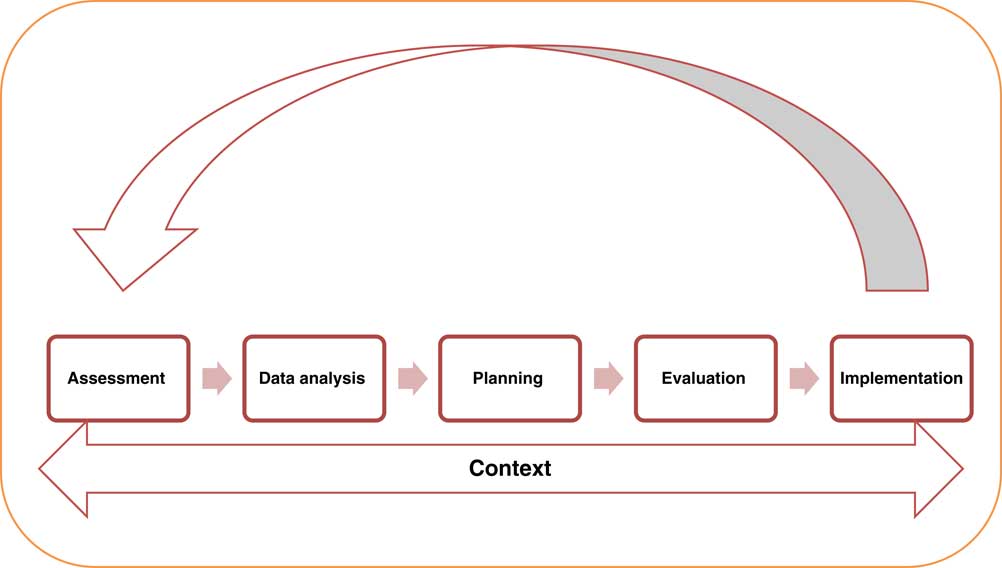
With regard to the importance of the emergency department in reduction of causalities, it seems reasonable to inform hospital authorities to improve the status quo. In this regard, it seems that the findings proposed by the present study would be fruitful for determining areas requiring further attention. These areas can be different according to hospital ownership: surge capacity in private and public hospitals, safety and security in social security hospitals, logistic and supply management in charity hospitals, and post-disaster recovery in military hospitals. We propose the following framework to improve the level of hospital emergency response (Figure 2):
1. Assessment of hospital emergency response (based on context).
2. Data analysis.
3. Planning for hospital emergency response (100% response).
4. Implementation of hospital emergency response using scenario models (based on the best evidence).
5. Evaluation of the emergency response plan in a hospital.
Process of Improving Hospital Emergency Response.

The process shows that, initially, the assessment must be carried out in a context-oriented manner. Then, the evidence must be systematically analyzed. Third, the evidence should be appraised and we should plan for the improvement of emergency response. Afterward, the outcome of the decision taken and also the indicators of hospital emergency response must be evaluated. At the end of the process, the indicators will be created and implemented in hospitals based on the best available evidence.
Acknowledgments
The authors are very thankful to all participating hospitals that played role in this survey and to TUOMS for organizational support. The authors also highly appreciate TUOMS’s Road Traffic Injury Prevention Research Center.