INTRODUCTION
In 2007, Betti et al. (Reference Betti, Zhou, Anderson, Perkins, Theobald and Solodov2007) came up with shock ignition in order to achieve inertial confinement fusion, and it has high neutron efficiency (Theobald et al., Reference Theobald, Betti, Stoekl, Anderson, Delettrez, Glebov, Goncharov, Marshall, Maywar, Mccrory, Meyerhofer, Radha, Sangster, Seka, Shvarts, Smalyuk, Solodov, Yaakboi, Zhou, Frenje, Li, Séguin, Petrasso and Perkins2008; McCrory et al., Reference Mccrory, Meyerhofer, Betti, Boehly, Collins, Craxton, Delettrez, Edgell, Epstein, Froula, Glebov, Goncharov, Harding, Hu, Igumenshchev, Knauer, Loucks, Marozas, Marshall, Mckenty, Michel, Nilson, Radha, Regan, Sangster, Seka, Shmayda, Short, Shvarts, Skupsky, Soures, Stoeckl, Theobald, Yaakobi, Frenje, Casey, Li, Petrasso, Séguin, Padalino, Letcher, Celliers, Collins and Robey2008). In the process of shock ignition, how to obtain the desired high peak power laser pulse and how to get 100 ps laser pulse amplification with high efficiency are key problems that need to be solved.
Simulated Brillouin scattering (SBS) is a nonlinear optical effect between acoustic wave and light. Originally it was used as a phase conjugation mirror. The Technical University of Berlin used an organic liquid medium to build a phase conjugation mirror. The output power had been reached for more than 100 watts and can work at a high repetition rate (Eichler et al., Reference Eichler, Konig, Patzold and Schwartz1995; Reference Eichler, Haase and Liu1996). The Lawrence Livermore National Laboratory in the United States used CCl4 as a SBS phase conjugation mirror medium. They regularly filtered the medium to improve the breakdown threshold (Hackel et al., Reference Hackel, Dane and Zapata1994; Dane et al., Reference Dane, Zapata and Neuman1995).
Since the 2000s, most papers focused attention on SBS pulse compression. Velchev et al. (Reference Velchev, Neshev, Hogervorst and Ubachs1999) established the transient conditions coupled wave equations and got 160 ps pulse through SBS in water. Marcus et al. (Reference Marcus, Pearl and Pasmanik2008) got 175 ps pulse compression in fused quartz; Yoshida et al. (Reference Yoshida, Hatae, Fujita, Nakatsuka and Kitamura2009) got 160 ps compression in FC-40. Through the method of SBS, pulse compression of up to 100 ps could be obtained. From the above experiments, it is proved that high gain factor and short phonon lifetime are beneficial for short pulse compression. Hundred picoseconds pulse amplification can be expected to have similar properties.
The results of former experiments draw a conclusion that the medium has a direct influence on the SBS process. In 1990s, Yoshida et al. (Reference Yoshida, Kmetik, Fujita, Nakatsuka, Yamanaka and Yoshida1997) found FC-72, FC-75, etc., per-fluorinated hydrocarbons as new SBS mediums. And then in 2006 he found a series of per-fluorinated hydrocarbons, per-fluorinated amines, and per-fluorinated ether as SBS mediums (Park et al., Reference Park, Lim, Yoshida and Nakatsuka2006). These new SBS mediums have similar frequency shift, low absorption, and small phonon lifetime. Such liquid mediums are purified easily with other advantages of high damage threshold and stable chemical properties. So it is conducive to high power high energy SBS amplification experiments.
According to Dane et al. (Reference Dane, Neuman and Loyd1994) and Schiemann et al. (Reference Schiemann, Ubachs and Hogervorst1997), compression structures include taped waveguide, one-cell geometry, oscillator amplifier, compact two-cell, and scalable two-cell. What are widely used include one-cell geometry, compact two-cell, and scalable two-cell, and some others variants on these structures.
Among them, the scalable two-cell is a relatively good experimental structure. It has the following several advantages. (1) It loses less energy so that it can improve the energy efficiency. (2) In the amplifying cell, the seed and the pump are incident from both ends of the pool, so that the energy can be separately controlled below self-focusing or the breakdown threshold. (3) In the interaction region of the pool, the seed and the pump can be adjusted in order to obtain higher energy conversion efficiency.
Through previous experimental results, it is possible to get 100 ps laser pulse through the SBS method. But most results are by means of compression. SBS amplification by the scalable two-cell structure method seems less reported. By means of SBS amplification, its effect is straightforward and the amplifying structure is simple. By this way, nanosecond pulse with high energy can be directly used as the pump to amplify the 100 ps Stokes seed.
This paper demonstrated that the scalable two-cell structure was suitable to the amplification of 100 ps pulse. The amplification gain and energy extraction efficiency of several kinds of heavy fluorocarbon medium were studied.
EXPERIMENTAL OPTICAL PATH
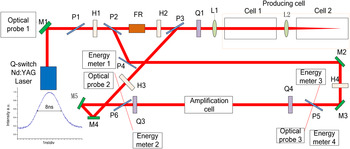
The experimental optical path is shown in Figure 1. A Q-switched Nd:YAG laser outputs a single longitudinal mode Gaussian baseband laser. The laser pulse width is 8 ns with repetition frequency of 1 Hz. The initial spot diameter is approximately 6 mm with the energy of 1 J. First, the laser passes through a polarizer P1 and a half wave plate H1. After passing through polarizer P2, it is separated into two polarization components, which are P and S. When the P component passes through the Faraday and some optical devices, it turned into circularly polarized by a 1/4 wave plate Q1. Then the laser gets into the generating cell after the lens is focused. This cell is based on compact two-cell structure. The producing Stokes light will be turned into the S component after passing through Q1. It is the seed light in the amplifying cell. The cell1's length is 1 m, the cell2's length is also 1 m. Focal length of lens L1 is 1.5 m, and L2 is 60 cm. The space between the two cells is 10 cm. The medium in the cell is FC-40.
(Color online) Experimental optical path through scalable two cell structure method.

The seed passes through half-wave plate H3, mirror M4, M5, and turns into circularly polarized after 1/4wave plate Q3. The pump also turns into circularly polarized. They meet in the middle of the amplifying cell. The length of the cell is 60 cm.
What it used in this experiment is collinear plan. By means of H3, the energy of the seed can be controlled, it is also the same with the pump light. The meeting position can be adjusted by the path length or the cell's position.
Energy meter 1 is used to monitor the Stokes seed light energy, and energy meter 2 is used to monitor the residual energy of the pump light. Energy meter 3 is used to monitor the pump light energy, and energy meter 4 is used to monitor the amplified Stokes light energy. Optical probe 1 is used to monitor the waveform of the pump light, and optical probe 2 is used to monitor Stokes light's waveform. Optical probe 3 is used to monitor the waveform Stokes after amplifying.
The oscilloscope used in this experiment is from Tektronix DPO71254C. Energy meter is OPHIR of PE50. Measurement used for Stokes is optical fiber probe New Focus of 1454 and 1024.
In the experiment, to ensure cell length and meet latency unchanged, to ensure seed light and pump light in the enlarged pool encounter fixed position, thus the interaction length of the seed and the pump in the medium cell is fixed. By means of replacing several different medium, SBS medium parameters' effect on Brillouin amplification process can be studied. And the same is with energy parameters. Main parameters of the SBS medium are shown in Table 1.
Parameters of FC series medium

FC series of medium belongs to fluorocarbons. Hydrogen atoms are replaced by fluorine atoms. Liquid viscosity and phonon lifetime have a direct relation, where the greater the viscosity is the smaller the phonon lifetime will be. From the above, it can be seen of these given the medium parameters. FC-72 has the maximum gain factor and the longest phonon lifetime, and FC-40 has the minimum gain factor and the shortest phonon lifetime. The FC-770 and FC-3283 have similar gain parameters and phonon lifetime. These FC series SBS medium has a similar frequency shift as shown in the table above. So we can focus on energy parameters such as gain coefficient and phonon's lifetime for energy magnification SBS amplification process and the impact of energy extraction efficiency.
RESULTS AND DISCUSSION
In the experiment, the pump energy is kept 500 mJ. The energy extraction efficiency and the power magnification of SBS amplification are investigated by changing the Stokes seed energies.
Energy conversion efficiency is defined here as the minus amplified Stokes light energy (Esout) and injected Stokes light energy (Esin), and then ratio of the pumping light (Ep) energy. η = (Esout-Esin/Ep. Peak power magnification light is emitted Stokes peak power (Psout) with incident light Stokes peak power (Psin) ratio. εp = Psout/Psin.
As we all know, SBS occurs in some kind of medium that interacts with light and acoustic waves. When the laser enters into the medium, electrostrictive effect occurs, which changes the refractive index of the medium. In this way the acoustic wave is generated. Under the effect of acoustic wave, the pump light energy is transferred to the Stokes light.
From the physical process of SBS above, it can be seen that the acoustic wave in the medium is the main driver of the SBS process and has a great influence on the experiment results. The acoustic wave has a great relationship with two kinds of parameters of the medium. First, the gain factor immediately impacts on the initial strength of the acoustic wave. Second, the phonon lifetime is closely related to the frequency of acoustic field. These two parameters directly affect the Stokes light energy extraction process.
FC series of medium has a high gain factor and a short phonon lifetime which can be considered as an ideal medium for SBS amplification; meanwhile they also have a low absorption rate that can be regarded as another advantageous property.
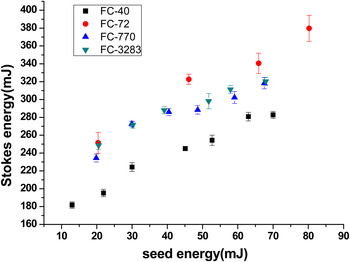
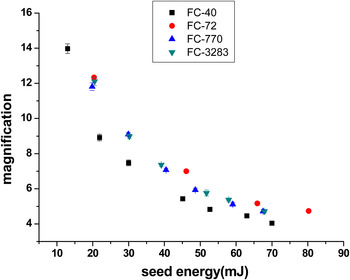
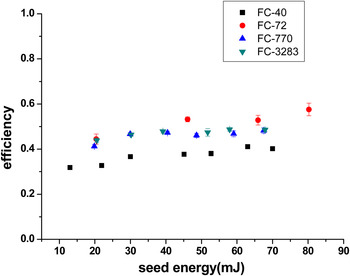
In order to find their relationship between the four kinds of medium and the variation of the seed, the experiment results are as follows. Figure 2 shows that in different energy of seed injection and the amplified Stokes, light changes with the seed of light energy in four different medium. Figures 3 and 4, respectively, correspond to the energy magnification and the energy extraction efficiency amplification curve.
(Color online) Amplified Stokes light energy as seed light energy change in four kinds of medium.

(Color online) Stokes energy magnification as seed light energy change in four kinds of medium.

(Color online) Stokes energy extraction efficiency as seed light energy change in four kinds of medium.

According to the traditional view, SBS gain coefficient of the medium plays a vital role in energy amplifying process. From the results above, FC-72 has the maximum gain coefficient. Its amplifying Stokes light energy magnification and the energy extraction efficiency is higher than the other three kinds of medium.
By using different kinds of medium, the amplified Stokes light energy increases with the seed light energy increasing. On the other hand, the energy magnification is decreasing, while the energy extraction efficiency increases a little. This is because when it keeps the energy and the peak power unchanged, the meeting condition and the cell's length will be unchanged. The gain that the Stokes light obtained from the pump is at a certain value. Therefore as the seed light energy increases, the energy magnification is decreasing and the energy extraction efficiency is relatively stable.
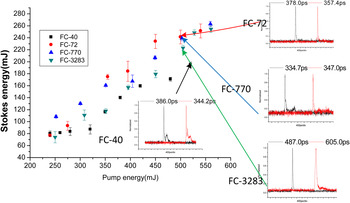
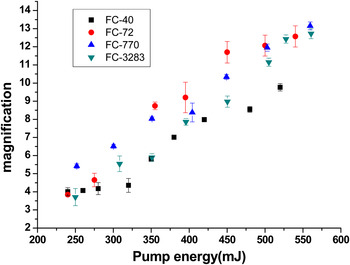
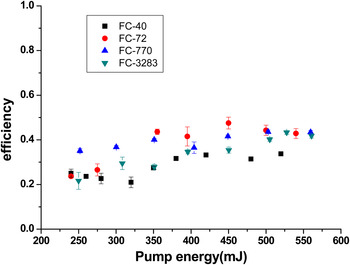
Then keeping the seed energy at 20 mJ, the Brillouin amplifying process was observed with the pump light energy variation in four kinds of different medium. Figure 5 shows the energy of Stokes light changes with the increase of the pump energy, as well as the waveform of the Stokes light. Figures 6 and 7, respectively, correspond to the energy magnification and the energy extraction efficiency amplification curve as the pump energy changes.
(Color online) Amplified Stokes light energy as pump light energy change in four kinds of medium and waveform of the Stokes light.

(Color online) Stokes energy magnification as pump light energy change in four kinds of medium.

(Color online) Stokes energy extraction efficiency as pump light energy change in four kinds of medium.

As the pumping light energy changes, FC-72 has the maximum energy extraction efficiency and the highest magnification. And FC-40 is the minimum.
The gain that the Stokes light got from the pump satisfies the equation G = gIL. As the pump light energy increases, SBS amplification gain becomes larger and the amplified Stokes light energy increases and the magnification improve. And with the increasing of the gain, the seed light can extract more pumping light energy in a unit time, therefore the energy extraction efficiency increases.
From the experiment results, it can be seen that the experimental data of FC-40 has a smaller deviation and FC-72 has a bigger deviation. It means that FC40 has a higher stability of energy amplification. What has been listed in Table 1 is that FC 40 has the shortest phonon lifetime while FC 72 has the longest. Phonon lifetime has a great relationship with amplification stability. The shorter the relaxation time is, the higher stability could be expected. This phenomenon can draw a conclusion that medium with shorter phonon lifetime and high gain factor is fit for SBS amplification.
The energy extraction efficiency doesn't change much as the pump light varies. The pump light is nanosecond pulse with width of 8 ns. If the Stokes and the pump have the same peak power, the energy of the pump will be much larger than the Stokes. The amplification program can be regarded as saturated gain process. The energy extraction efficiency didn't rise as the pump energy increase. On the other hand it shows attenuation trend.
CONCLUSION
By the same peak power with the pump pulse of 8 ns width, the Stokes seed of a few hundred picoseconds was amplified based on SBS amplification. Different energy condition and different kinds of medium were studied. The results show that with the increasing in the gain of the medium, Stokes light energy magnification and energy extraction efficiency are increasing, and with the increasing of the pump light energy, Stokes light energy magnification and energy extraction efficiency are also increasing. By using new fluorocarbon medium and being through SBS amplification process, over 10 times magnification can be gained, and energy extraction efficiency is about 40%. This experiment proves that it is available to amplify 100 ps laser pulse by nanoseconds laser pulse through SBS method.
In additional, some of the experiment results show that the waveform will broaden after SBS amplifying, for example in FC-3283. This phenomenon may have a relationship with the purity of the medium, the Brillouin gain width, medium phonon lifetime, and the injection pulse width of the seed light. In the future we want to fulfill some experiments to explain this phenomenon.
ACKNOWLEDGEMENTS
Project supported by the National Natural Science Foundation of China (Grant No. 61378007 and No. 61138005) and the Doctoral Fund of Ministry of Education of China (Grant No. 20102302120030).