Social memory has become an increasingly relevant topic within anthropology, history, and archaeology, as the scientific and humanistic aspects of these disciplines are scrutinized, parsed, and critiqued. Archaeologists in particular have been drawn toward social memory as a means of reconceptualizing the past in collective, incorporative terms that can potentially balance local, community-based processes and broader meta-narratives, such as scientific objectivity. In Maya archaeology, the importance of understanding social context and archaeological relevance has never been greater, as indigenous activism, postcolonial thought, and identity politics challenge a model of archaeology as a Western-dominated, insulated practice.
The utilization of social memory as an interpretive tool may provide one means of bringing together seemingly disparate practices for understanding the past. As defined by the sociologist Maurice Halbwachs (Reference Halbwachs and Coser1992), social memory is a collection of remembrances shared by a community. This deceptively simple definition begs a number of key issues, which have been taken up by Halbwachs himself and subsequent researchers (see Olick and Robbins Reference Olick and Robbins1998), including how memories are created, collected (or discarded), and shared (Connerton Reference Connerton1989; Shackel Reference Shackel2001); the role of history vis-à-vis memory (Bourguet et al. Reference Bourguet, Valensi and Wachtel1990; Burke Reference Burke and Butler1989; Lowenthal Reference Lowenthal1997; Nora Reference Nora1989); and the role of culture and community (Birth 2006; Butler Reference Butler1990; Cattell and Climo Reference Cattell, Climo, Climo and Cattell2002; Rowlands Reference Rowlands1993; Shackel Reference Shackel2001). Recently archaeologists have begun attempts at applying social memory approaches, as diverse as they are, to interpreting the archaeological past (e.g., Van Dyke and Alcock Reference Van Dyke, Alcock, Van Dyke and Alcock2003) in an attempt both better to understand the past and to historicize the study of social memory; a corrective to what Olick and Robbins (Reference Olick and Robbins1998:134) called the “ahistorical” underpinnings of sociological studies of the topic. This paper examines sacred sites of the Jakaltek Maya of western Guatemala as examples of the connection between the materiality of archaeology and social memory in a community.
The dichotomous relationship between memory as a culturally contingent, communal, and subjective process and history as an impartial, academic, fact-based analysis has been subjected to a rigorous critique (Lowenthal Reference Lowenthal1997). While this critique is partially due to the diverse disciplines that have appropriated the topic and the resulting variety of uses and interpretations (Olick and Robbins Reference Olick and Robbins1998:105), the dialog attests to the general relevance of social memory to all societies and to the increasing blurriness of boundaries among disciplines as well as categories of social analysis. While the memory-history dichotomy continues to fuel research, such as questioning the persistence of memory beyond an individual's life or contrasting objectivity (history) with subjectivity (memory), researchers have increasingly emphasized questions regarding the constitution of society generated from different views of the past. In this way, the production of history is seen as equally constructed and contingent as social memory, with history often becoming an official, sanctioned version of the past (see Geary Reference Geary1994), with different versions being deployed for various purposes within a given context.
Seminal works in social memory such as Halbwachs (Reference Halbwachs and Coser1992) and Connerton (Reference Connerton1989) do not explicitly address archaeology, but they do provide themes that are relevant and can be applied to archaeological issues, as papers in this special section demonstrate. Maurice Halbwachs (Reference Halbwachs and Coser1992) suggested a number of key characteristics to distinguish collective memory. First, he argued that it operates in the “mental and material spaces of the group;” collective memory is both social and tied to materiality. While not developed by Halbwachs, memory's social aspect relies on culture, implying that the cultural differences of groups generate different collective memories. The shared nature of culture, particularly as a process, necessarily incorporates a degree of instability and variability, and versions of the past are likewise experienced, interpreted, and understood in different ways, both by individuals and groups. As Paul Shackel (Reference Shackel2001:655) points out, individuals seek validation of their memories with other people; moving from individual to social, they agree to remember (or forget) collectively.
Regarding materiality, Halbwachs suggests that collective memory is closely tied to specific places or locations. While materiality applies fairly broadly to categories such as burial practices (Gillespie Reference Gillespie, Silverman and Small2002; Joyce Reference Joyce and Chesson2001), Halbwachs specifically mentioned locations. While this idea is not developed by Halbwachs, he anticipated anthropological and archaeological research on the role of place (Basso Reference Basso1996; Feld and Basso Reference Feld and Basso1996) and landscapes (Ashmore and Knapp Reference Ashmore and Knapp1999). Halbwachs' observations and subsequent developments reinforce the close ties between collective memory and specific, definable places. Connerton (Reference Connerton1989) built upon Halbwachs' observations to suggest social memory was performance-based and proposed that various types of rituals were enacted at specific places, providing continuity with the past. For archaeology, the importance of the relationship between place and social memory cannot be overstated, as it provides a vital link between versions of the past and the material record. And, as shown below for the Maya in particular, specific places—known as sacred sites (Ivic de Monterroso Reference Ivic de Monterroso, Golden and Borgstede2004)—are integral to understanding social memory and culture.
SACRED SITES, SOCIAL MEMORY, AND ARCHAEOLOGY
Archaeology, as a discipline involved in the development of a version of the past, has a vested interest in the study of the processes of remembrance and social memory—for both interpretation and as a sociocultural influence on the practice of the discipline in the present. Landscape approaches have provided one point of entrance for analyzing the materiality of social memory. As Knapp and Ashmore (Reference Knapp, Ashmore, Ashmore and Knapp1999:13) state, “landscape is often regarded as the materialization of memory, fixing social and individual histories in space,” as places become repositories for collective memory. This memory encoding of landscape is common in many cultures (Buikstra and Charles Reference Buikstra, Charles, Ashmore and Knapp1999; Snead and Preucel Reference Snead, Preucel, Ashmore and Knapp1999) and often revolves around the memorial encoding of places. Van Dyke and Alcock (Reference Van Dyke, Alcock, Van Dyke and Alcock2003:5) have suggested that “place” is one line of evidence for examining social memory archaeologically. Places—specific locales imbued with historical meaning—are sites of memory.
Communities often organize social remembrance around sites of memory (Connerton Reference Connerton1989). Research on both social memory and sites leads to a possible framework for its investigation in archaeology, which I believe is distinguished by three elements: (1) symbolism—cultural significance to the members of the community; (2) materiality—actions associated with particular, known places; and (3) temporality—an association with the past. Sites of memory define, delimit, and categorize the memories of individuals, integrating them into the collective memory (Shackel Reference Shackel2001:655). Sites of memory are locales of practices—often ritual action—that reinforce the cohesion of the community through either collective activity or individual actions that draw upon shared understandings. They also encode culturally-specific understandings of the past, knowledge of which is required to identify with and participate in the community, establishing memories—both those that should be remembered as well as those to be forgotten. As Van Dyke and Alcock (Reference Van Dyke, Alcock, Van Dyke and Alcock2003:3) suggest, social memory acts to obliterate as well as connect to the past, “as pasts may be subsumed and dominated, conquered and dismantled.” Ultimately, the collective memory is shaped by and also shapes the practices and meanings at a site of memory.
Additionally, social memory as enacted through sites of memory reinforces and constructs a common past for the development of boundaries of identity formation. Social memory can act to create and reinforce ethnic identity by providing a sense of time depth and a shared past often required of ethnic identification (Eriksen Reference Eriksen2002). The production of collective memory and the sites at which production occurs define collective identity, binding together places, actions in the present, and understandings of the past into a meaningful boundary marker of identity (Knapp and Ashmore Reference Knapp, Ashmore, Ashmore and Knapp1999:14–16).
These aspects of sites of memory—symbolism, materiality, and temporality—are incorporated in the sacred sites of the Maya of Highland Guatemala. Most ethnographers of the Maya recognize the close relationship between Maya cultural meanings and specific places.Footnote 1 Sacred sites, particularly in the highlands (Fruhsorge Reference Fruhsorge2007; Ivic de Monterroso Reference Ivic de Monterroso, Golden and Borgstede2004), are often associated with mountains, caves, and rivers (e.g., Vogt Reference Vogt1969) that probably have great time depth of sacredness in Maya thought (Brady and Ashmore Reference Brady, Ashmore, Ashmore and Knapp1999). The definition of the community that holds these sites of memory to be sacred is an open question, given the complexity of defining “Maya” (Bastos and Camus Reference Bastos and Camus2003; Gabbert Reference Gabbert, Hostettler and Restall2001) or related ethnic (Wilson Reference Wilson1995) or closed corporate (Wolf Reference Wolf1957) communities.
Sites of memory in the Maya Highlands in particular must be understood as locales where ritual practices occur; they become sacred sites through ceremonial activities. Through landscapes, histories are tied to specific, fixed, and material places (Knapp and Ashmore Reference Knapp, Ashmore, Ashmore and Knapp1999:13), creating permanence in sites of memory that is accessed through practices in order to construct and reinforce histories. A sacred place without ritual activity ceases to be remembered and loses its importance as a repository of memory; it is forgotten. Additionally, practices by individuals integrate that person into a broader social narrative and memory. Individual actions tie contingent, personal recollections to the shared cultural understanding of what a sacred site represents, molding that memory in the process. As Kay Warren (Reference Warren and Stepan1992:194–195) states of religious processions among the highland Maya, “remembering [is] a specialized activity in a system in which religious participation in processions and rituals [is] of primary importance for most individuals … what matter[s] [is] that different [individual] wills manage to converge to celebrate the commonality of place that define[s] their community.”
JAKALTEK SITES OF MEMORY
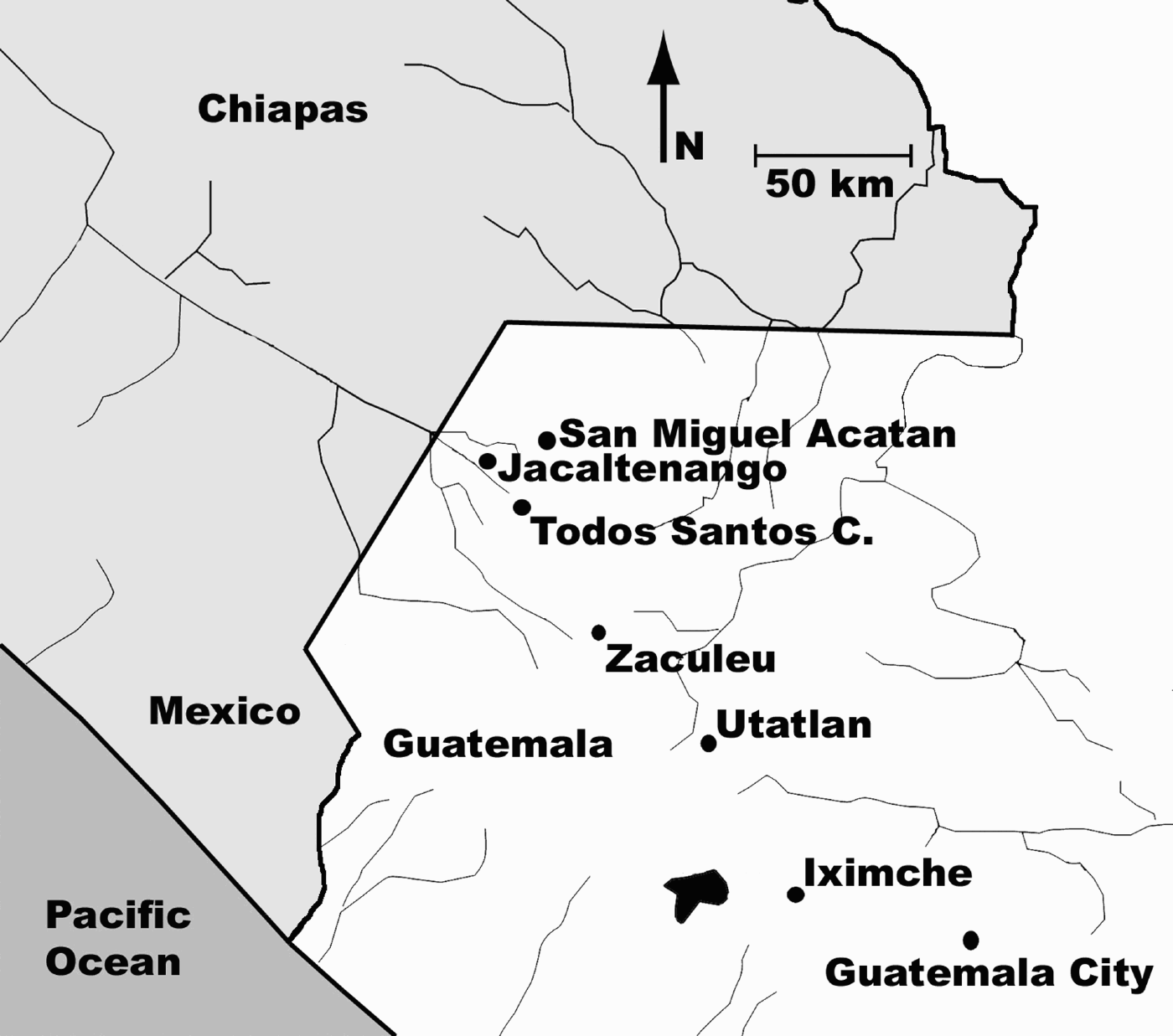
These aspects of social memory—symbolism, materiality, and temporality—can be illustrated through an examination of three sacred sites among the Jakaltek Maya of the western highlands of Guatemala (Figure 1). Centered around the modern town of Jacaltenango in the Cuchumatan Mountains of the Department of Huehuetenango, Guatemala,Footnote 2 the Jakaltek Maya are also known as the Huista and speak Popti' (or Jakaltek). The Jakaltek have been the objects of study by Western researchers of culture (Casaverde Reference Casaverde1976; LaFarge and Byers Reference LaFarge and Byers1931, Reference LaFarge, Byers, Montejo and Estrada1997) and history (Borgstede and Romero Reference Borgstede, Romero, Laporte, Arroyo, Escobedo and Mejia2003, Reference Borgstede and Romero2004; Collins Reference Collins1980) as well as Jakaltek Maya researchers (Asociación Jacalteca Reference Jacalteca1990; Montejo Reference Montejo2005; Montejo Diaz Reference Montejo Diaz1998a, Reference Montejo Diaz1998b). Recent research on the archaeology of the Huista region (Borgstede Reference Borgstede2004) has shown that there is, not surprisingly, a close relationship between the Jakaltek community's understanding of the past and the archaeological heritage of the region. The correlation is best represented by the use and remembrance of sacred sites, the majority of which are also archaeological sites.Footnote 3
Map of Guatemala Highlands, indicating locations mentioned in the text.

Sacred sites are common throughout the Jakaltek region and are most often marked by the erection of one or more crosses. The cross, as a sacred symbol of Catholicism with syncretic elements of pre-Columbian ideology, has developed into a symbol of sacredness with meaning beyond merely Christ's crucifixion (LaFarge and Byers Reference LaFarge, Byers, Montejo and Estrada1997:190). Crosses are ubiquitous throughout the Jakaltek landscape, marking both secular space, when functioning to mark territorial boundaries or mojones, and sacred space, when marking sacred sites as well as pilgrimage routes. As Casaverde (Reference Casaverde1976:86) states:
Crosses are tz'unu “planted” in strategic places … which are believed to protect the settlement [of Jacaltenango]. [These crosses] symbolize the unity and identity of the Jacaltenango [community] members. … Similarly, crosses are “planted” on specific places along trails. …Alcaldes rezadores of the [Jakaltek community] perform rituals to these crosses on behalf of [community] members …Crosses serve as markers of sacred places. Thus all the sacred places are marked by wooden crosses that serve as shrines, in front of which rituals and prayers are performed.
Because Jakaltek sacred sites are usually archaeological sites, social memory maintains the cultural and historical importance of a locale, or at least actively to remember places. Sacred sites also have local, community-based relevance. That is, they are understood to mean something in local lives, pasts, or memories; they are situated where they are for a particular, socially rationalized, and explicable reason. Casaverde (Reference Casaverde1976:78a) provides a partial map of Jakaltek sacred places, but here I will discuss three that underscore elements of social memory and archaeology in Jakaltek culture. Not coincidentally, these sites reflect a Jakaltek tradition of marking sacred space on mountains, along river valleys, and in caves, locations often associated with ancient (e.g., Brady and Ashmore Reference Brady, Ashmore, Ashmore and Knapp1999) and modern Maya (e.g., Vogt Reference Vogt1969).
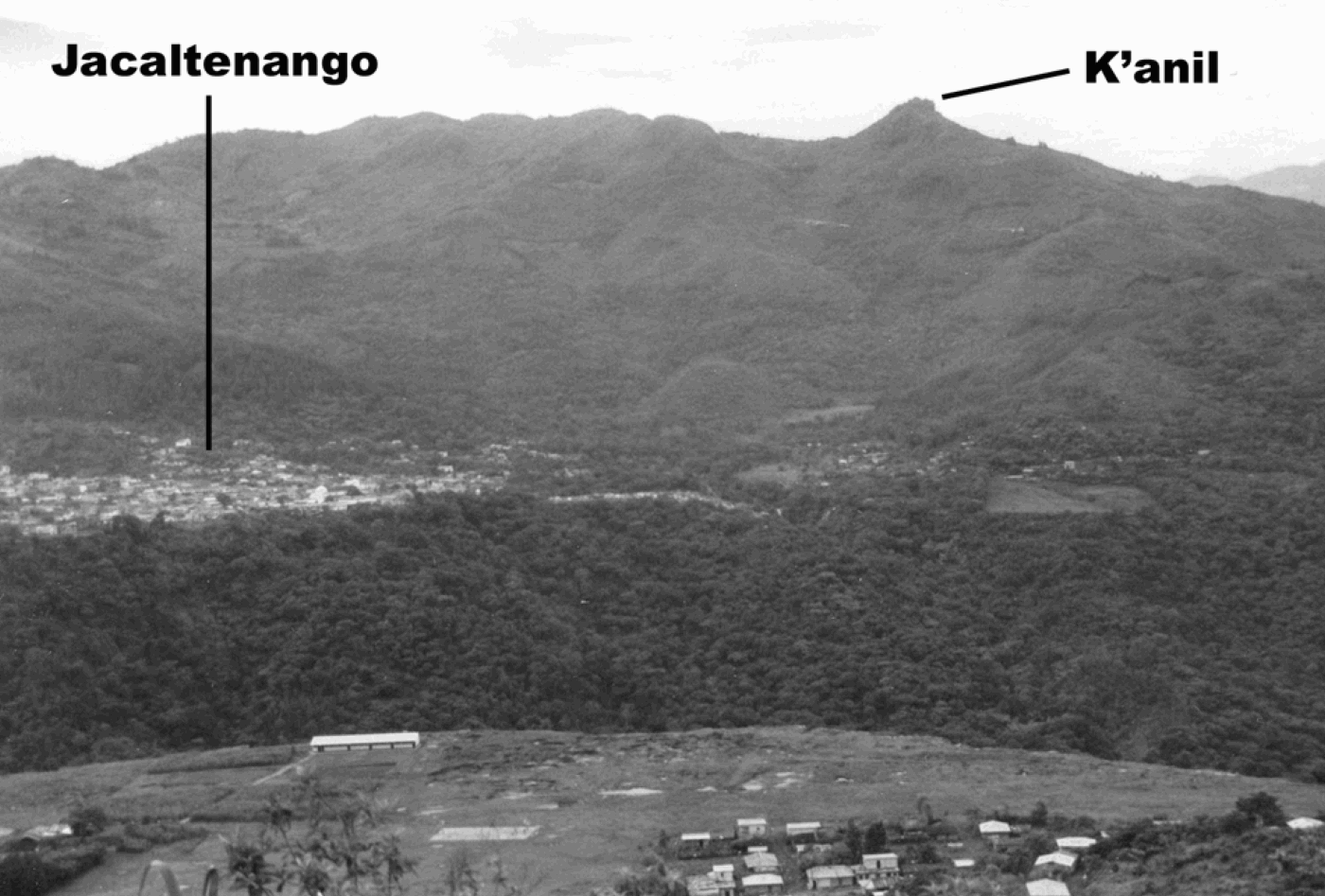
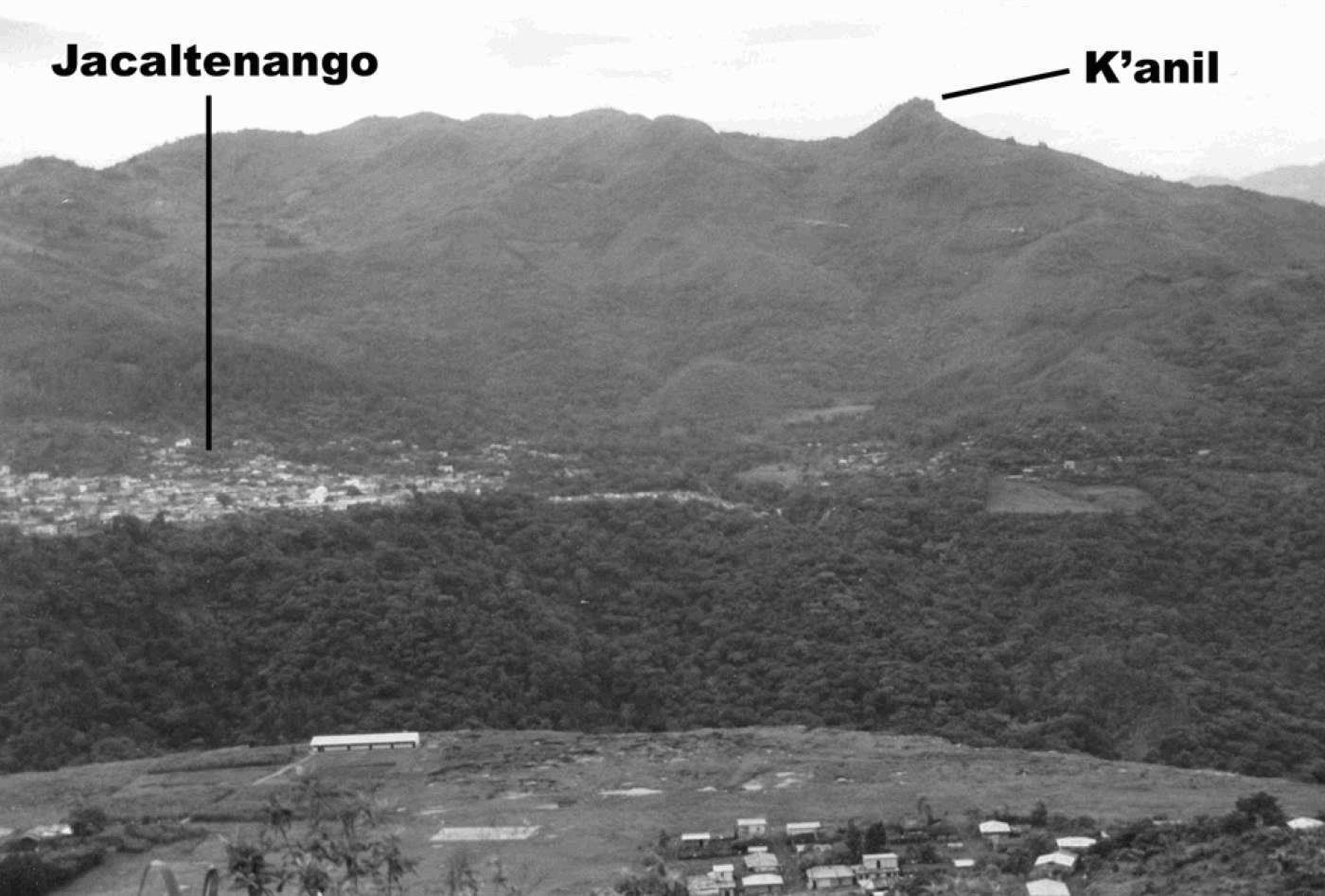
The first site, K'anil, is located on a mountaintop in the center of the Huista territory and is arguably the most important sacred site in the Jakaltek region (Figure 2). The archaeological site consists of a series of low and medium-sized (3–5m in height) platform mounds constructed of cut stone and river cobbles, spread along the relatively flat apex of the mountain, dating to the Postclassic period (a.d. 1000–1500). The site overlooks two river valleys, the Río Azul and the Río Huista, that are occupied by the Huista. It is associated with (and named after) a principal protagonist in Jakaltek history (Casaverde Reference Casaverde1976:32; Montejo Reference Montejo1984), who is also a Yearbearer in the Jakaltek calendar (LaFarge and Byers Reference LaFarge, Byers, Montejo and Estrada1997:198). The understanding of the site, as of the deity itself, is variable, with multiple meanings. Casaverde (Reference Casaverde1976:33), for example, lists four different meanings for K'anil (founding ancestor, protector god, war god, and Yearbearer). While Montejo (Reference Montejo1984) provides another robust characterization of K'anil, Jakaltek oral histories provide other versions for K'anil as well. While the narratives themselves are important in Jakaltek culture, with regard to social memory, the salient point is that they tie K'anil to the mountain on which the archaeological/sacred site is located.
View of K'anil, located on mountaintop, and Jacaltenango, facing south (photo by author).
The variable meanings of the sacred site are reflected in the different acts and rituals carried out at the site. Both individuals and groups perform at K'anil, with varying motives and understandings of the site's role. Individual acts are often one of two types: petitions or respects. Petitions refer to individuals requesting particular outcomes, such as crop fertility, healthy childbirth, or successful marriage, drawing on the guise of K'anil as community protector. Petitions can be made by community members or mitigated through an alcalde rezador. Respects refer to prayers and rituals associated with other, nonpetition acts, particularly the remembrance of ancestors, both specific (grandfathers, mothers, other lineal relatives) and general (non-named community ancestors, or nuestros antepasados). Social acts often revolve around the activities of cofradías, or religious groups organized under the rubric of the Catholic Church. These acts are often syncretic, combining indigenous and Catholic symbols, practices, and meanings. These social groups are integrated into a broader civic-religious hierarchy (for other highland Maya examples, see Cancian Reference Cancian1965; Tax Reference Tax1937) operating in Jacaltenango and their meaning and function are dependent upon the operation of the hierarchy as a whole. As with individual acts, the social groups also carry out petitions and respects but are dedicated to the specific roles of the cofradía within the system. Importantly, all of these acts reference the role of K'anil in Jakaltek history, primarily as protector of the pueblo. This protector guise is based on the memory of K'anil's role in the town's founding.
An understanding of the importance of both the sacred site and its dedicated protagonist are required for inclusion in a Jakaltek identity. That is, the meaning associated with the site is a rather clear boundary marker for distinguishing authentic “Jakaltekos” from noncommunity members. This is in contrast to another sacred site, Yul Ha' (discussed below), which is of significance outside the Jakaltek community to members of the neighboring towns of San Miguel Acatán and Todos Santos Cuchumatan. Narratives attached to K'anil the protagonist and K'anil the sacred site, which are nearly indistinguishable, are understood less as history (in the Western, academic, objective sense) and more as a reinforcement of Jakaltek identity and cultural continuity between past and present. The fact that the sacred site of K'anil is an archaeological site dating to the Postclassic period reinforces this continuity and suggests collective memory with substantial time depth; the continued use and importance of the site over time shows that the community has collectively remembered the site, claiming it territorially and ideologically in the past and present.
Of equal importance are the acts that are carried out at the site, which connect the present of the modern Maya with the past and revered ancestors. While reverence for ancestors has long been recognized as an important aspect of Maya culture in both the past (McAnany Reference McAnany1995) and the present (Brintnall Reference Brintnall1979; Nash Reference Nash1970), its role in connecting one with the other is understudied (but see Wilk Reference Wilk1985). It is at sacred sites such as K'anil that this process occurs in everyday practice in the Jakaltek world, stressing cultural continuity and social memory through both known, named ancestors and general, nonspecific ancestors.Footnote 4 As Van Dyke and Alcock (Reference Van Dyke, Alcock, Van Dyke and Alcock2003:3) state, “The construction of social memory can involve direct connections to ancestors in a remembered past, or it can involve more general links to a vague mythological antiquity, often based on the reinterpretation of monuments or landscapes.”
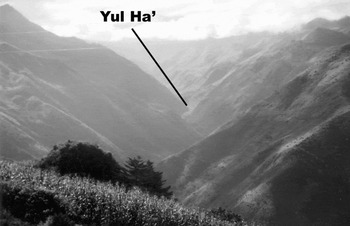
The second site—Yul Ha'—is located at the base of a river valley (Figure 3) and holds the burial places of the male and female founding couple of the Jakaltek ethnic group. These two figures are purportedly buried in mounds about 300m apart alongside an important river through Jakaltek territory near the river's source. The two figures are considered the founders of the Jakaltek pueblo as well as the founders of the raza, or ethnic group, of San Miguel Acatán (the Acatec Maya, close neighbors of the Jakaltek Maya). The locale is a sacred site for the Jakalteks and is often visited by people of San Miguel Acatán and Todos Santos Cuchumatan. The narrative associated with Yul Ha' revolves around a first couple who traveled from the (vaguely defined) North to settle at the site after undergoing a number of stops and trials. They then founded, by various means, the towns of Jacaltenango and San Miguel Acatán in their current locations. A version of the narrative is known to all Jakaltek community members, and it has much in common with the founding story recorded in the Popol Vuh of the K'ich'e Maya. In addition to association with the founding couple, Yul Ha' is an archaeological site, dating to the early Postclassic period (a.d. 1000–1250).
View of Yul Ha', located at base of a river valley, facing east (photo by author).

This sacred site is closely associated with a particular past of the Jakalteks and one of the most important sites of memory in the region. It is tied to ancestors—the founding couple—and is gendered—the founding father and mother are buried in separate, known locations at the site. Rituals performed at the site are both individual and social, in a manner similar to those at K'anil. Also similar to K'anil, access to the site is restricted, not by institutional means (fences, tolls, permits, and so on), but by topography. Until recently, both sites could only be reached via long and difficult treks, up a mountain in the case of K'anil and deep into a valley in the case of Yul Ha'. Inaccessibility reinforced the importance of the ritual act of reaching the place, and the pilgrimage to the site became an important component of the site's sacredness.
Yul Ha', as with K'anil, perpetuates itself through its association with the ancestors and their importance in social memory. Yul Ha' is associated with a more specific past, or events in the past—that of the founding of the town of Jacaltenango. The past is accessed through the act of remembering the individuals involved in the founding, the first mother and first father. This past is less “messy”; there is a more generally accepted and recounted version of the narrative. The ability to be able to point to a knowable past, as well as to locales where key events took place, is viewed as vital to the legitimization of the past itself as well as the cohesion of the group relying on that past. For the Jakalteks, who are taught versions of Spanish and European history in school, there is a certain amount of cultural validation in the ability to index a uniquely Jakaltek past and where events occurred (Silvestre [Reference Silvestre2000] and Borgstede and Silvestre [Reference Borgstede and Silvestre2002] examined Jakaltek history and education). The reinforcement of this history is an important reason for a focus on political action in the present to reclaim sacred sites across the highlands by various Maya groups.
A third sacred site is a cave that was recently rediscovered and sacralized by the Jakaltek community. There is an abundance of caves in the Jakaltek region, many of which have evidence of pre-Columbian occupation and use. While constructing a road, workmen discovered a cave that contained a number of pre-Columbian artifacts, including ceramic bowls and jars, greenstone celts, and musical instruments (flutes and drums), as well as human remains. After some of the objects were removed, community members sealed the entrance and constructed a shrine at the site. The shrine consists of an open-air pavilion, a cement patio, and two crosses. This effort sacralized the site which is now incorporated into the corpus of sacred sites in the region.
The cave underscores two important points concerning sites of memory among the Jakalteks. First, evidence of past, pre-Columbian use is usually sufficient for beginning the process of sacralization of a place. That is, most archaeological sites, by virtue of containing evidence of the past, are candidates for sacred places. An open issue, however, is the decision-making process by which one archaeological site is chosen as a sacred site over another, equally viable candidate. In the Jakaltek region, the majority of sacred sites are archaeological sites, but not all archaeological sites are sacred sites. In the case of the cave site, part of its sacredness is based on archaeological evidence; it referenced, through material objects, the Jakaltek past and the ancestors inhabiting that past. The presence of human remains, importantly, reinforces the connection of the site to community ancestors. Combined with this, however, was the context of community awareness, publicity, location, and other factors that generated an ideal situation for the sacralization of this particular place at this particular time.
The elevation of the cave as a sacred site highlights the active and ongoing nature of sites of memory. There is a process, whether explicitly stated or not, of sacralization of locales that plays out through various community acts: discovery, raising of awareness, conviction of importance, material reinforcement (construction of buildings, erection of crosses, etc.). Many different locations have the potential to become sacred sites, provided that they fulfill certain community-determined criteria. In Jacaltenango, one important criterion, although not the only one or necessarily the most important, is archaeological evidence. It stresses the connection between the modern community and its roots in the past. The fact that an archaeological site, even a recently discovered one, can be sacralized and obtain a place in the social memory of the community has important implications, including for ethical archaeological practice in the Maya Highlands.
Each of the three Jakaltek sacred sites displays the characteristics of sites of memory. Each place, in its variations, highlights different aspects of sites of memory. K'anil encapsulates variable narratives, but all connect past with present. Yul Ha' exemplifies a more fixed history and one that involves the development of, and appreciation for, a widely accepted or shared Jakaltek history. And the cave site provides an example of process in sacred site construction and development, reinforcing the nonstatic, nonessentialist nature of sites of memory and Jakaltek culture.
DISCUSSION AND CONCLUSION
The aim of this examination is not to provide a highland Maya analogy for interpreting sites of the Classic period. Too often the modern Maya are seen by archaeologists as sources of uncritical, ahistorical analogies for interpretation or hypothesis testing, which reinforces cultural essentialism at the expense of understanding the complex historical and cultural trajectories that connect ancient and modern Maya (Borgstede and Yaeger Reference Borgstede, Yaeger, Rizvi and Liebmann2008). Rather, the intent is to examine the relationship between social memory, sacred sites, and archaeological resources in the present. One aspect of the significance of the relationships lies in its implications for the practice of archaeology in Guatemala. The social context of archaeological practice among the Maya is gradually shifting, due to pan-Maya organizing (Arias Reference Arias2006; Bastos and Camus Reference Bastos and Camus2003, Reference Bastos and Camus2004; Cojtí Cuxil Reference Cojtí Cuxil1995; Macleod Reference Macleod2006; Montejo Reference Montejo2005; Warren Reference Warren1998), the relationship between archaeologists and local communities (Ardren Reference Ardren2002; Del Cid and Demarest Reference Del Cid, Demarest, Laporte, Arroyo, Escobedo and Mejía2004; Pyburn Reference Pyburn, Golden and Borgstede2004; Yaeger and Borgstede Reference Yaeger, Borgstede, Golden and Borgstede2004), international and national forces (Magnoni et al. Reference Magnoni, Ardren and Hutson2007; Cojtí Ren Reference Cojtí Ren2006), and other factors. Sacred sites, which are fundamentally tied to social memory, retain a prominent position in modern Maya cosmovision (Bastos and Camus Reference Bastos and Camus2003) and will continue to impact decisions regarding archaeological sites in Guatemala.
As the example of the cave suggests, sacred sites can be created in the present, raising the question of sacredness in ongoing archaeological research in the highlands and elsewhere. In the Jakaltek example, the cave site was uncovered accidentally, but systematic archaeological investigations and continuing community development and population growth throughout the Maya Highlands are sure to uncover more places with archaeological remains in a wide range of categories (including caves and human remains). Because these places have the potential to become sacralized, dialogue and collaboration among stakeholding groups is imperative. As sites of memory are negotiated in the present, it is important to realize that the process is neither random nor entirely constructed; it follows identifiable lines, drawing upon cultural conceptions, norms, and histories already extant, occasionally even drawing on other sites of memory. In the Jakaltek example, K'anil and Yul Ha' are related through a common past. In addition, Jakaltek sacred sites cannot be essentialized into “timeless” locales of memory where narratives do not change, even as they draw upon both the past and the present. Researchers must understand social memory as a constructive process that is enacted at specific locales for specific purposes. Sacred sites, as with other aspects of Maya culture, are a cross between structure and process, agency and institution, which by association calls for a balanced, nuanced approach in archaeological investigations (Hegmon Reference Hegmon2003).
In addition, the value of archaeological resources as sites of memory resonates with many Maya groups' desire for community-based histories, often built in a Western mode. As pointed out above, social memories encoded in sacred sites are often the only surviving versions of the past available to a community. Van Dyke and Alcock (Reference Van Dyke, Alcock, Van Dyke and Alcock2003:3) state that “Although in archaeological contexts it is easiest to see the top-down machinations of elite groups using memory to [further their own] ends, memory is also employed in the service of resistance[,]” that is, to validate alternative, community-based histories. Maya public intellectuals have argued for protecting these histories (Bastos and Camus Reference Bastos and Camus2003; Cojtí Cuxil Reference Cojtí Cuxil1995; Montejo Reference Montejo2005) and the sites used to remember them. By valorizing and protecting these versions of the past, pan-Maya leaders hope to reinforce claims on political and economic power in the present. Sacred sites, along with Maya languages, have become a common symbol of Maya activism in Guatemala. The role of archaeology in this discussion is evolving and potentially contentious (Cojti Ren 2006; Ivic de Monterroso Reference Ivic de Monterroso, Golden and Borgstede2004). Ultimately, history is a key aspect in identity formation and the retention of a distinctly Maya history is an important component of the validation and legitimization of Maya culture in the modern Guatemalan state.
Halbwachs (Reference Halbwachs and Coser1992) and other scholars of social memory (e.g., Connerton Reference Connerton1989) pointed out that while different groups share different memories, those memories both shape and are shaped by actions in the present. This recursivity has implications for the practice of archaeology, particularly when, for example, Western archaeologists are viewed as a distinct community with a social memory of its own. Such a community draws upon a different social memory to interpret actions in the present. The archaeological and descendant Maya communities, neither monolithic nor atomistic, will draw upon their distinct social memories to interpret and understand both the past and places associated with the past. And while the understandings are different, mutual interests suggest a point of departure for dialogue.
These limited examples highlight the close relationship between archaeological practice and the social contexts in which it is carried out. Maya sacred sites, as sites of memory and repositories of culturally-specific versions of the past, have an important role to play in the political, economic, and cultural movements now transpiring in Guatemala. That role is not secondary; in fact, sacred sites are a critical aspect of the pan-Maya agenda. When framed as archaeological sites and the validity that goes with that ascription, the relationship between archaeological definitions and understandings and culturally Maya ones becomes increasingly salient. It is within this context that archaeology will operate within the Maya Highlands for years to come.
RESUMEN
Este artículo aplica técnicas antropológicas y sociológicas a la memoria social para analizar la importancia y ubicación de lugares sagrados de los mayas jakaltekos de las tierras altas occidentales de Guatemala. Después de un resumen breve de la teoría asociada con memoria social, se discute el papel de memoria social en comunidades y se sugiere que los lugares sagrados son lugares de memoria en comunidades de las tierras altas Mayas. Lugares de memoria proveen la evidencia física o material de historias alternativas además de conectar el pasado y el presente con conexiones culturales y sociales.
Basado en investigaciones arqueológicas y la historia oral, la conexión entre el pasado y el presente se analiza para la comunidad maya jakalteka (Jacaltenango) en las tierras altas occidentales de Guatemala. Tres lugares sagrados distintos son discutidos, incluyendo la evidencia arqueológica, importancia en historias (orales y etnohistóricas), creación y situación como lugar sagrado, y enlaces a la memoria social de la comunidad. El primer lugar está ubicado encima de una montaña, contiene evidencia arqueológica del periodo postclásico, y se incorpora en la identidad comunitaria. El segundo lugar, también un sitio arqueológico, se ubica en el valle de un rió y tiene importancia con otras comunidades mayas además de la comunidad jakalteka. El tercer lugar es una cueva recién descubierta que muestra la posibilidad de la creación de lugares sagrados nuevos. En conclusión, lugares sagrados y memoria social se ven como partes integrales del activismo indígena y la política de identidad como también son parte del entendimiento del contexto social de la práctica de arqueología en las tierras altas mayas de Guatemala.
ACKNOWLEDGEMENTS
Field research was conducted under the auspices of the Proyecto Arqueológico de la Región Huista-Acateco, directed by the author and Luis Romero, with the permission of the Ministerio de Cultura y Deportes and the municipios of Jacaltenango, Concepción, San Miguel Acatán, Santa Ana Huista, San Antonio Huista, and San Martin Cuchumatan. The author would like to thank Juan Jose Camposeco, Balthazar Cárdenas, Juan Edmundo Cárdenas, and Tito Delgado. Helpful comments were received by Wendy Ashmore, Charles Golden, Eugenia Robinson, Carole Ventura, and an anonymous reviewer; the author is responsible for all information and conclusions presented in this article. Funding for different components of research was provided by the University of Pennsylvania Department of Anthropology, the Foundation for the Advancement of Mesoamerican Studies, Inc, and the National Science Foundation (No. 0208553).