


Introduction
Studies of violent, infant-related intrusive thoughts experienced by mothers (especially first-time mothers) during the early postpartum period make it clear that they are a very common and distressing experience, affecting more than 90% of new mothers (Abramowitz et al., Reference Abramowitz, Tolin and Diefenbach2005; Abramowitz and Deacon, Reference Abramowitz and Deacon2006; Ahmad et al., Reference Ahmad, Suleiman and Shougah1994; Kleinknecht and Thorndike, Reference Kleinknecht and Thorndike1990; Mann et al., Reference Mann, Gilbody and Adamson2010; Meyer et al., Reference Meyer, Miller, Metzger and Borkovec1990; Wynter et al., Reference Wynter, Rowe and Fisher2013). Such thoughts may pertain to accidental or intentional harm to the infant. Given the proportion of new mothers who report thoughts of infant-related harm, it appears that these thoughts are a normal postpartum experience (Kleinknecht and Thorndike, Reference Kleinknecht and Thorndike1990; Mann et al., Reference Mann, Gilbody and Adamson2010; Meyer et al., Reference Meyer, Miller, Metzger and Borkovec1990; Wynter et al., Reference Wynter, Rowe and Fisher2013).
One of the possible negative consequences of new mothers’ experience of infant-related harm thoughts is the development of obsessive compulsive disorder (OCD).
OCD is a mental health condition characterized by obsessions (recurrent, unwanted and distressing thoughts, images or impulses) and/or compulsions (repetitive mental or behavioural acts that the person engages in, in order to decrease the distress associated with the obsessions). OCD is a psychiatric disorder associated with high levels of distress and impairment (Monk, Reference Monk2001; Nerum et al., Reference Nerum, Halvorsen, Straume, Sørlie and Øian2013; Newham et al., Reference Newham, Wittkowski, Hurley, Aplin and Westwood2014; Nieminen et al., Reference Nieminen, Stephansson and Ryding2009, Reference Nieminen, Berg, Frankenstein, Viita, Larsson and Persson2016). For pregnant and postpartum women, OCD has negative implications for fetal and newborn health, mothering and infant development (Challacombe et al., Reference Challacombe, Salkovskis, Woolgar, Wilkinson, Read and Acheson2016; Saisto et al., Reference Saisto, Salmela-Aro, Nurmi and Halmesmäki2001; Salomonsson et al., Reference Salomonsson, Gullberg, Alehagen and Wijma2013; Stoll et al., Reference Stoll, Hauck, Downe, Edmonds, Gross and Malott2016; Straub et al., Reference Straub, Adams, Kim and Silver2012; Sydsjö et al., Reference Sydsjö, Bladh, Lilliecreutz, Persson, Vyöni and Josefsson2014; Sydsjö et al., Reference Sydsjö, Blomberg, Palmquist, Angerbjörn, Bladh and Josefsson2015; Takegata et al., Reference Takegata, Haruna, Matsuzaki, Shiraishi, Okano and Severinsson2015). OCD sufferers are frequently motivated to conceal their obsessions from others, including health-care providers, due to the often socially unacceptable nature of them and fears about what they might mean (Nilsson et al., Reference Nilsson, Lundgren, Karlstrom and Hildingsson2012). This is especially true for women suffering from postpartum OCD (ppOCD) and experiencing thoughts of harming their infant. They may be fearful that their infant will be removed from their care should they disclose their thoughts and, therefore, are highly motivated to conceal their obsessions.
Based on the now significant number of studies demonstrating an increased risk of OCD onset and exacerbation during the perinatal period (Russell et al., Reference Russell, Fawcett and Mazmanian2013), and borrowing heavily from these existing cognitive behavioural theories of OCD, Fairbrother and Abramowitz (Reference Fairbrother and Abramowitz2007) proposed a cognitive conceptualization of postpartum OCD. They hypothesized that the dramatic objective increase in responsibility (i.e., I am responsible for my infant's care and wellbeing) and threat (i.e., my infant is vulnerable to harm and highly cherished) that accompanies the perinatal period, lowers the threshold for OCD development or exacerbation. According to Fairbrother and Abramowitz, cognitive vulnerability to OCD increases the likelihood that normally occurring, albeit upsetting, intrusive infant-related thoughts will be interpreted as highly significant, threatening, and as otherwise requiring attention in order to prevent some feared negative behavioural or moral consequence. Furthermore, overt and covert behavioural patterns that develop in response to the intrusive thoughts (e.g. checking on the infant, avoidance of the infant, attempts to suppress or counteract intrusive ideation) contribute to the maintenance of the obsessional distress.
A number of studies of expectant parents, and parents of infants, provide preliminary support of for this conceptualization. For example, prenatal measures of dysfunctional OCD-related beliefs have been found to predict postpartum OC symptoms even after controlling for pre-existing OC symptoms, anxiety and depression (Abramowitz et al., Reference Abramowitz, Khandker, Nelson, Deacon and Rygwall2006). The tendency to negatively interpret the presence and meaning of early postpartum unwanted intrusive infant-related thoughts has also been shown to be predictive of later postpartum OC symptoms, even after controlling for baseline levels of OC symptoms (Abramowitz et al., Reference Abramowitz, Nelson, Rygwall and Khandker2007). Among mothers and fathers who reported intrusive obsessional thoughts about their infant, thought control strategies have been positively associated with obsessional symptoms (Larsen et al., Reference Larsen, Schwartz, Whiteside and Khandker2006).
In a comparison with pregnant, postpartum and non-childbearing women, general beliefs about responsibility were not found to differ between groups (Barrett et al., Reference Barrett, Wroe and Challacombe2016). However, among pregnant women, baby-related intrusions were interpreted as implying more responsibility, and among mothers, only baby-related responsibility interpretations were related to OC symptomatology.
As pregnancy and the first 6 months postpartum is a unique time in a woman's life, it provides a brand-new source of unwanted intrusive thoughts, namely thoughts of harm coming to the baby, and therefore represents a naturally occurring experiment that allows us to better understand OCD development. The purpose of the present research was to take advantage of the natural changes in the occurrence of unwanted intrusive thoughts, and symptoms of OCD that occur during the perinatal period to assess components of cognitive behavioural conceptualizations of ppOCD. The novel contribution of this research is our focus on new mothers’ thoughts of infant-related harm, and the distinction between thoughts of accidental and intentional harm. In addition, although associations have been established in non-perinatal OCD (Nota et al., Reference Nota, Schubert and Coles2016) it is the first study to assess the impact of sleep difficulties on perinatal OC symptoms. Specific study hypotheses are:
Hypothesis 1:
Prenatal OC-related beliefs are predictive of the development of postpartum OC symptoms (i.e. OBQ-44 subscale scores will predict postpartum OCI-R obsessing subscale scores, at 4 and 12 weeks postpartum, over and above the contribution of prenatal OCI-R obsessing subscale scores).
Hypothesis 2:
Prenatal OC-related beliefs are predictive of maternal postpartum harm thought characteristics and maternal behavioural responses to the thoughts, for both accidental and intentional harm thoughts (i.e. prenatal OBQ-44 subscale scores will predict: (a) infant-related harm thought characteristics, and (b) the severity of behavioural responses to thoughts, for both accidental and intentional harm thoughts, at 4 and 12 weeks postpartum).
Hypothesis 3:
The use of safety-seeking or other strategies to neutralize postpartum intrusive thoughts is predictive of later ppOC symptoms. Specifically:
(1) The severity of postpartum behavioural responses to early (4 week) postpartum intrusive thoughts of infant-related harm (accidental and intentional) predict later (12 week) postpartum OCI-R obsession subscale scores, controlling for 4 week postpartum OCI-R obsession subscale scores.
(2) The severity of postpartum behavioural responses to early (4 week) postpartum intrusive thoughts of infant-related harm (accidental and intentional) predict later harm thought characteristics, controlling for 4 week postpartum harm thought characteristics.
Hypothesis 4:
Concurrent negative mood, maternal fatigue and self-reported sleep difficulties are associated with higher levels of OC symptoms and harm thought characteristics. Specifically, 4 week postpartum BDI, MAF and PSQI scores will correlate positively with 4 week postpartum OCI-R obsessing subscale scores and harm thought characteristics. This will be true for 12 week measures also.
Method
Design
This is a prospective cohort study of postpartum maternal affective, cognitive and behavioural responses to postpartum thoughts of infant-related harm. Additional findings from this research have been presented in an earlier publication (Fairbrother and Woody, Reference Fairbrother and Woody2007).
Participants
Participants were 100 English-speaking pregnant women experiencing a medically uncomplicated pregnancy and expecting a healthy first child. They were recruited via two major hospitals, midwifery and physician offices, and prenatal classes in Vancouver, British Columbia, Canada.
The average age of participants was 32.0 years (SD = 4.3) and ranged from 23 to 41 years. Participants reported an average of 16.7 (SD = 2.4) years of formal education. The majority of the sample was married or living with a romantic partner (97%), was employed (79%), and reported their ethnicity as either Caucasian (76%) or Asian (13%). More than two-thirds of the sample (69%) reported a family income of $50,000 or greater.
Procedures
Participants were recruited in the third trimester of pregnancy and completed questionnaires prenatally (at approximately 36 weeks gestation), and again at 4 and 12 weeks postpartum. At 4 and 12 weeks postpartum, participants were also administered a semi-structured interview to assess infant-related thoughts of harm.
All but two of the 100 participants completed the prenatal questionnaire package. At 4 weeks postpartum, 91 women completed the questionnaires, and 84 completed the interview. A total of 81 women completed the 12 week questionnaires, and 83 completed the 12 week interview. Altogether, this represents a 16% loss to follow-up. Two women entered the study after they had given birth and therefore provided postpartum data only.
Measures
The Obsessional Beliefs Questionnaire (OBQ-44; Obsessive Compulsive Cognitions Working Group (OCCWG), 2005) is a 44-item self-report measure designed to measure beliefs associated with OCD including: responsibility and threat estimation, perfectionism and need for certainty, and importance and control of thoughts. Psychometric properties of the OBQ-44 are good, although discrimination between subscales is low (OCCWG, 2005).
The Postpartum Intrusions Interview (PPII; Fairbrother and Woody, Reference Fairbrother and Woody2007) is a semi-structured interview designed to assess new mothers’ thoughts of accidental and intentional harm related to the newborn. The interview includes an assessment of the content and characteristics of (i.e., frequency of the thoughts, time occupied by the thoughts, distress associated with the thoughts, perceived interference with parenting and other aspects of one's life by the thoughts, and difficulty distracting oneself from the thoughts), emotional and behavioural responses to, and the natural history of accidental and intentional harm thoughts. The PPII was designed specifically for use in this project, the details of which are described in full in an earlier publication (Fairbrother and Woody, Reference Fairbrother and Woody2008).
To date, studies of postpartum intrusive thoughts and ppOCD have focused on the assessment of obsessive compulsive symptoms assessed using self-report measures of symptoms of OCD, validated in non-perinatal samples. We were concerned that some elements of typical self-report measures of OC symptoms might not be recognized by new mothers as relevant to their infant-related harm thoughts, and consequently underestimate their emotional and behavioural responses to infant-related harm thoughts. Specifically, symptoms of ordering and arranging counting or hoarding may be less relevant to women whose OC symptoms primarily pertain to infant-related harm thoughts. Beyond this, references to unpleasant or nasty thoughts, or difficulties controlling one's thoughts may not be perceived by new mothers as pertaining to their thoughts of infant-related harm. Given this, we developed a series of questions similar to those used to assess obsession severity in the Y-BOCS. Specifically, we asked participants about harm thought frequency, distress and perceived interference as well as how time consuming the thoughts are, and how much control they have over the thoughts. We believe this assessment provides a clearer view of the severity and scope of new mothers’ cognitive and emotional responses to early postpartum harm thoughts compared with more standard symptom measures of OCD.
The Beck Depression Inventory-II (BDI-II; Beck et al., Reference Beck, Steer and Brown1996) is a 21-item self-report measure of depression. Scale items are scored on a 4-point scale. Psychometric evaluations of the BDI-II suggest a two-factor solution and indicate that the scale possesses excellent reliability and validity (Beck et al., Reference Beck, Steer and Brown1996; Dozois et al., Reference Dozois, Dobson and Ahnberg1998).
The Multidimensional Assessment of Fatigue Scale (MAF; Belza, Reference Belza1990) is a 16-item self-report measure of fatigue that produces a global fatigue index (GFI). Individual MAF items are scored on a Likert-type scale. GFI scores range in value from 0 (no fatigue) to 50 (severe fatigue). Cronbach alphas for the measure are strong (i.e. range from .88 to .96) (Belza et al., Reference Belza, Henke, Yelin, Epstein and Gilliss1993; Belza, Reference Belza1995; Bormann et al., Reference Bormann, Shively, Smith and Gifford2001; Cella et al., Reference Cella, Yount, Sorensen, Chartash, Sengupta and Grober2005; Hall et al., Reference Hall, Clauson, Carty, Janssen and Saunders2006; Jump et al., Reference Jump, Fifield, Tennen, Reisine and Giuliano2004; Meek et al., Reference Meek, Nail, Barsevick, Schwartz, Stephen and Whitmer2000; Wambach, Reference Wambach1998; Williams et al., Reference Williams, Williams, Press, Piamjariyakul, Keeter, Schultz and Hunter1999; Winstead-Fry, Reference Winstead-Fry1998). The MAF is also stable over time (Belza, Reference Belza1995; Bormann et al., Reference Bormann, Shively, Smith and Gifford2001; Grady et al., Reference Grady, Anderson and Chase1998; Meek et al., Reference Meek, Nail, Barsevick, Schwartz, Stephen and Whitmer2000), and responsive to change (Belza et al., Reference Belza, Steele, Cain, Coppersmith, Howard and Lakshminarayan2005; Hall et al., Reference Hall, Clauson, Carty, Janssen and Saunders2006; Kaltwasser et al., Reference Kaltwasser, Kessler, Gottschalk, Stucki and Möller2001; Roscoe et al., Reference Roscoe, Morrow, Hickok, Mustian, Griggs and Matteson2005; Wambach, Reference Wambach1998; Williams et al., Reference Williams, Williams, Press, Piamjariyakul, Keeter, Schultz and Hunter1999).
The Pittsburgh Sleep Quality Index (PSQI; Buysse et al., Reference Buysse, Reynolds, Monk, Berman and Kupfer1989) is a self-report measure of sleep quality and disturbance over the previous month, with higher scores indicating reduced sleep quality. This scale has shown good internal consistency and test‒retest reliability as well as good construct validity (Backhaus et al., Reference Backhaus, Junghanns, Broocks, Riemann and Hohagen2002; Buysse et al., Reference Buysse, Reynolds, Monk, Berman and Kupfer1989; Carpenter and Andrykowski, Reference Carpenter and Andrykowski1998).
Data analytic approach
When possible, data were analysed using structural equation modeling (SEM) of observed variables, using the lavaan package (Rosseel, Reference Rosseel2012) for R (R Core Team, 2016). We used full-information maximum likelihood estimation for models with variables that were normally distributed, while using diagonal weighted least-squares estimation for models with a presence of non-normal data (Rhemtulla et al., Reference Rhemtulla, Brosseau-Liard and Savalei2012). Otherwise, data were analysed using IBM, SPSS version 23. As the three OBQ-44 subscales were highly intercorrelated (r = 0.64 to 0.76), collinearity becomes an issue. In order to avoid collinearity problems, analyses involving the OBQ-44 were carried out using total scale scores only. Descriptive findings are presented in the form of means and standard deviations.
Hypothesis 1 was tested using SEM. Specifically, we fitted a model with prenatal OCI-R obsessing subscale scores and prenatal OBQ-44 total scale scores predicting both 4 week and 12 week postpartum OCI-R obsessing subscale scale scores, while modelling the residual correlation between these similar outcomes and predictors.
As Hypothesis 2 and its related analyses involve a single predictor only (i.e. OBQ-44 total scores), bivariate correlations were calculated for the relationship between prenatal OBQ-44 total scores and infant-related harm thought characteristics for both accidental and intentional harm thoughts, at both 4 and 12 weeks postpartum.
Hypothesis 3 was tested using SEM for thoughts of accidental harm, whereas linear regression was used for analysing thoughts of intentional harm due to sparse data. For the SEM portion of this hypothesis, we fitted a model in which 12 week postpartum OCI-R obsessing subscale scores and 12 week postpartum thoughts of accidental harm were predicted by 4 week postpartum OCI-R obsessing scores and 4 week postpartum thoughts of accidental harm, respectively, as well as severity of behavioural responses to accidental infant-related harm thoughts.
For testing Hypothesis 3 with respect to thoughts of intentional harm, we used linear regression models for each of the outcome variables (i.e. 12 week postpartum OCI-R obsessing subscale scores, and 12 week postpartum harm thought characteristics for thoughts of intentional harm). In step one of each regression, either 4 week postpartum OCI-R obsessing subscale scores or 4 week postpartum harm thought characteristics were entered. Severity of behavioural responses to the infant-related harm thoughts (intentional) was entered in Step 2.
Finally, Hypothesis 4 was tested using bivariate correlations.
Results
Descriptive findings
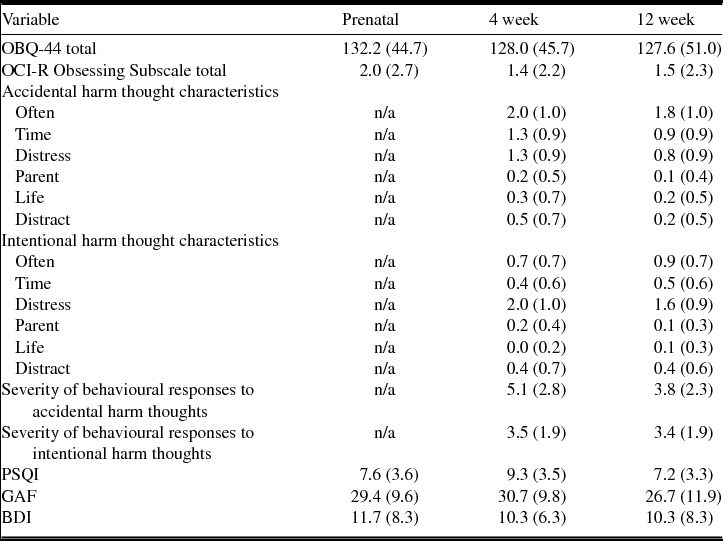
Means and standard deviations for all scale scores are presented in Table 1.
Descriptives: means and standard deviations

Hypothesis 1
Results of the SEM in which postpartum OCI-R obsession subscale scores were predicted by prenatal OCI-R obsessing scores and prenatal OBQ-44 total scores are presented in Fig. 1. Indexes of model fit are uninformative for this model, as it is fully saturated and therefore perfectly fits the data. As expected, prenatal OCI-R obsessing scores and prenatal OBQ-44 total scores were both uniquely and positively associated with greater 4 week and 12 week postpartum OCI-R obsessing scores. OBQ-44 total scores uniquely explained an additional 6.60% of the variance in 4 week postpartum OCI-R obsessing subscale scores, and 7.80% of the variance in 12 week OCI-R obsessing subscale scores.
SEM of postpartum OCI-R Obsessing Subscale scores predicted by prenatal OCI-R Obsessing Subscale score and OBQ-44 total score. Directional pathways are standardized slopes. **p < .01, ***p < .001.

Hypothesis 2
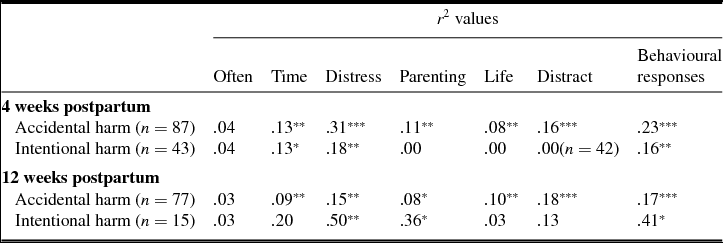
The proportion of variance in infant-related harm thought characteristics, for both accidental and intentional harm thoughts, at both 4 and 12 weeks postpartum, accounted for by OBQ-44 total scores (i.e. squared bivariate correlations) are presented in Table 2.
Proportion of variance (r 2) in postpartum harm thought characteristics and behavioural responses to postpartum harm thoughts, at 4 and 12 weeks postpartum, predicted by prenatal OBQ-44 total scores

*p < .05, **p < .01, ***p < .001.
Prenatal OBQ-44 total scores significantly predicted all 4 week and 12 week accidental harm thought characteristics (other than thought frequency), and the severity of behavioural responses to the thoughts. For 4 week intentional harm thoughts, prenatal OBQ-44 total scores predicted time occupied by the thoughts, distress associated with the thoughts, and the severity of behavioural responses to the thoughts. For 12 week intentional harm thought characteristics, OBQ-44 total scores predicted distress associated with the thoughts, perceived interference with parenting, and the severity of behavioural responses to the thoughts.
Hypothesis 3
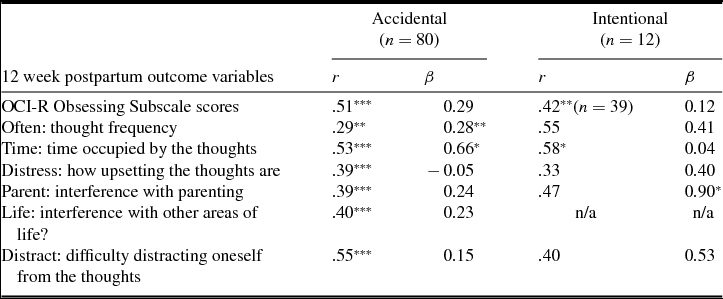
We have reported the zero-order correlations and the beta-values for each analysis in Table 3. This model fitted the data extremely well: χ2 (42) = 10.60, p = 1.00, CFI = 1.00, SRMR = .06. Although a number of zero-order correlations for severity of behavioural responses to both accidental and intentional harm thoughts were significant, once 4 week OC symptoms and harm thought characteristics were controlled for (either through SEM, for accidental harm thoughts, or through regression models, for intentional harm thoughts, see also Table 3), behavioural response severity only predicted 12 week postpartum accidental harm thought frequency and time occupied by the thoughts, as well as intentional harm thought perceived interference with parenting.
Associations between 4 week severity of behavioural responses to harm thoughts and 12 week postpartum outcomes before (r) and after (β) controlling for 4 week postpartum outcomes

*p < .05, **p < .01, ***p < .001. β for accidental variables estimated using SEM; β for intentional variables estimated using separate regression models.
Hypothesis 4
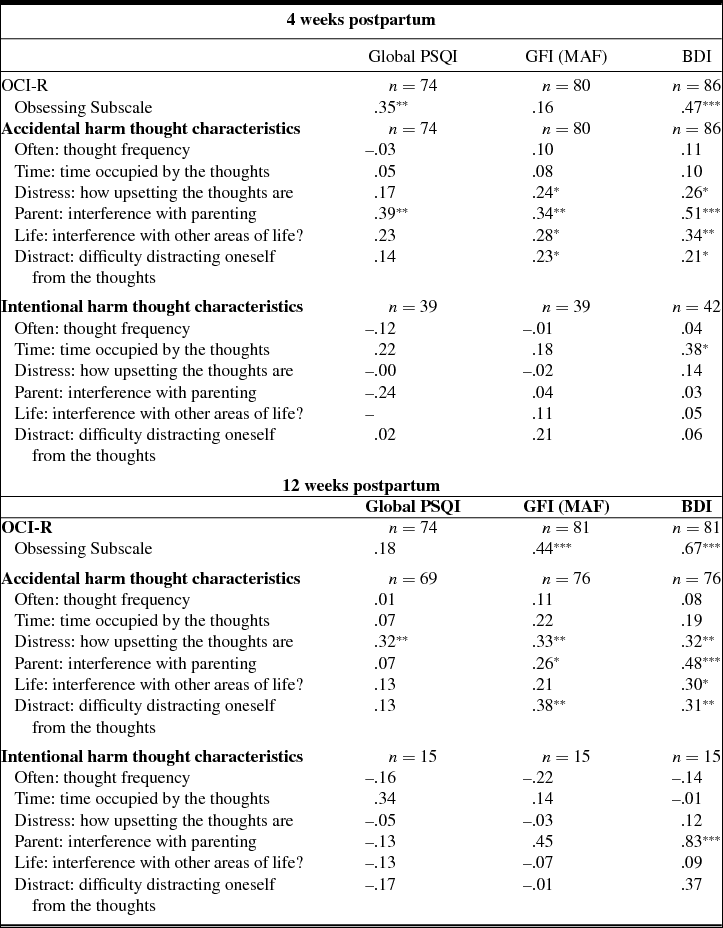
The majority of the significant correlations were for accidental harm thought characteristics, at both postpartum assessment points. For intentional harm thought characteristics, only two correlations were significant: time occupied by the thoughts and BDI-II scores at 4 weeks postpartum, and perceived interference with parenting and BDI-II scores at 12 weeks postpartum. Correlations are presented in Table 4.
Correlations between OCI-R Obsessing Subscale scores and harm thought characteristics (for both accidental and intentional harm thoughts), and measures of sleep quality, fatigue and depressed mood, at both 4 and 12 weeks postpartum

*p < 0.05, **p < 0.01, ***p < 0.001.
Discussion
The primary purpose of this research was to assess elements of cognitive behavioural conceptualizations of ppOCD (Fairbrother and Abramowitz, Reference Fairbrother and Abramowitz2007) and build on earlier findings pertaining to this conceptualization (Abramowitz et al., Reference Abramowitz, Khandker, Nelson, Deacon and Rygwall2006, Reference Abramowitz, Nelson, Rygwall and Khandker2007; Barrett et al., Reference Barrett, Wroe and Challacombe2016; Larsen et al., Reference Larsen, Schwartz, Whiteside and Khandker2006). Ours is the first study to distinguish between, and explore, separately, postpartum thoughts of accidental versus intentional harm.
Hypothesis 1
Our prediction that prenatal OC-related beliefs would predict postpartum OC symptoms, even when controlling for the contribution of prenatal OC symptoms was supported by the data. Specifically, prenatal obsessive beliefs were found to predict unique variance in 4 week and 12 week postpartum OC symptoms, even after taking prenatal OC symptoms into account. These findings further support cognitive behavioural conceptualizations of ppOCD – namely that pre-existing, maladaptive beliefs about responsibility, uncertainty, and the importance and control of thoughts are a risk factor for OC symptom development. However, it is worth noting that the proportion of variance accounted for was small. This may be partially a function of standard OC symptom measures (e.g. the OCI-R) not being fully relatable to women experiencing postpartum OC symptoms specific to thoughts of infant-related harm. With more postpartum appropriate measurement of OC symptoms, we may see prenatal beliefs about thoughts predicting a greater proportion of unique variance in OC symptoms. Additionally, properties of the OBQ mean that we were not able to distinguish the relative contribution of the subscales.
Hypothesis 2
Our prediction that prenatal OC-related beliefs would predict maternal postpartum harm thought characteristics and maternal behavioural responses to the thoughts, for both accidental and intentional harm thoughts, was also supported by the data. Most of the significant findings were for thoughts of accidental harm, and provide empirical support for cognitive behavioural conceptualizations of OCD. Specifically, these conceptualizations posit that prenatal OC-related beliefs represent a risk factor for OC symptom development. Our findings provide specific support for the hypothesis that OC-related beliefs are predictive of postpartum, harm thought-related OC symptoms. Furthermore, these findings also provide support for the use of perinatal specific measures of OC symptoms (e.g. the PPII). It may be that measures specific to postpartum thoughts of harm (i.e. the PPII), similar to the Y-BOCS (Goodman et al., Reference Goodman, Price, Rasmussen, Mazure, Fleischmann and Hill1989) better capture OC symptoms in response to postpartum thoughts of infant-related harm than do more traditional OC symptom measures. It is also worth noting, however, that prenatal OC symptoms were not controlled for in the analyses involving measures of harm thought characteristics as there was not a prenatal parallel. Had this been possible, the variance accounted for above would most likely have been lower.
OC-related beliefs predicted a significant proportion of the variance in all accidental harm thought characteristics, with the exception of harm thought frequency. This finding is consistent with cognitive behavioural conceptualizations of OCD which posit that it is not the occurrence of unwanted, intrusive ideation that predict OC symptom development, but rather the appraisals that one makes of the occurrence of the thoughts (Rachman, Reference Rachman1998). OC-related beliefs most strongly predicted the following accidental harm thought characteristics, at both 4 and 12 weeks postpartum: distress associated with the thoughts, and one's ability to distract oneself from the thoughts. With respect to infant-related thoughts of accidental harm, negative beliefs about thoughts are predictive of, and may even increase how distressing these thoughts are and how mentally captivating they are.
Fewer significant relationships were found for thoughts of intentional harm. At 4 weeks postpartum, these analyses included only 43 women, and at 12 weeks only 15. It is clear that this analysis was underpowered, therefore reducing our ability to detect effects related to intentional harm thoughts, and compromising the precision of the effects that we were able to detect. It is interesting that, among significant variables, OC-related beliefs predicted the time occupied by the thoughts, for both accidental and intentional harm thoughts, but not the frequency with which the thoughts occurred. This finding is consistent with cognitive behavioural theories of OCD. Specifically, CBT theories of OCD posit that the occurrence of unwanted, intrusive thoughts about one's baby are normal, but maladaptive OC-related beliefs may significantly increase how time-consuming they are (Fairbrother and Abramowitz, Reference Fairbrother and Abramowitz2007, Rachman, Reference Rachman1998). For example, maladaptive OC-related beliefs may result in time spent ruminating about the thoughts, or trying to neutralize them. Prenatal OC-related beliefs also predicted half of the variance in the distress associated with 12 week intentional harm thoughts, and slightly more than a third of the variance in how much these thoughts interfered with parenting. One might imagine that the longer the thoughts persist, the more strongly OC-related beliefs might impact how distressing and impairing the thoughts become. Although the sample sizes for these analyses are very small, and therefore findings should be interpreted cautiously, the magnitude of the relationships makes it clear that they merit additional assessment in a larger sample.
Prenatal OC-related beliefs predicted significant variance in behavioural responses to both accidental and intentional harm, at both 4 and 12 weeks postpartum. The strongest effect was for 12 week postpartum thoughts of intentional harm. This suggests that perhaps negative beliefs about unwanted, intrusive thoughts trigger a stronger urge to engage in avoidance, reassurance seeking, checking or other behavioural and mental activities in response to unwanted thoughts of intentionally harming one's infant, compared with thoughts of accidental harm coming to one's infant. This is consistent with the finding that thoughts of intentional harm are reported to be more distressing than thoughts of accidental harm.
Hypothesis 3
We hypothesized that the use of safety-seeking or other strategies to neutralize postpartum intrusive thoughts would be predictive of later ppOC symptoms. This hypothesis was only weakly supported by the data. Although a number of zero order correlations between the severity of behavioural responses to accidental and intentional harm thoughts and 12 week postpartum OC symptoms, and harm thought characteristics were significant, few significant relationships remained once 4 week variables (i.e. OC symptoms and harm thought characteristics) were controlled for.
The severity of behavioural responses to harm thoughts did not predict unique variance in OCI-R obsessing subscale scores at 12 weeks postpartum, for either accidental or intentional harm thoughts. It may be that the OCI-R is neither specific enough (i.e. non-perinatal in focus), nor sensitive enough to detect the experiences of postpartum women, as it refers to more generic rather than postpartum-specific intrusive thoughts. Furthermore, mean scores on the OCI-R were low at all three time points, suggesting that perhaps there was insufficient variance in OC symptoms, as measured by the OCI-R, to detect the hypothesized relationships.
With respect to harm thought characteristics, a small number of significant relationships emerged. Specifically, for thoughts of accidental harm, behavioural response severity predicted the frequency of and time occupied by 12 week postpartum thoughts. With respect to thoughts of intentional harm, behavioural response severity predicted perceived interference with parenting only. What is most notable is that the severity of 4 week postpartum behavioural responses to intentional harm thoughts predicted close to half of the variance in perceived interference with parenting (from intentional harm thoughts) at 12 weeks postpartum, even after controlling for 4 week postpartum perceived interference with parenting. This finding, that new mothers perceive that their OC symptoms (i.e. behavioural responses to harm thoughts) significantly interfere with parenting is consistent with findings by others (Barrett et al., Reference Barrett, Wroe and Challacombe2016). Due to the very small sample involved in this analysis (n = 12), the possibility that behavioural responses to intentional harm thoughts may contribute negatively and significantly to parenting deserves further exploration.
Hypothesis 4
Sleep. OC symptoms were positively associated with sleep difficulties at 4 weeks postpartum, but not 12 weeks postpartum. Perceived interference with parenting from 4 week accidental harm thoughts, and with distress associated with 12 week accidental harm thoughts were also positively associated with sleep difficulties. This is consistent with the fact that women reported the most sleep difficulties at 4 weeks postpartum. It may be that sleep has a stronger association with OC symptoms and perceived interference with parenting at higher levels of sleep interference. Perhaps, in part, sleep difficulties at 12 weeks postpartum are driven by distress associated with harm thoughts, more than by interference by one's infant. This would explain why sleep difficulties were associated with distress associated with accidental harm thoughts at 12 but not 4 weeks postpartum.
Fatigue
OC symptoms were positively associated with sleep difficulties, but at 12 weeks postpartum only. Maternal fatigue was also positively and significantly related to 4 and 12 week distress associated with harm thoughts, harm thought perceived interference with parenting, as well as difficulty distracting oneself from the thoughts, but only for accidental harm thoughts. At 4 weeks postpartum, maternal fatigue was also associated with interference (from thoughts of accidental harm only) with other areas of ones life. The strongest relationships were for perceived interference with parenting at 4 weeks, and difficulty distracting oneself from the thoughts at 12 weeks. No significant relationships between maternal fatigue and intentional harm thought characteristics were found.
Negative mood
Not surprisingly, OC symptoms were positively associated with negative mood at both 4 and 12 weeks postpartum. There is compelling evidence that OC symptoms and negative mood are correlated and frequently co-occur (Ruscio et al., Reference Ruscio, Stein, Chiu and Kessler2010). At both 4 and 12 weeks postpartum, negative mood was also positively associated with distress associated with harm thoughts, perceived harm thought interference with parenting and other aspects of life, and difficulty distracting oneself with the thoughts, but only for accidental harm thoughts. For intentional harm thoughts, the only significant relationships were between negative mood and time occupied by the thoughts at 4 weeks postpartum and perceived interference with parenting at 12 weeks postpartum. The implication of this latter finding is that while the occurrence of postpartum thoughts of infant-related harm appears to be a normal experience for new mothers, being very distressed by them, or for them to interfere significantly with one's life may be indicative of significant mood difficulties. This also suggests that negative mood may be an important mechanism via which OCD interferes with parenting.
Limitations and future directions
The primary limitation of this research is that it is based on a small, upper-middle class sample. Sample size limitations were particularly problematic for our analyses of thoughts of intentional harm. Studies involving large enough sample sizes to be able to speak more definitely about the relationship between postpartum thoughts of intentional harm and OC symptoms are required. Our team has recently completed data collection for a study in which we replicate many of the above findings in a sample of over 600 women. This much larger sample size will allow us to provide more definitive and stable estimates of the relationships described above, in particular with respect to thoughts of intentional harm. Further exploration of the impact of postpartum OC symptoms on perceived interference with parenting is also warranted.
Conclusions
Our study provides important support for CBT conceptualization of ppOCD and extends our understanding of the relationship between pre-existing OC-related beliefs, and OC symptoms and characteristics of new mothers’ thoughts of infant-related harm. Prenatal OC-related beliefs predicted change in OC symptoms from prenatal to postpartum, as well as characteristics of and behavioural responses to postpartum intrusive thoughts of harm. This was particularly true for thoughts of accidental harm coming to infants, which were more common and therefore for which we had more power to detect an effect. Behavioural responses to early postpartum thoughts did not predict worsening of OC symptom thoughts later in postpartum, but did predict perceived interference with parenting from intentional harm thoughts. An issue deserving of consideration is that of disclosure. It may be that unwanted, intrusive thoughts of intentional, infant-related harm are only experienced by half of all new mothers. However, it may also be that, despite our efforts to normalize these thoughts and maximize disclosure, some women who experience them may nevertheless not report them. Depressed mood was associated with more OC symptoms postpartum. Poor sleep predicted more OC symptoms at 4 weeks, whereas fatigue predicted more OC symptoms at 12 weeks. Depressed mood, poor sleep and fatigue did not predict the occurrence or frequency of intrusive thoughts of harm, but did predict other harm thought characteristics such as distress and perceived interference with parenting.
Acknowledgements
We would like to express our gratitude to Dr Michael Papsdorf, Ms Elizabeth Horner, Ms Marion MacKay-Dunn, Ms Maria Watson, and our study participants for their invaluable contributions to this project.
Financial support: This work was supported by the Lion's Gate Healthcare Research Foundation ($39,837; 2004‒2006; Sheila Woody, PI; Nichole Fairbrother, Co-I).
Conflicts of interest: Nichole Fairbrother, Dana S. Thordarson, Fiona L. Challacombe and John K. Sakaluk have no conflicts of interest with respect to this publication.
Ethical statement: The authors have complied with the Ethical Principles of Psychologists and Codes of Conduct as set forth by the APA. This study was reviewed and approved by the University of British Columbia's Behavioural Research Ethics Board and the Children's and Women's Health Centre of British Columbia Research Review Committee (B04-0370).




Comments
No Comments have been published for this article.