INTRODUCTION
The family Newtoniellidae Korobkov, 1955 is part of Triphoroidea (Ponder & Bouchet, Reference Ponder, Bouchet, Bouchet and Rocroi2005), and is a group with uncertain limits of usually dextral and elongated shells, believed to contain clades of very old origins (Nützel, Reference Nützel1998; Gofas, Reference Gofas2003; although both authors do not classify these clades properly in Newtoniellidae). It is most commonly found in to deep (e.g. Bouchet & Warén, Reference Bouchet and Warén1993) and/or cold (e.g. Engl, Reference Engl2012) waters, in contrast to the usually shallow and tropical/temperate families Triphoridae and Cerithiopsidae, both also members of Triphoroidea (Ponder & Bouchet, Reference Ponder, Bouchet, Bouchet and Rocroi2005). As in these families, Newtoniellidae contains sponge feeders (Marshall, Reference Marshall1980; Gofas, Reference Gofas2003). Genera of this family were traditionally included in Cerithiopsidae (e.g. Bouchet & Warén, Reference Bouchet and Warén1993) and were recently transferred to Newtoniellidae (Ponder & Bouchet, Reference Ponder, Bouchet, Bouchet and Rocroi2005), but still with divergences in its classification (e.g. Nützel, Reference Nützel1998; Engl, Reference Engl2012). In molecular phylogenies, Newtoniellidae appeared in undefined positions among the Hypsogastropoda (Colgan et al., Reference Colgan, Ponder, Beacham and Macaranas2007, who classified it as Cerithiopsidae s.l.). Five subfamilies are currently recognized in Newtoniellidae (Ponder & Bouchet, Reference Ponder, Bouchet, Bouchet and Rocroi2005), but the family still needs a thorough taxonomic revision (P. Bouchet, pers. comm.).
Newtoniellinae Korobkov, 1955 (=Cerithiellidae Golikov & Starobogatov, Reference Golikov and Starobogatov1975) was diagnosed by Golikov & Starobogatov (Reference Golikov and Starobogatov1975) as having a paucispiral protoconch [but see below], a spirally nodular sculpture on the teleoconch, a basal keel, a developed and oblique anterior canal, and certain radular features. Newtoniellinae has three valid genera (Rosenberg, Reference Rosenberg2013): Cerithiella Verril, 1882, Paramendax Powell, 1937 and Trituba Jousseaume, Reference Jousseaume1884, the latter including the previously accepted genus Granulotriforis Kosuge, Reference Kosuge1967, currently as a subgenus (Rosenberg & Gofas, Reference Rosenberg and Gofas2014a). A Cerithiella species was proved to have a multispiral protoconch derived from intracapsular development (Bouchet & Warén, Reference Bouchet and Warén1993), and Trituba species are believed to have the same development (Gofas, Reference Gofas2003), owing to the unclear limits between embryonic shell/larval shell and protoconch/teleoconch.
Cerithiella is the best-known genus of Newtoniellinae, with 36 Recent species worldwide (Bouchet et al., Reference Bouchet, Rosenberg and Gofas2014) and a large number of morphospecies in Antarctica (Engl, Reference Engl2012). It is found in deep and cold waters, sometimes in temperatures below 0°C (Høisaeter, Reference Høisaeter2010). Cerithiella is the only genus of Newtoniellidae recorded for Brazil (although not yet included in Newtoniellidae in the Brazilian scientific literature, but in Cerithiopsidae; e.g. Lima & Barros, Reference Lima and Barros2007), with four species: Cerithiella amblytera (Watson, Reference Watson1880), Cerithiella enode (Watson, Reference Watson1880), Cerithiella cepene Lima & Barros, Reference Lima and Barros2007 and Cerithiella pernambucoensis Lima & Barros, Reference Lima and Barros2007; besides Cerithiella mamillana (Watson, Reference Watson1880), described from Pernambuco (north-eastern Brazil), but considered a synonym of C. amblytera by Bouchet & Warén (Reference Bouchet and Warén1993). Cerithiella is differentiated from other genera of Newtoniellinae by the teleoconch sculpture, with a less-developed and non-tubular anterior canal and the absence of a strongly developed posterior canal, besides certain radular features (Marshall, Reference Marshall1980).
The name Triforis Deshayes, 1834 (not Triphora Blainville, 1828) was until recently applied to Granulotriforis, Paramendax and Trituba, all previously considered subgenera of Triforis (Kosuge, Reference Kosuge1967; Marshall, Reference Marshall1977, Reference Marshall1980). In addition to the historical confusion relating to Triforis and Triphora (see Kosuge, Reference Kosuge1967; Marshall, Reference Marshall1980), the name Triforis is currently considered invalid (Rosenberg & Gofas, Reference Rosenberg and Gofas2014b), but it is usually informally applied to the three above-mentioned groups. Triforids have a great diversity of radulae (Bouchet & Fechter, Reference Bouchet and Fechter1981; Nützel, Reference Nützel1998) and share features such as the protoconch axially ribbed, the presence of two strongly nodular spiral cords on short spire whorls, the tubular anterior canal and aperture (Marshall, Reference Marshall1977), besides the development of a characteristic posterior canal. They are well known from fossil material (Marshall, Reference Marshall1977), and Recent species were recognized as part of this group only in the last few decades (e.g. Kosuge, Reference Kosuge1967; Marshall, Reference Marshall1977).
The genus Trituba, including the current subgenus Granulotriforis, is composed by 18 species (Coomans & Faber, Reference Coomans and Faber1984; Rosenberg & Gofas, Reference Rosenberg and Gofas2014a). The only species of Trituba known from the western Atlantic is Trituba barbadensis (Coomans & Faber, Reference Coomans and Faber1984), described from Barbados (West Indies), although several Recent species occur near the Mid-Atlantic Ridge (Gofas, Reference Gofas2003).
The main objective of the present work is to update the taxonomic knowledge of Newtoniellinae from Brazil, including new records and two new species of Cerithiella, besides the description of a Trituba species.
MATERIALS AND METHODS
The material examined was obtained by different expeditions along the continental slope of Brazil and it is deposited in the following institutions: Instituto de Biologia/Universidade Federal do Rio de Janeiro (IBUFRJ), Rio de Janeiro, Brazil; Muséum national d'Histoire naturelle (MNHN), Paris, France; Museu Nacional/Universidade Federal do Rio de Janeiro (MNRJ), Rio de Janeiro, Brazil; Museu de Zoologia da Universidade de São Paulo (MZUSP/MZSP), São Paulo, Brazil; National Museum of Natural History (NMNH/USNM), Washington, DC, USA. Other abbreviations: Academy of Natural Sciences of Philadelphia (ANSP), Philadelphia, PA, USA; Museum of Comparative Zoology (MCZ), Cambridge, MA, USA; Natural History Museum (NHM), London, UK. Most specimens were obtained from three major expeditions: Canopus Bank (off Ceará State, north-eastern Brazil), conducted in 2005 by dredgings from commercial fishing boats, including depths between 240–260 m, in biogenic substrate; Oceanprof (Campos Basin, off Rio de Janeiro State, south-eastern Brazil), conducted in 2002 (Oceanprof I) and 2003 (Oceanprof II), with benthic samples made by box-corer in depths of 750–1950 m (more details in Lavrado et al., Reference Lavrado, Brasil, Fernandez, Campos, Lavrado and Brasil2010); MD55 Expedition, conducted in 1987 by the Research Vessel Marion-Dufresne, sampling by dredging and trawling in several localities in the southern Bahia State and in the south-east region of Brazil, in a bathymetric range of 15–5100 m (Tavares, Reference Tavares1999).
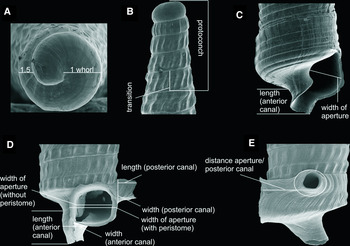
The taxonomic identifications were based on conchiliological comparisons viewed under a stereomicroscope and on scanning electron microscope (SEM) images. When necessary, comparisons were made with type material, in addition to published descriptions and photographs (e.g. Bouchet & Warén, Reference Bouchet and Warén1993; Gofas, Reference Gofas2003; Lima & Barros, Reference Lima and Barros2007). Terminology and characters used for shell descriptions and parameters were based partly on Gofas (Reference Gofas2003), although the distinction between the protoconch and teleoconch by a change in the sculpture (Gofas, Reference Gofas2003) was not always clear (Figure 1B). When a posterior or anterior canal was present, its maximum length and diameter were measured, as well as the diameter of the aperture and the maximum distance between the posterior canal and the border of the aperture (Figure 1C–E). In the lists of material examined, the number of shells in each lot is indicated between brackets.
Terminology and measurements of some shell characters. (A) Counting whorls procedure on the protoconch, adapical view; (B) Unclear transition between protoconch and teleoconch; in this case, the teleoconch is defined on the beginning of the spiral sculpture, as in Gofas (Reference Gofas2003); (C) Abapical portion of shell in Cerithiella, frontal view; (D) Abapical portion of shell in Trituba, frontal view; (E) Abapical portion of shell in Trituba, lateral view.

RESULTS
SYSTEMATICS
Subclass Caenogastropoda Cox, 1960
Superfamily Triphoroidea Gray, 1847
Family Newtoniellidae Korobkov, 1955
Subfamily Newtoniellinae Korobkov, 1955
Genus Cerithiella Verrill, 1882
TYPE SPECIES
Cerithium metula Lovén, 1846, designation by Sars (Reference Sars1878) when creating the pre-occupied name Lovenella Sars, Reference Sars1878 non Hincks, 1869. Recent, Europe.
DIAGNOSIS
Conical, elongated and dextral shell; protoconch with apex dome-shaped or pointed and twisted; teleoconch usually reticulated, with considerable variation on number and strength of spiral cords and axial ribs; anterior canal distinctly twisted; posterior canal as a small sinus or absent; base smooth below the single peripheral cord; central tooth with three cusps, lateral teeth broad and with two pointed cusps, marginal teeth short, arched and simply pointed (adapted from Thiele, Reference Thiele1929 and Bouchet & Warén, Reference Bouchet and Warén1993).
SYNONYMS
Lovenella Sars, Reference Sars1878 non Hincks, 1869; Stilus Jeffreys, 1885; Newtonia Cossmann, 1892 non Schlegel, 1867; Newtoniella Cossman, 1893; Cerithiolinum Locard, 1903; Chasteria Iredale, 1915; Euseila Cotton, 1951; Binda Laseron, 1951 (based on Bouchet & Warén, Reference Bouchet and Warén1993).
Cerithiella amblytera (Watson, Reference Watson1880)
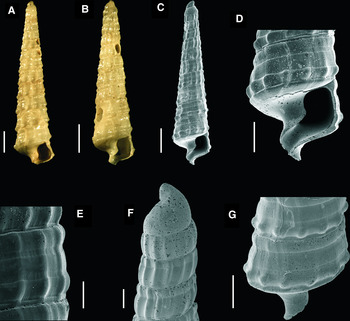
(Figure 2A–B, E–G)
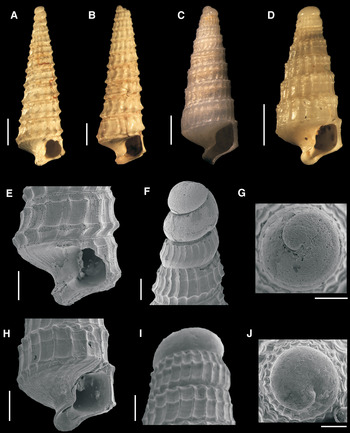
A–B, E–G: Cerithiella amblytera: (A) Shell from off Rio de Janeiro, MNRJ 32637, 6.00 mm long; (B) Shell from off Amapá, MNRJ 17240, 7.06 mm long; (E–G: same shell as A): (E) Abapical portion of shell; (F) Protoconch; (G) Adapical view of protoconch. C–D, H–J: Cerithiella enode: (C) Shell from off Bahia, MNRJ 32869, 5.47 mm long; (D) Shell from off Espírito Santo, MNRJ 17237, 3.71 mm long; (H–J: same shell as D): (H) Abapical portion of shell; (I) Protoconch; (J) Adapical view of protoconch. Scale bars: A–D, 1 mm; E, H. 500 μm. F–G, I–J, 200 μm.

Cerithium (Bittium) amblyterum Watson, Reference Watson1880: 108; 1886: 542, pl. 39, figure 6.
Cerithium (Bittium) mamillanum Watson, Reference Watson1880: 109; 1886: 543, pl. 40, figure 6.
Cerithiopsis amblytera var. attenuata Locard, Reference Locard1897: 382.
Finella mamillatum [sic]: Rios (Reference Rios1975: 50; Reference Rios1985: 52, pl. 19, figure 232; Reference Rios1994: 64, pl. 21, Figure 243; Reference Rios2009: 110, text-fig.)
Cerithiella amblytera: Bouchet & Warén (Reference Bouchet and Warén1993: 597, figures 1316, 1319–1324).
TYPE MATERIAL
Holotype: NHM 1887.2.9.1696.
TYPE LOCALITY
38°38′N 28°29′W, 823 m, Azores.
MATERIAL EXAMINED
Brazil: off Amapá State: MNRJ 17240, 03°25′N 48°03′W, 700 m, Ship Paulo Moreira coll., 14/xii/2005 [1]. Campos Basin, off Rio de Janeiro State: MNRJ 32637, 21°54′00″S 39°49′50″W, 1170 m, 24/viii/2001 [2].
REMARKS
This is the third record of Cerithiella amblytera for Brazil, following those by Watson (Reference Watson1880; as Cerithiella mamillana) and Bouchet & Warén (Reference Bouchet and Warén1993). The present study establishes the shallowest record of C. amblytera (700 m), similar to that of the type locality (823 m), although shells of this species have been collected from depths up to 3910 m in the eastern Atlantic (Bouchet & Warén, Reference Bouchet and Warén1993).
GEOGRAPHIC DISTRIBUTION
Azores (type locality); Madeira Is. (Bouchet & Warén, Reference Bouchet and Warén1993); off Morocco (type locality of C. amblytera var. attenuata); off Nigeria (Bouchet & Warén, Reference Bouchet and Warén1993); Brazil: off Amapá (this study); off Pernambuco (type locality of C. mamillana), off Espírito Santo (Bouchet & Warén, Reference Bouchet and Warén1993), off Rio de Janeiro (this study).
BATHYMETRIC DISTRIBUTION
700 m (this study) to 3910 m (Bouchet & Warén, Reference Bouchet and Warén1993).
Cerithiella enode (Watson, Reference Watson1880)
(Figure 2C–D, H–J)
Cerithium (Bittium) enode Watson, Reference Watson1880: 115; Reference Watson1886: 541, pl. 39, figure 3.
Finella enode: Rios (Reference Rios1975: 50, pl. 13, figure 183; Reference Rios1985: 52, pl. 19, figure 231; Reference Rios1994: 63, pl. 21, figure 242; Reference Rios2009: 110, text-fig.); Barros et al. (2001: 17, figure 5C).
Cerithiella enode: Bouchet & Warén (Reference Bouchet and Warén1993: 599, figures 1325–1327).
Cerithiella enodis [sic]: Absalão (2010: 91).
TYPE MATERIAL
Syntypes: NHM 1887.2.9.1694–5 [2].
TYPE LOCALITY
08°37′S 34°28′W, 1235 m, off Pernambuco State, Brazil.
MATERIAL EXAMINED
Brazil: Camamu-Almada Basin, off Bahia State: MNRJ 32869, 14°19′48″S 38°32′34″W, 2200 m, 2011 [2]; MNRJ 32870, 14°30′42″S 38°44′02″W, 1400 m, 2011 [1]. Campos Basin, off Espírito Santo State: MNRJ 17237, REVIZEE station C5-50F, 20°49′58″S 39°13′58″W, 1650 m, 20/vii/2001 [1]. Campos Basin, off Rio de Janeiro State: IBUFRJ 19644, Oceanprof II station 62, 21°52′41″S 39°46′17″W, 1688 m, 26/vi/2003 [1]; IBUFRJ 19650, Oceanprof II station 63, 21°52′43″S 39°40′41″W, 1941 m, 26/vi/2003 [1]; IBUFRJ 19645, Oceanprof I station 45, 22°10′54″S 39°52′19″W, 1040 m, 10/xii/2002 [1]; MNRJ 26619, Oceanprof I station 47, 22°11′04″S 39°47′04″W, 1654 m, 25/xi/2002 [1].
REMARKS
This is the fourth record of Cerithiella enode for Brazil, following those by Watson (Reference Watson1880), Barros et al. (Reference Barros, Santos, Santos, Cabral and Acioli2001) and Absalão (Reference Absalão, Lavrado and Brasil2010). As noted by Bouchet & Warén (Reference Bouchet and Warén1993), the abyssal fauna in Brazil reaches shallower waters than in the north-eastern Atlantic; in accordance with this pattern, the bathymetric records in this study (1040–2200 m) are much more similar to the type locality (1235 m) than to north-eastern Atlantic records (3460–4796 m). Precise coordinates and depths for C. enode were not provided by Barros et al. (Reference Barros, Santos, Santos, Cabral and Acioli2001) or by Absalão (Reference Absalão, Lavrado and Brasil2010).
GEOGRAPHIC DISTRIBUTION
North-eastern Atlantic Ocean (Bouchet & Warén, Reference Bouchet and Warén1993); Brazil: off Pernambuco (type locality), off Bahia (this study), off Espírito Santo, off Rio de Janeiro (Absalão, Reference Absalão, Lavrado and Brasil2010; this study).
BATHYMETRIC DISTRIBUTION
1040 m (this study) to 4796 m (Bouchet & Warén, Reference Bouchet and Warén1993).
Cerithiella sigsbeana (Dall, Reference Dall1881) comb. nov.
(Figure 3)
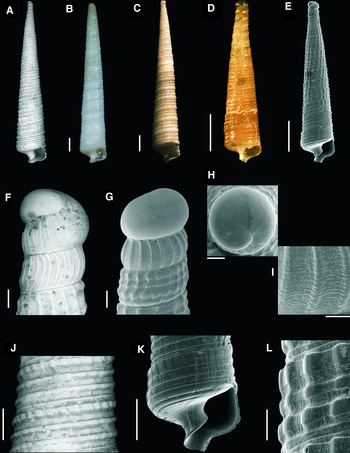
Cerithiella sigsbeana comb. nov. (A) Syntype, USNM 87300; (B) Syntype, MCZ 7407; (C) Shell from off Amapá, MNRJ 26608, 10.13 mm long; (D–E) Shells from off Ceará, MNRJ 31100, 4.35 and 5.13 mm long, respectively; (F, J: same shell as A): (F) Protoconch; (J) Detail of teleoconch, late whorls; (G–I, K–L: same shell as E): (G) Protoconch; (H) Adapical view of protoconch; (I) Detail of protoconch; (K) Abapical portion of shell, frontal view; (L) Detail of teleoconch, early whorl. Scale bars: B–E, 1 mm; F–H, L, 100 μm; I, 50 μm; J–K, 500 μm.

Cerithiopsis sigsbeana Dall, Reference Dall1881: 87; 1889: 254, pl. 20, figure 1.
TYPE MATERIAL
Syntypes: USNM 87300 [1]; MCZ 7407 [1].
TYPE LOCALITY
23°02′39″N 83°10′59″W, 402 m, off Honda Bay, Cuba.
MATERIAL EXAMINED
Brazil: off Amapá State: MNRJ 26608, 04°27′54″N 49°58′05″W, 160 m, 13/x/2000 [1]. Canopus Bank, off Ceará State: MNRJ 31100 [6], MZSP 70358 [2], MZSP 90284 [3], all lots from 02°14′25″S 38°22′50″W, 240–260 m, P.M.S. Costa and J. Coltro coll., xi/2005.
CHARACTERIZATION
Shell up to 10.13 mm in length, 1.69 mm in width, dextral, conical-fusiform, elongated, rectilinear profile, white or light brown. Protoconch with 2.5–2.75 whorls, reaching 0.48–0.54 mm in length, 0.37–0.42 mm in width, but not easily distinct of teleoconch; apex dome-shaped, nucleus moderately protruded, first 1.75 whorl slightly inflated, smooth and convex, remaining whorl less convex and not inflated, but sculptured with straight to slightly sigmoid axial ribs and several microspiral threads. Teleoconch with up to 19 not convex whorls; two spiral cords on beginning, but a median spiral cord develops on the first or second whorl, reaching same size as the abapical cord after one to three whorls; the adapical spiral cord is slightly more prominent than the others, especially on late whorls; the three cords are equidistant and weakly nodulose, except on late whorls, being smooth; distance among spiral cords varies slightly, being quite close or more spaced; a smooth and sutural cord gradually strengthens and forms a fourth spiral cord on late whorls, but always thinner than other cords; weak, straight and nearly orthocline to slightly opisthocline axial ribs, numbering 21–25 ribs on eighth whorl of teleoconch, but disappearing on late whorls; short whorls, suture very shallow, almost indistinct; body whorl not constraining; smooth subperipheral cord, below which there are two to three small spiral threads; elliptical aperture, reaching 0.67 mm in width; anterior canal twisted and widely open, directed downward/sideward, reaching 0.47 mm in length; posterior sinus acute.
REMARKS
This is the only record of Cerithiella sigsbeana since its original description (Dall, Reference Dall1881), and the two syntypes are illustrated (Figure 3A, B, F, J). Dall (Reference Dall1881) recognized colour variation in C. sigsbeana, usually reddish brown on the apex but changing to waxy white on late whorls, which also occurred with two worn shells from Brazil. The single shell from Amapá State is entirely white (Figure 3C), as is the syntype held by the MCZ (Figure 3B), however most shells from the Canopus Bank are light brown (Figure 3D). Some intraspecific variation is also observed on the strength of the axial sculpture of the teleoconch in shells from Brazil. In relation to the dimensions, the greatest length of shell in the type material of C. sigsbeana is 13.25 mm for 23 whorls of shell (Dall, Reference Dall1881), in contrast to only 6.66 mm (15 whorls of teleoconch) in shells from the Canopus Bank, but similar to the single shell from Amapá (10.13 mm, 19 whorls of teleoconch).
Cerithiella sigsbeana is similar to C. pernambucoensis, especially relating to protoconch sculpture and size of the shell. After examining type material of C. pernambucoensis (MNRJ 10834, MNRJ 10835, MNRJ 10836), we noted that the main differences between them consist of the more developed and nodulose adapical spiral cord of C. pernambucoensis, much more prominent than the remaining spiral cords (but only slightly more prominent than other cords in C. sigsbeana), and the development of the median spiral cord (on third to fourth whorl in C. pernambucoensis; on first to beginning of second whorl in C. sigsbeana).
Marshall (Reference Marshall1978) indicated that C. sigsbeana could be included in the genus Euseila Cotton, 1951, defined by him as having three to four well-defined spiral cords but very weak, almost obsolete, axial sculpture. Cerithiella sigsbeana shows this kind of sculpture, unique among its congeneric species from the western Atlantic. However, the absence of significant differences in radula and shell characters between Cerithiella and Euseila makes the latter a junior synonym of the former (Bouchet & Warén, Reference Bouchet and Warén1993).
GEOGRAPHIC DISTRIBUTION
Cuba (type locality); Brazil: off Amapá, off Ceará (this study).
BATHYMETRIC DISTRIBUTION
160 m (this study) to 418 m (Dall, Reference Dall1881).
Cerithiella producta Dall, Reference Dall1927
(Figure 4)
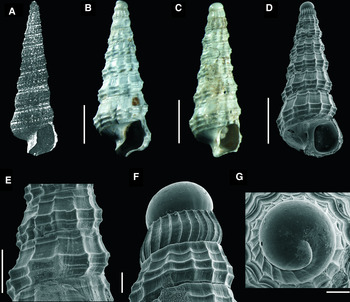
Cerithiella producta: (A) Holotype, USNM 87305, courtesy Dr A. Wáren; (B) Shell from off Rio de Janeiro, MNRJ 26621, 4.02 mm long; (C) Shell from off Rio de Janeiro, USNM 1250194, 3.59 mm long; (D) Shell from off Rio de Janeiro, IBUFRJ 15945, 3.41 mm long; (E: same shell as B) Detail of teleoconch, late whorls; (F–G: same shell as D): (F) Protoconch; (G) Adapical view of protoconch. Scale bars: B–D, 1 mm; E, 500 μm; F–G, 100 μm.

Cerithiella producta Dall, Reference Dall1927: 103.
TYPE MATERIAL
Holotype: USNM 87305 (not found; E. Strong, pers. comm.)
TYPE LOCALITY
30°58′N 79°38′W, 538 m [Dall (Reference Dall1927) wrongly cited 678 m], off Fernandina, Florida State, USA.
MATERIAL EXAMINED
Brazil: Camamu-Almada Basin, off Bahia State: MNRJ 32872, 14°21′56″S 38°39′47″W, 1800 m, 2011 [1]. Campos Basin, off Rio de Janeiro State: USNM 1250194, Oceanprof II station 61, 21°52′52″S 39°48′12″W, 1372 m, 26/vi/2003 [3]; IBUFRJ 19648, Oceanprof I station 57, 21°57′15″S 39°47′44″W, 1600 m, 14/xii/2002 [1]; IBUFRJ 19647, Oceanprof II station 51, 22°04′43″S 39°49′09″W, 1308 m, 25/vi/2003 [1]; MNRJ 26621, Oceanprof I station 47, 22°11′04″S 39°47′05″W, 1654 m, 25/xi/2002 [1]; IBUFRJ 19646, Oceanprof I station 82, 22°28′49″S 39°53′24″W, 1650 m, 17/xi/2002 [1]; MNRJ 26622, Oceanprof II station 86, 22°31′37″S 39°55′14″W, 1636 m, 16/vi/2003 [1]; IBUFRJ 19649, Oceanprof II station 77, 22°36′12″S 39°58′23″W, 1666 m, 13/vi/2003 [1]; MNRJ 26620, Oceanprof II station 77, 22°36′12″S 39°58′23″W, 1666 m, 13/vi/2003 [1]; IBUFRJ 15945, Oceanprof II station 67, 22°46′58″S 40°07′49″W, 1596 m, 12/vi/2003 [1]; IBUFRJ 19652, Oceanprof I station 67, 22°46′59″S 40°07′49″W, 1650 m, 22/xi/2002 [3].
CHARACTERIZATION
Shell up to 4.30 mm in length, 1.39 mm in width, dextral, conical, elongated, rectilinear profile, white colour. Protoconch with 2.5–2.75 whorls, barely distinct of teleoconch; apex dome-shaped, nucleus moderately protruded, remaining whorls convex and slightly bulbous; sculpture initially smooth, with close, narrow, nearly straight to slightly sinuous axial ribs on last whorl; micro-spiral threads more evident in the adapical portion of the second whorl of protoconch. Teleoconch with up to seven moderately convex whorls; micro-spiral threads more evident in the adapical portion of the second whorl of protoconch; three spiral cords on the beginning, one (adapical) just below the suture, two (median abapical and abapical) very close to each other, on the abapical portion of whorl; during the first whorl or at the beginning of the second one, an additional spiral cord (median adapical) develops below the adapical cord, still distant from the two abapical cords; the spiral cords develop minute nodules (especially on the two abapical cords) or just slight elevations (especially on the median adapical cord) when crossed by axial ribs, with the adapical cord being mainly smooth/wavy; on late whorls, the median abapical is by far the most developed, with its profile resembling a keel, followed by the abapical one, and the adapical ones; straight, orthocline to slightly opisthocline, and pronounced axial ribs, numbering 13–16 ribs on fifth whorl of teleoconch; suture shallow, with a very small sutural cord more evident on late whorls; body whorl not constraining; smooth subperipheral cord, with a smooth basal cord developing just below the subperipheral one; elliptical aperture, reaching 0.58 mm in width; anterior canal twisted and widely open, directed downward/sideward, reaching 0.47 mm in length; posterior sinus little developed.
REMARKS
The most similar species to Cerithiella producta are C. amblytera and C. cepene, although they are easily differentiated by presenting only two main spiral cords on the teleoconch, versus four in C. producta (Figure 4E).
The holotype and only shell of C. producta examined by Dall (Reference Dall1927) was not found, and it is probably misplaced (E. Strong, pers. comm.). The single available image of this species (Figure 4A) was taken some decades ago by A. Warén, and it shows the same conchiliological features observed in the shells from Brazil, such as the unique spiral sculpture. The most discrepant feature is the dimension of the holotype, described by Dall (Reference Dall1927) as being 8.5 mm in length and 2.5 mm in width, for about nine whorls of teleoconch (Figure 4A), almost double the size of the largest shell examined here (4.30 mm in length, 1.39 mm in width, for seven whorls of teleoconch). In addition, the bathymetric record of the holotype (538 m) is considerably shallower than the Brazilian records (1308–1800 m). Notwithstanding, we consider these as minor differences, and more studies of material of the deep-water fauna from the Caribbean and South America will probably reveal more occurrences of this species.
Bouchet & Warén (1993: 606) proposed the new combination of Krachia producta (Dall, 1927) to this species, with the genus Krachia Baluk, 1975 being currently allocated in Cerithiopsidae owing to the absence of phylogenetic works in Triphoroidea. Cerithiella producta truly shares great similarities with other eastern Atlantic species also allocated in this genus by Bouchet & Warén (1993), especially with Krachia guernei (Dautzenberg & Fischer, 1896), only differentiated by the number of spiral cords of teleoconch. The type species of Krachia, Cerithiopsis korytnicensis Baluk, 1975, is a fossil one from the Miocene, with a similar protoconch to the Recent Krachia species but a very different teleoconch, possessing three spiral cords crossed by strong axial ribs. It is certainly preferable to maintain C. producta in the variable genus Cerithiella; the generic allocation of the eastern Atlantic species of Krachia does not concern us here, despite their similarity with C. producta.
GEOGRAPHIC DISTRIBUTION
USA: off Florida (type locality); Brazil: off Bahia, off Rio de Janeiro (this study).
BATHYMETRIC DISTRIBUTION
538 m (type locality) to 1800 m (this study).
Cerithiella atali sp. nov.
(Figure 5)
Cerithiella atali sp. nov. (A) Paratype, MNHN IM-2000-27532, 7.68 mm long; (B) Paratype, MNRJ 25900, 5.80 mm long; (C) Holotype, MNHN IM-2000-27531, 6.76 mm long; (D–G: holotype): (D) Abapical portion of shell; (E) Detail of teleoconch, late whorl; (F) Protoconch; (G) Dorsal view of abapical portion of shell. Scale bars: A–C, 1 mm; D, G, 500 μm; E–F, 200 μm.

DIAGNOSIS
Protoconch mainly smooth and with apex very pointed; teleoconch initially with two spiral cords, abapical one assuming a more pronounced profile than adapical cord on later whorls, median spiral cord develops on seventh/eighth whorl.
TYPE MATERIAL
Holotype: MNHN IM-2000-27531, Expedition MD55 station 65-CB106, 02/vi/1987. Paratypes: off Espírito Santo State: MNHN IM-2000-27532, Expedition MD55 station 54-CB93, 19°36′S 38°53′W, 640 m, 30/v/1987 [1]. Campos Basin, off Rio de Janeiro State: MZSP 110599 [1]; IBUFRJ 19651, Oceanprof II station 49, 22°04′33″S 39°54′11″W, 722 m, 30/vi/2003 [1]; IBUFRJ 16989, Oceanprof II station 45, 22°10′53″S 39°52′18″W, 1039 m, 01/vii/2003 [2]; IBUFRJ 17263, Oceanprof II station 74, 22°27′31″S 40°09′23″W, 749 m, 18/vi/2003 [1]; MNRJ 26623, Oceanprof II station 75, 22°31′28″S 40°03′49″W, 1043 m, 18/vi/2003 [1]. Off Rio de Janeiro State: MNRJ 25900, type locality, Expedition MD55 station 65-CB106, 02/vi/1987 [1].
TYPE LOCALITY
23°54′S 42°10′W, 830 m, off Rio de Janeiro State, Brazil.
ETYMOLOGY
The specific name alludes to the god of ice in the Nordic culture, Atali, due to the snow-white colour of the shell. Epithet as a noun in apposition.
DESCRIPTION
Shell up to 8.47 mm in length, 1.97 mm in width, dextral, conical-fusiform, elongated, rectilinear profile, snow-white colour. Protoconch with 2.5–2.75 whorls, barely distinct of teleoconch; apex very pointed, nucleus totally protruded, remaining whorls convex and slightly bulbous; sculpture mainly smooth, except by spaced axial ribs on last whorl. Teleoconch with up to 11.5 whorls of very weak convex profile; two spiral cords on beginning, each situated on an extremity of the whorl, adapical one initially slightly larger, abapical one gradually strengthening and reaching same size as the adapical about the fifth whorl; on subsequent whorls, abapical cord assumes a more pronounced profile than adapical cord, resembling a keel; a small median spiral cord develops on seventh/eighth whorl in the wide zone between the other cords, equidistant from them; adapical and abapical spiral cords with nodules, median one nearly smooth; straight, orthocline and weak axial ribs, numbering 16–19 ribs on fifth whorl of teleoconch, almost disappearing on later whorls; short and broad whorls, suture shallow, with a small sutural cord; body whorl not constraining; thin and smooth subperipheral cord, base totally smooth; elliptical aperture, reaching 0.87 mm in width; anterior canal twisted and widely open, directed downward/sideward, reaching 0.70 mm in length; posterior sinus acute.
REMARKS
Cerithiella atali sp. nov. has the teleoconch somewhat similar to C. amblytera (Figure 2A–C), including the presence of two main spiral cords situated on each extremity of the whorl, although C. atali develops a median spiral cord on late whorls (Figure 5D). In addition, the very pointed protoconch of C. atali (Figure 5F) differs radically from C. amblytera (Figure 2F) and it is related to species previously referred to Stilus, a currently accepted synonym of Cerithiella (Bouchet & Warén, Reference Bouchet and Warén1993). The type species of Stilus, Cerithiella insignis (Jeffreys, 1885), from the eastern Atlantic, has three well-developed spiral cords since the beginning of the teleoconch and the protoconch is axially sculptured earlier than in C. atali. The protoconch of C. atali is also similar to that of Cerithiella genei (Bellardi & Michelotti, 1840), a fossil European species, although the teleoconch of C. genei resembles that of C. insignis.
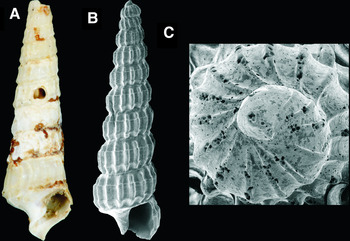
Two species previously allocated to the genus or subgenus Stilus are herein transferred to Eumetula Thiele 1912 (see Discussion): Eumetula axicostulata (Castellanos, Rolán & Bartolotta, Reference Castellanos, Rolán and Bartolotta1987) comb. nov., described from Argentinian waters, and Eumetula vitrea (Dall, Reference Dall1927) comb. nov. (Figure 8B, C), from the south-eastern USA. Although E. axicostulata and E. vitrea show a slightly pointed apex, which may have influenced respectively Castellanos et al. (Reference Castellanos, Rolán and Bartolotta1987) and Dall (Reference Dall1927) in their original allocations to Stilus, they differ radically from C. atali by the much stronger axial sculpture of the teleoconch, the strong convexity of the whorls, and the absence of the typical twisted anterior canal of Cerithiella.
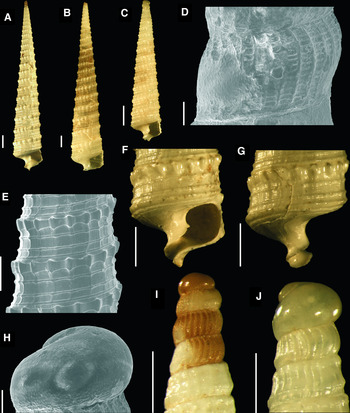
A–B, D–I: Cerithiella candela sp. nov. (A) Holotype, MNRJ 32635, 13.49 mm long; (B) Paratype, MNHN IM-2012-2724, 15.05 mm long; (D–I: holotype): (D) Detail of larval shell; (E) Detail of teleoconch, mid whorls; (F) Abapical portion of shell; (G) Dorsal view of abapical portion of shell; (H) Embryonic shell; (I) Protoconch. (C, J) Cerithiella pernambucoensis: (C) Shell from north-eastern Brazil, MNRJ 17238, 7.35 mm long; (J) Protoconch, same shell as C. Scale bars: A–C, F–G, 1 mm; D, H, 50 μm; E, I–J, 500 μm.

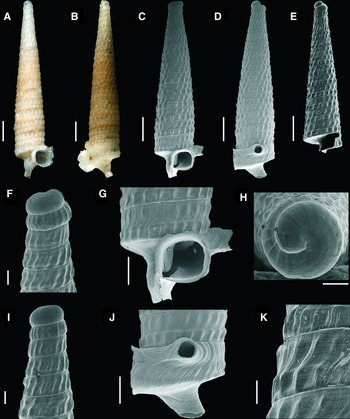
Trituba anubis sp. nov. (A–B) Holotype, MNRJ 18000, 8.90 mm long; (C–D) Paratype, MNRJ 31097, 7.14 mm long; (E) Paratype, MNRJ 31097, 6.04 mm long; (F, H, K: MNRJ 31097, but entire shell not illustrated): (F) Apex; (H) Adapical view of protoconch; (K) Detail of teleoconch, mid whorls; (G, J: same shell as C–D): (G) Abapical portion of shell; (J) Lateral view of abapical portion of shell; (I: same shell as E) Protoconch. Scale bars: A–E, 1 mm; F, H–I, K, 200 μm; G, J, 500 μm.

A: Cerithiella martensii, syntype, USNM 93770. B–C: Eumetula vitrea comb. nov., holotype, USNM 108337.

GEOGRAPHIC DISTRIBUTION
Brazil: off Espírito Santo, off Rio de Janeiro.
BATHYMETRIC DISTRIBUTION
640–1043 m.
Cerithiella pernambucoensis Lima & Barros, Reference Lima and Barros2007
(Figure 6C, J)
Cerithiella pernambucoensis Lima & Barros, Reference Lima and Barros2007: 64, figures 1–9.
TYPE MATERIAL
Holotype: MNRJ 10834. Paratypes: MNRJ 10835 [3]; MNRJ 10836 [1]; MZSP 80484 [4]; MORG 50690 [3]; ANSP 413609 [3]. All lots from type locality.
TYPE LOCALITY
08°46′30″S 34°44′30″W, 690 m, off Pernambuco State, Brazil.
MATERIAL EXAMINED
Holotype and paratypes deposited in MNRJ; and MNRJ 17238, somewhere between 06°30′S (Paraíba State) and 10°30′ (Alagoas State), north-eastern Brazil [no precise data of coordinates and depth], 12/xi/2001 [2].
REMARKS
See comments on the following species.
GEOGRAPHIC DISTRIBUTION
Brazil: off Pernambuco (type locality).
DIAGNOSIS
Brown protoconch with four whorls; white teleoconch with three (initial whorls) to four (late whorls) main spiral cords, adapical one very nodulose and much larger than remaining cords.
TYPE MATERIAL
Holotype: MNRJ 32635, 24/viii/2001. Paratypes: Vitória-Trindade Seamount Chain: MNHN IM-2012-2724, Expedition MD55 station 43-CB77, 19°40′S 37°48′W, 790–940 m, Champlain Seamount, 27/v/1987 [1]. Campos Basin, off Rio de Janeiro State: MNRJ 26618, Oceanprof II station 45, 22°10′53″S 39°52′18″W, 1039 m, 01/vii/2003 [1].
TYPE LOCALITY
21°53′37″S 39°50′19″W, 1129 m, Campos Basin, off Rio de Janeiro State, Brazil.
ETYMOLOGY
Candela, L. = candle. The specific name alludes to the resemblance of its shell to a candle.
DESCRIPTION
Shell up to 15.05 mm in length, 3.01 mm in width, dextral, conical-fusiform, very elongated, rectilinear profile. Protoconch brown with four whorls, with 0.58 mm in length, 0.35 mm in width; first 1.5 whorl dome-shaped, convex, nucleus moderately protruded, with very small granules only visible on its abapical portion; remaining whorls less convex, with close and nearly straight to slightly sigmoid axial ribs, besides several small spiral threads along the entire whorl. Teleoconch white to dirty-white, with up to 23 not convex whorls; it begins with two thin and faint spiral cords, each situated on an extremity of the whorl, with a median spiral cord appearing on the second/third whorl; after the third whorl, the adapical spiral cord gradually enlarges, becoming very nodulose and much larger than the smooth median and abapical spiral cords; a fourth, smooth and suprasutural cord is more evident on later whorls; several micro-spiral cords among the main spiral cords; nearly orthocline but slightly sigmoid axial ribs, numbering 20–22 ribs on tenth whorl of teleoconch, becoming very weak on later whorls; intense axial microsculpture between primary axial ribs; short and broad whorls, suture very shallow; body whorl not constraining; smooth subperipheral cord above two to three very small spiral basal threads, diminishing abapically and resulting in several micro-spiral threads; elliptical aperture, reaching 1.23 mm in width; anterior canal twisted and widely open, directed downward/sideward, reaching 1.02 mm in length; posterior sinus acute.
REMARKS
The teleoconch of Cerithiella candela sp. nov. (Figure 6A, B) is identical to that of Cerithiella pernambucoensis (Figure 6C), including the spiral sculpture, as well as similar dimensions of the shell (15.05 mm to 23 whorls of teleoconch in C. candela, protoconch partially broken; 16.1 mm to 23 whorls of teleoconch in C. pernambucoensis). The differences between them consist of the colour and shape of the protoconch: it is brown and typically multispiral, with four whorls, in C. candela (Figure 6I), and white and typically paucispiral (with 1.5 whorls) in C. pernambucoensis (Figure 6J). Several gastropod groups contain sibling species mainly differentiated by larval development, as observed in Vermetidae (Safriel & Hadfield, Reference Safriel and Hadfield1988), Rissoidae (Russo & Patti, Reference Russo and Patti2005) or Raphitomidae (Fedosov & Puillandre, Reference Fedosov and Puillandre2012), among many others. As poecilogony in Gastropoda has been proved to occur only in some taxa of Sacoglossa (Bouchet, Reference Bouchet1989), we discard the hypothesis of C. candela being conspecific with C. pernambucoensis.
GEOGRAPHIC DISTRIBUTION
Brazil: Vitória-Trindade Seamount Chain, off Rio de Janeiro.
TYPE SPECIES
Triforis bitubulatus Baudon, 1856, by original designation [Jousseaume (Reference Jousseaume1884) wrongly cited ‘Triforis bituberculatus’]. Eocene, France.
DIAGNOSIS
Cylindrical, elongated, dextral and white shell; protoconch axially ribbed, whorls more or less convex, with the apex sunken in the next whorl or protruding; teleoconch with opisthocline axial ribs and two spiral cords, usually producing nodular intersections; aperture usually circular, anterior and posterior canals tubular and well developed (adapted from Gofas, Reference Gofas2003).
SYNONYM
Tauroforis Sacco, 1895 (based on Cossmann & Peyrot, Reference Cossmann and Peyrot1922 apud Marshall, Reference Marshall1977).
Trituba anubis sp. nov.
(Figure 7)
DIAGNOSIS
Protoconch with first 1.5–1.75 whorl dome-shaped, smooth and slightly inflated, more convex than remainder of protoconch.
TYPE MATERIAL
Holotype: MNRJ 18000. Paratypes: MNRJ 31097 [8]; MZSP 53716 [2]; MZSP 53922 [1]; MZSP 70275 [2]; MZSP 70306 [4]. All lots from: type locality, P.M.S. Costa and J. Coltro coll., xi/2005.
TYPE LOCALITY
02°14′25″S 38°22′50″W, 240–260 m, Canopus Bank, off Ceará State, Brazil.
ETYMOLOGY
The specific name alludes to the god of mummification in the Old Egyptian culture, Anubis, due to the presence of mummified soft parts in this species. Epithet as a noun in apposition.
DESCRIPTION
Shell up to 14.47 mm in length, 2.15 mm in width, dextral, conical-fusiform, elongated, rectilinear profile, white, with up to 26 whorls. Protoconch with 3–3.5 whorls, barely distinct of teleoconch; first 1.5–1.75 whorl dome-shaped, convex, nearly smooth (only with micro spiral threads) and slightly inflated, nucleus moderately protruded; in the next 1.5–1.75 whorl the convexity of the whorls diminishes and the axial sculpture predominates, initially with spaced and orthocline axial ribs that gradually become closer and opisthocline. Teleoconch whorls not convex; it begins with gradual development of two thin and faint spiral cords, abapical one usually slightly larger, resulting in small elevations in the intersections with the axial ribs; sigmoid and opisthocline axial ribs, numbering 19–20 ribs on tenth whorl of shell, but becoming very weak on later whorls; intense axial microsculpture between primary axial ribs; short and broad whorls, suture very shallow; body whorl weakly constraining in large shells; small subperipheral cord crossed by the weak axial sculpture; base with intense microsculpture of axial lines that converge to aperture and posterior canal; circular aperture, very projected, with a continuous peristome, reaching 0.95 (without peristome)/1.22 (with peristome) mm in width; elongated anterior canal, closed (except at its end), directed downward, reaching 1.07 mm in length, 0.75 mm in width; posterior canal dislocated up to 1.06 mm of the border of the aperture, directed sideward, forming an elongated and thick tube with up to 0.78 mm in length, 0.67 mm in width; columellar and labial edges coming very close, often with a small gap on the abapical extremity of the junction.
REMARKS
Trituba anubis sp. nov. is distinct from Trituba barbadensis, the only species of this genus previously recorded from the western Atlantic. Trituba anubis has two defined, although weak, spiral cords on the teleoconch, axial ribs closely spaced (Figure 7A–E, K), and the protoconch initially smooth and concave but thereafter axially ribbed and less convex (Figure 7F, I), in contrast to T. barbadensis, with only one visible spiral cord on the teleoconch, axial ribs widely spaced, and the protoconch strongly convex, with axial ribs present since its beginning (Coomans & Faber, Reference Coomans and Faber1984). Trituba anubis is also distinct from the species described from the north-eastern Atlantic (Gofas, Reference Gofas2003) in its smooth and inflated beginning of the protoconch. Similarly to T. barbadensis (90–100 m; Coomans & Faber, Reference Coomans and Faber1984) and Trituba dexia (73–201 m; Verco, Reference Verco1909), Trituba anubis (240–260 m) occurs in shallower depths than species from the north-eastern Atlantic (270–1520 m; Gofas, Reference Gofas2003).
Species of the subgenus Granulotriforis have much more nodulose teleoconch than T. anubis, and species of the genus Paramendax have a different shell profile. The generic allocation of T. anubis is based on conchiliological similarities to its congeners, despite the unusual structure of its protoconch. We note the clearly multispiral protoconch in the type species of Trituba (illustrated by Marshall, Reference Marshall1980), although it is difficult to determine if the protoconch of T. anubis (Figure 7F, I) is multispiral but derived from intracapsular development, as proposed by Gofas (Reference Gofas2003), or paucispiral.
GEOGRAPHIC DISTRIBUTION
Brazil: off Ceará.
BATHYMETRIC DISTRIBUTION
240–260 m.
DISCUSSION
Although absent from Brazil, some species previously referred to Cerithiella and Stilus are herein analysed to avoid future taxonomic problems: Cerithiella martensii (Dall, Reference Dall1889), described from the Florida Strait and illustrated here for the first time (Figure 8A), is very similar to C. amblytera, including the presence of two spiral cords situated on each extremity of whorl; however, the only shell of C. martensii is very worn, without an apex, and it cannot be treated with certainty as a synonym of C. amblytera. Eumetula axicostulata (Castellanos et al., Reference Castellanos, Rolán and Bartolotta1987) comb. nov. was described in Cerithiella, but in the abstract of the same paper (Castellanos et al., Reference Castellanos, Rolán and Bartolotta1987) it was allocated to Cerithiopsilla Thiele, 1912, the same genus to which Dr P. Bouchet considered this species belonged (Martín & César, Reference Martín and César2004); however, the narrow appearance of the shell, the prevalence of axial sculpture and the near-absence of an anterior canal in E. axicostulata mainly distinguishes it from the concept of Cerithiopsilla. Eumetula vitrea (Dall, Reference Dall1927) comb. nov., also illustrated here for the first time (Figure 8B, C), was described as having a very short and not recurved anterior canal (Dall, Reference Dall1927), which differentiates it from Cerithiella; E. vitrea resembles the variable eastern Atlantic species Eumetula bouvieri (Dautzenberg & Fischer, 1896), illustrated in Bouchet & Warén (1993: figures 1334, 1336–1340). Although the current concept of Eumetula comprises species with variable degrees of axial or spiral sculpture and convexity of whorls on the shell, E. axicostulata and E. vitrea share with the type species Eumetula dilecta Thiele, 1912 and other congeners some diagnostic features of the genus, such as the absence of a drawn-out anterior canal, but a base with a very narrow cord and the shell smaller than 10 mm (Bouchet & Warén, Reference Bouchet and Warén1993). The junior homonym Eumetula vitrea Høisaeter, 2011 will receive a replacement name in an oncoming paper (T. Høisaeter, pers. comm.).
Recent Newtoniellinae species seldom present truly planktotrophic development, which appears to have been common in fossil species of this group (references and comments for triforids in Marshall, Reference Marshall1977, Reference Marshall1980; Gofas, Reference Gofas2003). Cerithiella candela sp. nov. possesses a multispiral protoconch with a clear delimitation from the teleoconch, which is rare among its Recent congeners and triforids, both considered to have multispiral protoconchs but derived from intracapsular metamorphosis (Bouchet & Warén, Reference Bouchet and Warén1993; Gofas, Reference Gofas2003), with unclear delimitation from teleoconch. Another evidence for planktotrophy in C. candela is the brown colour of its protoconch, suggesting that larvae migrate to the photic zone to feed on phytoplankton (Bouchet, Reference Bouchet1976), and complete its ontogenetic migration when metamorphosing at the deep-sea floor (Bouchet & Warén, Reference Bouchet, Warén, Young and Eckelbarger1994), when the adult begins to produce the white teleoconch. Bouchet & Warén (Reference Bouchet, Warén, Young and Eckelbarger1994: 112) also considered ‘occurrence of planktotrophy in deep-sea taxa to be a plesiomorphy that primarily reflects phylogeny’; in this way, C. candela could be related to an ancestral lineage in Cerithiella.
Previously to this study, four species of Newtoniellinae were recognized for Brazil, although still classified in Cerithiopsidae. Currently, nine species are recognized, in addition to a previously unknown genus to Brazil, Trituba. Of these species, five have a very restricted distribution (Cerithiella cepene; Cerithiella pernambucoensis; Cerithiella atali; Cerithiella candela; Trituba anubis), two have a wide range through the western Atlantic (Cerithiella sigsbeana; Cerithiella producta) and two are recognized as amphi-Atlantic species (Cerithiella amblytera; Cerithiella enode). Owing to the deep-sea habitat of Newtoniellinae species and its related difficulty in sampling, probably more species of this group exist in Brazilian waters.
ACKNOWLEDGEMENTS
We are very grateful to: Dr Ellen Strong (USNM), who photographed type material of Cerithiella sigsbeana, Cerithiella martensii and Eumetula vitrea, besides verifying the availability of the holotype of Cerithiella producta; Dr Anders Warén (Swedish Museum of Natural History), who furnished the photograph of the holotype of C. producta; Dr Adam Baldinger (MCZ), who photographed type material of C. sigsbeana; Dr Paulo Márcio Costa and José Coltro, who provided the samples of C. sigsbeana and T. anubis from Canopus Bank, besides providing material from several lots (P. M. Costa); Dr Luiz Simone (MZUSP), who lent some lots of Trituba anubis deposited on MZUSP; Dr Philippe Bouchet and Dr Philippe Maestrati (MNHN), for loan of lots from the MD55 Expedition; Dr Franklin Santos (Universidade Federal do Espírito Santo), who donated a lot of C. pernambucoensis; Department of Entomology (MNRJ), that provided equipment for the colour photographs; Amanda Veiga and Beatriz Cordeiro, who operated the SEM at Department of Invertebrates (MNRJ); Janet Reid, for revising the English text; Dr Nick Pope, who edited the manuscript; two anonymous reviewers, for their criticisms and suggestions to improve the manuscript.
FINANCIAL SUPPORT
FAPERJ (Fundação Carlos Chagas Filho de Amparo à Pesquisa do Estado do Rio de Janeiro) provided financial support through project E-26/110.325/2014 and project E-26/110.068/2014 and CNPq (Conselho Nacional de Desenvolvimento Científico e Tecnológico) provided fellowships to M. Fernandes and R. Garofalo.