


The campaign (…) is the culmination of a contest to see who makes best use of the social structure.
Mary Hollsteiner, The Dynamics of Power
INTRODUCTION
Political institutions are built on existing social structures, with their own hierarchies, rules, and norms governing interactions and behavior. The existing literature often focuses on ethnic and religious cleavages and associates social cohesion with a host of positive outcomes such as greater public goods provision, arguing that fractionalization undermines communities’ collective action and aggregation of preferences. However, in most developing countries, politicians (and not communities) are responsible for the provision of public goods, which are funded with transfers (rather than local taxes). In these contexts, the implication of social fractionalization for collective action and preference aggregation may be less relevant for understanding public goods provision. Thus, it is essential to understand how social structures shape the incentives of local politicians to allocate resources across communities.
We offer a new framework for theorizing about the link between social structure—the configuration and relative position of social groups—and subsequent electoral strategies for redistribution. We argue that in weakly institutionalized and clientelistic democracies, social cohesion can also facilitate elite capture by concentrating political influence in a handful of leaders who can help provide votes in exchange for private transfers. Consequently, if society is divided into multiple relevant social groups, the subsequent redistributive strategies adopted by politicians to attract voters may shift toward greater—rather than lower—public goods provision.
We study these questions in the context of local politics in the Philippines. The provision of public goods in the Philippines is partly the responsibility of elected municipal mayors whose budgets depend mostly on transfers from the central government. Mayors must allocate their budget across the different barangays (villages) that compose the municipality. Critical actors in Filipino social and political life are clans or extended families: political alliances at the local level often involve securing the support of clan leaders who can leverage strong norms of in-group cooperation and reciprocity to deliver the votes of their family members and other members of the community (Fegan Reference Fegan and McCoy2009; Hollnsteiner Reference Hollnsteiner1963; Timberman Reference Timberman1991).
We demonstrate that mayors’ decisions to provide public goods across the different villages that comprise their municipality vary as a function of the social structure of the village. To do this, we use a unique dataset covering 20 million individuals in more than 15,000 villages across 709 municipalities of the Philippines. The dataset includes information on family names and we use naming conventions in the Philippines to establish ties between families through intermarriages. Following Padgett and McLean (Reference Padgett and McLean2006) and Cruz, Labonne, and Querubín (Reference Cruz, Labonne and Querubín2017), we consider a tie between two families to exist whenever we observe at least one marriage between members of the two families. We graph the full family network in all villages in our sample. We then use community detection algorithms (Girvan and Newman Reference Girvan and Newman2002; Pons and Latapy Reference Pons, Latapy, Yolum, Güngör, Gürgen and Özturan2005) to identify the configuration of clans in every village based on the relative number of ties within and between clusters of families in the network. To account for the relative influence of each clan, we create a measure of social fractionalization with the Herfindahl index that captures how the village population is distributed across the different clans. We hypothesize that in less fractionalized or more cohesive villages, clan leaders are more effective in concentrating political influence and capturing politicians at the expense of public goods provision. Another implication of this is that more fractionalized villages will also feature higher political competition because clan heads will exert less persuasion and control over candidacy and the voting decisions of village residents.
Our results show that social fractionalization is positively correlated with village-level provision of public goods such as schools, public marketplaces, water systems, and health centers. These correlations are sizable, for example, a one standard deviation increase in social fractionalization increases the probability that a health center is located in the village by around 6 percentage points (an increase of 10% relative to the sample mean). These correlations are robust to the inclusion of municipality fixed effects and a broad set of village covariates such as village population, the number of distinct families in the village, whether the village is classified as rural, and controls for different occupations and educational levels. To address concerns about reverse causality (i.e., whether family ties, and thus our social fractionalization measures, are affected by public goods provision), we restrict our network to ties between individuals aged 45 years or older and use the social fractionalization measure in the restricted network—capturing marriages that took place at least 20–25 years ago—as an instrument for the corresponding measure in the full network. Our results are similar when we use this approach.
We also use two further approaches to establish that social fractionalization is correlated with stronger political competition. First, we use data on local sources of political influence from an original survey conducted in two provinces shortly after the 2013 election to show that, consistent with our theory, less fractionalized villages are characterized by a greater concentration of political influence. Second, we show that social fractionalization is associated with (i) a larger number of candidates running for office in village elections and (ii) narrower vote margins for the winning candidate in village and municipal elections.
Our results should be interpreted cautiously because naturally, social structure measures are not randomly assigned across villages. Although we control for several village-level characteristics that may potentially confound our estimates and follow an instrumental variables approach, we cannot fully account for all variables that may have shaped intermarriage networks over many decades. We show that fractionalization across clans is not correlated with preference heterogeneity or collective action and thus rule out these variables as mediators in our context. Although political competition may partly mediate the effect of fractionalization on public goods (political competition and public goods provision are indeed positively correlated in our context), it may also be an outcome and there are other channels through which fractionalization may impact the redistributive strategies of politicians. Our findings point to the importance of considering how social structure shapes the concentration of power and the distributive strategies of politicians.
Much of the literature on public goods provision uses ethnic, linguistic, or religious fractionalization as a measure of social structure. This research has shown mixed results, with many papers showing a negative relationship between fractionalization and public goods provision across both developed and developing countries (Alesina, Baqir, and Easterly Reference Alesina, Baqir and Easterly1999; Easterly and Levine Reference Easterly and Levine1997; Miguel and Gugerty Reference Miguel and Gugerty2005), whereas others question these correlations on both methodological and substantive grounds (Gao Reference Gao2016; Kustov and Pardelli Reference Kustov and Pardelli2018; Soifer Reference Soifer2016; Wimmer Reference Wimmer2016). We contribute to this literature in several ways. First, we argue that when politicians, rather than communities, are responsible for public goods provision, social cohesion may promote elite capture and lead to the underprovision of public goods. This is particularly relevant in clientelistic democracies where electoral strategies focus on the exchange of private transfers for electoral support. Second, we focus on a different measure of fractionalization based on a fundamental unit of social organization—the family—which may account for social structure even in countries where ethnic and religious fractionalization are not as relevant.
We also add to the literature on local elite capture—the concern that influential groups in the community with strong connections to local politicians disproportionately benefit from government resources—and the delivery of public goods (Bardhan Reference Bardhan2002). Our theory argues that patterns of elite capture can emerge endogenously as a function of the social structure and the electoral strategies of politicians. Our key contribution is that the political influence of different groups is a function of social fragmentation. We interpret the concentration of political influence and the resulting underprovision of public goods as a form of elite capture in our context. Closely related to our paper is the work by Acemoglu, Reed, and Robinson (Reference Acemoglu, Reed and Robinson2014) who find that places in Sierra Leone with more ruling families exhibit better development outcomes today. In these places, “chiefs constrained by greater competition will be less able to manipulate access to land for their own benefit or will have to compete by offering and providing public goods” (p. 321).
Our paper builds on a growing literature on the economic and political impact of families and kinship ties (Moscona, Nunn, and Robinson Reference Moscona, Nunn and Robinson2017; Padgett and McLean Reference Padgett and McLean2006; Todd Reference Todd1985). In a closely related paper, Xu and Yao (Reference Xu and Yao2015) study the role of lineage groups in local governance in China. However, to our knowledge, our paper is the first to use large-scale family networks (based on the full sample of intermarriage ties for a large number of villages) to study how social structures influence the incentives of politicians to provide public goods.
We also contribute to the empirical literature on the role of social networks in the distributive strategies of politicians (Calvo and Murillo Reference Calvo and Murillo2013; Larson and Lewis Reference Larson and Lewis2017) and other political outcomes such as turnout (Eubank et al. Reference Eubank, Grossman, Platas and Rodden2017). We build on Cruz, Labonne, and Querubín (Reference Cruz, Labonne and Querubín2017) who show that a candidate’s centrality in family networks facilitates brokered linkages with voters and contributes to higher vote shares during the elections. In this paper, rather than exploiting the position of individual candidates in the network, we study how the network structures of villages condition the distributive strategies of politicians.
Finally, we also contribute to the literature on social diversity and political competition. A series of studies have documented that greater social diversity leads to a larger number of parties and stronger political competition (Amorim-Neto and Cox Reference Amorim-Neto and Cox1997; Lublin Reference Lublin2017; Potter Reference Potter2014). This is consistent with our finding that greater fractionalization is associated with a larger number of candidates and less concentrated political influence.
SOCIAL STRUCTURE, PUBLIC GOODS, AND ELECTORAL COMPETITION
Most existing theories on how social structures influence political and economic outcomes are based on studies documenting a negative correlation between ethnic or religious fractionalization and public goods provision (Alesina, Baqir, and Easterly Reference Alesina, Baqir and Easterly1999; Easterly and Levine Reference Easterly and Levine1997). These theories emphasize how fractionalization may undermine collective action and the aggregation of policy preferences among citizens. These seem particularly relevant in contexts in which communities are responsible for the provision of public goods, for example, through the payment of taxes or other contributions and must collectively agree on local priorities. However, in most of the developing world, public goods are the responsibility of elected politicians rather than of communities. These public goods are often funded with transfers from the central government (not local taxes) and thus collective action and preference heterogeneity may be less relevant. In these contexts, it becomes essential to understand how social structure shapes the distributive choices of politicians.Footnote 1
We argue that in weakly institutionalized democracies, where politicians are responsible for public service delivery, social cohesion can lead to the underprovision of public goods. This is especially important in clientelistic contexts, where voters engage with politicians through brokers and rely on information from friends, family, and neighbors to make political decisions.Footnote 2
When members in a society are concentrated in a relatively small number of politically relevant groups, political influence—used here to refer to social persuasion and the ability to broker political exchange—also becomes more concentrated. As a consequence, leaders of larger groups have high bargaining power and can demand private, targeted, excludable transfers to their group in exchange for the electoral support of its members. Transfers to these influential groups, which we interpret as a form of elite capture, crowd out and undermine the provision of public goods.
Social fractionalization can also increase the agency and transaction costs for politicians of engaging in the clientelistic exchange of private transfers for votes. Consider a society in which a large share of citizens belong to a handful of groups; in this case, politicians can secure a large number of votes by brokering deals with a small number of influential leaders that they can more easily monitor. As the number of groups increases and each group represents a smaller share of the electorate, this electoral strategy becomes less attractive. Following Lizzeri and Persico (Reference Lizzeri and Persico2004), as society becomes more fragmented, the incentives for politicians to provide policies with diffuse (as opposed to targeted and excludable) benefits increases, which can encourage the provision of public goods. This argument is also related to Dahl’s theory on the benefits of pluralism and diversity for the performance of democracy (Dahl Reference Dahl1973).
Finally, another implication of our theory is that less fractionalized villages will also feature lower political competition. First, clientelistic transfers become a more appealing strategy in these villages than providing public goods which will encourage clan leaders to mobilize voters in support of one of the candidates leading to both high turnout and less competitive races. Second, the concentration of political influence implies that clan leaders can mobilize a large set of voters over whom they exert influence in support of their preferred candidate. As a result we expect to observe a broader set of individuals running for public office and tighter races in more fractionalized villages. In the next section we illustrate some of these ideas in the Philippine context.
Clans and Elections in the Philippines
Local democracy in the Philippines is vibrant and highly relevant for studies of public service delivery (Abinales and Amoroso Reference Abinales and Amoroso2017; Rogers Reference Rogers2004). The country is divided into roughly 1,600 cities and municipalities which are themselves divided into over 42,000 barangays (villages). Municipalities are governed by a mayor, a vice-mayor, and eight municipal councilors. All municipal officials are elected in first-past-the-post elections organized, by law, at fixed intervals of three years. Political parties tend to be weak and unstable, and there are typically large shifts in party affiliations after each election (Hutchcroft and Rocamora Reference Hutchcroft and Rocamora2003; Mendoza, Cruz, and Yap Reference Mendoza, Cruz and Yap2014). Every three years, each barangay also elects a barangay captain (village head) and a barangay council. These are responsible for the maintenance of public goods and assisting the mayor with the implementation of municipal programs.
The 1991 Local Government Code devolved significant responsibilities for the delivery of a number of social services to municipalities, including primary healthcare programs, repair and maintenance of local infrastructure, and provision of agricultural, fishery, mines, and geoscience services (Azfar et al. Reference Azfar, Gurgur, Kahkonen, Lanyi and Meagher2000). Municipalities are expected to finance these services through yearly transfers from the central government, known as the Internal Revenue Allotment (IRA) (Llanto Reference Llanto2012). Although municipalities can also raise their own revenues through local taxes and fees, the IRA provides 85% of their budgets on average (Troland Reference Troland2016).Footnote 3
The mayor, as the chief executive of the municipal government, enjoys significant responsibilities and discretionary powers. Even in sectors with national-level programs such as education and health, the Local Government Code devolved responsibility for many client-facing services to the municipalities, as well as significant fiscal and regulatory functions (Capuno Reference Capuno2012; Llanto Reference Llanto2012). This is consistent with Rogers’s (Reference Rogers2004) characterization that for the day-to-day life of Filipinos, “government in every practical sense means local government.” Mayors play an important role in deciding how to allocate the budget across various sectors and the different barangays that compose the municipality (Capuno Reference Capuno2012; Hutchcroft Reference Hutchcroft2012).
At the same time, service delivery and public goods provision remain a challenge. For example, according to the 2010 Population Census, about 32% of villages do not have a health center and close to 40% do not have modern water and sanitation systems. Not surprisingly, health outcomes are also lacking. Under-five infant mortality is about 28 per 1,000 live births, higher than neighboring countries with lower income levels like Vietnam. About 33% of children under five years are stunted, a rate similar to that of poorer countries like Cambodia and Myanmar. This suggests that underprovision of public goods is not only due to low income or lack of resources but also the average municipality only spends 90% of its budget every year.
These challenges are largely attributed to electoral incentives that center on clientelism rather than public goods provision (Azfar et al. Reference Azfar, Gurgur, Kahkonen, Lanyi and Meagher2000; Khemani Reference Khemani2015; Timberman Reference Timberman1991). This includes providing jobs (Fafchamps and Labonne Reference Fafchamps and Labonne2017; Lande Reference Lande1964), money (Cruz Reference Cruz2019; Khemani Reference Khemani2015; Mendoza et al. Reference Mendoza, Beja, Venida and Yap2016), and other private goods and services (Hutchcroft and Rocamora Reference Hutchcroft and Rocamora2003) in exchange for political support. For example, surveys carried out in both urban and rural communities after the 2010 and 2016 elections suggest that around 30% of voters were offered money for their vote (Cruz Reference Cruz2019; Mendoza et al. Reference Mendoza, Beja, Venida and Yap2016).
Although clientelism can take different forms, the logistical requirements are substantial: the identification of clients and the delivery of benefits require sophisticated networks to monitor actors and manage exchange relations (Kitschelt and Wilkinson Reference Kitschelt and Wilkinson2007).Footnote 4 Consequently, the practice of clientelism is predicated on social norms of reciprocal exchanges and obligations, which in the Philippines is reinforced by family ties (Corpuz Reference Corpuz1965; Covar Reference Covar1998; Enriquez Reference Enriquez and Enriquez1986; Miralao Reference Miralao1997).
Taken together, it becomes easier to understand why Philippine political culture revolves around families and clans (Abinales and Amoroso Reference Abinales and Amoroso2017; Hutchcroft and Rocamora Reference Hutchcroft and Rocamora2003; Lande Reference Lande1964; McCoy Reference McCoy2009). Sidel (Reference Sidel1999) attributes the importance of families in politics to the overlaying of democracy on the emerging socioeconomic landscape of hacienda-based clans and business elites.Footnote 5 There is even a commonly used Tagalog phrase that highlights the linkages between families and clientelism: kasal, binyag, and libing, which literally means “weddings, baptisms, and funerals.” This well-known term for clientelism refers to the fact that politicians are involved even in intimate family events, serving as godfathers for baptisms, sponsors for weddings, and contributing toward funeral costs.
Consequently, politicians competing in municipal elections must often seek the support of extended families or clans (Abinales and Amoroso Reference Abinales and Amoroso2017; Timberman Reference Timberman1991). Fegan (Reference Fegan and McCoy2009) argues that families are key political actors because their reputation, loyalties, and alliances are transferable from members who die or retire to the younger generations. One example is the norm of utang na loob (literally “inner debt”), which refers to a debt of gratitude that fosters reciprocity and feelings of social obligation. As stated by Hollnsteiner (Reference Hollnsteiner1963), “keeping with the highly familistic orientation of Philippine society whereby an individual represents his family, utang na loob is not limited to an individual-to-individual relationship but is rather seen as operative from family to family” (p. 79). Although we do not want to overstate the cultural basis for clans as political units, even conceptions of Filipino culture that would consider utang na loob as just a small part of a broader value framework would still emphasize the relational basis of Filipino values and the importance of the family unit for understanding politics (Aquino Reference Aquino2004; Enriquez Reference Enriquez and Enriquez1986; Reyes Reference Reyes2015). For example, Timberman (Reference Timberman1991) cites the norms of utang na loob and pakikisama (ability to engage with others) as contributing to a personalistic and patronage-based political culture. Furthermore, although adherence to these traditional norms (as well as their social relevance) may decline over time, a recent study on Filipino adolescents conducted by Clemente et al. (Reference Clemente, Belleza, Yu, Catibog, Solis and Laguerta2008) shows that the relational values identified by Enriquez (Reference Enriquez and Enriquez1986)—utang na loob, pakikisama, and hiya (shame as a result of unfulfilled social obligations)—were still considered to be important.
An implication of these features of Philippine society is that municipal politicians can often secure a large number of votes by targeting private transfers and services to members of large clans. These private transfers often come at the expense of the provision of public goods that would benefit all village residents equally. Clan heads, together with barangay officials, often operate as brokers between municipal candidates and clan members, monitoring that clans vote as promised and that resources flow to the families. Although in some instances clan members can only imperfectly command the votes of their clan, the shared expectations and norms of reciprocity among clan members give them organizational advantages for engaging in political exchange.
IDENTIFYING CLANS AND MEASURING FRACTIONALIZATION
Clans and Communities
An empirical challenge in our context is characterizing the social structure in every village. Key to our analysis is determining the number of politically relevant clans in each village. Theoretically, for our purposes a clan is a set of families: (i) connected to each other by kinship or marriage and (ii) where relationships of exchange among members are governed by well-established norms of cooperation and reciprocity. In other words, they are the set of individuals for whom existing familial ties can facilitate coordination of votes for the politician that provides patronage or transfers to the clan. Although individuals in the Philippines can easily provide us with this information, collecting these data at a large scale is challenging. We propose to use social network analysis to address this issue by identifying cohesive groups of families in the intermarriage network. Cohesive groups are those with many ties within the group and relatively fewer ties to other groups.
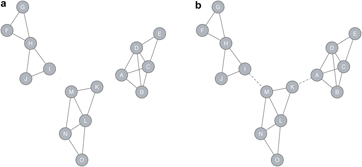
Consider a social network in which a node is a family and edges between nodes imply that a marriage has occurred between members of these families. An example is illustrated in panel (a) of Figure 1, which shows a network with 15 different families. This network features three components, that is, groups within which nodes are path-connected, but disconnected from other sets of nodes in the network (Jackson Reference Jackson2010). One intuitive approach would be to identify each different clan with the different components in the marriage network. This approach, although appealing, can be quite restrictive in practice because family networks in real life (and in our Filipino context, in particular) rarely feature neatly distinct components as those illustrated in panel (a) of Figure 1.
Sample Marriage Networks. Nodes Represent Families and Edges Indicate a Marriage Between Those Families

By contrast, the slightly modified network in panel (b) of Figure 1 differs only from panel (a) in that we have added two additional edges (represented by dashed lines): one between families A and K and another one between families I and M. The three distinct sets of nodes are still apparent, but this modified network has only one component (the full network). Thus, an approach based on components would identify only one clan in this network and all individuals would belong to that clan. An alternative that considers both the distinct sets of nodes and also the additional links among them is the concept of communities. In a social network, communities are groups of nodes with dense connections internally (i.e., within the group) and sparser connections between groups (Jackson Reference Jackson2010). Intuitively, the social network in panel (b) of Figure 1 has three different communities even though it has only one component.
Our approach is thus to use the different communities in the social networks as proxies for the clans. At the same time, the community structure in a network is a latent feature that needs to be uncovered; there are several potential ways to partition a network’s nodes into separate groups that we describe in the following section.
Community Detection
One approach to uncovering community structures in social networks is based on edge removal. The intuition is as follows: if two groups of nodes are only loosely connected with each other, then removing the edges between those two groups will generate components in the restricted network. Communities correspond to those components in the restricted network. The networks in Figure 1 can be used to illustrate this approach. The two dashed edges in panel (b) loosely connect groups of nodes that are densely connected with each other. Removing those two edges will yield a restricted network like the one illustrated in panel (a) with three different components.
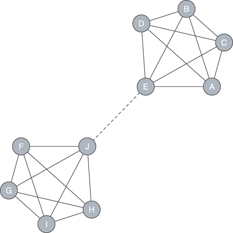
Approaches based on edge removal differ in terms of the selection rule regarding which edges to remove. We follow an algorithm proposed by Girvan and Newman (Reference Girvan and Newman2002) that consists in the sequential removal of edges with high betweenness centrality. This centrality measure captures the extent to which the edge serves as a link between different groups. It is calculated using the number of shortest paths between nodes in the network that pass through that edge.Footnote 6 For example, the dashed edge between nodes J and E in Figure 2 has the highest betweenness centrality in that network. Similarly, the dashed edges in panel (b) of Figure 1 have high betweenness centrality.
Edge With High Betweenness Centrality

The Girvan–Newman algorithm proceeds as follows:
1. Calculate betweenness for all edges in the network
2. Remove the edge with the highest betweenness
3. Recalculate betweenness for all edges affected by the removal
4. Repeat from step 2 until no edges remain
5. From the resulting dendrogram (the hierarchical mapping produced by gradually removing these edges), select the partition that maximizes network modularity (characterized by dense connections within clusters and sparse connections between them)
Although in our baseline analysis we focus on communities identified by the Girvan–Newman algorithm, for robustness we also implement the Walktrap algorithm developed by Pons and Latapy (Reference Pons, Latapy, Yolum, Güngör, Gürgen and Özturan2005). Intuitively, the algorithm relies on the idea that random walks on a graph tend to get “trapped” into densely connected parts corresponding to communities. The algorithm thus generates a large number of random walks and groups together nodes that are tied together through those walks. See Pons and Latapy (Reference Pons, Latapy, Yolum, Güngör, Gürgen and Özturan2005) for more details.
Measuring Fractionalization
The algorithm delivers a partition of C communities (indexed by c = 1,…, C), each containing a share s c of distinct nodes (families). We then use this to compute our main independent variable, the measure of social fractionalization (SF), using the standard Herfindahl–Hirschman index:
 $${\rm{SF}} = 1 - \sum\limits_{\vskip6pt\hskip-13pt{{\it c} = 1}}^{\vskip-5pt\hskip-9pt\it C} {{\it s}_{\it c}^2 } .$$
The measure can be interpreted as the probability that two randomly selected families are from different clans. We use this approach because we are interested in accounting for both the overall configuration of clans in the village and differences in relative size or strength among clans.Footnote 7
DATA
In this section, we present our various data sources and describe our main dependent and independent variables.
Family Networks
Our main independent variable is the extent to which a village’s population is fragmented into several clans. To do this, we identify network communities and use them as proxies for clans in the family network of the village. To construct the family networks, we use data collected for the National Household Targeting System for Poverty Reduction (NHTS-PR). This large-scale household survey, implemented between 2008 and 2010, reports several socioeconomic characteristics of the household and the gender, age, educational attainment, and occupational category of every household member. We focus on municipalities where full enumeration took place.Footnote 8 This leaves us with information on 20 million individuals in about 15,000 barangays in 709 municipalities.Footnote 9 Importantly, we have access to the non-anonymized version of the dataset and have two family names (the middle and last name) for every individual.Footnote 10
We are able to measure large-scale family networks in the Philippines due to naming conventions with two convenient features: (i) within a municipality, a shared family name implies family connections and (ii) each individual carries two family names, which establishes that a marriage took place between members of those two families.
More concretely, names in the Philippines have the following structure:
 $${\rm{firstname}}\;{\rm{midname}}\;{\rm{lastname}},$$
where first name corresponds to the individual’s given first name, midname corresponds to the mother’s maiden name (for men and single women) or the father’s family name (for married women), and last name corresponds to the father’s family name (for men and single women) or the husband’s family name (for married women).
The naming structure and distribution of family names in the Philippines can be traced back to the nineteenth century. In 1849, concerned with the arbitrary way in which Filipinos chose their surnames and the implications for tax collection, Governor Narciso Claveria y Zaldua created a catalog with a list of 61,000 different surnames. Municipal officials throughout the country then assigned a different name to each family. Since then, names have been transmitted through generations according to well-established and enforced naming conventions. As a consequence, very common family names are not as prevalent in the Philippines as in other countries and thus, sharing a family name is very strongly correlated with an actual family tie. This is especially the case within municipalities and villages.
Given the full names of all individuals in an area, we are able to reconstruct all the edges in the family network by examining the joint occurrences of middle and last names.Footnote 11 As noted above, each individual maintains two family names: their father’s name and either their mother’s maiden name or their husband’s name, in the case of married women. Thus, each individual’s set of family names indicates an intermarriage between the two families—either in their generation (in the case of married women) or in their parents’ generation (in the case of men and single women). As a result, we are able to observe ties between families merely by the occurrence of the family names within an individual.
For example, Figure 3 depicts the family network that can be drawn from a list of relatives of the previous Philippine President, Benigno Cojuangco Aquino. His middle name is his mother’s maiden name, Cojuangco, and his last name is his father’s last name, Aquino, implying a marriage tie between the Cojuangco and Aquino families. Similarly, we can show ties among the Aquino, Abellada, and Aguirre families through the names of his sister Aurora Aquino Abellada and cousin Bam Aguirre Aquino. On the Cojuangco side, we can show ties to the Sumulong and Teodoro families through the names of his cousin Gilberto Cojuangco Teodoro and uncle Jose Sumulong Cojuangco, as well as an indirect tie to the Prieto family through Gilberto’s wife Monica Prieto Teodoro.
Family Network for Selected Members of Former President Aquino’s Family

Once the networks are constructed, we implement the Girvan–Newman and Walktrap algorithms and compute our main independent variable, the measure of social fractionalization.
Table A.2 in the Online Appendix presents some descriptive statistics on the number of communities and fractionalization measures. The average (median) number of communities per village is 46 (34). However, the two largest communities in the village contain, on average, close to 25% of the village population. Although more populated villages exhibit higher fractionalization, there is substantial variation in fractionalization across villages in all terciles of the population distribution. Below, we show that our estimates are robust to controlling for village population and to dropping villages with extreme fractionalization and population values.
Outcome Variables
Public Goods
For our main outcome, we use data from the 2010 population census that lists public goods available in every barangay. We use this to code dummies for whether the barangay has an elementary school, a high school, a public market, a health center or a community water system. Because our indicators all capture the same concept to address the multiple comparisons problem, we combine them into a public goods index using the inverse covariance weighting approach proposed by Anderson (Reference Anderson2008).Footnote 12 Table A.2 in the Online Appendix provides some descriptive statistics for our different outcome variables.
Preference Heterogeneity and Collective Action
We use data from a survey conducted shortly after the 2013 local elections to examine the extent to which social fractionalization is correlated with heterogeneity in preferences over public goods and collective action.Footnote 13 Previous studies argue that these variables play an important role in understanding the effect of fractionalization on public goods provision.
More specifically, respondents were asked about their preferred allocation of the municipality’s Local Development Fund (LDF) across 10 different sectors.Footnote 14 As a measure of heterogeneity in preferences, we simply take the standard deviation in respondents preferred allocation for each budget item.
To measure social capital and collective action, we simply use dummy variables for whether the household participated in any formal group (such as unions, farmer’s or other professional associations, community development associations, microfinance groups, and cooperatives) or in communal voluntary work activities (known locally as Bayanihan) and average those over all village respondents.
Political Competition
To examine the correlation between social fractionalization and political competition, we use electoral outcomes from the 2010 municipal elections and the 2010 and 2013 barangay elections collected from the Commission of Elections (COMELEC) website. For municipal elections, we have precinct-level data on the number of registered voters, the number of individuals who voted, and the number of votes received by each mayoral candidate.Footnote 15 For barangay-level elections, we have village-level data on the votes obtained by every candidate for barangay head (Punong Barangay) and for the barangay council (Barangay Kagawad).
Our main political competition variables are the win margin (vote share of the candidate that received the most votes in that precinct minus vote share of the runner-up in that precinct) and the number of candidates running in the race. We also use indices of effective number of candidates, proposed by Laakso and Taagepera (Reference Laakso and Taagepera1979) and Golosov (Reference Golosov2010) and described in Section A.2 in the Online Appendix. As above, we combine these measures into a single political competition index following Anderson (Reference Anderson2008).
To capture the effect of social fragmentation on the concentration of political influence, we also use the 2013 survey. Respondents were asked to “name five individuals living in the barangay, but not living in your household, whose opinions you respect the most when it comes to politics.” This allows us to test whether social fractionalization affects the overall number of influential leaders that villagers mention in their responses.
EMPIRICAL ANALYSIS AND RESULTS
Our main analysis consists of village-level cross-sectional regressions between public goods and political competition outcomes and our index of social fractionalization. More concretely, we estimate ordinary least-squares (OLS) regressions of the form:
 $${\it y}_{{\it vm}} = \alpha + \beta {\rm{SF}}_{{\it vm}} + \gamma {\it X}_{{\it vm}} + \delta _{\it m} + \varepsilon _{{\it vm}} ,$$
where y vm is the outcome variable in village v in municipality m, SFvm is our measure of social fractionalization, X vm corresponds to a full set of village covariates, and δ m is a full set of municipality fixed effects. Standard errors are clustered at the municipality level.
The inclusion of municipality fixed effects is important in this context because they allow us to absorb all municipality-specific characteristics that may be correlated with both social fractionalization and our different outcome variables. Moreover, we are interested in how mayors adjust their electoral and distributive strategies across the different villages in their municipality as a function of the level of social fractionalization. Thus, we are interested in exploiting within-municipality variation. For ease of interpretation, in all regressions we include a standardized version (mean zero, standard deviation one) of the social fractionalization index.
Public Goods
We begin by estimating the correlation between social fractionalization and the public goods index, as well as dummies for the presence of each of the different public goods in the village. Estimates of β are reported in panel A of Table 1. The coefficients reveal a positive and statistically significant correlation between social fractionalization and public goods provision. For example, a one-standard deviation increase in social fractionalization is associated with an increase in 0.21 standard deviations in the public goods index. Looking at the individual public good dummies, a one-standard deviation increase in social fractionalization is associated with an increase in 8 percentage points in the likelihood of having a secondary school in the village and a 6 percentage point increase in the likelihood of having a public market or a health center in the village. Some of these estimates are sizable; relative to the mean, they correspond to an increase of 40% for high schools, 30% for public markets and 10% for health centers and waterworks. However, these coefficients must be interpreted very cautiously because social fractionalization is not randomly assigned across villages. Although municipality fixed effects account for municipal-level confounders, omitted variable bias remains a concern because other village characteristics may be correlated with social fractionalization and public goods provision. For example, larger, heavily populated, urban villages that feature higher social fractionalization may be more likely to have public goods. It may also be the case that wealthier villages feature greater fractionalization and can use their resources to secure more public goods from politicians. Finally, reverse causality may also be a concern: there may be higher migration into villages with a larger supply of public goods and new migrants may generate more social fractionalization (i.e., more disperse marriage networks).
Network Fractionalization and Public Goods Provision

Notes: Results from village-level regressions with municipal fixed effects. The dependent variable is an index (Column 1) capturing the availability of key public goods at the village-level (elementary schools, high schools, markets, health center, and water systems), a dummy equal to one if there is an elementary school in the village (Column 2), a high school in the village (Column 3), a market in the village (Column 4), a health center in the village (Column 5), and a waterworks system in the village (Column 6). In Panel B, regressions control for village-level average age, average length of stay in the village, gender ratio, village population, the number of distinct families in the village, whether the village is classified as rural, and education levels in the village, occupation in the village, and average per capita income and poverty incidence. Standard errors (in parentheses) are clustered by municipality. * p < 0.05, ** p < 0.01.
To deal with this concern, we follow two approaches. First, we control for a wide range of village characteristics. To deal with potential demographic confounders, we include average age, gender ratio, village population, and the number of distinct families in the village. We also include average length of stay in the village, which may account for differential migration patterns. To control for economic characteristics of the village, we control for a dummy, indicating whether the village is classified as rural, as well as population in each of 17 educational and 11 occupational categories, average per capita income, and poverty incidence. The estimates of β once we include this set of controls are reported in panel B of Table 1. The point estimates become smaller but remain statistically significant at conventional levels and substantively large for some outcomes (e.g., a one standard deviation increase in fractionalization leads to a 10% increase in the likelihood of having a high school or market in the village).Footnote 16
Our second approach to address concerns of endogeneity and reverse causality is to construct networks based on individuals aged 45 or older. These networks would mostly reflect marriage decisions made before when public goods are observed (i.e., a generation earlier), and thus, the social fractionalization measures based on these networks are less likely to reflect reverse causality. All our subsequent robustness checks are reported only for the public goods index and include the full set of village controls.Footnote 17 In Column 1 of Table 2, we report the reduced form (OLS) estimate using the social fractionalization index from the network restricted to those aged 45 and older, whereas in Column 2, we instead use the social fractionalization index in the restricted network as an instrument for social fractionalization in the full network and report the 2SLS estimate of β. Both point estimates are positive and statistically significant. In Table 2, we also report the robustness of our estimates to different ways of constructing our fractionalization measure, where s c is the share of villagers who belong to community c (Column 3) or the share of voting age villagers who belong to the community (Column 4) or using the Walktrap algorithm to identify the set of communities (clans) in every village (Column 5). The point estimates remain essentially unchanged, which suggests that our estimates do not depend on our particular choice of community detection algorithm.
Robustness to Alternative Fractionalization Measures

Notes: Results from village-level regressions with municipal fixed effects: Ordinary least squares (OLS) in Columns 1 and 3–5 and two-stage least squares (IV) in Column 2. The dependent variable is an index capturing the availability of key public goods at the village level (elementary schools, high schools, markets, health center, and water systems). In Column 1, the fractionalization measure is computed using communities obtained on the network restricted to individuals over the age of 45. In Column 3, the fractionalization measure weights each community by its share of villagers. In Column 4, the fractionalization measure weights each community by its share of villagers aged 18 or older. In Column 5, the fractionalization measure is computed using communities obtained with the Walktrap algorithm. Regressions control for village-level average age, average length of stay in the village, gender ratio, village population, the number of distinct families in the village, whether the village is classified as rural, and education levels in the village, occupation in the village and average per capita income and poverty incidence. Standard errors (in parentheses) are clustered by municipality. * p < 0.05, ** p < 0.01.
We report additional robustness checks in Tables A.3–A.5 in the Online Appendix. In Table A.3 we show that our results are robust to dropping villages in the top and bottom 1% and 5% of the fractionalization (Columns 1 and 2) and population (Columns 3 and 4) distributions. This suggests that our findings are not driven by villages with extremely high or low values of population or social fractionalization. In Table A.4, we also show that our estimates are robust to dropping urban areas (Column 1), dropping the village where the largest number of relatives of the incumbent mayor reside (Column 2), and dropping municipalities in the Autonomous Region of Muslim Mindanao (ARMM), a majority Muslim region and one of the poorest in the country (Column 3). Finally, we also show that our estimates remain relatively unchanged when we control for characteristics of the incumbent and the challengers’ families in the village (Columns 4 and 5).Footnote 18 This addresses the concern that more fragmented villages are more likely to house immediate relatives of politicians, and this is what drives the higher provision of public goods.
The Philippines is a relatively ethnically and religiously homogenous country (although it is very linguistically diverse–easily in the top 20 in the world and the highest in Asia), and thus, our measure of social fragmentation is unlikely to capture fragmentation across these two dimensions. One potential external validity concern is that our measure of social fractionalization is only relevant in an ethnically or religiously homogenous setting like the Philippines, a natural concern in within-country studies. However, at the level of analysis of the village, the Philippines even more closely resembles more ethnically fragmented countries. For example, comparing village-level data from Tajima, Samphantharak, and Ostwald (Reference Tajima, Samphantharak and Ostwald2018), although there are notable differences in ethnic diversity between Indonesia and the Philippines at the national level, these differences all but disappear at the village level (Table 3). In other words, even if the Philippines may seem to be an outlier in terms of ethnic diversity at the national level and the actual villages and communities we study, Philippine villages look very much like villages across the developing world in terms of ethnic diversity.
Comparing Ethnic Diversity in the Philippines and Indonesia

Notes: National level ethnic fractionalization measures for the Philippines and Indonesia, from Alesina et al. (Reference Alesina, Devleeschauwer, Easterly, Kurlat and Wacziarg2003) and Fearon (Reference Fearon2003). Village level figures from Tajima, Samphantharak, and Ostwald (Reference Tajima, Samphantharak and Ostwald2018) (Indonesia) and authors’ calculations (Philippines). Village-level data from the Philippines refer to villages in our sample.
Furthermore, we do not think that our results are merely capturing the role of ethnic diversity. In fact, in Column 6 of Table A.4, we show that our point estimate for social fractionalization remains unchanged when we control for Herfindahl indices for ethnic and religious fractionalization. In addition, in Table A.5, we show that the correlation between fractionalization and public goods provision is statistically significant and of similar magnitude in villages above or below the median value of ethnic or religious fractionalization (Columns 1 and 2).Footnote 19 Our estimate is also similar when we restrict the analysis to ARMM (Column 3).
In sum, our results provide evidence of a positive correlation between social fractionalization and public goods provision. As previously highlighted, a key feature of our setting, of broader theoretical and empirical relevance, is that public goods provision in the Philippines is not the responsibility of local communities but rather of politicians with funds transferred by the central government. In these settings, the risk of elite capture becomes particularly important and collective action or heterogeneous preferences may become less relevant. We explore this directly in Tables 4 and 5, where we show that (i) more fractionalized villages do not exhibit more heterogeneous preferences over 10 different public goods categories, as measured by the standard deviation of respondent’s average desired budget share on each item and (ii) social fractionalization is not robustly correlated with collective action as measured by participation in voluntary work (Bayanihan) or membership in groups and civil associations, respectively.Footnote 20
Network Fractionalization and Preferences Over Public Goods

Notes: Results from village-level regressions with municipal fixed effects. The dependent variable is the standard deviation in the budget share that voters in the village would like to spend on health (Column 1), education (Column 2), emergencies (Column 3), water (Column 4), roads (Column 5), community facilities (Column 6), business loans (Column 7), agriculture (Column 8), security (Column 9), and community events/festivals (Column 10). In Panel B, regressions control for village population, whether the village is classified as rural, average education, age, household size, and length of residence, and the share of population, that is, female receives remittances from abroad and benefits from a conditional cash transfer (CCT) program. Standard errors (in parentheses) are clustered by municipality. * p < 0.05, ** p < 0.01.
Network Fractionalization and Collective Action

Notes: Results from village-level regressions with municipal fixed effects. The dependent variable is the share of households that participates in voluntary work (Columns 1 and 2) and the share of households that is a member of a formal group (Columns 3 and 4). In Columns 2 and 4, regressions control for village population, whether the village is classified as rural, average education, age, household size, length of residence, and the share of population, that is, female receives remittances from abroad and benefits from a conditional cash transfer (CCT) program. Standard errors (in parentheses) are clustered by municipality. * p < 0.05, ** p < 0.01.
Political Competition
We hypothesize that social fractionalization can limit the ability of clan heads to effectively deliver a large number of votes in exchange for private transfers, which in turn provides incentives for mayors to provide more public goods in these areas. An additional implication of our theory is that more fractionalized villages will also feature higher political competition because clan heads will have a weaker influence over candidacy and voting decisions of village residents.
First, we provide evidence that higher social fractionalization undermines the ability of a small set of elite members (e.g., clan leaders) to exercise disproportionate influence on the political choices of village residents. To study this, we consider the number of politically influential individuals mentioned by village respondents in our 2013 survey.Footnote 21 We consider both the raw number of individuals nominated and the effective number of nominees (where we take into account the number of mentions). The estimates reported in Table 6 suggest that political influence is less concentrated in highly fragmented villages: a one standard deviation increase in social fractionalization is associated with approximately one additional politically influential leader.
Network Fractionalization and Politically Influential Individuals

Notes: Results from village-level regressions with municipal fixed effects. The dependent variable is the number of distinct individuals named as influential by survey respondents (Column 1), the effective number of distinct individuals named as influential by survey respondents computed as Laakso (Column 2), and the effective number of distinct individuals named as influential by survey respondents computed as Golosov (Column 3). In Panel B, regressions control for village population, whether the village is classified as rural, average education, age, household size, length of residence, and the share of population, that is, female receives remittances from abroad and benefits from a conditional cash transfer (CCT) program. Standard errors (in parentheses) are clustered by municipality. * p < 0.05, ** p < 0.01.
Next, we provide estimates of regression (1) but using different measures of political competition as outcomes. In Table 7, we first report the correlation between social fractionalization and political competition in barangay elections. In Column 1, we show that a one standard deviation increase in social fractionalization is associated with an increase in 0.07 standard deviations in our index of political competition for barangay elections. In Columns 2–6, we then show the estimates for the individual outcomes that constitute the index.Footnote 22 Social fractionalization is positively correlated with the raw and effective number of candidates running for barangay captain (Columns 2–4) and for the barangay council (Column 6). For example, a one standard deviation increase in social fractionalization is associated with roughly an additional candidate in the barangay council elections. Also, social fractionalization is positively correlated with more competitive races as measured by the win margin between the winner and runner-up in barangay captain elections (Column 5). A one standard deviation increase in social fractionalization is associated with a decrease in the win margin of almost 2 percentage points, an effect of almost 5% relative to the sample mean. The point estimates are remarkably stable to controlling for the same set of village covariates included in the public goods regressions (panel B, Table 7) or to reduced form or instrumental variables regressions based on the network of individuals older than 45 (Table A.6 in the Online Appendix). In Tables A.5–A.8 in the Online Appendix we report, for our political competition index, the same set of robustness checks conducted on the public goods estimates.
Network Fractionalization and Competition in Barangay Elections

Notes: Results from village × election-level regressions with municipal × election fixed effects. The dependent variable is an index (Column 1) capturing the competitiveness of barangay elections (number of candidates for barangay captains, win margin, and number of candidates for barangay councilors), the number of candidates for barangay captain (Column 2), the effective number of candidates for barangay captain computed as Laakso (Column 3), the effective number of candidates for barangay captain computed as Golosov (Column 4), the win margin in the barangay captain election (Column 5), and the number of candidates for barangay councilor (Column 6). In Panel B, regressions control for village-level average age, average length of stay in the village, gender ratio, village population, the number of distinct families in the village, whether the village is classified as rural, and education levels in the village, occupation in the village, and average per capita income and poverty incidence. Standard errors (in parentheses) are clustered by municipality. * p < 0.05, ** p < 0.01.
Finally, we study how social fractionalization correlates with political competition in mayoral elections. In this case, we keep the number of candidates constant, allowing us to explore whether races in more fragmented villages are more competitive. The estimates reported in Columns 1 and 2 of Table 8 are consistent with previous findings and suggest that mayoral races are more tightly contested in highly fragmented villages.
Network Fractionalization, Turnout, and Win Margin in Municipal Elections

Notes: Results from precinct-level regressions with municipal fixed effects. The dependent variable is win margin in the 2010 municipal elections (Columns 1 and 2) and turnout in the 2010 municipal elections (Columns 3 and 4). In Columns 2 and 4, regressions control for village-level average age, average length of stay in the village, gender ratio, village population, the number of distinct families in the village, whether the village is classified as rural, and education levels in the village, occupation in the village, and average per capita income and poverty incidence. Standard errors (in parentheses) are clustered by municipality. * p < 0.05, ** p < 0.01.
Identifying all the potential mediators between social fractionalization and public goods provision in our context is challenging. The evidence presented above suggests that collective action and preference heterogeneity play a limited role in our context. Previous research provides evidence of a positive correlation between electoral competition and public goods provision (Besley and Burgess Reference Besley and Burgess2002; Crost and Kambhampati Reference Crost and Kambhampati2010; Rosenzweig Reference Rosenzweig2015), which suggests that political competition may be an important mediator between fractionalization and public goods provision. Indeed, in Table A.9 in the Online Appendix, we show that political competition and public goods provision are positively correlated in our sample. However, political competition may simply be a separate outcome (not a mediator), and there are other channels through which fractionalization may impact the redistributive strategies of politicians.Footnote 23
Our theory suggests that socially fragmented villages receive more public goods at the expense of private or clientelistic transfers to clans. In fact, in the Philippines, Khemani (Reference Khemani2015) reports a strong negative correlation between the extent of clientelism (proxied by vote buying) and public goods provision at the local level. Unfortunately, we do not have access to systematic measures of vote buying or private transfers across a wide number of villages. However, a very strong correlate of vote buying or clientelism in the Philippines is turnout.Footnote 24 Consistent with this, in Columns 3 and 4 of Table 8 ,we show that a one standard deviation increase in social fractionalization is associated with a 1 percentage point decrease in turnout. Although indirect, this evidence is consistent with lower clientelism in highly fragmented villages.
CONCLUSION
We find compelling evidence that the fractionalization of social networks is associated with greater incentives for politicians to provide public goods and with higher levels of electoral competition. Our paper is among the first to provide such evidence using large-scale social networks data. We use a number of approaches to account for potential confounders of social fractionalization and establish robustness of our findings to alternative samples and estimation strategies.
We highlight alternative ways in which social fractionalization may impact local governance depending on the institutional context that shapes the incentives for politicians and citizens to exert effort toward the provision of public goods. Although fractionalization may indeed make it difficult for the community to act collectively or to aggregate heterogeneous preferences, these may be less relevant in contexts where politicians (and not communities) are responsible for the provision of public goods, which are funded with transfers (rather than local taxes). In these contexts, we argue that fractionalization may also be associated with lower concentration of political influence, which limits the likelihood of elite capture and makes it relatively more appealing for politicians to spend in public goods (rather than in clientelistic transfers) as an electoral strategy.
Our work highlights the challenges of local public goods provision in decentralized contexts. Previous literature has highlighted the potential for elite capture to undermine the potential benefits of decentralization on local governance (Bardhan Reference Bardhan2002; Ostwald, Tajima, and Samphantharak Reference Ostwald, Tajima and Samphantharak2016). Our study shows how social structures can shape the degree of elite capture, electoral competition, and the incentives of politicians to provide public goods. Thus, we contribute to a growing literature showing that the effects of policy interventions depend on the cultural and social context (Ashraf et al. Reference Ashraf, Bau, Nunn and Voena2016; Rao and Walton Reference Rao and Walton2004).
SUPPLEMENTARY MATERIAL
To view supplementary material for this article, please visit https://doi.org/10.1017/S0003055419000789.
Replication materials can be found on Dataverse at: https://doi.org/10.7910/DVN/B9U5BH.




Comments
No Comments have been published for this article.