INTRODUCTION
The photo-identification technique was developed for the individual identification of terrestrial animals (Calstrom & Edelstam, Reference Carlstrom and Edelstam1946) and since the 1970s it has been adapted with success to several species of cetaceans (Würsig & Würsig, Reference Würsig and Würsig1977; Würsig, Reference Würsig1978; Ford et al., Reference Ford, Ellis and Balcomb1994). Nowadays this is the main method used to identify individuals of cetaceans. It is primarily based on natural marks, such as fingerprints, or on scars and cuts that are present on the dorsal fin and dorsal region of the animals.
The method of individual identification makes it possible to obtain data about the biology and ecology of these animals such as, habitat use (Wursig & Wursig, 1977; Simões-Lopes & Fabian, Reference Simões-Lopes and Fabian1999; Hooker et al., Reference Hooker, Whitehead, Gowans and Baird2002), behavioural patterns (Würsig & Würsig, Reference Würsig and Würsig1977; Weigle, Reference Weigle1990; Kreho et al., Reference Kreho, Kehtarnavaz, Araabi, Hilman, Würsig and Weller1999), displacement patterns (Würsig & Jefferson, Reference Weigle1990; Wells, Reference Wells, Pryor and Norris1991), survival, reproduction, social structure (Balance, Reference Ballance, Leatherwood and Reeves1990; Bigg et al., Reference Bigg, Olesiuk, Ellis, Ford and Balcomb1990; Slooten et al., Reference Slooten, Dawson and Whitehead1993;
Christal et al., Reference Christal, Whitehead and Lettevall1998) and population size and migration routes (Ford et al., Reference Ford, Ellis and Balcomb1994). The method has been applied mainly to the bottlenose dolphin, Tursiops truncatus (Würsig & Würsig, Reference Würsig and Würsig1977; Wilson et al., Reference Wilson, Thompson and Hammond1997, Reference Wilson, Hammond and Thompson1999; Sargeant et al., Reference Sargeant, Mann, Berggren and Krützen2005; Scott et al., Reference Scott, Mann, Watson-Capps, Sargeant and Connor2005), killer whale, Orcinus orca (Ford et al., Reference Ford, Ellis and Balcomb1994), humpback whale, Megaptera novaeangliae (Darling & Morowitz, Reference Darling and Morowitz1986; Allen et al., Reference Allen, Rosenbaum, Katona and Clapham1994; Dalla Rosa et al., Reference Dalla Rosa, Secchi, Kinas, Santos, Martins, Zerbini and Bethlem2001), right whale, Eubalaena australis (Burnell & Bryden, Reference Burnell and Bryden1997), bowhead whale, Balaena mysticetus (Zeh et al., Reference Zeh, Poole, Miller, Koski, Baraff and Rugh2002) and to the estuarine dolphin, Sotalia guianensis (Flores, Reference Flores1999; Pizzorno, Reference Pizzorno1999; Santos, Reference Santos1999; Simão et al., Reference Simão, Pizzorno, Perry and Siciliano2000; Ananias, Reference Ananias2004; Jesus, Reference Jesus2004; Hardt, Reference Hardt2005; Rossi-Santos, Reference Rossi-Santos, Wedekin and Monteiro-Filho2007), a small Delphinidae found on the Latin America Atlantic coast.
Although photo-identification is a method that shows very good results, recently video-identification, an alternative method that, so far, has been tested to identify individuals of bottlenose dolphins (Sanino & Yáñez, Reference Sanino and Yáñez2001) was successfully used for our purpose. Recently, this technique was used to study estuarine dolphins too (Hardt, Reference Hardt2005; de Oliveira, Reference de Oliveira2006).
Video-identification, like photo-identification, allows the researcher to identify animals individually, using features that occur naturally and which change between individuals of the same species. Unlike the photo-identification method, video images are used instead of photographic records.
Thus, knowing about the need for information regarding aspects of the biology and ecology of the estuarine dolphin, video-identification was tested on the population present in Cananéia Estuary, on the south-eastern coast of Brazil. The main goal of this research was to verify the applicability of the video-identification technique for estuarine dolphins and to take advantage of this possibility to study how the dolphins use the area in the Cananéia Estuary.
MATERIALS AND METHODS
The study was carried out in the estuarine complex of Cananéia, southern coast of São Paulo State, Brazil (25°00′–25°04′S 47°56W; Figure 1). This region is a highly productive area (Fundação SOS Mata Atlântica, 2004), characterized by many mangroves, few beaches and a bottom mainly formed by sludge (Schaeffer-Novelli et al., Reference Schaeffer-Novelli, Mesquita and Citrón-Molero1990). The area has 110 km of extension and is mainly formed by a wide channel protected by an island barrier (Ilha Comprida Island in the north and Ilha do Cardoso Island in the south). The medium and maximum depths are 6 and 20 m, respectively. The mean annual air temperature is ~21.4°C and the seawater temperature is ~23.8°C (Schaeffer-Noveli et al., 1990).
Map of the south sector of the Cananéia estuarine complex. The circle shows the region where the images were recorded. The arrows show the Ponta da Trincheira beach (Ilha Comprida Island) and Itacuruça beach (Ilha do Cardoso Island).

The images of estuarine dolphins were recorded using a Samsung SCL 520 Hi8 video camera, from beaches (Itacuruça on Ilha do Cardoso Island and Ponta da Trincheira on Ilha Comprida Island; Figure 1) and from a small sized (5 m) and a medium sized boat (10 m).
The climatic conditions influenced the likelihood of recording images of dolphins, caution had to be taken on days with inadequate light. On cloudy days, the image contrast between animal and environment was worsened, making it difficult to focus the image. On rainy days it was impossible to record, because the equipment was not waterproof. When sea conditions were force three or more (Beaufort scale) it was not possible to work because the waves could cover up the dolphin's dorsal fin.
The images emphasized the dorsal fin and dorsal region of the animals when they emerged to breathe, later these images were transferred to a computer connecting the camera to a capture images signboard (Pixel View 3D Combo TV), and analysed frame by frame. The images that could be used for the individual identification were selected and analysed using the Software Adobe PhotoShop. The images with good quality and focus, with the dorsal fin perpendicular to the film plan and large enough to allow the identification of small cuts, were selected to determine the presence of natural marks and were used in the comparisons.
Different kinds of marks have changeable length, hence only the permanent marks, such as cuts, and the long duration marks, such as deep scratches on the dorsal fin or dorsal region (e.g. Würsig & Würsig, Reference Würsig and Würsig1977) were used to identify individually the estuarine dolphins. Because the appearance of the dorsal fin can be altered by new cuts and scratches, the major number of useful features was applied to reduce the possibility of a false positive. According to Gunnlaugsson & Sigurjónsson (Reference Gunnlaugsson and Sigurjónsson1990), the false positive occurs when two or more dolphins are considered as being just one individual because they have similar marks, or when one dolphin previously registered is considered as a new identification after suffering alterations in its marks. Finally, the images of dolphins that were often present in the study area were compared throughout the research to observe the durability of the marks, mainly cuts and scratches.
After the individual identification, each dolphin received one letter, a number of identification, and was added to a catalogue. The catalogue had the fin outline and information about date, place of register and other important information for the dolphin recognition. The dorsal fin outline was produced manually based on images in the computer.
RESULTS
The data presented here were collected between June 2001 and August 2002, which represented 29 days of fieldwork, totalling 116 effort hours and 12 hours of recordings.
The Hi8 video images have poorer quality than photographic images, nevertheless the analysis could be done without impairment of results.
The dolphins were present on 100% of the sampled days, but on 17.5% of these days it was not possible to film due to climatic conditions.
The cuts used for individual identification occurred mostly on the posterior margin of the dorsal fin, while the scratches occurred on the whole body, with most of the scratches on the dorsal region and head. Cuts with a ‘C’ (30%) and a ‘∑’ (44%) shape were the most registered.
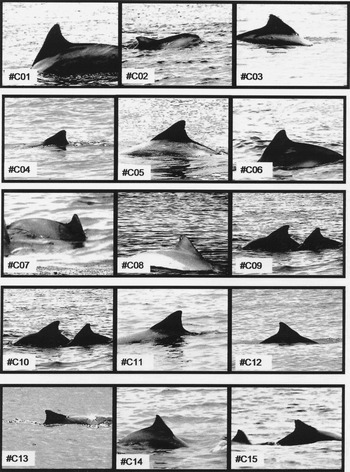
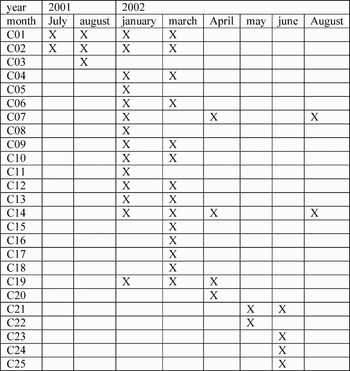
Twenty-five different dolphins were identified individually (Figure 2), and 7.7% of these animals were present on the area during more than 50% of the sampled days (Figure 3).
Estuarine dolphins identified at the region of Cananéia.

Occurrence pattern of identified dolphins.

The majority of the identified dolphins (N = 24) were adults. Because there is no ostensible sexual dimorphism, and because the estuarine dolphin is a small and shy species, it was not possible to determine the sex of the identified dolphins. Exceptions occurred when two animals, one adult and one calf, were seen in a long time association. For these particular cases, the adults were considered as females, and this pair as a mother and calf. The differentiation between adults, young and calves was made by the dorsal fin colour pattern (Randi et al., in preparation).
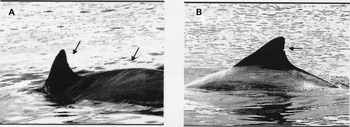
The identification of the dolphins was performed by noting cuts on the dorsal fin (80%) and by the association of cuts and scratches on the dorsal fin and dorsal region of the body (20%) (Figure 4). To verify the durability of different kinds of marks present on the estuarine dolphin's body, some animals previously identified and that were more often seen in the study area (No.C01, No.C02, No.C07 and No.C19), had their marks (scratches and cuts) monitored monthly. The reconstitution of areas with cuts was not observed, but the superficial scratches disappeared between one and six months. The major number of helpful features for the individual identification was used during the comparison among dolphins to reduce the possibility of a false positive occurrence. Even so, one false positive case was clearly detected when the dolphin No.C01 had the dorsal fin appearance totally modified by new cuts. This dolphin was recognized just because of the long association with a calf that had previously been identified (No.C02).
Images of the estuarine dolphins identified on the region of Cananéia. (A) Dolphin (No.C01) identified through the cuts on the dorsal fin and scratches on the dorsal region of the body; and (B) dolphin (No.C05) identified through cuts on the dorsal fin.

Some dolphins were repeatedly registered in the same sector of the area (Figure 3). The presence of dolphins No.C01 and No.C02 (mother and calf) could be noticed on 68% of the sampled days, and they were always seen at two different beaches, Praia da Ponta da Trincheira (Ilha Comprida Island) and Praia do Itacuruça (Ilha do Cardoso Island). Dolphins No.C07 and No.C19 were observed in 38% and 35.7% of the sampled days respectively. Normally they were seen near an artisanal trap to catch fish placed on the Ilha Comprida Island, which is characteristic of the region and known as ‘Cerco fixo’.
DISCUSSION
The use of Hi8 video images associated with computer programs to study the estuarine dolphins in Cananéia, proved to be efficient even considering the loss of distinctiveness of the images.
When compared to photo-identification, the application difficulties are similar, mostly the ones related to distance of dolphins and climatic conditions such as light, rain and sea conditions.
For bottlenose dolphins, Würsig & Würsig (Reference Würsig and Würsig1977) reported that apparently the dorsal fin tissue does not suffer reconstitution, and the cuts and prominent scars, present in many animals, may last more than two years, though fine marks such as spots and bit marks made by con-specifics last approximately six months to one year. Reports about durability of different scars on estuarine dolphins do not exist. During this research, the durability of marks used for the individual identification of estuarine dolphins was monitored, but the reconstitution of cut areas was not observed. The superficial scratches disappeared on an average of one to six months, showing that they are not eligible features for the individual identification on long duration studies; however, when associated to cuts they have been shown to be helpful to identify individuals in a short duration study.
As the estuarine dolphin demonstrates a shy behaviour, often swimming away from boats and of fast crossing on the surface (Hetzel & Lodi, Reference Hetzel and Lodi1993), it is difficult to obtain adequate images for individual identification. On the other hand, video-identification has the advantage of taking continuous images of dolphins, from when they emerge to breathe until they submerge. Therefore, when the dolphin surfaces, it is possible to observe marks on the whole body.
The dolphins were present in the studied site on 100% of the sampled days. Similar results were found for Sotalia guianensis in the northern region of Brazil (Jesus, Reference Jesus2004). Researches on estuarine dolphins have demonstrated that these animals may use specific sectors in the area more than others, and might show some degree of residence (Monteiro-Filho, Reference Monteiro-Filho1991; Correia, Reference Correia1999; Flores, Reference Flores1999; Hayes, Reference Hayes1999; Ananias, Reference Ananias2004; Jesus, Reference Jesus2004; Hardt, Reference Hardt2005; de Oliveira, Reference de Oliveira2006; Rossi-Santos, Reference Rossi-Santos, Wedekin and Monteiro-Filho2007). According to Geise et al. (Reference Geise, Gomes and Cerqueira1999), the estuarine dolphin can be seen in every area of the Cananéia Estuary, but with higher utilization of the Baía de Trapandé Bay. Similar information is herein described. Some dolphins, such as No.C01, No.C02, No.C07 and No.C19 are more often found in specific beaches of the region. In addition, dolphins No.C02, No.C07 and No.C19 were continuously seen in these locations until June 2005 (personal observation).
Many animal species use the area irregularly and may be found more frequently in some of the sectors. This pattern of occurrence may be related to environmental differences, reproductive and nutritional resources, such as the case of females with calves which tend to use areas with major resources concentration that may increase the nursing demand (Gubbins, Reference Gubbins2002).
Wilson et al. (Reference Wilson, Thompson and Hammond1997) reported habitat use by one population of bottlenose dolphins. The animals occurred in the whole area studied, but the authors detected three areas of concentration. These areas had similar topographical features, being deeper in the centre with narrow channels and they had strong currents. The utilization of sectors with these characteristics was observed for other odontocetes (cf. Wilson et al., Reference Wilson, Thompson and Hammond1997). Regarding the estuarine dolphin, Bonin (Reference Bonin2001) reported the existence of two intense areas of use, although these areas show different features, both have a high gradient near the margin. According to Monteiro-Filho (1991), some estuarine dolphins are ordinarily seen in specific sectors of the area in the region of Cananéia, suggesting that dolphins tend to fish at known places.
In summary, considering habitat use, this research assumes that, as occurs with bottlenose dolphins (Wilson et al., Reference Wilson, Thompson and Hammond1997), the estuarine dolphin occupies an extensive area in the region of Cananéia, however, they use it in an intended way. They were found principally in the Baía de Trapandé Bay; where some dolphins use specific sectors of high fish concentration more than other sectors. Considering video-identification, the use of Hi8 images associated to computer programs for individual identification of estuarine dolphins of Cananéia proved to be efficient. It allowed the individual recognition and accompaniment of dolphins for at least four years and allowed us to obtain important information about the way these dolphins use the studied area.
ACKNOWLEDGEMENTS
We are grateful to IPeC (Instituto de Pesquisas Cananéia) for support during the study and all the individuals who helped with comments, support and friendship. To CNPq (Conselho Nacional de Desenvolvimento Científico e Tecnológico) for funding Emygdio L.A. Monteiro-Filho.