INTRODUCTION
The Waverley CriteriaFootnote 1
1. Is it so closely associated with our history and national life that its departure would be a misfortune?
2. Is it of outstanding aesthetic importance?
3. Is it of outstanding significance for the study of some particular branch of art, learning, or history?Footnote 2
For more than a half a century, three questions have governed the remarkably resilient system that controls the export of national treasures from the United Kingdom (Table 1). Over the decades, with each threat of a consummate work of art being exported to a foreign buyer, the Waverley system has repeatedly elicited the interest of the British art and museum world. But perhaps because of the sense of urgency that inherently surrounds the system, interest has typically focused on the present state of the system. Its history has fallen into the shadow, yet it is vital to understanding the current situation and its future trajectory.
Ranking of Countries in Terms of Severity of Export RestrictionsFootnote 87

The Waverley Criteria are named after John Anderson, first Viscount Waverley (1882–1958), who from 1951 to 1952 presided over a committee formed to “consider and advise on the policy to be adopted by His Majesty's Government in controlling the export of works of art, books, manuscripts, armour and antiques and to recommend what arrangements should be made for the practical operation of the policy.”Footnote 3 In its 1952 report, the Waverley committee formulated a system based on the principle that “in every case in which an export is prevented, the owner must be assured of an offer to purchase at a fair price.”Footnote 4 The committee's proposals were swiftly adopted, instituting a procedure that remains unchanged in its essentials. This procedure consists of the following key steps:Footnote 5
• Anyone wishing to export a work of art (or a manuscript, archive, piece of armor, etc.) exceeding age and value thresholdsFootnote 6 is required to complete an export application.
• A subset of these export applications is referred to individual expert advisers with the relevant expertise from national museums and galleries.
• The expert advisers refer a further subset to the reviewing committee, an “independent body set up to advise … whether a cultural object which is the subject of an application for an export licence is of national importance under the Waverley Criteria.”Footnote 7
• The reviewing committee makes the final judgment about which objects meet one or more Waverley Criteria. For objects deemed to be of Waverley standard, the reviewing committee also evaluates evidence to determine a “fair price” for the object.Footnote 8
• The committee then recommends a “length of time [typically two to six months] for which the decision on the export licence should be deferred to provide U.K. institutions and private individuals with a chance to raise the money to purchase the item to enable it to remain in this country.”Footnote 9
• If funds are successfully raised, the owner can choose to accept the United Kingdom offer or to retain the object for himself.Footnote 10 The owner is not permitted to export the object. The work is thus retained within the United Kingdom. Otherwise, if no matching offer can be made from within the United Kingdom, the owner is granted a license to sell and export the work to a foreign buyer, and the work is thus lost from the United Kingdom.
By the time the Waverley committee was formed in 1951, the hemorrhaging of national treasures was considered to have reached a state of unprecedented urgency. However, there had been serious concerns about the loss of masterpieces from the United Kingdom since the late nineteenth century. Prized objects were increasingly being sold from private collections, spurred “by the provisions of the Settled Land Act, 1872, and accelerated by death duties and other forms of taxation.”Footnote 11 The United States was—and continues to be—the threatened destination for most of these treasures. A list of approximately 500 recently lost masterpieces that Claude Phillips, first keeper of the Wallace Collection, compiled in the early 1900s vividly illustrates this pattern.Footnote 12 It details the scores of important objects that flowed from British hands into, overwhelmingly, those of American collectors: J. P. Morgan, Isabella Stewart Gardener. and Henry Frick feature particularly frequently among the buyers on the list.
This phenomenon has engendered a range of feelings, from begrudging acceptance to outrage, in British observers. In 1907 George Bernard Shaw lamented the competition from “the American millionaires who are stripping us of Art treasures more ruthlessly than Napoleon stripped Italy and Spain.”Footnote 13 Other Britons such as Robert Witt were more restrained, being mindful of how the nation's great collections were built in the first place. Witt stated in 1928, “There could be no feeling of resentment for we were being treated as we ourselves had treated the Continent during the seventeenth, eighteenth, and early nineteenth centuries.”Footnote 14 Still, it was a potent issue, and a curator from the Wallace Collection asserted in 1949, “After the First World War we were in effect looted by our former ally, the United States.”Footnote 15 More recently, the ambitious 1985 exhibition “Treasure Houses of Great Britain” at the National Gallery of Art, Washington D.C., was met with both apprehension and pride in the United Kingdom. The then-chairman of the reviewing committee recalls visiting the gallery's director expressly to convey his hope that “U.S. buyers won't regard this as a shop window.”Footnote 16
Thus, the threat from America—a country with no art export restriction policies of its own because it is predominantly a buyer, not a seller, in the trade—must be understood as the context for British movements to save its national treasures. Although new market patterns are emerging (Middle Eastern buyers, for example, are increasingly bidding for British objectsFootnote 17) the ambivalence toward the American art-buying millionaire is a recurring theme in the British quest to save its treasures.
The challenges faced by the Waverley system have been discussed often in the annual reports of the reviewing committee, but these take a year-by-year approach, often without tending to the broader picture of how the system has evolved in more than 50 years. Additionally, Clare Maurice and Richard Turnor's Reference Maurice and Turnor1992 article in this journalFootnote 18 provides valuable background on the subject; but it does not go into depth about how the system was formed, and its analysis is now 15 years old. This article aims to make a unique contribution to the literature on the Waverley system by drawing on unpublished treasury archives to detail how the system was formed and offering a synthetic view of the system from 1952 to the present day, with a focus on the relationship between the treasury and the Waverley system.
This article attempts, first, to illuminate the little-known story of the people, personalities, and paintings behind the birth of the Waverley system—a story that startlingly contrasts with present times in terms of how closely the treasury is involved with the system. Second, it considers how the system has evolved throughout the years, particularly in terms of the issue of responsibility. That is, which bodies have been charged, administratively and financially, with the task of saving Waverley objects? The theme that emerges is that over the decades, the burden of saving these objects has become increasingly dispersed. In the 1950s the treasury was the direct source of funds for Waverley objects, but today the treasury is only distantly involved and there exists a more layered and piecemeal process for purchasing them.
The treasury has indeed marginalized the Waverley system from its priorities, but it would be an oversimplification to blame the government for not providing more direct funds for Waverley objects. Data shows that the government has actually channeled funds toward the Waverley system at a rate that overwhelmingly outstrips inflation. Yet the system still struggles because of the extraordinary rise of art market prices.Footnote 19 The future of the Waverley system may inevitably have to rely on private funding. Still, the historical relationship between the treasury and the Waverley system is vital because it reveals that the treasury once regarded the retention of national treasures as a genuine priority and urgency. This attitude must be revived if the system is to survive, because the treasury is essential in shaping tax cuts and other policies to foster private support.
BEFORE WAVERLEY
The Waverley committee was not the United Kingdom's first attempt to prevent the export of national treasures; it was preceded by valiant efforts to retain masterpieces for the nation. However, these endeavors were rooted in faith in voluntary action by private individuals, a faith that would prove overoptimistic and under-effective by midcentury.
Early movements to protect cultural heritage in the English-speaking world are credited to John Ruskin and William Morris, who founded the Society for the Protection of Ancient Buildings in 1877. Many similar voluntary associations soon followed.Footnote 20 In 1903 the National Art Collections Fund (NACF) was formed as a charity through which members' subscription fees and donations were used to help purchase works of art for national museums. Founding member D.S. MacColl summarized the situation: “In 1903 times were bad … and … there was need of an outside, independent body to do the double work of rescue and forestalling.”Footnote 21 The fund is independent of the government, supported solely by its members and donors.
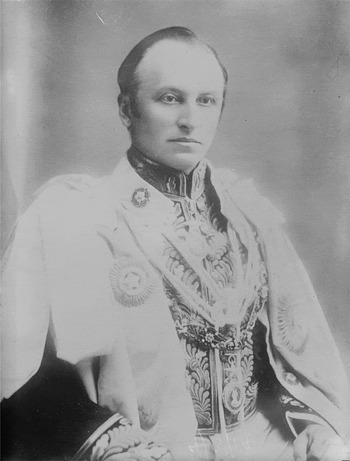
Approximately a decade later, the trustees of the National Gallery investigated the problem by forming a committee chaired by the statesman George Nathaniel Curzon, Marquess Curzon of Kedleston (1859–1925) (Figure 1). Lord Curzon had, among other things, served as viceroy of India and during his tenure passed the Ancient Monuments Bill, which created a directorate-general of archaeology and has been called “the most far-sighted of Curzon's reforms.” Curzon “personally oversaw repairs to monuments all over India,” notably the Taj Mahal. In the United Kingdom he purchased and restored Tattershall Castle and Bodiam Castle, both of which he eventually bequeathed to the National Trust. Curzon also served in Lloyd George's war cabinet during World War I and as a foreign secretary after World War II.Footnote 22
George Nathaniel Curzon, 1st Marquess Curzon of Kedleston, glass negative, date unknown. George Grantham Bain Collection, Prints & Photographs Division, Library of Congress, LC-B2-3070-6 [P&P] (Public domain).

Curzon purchased Tattershall six years after The National Trust Act of 1907 proclaimed the need for “promoting the permanent preservation for the benefit of the nation of lands and tenements (including buildings) of beauty or historic interest.”Footnote 23 The establishment of the NACF and the National Trust in the early twentieth century reflected a growing concern for protecting the nation's cultural heritage, and the Curzon committee was part of this pattern.
Published in 1914, the Curzon report asserted that “the export … of pictures from private collections … is undoubtedly proceeding at a rate which cannot fail to cause serious apprehension.”Footnote 24 But despite its lengthy report, the Curzon committee's influence on policy was regrettably negligible. As the Waverley report notes, “After an exhaustive enquiry the [Curzon] Committee rejected … [the option] to restrict or prohibit the export of works of art from the U.K., or place an export duty on them,” and, furthermore, “Whatever action might have ensued from the Curzon Committee's recommendations was overtaken by the events of 1914.”Footnote 25 Although the committee considered various legal and policy solutions, including tax incentives, it ultimately placed great weight on voluntary solutions rooted in “honour,” “patriotism,” and “public spirit.” It believed that the National Gallery could more vigorously pursue private negotiations with art owners. Curzon stated, “You must trust to [the seller's] honour … appeal to the man as a patriotic citizen, that if he sells, he will sell to you [the National Gallery] before he sells to anyone else.”Footnote 26 He elaborated his vision as follows:
Let us … go to an owner … We say to him, “You have this famous Titian which, if it is parted with at all, ought in our judgement to belong to the National Collection: Will you, from the patriotic point of view, and from the love of art, be willing to give us an engagement that if at any time you feel called upon to sell it, you would give the right of pre-emption to the government?”Footnote 27
Curzon's optimism was echoed by numerous witnesses whom the committee interviewed. The scholar Roger Fry (1866–1934), for example, believed
an attempt ought to be made to secure these [important artworks] by direct treaty with the owners … I cannot help thinking that the owners might, out of public spirit, be prepared to accept a good price from the Nation rather than stand out for an excessive price from a foreign purchaser.Footnote 28
Alfred de Rothschild (1842–1918), a prominent collector, stated,
Owners of … celebrated works of art in this country should be approached with the object of obtaining from them their willingness to cooperate … and I cannot help thinking that the reply … would be sufficiently encouraging to give us every hope and every confidence that they would help us in this delicate matter.Footnote 29
But the optimism expressed by the Curzon committee would deteriorate severely in subsequent decades, eventually necessitating an official policy that the Waverley committee was charged with developing.
POSTWAR TROUBLES
Between the Curzon and the Waverley committees, a few more attempts were made to save masterpieces for the nation. The Waverley report notes:
• In 1917 a printed appeal was circulated to all members of Parliament … proposing a “Bill to augment the … funds of the National Gallery” … by means of “an export duty …”
• In 1919…. [Trustees of the National Gallery] recommended … a tax of 1 or 2 per cent on all sales of works of art, by means of an ad valorem stamp duty. This proposal was put by the Trustees to … [the] Chancellor of the Exchequer, but in 1921 it was rejected.
• The next significant event was the introduction into Parliament in 1926 of a private member's Bill, the purpose of which was to prohibit the export … of certain works of art … This bill did not get beyond its First Reading.Footnote 30
Evidently, these attempts, like those of the Curzon committee, made no lasting effect.
Until World War II, there were no restrictions whatsoever on art exports. By the end of the war, however, an ad hoc system of controlling art exports had developed. The system grew out of the Import, Export and Customs Powers (Defence) Act of 1939, which, as the Waverley report points out, had “no direct relation to the problem of safeguarding national treasures,” but was rather an emergency measure “intended primarily to safeguard the nation's resources in foreign exchange and at the same time to prevent the flight of capital abroad.”Footnote 31 Under this legislation the Board of Trade was responsible for reviewing applications for exports of every kind. When it came to applications regarding highly valuable works of art, the Board of Trade started to seek the advice of curators in national museums. Additionally, in 1944 Captain Charles Waterhouse, parliamentary secretary to the Board of Trade, stated in the House of Commons: “If [the museum advisers] raise any doubt, automatically the license is not granted; there is no question of proving a case; they have only to say, ‘we do not think this is the proper thing to export,’ and straight away that licence is not granted.”Footnote 32 Thus, as one official summarized it, “It has become the practice to use the export licence power … to give the National Gallery the opportunity of preventing a picture going out of the country if [it] consider[s] that it is a matter of national importance to keep it in the country.”Footnote 33
In other words, this system used expert advisers from museums, as does the Waverley system. However, unlike Waverley, this system gave the expert advisers the authority to judge whether an object was important enough to export-stop. There was no adjudicating body, nothing analogous to the present reviewing committee, between the expert advisers and the Board of Trade, which made the ultimate decision but typically rubber-stamped the museums' recommendations. Furthermore, the cobbling together of the 1939 export legislation with Captain Waterhouse's 1944 statement to form this ad hoc system left a major ambiguity that soon led to significant confusion: It did not make explicit whether a museum's recommendation to prevent an export obliged the museum itself to then purchase the object.
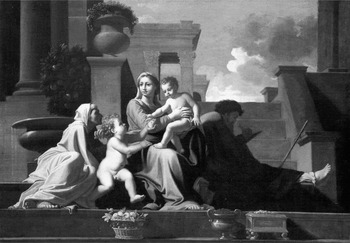
These holes in the system were brought to light when export applications for two paintings—both by Nicolas Poussin, coincidentally—triggered serious discussions about reevaluating the system at hand. The first painting was Poussin's Holy Family on the Steps Footnote 34 (Figure 2), from the collection of the Duke of Sutherland, which in 1948 became the source of tensions between the National Gallery in London and the National Gallery of Art in Washington, D.C. Because of miscommunications and perhaps misrepresentations, a situation developed in which both galleries felt entitled to the painting after they were each approached by dealers from Thomas Agnew & Sons. In November 1948 the National Gallery reported in its board minutes that
Messrs. Agnew had asked for an export licence for Poussin's “Holy Family on the Steps” with the intention of selling it to the NGA. Agnews' export application was referred … to the National Gallery for review, and the Keeper quoted from a letter that he had received from [Poussin expert] Professor [Anthony] Blunt stating that the picture was a most perfect example of Poussin's mature style … [and thus] the Board … resolved to purchase it.Footnote 35
In the following month, however, the chief curator at the National Gallery of Art, who had already secured donations in expectation of obtaining the Poussin, wrote to the National Gallery, “[we] understood that a representative of your Board had viewed the painting after it was placed on sale at Agnew's several months before it was offered to [us], and your representatives had expressed no interest in buying it.”Footnote 36 The chairman of the National Gallery retorted,
I … must … mak[e] it plain that Agnew's were not correct in informing [you] … about the Sutherland Poussin … [We] went to see it as soon as possible after it had gone to Agnew's … and [were] told that the picture had been reserved … for an English buyer, [so] there was nothing [we] could do. The proper course would have been for Agnew's to inform [us] when these negotiations had fallen through and the picture had thus become free again.Footnote 37
Eventually, however, the National Gallery relinquished its claim for the sake of maintaining goodwill with the National Gallery of Art. The chairman of the National Gallery wrote to the National Gallery of Art chief curator that “the Board would regret it if [this misunderstanding] left you with a feeling of dissatisfaction, and though they are anxious to retain the picture they would consider ceding it if you so desire.”Footnote 38 The National Gallery of Art accepted the offer. But to further complicate matters, the Board of Trade then threatened to export-stop the painting anyway, believing that the National Gallery's efforts indicated that it was a preeminent work, even if the National Gallery was willing to cede it. After this debacle, the National Gallery resolved that “it was most important that the circumstances which had led to ceding the Sutherland Poussin to Washington should not happen again.”Footnote 39
Follower of Nicolas Poussin, Holy Family on the Steps, oil on canvas, 1648, 27 inches × 38½ inches, Samuel H. Kress collection. Board of Trustees, National Gallery of Art, Washington D.C.

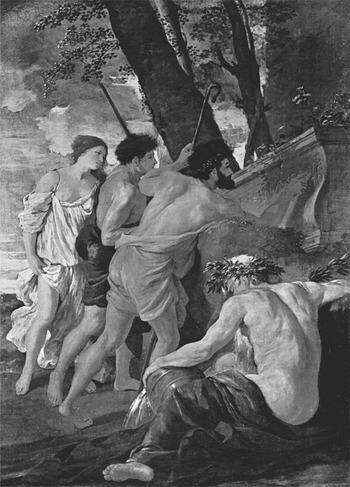
But while the Sutherland Poussin was still being disputed, the second Poussin, Et in Arcadia Ego (Figure 3), belonging to the Duke of Devonshire, was causing complications. In this case, the National Gallery
received an application for the export of [the painting] to be sold by the Chatsworth Estates Company to the Toledo Gallery in the USA. The Chairman said that … the Scottish National Gallery [was] very anxious to acquire the picture. It was resolved that the Export licence should be withheld.Footnote 40
Although the National Gallery of Scotland indeed made a matching offer for Et in Arcadia Ego, the Duke of Devonshire and the Toledo Museum were severely frustrated at the interference, because they were completely unaware of the possibility of an export ban when they had negotiated the sale. Upon learning that his painting was export-stopped, the Duke of Devonshire refused to sell to the National Gallery of Scotland, believing that he was “under a moral obligation to sell to the Toledo Museum.”Footnote 41
Nicolas Poussin (1594–1665), Et in Arcadia Ego, oil on canvas, 1629–1630, 101 × 82 cm, Devonshire Collection, Chatsworth (Derbyshire). The Yorck Project 10,000 Meisterwerke der Malerei.

The complications over these two paintings spurred the National Gallery to seek clarification on the export policy. In the board minutes from February 1949, the National Gallery recorded, “The Board of Trade no longer required that there should be a purchaser in this country before they prohibited the export of work of art. They were now prepared to forbid the export of any work of art which had been pronounced of national importance.”Footnote 42 In the following month's board meeting, the issue was again discussed: “Members of the Board [of the National Gallery] expressed concern at the hardship which might be suffered by owners who, wishing to sell their pictures abroad, were forbidden to do so and who could not find a purchaser in this country.”Footnote 43 They would soon learn that they were not the only ones concerned by this dilemma.
TREASURY INVOLVEMENT
Although the National Gallery initially sought guidance from the Board of Trade, the government department that proved to be most concerned was the treasury. Without the treasury's deep initiative and involvement, it is unlikely that the Waverley system would have been established. This was an era in which treasury civil servants were also museum trustees and art connoisseurs, and they sat in meetings and corresponded with museum directors and curators. When the troubles over the Poussins surfaced, the treasury wrote to the Board of Trade, “I think we ought to keep the centre of gravity in handling this question in the Treasury rather than in the Board of Trade.” Its reasoning, which sounds remarkable to modern ears, was that the chancellor of the Exchequer was “the nearest thing we have in this country to a Minister of Fine Arts.”Footnote 44 To further contextualize, the Waverley system was established alongside the birth of the British welfare state. The government was
tak[ing] on responsibility for the well-being of its citizens to a far greater extent than had been the case before the war … the Labour government established free medical care under a newly constituted National Health Service, created new systems of pensions, promoted better education and housing, and sought to deliver on the explicit commitment to “full employment.” All of this added up to what the Labourites were to call the welfare state—and they were very proud to do so.Footnote 45
Correspondingly, Theresa Lloyd writes, “The establishment of the welfare state also gave rise to a significant change in … the state's role in the provision of public goods,” including the arts. For example, the Arts Council—another organization that then reported directly to the treasury—was founded in 1946 to “provide public funding for artists and cultural organisations, and to ensure universal access to the arts.”Footnote 46
It is fitting that Viscount Waverley was himself recently retired from the position of chancellor of the Exchequer when he became chairman of the Waverley committee. But on an even deeper level, it was the treasury civil servants who articulated the nuances and complexity of the problems and gathered much of the evidence to present to the Waverley committee for consideration.
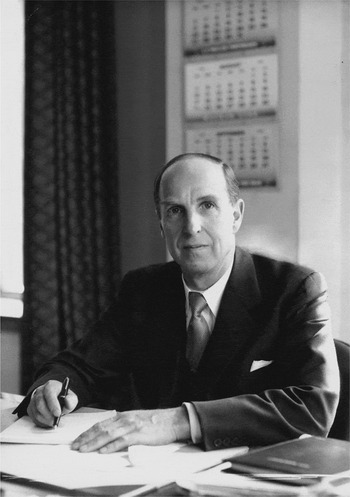
The treasury official who assumed leadership for the art export issue was Sir Philip Dennis Proctor (1905–1983) (Figure 4), treasury third secretary responsible for dealing with the arts and science. Proctor is remembered as “a connoisseur of the arts, with many friendships in the art world … always passionate about painting,” and he served on the governing bodies of the Courtauld Institute as well as several Gulbenkian Foundation arts committees. Additionally, he became a Trustee of the Tate in 1952 and served as its chairman from 1953 to 1959.Footnote 47
Elliot & Fry, Sir Phillip Dennis Proctor (1905–1983), vintage print, 1958, National Portrait Gallery, London. ©National Portrait Gallery, London.

Proctor was engaged with the issue of art exports from the time the tensions over Sutherland Poussin began to surface, corresponding with the chairman of the National Gallery. This correspondence further illustrates the confusion over the practice, because Proctor attests in one letter that if the National Gallery stopped an export, “I think this usually involves the corollary that the Gallery should be willing to purchase it at a fair price itself (or … ensure that there is some purchaser at a fair price within the country).”Footnote 48 Also involved in the discussions was Sir Alan Barlow (1881–1968), who had just retired as treasury second secretary in 1948 and began his appointment as a trustee of the National Gallery that year. In May 1949 Proctor wrote to Barlow, “the two Poussins … have led us all to think that we ought to try to get some clarification of the general policy and procedure in this matter,” because the 1944 Waterhouse policy was an “extremely flat-footed statement.”Footnote 49 In another letter, Proctor reiterated, “At present the National Gallery authorities simply do not know what [the rules] are … it is abundantly clear that we all need some clarification … and some reformulation of the arrangements for handling particular cases.”Footnote 50 These were early signs of the persistence with which Proctor would pursue progress on the issue.
In June 1949 Barlow and Proctor held a meeting with directors and curators from the major national museums to canvas their perceptions about what was the correct procedure to follow. The minutes of this meeting confirmed the confusion that had been expressed by the National Gallery:
Until early in the present year advice had been given … that a recommendation for the refusal of an export licence carried with it a moral responsibility to purchase the work concerned. Only recently had they … recommended the grant or refusal of licences regardless of any moral obligations to purchase.Footnote 51
Leigh Ashton, director of the Victoria and Albert Museum (V&A), further underscored the inconsistency when he countered that this statement was “quite wrong” with regard to his institution, because “never … has this Museum … ever considered that there was any moral responsibility to purchase.”Footnote 52
A FIRST ATTEMPT BY PROCTOR
Proctor was thus convinced of the need for a “party … to advise to Government on a reformulation of the policy to be followed as regards the granting or withholding of export licences for works of art,”Footnote 53 and took the initiative of drafting a nine-page memorandum in August 1949 that he intended ultimately to submit to the chancellor of the Exchequer and the president of the Board of Trade. In the memo Proctor asserts that the existing system was unsustainable, and
that the question of controlling the export of works of art and antiques as such should be considered as a separate issue from the export of capital, and that if such control is to be continued as a permanent measure, it should be based upon a considered long-term policy justified on its own merits.Footnote 54
His memo outlines the numerous facets of the problem admirably. He notes that if only works that museums could afford to purchase were export stopped, “the effect will be to expose the country to a continuous drain of works of art.”Footnote 55 He is even conscious about the issue's effect on foreign relationships, noting that “attempts on our part to prevent the sale of works of art which are wanted by American public galleries is viewed with much resentment in that country.”Footnote 56 The memorandum's most far-sighted element is its proposal to create an “independent advisory committee … solely for the consideration of any cases of doubt or difficulty involving any work of art or antique of national importance.”Footnote 57 This body would be completely separate from the expert advisers in museums; its membership would instead be drawn from leaders from organizations such as the “Royal Fine Arts Commissions, Historical Manuscripts Commission, Arts Council, NACF.”Footnote 58 The memo thus contains the seeds for the future reviewing committee, articulating the concept of an independent adjudicating body.
Proctor's memo was distributed to the museum directors for feedback. Although they had seen first hand that the existing procedure left undesirable holes, some were surprisingly resistant to Proctor's suggestions for reform. Philip Hendy, director of the National Gallery, wrote, “there has been nothing in the working of the order so far which would seem to necessitate a more complicated machinery.”Footnote 59 James Mann of the Wallace Collection added, “I do not think that an Advisory committee … is either needed or would prove efficient. Questions of taste would constantly arise and these are the most difficult of all to resolve.”Footnote 60 In October 1949, in a meeting attended by Proctor, the expert advisers, and museum directors, Proctor's idea for an independent advisory committee was rejected by the museum directors in favor of a “standing committee” that would decide on objects of contention. It would be formed—rather redundantly—of “representatives of the Treasury and Board of Trade, the Director or Keeper immediately concerned, and two other [expert advisers or museum directors] acceptable to that Director or Keeper.”Footnote 61 Proctor noted that this was “open to the objection … [of being a] body mainly composed of the interests responsible for the original decision,” but reluctantly accepted the idea.Footnote 62
Perhaps the museum directors and curators were simply resistant to relinquishing to the authority they held under the ad hoc system; but whatever the reason, it is evident in hindsight that the treasury was more prescient than the museum community. Fortunately, Proctor would discover within two months of this meeting that his memo would not be wasted. Within this short period, the Antique & Art Dealers' Export Group and several important art owners and dealers had contacted the Board of Trade pressing for a clarification of policy. As Proctor noted, “pressure was converging on us from a number of different directions, and … Ministers ought to be warned that trouble is brewing … we should recommend Ministers to set up a public committee of enquiry on similar lines to the Gowers Committee on Stately Homes.”Footnote 63 In December 1949 Proctor's colleague at the Board of Trade echoed, “The signs of storm ahead continue to gather.”Footnote 64
Proctor's memo was then revived for discussion. Over the following months, Proctor determinedly championed the matter. In June 1950, when he perceived a lull in progress, he wrote, “I am rather worried that nothing seems to have happened about the memorandum … I think that we ought to try to get something moving before the end of the Session, and there is not very much time left.”Footnote 65 His efforts finally resulted in a milestone on July 17, 1950, when Sir Stafford Cripps, chancellor of the Exchequer, submitted a statement to the Lord President's Committee:
Some restatement of government policy is required … some public ventilation of the issues seems desirable before the Government commits itself to a fresh restatement of policy. I therefore propose … to set up an independent committee … To consider and advise on the policy to be adopted by H. M. G. in controlling the export of works of art, books, manuscripts, armours and antiques, and to recommend what arrangements should be made for the practical operation of the policy.Footnote 66
THE WAVERLEY COMMITTEE IS FORMED
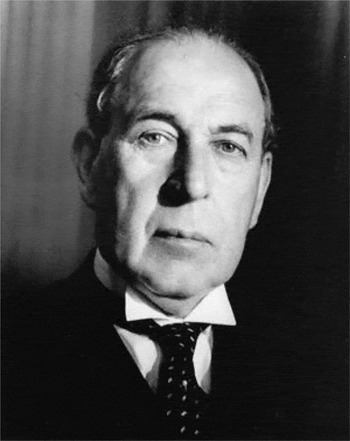
Within six weeks of this statement, the composition of the committee was all but final. The position of chairman, who needed to be “an independent person of some distinction who is personally interested in artistic matters but is not publicly identified with any particular point of view,”Footnote 67 was entrusted to Sir John Anderson, first Viscount Waverley (Figure 5).Footnote 68 “Some distinction” was an understatement. Waverley had served as chairman of the Board of Inland Revenue; governor of Bengal; lord president of the council; home secretary in the early years of World War II; and, from 1943 to 1945, chancellor of the Exchequer. His “career as an official, pro-consul, and minister was probably unique in its range, certainly in the twentieth century,” and “it was generally agreed in Whitehall that he was the greatest administrator of his age, perhaps of any age.”Footnote 69 These were the talents that he brought to the Waverley committee, and his biographer writes of this episode in his career as follows:
John, like any other well-educated man, had a respect for the visual arts and their place in civilization, but … he knew nothing of the minutiae of art history. Yet, here he was, charged with the investigation of the most intricate and controversial problems of general policy regarding the arts and museum administration, with connoisseurs, art historians, and the trade all straining at the leash—though in different directions—to complain and criticize.
If, at the outset, there were those … who doubted his capacity to cope with this highly complex task they were speedily disillusioned … he now amazed his fellow committee members by his ability within a few weeks to carry out the main examination of the expert witnesses without falling into error….Footnote 70
Waverley's appointment as chairman underscores the importance of the project, as does the fact that all those who were invited as first choices to the committee rapidly accepted their invitations. The committee was composed of six members in addition to Waverley: Anthony Blunt; David Lindsay, 28th Earl of Crawford and 11th Earl of Balcarres; Ruth Dalton; Vivian Galbraith; Christopher Hussey; and Lionel Robbins. Their biographies should leave no doubt about the capabilities of those who formulated this enduring policy.
Howard Coster, John Anderson, first Viscount Waverley (1882–1958), toned bromide print on card mount, 1953, National Portrait Gallery, London. ©National Portrait Gallery, London.

Professor Anthony Blunt (1907–1983), the same Poussin scholar who had urged the National Gallery to obtain the controversial Sutherland painting, had become director of the Courtauld Institute in 1947. His ties to the Waverley system would come full circle yet again in 1963 when he would begin a 12-year term as a member of the reviewing committee.
David Lindsay, 28th Earl of Crawford and 11th Earl of Balcarres (1900–1975), was known for the “administrative shrewdness and personal charm [which] enabled him throughout his life to place his knowledge unreservedly at the service of the arts in Great Britain.” As the committee was being formed, Waverley wrote, “I attach paramount importance to securing Crawford—whose position in the world of art [is] infinite.”Footnote 71 Lord Crawford “applied himself energetically to [his posts] with wide-ranging knowledge, unobtrusive forcefulness, and a charm of manner.”Footnote 72 His appointments were staggering: From the 1930s to the 1970s, he held positions—if not chairmanships—on the boards of trustees of the National Gallery, British Museum, Royal Fine Arts Commission, National Library of Scotland, National Trust, National Gallery of Scotland, and NACF. Coincidentally, the duration of his appointments was such that in 1952, the year the Waverley report was published, he was simultaneously serving on the boards of every single one of these organizations.Footnote 73
The experiences of Ruth Dalton (1890–1966) included serving as a member of the executive and publicity committees of the National Trust and as a trustee of the Royal Ballet. She also chaired the London County Council Parks Committee, where she initiated a program of holding sculpture exhibitions in parks and helped reopen Kenwood House after its transfer to the London County Council.Footnote 74 Furthermore, her husband was Hugh Dalton, who succeeded Waverley as chancellor of the Exchequer from 1945–1947, and who was himself very active in the arts.Footnote 75
Professor Vivian Galbraith (1889–1976) was then Regius Professor of Modern History at Oxford, where his “effervescent vitality, and his intimate knowledge of documents, gave his pupils the feeling that this was the real thing in historical scholarship.”Footnote 76 Professor Galbraith authored an Introduction to the Use of Public Records and is noted for his “fundamental reappraisal … [and] study of Domesday Book” which “had its origin in the discovery of a late twelfth-century annotated copy of … [a] portion of the survey in a manuscript” at Oxford. His expertise in historical documents would be an important contribution to the Waverley committee.Footnote 77
Christopher Hussey (1899–1970) was an architectural historian and author whose appointment to the Waverley committee fell squarely in the middle of his 50-year tenure on the editorial board of Country Life (1920–1970). Hussey is remembered for “mak[ing] the weekly country-house article into a tradition, which was strengthened as architectural history became established as a subject,”Footnote 78 and for his efforts against what he saw to be the demise of the country house beginning in the 1920s.
Professor Lionel Robbins (1898–1984) was a preeminent economist who is credited with building up the London School of Economics' international reputation. Previously, Robbins worked closely with Waverley as an economic adviser. Robbins reflected on Waverley's leadership on the Waverley committee,
Within a meeting or two … he had so made himself a master of the subject that I would defy the keenest outside observer not to have thought that he had been dealing with it all his life. Only once did my inquisitive ear detect the attribution of a famous painter to a wrong century—and that might have been a slip of the tongue. All was orderly, well-informed, sympathetic and just.Footnote 79
Robbins also served as president of the managing committee of the Courtauld Institute and as a trustee of the National Gallery. Although he held numerous influential posts in his lifetime,Footnote 80 he would reflect on his trusteeship at the National Gallery as “perhaps the most rewarding and happiest office of my life.”Footnote 81 Robbins would also serve as the first chairman of the reviewing committee established by the Waverley report.
These illustrious biographies support the argument that the export of national treasures was treated seriously by the treasury in those days because of the close ties (if not synonymity) between those with influence in the art world and those with influence on the national purse strings. In contrast, the theme repeated in my conversations with those involved with the modern-day Waverley system is the lack of interest from the treasury. The evolution of the system over the next 50 years reveals numerous administrative layers that would come between the reviewing committee and the treasury.
THE FINDINGS
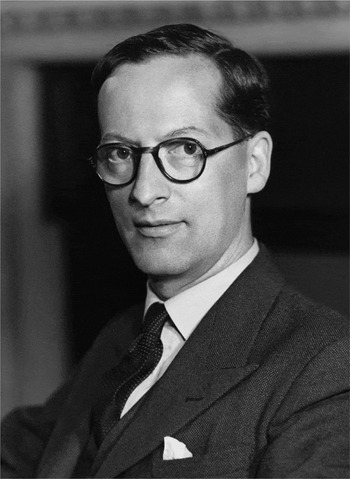
Unfortunately, Proctor left his post at the treasury too early to see his labors bear fruit. In August 1950 Proctor passed his duties to a capable successor, Sir Edward W. Playfair (1909–1999) (Figure 6), who took an equal, if not deeper, interest in the issue. Playfair had a “strong intellectual and artistic bent” and would later serve as a trustee of the National Gallery from 1967 to 1974, including a term as chairman in 1972.Footnote 82 Following in Proctor's footsteps, Playfair exhibited impressive diligence in a thorough memorandum that he wrote in preparation for being questioned by the Waverley committee. In April 1951 he was finally “examined … at fearful length”Footnote 83 (an hour and a half) by the committee, and he “noticed … that [the chairman] had a copy of my brief in his hands, which is all to the good.”Footnote 84 He was part of a remarkably thorough list of approximately 150 consultees who presented evidence for the Waverley committee's consideration.Footnote 85
Eliot & Fry, Sir Edward Wilder Playfair (1909–1999), vintage print, 1956, National Portrait Gallery, London. ©National Portrait Gallery, London.

Among other things, the committee considered the practices of other European countries. The treasury received responses from Spain, the Netherlands, Italy, France, and Austria; and their policies at the time are summarized in Appendix 2. It is evident that they all shared a common denominator: The government reserved the ultimate right to prohibit the export of national treasures, regardless of whether an equal value offer was made from within the country. In 1991 the question of other nations' art export policies was reinvestigated, revealing a more comprehensive and complex picture, but it is still evident that most countries retain some form of ultimate veto power, without mandating equal compensation to owners (Appendix 3). In contrast, the commitment to fairly compensating the owners lies at the heart of the Waverley system. The Waverley report establishes the following:
In every case in which an export is prevented, the owner must be assured of an offer to purchase at a fair price. This is a principle to which we attach the utmost importance, and on which we found a striking consensus of opinion among our witnesses. We think that the State has a clear right to forbid the export of objects which it regards as of national importance. But we think that it has the equally clear duty to see that particular individuals are not unfairly treated as a result.Footnote 86
This principle places the United Kingdom on the relatively liberal end of the possible spectrum of art export restriction policies, as sketched out by John O'Hagan and Clare McAndrew in the Table 1.
Indeed, Paul Bator notes that the United Kingdom's system stands out for how “eminently fair” it is to owners. Because the Waverley system “minimiz[es] the incentive to smuggle art by insuring [sic] that the owner forced to retain an art work at home will not suffer economic harm as a result,” the United Kingdom avoids black market problems that trouble other countries that use more restrictive export policies. Yet the Waverley system depends on critical preconditions to thrive; therefore, it may not be easily mimicked in other nations. Bator notes that the Waverley system operates in a
stable, highly organized, and notably law-abiding communit[y]…. England [is] … by world standards, affluent; both the public and private sectors can provide an important market at home. [Its] regulatory system [is] designed for an art market that is highly structured and that operates in the context of a well-established and secure system of entitlements.
And, of course, even within a structured, relatively affluent, and rights-protecting society such as the United Kingdom, a Waverley-like system is always subject to the restraint that it “can achieve its purposes only if funds are available to prevent export in cases of true national importance.”Footnote 88 Derek Gillman echoes, “the system works only if … [there are] funds available to catch not only the important and cheap, but the important and very expensive.”Footnote 89
“A VERY ENLIGHTENED REPORT”
When the 88-page Waverley report was finally published on September 6, 1952, it attracted much media interest. Newspapers recognized that requiring export-stopped works to be purchased at a matching price within the country was an “innovation;”Footnote 90The Times called it a “revolutionary recommendation.”Footnote 91 There was a consensus among the press that the report was very well done. The Spectator called it a “very enlightened report … neither sentimental nor short-sighted,”Footnote 92 while The Manchester Guardian deemed it “sensible”Footnote 93 and The Financial Times predicted that “its recommendations will almost certainly command universal approval.”Footnote 94 Furthermore, the press reiterated the report's sense of urgency. The Daily Telegraph called it a “tragic commentary on Britain's present situation,”Footnote 95 while The Birmingham Post stated, “This generation, buying economy at a ludicrous price, is failing in its trust.”Footnote 96The Economist asserted that national treasures were “an item of expenditure that unfortunately cannot be put off till better days. Losses cannot be made good another time.”Footnote 97
The responses of museum directors were somewhat more mixed. Leigh Ashton called the report “quite admirable … I heartily congratulate [the committee].”Footnote 98 T.D. Kendrick, director of the British Museum, seconded, “There is a general welcome to what is regarded in all Departments (except manuscripts) as a most helpful and admirable report.”Footnote 99 However, Philip Hendy of the National Gallery proved once again more difficult to please. Playfair observed that Hendy disliked “the weakening of the position of museum and gallery directors…. Hendy wants to get back on the Reviewing Committee … as a member and not to appear before it as a party.”Footnote 100 Furthermore, after digesting the Waverley report, Hendy drafted a letter to send to the editors of major papers, but he showed it to the other museum directors and to Playfair first:
In … 1944, the Government promised an absolute veto on the export of works of art … of national importance … [thus] the national museums at least have enjoyed some feeling of security … it is essential that the public should understand that, if … the State loses the absolute right to prevent the export of great works of art, then, unless the State is willing to provide the funds to purchase them … the consequences will be deplorable.Footnote 101
Hendy's letter closed by restating the urgent need for the government to increase museums' funds for acquisitions.
To modern ears, Hendy's letter hardly sounds offensive; rather, it seems only logical, even obvious, given the requirements of the system. The warning that the system cannot serve its purpose without adequate funding has been all too often reprised over the years. However, it is interesting to consider the responses that it elicited in that period. Although many museum directors supported Hendy's letter, Leigh Ashton of the V&A replied to Hendy,
I cannot sign the letter you propose sending … I do not think that we ought to comment on a proposal that is sub judice by the Government and I think that this method of pressure on the Chancellor, who has shown himself willing to act immediately … is not the right one. It is a question … both of principle and timing and in neither case do I think the decision is right.Footnote 102
Playfair added, “The Chancellor would find it embarrassing if … [you] were to send … a letter on [those] lines.”Footnote 103 Playfair's and Ashton's responses reflect a faith in the treasury to follow through with increased funding, a faith that has all but vanished today. At that time, however, their admonitions were enough to dissuade Hendy from submitting his letter to the newspapers.
On December 29, 1952, less than four months after the Waverley report was published, the first reviewing committee gathered for its first meeting.Footnote 104 Two years later it published its first annual report, covering the fiscal year 1953 to 1954.
The Next Fifty Years
Throughout the next half-century, the Waverley system was reassessed on numerous occasions. Time and again, the conclusions have overwhelmingly been in favor of the system. The reviewing committee's report of 1962 to 1963 stated, “To sum up we are without doubt, in light of the experience of the last ten years, that the control is soundly based and should be continued.”Footnote 105 The 1996 to 1997 report repeated, “The Committee believes that the Waverley system has served the nation well since … 1952. Its success has been based on all concerned not only respecting the letter of the system, but also its spirit.”Footnote 106 Sir Jack Baer, member of the reviewing committee from 1992 to 2001, adds that “the applicant for the licence is treated with great respect. Most people on reading the original wording would agree that it is a well-constructed plan.”Footnote 107 Even a prominent art dealer, whom one might expect to dislike the system because of the inconvenience it can cause for his business, offers a favorable opinion, calling it a “fair” system.Footnote 108
Unfortunately, the enduring consensus that the Waverley system is extremely effective and efficient in identifying national treasures is only half the equation. The positive opinions of the Waverley system have always been accompanied by an essential if obvious caveat: Identifying national treasures is useless if there are no funds with which to purchase them. As the original Waverley report emphasized, “We received evidence from all sides that the grants available annually for new acquisitions are quite inadequate … There is an urgent need … for increased regular financial assistance to the national collections.”Footnote 109
This warning seems to become progressively more dire. The department behind the formation of the Waverley committee 55 years ago is now accused of unawareness and apathy about the loss of national treasures from the United Kingdom. Sir Jack Baer states, “Having spent many years on the Reviewing Committee and as a member of the Museums & Galleries Commission … I witnessed how increasingly starved of funds our institutions are; it shows a total lack of government interest.”Footnote 110 When Charles Saumarez Smith resigned as director of the National Gallery in March 2007, he expressed his “frustrat[ion] at the number of big works which the National Gallery ought to be in a position to acquire and … didn't have the money to do so.” Saumarez Smith condemned the “absen[ce] … of political will to solve the problem … The Treasury is completely deaf [to it].”Footnote 111 Sir John Guinness, who chaired the reviewing committee from 1995 to 2003, also states, “The Treasury is just not interested in saving Waverley items.”Footnote 112
Indeed, as one traces the Waverley system throughout the years, it is clear that the treasury becomes increasingly distanced. In 1964, the position of minister of the arts was created. Thus, the chancellor of the Exchequer would no longer be considered “the nearest thing we have in this country to a Minister of Fine Arts,” as Proctor stated in 1949. In 1965, the reviewing committee's reports stopped being addressed to the chancellor of the Exchequer and began being addressed to the secretary of state for education and science.Footnote 113 Subsequently, from 1979 to 1992, the reports were addressed to the minister of the arts.
Furthermore, in 1992, a Department of National Heritage “was constituted to take over the functions of the Office of Arts & Libraries and selected functions from some other departments.”Footnote 114 In 1997 the Department of National Heritage was renamed to become the modern-day Department of Culture, Media and Sport (DCMS), and the reviewing committee's reports correspondingly began to be addressed to the DCMS secretary. The year 2000 marked another change: the formation of the Museums, Libraries and Archives council (MLA), a nondepartmental public body sponsored by the DCMS. The MLA's Export Licensing Unit now oversees the work of the reviewing committee. Although it must be emphasized that the reviewing committee and others have frequently praised the professionalism of the MLA, believing that the MLA does the best job it possibly can, one must recognize that the very creation of the MLA represents one more degree of removal from governmental involvement. According to Sir John Guinness, “Staff were transferred from the DCMS to the MLA to handle most Waverley matters so as to enable the DCMS to reduce the number of its civil servants in line with Treasury requirements.”Footnote 115 And by the government's own definition, “A non-departmental public body is a body which has a role in the processes of national government, but is not a government department, or part of one, and which accordingly operates to a greater or lesser extent at arm's length from Ministers”Footnote 116 (emphasis mine).
Another example of the treasury's dwindling concern is the fate of the recent Goodison Review. In 2003 Sir Nicholas Goodison undertook a “review of the effectiveness and efficiency of support to regional and national museums and galleries to help them acquire works of art and culture of distinction that might otherwise be sold abroad.” His findings and recommendations were published in the Goodison Review, but the treasury has been slow to respond.Footnote 117 In January 2007 Goodison testified in the House of Commons, “The report was published in January 2004 and I have had no contact with the Treasury since that date. There has been no discussion and no formal response to my review.”Footnote 118
SOURCES OF FUNDING
What have been the financial ramifications of the treasury's increasing distance from the Waverley system? Just as the treasury has shifted responsibility for administering the system to various bodies, it has shifted responsibility for funding Waverley objects to different organizations over the years.
When the Waverley system was established, the treasury was the primary and direct source of funding for Waverley objects. The reviewing committee's first report, covering the fiscal year 1953 to 1954, summarized the improvements that the Waverley committee triggered:
The Chancellor of the Exchequer … announce[d] … on 9th December, 1952, [that] the purchase grants of the English and Scottish national collections were increased by 25% for the financial year 1953–54. A further increase of the same amount has been made for 1954–55 … The purchase grants-in-aid to assist local institutions has been increased by a corresponding amount.Footnote 119
Furthermore, in addition to the annual purchase grants, the reviewing committee could appeal directly to the treasury for a special grant, a one-time allowance for the purchase of a specific Waverley object.
In 1968 the reviewing committee reported that until the previous year (i.e., for the first 15 years of the Waverley system's existence) the government had rejected requests for special grants only three times.Footnote 120 That year, however, the treasury refused special grant requests for two particularly prized objects, a fifteenth-century Flemish lectern and a manuscript of William Caxton. The reviewing committee admonished, “A control without a financial longstop [i.e., backup] is quite unable to perform its prime function … To function effectively, and to save its labours from futility, it is essential that the Committee should be provided with effective financial teeth.”Footnote 121 By 1989, the reviewing committee had come to feel that “reliance … upon a special Government grant is reliance upon a broken reed.” It reflected, “The Committee had hoped that the failure to provide funds during 1967–68 would be an isolated act of omission but, once the precedent had been set, it became all too easy for successive Governments to ignore calls for additional funds for outstanding objects.”Footnote 122
This pattern can be explained by the emergence of new funding bodies. The National Heritage Memorial Fund (NHMF) was established in 1980 for the purpose of “providing financial assistance for the acquisition, maintenance and preservation of land, buildings and objects of outstanding historic and other interest.”Footnote 123 With the establishment of the NHMF, the treasury soon stopped awarding special grants.Footnote 124 In its 1984 to 1985 report, the reviewing committee commented on the resulting problem. There were differences between its own mission and that of the NHMF:
The Fund [NHMF] has a responsibility to assist the preservation of non-movable property as well as artefacts. We, in our turn, are concerned to prevent the export of these works of art which may be outstandingly fine or rare in themselves but which might not be regarded by the Fund as part of the British Heritage. [The result is thus a] gap … which used to be filled by the system of special Treasury Grants.”Footnote 125
Eilish McGuinness, head of the Major Grants and Memorial Team, which manages NHMF applications and Heritage Lottery Fund applications for over £5 million, affirms the following:
NHMF is … directly financed by Treasury for the purpose of acquiring items of outstanding national importance that are at risk. Therefore … there [is] some link with Waverley Criterion #1 … although a less close link with Criteria #2 and #3 … it is not automatically the case that meeting the Waverley Criteria, even Criterion #1, would result in an NHMF grant being awarded.Footnote 126
In 1988 and 1989 the reviewing committee reiterated that “additional grant-in-aid for special acquisitions has ceased and the Fund [NHMF] has effectively become the banker of last resort.”Footnote 127 Goodison summarized that “the Treasury ha[s] taken the view that the National Heritage Memorial Fund has taken the place of Exchequer grants which it patently has not.”Footnote 128
Additionally, in 1994, the Heritage Lottery Fund (HLF) was established “to give grants to a wide range of projects involving the local, regional and national heritage of the UK,”Footnote 129 with a “commit[ment] to developing the widest possible constituency for heritage, and to promoting access, equality of opportunity and inclusion in its activities.”Footnote 130 Although the HLF, funded by lottery players, has made significant grants for saving Waverley objects—notably £11.5 million in 2004 to help the National Gallery purchase Raphael's Madonna of the Pinks—its own criteria are wider and require access and education. Therefore, says Eilish McGuinness, “there is no direct fit with the Waverley Criteria.”Footnote 131 Nevertheless, the HLF, like the NHMF, has been viewed by the treasury as a replacement for the former practice of awarding special grants for Waverley objects.Footnote 132 This view has further frustrated the reviewing committee, which stated in its 1998 to 1999 report, “The hope of many people, when the HLF was set up five years ago, that there need never again be a heritage crisis in Britain, has so far proved to be incorrect.”Footnote 133
Some Data
It would be unfair and incomplete to rely solely on qualitative patterns in discussing the Waverley system's evolution. There is much relevant data available, and a thorough quantitative analysis could fill a dissertation of its own. Having acknowledged this, however, it is still possible and worthwhile to perform, in the limited space of this article, a few back-of-the-envelope calculations. The section that follows compares figures from approximately 1955 (i.e., immediately after the two successive 25% funding increases triggered by the Waverley report had been implemented) to figures from circa 2004 (selected because it is a relatively recent year for which useful data is readily available).
First, one should establish how much prices for goods in general have increased between 1955 and 2004. In other words, what is £1 in 1955 worth in 2004 terms? According to the Office for National Statistics, the answer is approximately £17.12. In other words, an item that cost £100 in 1955 would cost around £1712 in 2004. This benchmark is summarized in Table 2.
Average Increase in Prices Caused by Inflation, 2004 versus 1955, According to the Retail Price Index (RPI)Footnote 134

Having established this, one might compare how last resort or emergency funding for Waverley objects has increased over the same period. As previously mentioned, the practice for emergency funding in 1955 was to appeal directly to the treasury for special grants, whereas the practice today is to appeal to the NHMF. Objections to the imperfection of this substitution aside, the comparison of 1955 special grants to 2004 NHMF grants is arguably still very useful. As shown in Table 3, the amount of NHMF grants in 2004 is nearly 66 times the amount awarded in special grants in 1955—i.e. significantly higher than the 17-fold increase of average prices in society.
Increase in Emergency Governmental Funding for Waverley Objects, 2004 versus 1955Footnote 135

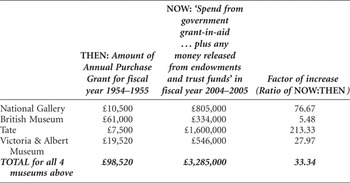
Additionally, one can compare the amounts of regular (i.e., nonemergency) government funding spent on acquisitions by the major museums in 1955 versus 2004. Again, the analogy is imperfect because of changes in policy. In 1955 museums received an annual sum specifically ring fenced for the purpose of acquisitions. But starting in 1993, the government began granting lump-sum budgets to museums, leaving each museum to decide how to allocate the money among different categories of expenditures. Therefore, the best one can do is compare the amounts of 1955 purchase grants to the amounts that museums saw fit to allocate to acquisitions from their total government grant-in-aid in 2004. Still, it is arguably a reasonable comparison (Table 4).
Increase in Nonemergency Governmental Funding for Waverley Objects, 2005 versus 1955Footnote 136

Therefore, this sketch of the quantitative story suggests that the amount of government money spent by the top national museums on acquisitions today is on the whole significantly greater than in the immediate post-Waverley years (inflation adjusted). Although the normal course of inflation has raised average prices between 1955 and 2004 by a factor of approximately 17,
• the 2004 NHMF government grant exceeds the sum of 1955 special treasury grants by a factor of about 66, and
• government-funded acquisitions spending in 2004 by four major national museums exceeds their 1955 annual purchase grants by a factor of approximately 33.
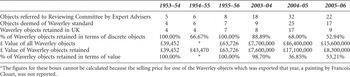
However, this data should be considered in conjunction with a few more numbers. Table 5 includes figures for the outcomes of Waverley objects in early years versus recent years.
Percentage of Waverley Objects Saved for Selected YearsFootnote 137

* The figures for these boxes cannot be calculated because the selling price for one of the Waverley objects which was exported that year, a painting by Francois Clouet, was not reported.
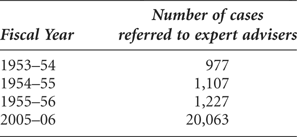
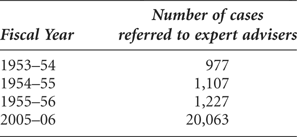
It appears that the percentage of objects saved—both in terms of number of objects as well as monetary value—is often significantly lower today than in the 1950s. At the same time, however, one must note that the number of Waverley objects per year has increased substantially. This increase might be explained by the fact that the expert advisers are asked to assess far more objects today than in the 1950s, and therefore they refer more objects to the reviewing committee. In 1953 to 1954, a total of 977 cases were referred to expert advisers in museums, with slight increases in 1954 to 1955 and 1956 to 1957. In sharp contrast, expert advisers in 2005 to 2006 reviewed a total of 20,063 cases (Table 6)!
Number of Cases Referred to Expert Advisers for Selected YearsFootnote 138
Even David Barrie, director of the NACF and a strong proponent for acquisitions, admits, “It may well be that too many items are being stopped.”Footnote 139 In 1988, the reviewing committee began the practice of starring, that is, marking the most important of waverley objects. Jonathan Scott, who introduced this practice, explains, “it seemed to me one had to ration the stars very strictly. It had to be absolutely without question that an object that had been starred would be acquired.”Footnote 140 Arguably, however, indicating the upper echelon of art objects to be saved by all means possible was the original intention of the Waverley designation, and perhaps this is why the early reviewing committees restricted the label to around a half dozen objects per year.
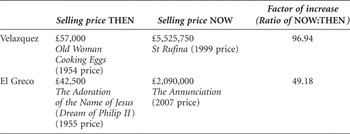
Finally, a critical factor that must also be considered is the rate at which prices in the art market have increased between the 1950s and today. Again, this article is restricted to presenting a brief sketch rather than a comprehensive picture of changes in the art market, but these limited numbers are still revealing. In fiscal year 1954 to 1955 the National Gallery of Scotland purchased the Waverley standard An Old Woman Cooking Eggs by Velazquez for £57,000. In contrast, the last Velazquez to hit the art market, St. Rufina, was sold in 1999 for £5,525,750.Footnote 141 This represents a staggering increase of a factor of 96.94! A second example, albeit slightly less astonishing, is to compare El Grecos sold then and now. In fiscal year 1955 to 1956, the National Gallery acquired El Greco's Waverley standard The Adoration of the Name of Jesus (then called Dream of Philip II) for £42,500. In 2007 El Greco's The Annunciation sold for £2,090,000.Footnote 142 This is an increase of a factor of 49.18 (Table 7).
Comparison of Old Master Prices, Recent versus 1950s

Jonathan Scott states the following:
There's been a really massive change because of changes in the art market … No one is standing back and saying “just hold on a moment, what are our priorities, what are we trying to do?” It's a big awkward, difficult subject, but I suspect we must go back and re-examine our priorities in light of the new market.Footnote 143
These skyrocketing art prices help explain why the sense of urgency continues to mount, even though the amount of governmental funding that gets channelled toward acquisitions appears to have increased at a rate which significantly exceeds normal inflation.
A CHANGING LANDSCAPE?
The evidence collected in this article supports the consensus that the Waverley system is generally efficient, resilient, and fair. Alternative systems, notably “listing,”Footnote 144 have seriously been considered more than once since 1952 and have consistently been rejected in favor of Waverley. The problem lies in funding Waverley objects. Can the labors of Proctor, Playfair, and Waverley—all treasury men—provide hope and encouragement? Or is it time to acknowledge that the system's postwar level of closeness to the treasury can never be restored? Is it even realistic or reasonable to expect the government to keep pace with a soaring art market? As a spokesperson at the DCMS suggests, “There's a major problem of expecting the public sector, basically the taxpayer, to chase international art prices at the highest level.”Footnote 145
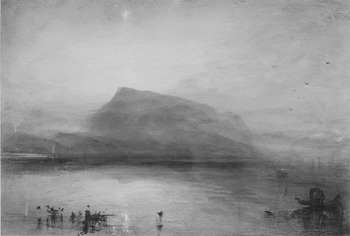
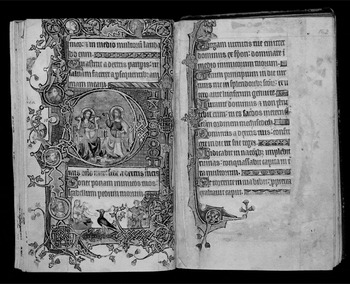
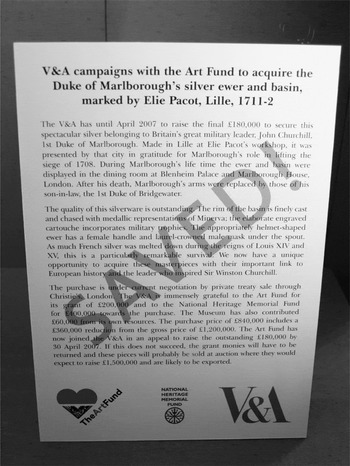
Perhaps a new culture of funding Waverley objects lies ahead. The NACF's recent campaign to save the Waverley standard Blue Rigi by Turner (Figure 7) seemed to spark a new kind of public enthusiasm for saving a masterpiece for the nation. The Guardian called the campaign a “spectacular success,” and the director of the NACF stated, “I felt that £300,000 was very ambitious, but five weeks later we have raised more than £550,000 … It's the largest sum ever raised from a public appeal of this sort.”Footnote 146 The campaign capitalized on the capabilities of the Internet, creatively calling on the public to “Buy a [Virtual] Brushstroke” for as little as £5. Another Waverley object recently saved is the Macclesfield Psalter (Figure 8), now in Cambridge's Fitzwilliam Museum. Public enthusiasm for saving the psalter also exceeded expectations, and visitors queued for hours to see it when it was first displayed. Duncan Robinson, director of the Fitzwilliam, reflects, “Sometimes we're afraid of public reaction when in actuality we'll find that public reaction is very much on our side.”Footnote 147 A recent display at the V&A (Figure 9) is further evidence that the mission of saving national treasures is increasingly framed as an issue that every museum visitor should know about and can contribute toward.
J.M.W. Turner, The Blue Rigi, watercolor on paper, 1842, 29.7 × 45 cm, Tate Britain. ©Tate, London 2008.

The Father and Son, historiated initial from the Macclesfield Psalter, vellum, use of sarum, East Anglia, c. 1330, English School (14th century). ©Fitzmilliam Museum, University of Cambridge, UK/Bridgeman Art Library, Ms 1-2005, ff. 161-v-162.

Display of the Marlborough ewer and basin at the Victoria and Albert Museum, London, 2007. ©Vivian F. Wang, 2007.

Others have also been optimistic about private philanthropy, with the caveat that it is currently more potential than realization. The 1999 to 2000 reviewing committee report surmised that “with the rise of the new economy, there must be hundreds, if not thousands, of people in this country who could … have saved”Footnote 148 some of the Waverley objects lost that year. Goodison has stated, “It is the main thrust of my report, that … we need to encourage more private money to come into the system to help solve the starvation of public money.”Footnote 149 After all, the United States—that source of the United Kingdom's headaches when it comes to art exports—has built great collections in its own museums through a tradition relying almost entirely on private philanthropy. But the United States has more generous tax incentives than the United Kingdom; even private philanthropy needs government support to flourish. As Derek Gillman points out, “Britain … has charitable foundations with the capacity to provide economic assistance, [but] their activities are generally on a modest scale compared to the United States.”Footnote 150 The argument for not considering new incentives because “present concessions and present incentives are not used sufficiently” is unconvincing, focused more on shifting the onus than on achieving results.Footnote 151
At the very least, the story of how the Waverley system came into being is valuable not because it implies that the government should or will dig deeper into its purse, but because it illustrates a fundamental mindset and interest. If the treasury in 1952 could act on the Waverley report within four months, why did it recently take more than three years merely to acknowledge the Goodison Review? Whatever the shape of the future path for saving Waverley objects, a genuine concern for the issue from the treasury is a prerequisite if substantial progress is to be made.
APPENDIX 1: CURRENT INTERPRETATION OF THE WAVERLEY CRITERIA
Source: Department for Culture, Media and Sport. Response to the Quinquennial Review of the Reviewing Committee on the Export of Works of Art, 10–11. London: Department for Culture, Media and Sport, 2004.
(I) Is it so closely connected with our history and national life that its departure would be a misfortune?
The first criterion was originally intended to catch such objects as the Alfred Jewel or the manuscript of Gray's Elegy but we interpret it in a somewhat wider context to include items which are of major importance for local history, or which have been part of collections which are of great historical significance, or which are associated with significant historical events, people or places.
Examples of “Waverley One” items include: the deposit from the “royal” ship burial from Sutton Hoo, the Middleham jewel, the Lutterell psalter, The Dog of Alcibiades, a portrait miniature of Henry Stuart, Lord Darnley, the archive of manuscripts relating to the editing of Newton's Principia Mathematica, decorations awarded to Sir William Carnegie in connection with the battle of Trafalgar, Lewis Carroll's photographs of Alice Liddell (the Alice of Alice in Wonderland), the Royal Standard belonging to Sir Ernest Shackleton, and Captain Scott's sledging flag.
(II) Is it of outstanding aesthetic importance?
The assessment of outstanding aesthetic importance involves a subjective judgement. The Committee does not restrict this criterion to great works of painting or sculpture. We might, for instance, conclude that an exquisite snuff box met this criterion as well as a painting by Poussin … [we] may take into account the condition as well as the quality of the work in question and the extent of the damage or restoration to which it may have been subjected.
Examples of “Waverley Two” items include the paintings Venus and Adonis by Titian and The Holy Family with the Infant St. John by Fra Bartolommeo, a pair of George II open armchairs by William and John Linnell, Henry Moore's sculpture, Bird Basket, a George III mahogany commode attributed to Thomas Chippendale, a drawing by Gainsborough, A Peasant Family Going to Market and a Van Gogh watercolour, Harvest in Provence.
(III) Is it of outstanding significance for the study of some particular branch of art, learning or history?
The object might be considered of outstanding significance either on its own account or on account of its connection with a person, place, event, archive, collection or assemblage. Such items serve as bench marks for assessing other objects since they can throw new light on the study of their type. We believe that “learning” … should cover a wide number of disciplines e.g. art history, archaeology, ethnography, anthropology, palaeontology (subject to an agreed definition of “fossils”), science, engineering, architecture or literature, etc….
1. Examples of “Waverley Three” items include: a lady's secretaire by Thomas Chippendale, mathematical instruments associated with Charles, Earl Stanhope, ledgers and account books of Messrs Fribourg and Treyer, three albums comprising photographs of Indian architecture and scenery by Samuel Bourne, Shepherd and Robertson c. 1870, a thirteenth-century gold and sapphire clasp, a Hutton racing car, and the Swan Roll manuscript.
APPENDIX 2: EXCERPTS FROM 1950 RESPONSES FROM FOREIGN COUNTRIES RE TREASURY'S ENQUIRY ABOUT THEIR ART EXPORT POLICIES
Source: Treasury papers, National Archives, T218/24.
Spain
Works of art require … an authorisation from the Junta del Patrimonia Artistico Nacional (Committee of National Artistic Heritage), which is only granted when the work concerned is of no national importance. No distinction is made between works for which there is a ready buyer in Spain and others; nor does the foreign currency accruing from the sale affect the decision of the Junta.
Netherlands
The Minister of Education has drawn up a list of works of art of national, historical, or cultural importance…. The export of works of art in these categories is absolutely prohibited.
The export of all other works of art is subject to the approval of the Government expert. If he considers the work of art is of major importance as a national art treasure, he will give notice thereof to the Minister of Education. In such a case the export licence can be held up for sixteen days, during which period the Government has the opportunity to enquire whether the work in question may be purchased by some official or semi-official institution at the same price for which it was offered to the foreign buyer.
These regulations apply irrespective of whether there is a ready buyer in the Netherlands.
Italy
No export licences permitted of works of art unless the object to be exported is accompanied by a permit issued by the superintendent of the special inspectorate set up for this purpose by the Ministry of Education.
This inspectorate may refuse permission to export and indeed is certain to do so if the object in question is of national interest.
France
The export of … works of art [older than a certain cutoff] is prohibited except under licence approved by the Direction de Musees de France, Ministere de Education Nationale…. Approval is withheld in cases where these authorities consider the work to be worthy of belonging to the national artistic patrimony. This restriction is applied irrespective of whether there is a ready buyer in France.
Austria
[T]he export of objects of historial [sic], artistic or cultural importance is forbidden, with the exception of works by artists who are still living or who died within the preceding twenty years…. No special weight is given to the question of the existence of an indigenous ready buyer.
In practice, we are assured, relatively few applications for permission to export works of art … have been rejected….
APPENDIX 3: EXPORT CONTROLS ON WORKS OF ART IN OTHER COUNTRIES AS OF 1991
Source: Summary of Export Controls on Works of Art in Other Countries. “A Review of the Current System of Controls on the Export of Works of Art: A Report to the Minister for the Arts,” 45, 1991.
Belgium
There does not appear to be any legislation regarding works of art from Belgium. Private owners of works of art are free to dispose of them in any way the like. They can give them away, sell them, or export them; this is not subject to any regulation or legislation.
Denmark
Rare works of art, objects of importance to cultural history, books, manuscripts, documents and the like may no longer be taken out of Denmark without permission…. A committee of five persons, the cultural Assets Committee … decides whether an export licence is to be granted. If an application for an export licence is refused, the State must offer to buy the object at market price….
France
[French controls include:]
(a) a list of items which can, in no circumstances be exported;
(b) a requirement for exporters of articles [above a threshold value] to apply for an export licence. Once the application for the licence has been received by the French Customs, there is a three-week waiting period during which national and local museums are informed of the request for permission to export … and are asked if they are interested in acquiring the articles themselves. The museums have the right to purchase at this point….
(c) the power to make known publicly at the beginning of a sale that a particular item would not receive an export licence if, after the sale, a licence was sought.
Germany
[A]ll works of art and other cultural assets (including library assets), the departure of which would constitute and essential loss to the German cultural heritage, are entered in a “Directory of Cultural Assets of National Value” in the Land in which they are situated …
Protected cultural assets may not be exported without the consent of the Federal Minister of the Interior, following his consultation wit a committee of five experts. Permission for export will not be granted if it is found that essential interests of the German cultural heritage prevail. If permission is not granted and the owner is forced by financial distress to sell, then the Supreme Land Authority of the Land in which the cultural assets are located must “use his influence” … to bring about a cheap equalisation….
Greece
[E]xports of works of art etc. are prohibited without … prior permission…. In the event that permission is refused, the state is obliged (if the applicant so wishes) to purchase the work of art by paying half the declared value.
Irish Republic
In 1985, the Hamilton Committee was set up to review the System of Control and subsequently recommended the introduction of an effective Licensing System. The System which is being introduced varies little from the British System.
Italy
If a work of art is of possible interest to the State, and particularly if its on the Government's list of desiderata, then special application has to be made to the central Government … which decides … whether or not the export is to be allowed…. If an application for export is refused, the State itself has the right either to purchase the object (a right not infrequently exercised) or merely to forbid the export in a sense that makes the sale of the object in question null and void. In other words, the decision that a particular work of art shall not leave the country is not dependent upon an equivalent sum of money being raised to keep it within the country.
Luxembourg
The State has the right to purchase the items within one month from the submission of the export permit application, at a price determined by the would-be exporter.
The Netherlands
[L]egislation … provides for the listing … of privately-owned works of art in The Netherlands for which the Government's permission would have to be granted for export … In the event of a private owner wanting to export a listed item, he must inform the Government of his intention and the price for which it is likely to be sold. The Government then has 8 months in which to find an equivalent sum of money in order to retain the work in The Netherlands. If it is unable to raise the necessary funds within the 8-month time limit, the export may go ahead.
Portugal
The central Government maintains a list of works of art of national importance…. For permanent export, the applicant writes to the Minister of Culture…. The decision on whether an export licence is granted is taken by the Minister. This is usually a long and tedious process, and licences are frequently refused.
Spain
The Spanish Government forbids the export of any work of art more than 100 years of age, which has been in the country for more than 10 years, if (in the opinion of a special Committee of the Ministry of Culture) the export would constitute “notorious damage to the artistic, historic, archaeological, documentary or ethnological patrimony of the nation.” If the Committee forbids export, then the Government has the power to acquire the object in question at a price fixed by the committee in agreement with the seller … There is, however, no obligation on the part of the State to purchase the work. If the Government does not wish to acquire the object, then the export is still refused, regardless of any organisation or person within the country being able to raise a sum of money equivalent to the price at which the object had been sold for export.