In China, the term “migrant” refers to individuals who relocate from rural to urban areas for work without permanent urban residency.Footnote 1 To varying degrees, migrants experience a journey of individualization, as described by Ulrich Beck.Footnote 2 During the process of rural–urban migration, individuals are first removed from past social formations and connections (de-embedding). This leads to customary practical knowledge, beliefs and norms losing their significance, or de-traditionalization. Following this, individuals establish themselves in new social relationships (re-embedding).Footnote 3 This conceptualization of individualization was, however, developed in the context of the Western welfare state, where modern societal institutions are designed for individuals rather than for groups.Footnote 4
In China, individualization proceeds in tandem with social transformation, yet social institutions evolve at a slower pace. This leaves migrants with inadequate institutional safeguards and underdeveloped personal social capital. Migrants do not receive the same institutional protections as local residents, and they lack social trust, stable affective relationships and instrumental ties in their new locality, making it more difficult for them to act collectively towards shared goals.Footnote 5 Essentially, individualization reveals particular forms that relationships between individuals and society can take at certain stages of social development. We therefore define individualization as the continuous and dynamic process that occurs when individuals leave their village or hometown and its associated social relations to relocate to another place for business or work, which involves rebuilding their social networks in an unfamiliar urban society with more social mobility.
While individualization is a structural trend that is reshaping social relations in Chinese cities, its impact is particularly acute among groups lacking social anchors. The self-employed migrants (getihu 个体户) examined in this study, who hail from rural areas in Henan province, typically experience this situation. This group comes from diverse locales and differs from other migrant groups, such as migrant workers, who often share geographical and kinship ties that foster deeper emotional connectionsFootnote 6 and make it easier for them to form a “new working class” identity. The relationships formed among self-employed migrants are primarily competitive and instrumental in nature; they coalesce around shared interests and dissipate once those interests are no longer present. In their destination areas, they live more dispersedly, exhibit weaker intra-group ties and have lower levels of mutual trust compared to those of migrant workers. Furthermore, self-employed migrants bear the risks of protest individually, unlike migrant workers, whose protest logic involves collectively sharing risks.
As of November 2019, there were 82.61 million self-employed migrants in China employing 176.91 million people.Footnote 7 In January 2020, the Chinese government required self-employed business owners to halt operations as part of the effort to combat COVID-19. However, individuals still had to bear the high cost of rent during the three-month suspension of business, which caused many stores to close down.Footnote 8 The government introduced relevant initiatives and policies to alleviate this burden, which benefited both tenants and landlords and was crucial for maintaining social stability and continuing development. Nevertheless, some local governments and landlords refused to enforce the policies, spurring some self-employed migrants to launch rent reduction campaigns after they had exhausted all other means of safeguarding their interests.
While studying these protests in Zhengzhou, we observed that the types of relationships that the self-employed migrants had established in their new city greatly influenced their protests. These relationships included those with the landlord, an investment promotion company that was the target of the protest, as well as those with the village committee, subdistrict office and higher-level government agencies, who acted as mediators. Through this case study, we explore how the instrumental relational networks constructed by migrants against the backdrop of individualization acted as both catalyst and inhibitor for their collective rent reduction action. While individualization endowed the migrants with agency for resistance, it also ultimately led to a form of fragmented contention by fracturing intra-group relations, severing local ties, confronting market power and facing institutional voids. This investigation not only deepens our understanding of contentious politics in China but also provides empirical evidence for revising the theoretical conceptualizations of relationships in the era of individualization.
Individualization, Relationships and Collective Action: Towards a Context-Sensitive Analytical Framework
In 1965, Mancur Olson defined collective action as actions taken by group members in pursuit of common interests, a category that includes collective resistance.Footnote 9 Based on overarching goals, collective action can fall into one of two categories. First, public service-oriented collective action is directed towards achieving goals like urban renewal, community participation and resource management in fields such as urban planning. This type of action entails concerted efforts to produce public goods or achieve shared objectivesFootnote 10 and is typically analysed through theoretical frameworks, such as public choice and self-governance. The second category, political participation-oriented collective action, is often a response to perceived rights violations in Western political science. This type of action involves individuals leveraging group identity to strengthen their collective positionFootnote 11 and advance their shared interests or agendas.Footnote 12 Theories, such as resource mobilization, political opportunity structures and social capital, provide key explanations for this form of collective action.
In China, however, collective action through protest is a means for protesters to express grievances and seek solutions only after exhausting institutionalized channels.Footnote 13 Its purpose is to protest improper policy implementation or failure to deliver promised goods or services.Footnote 14 Consequently, protesting usually involves actions that are considered illegal.Footnote 15 This is distinct from the second type of collective action described above, which arises from the particular cultural and institutional context of Western democracies. Accordingly, in this study, collective action refers to coordinated efforts undertaken by a group of unorganized individuals to advance challenging claims against opponents, elites or even authorities with the aim of rectifying failures in policy implementation. In this context, collective action encompasses such forms as mass demonstrations and collective petitions.
Faced with this distinctive form of collective action in China, research based on Western theories encounters explanatory difficulties. First, resource mobilization theory emphasizes organizational resources and strategic action,Footnote 16 highlighting the central role of formal organizations in mobilizing resources.Footnote 17 Yet, Chinese social reality leads migrant protests to exhibit a pattern of “mobilization without formal organization.”Footnote 18 This gives rise to the organizational resource paradox and prompts the question of how atomized individuals mobilize in the absence of institutional organizational resources. Second, political opportunity structure theory stresses the openness of the political opportunity structure.Footnote 19 However, China’s stability maintenance system has created a unique structure characterized by the coexistence of both rigidity and flexibility, which leads protests to erupt precisely when institutional channels are blocked.Footnote 20 This opportunity structure paradox necessitates an analysis of how relational networks carve out spaces for contention through micro-level interactions with local power. Finally, social capital theory posits that strong-tie networks and trust form the foundation of collective action.Footnote 21 However, the process of individualization in China has given rise to a form of “instrumental solidarity” based on purposive rationality.Footnote 22 This constitutes the relational capital paradox: why do relational networks act simultaneously as a catalyst for initial mobilization and an inhibitor that erodes protest? These paradoxes reveal that Western theories lack a contextualized analysis of the nature and dynamics of the relational networks in which actors are embedded and, in particular, fail to address their potential vulnerability, instrumentality and inherent contradictions within the context of market-driven individualization.
Recent studies of migrant collective action in China have increasingly adopted a relational perspective to address this core blind spot and bridge the gap between Western theories and Chinese realities.Footnote 23 The analytical focus has thus expanded from a primary concern with state repression to include a nuanced examination of the enabling or constraining role of social relationships in collective action. Scholars have found that informal relationships provide crucial protest resources and informational support.Footnote 24 Relationships are also used by local governments to suppress and divide protesters.Footnote 25 The integration of digital technology with relationships has reconfigured spaces for online mobilization and identity formation.Footnote 26 The strength of ties,Footnote 27 social embeddedness,Footnote 28 and the structure of networks within specific industrial clusters profoundly influence the likelihood of protests and the form that they take.Footnote 29 For instance, the strength of kinship ties shapes the costs and benefits of individual participation, and kinship with the protest target is a stronger predictor of protest willingness than kinship with fellow protesters.Footnote 30 Sustained protest requires the activation of strong social ties in combination with other factors.Footnote 31
Although these studies demonstrate the pivotal role of relationships in protest in China, they have tended to treat relationships as a form of stable and generally enabling social capital. They have predominantly focused on singular, static and enabling strong ties, such as those based on kinship or shared place of origin, while similarly overlooking the fact that migrants experiencing individualization rely on complex, dynamic networks of weak ties that may simultaneously facilitate mobilization and undermine collective solidarity. This leads to the central question of this paper: if relational networks are the foundation of collective action, how are the dynamics and sustainability of collective action transformed when political exclusion, market domination and social isolation jointly shape new, highly instrumental and inherently fragile forms of relational networks during the process of individualization?
We therefore develop an integrated analytical framework of “relational duality” to address this question. Following Charles Tilly’s relational approach to contentious politics, we regard collective action as a result of dynamic interactions within relational networks.Footnote 32 Tilly argued that interpersonal interaction is a fundamental element of social processes that continuously generates and reshapes collective identities and social boundaries.Footnote 33 He thus treated social relations as the bedrock of contentious politics, with a focus on everyday activities and relational networks within protests,Footnote 34 and sought to uncover the mechanisms and processes among protesters, their targets, public authorities and third parties in sequences of interaction.Footnote 35 However, Tilly emphasized how relationships generate collective identities through interaction without considering how shared identities fail to coalesce when social ties are reshaped by market-driven instrumentalization and socio-political marginalization. Here, we incorporate the individualization theories of Beck and Yunxiang Yan to reveal how market-driven de-embedding and re-embedding shape a different type of relational network characterized by instrumental rationality.Footnote 36 We argue that it is precisely this instrumentality that introduces a duality into relational networks. This duality enables mobilization in some contexts yet simultaneously undermines collective solidarity in others. Although the existing literature has documented the enabling role of relationships in collective action,Footnote 37 there is insufficient explanation regarding how, under specific conditions, the relationships dismantle solidarity and fragment collective action.
This study draws on Xi Chen’s research on boundary activation to clarify the critical conditions under which relational networks shift from enabling to constraining.Footnote 38 Chen demonstrates that internal group divisions do not inevitably lead to the fragmentation of collective action; rather, the key lies in specific actors actively transforming latent boundaries into salient cleavages.Footnote 39 Our case similarly reveals that the individualized relational networks of self-employed migrants are not a one-dimensional form of social capital but a dynamic structure that plays opposing roles at different stages of collective action. This structure is particularly susceptible to strategic exploitation by external actors, thereby activating internal boundaries of competition and division.
In summary, the analytical framework of “relational duality” proposed in this paper addresses how the political, market and social relationships of self-employed migrants dynamically interact within the context of individualization and jointly shape the trajectory and outcome of collective action. Political exclusion blocks potential institutional outlets, market logic undermines the basis for reciprocity, and social isolation disrupts cross-group linkages. It is the combined force of these three factors that makes the instrumental relational network simultaneously the only available channel for mobilization and inherently fragile. This analytical framework thus systematically addresses the three aforementioned paradoxes – organizational resources, opportunity structures and relational capital – to reveal the distinctive logic of collective action among Chinese self-employed migrants in the context of individualization.
Methods and Data
A 15-month ethnographic study was conducted from February 2020 to May 2021 in Community D, Zhengzhou, China, after the outbreak of COVID-19. We observed the collective actions of self-employed migrants protesting to their landlord for rent reductions. Although this type of action also occurred in other parts of Zhengzhou, we specifically selected Community D for data collection owing to the government’s sequestration policy and practical feasibility.
Data were collected through the direct observation of participants and semi-structured interviews.Footnote 40 First, the rent reduction dispute between the self-employed migrants and their landlord was observed and recorded throughout the protests. Second, a preliminary survey of all 116 businesses in the community was conducted. By 5 May 2020, 16 businesses had closed due to the effects of the COVID-19 pandemic. Of the remaining 100 businesses, 15 were operated by the landlord, 10 by local villagers, and 75 by self-employed migrants (five of which were waiting to transfer ownership). We recruited the remaining 70 self-employed migrant business owners as primary survey respondents. Among these, 46 were willing to be surveyed through in-depth interviews, which were then analysed using coding from the preliminary survey data. The interviews covered multiple dimensions, including their business situation during the COVID-19 pandemic, stress, rent prices, relationship to towns and localities before and after migration, perceptions of the protests, reasons for participating in the protests, protest goals and tactics, experience of the protests, and trust in the central government.
To understand and present the entire protest process as completely as possible, we also interviewed two key landlord representatives, four local villagers and three government officials, based on the recommendations of an acquaintance (a local villager). Our interviews with landlord representatives and villagers covered their attitudes towards the self-employed migrants, resources available for counter-protests, objectives and strategies, relationships with the self-employed migrants and local governments, and store occupancy rates. Our interviews with local government officials across three levels covered their attitudes towards and handling of the protests. We also drew on data from local village records and information on similar cases collected online from surrounding areas. Each interview lasted two to three hours, and each interviewee was given two cartons of milk as compensation. No authors have any connection with the interviewees or host community, and we tried to analyse objectively how the self-employed migrants conducted their protests. The interviewed self-employed migrants had the goal of obtaining rent reductions, while landlord representatives, local villagers and government officials sought a quick resolution to end the protests.
Both authors read, labelled, categorized and analysed the primary sources following data collection. Based on Tilly’s relational insight that social processes are constituted by sequences of interpersonal interaction, we employed a “relationship–process–event” analytical framework to excavate the multidimensional relationships and interactions among actors. In this way, the self-employed migrants were placed within a complex thicket of relationships, which allowed their mobilizations, goals, strategies and outcomes to be better presented. This enabled us to map the tension between the mutual constructions of the individual and society in the process of individualization in China. To protect interviewees, pseudonyms are used throughout the text.
Individualization and the Making of Relational Networks Among Self-employed Migrants
Owing to the unique circumstances surrounding Chinese migrants, only the de-embedding, de-traditionalization and re-embedding portions of Beck’s individualization framework were used in this study. During the de-embedding stage, the migrants actively detached from rural social relations and agricultural labour to pursue better livelihood opportunities. For example, one business owner stated, “When I was farming in the countryside with little income and a heavy family burden, a friend introduced me to this business, which has allowed me to raise my children better.”Footnote 41 During the de-traditionalization stage, traditional concepts gradually disintegrated, and individuals’ self-awareness increased, although they retained some of their rural attributes and adapted their actions to suit their desired trajectory. For instance, some interviewees told us, “We hardly return to the countryside because we are busy with business. Former relatives and friends work in different cities, and their lifestyles and ideas have changed. So, we have few interests in common and little contact.”Footnote 42 During the re-embedding stage, the migrants moved into Community D for business and integrated into new social relationships and structures, including political, economic and cultural institutions in the city. One restaurant owner explained, “I met some local friends when they came here for dinner. Sometimes, they invite me to events.”Footnote 43 Although the migrants internalized a market-rational orientation to action, they remained de-embedded in their professional lives due to their limited capital and lack of organization to protect their rights.
Individualization is a structural change in the essential relationship between the individual and society, with re-embedding emphasizing the integration of the self-employed migrants into new social relationships and structures. We thus present the migrants’ living and working status after re-embedding into their new city from a relational perspective. Specifically, the migrants were found to have established four types of relationships with individuals or organizations in the place of relocation.
The first type of relationship included fragmented intra-group relationships between migrants. According to our survey, 95 per cent of them had largely lost contact with their hometowns after moving. This situation not only left them unable to access resources through relatively well-established institutional arrangements, as was the case for their urban counterparts, but also meant that they could not obtain help from traditional rural relationships as they once did. To guard against the unknown risks brought about by individualization, the migrants focused intensely on earning money; even when two businesses were next to each other, the owners were reluctant to socialize with their neighbours.Footnote 44 The relationships that they established were acquaintanceships rather than strong ties. When confronted with the survival crisis during the pandemic, non-mandatory policies and competition from peers, intra-group relationships appeared particularly fractured and transient. It is crucial to emphasize that this relational fragmentation is not a failure of the migrants, but rather a cost within the process of compressed modernization.
The second type of relationship included the fragile local relationships formed between the self-employed migrants and local villagers. Individualization left the self-employed migrants in a state of dispersal, isolation and detachment within their new communities. Individuals running restaurants told us, “We usually shop for ingredients at 05:00 and finish preparations at 09:30. Then, we receive customers until 23:30 or even 01:00.”Footnote 45 Their intensive work schedules created a temporal conflict with the daily rhythms of local villagers. Relationship building primarily relied on brief, consumption-based encounters, making it difficult to develop deeper social acceptance. Furthermore, their exclusion from community activities, collective welfare and shop ownership – a symbol of local belonging – gradually transformed economic isolation into social segregation, further undermining the stability and integration of their relationships with locals.
The self-employed migrants also formed an unstable market relationship with their landlord, the investment promotion company. Community D initially introduced a merchant company (the landlord) to manage the shops through a public bidding process. However, months later, in pursuit of higher profits, the company colluded with the village committee to initiate a second round of bidding. It ultimately secured the leasehold at 60 per cent of the original price but maintained the original rent for the self-employed renters. The head of the company wielded significant local influence and had close ties with the government, so most villagers remained silent.Footnote 46 Consequently, the self-employed migrants tolerated rents set by the landlord that were approximately 30 per cent higher than those in the surrounding areas. When they struggled to make a profit or operated at a loss, many renters had little choice but to leave, leading to a complete turnover of tenants approximately every two years. This power-driven high turnover kept the relationships between the two parties in a perpetually unstable state.
The self-employed migrants maintained only essential contact with the government. Despite moving to and living in Community D, they were not included in the village committee management.Footnote 47 The migrants therefore channelled all their energies into their businesses rather than engaging with the local government. Furthermore, the subdistrict office lacked any relevant protocols or mechanisms to manage or assist them.Footnote 48 This meant that the individualization of self-employed migrants further removed them from any original and current government protections. By remaining outside of local institutionalized activities, the migrants were unable to establish government–citizen relationships with the authorities beyond those pertaining to essential matters.
The self-employed migrants’ individualization gave rise to the structural outcome of a relational network that was instrumental, transient, fragile and non-institutionalized. This network not only shaped their everyday practices but also critically influenced the trajectory and outcomes of their collective action.
The Manifestation of Relational Networks in Protest: Mobilization to Disintegration
The relational networks shaped by individualization played diametrically opposing roles at different stages of the protest, functioning as both a catalyst for its emergence and an inhibitor that led to its ultimate failure.
Weak external ties: networks as a catalyst for protest
The stores rented by the self-employed migrants were collectively owned by villagers, managed by the village committee and operated by the landlord. The village committee distributed the profits from shop rentals among the villagers, who also participated in the profit-sharing as shareholders. The self-employed migrants faced multiple pressures at the onset of the pandemic, including rent and employee salaries during the three-month suspension of business operations. Even after the resumption of business, business turnover was only 20 to 33 per cent of pre-pandemic levels, but their rent still accounted for approximately 50 per cent of their costs. With many liabilities, the migrants had minimal ability to endure these risks. Some chose to cut their losses by selling their businesses, while others, citing central government rent relief policies, sought reductions from the landlord through direct appeals and local connections; however, all of these appeals were denied.
The closure of several shops further destabilized the migrants’ market-based relationship with the landlord. Their ties with villagers were also fundamentally weak, as is typical of instrumental or distant acquaintanceships, and these ties turned adversarial as interests diverged. Deprived of previously accessible relational resources, the migrants were left to confront risks individually. Moreover, tenuous relationships with local authorities, who were also shareholders, foreclosed access to institutional mechanisms for conflict resolution. Ultimately, the convergence of the migrants’ weak external ties with villagers, their landlord and the authorities eliminated all institutional avenues for redress. This external exclusion catalysed the formation of a collective identity centred on a shared demand – rent reduction – and galvanized a strong willingness to protest, which led to the rapid consolidation of internal solidarity and the establishment of a protest organization. This process exemplifies one of the core dynamic mechanisms described in this paper, “external exclusion–internal solidarity.”
The 32-year-old owner of Store A, who had been running a restaurant in the community for two years, emerged as a leader in the mobilization of the protest due to his education and persuasive debating skills. He established a “Rent reduction exchange group” on WeChat, where he shared central government reduction policies, loss projections and successful rent reduction cases from across the country and the surrounding area. These success stories stimulated a shared experience of relative deprivation among the self-employed migrants and served to strengthen group solidarity. He described the group’s decision-making process:
We have no money or power here. On rent reduction, none of them – the landlord, the villagers or the village committee – would budge. But we had to survive. We had no choice but to come together and figure out a way. Some suggested hiring a lawyer to resolve the rent issue or collectively pressuring the landlord. After analysing all suggestions, we felt that solving the problem through the legal system would be costly and inefficient. Therefore, we decided to demonstrate at the landlord’s door and negotiate with them.Footnote 49
This supports the idea that younger migrants possess greater levels of legal awareness and rights consciousness and that perceived rights violations may lead them to participate in protests.Footnote 50 However, as we discuss below, although the weak online ties facilitated an initial mobilization and information diffusion, they failed to translate into offline trust.
Weak intra-group ties: divergent claims as an inhibitor of solidarity
Divergent claims revealed the fragility of the group’s collective identity. After forming a protest organization, the self-employed migrants articulated a common demand: a three-month rent waiver and a 50 per cent reduction in the next three months’ rent.Footnote 51 While this common goal prompted some changes in their previously fragmented relational patterns, the ad hoc online platform served only as a channel for information sharing and did not underpin shared beliefs. This persistent individual atomization triggered an eventual crisis of trust, fuelling the individualization of demands and renewing the internal fragmentation stemming from several factors described below.
The migrants with smaller stores paid lower rents (3,500–8,000 yuan) and could absorb short-term losses. Their stance was: “Waive rent if possible; if not, we’ll pay.”Footnote 52 The owners of bigger stores with higher rent costs “maintained the common goal” and actively engaged with the protests.Footnote 53 Migrants who had operated their businesses for over three years protested less actively owing to their deeper local ties. For example, the owner of Store E, who had been in the community for five years, explained, “I have many friends here, including the landlord. He waived a month’s rent before I even asked. I tell other peers not to give the landlord a hard time.”Footnote 54 However, most of the migrants had been in business for less than two years and had few or no local ties. They demanded that “the landlord should share the risk with us and reduce the rent for three months.”Footnote 55 In addition, as the rent deadline approached, the level of protest activity increased, with the migrants demanding “a deferral and maximum rent reduction.”Footnote 56 Conversely, when the deadline was further away, migrants were less engaged, seeking only “whatever rent reduction they could get.”Footnote 57
Another factor centred around the migrants’ business situation and family finances. Those with stronger businesses or better-off households were less actively engaged in the protests, aiming only to “reduce the rent as much as possible.”Footnote 58 People with average family finances and business conditions, on the other hand, campaigned more vigorously, aiming for “at least two months of rent waived.”Footnote 59 Finally, among the protesters, 32 per cent were older migrants (born before 1980) and 68 per cent were younger migrants (born after 1980). The older migrants were wary of confrontation and demanded only “one month’s rent waived.”Footnote 60 The younger migrants, on the other hand, who formed the backbone of the protests, insisted on “three months’ rent waived and the next three halved.”Footnote 61
In summary, differences across the five factors generated divergent demands and distinct group characteristics, creating multiple hidden boundaries within the self-employed migrant community. This illustrates one of the core joint mechanisms described in this paper, “competition anxiety–goal fragmentation,” referring to how competitive pressures generated by individualized circumstances fragment collective goals, and how it operates in a group lacking strong-tie cohesion. As Chen notes, such internal divisions do not inevitably lead to protest failure; the key lies in whether and how group boundaries are strategically activated.Footnote 62 What is certain, however, is that these latent divisions further weakened internal relations and hindered the formation of unified goals and a cohesive collective identity. The group thus became vulnerable to co-optation and relational repression, which significantly undermined its solidarity, participation levels and the sustainability of protest activities, ultimately shaping the protest’s outcome.
How relational duality shaped the protest process
At the end of March 2020, 26 self-employed migrants gathered outside the property management office to demand rent reductions. The landlord responded, “We also rent these premises from villagers; there’s no way to cut the rent.”Footnote 63 When the migrants’ defensive demands went unmet, they turned to the local government, guided by a cultural view of the state as arbiter and protector,Footnote 64 as well as expectations of shared risk. They insisted that the local authorities should implement the central government’s rent reduction policy even though it was non-binding. This expectation of the government stemmed from their inability to confront the risks of individualization alone and their need for institutional protection. They petitioned the village committee to mediate but were told: “These shops aren’t our private property. We must hold a villagers’ meeting to solicit opinions and negotiate with the landlord. We cannot reply today.”Footnote 65 The protesters discussed the matter and agreed to leave, although some later returned for a response after growing impatient with the delay. The committee, however, was aligned with the landlord’s interests and kept the protesters waiting.
During the wait, the self-employed migrants sought out villagers to gauge the likelihood of rent reduction. The villagers responded: “The company already rents the shops from us at a low enough price. We won’t budge.”Footnote 66 Thus, despite internal conflicts over interest distribution among the villagers, village committee and landlord, all three parties presented a united front against the migrants’ demands. As a result, the villagers backed the landlord’s stance: “No rent reduction!”Footnote 67 The migrants who were unable to pay were therefore forced to exit the local market, further destabilizing the group. The migrants attempted to mobilize media resources but received no support. The owner of Store A then proposed asking the subdistrict office to put pressure on the landlord to reduce rents, but this proposal was met with no response. At this point, the first rent reduction effort had failed.
In April 2020, a new central government policy reignited the migrants’ hope of a successful protest. It explicitly included a three-month rent waiver for the self-employed and, in return, exempted complying landlords from that year’s property and urban land-use taxes.Footnote 68 Nevertheless, the landlord in Community D continued to resist rent reductions. In response, the self-employed migrants united in a rent strike. However, owing to their fragmented intra-group relations, weak local ties, and the solid alignment of interests between the landlord and the village committee, some eventually compromised. According to the owner of Shop L, some of the protestors withdrew after the landlord privately promised them rent reductions; others were threatened and intimidated into silence; and still others, particularly those with strong local connections, such as the owner of Shop E, were persuaded to abandon the protest.Footnote 69
The self-employed migrants then submitted a collective petition requesting a rent reduction. Compared to the first protest, twice as many participants signed the petition. They delivered it to the village committee on 8 May but were told to forward it to the landlord instead. Upon receiving it, the landlord declared, “This concerns all the villagers – it’s up to the village committee to decide.”Footnote 70 Recognizing these refusals as pretextual runaround, the self-employed migrants decided to appeal directly to the higher authorities. On 12 May, the owner of Store A approached the owner of Store L to discuss the matter and learned that she had withdrawn from the protest because “her father, a member of the village committee, accused her of betraying the interests of her fellow villagers and asked her to stop protesting. Her father acted at the village committee’s request.”Footnote 71
This demonstrates another core joint mechanism, “co-optation–key defection,” which functions as a nexus linking external and internal relations. By exploiting the lack of cohesion within the self-employed migrant group, the landlord and village committee employed divisive tactics, including selective co-optation and relational repression, to transform latent intra-group interest divergences into salient, action-relevant cleavages. This boundary activation, facilitated by the group’s weak internal ties, ultimately dismantled its temporarily forged collective identity.
Nevertheless, on 13 May, the self-employed migrants submitted a petition to the subdistrict office. The official who received it advised them to await a mandatory national rent relief policy. Another official, alluding to the office’s informal ties with the village committee, explained: “Decisions are made by the collective body of villagers, not the committee itself. Moreover, the landlord has obligations to both the villagers and the bank, so they face difficulties as well. If you want rent reductions, you must negotiate directly with them.”Footnote 72 When the migrants reported that their negotiations with the landlord had failed, the official suggested that they try the village committee, which again refused to engage with them. The owner of Shop L said, “The only way out is to move upward – breaking free from entrenched local power and informal ties.”Footnote 73 Yet the prospects remained grim.
On 25 May, the self-employed migrants sought assistance from the X District Government, only to be told, “Neither policy nor law mandates rent reductions; you must bear the losses yourselves.”Footnote 74 They then appealed to the municipal government and received the same response. The second rent reduction campaign thus failed, ending their protest. In this case, moderate tactics ultimately proved ineffective, hampered by fractured government–migrant relations, antagonistic local interests, fragmented intra-group solidarity and the inherent volatility of market relations.
By contrast, tenant protests succeeded in a neighbourhood adjacent to Community D, where, according to survey data, 68 per cent of the tenants were local residents. Over 2,000 wholesale business tenants also succeeded in their dispute with the management of a large shopping mall under single corporate ownership.Footnote 75
Analysis: Mechanisms Underlying the Dual Role of Relational Networks
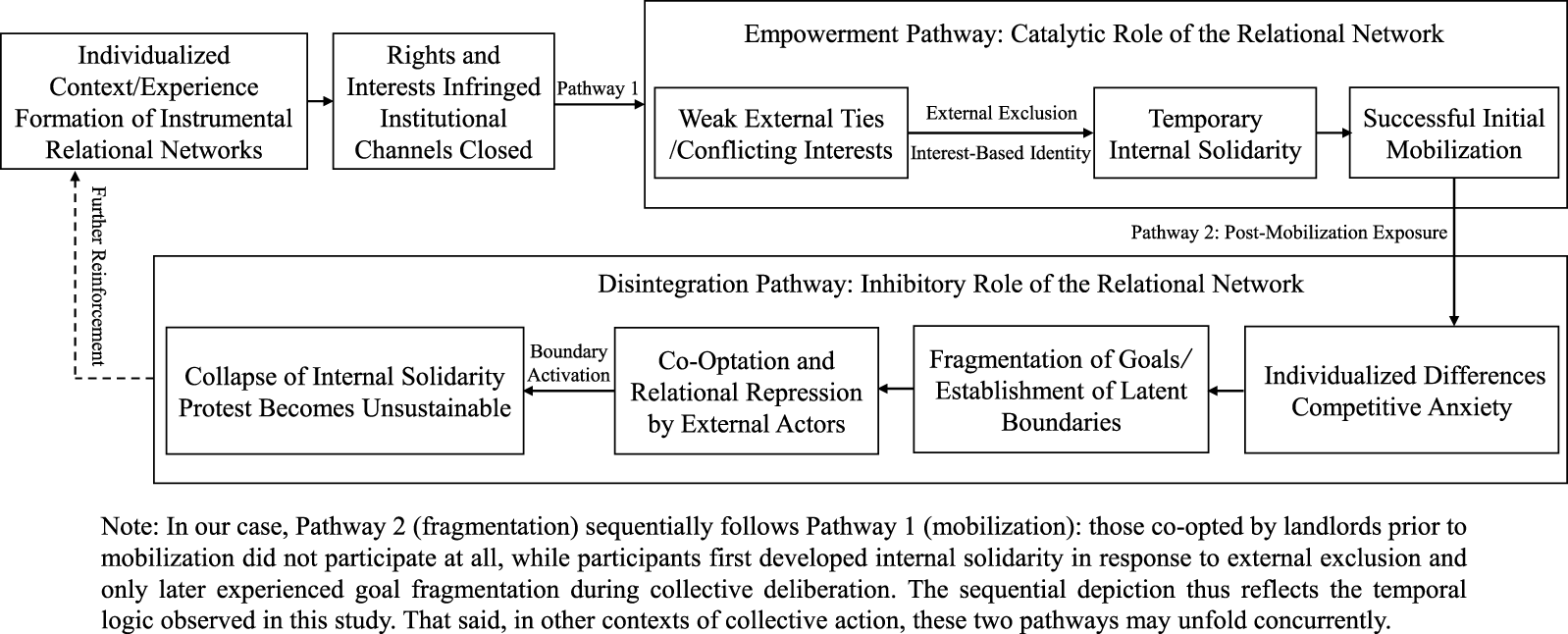
The individualized relational network exhibits a dynamic duality during contention, which is realized through three sequential and nested mechanisms (Figure 1). First, the mobilization mechanism of “external exclusion–internal solidarity” was at play when the self-employed migrants faced consistent exclusion by the landlord, villagers and the village committee due to weak external ties and opposing interests. This shared external pressure forged an adversarial “us versus them” identity. This strengthened internal group solidarity, transforming atomized individuals into a protest community capable of collective action, thereby explaining the success of the initial mobilization.
Second, the division mechanism of “competition anxiety–goal fragmentation” was at play as follows: once the group mobilized, intrinsic competitive anxieties rooted in individualized conditions, such as business scale and time in operation, rapidly eroded transient solidarity in the absence of robust trust and consensus-building mechanisms, thereby fragmenting protest goals. This mechanism indicates that weak ties do not directly cause dissolution but are insufficient to withstand the competitive anxieties generated by individualization. Meanwhile, latent boundaries within the group – formed by interest divergence, varying degrees of local embeddedness and competitive anxiety – remained passive and unactivated at this stage.
Finally, the dissolution mechanism of “co-optation–key defection” worked as follows: as the protest escalated into confrontation, the landlord and the village committee leveraged their local networks to co-opt key protesters strategically and exercise relational repression. This move activated the group’s aforementioned latent boundaries and directly removed core participants. Consequently, the group’s collective identity fragmented, solidarity shattered and sustained collective action collapsed.
Dynamic Mechanisms of Mobilization and Disintegration in Relational Networks

Figure 1 Long description
The diagram illustrates two pathways: Empowerment Pathway and Disintegration Pathway. Based on Individualized Context/Experience Formation of Instrumental Relational Networks, Rights and Interests Infringed Institutional Channels Closed, the Empowerment Pathway, labeled as the catalytic role of the relational network, includes: Weak External Ties/Conflicting Interests, External Exclusion/Interest-Based Identity, Temporary Internal Solidarity and Successful Initial Mobilization. The Disintegration Pathway, labeled as the inhibitory role of the relational network, includes: Individualized Differences/Competitive Anxiety, Fragmentation of Goals/Establishment of Latent Boundaries, Co-Optation and Relational Repression by External Actors, Boundary Activation and Collapse of Internal Solidarity/Protest Becomes Unsustainable. A note at the bottom explains that in the case studied, Pathway 2 (fragmentation) follows Pathway 1 (mobilization): those co-opted by landlords prior to mobilization did not participate at all, while participants first developed internal solidarity in response to external exclusion and only later experienced goal fragmentation during collective deliberation. That said, in other contexts of collective action, these two pathways may unfold concurrently.
The interweaving of external and internal mechanisms provides an integrated explanation for the protest’s trajectory. The dynamic process of “relational duality” is deeply embedded in an institutional context shaped by local market, political, social and cultural institutions (Table 1). Institutions themselves do not think or produce, but imbalanced local institutional structures permeate actors’ principles of action through institutional logics, thereby enabling institutionalized actions to be reproduced.Footnote 76 Therefore, these external mechanisms are not a static backdrop; rather, they pre-shape and continuously reinforce the instrumental and fragile relational networks of self-employed migrants, consequently shaping their duality in protest.
Linking Mechanisms Between External Institutional Structures and Endogenous Action Logics

Table 1 Long description
The table links four external institutional systems to their operational mechanisms, how each reshapes migrants’ relational networks, and which internal protest-related mechanisms are strengthened. In the local market, capital power and high mobility produce unstable, unequal relations and frame claims as zero-sum, reinforcing competition anxiety, goal fragmentation, and co-optation. In local politics, stability maintenance tied to economic performance closes formal channels and recasts protest as an economic dispute, reinforcing external exclusion alongside internal solidarity, plus co-optation and relational repression. In local society, internal patronage combined with external exclusion keeps migrants out of welfare and trust networks, intensifying outsider status and reinforcing exclusion and co-optation. In local culture, instrumental rationality and a marketized mentality legitimize short-term profit seeking and weaken long-term trust and reciprocity. As shown in the table, this logic permeates all mechanisms. Across rows, co-optation appears repeatedly, while culture is presented as the broadest influence because it affects every mechanism rather than a single pathway. The entries summarize patterns from case analysis and use qualitative phrasing rather than quantified measures.
Source: Developed by the authors based on case analysis.
Notes: Internal mechanisms refer to the three protest mobilization, division and dissolution mechanisms outlined in the text.
These institutional logics operate through four interrelated dimensions: local market, politics, society and culture. First, the logics of “capital power” and “high mobility” in the local market conferred upon the landlord a monopolistic position in rent-setting and tacitly legitimized its profit-maximizing use of market power. This not only directly created unstable market relations but also, during the crisis, swiftly framed the demand for rent reduction as a zero-sum game, providing fertile ground for the “competition anxiety–goal fragmentation” mechanism. Second, the dual imperatives of “stability maintenance–economic performance” in local politics drove agencies like the subdistrict office to define protests as economic disputes rather than rights claims. This framing not only closed off institutionalized pathways that could have emerged within the “external exclusion–internal solidarity” mechanism but also tacitly permitted or even encouraged the landlord and the village committee to employ relational means to resolve conflicts instead of fulfilling their mediation duties. Indeed, consistent with existing research on local governments’ preference for non-confrontational measures in livelihood-related disputes, the village committee exercised relational repression against the migrants’ protests.Footnote 77 Third, the tradition of relational patronage and interest-based exclusion in local society systematically excluded the self-employed migrants from collective community benefits and decision-making. This entrenched the fragility of their local ties and led the villagers to side with the landlord, which held embedded local connections during conflicts, dramatically amplifying “external exclusion” and rendering the landlord’s strategy of “co-optation” particularly effective. Finally, the “marketized mentality” and “relational mentality” permeating all the above systems not only legitimized the landlord’s profit-seeking behaviour but also shaped the migrants’ own logic of action in viewing their relationships with each other in short-term, instrumental terms. This fundamentally eroded the generalized trust and reciprocal expectations necessary for building strong ties, rendering solidarity based on instrumental networks fragile, transient and easily fractured.
Thus, the fragmented contention elucidated in this study emerges from the interplay between the inherent tensions within the migrants’ relational networks under individualization, which unfolded through the three mechanisms described, and the structuring force of the external institutional system. Localized institutional logics (Table 1) pre-structure the arena and the rules of the game, while the migrants’ individualized relational networks determine the concrete forms of mobilization and dissolution within that arena (Figure 1). This integrated analysis reveals that the predicament of the migrants’ collective action stems not merely from the “weakness” of their social ties but, more crucially, from the fact that this “weakness” is systematically produced and reproduced by a market and institutional system that withholds access to alternative, institutionalized strong-tie resources. Consequently, ostensibly equal political opportunities yield sharply divergent outcomes, rooted in the profound inequality of the relational resources in which actors are embedded.
Conclusion
Many studies have explained the collective action of Chinese migrants through a relational lens,Footnote 78 but they have often failed to clarify the nature of these relational networks and the forces that shape them. Through the proposed analytical framework of “relational duality,” this study demonstrates that in the process of individualization, self-employed migrants develop fragmented intra-group ties, fragile local relationships, unstable market relations and arms-length government–migrant interactions that occur only when absolutely necessary. It is precisely this dynamic and instrumental relational matrix encompassing the state, market and society that shapes the unique trajectory of their protest: common external exclusion catalyses internal solidarity and enables short-term mobilization, while the network’s inherent fragility enables external actors to exploit latent internal divisions strategically through co-optation and relational repression, leading to the rapid dissolution of solidarity and, ultimately, fragmented contention. This analysis not only systematically addresses the three core paradoxes concerning organizational resources, opportunity structures and relational capital that emerge from the tension between Western theories and Chinese reality, but also reveals a distinctive logic of “easy mobilization, difficult solidarity” among Chinese migrants under conditions of individualization that influences collective action.
Building on this, we propose the “paradox of relational empowerment.” While existing research has posited that Chinese protesters leverage relational networks to access resources and sustain mobilization,Footnote 79 we demonstrate that under individualization, instrumental relational networks can catalyse collective action around immediate interests, yet their inherent lack of trust and instrumental logic also render them inimical to sustainable solidarity. This paradox gives rise to a new model of “weak-tie fragmented contention.” This model challenges the conventional wisdom that relationships inevitably empower collective action. It also exposes the structural alienation of relational ties by marketization, transcends the theoretical narrative of a “state repression–societal resistance” binary and highlights the dialectical dynamic of mobilization and disintegration produced by individualization.
Situating this model within the scholarly literature on labour contention in China highlights its distinctiveness. Compared to factory workers, who rely on strong-tie collective decision-making,Footnote 80 self-employed migrants’ contention exhibits individualized, instrumental mobilization. Unlike state-owned enterprise workers, who adhere to a “law-abiding survival logic,”Footnote 81 migrants are more inclined to initiate non-institutionalized claims. Their “relational resilience” – the capacity to mobilize despite profound individualization – stands in stark contrast to the collective action dilemmas faced by peasants and industrial workers.Footnote 82 While Chen conceptualizes the state-led dismantling of worker solidarity as “fragmented activism,” which emphasizes how external repression fragments collective agency,Footnote 83 our analysis reveals a different pathway: market-driven individualization erodes self-generated instrumental weak-tie networks from within, giving rise to what we term “weak-tie fragmented contention.” These differences reflect the multiple trajectories of labour differentiation during China’s market transition and demonstrate how the “weak-tie fragmented contention” of self-employed migrants examined in this study adds a distinct modality to the repertoire of Chinese labour protest.
At the theoretical level, this study proposes a contextual recalibration of mainstream analytical frameworks for collective action. Mainstream theories of resource mobilization, political opportunity structures and social capital have not sufficiently explored how relational networks themselves are reshaped by individualization and the implications of such reconfiguration for equality in political opportunity. We demonstrate that the self-employed migrants’ highly instrumental weak-tie networks constitute a form of social capital reshaped by market logic. While these networks facilitate short-term mobilization through the information-spreading capacity of weak ties, they fail to sustain solidarity due to the absence of the trust, reciprocity and shared identity that anchor strong-tie bonds. Although protesters and their opponents enjoy formally equal opportunities for expression, these seemingly equal political opportunities shift from formal equality to substantive inequality owing to the unequal weight of the resources that each side commands. This invites three theoretical recalibrations. First, resource mobilization theory needs to incorporate the “instrumentalization of relationships” concept introduced in this study to explain how instrumental weak ties, in the absence of formal organization, function as a double-sided resource, simultaneously enabling and undermining collective action. Second, political opportunity structures should be understood as arenas profoundly shaped by local relational–market logics. Third, social capital theory needs to differentiate between affect- or trust-based strong-tie solidarity and instrumental weak-tie connectivity, the latter forming the micro-foundation of the “paradox of relational empowerment.”
While individualization is pervasive in contemporary China, self-employed migrants constitute a particularly distinctive case, given their distinct occupational nature, residential patterns and institutional status. It is through this lens that the duality of relational networks and the associated dynamic mechanisms for shaping collective action become clearly legible. The core contribution of this study lies in the analytical framework and causal mechanisms that it provides. Our “relational duality” framework offers the greatest explanatory power under the following co-occurring conditions: (1) the absence of institutionalized grievance channels; (2) the presence of instrumental weak-tie networks fostered by individualization without effective internal trust due to erosion by market power, high mobility among members and other related factors; (3) the presence of protest demands centred on divisible and rivalrous resources, such as rent reductions or compensation payments, which are highly susceptible to strategic fragmentation by powerful actors; and (4) the mobilizing group’s lack of collective property rights or other institutionalized organizational foundations in the protest arena.
This framework illuminates the logic of contention among highly mobile groups lacking collective representation under individualization, such as street vendors and platform-mediated gig workers. However, its explanatory power may be limited, or even superseded, among groups with shared residential spaces and workplace solidarity, such as state-owned enterprise employees, factory workers and migrant workers. Future research should systematically compare various groups to test the framework’s boundary conditions. Moreover, given the global rise of precarious self-employment and platform-mediated gig work, the interplay among individualization, relational precarity and fragmented contention calls for transnational comparative analysis.
Supplementary material
The supplementary materials for this article can be found at https://doi.org/10.1017/S0305741026102525.
Funding statement
This research is supported by the key project of the Hubei Social Science Foundation, “Research on employment challenges and the security system of young migrants of ‘informal employment’ in new forms,” No. HBSKJJ20240230; and the Fundamental Research Funds for the Central Universities, “Research on social psychology and new paths of social integration of migrants of unstable employment,” No. 30106246600.
Competing interests
None.
Mengfei NING is a PhD candidate in sociology at the School of Social and Public Administration, East China University of Science and Technology. Her research focuses on social inequality, migration and collective action, with particular attention to how migrant life courses are shaped by, and in turn reshape, cultural and institutional contexts in urban China.
Xiaohong JIN is a professor in the School of Sociology at Central China Normal University. Her research interests include youth and children’s attitudes and behaviour, especially concerning migrant populations and crime and justice in Asian societies. Her most recent publications have appeared in Child Abuse and Neglect, International Journal of Offender Therapy and Comparative Criminology and International Journal of Law and Crime and Justice.