Introduction
Conservationists and biogeographers often regard variation in the diversity of one group as a surrogate or proxy for another. For example, the species richness of macrolichens may predict that of co-occurring crustose microlichens (Bergamini et al. Reference Bergamini, Scheidegger, Stofer, Carvalho, Davey, Dietrich, Dubs, Farkas, Groner and Kärkkäinen2005). Likewise, floristic classifications assume that just a few dominant species represent subdominant taxa (e.g. Mucina et al. Reference Mucina, Bültmann, Dierßen, Theurillat, Raus, Čarni, Šumberová, Willner, Dengler and García2016). By interpreting the diversity of one easily measured group as a mirror for that of a less tractable group, the proxy concept can help plan protected areas, estimate regional diversity, predict cryptic or hard-to-detect species and identify responsive bioindicator groups (Dorey et al. Reference Dorey, Lendemer and Naczi2018). Yet the proxy concept depends on the assumption that ecological responses of different groups are tightly linked, such that variation in the richness and community compositions of different groups exhibit high agreement (i.e. concordance, or congruence). In other words, the proxy concept assumes both that groups share convergent ecological responses and that convergent responses manifest as ‘cross-taxon congruence’. A rigorous test of these assumptions has been lacking for lichen communities which co-occur on different substrates.
Very distantly-related phylogroups (e.g. lichens, birds, mammals, insects, seed-plants, bryophytes) typically diverge in environmental responses because they do not utilize the same resources or share the same physiological tolerances. Indeed, the species richness of one group is often a poor proxy for that of another (Wolters et al. Reference Wolters, Bengtsson and Zaitsev2006; Westgate et al. Reference Westgate, Barton, Lane and Lindenmayer2014), and low compositional congruence prevails in aquatic (Heino Reference Heino2010) and terrestrial (Barlow et al. Reference Barlow, Gardner, Araujo, Ávila-Pires, Bonaldo, Costa, Esposito, Ferreira, Hawes and Hernandez2007) ecosystems. These global studies, which consider the collective weight of available evidence, find that congruence is the exception and not the rule. A comprehensive global meta-analysis reveals that cross-taxon congruence is too weak and geographically variable to claim any predictive value (Westgate et al. Reference Westgate, Barton, Lane and Lindenmayer2014). For example, forest plants in horizontal strata (e.g. trees, shrubs, forbs, graminoids and mosses) typically lack compositional congruence in temperate deciduous forests (Bratton Reference Bratton1975; Rheinhardt Reference Rheinhardt1992; Sagers & Lyon Reference Sagers and Lyon1997; Sabatini et al. Reference Sabatini, Burrascano, Azzella, Barbati, De Paulis, Di Santo, Facioni, Giuliarelli, Lombardi and Maggi2016; Dorey et al. Reference Dorey, Lendemer and Naczi2018), temperate conifer forests (del Moral & Watson Reference del Moral and Watson1978; McCune & Antos Reference McCune and Antos1981), and subarctic boreal forests (Stehn & Roland Reference Stehn and Roland2018). How might widespread lack of congruence affect how we interpret bioindicators?
Lack of congruence between strata can result from different environmental drivers and different rates of compositional turnover (Pharo et al. Reference Pharo, Beattie and Binns1999). Restricting inference to cryptogams (mosses and lichens) stratified by substrate, Pharo & Beattie (Reference Pharo and Beattie2002) found richness and compositional differences between five substrates (tree, litter, soil, log, rock), and also found that key environmental drivers were not identical. Intriguingly, this suggests that lichen communities co-occurring on different substrates may have differential responses to environmental variation. However, we currently lack a complete characterization of which environmental drivers are most definitive for lichen communities on different substrates in boreal forests. Anticipating substrate specific outcomes will be key to selecting the best lichen bioindicators of global changes.
Lichens have a long and celebrated history as bioindicators of air quality and nutrient enrichment (Hyvärinen & Crittenden Reference Hyvärinen and Crittenden1998). Yet only recently have lichens been seriously considered as bioindicators of pressing global changes to historical disturbance and climate regimes (Crittenden et al. Reference Crittenden, Ellis, Vogt and Boddy2012; Ellis et al. Reference Ellis, Eaton, Theodoropoulos, Coppins, Seaward and Simkin2014; Miller et al. Reference Miller, Root and Safford2018). For example, experimentally simulated near-future climates have profound impacts on both ground-dwelling lichens (Ferrenberg et al. Reference Ferrenberg, Reed and Belnap2015) and epiphytes (Smith et al. Reference Smith, Nelson, Jovan, Hanson and McCune2018). Co-occurring lichen communities on different substrates (terrestrial vs epiphytic) might be congruent if they share the same climatic niche tolerances. Such an assumption is required if different strata are to be viewed as interchangeable bioindicators. Alternatively, lichens in one stratum need not have an identical bioindicator value as lichens in another; one group might be more useful as a climate or air-quality indicator while the other could be more indicative of disturbance or hydrological status. In this case, lack of congruence would indicate that different lichen strata possess unique but complementary information valuable to global change monitoring.
Boreal forests of subarctic, interior Alaska, USA are at the forefront of global changes that promise to alter ecosystem productivity, carbon balance and species diversity (Chapin et al. Reference Chapin, McGuire, Ruess, Hollingsworth, Mack, Johnstone, Kasischke, Euskirchen, Jones and Jorgenson2010). In this region, we asked whether co-occurring lichen communities in different horizontal strata responded identically to ecological gradients. We tested the null hypotheses that species richness, community compositional variation, and environmental drivers were congruent between co-occurring ground-layer and epiphyte-layer lichen communities. If species richness was congruent, then we would expect significant covariation between strata (i.e. richness values in one stratum could adequately predict values in the other). If community compositions were congruent, then we would expect significant covariation between the positions of sites on ordination axes, and between community dissimilarities of each stratum. If environmental responses were congruent, then we would expect the same environmental variables to be significantly associated with community compositions. Understanding the degree to which lichen responses vary by substrate can help pinpoint how to better deploy lichens as bioindicators.
Methods and Materials
Study area
We focused on the Tanana River watershed in subarctic, interior Alaska, at elevations ranging from c. 100 to 800 m above sea level. The climate is subarctic continental, characterized by extremely cold winters punctuated by brief summers when most precipitation occurs. Topography includes alluvial floodplains, peat-dominated fens and bogs, poorly drained north-facing slopes, and drier south-facing slopes and uplands. Discontinuous permafrost is present depending on topography. Forests are dominated by Picea mariana and Betula neoalaskana, with pockets of Picea glauca, Populus balsamifera, P. tremuloides and Larix laricina, and thickets of Alnus viridis and Salix spp. Ground layers are dominated by the cyanobacteria-harbouring feather mosses Pleurozium schreberi and Hylocomium splendens in uplands, and Sphagnum spp. peat mosses in lowlands. Lichens occur both in the terrestrial ground layer, and as epiphytes upon vascular plants (primarily tree species in the study area).
Plots were systematically located in two research blocks of the Bonanza Creek Long Term Ecological Research (LTER) site. The first block, Bonanza Creek Experimental Forest (‘BNZ’ hereafter), is located 25 km SW of Fairbanks, Alaska on south-facing slopes and wet, paludified lowlands on the north margin of the Tanana River floodplain. Dominant vegetation at BNZ is a mixed-age mosaic of Picea mariana, P. glauca, Betula neoalaskana and Populus tremuloides, with occasional Populus balsamifera, Alnus viridis and Salix spp. The second block, Caribou-Poker Creek Research Watershed (‘CPC’ hereafter), is located 40 km NE of Fairbanks on more complex topography consisting of moist valleys and drier upland ridges and slopes that drain to the Chatanika River (itself a Tanana River tributary). Dominant vegetation at CPC consists of uneven-aged Picea mariana on north slopes and relatively young, even-aged stands of hardwoods (Populus tremuloides and Betula neoalaskana) on south slopes. Wildfires have occurred in small portions of both research blocks in recent decades: the 1983 Rosie Creek wildfire in BNZ, the 1999 FROSTFIRE experimental burn in CPC, and the 2004 Boundary wildfire in CPC. Reliable and unambiguous fire histories were not available for the locations we studied. Historical fire polygons for the region (https://fire.ak.blm.gov/) exist only for a non-representative subset of very recent fires (mostly after 1950) and of a certain threshold size (fires < 400 ha were not recorded before 1987), and these discrete burn polygons do not adequately depict patchy or mosaic-patterned fire severity.
Our lichen plots were part of a systematic forest inventory at BNZ and CPC spanning 2011–2014. As a complement to a large-scale Interior Alaska Inventory conducted by the US Forest Service's Forest Inventory and Analysis (FIA) programme (Pattison et al. Reference Pattison, Andersen, Gray, Schulz, Smith and Jovan2018), the BNZ/CPC inventory was an intensified sample (more plots in a smaller area) conducted by cooperators at the Bonanza Creek LTER site and the University of Alaska-Fairbanks. The BNZ/CPC inventory aimed to use existing long-term records and infrastructure to measure the status and trends of multiple forest attributes in great detail (FIA 2012; Smith & Gray Reference Smith and Gray2019).
Lichen measurements in two strata
Crews systematically sampled lichens in each of two co-occurring ‘strata’: ground-layer lichens growing on terrestrial substrates, and epiphytic lichens on vascular plant substrates. For ground-layer lichens, field sampling consisted of estimating visual cover classes for all terrestrial lichen species exceeding 0.5% cover in each of four 168 m2 subplots regularly arranged in a 672 m2 plot. Upper breakpoints for cover classes were at 1, 5, 10, 20, 40, 60, 80 and 100%. Ground-layer sampling was restricted to soils, decorticated wood and basal portions of vascular plants (< 0.5 m above ground). Ground-layer abundance used for the analyses was the sum of estimated cover across the four subplots per plot, which we then log10(x + 1)-transformed to match the quasi-logarithmic abundance scale of the epiphytes.
For epiphyte-layer lichens, field sampling followed FIA protocols (Jovan et al. Reference Jovan, Haldeman, Will-Wolf, Dillman, Geiser, Thompson and Hollinger2020), consisting of a 2 h, time-constrained, exhaustive inventory of a circular, 0.379 ha fixed-area plot (spatially overlapping the ground-layer plots) in which technicians collected and assigned quasi-logarithmic abundance values (0–4) for all epiphytic macrolichen species growing on trees (> 0.5 m above ground) or on recently fallen litter. Abundance values were: 0 = not present; 1 = 1–3 individuals; 2 = 4–10 individuals; 3 = more than 10 individuals on < 50% of available substrates; 4 = individuals on > 50% of available substrates.
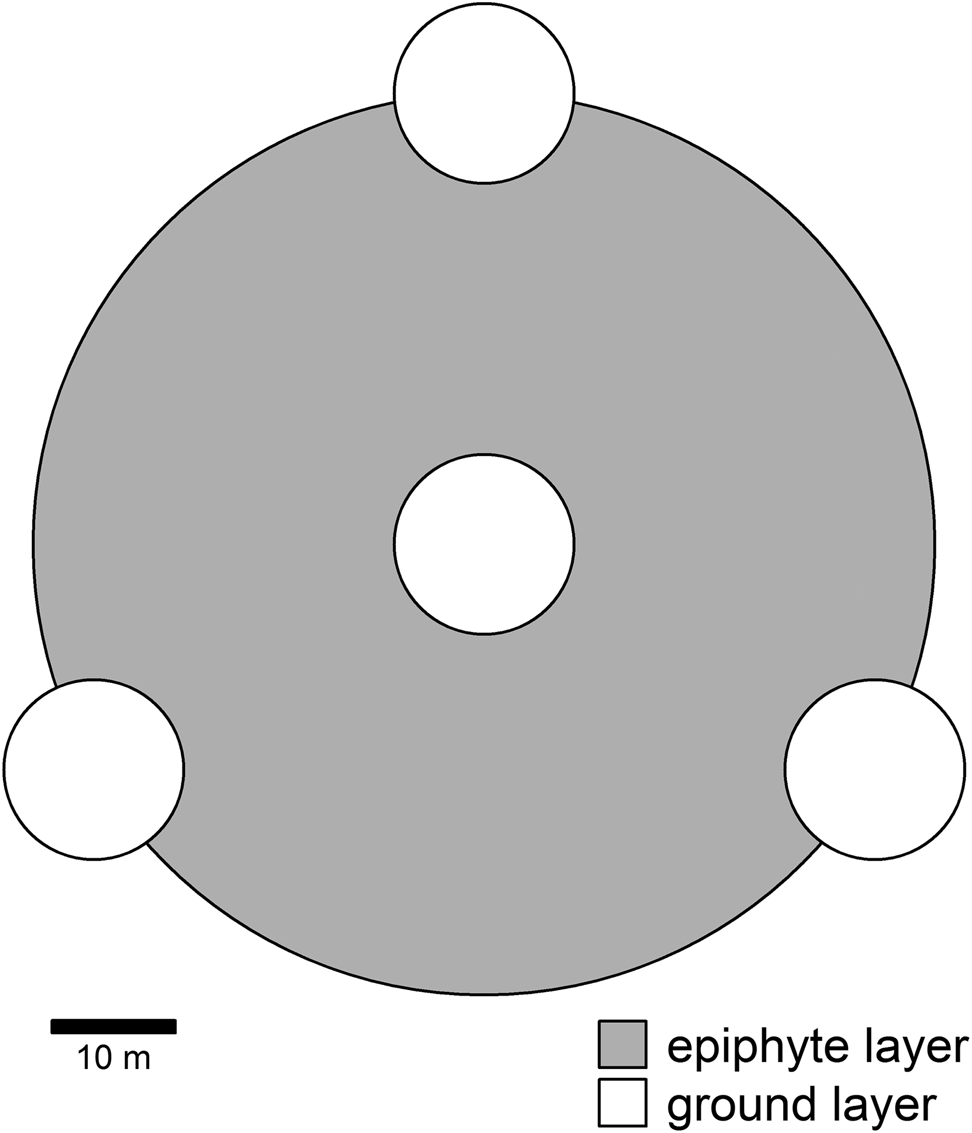
Both strata were measured at co-located (spatially matched) plots, on the same dates, by the same personnel. Plot sizes and configurations (Fig. 1) followed the sampling design of the FIA national forest inventory. The FIA establishes plot sizes and observation methods on the basis of statistically rigorous Measurement Quality Objectives (MQOs) designed to ensure sufficient and reproducible rates of species capture for ground-layer and epiphyte-layer organisms. Before beginning analysis, we confirmed that rates of species accumulation did not differ significantly between strata because species area curves fitted with a classical Arrhenius model (S = kAz) yielded completely overlapping 95% confidence intervals for the estimated slope parameter z (0.352–0.390 vs 0.356–0.369, for ground layers and epiphytes respectively). Since each stratum had slightly different sampling methods, we also performed preliminary analyses using identical exclusion criteria for both strata (temporarily discarding uncommon epiphytes with abundance codes 1 and 2 to emulate the 0.5% cover threshold that might exclude uncommon ground-layer species), but because the subset and full-set analyses gave qualitatively identical results, we report only the latter. Species concepts followed the North American Lichen Checklist version 22 (Esslinger Reference Esslinger2018), and vouchers are held at Oregon State University (OSC). In total, we considered 53 plots with concurrent observations of both lichen strata. The final products for analysis were one matrix of ground-layer abundances (38 species in 53 plots) and another of epiphyte abundances (77 species in the same 53 plots).
Plot layout for ground-layer and epiphyte-layer lichen strata sampling in the Tanana River watershed of boreal Alaska, USA. Sampling followed protocols of the US Forest Inventory and Analysis, a national forest inventory. Both strata were measured at co-located (spatially matched) plots, on the same dates, by the same personnel.

Auxiliary information
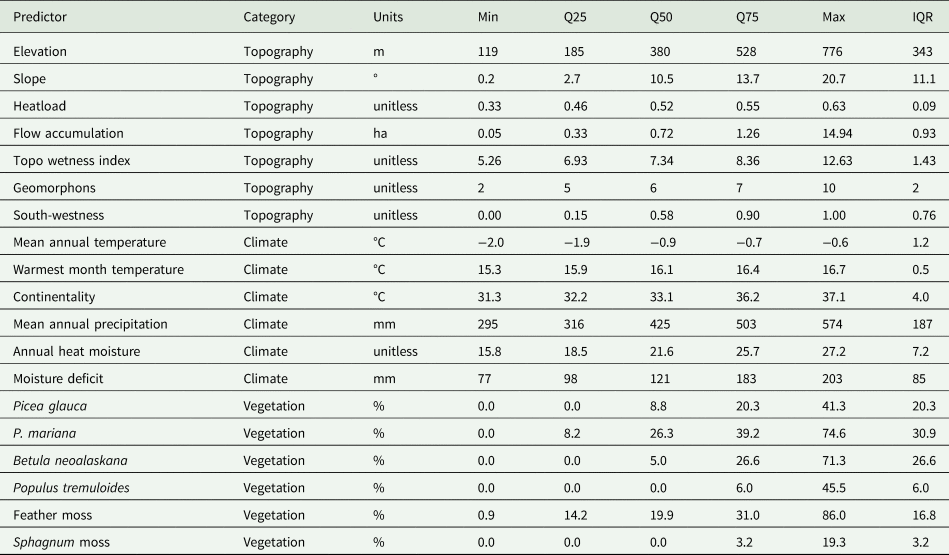
Complete data and computer codes for analysis are available in Supplementary Material files S1 & S2, available online. Statistical analyses were performed in R version 3.6.0 (R Development Core Team 2019), with geospatial analyses in GRASS version 7.6.1 (GRASS Development Team 2019). For each plot location, we determined geomorphic, hydrological, climate and vegetation values to explain lichen variation (Table 1). From a digital elevation model (US Geological Survey's 3DEP at 2 arc-second resolution), we determined elevation above sea level, then used GRASS module ‘r.param.scale’ to calculate slope and aspect, ‘r.watershed’ to calculate hydrological flow accumulation and topographic wetness index, and ‘r.geomorphon’ to determine topographic landscape position. Topographic landscape positions, also known as ‘geomorphons’ (Jasiewicz & Stepinski Reference Jasiewicz and Stepinski2013), have been used in vegetation science for decades as a proxy integrating geology, groundwater, and topographic exposure to radiation and weather. We calculated heat load according to McCune & Keon (Reference McCune and Keon2002) as a function of latitude, slope and folded aspect, and also transformed aspect values from 0–360° to a trigonometric index of ‘southwestness’ as per McCune & Keon (Reference McCune and Keon2002: 603). We obtained lichen-relevant climate values from ClimateNA version 6.10 (Wang et al. Reference Wang, Hamann, Spittlehouse and Carroll2016) as 30-yr annual normals covering the period 1980–2010, which directly precedes the lichen sampling period. Finally, we obtained vascular vegetation abundances from a parallel study (Smith & Gray Reference Smith and Gray2019): basal area of the two most dominant conifers (Picea mariana and P. glauca), basal area of the two most dominant hardwoods (Populus tremuloides and Betula neoalaskana), and percentage cover of the two most dominant moss functional groups (N-fixing feather mosses and Sphagnum peat mosses).
Descriptive statistics for environmental predictors at 53 plots in the Tanana River watershed of boreal Alaska, USA. These candidate predictors were used in the BIOENV procedure in the R package vegan (Oksanen et al. Reference Oksanen, Blanchet, Friendly, Kindt, Legendre, McGlinn, Minchin, O'Hara, Simpson and Solymos2019) to identify convergent environmental responses of lichen communities in the ground layer and epiphyte layer. Min, Max = minimum and maximum; Q25, Q50, Q75 = 25th, 50th, 75th percentiles; IQR = interquartile range (Q75 − Q25) within which half of all observations occur.

Species richness covariation
To assess covariation of species richness between lichen strata, we used both Spearman's rank correlation and total least squares (TLS) regression. Unlike ordinary least squares (OLS) which presumes a ‘fixed’ predictor and residual error only in the response variable, TLS realistically permits residual error in both the response and predictor variables. Species richness satisfied the TLS requirement that both predictors be on the same measurement scale. We estimated slope significance and confidence intervals using 999 bootstrap replicates (resampling plots with replacement).
Gradients of community compositions
All community analyses were based on Bray-Curtis community dissimilarities modified with a shortest path step-across adjustment (Williamson Reference Williamson1978) in the R package vegan (Oksanen et al. Reference Oksanen, Blanchet, Friendly, Kindt, Legendre, McGlinn, Minchin, O'Hara, Simpson and Solymos2019). For each stratum independently (ground layer vs epiphytes), we depicted compositional variation using nonmetric multidimensional scaling (NMS) ordination (Kruskal Reference Kruskal1964), which positions sample units in a point cloud where distance indicates community dissimilarity. Each NMS ordination was calculated with the ‘metaMDS’ function in vegan, with a specified 200 random starting configurations, maximum of 500 iterations, weak tie treatment, Kruskal's stress formula 1, 2-dimensional solutions, and final configurations rotated to orthogonal principal axes.
Congruence of community compositions
To evaluate congruence of community compositions between lichen strata, we used Procrustes analysis (Gower Reference Gower1966; Peres-Neto & Jackson Reference Peres-Neto and Jackson2001), which estimates residual error between a pair of configurations after centring, scaling and rotating them to maximum similarity. Procrustes analysis is preferred over a Mantel test because it has higher statistical power, it has lower Type-I error rates, and it provides for each plot or site a residual value describing its degree of congruence (Peres-Neto & Jackson Reference Peres-Neto and Jackson2001). We specified symmetric Procrustes solutions, calculated significance of the Procrustean congruence statistic (RP) from 9999 permutations, and applied this separately to both the NMS ordination scores of each stratum and their Bray-Curtis dissimilarities directly. The two research blocks (BNZ and CPC) were geographically separated by several kilometres and had different vegetation and physical attributes, differences which might be expected to influence variation in community compositions. Therefore, to isolate the effects of lichen strata independently of this geographical variation, we used a blocked Procrustes analysis, permuting observations within each ‘block’ (BNZ or CPC). Although it is grounded in the same statistical principles as blocked analysis of variance and mixed effects regression, we are not aware of any previous published examples of blocked or stratified Procrustes analysis. We calculated Procrustean congruence (RP) as one minus the Procrustes sum-of-squared-errors (rather than the square root of this quantity, as in vegan) to better interpret it as a ‘coefficient of determination’-like statistic on a 0–1 scale. We also interpreted Procrustes residuals (indicating the degree of congruence for each plot) in relation to plot-level species richness. Smaller Procrustes residuals indicate more congruence, larger residuals indicate less congruence.
Best environmental predictors
To determine the best subset of environmental variables most influential in each stratum, we used the BIOENV procedure in vegan. BIOENV seeks the subset of auxiliary environmental variables that have maximum rank correlation with the community dissimilarities (Clarke & Ainsworth Reference Clarke and Ainsworth1993). For this, we evaluated Spearman's rank correlation of Bray-Curtis community dissimilarities with Euclidean environmental distances and evaluated significance with 999 permutations.
Results
Species richness covariation
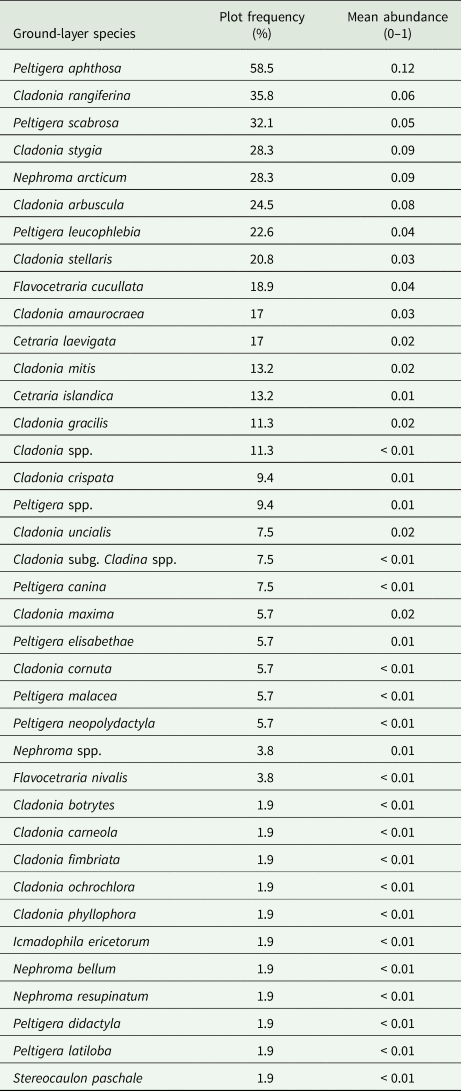
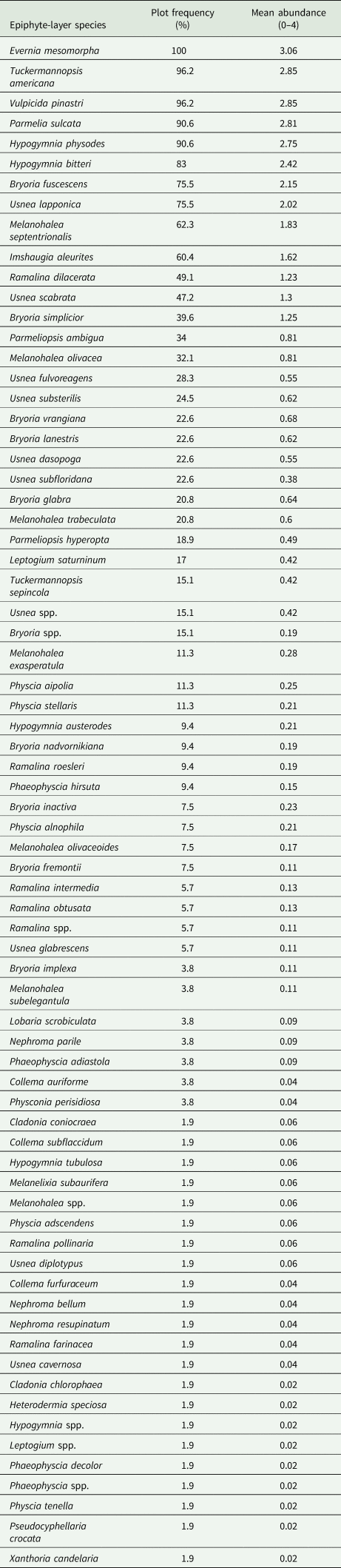
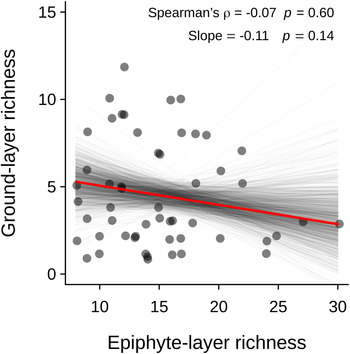
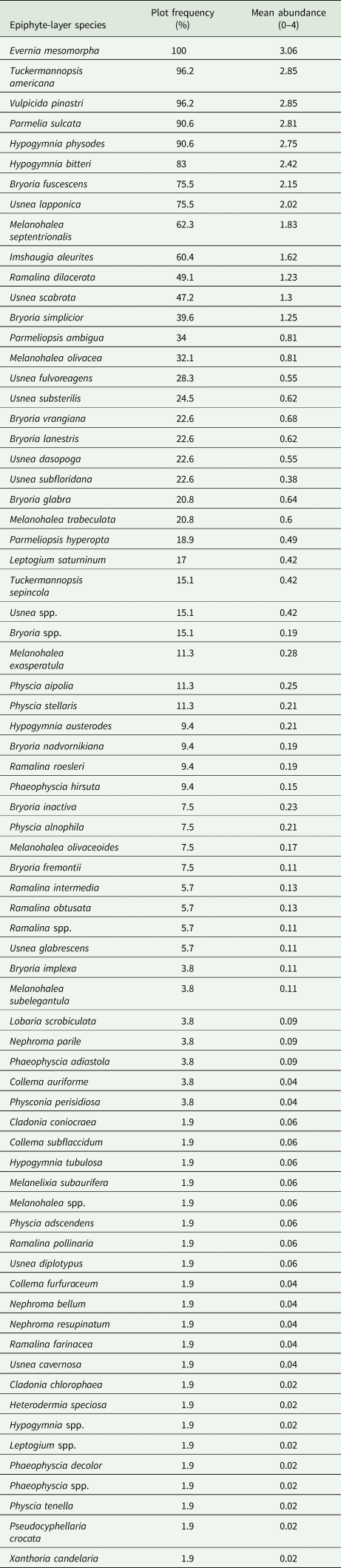
Within lichen communities at 53 plots in interior Alaska, species richness was lower in ground layers than epiphyte layers (regional species pool = 38 vs 77 species, respectively, and plot average richness = 4.5 vs 15.0 species). Of 113 lichen species in total (Tables 2 & 3), the only species shared between both strata were Nephroma bellum (a single occurrence in each stratum) and N. resupinatum (also one occurrence each). Species richness of ground layers was greater in the north-eastern CPC block than in the south-western BNZ block, but epiphyte species richness did not vary as much between blocks. Species richness between strata was not significantly correlated (Spearman's ρ = −0.07, P-value = 0.60), and richness of one stratum could not predict richness of the other (TLS regression slope not significantly different from zero; bootstrapped P-value = 0.14; Fig. 2).
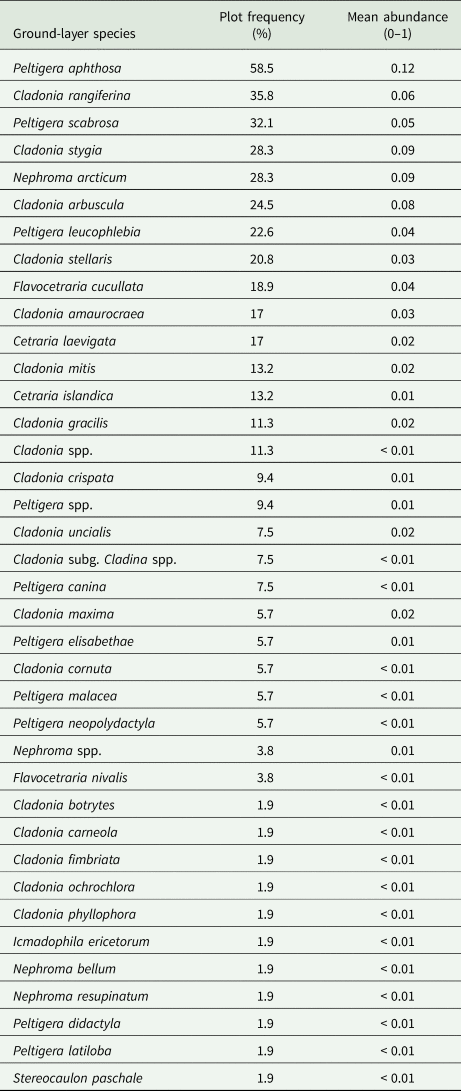
Ground-layer lichen species of 53 plots in the Tanana River watershed of boreal Alaska, USA. Frequency is expressed as the percentage of these plots in which each species occurred. Mean abundance is the mean for each species across all plots on a scale ranging from 0 to 1. Genus-level taxa marked ‘spp.’ are pseudospecies representing at least one taxon defined as recognizably distinct from other listed species.
Epiphyte-layer lichen species of 53 plots in the Tanana River watershed of boreal Alaska, USA. Frequency is expressed as the percentage of these plots in which each species occurred. Mean abundance is the mean for each species across all plots on a scale ranging from 0 to 4. Genus-level taxa marked ‘spp.’ are pseudospecies representing at least one taxon defined as recognizably distinct from other listed species.
Species richness of lichen strata (ground-layer and epiphyte-layer) of each plot in the Tanana River watershed of boreal Alaska, USA. Species richness between strata was not significantly correlated, and species richness of one stratum could not predict richness of the other (total least-squares regression slope not significantly different from zero). Thin grey lines are 999 bootstrap replicates (resampling plots with replacement) which were used to estimate confidence intervals and P-values for slope significance. Overlapping points are slightly offset to aid visualization. In colour online.

Gradients of community compositions
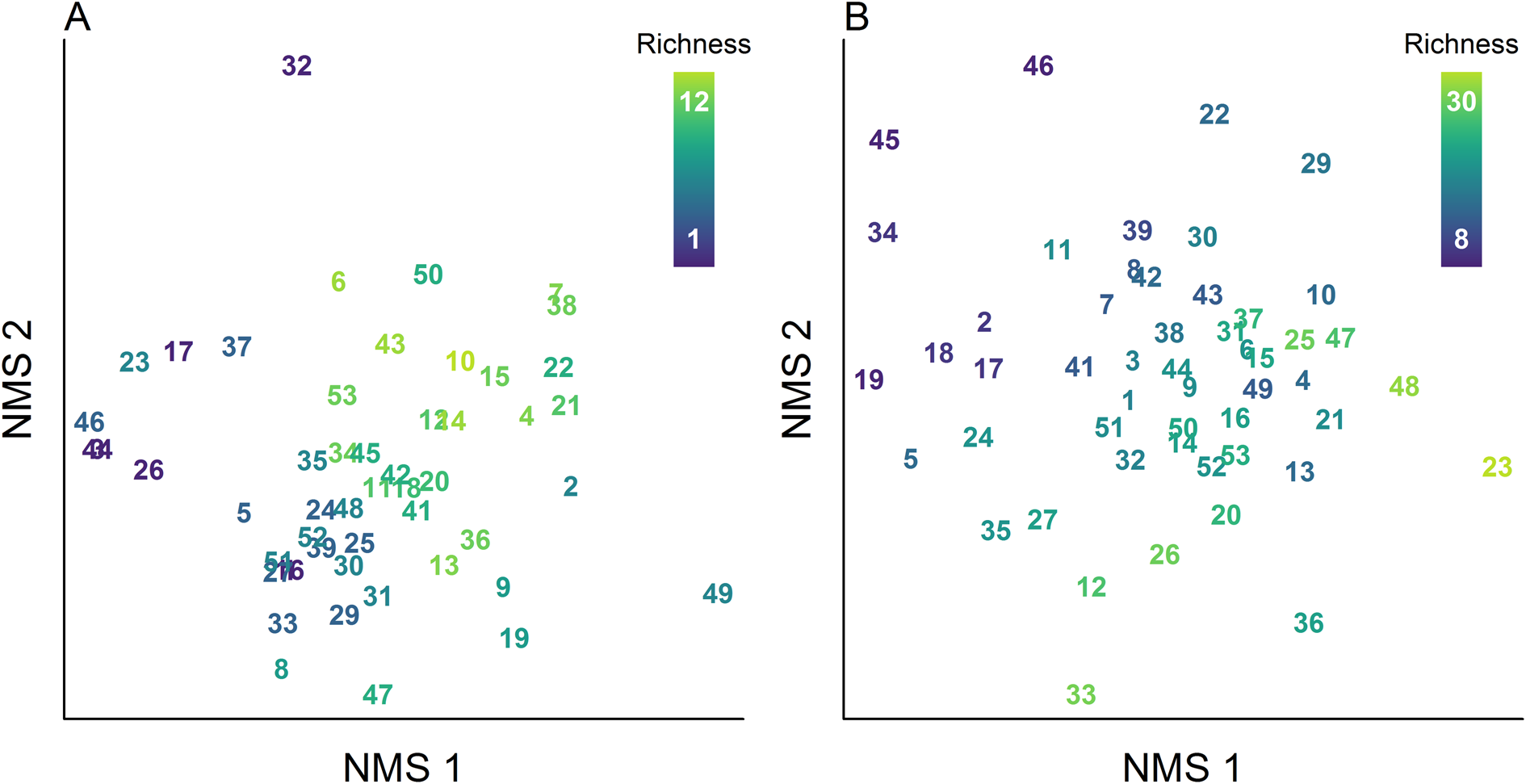
The final NMS ordination for ground-layer communities had 2 dimensions and stress = 0.165; the epiphyte-layer ordination had 2 dimensions and stress = 0.237. After rotating the two ordinations to maximum similarity, gradients of species richness did not map onto the ordination scores in the same manner (Fig. 3A & B). For ground layers, sites with outlying, peripheral scores were compositionally ‘distinctive’ because they were both species-poor and contained regionally rare species not common in other plots. By contrast, ordination scores of epiphytes were associated with a continuous gradient of species richness that did not directly depend on regional rarity (Fig. 3B).
Nonmetric multidimensional scaling (NMS) ordinations for ground-layer and epiphytic lichen communities of the Tanana River watershed of boreal Alaska, USA. Numerals indicate position of sample units, labelled by sequential number and shaded according to species richness (each plot occurs once per ordination). Distance between any two points indicates their compositional dissimilarity in the ground layer (A) or epiphyte layer (B). The two configurations are centred, scaled and rotated to maximum similarity with each other. Species richness did not identically map onto configurations, and relative plot positions did not correspond. In colour online.

Congruence of community compositions
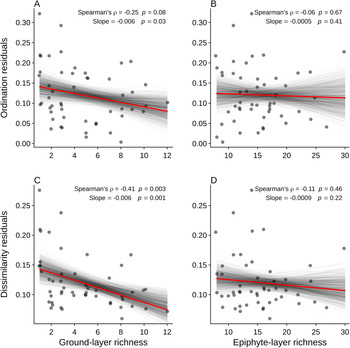
The association between ground-layer and epiphyte-layer community compositions did not differ significantly from random, neither when comparing ordination scores (RP = 0.007, P = 0.94) nor the Bray-Curtis community dissimilarities (RP = 0.15, P = 0.46). Thus, compositional congruence between strata was not supported. For each comparison, the degree of congruence (shown by Procrustes residuals) was negatively associated with species richness in ground layers: plots with few ground-layer species had the lowest compositional congruence between strata, and plots with many ground-layer species had the highest congruence (Fig. 4). By contrast, the degree of congruence was not significantly related to species richness of epiphytes (Fig. 4). Therefore, locations exhibiting the greatest departures from congruence were characterized by depauperate ground layers and any number of epiphyte species.
Procrustes residuals in relation to species richness for ground-layer and epiphyte-layer lichen communities in the Tanana River watershed of boreal Alaska, USA. Procrustes analyses (Gower Reference Gower1966; Peres-Neto & Jackson Reference Peres-Neto and Jackson2001) evaluated congruence between ordinations (A, B) or Bray-Curtis dissimilarities (C, D). Larger residual values indicate larger incongruence between strata, and zero-valued residuals would indicate exact congruence. The lowest congruence occurred where ground layers were species-poor (A, C), but epiphyte species richness had no significant bearing upon compositional congruence (B, D). Thin grey lines are 999 bootstrap replicates (resampling plots with replacement) which were used to estimate confidence intervals and P-values for slope significance. Overlapping points are slightly offset to aid visualization. In colour online.

Best environmental predictors
The top five environmental gradients most important to each lichen stratum were not identical. For ground layers, the best subset was dominated by hydrological and topographic variables: heatload, south-westness, topographic wetness index, cover of nitrogen-fixing feather mosses, and basal area of Picea glauca (BIOENV R 2 = 0.211). By contrast, the best subset for epiphytes included macroclimatic and thermal variables: heatload, mean annual air temperature, continentality, and basal areas of Picea glauca and Populus tremuloides (BIOENV R 2 = 0.329). Both strata shared tree variables in common (e.g. Picea glauca) but only ground layers included terrestrial bryophytes (nitrogen-fixing feather mosses) associated with cycling of groundwater and macronutrients in organic soil horizons.
Discussion
Three lines of evidence suggest a lack of coordinated responses between terrestrial and epiphytic lichen strata in subarctic boreal forests of interior Alaska. Species richness had no predictive value since richness in one stratum could not predict richness in the other. No significant association existed between the community compositions of each stratum. The environmental variables most influential to community composition were different for each stratum. Terrestrial and epiphytic lichen communities cannot be regarded as proxies for one another at the scales we measured. Our findings suggest that co-occurring lichens on different substrates experience environments uniquely and individualistically. What is simply background environmental variation for one forest stratum may pose a severe challenge to the other.
Co-occurring lichen strata diverge in how they experience the ‘same’ environment. This is partly because environments of different substrates are not truly identical: terrestrial and arboreal substrates have quite different textures, water-holding capacities, cation concentrations, nutrient content, boundary-layer resistance, exposure to weather, light and heat regimes, and different ages and disturbance histories. Ground-layer lichens typically experience lower light and higher litter deposition rates relative to canopy lichens (Brodo Reference Brodo, Ahmadjian and Hale1973) and may be competitively displaced by feather mosses and other plants (Sulyma & Coxson Reference Sulyma and Coxson2001). Even within the same substrate, complex environmental gradients vary sharply over just a few metres within a tree canopy (Barkman Reference Barkman1958; McCune Reference McCune1993) or just a few short centimetres within a terrestrial lichen mat (Crittenden Reference Crittenden1991, Reference Crittenden2000). Drastic environmental differences within and between substrates are responsible, in part, for the divergent responses of lichens in different forest strata.
Lack of congruence and divergent responses might also have an evolutionary basis. The phylogenetic conservation of substrate specificity (Gaya et al. Reference Gaya, Fernández-Brime, Vargas, Lachlan, Gueidan, Ramírez-Mejía and Lutzoni2015; Resl et al. Reference Resl, Fernández-Mendoza, Mayrhofer and Spribille2018) suggests that evolutionary adaptations define the limits of a ‘tolerable’ environment. For example, the evolution of chemical sunscreens in the order Teloschistales probably enabled a transition from low-light, epiphytic bark substrates to high-sunlight, rock substrates (Gaya et al. Reference Gaya, Fernández-Brime, Vargas, Lachlan, Gueidan, Ramírez-Mejía and Lutzoni2015). Substrate × environment interactions exert strong control on community compositions, both because individual species differ in their degree of substrate specificity, and because substrate switching is variable across environmental gradients (Barkman Reference Barkman1958; Brodo Reference Brodo, Ahmadjian and Hale1973). A species that primarily inhabits only bark in some portions of its range may occasionally inhabit rock substrates in permissible microsites. The most common epiphyte in our study, the iconic Evernia mesomorpha, occurs most frequently throughout its circumboreal range on conifer bark and twigs but at its southernmost range limits it may switch to siliceous rocks confined to sheltered riparian sites (Vondrák & Liška Reference Vondrák and Liška2010). Therefore, substrate specificity in part contributes to the geographical distributions and co-occurrences of lichen species.
Changes to land-use and disturbance regimes will differentially impact lichens in different strata. Low-intensity selective logging negatively impacts ground-layer lichens while opening canopy gaps that promote epiphytes (Nascimbene et al. Reference Nascimbene, Dainese and Sitzia2013). By contrast, high-intensity, stand-replacing forest disturbances (wildfires or clearcut logging) might open colonization sites for ground-layer lichens while they remove the chief substrates of epiphytic lichens (Boudreault et al. Reference Boudreault, Drapeau, Bouchard, St-Laurent, Imbeau and Bergeron2015). After severe logging and fires, post-disturbance community trajectories diverge among strata (Pharo & Beattie Reference Pharo and Beattie2002; Kantvilas & Jarman Reference Kantvilas and Jarman2006; Caruso et al. Reference Caruso, Rudolphi and Thor2008; Santaniello et al. Reference Santaniello, Djupström, Ranius, Weslien, Rudolphi and Thor2017), as do the most influential environmental predictors (Pharo & Beattie Reference Pharo and Beattie2002). Not only do intense wildfires remove large trees and woody material, but the hotter and drier post-disturbance conditions also impose a severe constraint on epiphyte colonization and establishment (Miller et al. Reference Miller, Root and Safford2018). Disturbances that alter the proportion of available substrates may lead to diverging community trajectories among strata (Brodo Reference Brodo, Ahmadjian and Hale1973). Thus, any widespread shifts in land-use or disturbance regimes which substantially alter forest structures will probably have differential outcomes in lichen communities, promoting some species at the expense of others. Testing this statement will require either an experimental approach or else more reliable and unambiguous disturbance histories than were available for our locations.
Global changes to atmospheric moisture and temperature regimes are of great societal concern due to their relative irreversibility. Consistent with previous studies, we found that lichen strata indicated climate to different degrees. Across a complex climate gradient in the western USA, Glauser (Reference Glauser2018) found that species and functional group turnover occurred at different rates for ground-layer and epiphytic lichens. Over several decades of climate changes in western Europe, Aptroot & van Herk (Reference Aptroot and van Herk2007) found epiphyte species richness increased as terrestrial taxa declined. Differential rates of species turnover may be rooted in functional ecophysiology, since ground- versus tree-dwelling lichens have different rates of growth (Armstrong Reference Armstrong, Upreti, Divakar, Shukla and Bajpai2015) and photosynthetic recovery (Phinney et al. Reference Phinney, Solhaug and Gauslaa2019) in response to climate. We contend that lack of congruence in environmental sensitivity might be useful for simultaneous bioindication of multiple attributes: whereas ground-layer lichens were linked to non-climate attributes (hydrology and geomorphology), the stronger association of epiphytic lichens to macroclimate recommends epiphytes as the primary focus of atmospheric bioindication programmes.
Our finding a lack of congruence between lichen strata could have been attributable to different sampling methods for each stratum. However, we rejected this possibility on several grounds. First, we eliminated the possibility that differences were due to plot location because plots for each stratum were exactly centred on one another. Second, we eliminated the possibility of observer bias because strata were always measured on the same date, by the same personnel, with the same time limit. Third, we eliminated the possibility that different abundance scales might unfairly exclude low-abundance species because we obtained virtually identical results from subanalyses that retroactively applied identical exclusion criteria. Fourth, we eliminated the possibility that different abundance scales might unfairly weight a given stratum in either the ordinations or the Procrustes analysis, both because the use of log transformation gave values a similar rate of change along each abundance scale, and because the use of Bray-Curtis dissimilarities prior to the analyses effectively placed all values on the same proportional scale ranging from zero to one (i.e. strata had an equal footing in ordinations and Procrustes). Fifth, we eliminated the possibility that different plot sizes might lead to different rates of species accumulation because the fitted slopes of species area curves did not differ significantly. Collectively, this suggests that the observed lack of congruence is robust to minor sampling differences. However, we still need to understand how the number of species relates to apparent congruence, since in our study congruence was linked to ground-layer (but not epiphyte) species richness. Factorially varying richness and composition in simulation scenarios, paired with comparative biogeography across regions, could help resolve how richness differences contribute to congruence (or lack thereof) between ecological communities.
In conclusion, our findings reinforce the expectation that co-occurring lichens in different strata will not respond uniformly to environmental stresses or disturbances. By definition, an ideal bioindicator exhibits a measurable response in proportion to environmental changes such that it indicates some generalized ecosystem response (Holt & Miller Reference Holt and Miller2010). Here, two lichen strata were neither redundant nor interchangeable bioindicators of the same environmental gradients, as evidenced by differences in the identity of and strength of fit to the ‘best’ environmental predictors. The best predictors of ground-layer community compositions were hydrological and topographic, whereas the best predictors of epiphyte community compositions involved tree abundances and macroclimate. This suggests that co-occurring lichen strata have distinct but complementary bioindicator values, and also that monitoring of multiple strata at the same time can yield unique and nuanced information not provided by either stratum alone. Such complementarity is useful, since local hydrological changes and broad-scale atmospheric changes are both impacting boreal forests (Chapin et al. Reference Chapin, McGuire, Ruess, Hollingsworth, Mack, Johnstone, Kasischke, Euskirchen, Jones and Jorgenson2010; Turetsky et al. Reference Turetsky, Donahue and Benscoter2011). The wise and timely use of lichen bioindicators can be part of broader strategies for mitigating and adapting to broad-scale global changes.
Acknowledgements
We thank Teresa Hollingsworth for help in the field and access to Bonanza Creek data, and Juan Benavides for contributing to ground-layer sampling. For collecting data, we thank the hardworking women and men of the USFS Forest Inventory and Analysis programme and cooperators at the Bonanza Creek Long Term Ecological Research programme and University of Alaska-Fairbanks. Funding for RJS was through Joint Venture Agreement 19-JV-11261979-116 between the US Forest Service and Oregon State University.
Author ORCID
Robert J. Smith, 0000-0001-5085-634X.
Supplementary Material
Supplementary Material is found in two files. Supplementary Material file S1: Data to reproduce analyses. Supplementary Material file S2: Computer code (R format) to reproduce analyses. To view Supplementary Material for this article, please visit https://doi.org/10.1017/S0024282920000407.