Cardiac catheterisations have long been recognised as a significant source of anxiety for patients and families. While the procedures are less invasive than surgery, cardiac catheterisations still incite a great deal of fear. Uncertainty of the outcome and fear of unfavourable findings, pain, death, and the need for further procedures all contribute to increased patient anxiety prior to a catheterisation procedure.Reference Gallagher, Trotter and Donoghue1–Reference Kobayashi, Turner, Forbes and Aggarwal5 This is especially true for children and adults with CHD.Reference Kobayashi, Turner, Forbes and Aggarwal5–Reference Rigatelli, Magro and Ferro7 The burden of CHD often includes multiple high-risk procedures, frequent and extended hospitalisations, social isolation, and economic instability. Due to the complexity, chronicity, and uncertainty that accompanies living with CHD, many of these patients and their families experience elevated levels of anxiety at baseline.Reference Gupta, Giuffre, Crawford and Waters8–Reference Kovacs, Saidi and Kuhl10 These baseline symptoms of anxiety and depression can be exacerbated by an upcoming cardiac catheterisation, which has been shown to increase morbidity and mortality associated with procedural interventions.Reference Celano, Millstein, Bedoya, Healy, Roest and Huffman11 Previous studies in the general adult population have examined multiple interventions targeted at lowering the patient and family’s anxiety prior to a cardiac catheterisation, ranging from educational approaches to sensory and therapy-based approaches.Reference Flory and Emanuel12–Reference Kendall, Williams, Pechacek, Graham, Shisslak and Herzoff14 These interventions often take place during a pre-procedure meeting to obtain informed consent, which alone has been shown to improve levels of anxiety.Reference Freeman, Pichard and Smith15 There is still a paucity of literature regarding the effectiveness of these interventions on children and adults with CHD undergoing cardiac catheterisations. Additionally, while there are a variety of educational tools that have been proposed and studied in isolation in the adult population, there are limited data regarding the comparative effectiveness of different educational tools and methods. In recent years, as part of an increase in personalised medicine, patient-specific three-dimensional models have increasingly been utilised across many medical specialties. A unique advantage of these models is the ability to generate a physical representation of complex anatomy which can highlight the anatomic region of interest for the healthcare provider and the patient. The benefits of these models have been evidenced in pre-procedure planning, resident and medical education, as well as patient education.Reference Teishima, Takayama and Iwaguro16–Reference Jones and Seckeler19 The purpose of this study was to evaluate patient and family anxiety before and after a pre-procedure meeting and qualitatively assesses the educational methods used in discussing complex anatomy and procedures.
Material and methods
Ethical approval was obtained through the University of Arizona Institutional Review Board. Parents of children with CHD and adults with CHD who were scheduled to undergo clinically indicated cardiac catheterisations from October 2017 through March 2019 were invited to participate in the study. Standard practice at our institution for congenital cardiac catheterisations includes an in-person pre-procedural meeting with the attending congenital interventional cardiologist. During these meetings, the procedure is discussed in detail, including the patient’s individual anatomy, the reason for the procedure, and any anticipated interventions, and informed consent is obtained. During each meeting, the interventionalist uses cardiac diagrams as well as any available additional imaging, including echocardiograms, MRI or CT images, angiograms (from the patient’s prior cardiac catheterisations or those of similar anatomy), and a three-dimensionally printed model of the patient’s heart defect. Parents of patients <18 and patients ≥18 who provided informed consent to participate completed pre- and post-meeting online surveys to evaluate their state of anxiety before and after the meeting, and to examine their opinion about the educational methods used. Data collected included demographics, severity of CHD (simple, moderate, severe, or complex single ventricle), and whether the planned procedure was diagnostic or interventional. The attending interventionalist who conducted the meetings was blinded to study participation.
Both the pre- and post-meeting surveys measured anxiety using the six-item Short Form State-Trait Anxiety Inventory.Reference Marteau and Bekker20,Reference Spielberger21 The State-Trait Anxiety Inventory scores range from 20 to 80, with higher scores indicating higher levels of anxiety. A normal score is defined as 34–36 for non-psychiatic patients, with scores above 38 suggesting significantly elevated anxiety.Reference Julian22,Reference Knight, Waal Manning and Spears23 In addition, the post-meeting survey evaluated the subjective value (from 1 to 4, least to most) of each educational tool for increasing understanding and reducing anxiety. Exclusion criteria included: emergent cardiac catheterisations, patient refusal of a pre-catheterisation meeting, no appropriate three-dimensionally printed model, inability to complete the English language survey, incomplete survey data, and refusal to participate in the study. Data were compared using paired t-tests.
Results
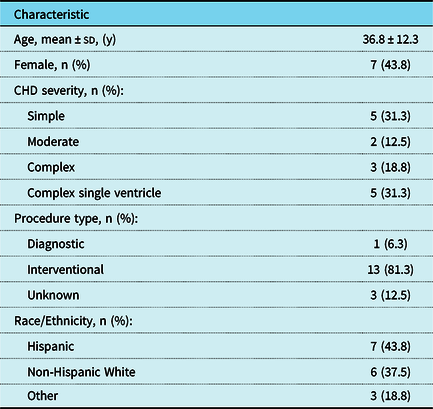
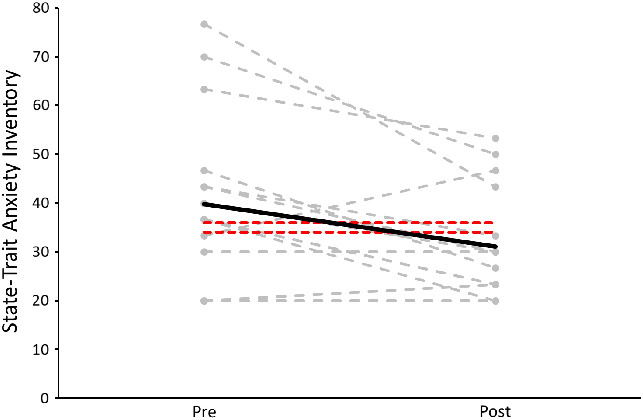
During the study period, there were 135 congenital cardiac catheterisations performed at our institution. Of these, 23 met inclusion criteria and consented to participate in the study and 16 completed both the pre- and post-meeting surveys (Fig 1). Demographics are summarised in Table 1. The mean State-Trait Anxiety Inventory score was markedly elevated before the meeting and returned to the normal range after the meeting (39.8 versus 31.0, p = 0.008) (Fig 2). There were no significant differences in State-Trait Anxiety Inventory scores or a score reduction between different CHD complexities. There were no differences in State-Trait Anxiety Inventory score based on age, race, or the primary respondent (patient versus parent).
Flow diagram for study enrollment.

Demographics of survey patients

sd=standard deviation; y=years.
Change in anxiety from pre- to post-meeting. State-Trait Anxiety Inventory scores for anxiety levels from pre- and post-meeting surveys for the entire study group. Individual responses are shown in dashed grey, and the overall mean is shown in bold black. The normal range of anxiety levels in a non-psychiatric population is shown between the dotted lines.

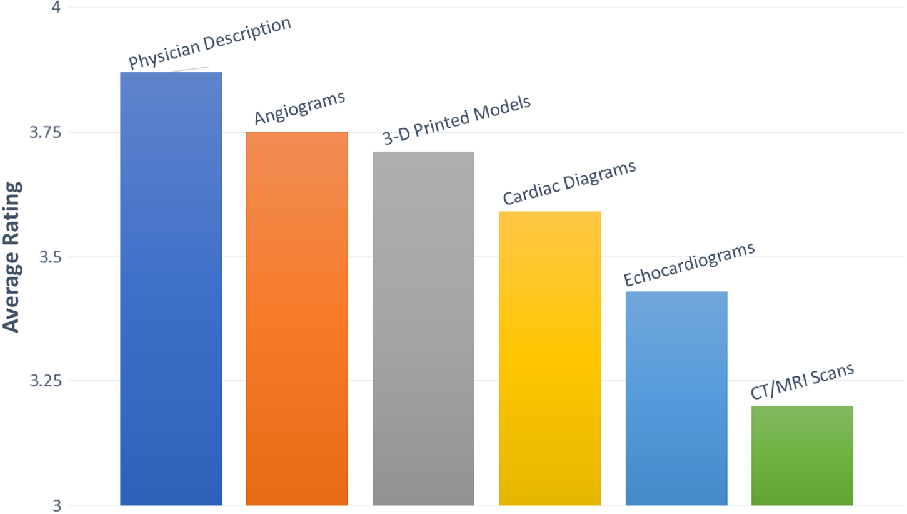
Subjective assessment of the educational tools for increasing understanding and reducing anxiety showed that physician description, angiograms, and three-dimensionally printed models were the most well-received (3.87 ± 0.34, 3.75 ± 0.44, and 3.71 ± 0.77, respectively), while cardiac diagrams, echocardiograms, and CT/MRI scans were rated lower (3.59 ± 0.63, 3.43 ± 0.94, and 3.20 ± 1.10, respectively) (Fig 3).
Average subjective rating of each teaching method. The y-axis shows the average patient rating for each of the six teaching methods evaluated.

Discussion
In this pilot study of children and adults with CHD undergoing cardiac catheterisation, we found that patients and their families experience a high level of anxiety prior to a cardiac catheterisation and that interventions including a pre-procedure meeting with the interventional cardiologist and three-dimensionally printed models help to reduce their anxiety to normal levels. Recognising the degree of anxiety surrounding, these procedures as well as the utility of three-dimensionally printed models to explain complex CHD anatomy will be important as patients with CHD undergo higher numbers of increasingly complex interventions.
The notion of informed consent gives interventional cardiologists opportunities not only to ensure patient’s agreement with planned interventions but also to educate and prepare patients for their upcoming procedure. This has been implemented in a variety of ways in the fields of adult and paediatric cardiology, from paper handouts to multimedia presentations.Reference Rigatelli, Magro and Ferro7,Reference Flory and Emanuel12,Reference Wu, Chen and Ko24,Reference Harkness, Morrow, Smith, Kiczula and Arthur25 In our experience, it is common for paediatric cardiologists to offer patients and families some type of in-person engagement prior to the procedure. It has previously been demonstrated that patients experience notably high levels of anxiety prior to meeting with a member of the paediatric cardiology team, levels even above that which would be expected for the anticipation of an upcoming procedure.Reference Kobayashi, Turner, Forbes and Aggarwal5 It is important to know if the pre-procedural face-to-face informational meetings are effective at reducing the elevated anxiety experienced by patients and families. In addition, there are a number of educational tools that can be used to help explain complex anatomy and pathophysiology, including diagrams, echocardiograms, CT/MR imaging, and angiography. More recently, three-dimensionally printed, patient-specific models can be added to the armamentarium, which have been subjectively well-received by patients and physicians as educational tools that can aid comprehension.Reference Biglino, Capelli and Wray26–Reference Lau and Sun28 Better understanding of the effect of pre-procedural meetings on patient/parent anxiety, as well as increased awareness of the effectiveness of different teaching methods can help interventional cardiologists ensure patient preparedness for procedures and promote improved outcomes.
Anxiety experienced by patients and parents in this population is important to consider as part of their overall health and quality of life. Patients with CHD and their families already experience higher levels of stress, anxiety, and depression than the general population.Reference Kovacs, Saidi and Kuhl10,Reference Uzark and Jones29 As our data confirm, baseline anxiety is likely to be further exacerbated in anticipation of a cardiac catheterisation. Higher levels of anxiety have been associated with increased morbidity and mortality for patients undergoing cardiac procedures and have a significant negative impact on the quality of life for these patients and their families.Reference Üzger, Başpinar, Bülbül, Yavuz and Kilinç6,Reference Celano, Millstein, Bedoya, Healy, Roest and Huffman11,Reference Lawoko and Soares30 As patients with CHD are able to live longer and healthier lives, and as advances in the field of interventional cardiology continue, these patients are expected to undergo an increasing number of cardiac catheterisations throughout their lifetime. It is important to know what tools are effective in reducing the anxiety associated with these procedures.
In addition to answering questions and obtaining informed consent, an important aspect of a pre-catheterisation meeting is the education for patients and families regarding not only the intended procedure but also the patient’s anatomy and physiology. Patients with CHD often have complex anatomy which can be difficult to describe with traditional two-dimensional representations. However, better understanding of their heart disease, especially the anatomy, increases the overall well-being of patients with CHD.Reference Wang, Hay, Clarke and Menahem31 The increasing incorporation of three-dimensionally printed models into medicine is a perfect medium to educate patients with CHD and their families. Our study found that families prefer verbal and tactile educational tools, including three-dimensionally printed models, over standard cardiac imaging. While echocardiography and advanced cardiac imaging are familiar to and useful for cardiologists, the current study suggests that their utility as educational tools for patients is limited.
This study has several limitations. The sample size is small, which may limit the generalisability of the results. However, pre-procedural meetings for cardiac catheterisations are already common among congenital cardiologists, and our study adds important objective data to support the ongoing practice of such meetings. The data were obtained through survey responses, which could be subject to response bias, recall bias, and selection bias; however, the State-Trait Anxiety Inventory assessment is a well-validated tool that is commonly used to evaluate patient anxiety and is designed to minimise bias from self-reported data.
In conclusion, patients with CHD and their families experience abnormally high levels of anxiety prior to cardiac catheterisations. Pre-procedure meetings utilising a variety of educational tools, including three-dimensionally printed models, can measurably reduce this anxiety. Expanding this practice among congenital cardiologists, an important step towards personalised medicine could lead to reduced peri-procedural anxiety and improved outcomes for this complex patient population.
Acknowledgements
None.
Financial support
Dr Seckeler received funding from the Sarver Heart Center Congenital Heart Disease Education Grant and the University of Arizona College of Medicine Vernon & Virginia Furrow Award for Medical Education Research. All other authors report no sources of funding from public, commercial, or not-for-profit sectors.
Conflicts of interest
None.
Ethical standards
The authors assert that all procedures contributing to this work comply with the ethical standards of the relevant national guidelines on human experimentation (United States Title 45 Code of Federal Regulations, Part 46 [45 CFR 46]) and with the Helsinki Declaration of 1975, as revised in 2008, and has been approved by the institutional committees (University of Arizona Institutional Review Board).