


1. Introduction
Environmental issues have been at the forefront of the political agenda in recent years, mostly taking the form of debates about the stringency of environmental regulation (Tosun, Reference Tosun2012). However, the growing body of environmental protection standards is only one piece of the solution; it is also critical to regulatory effectiveness to have a mechanism ensuring compliance (Gray and Shimshack, Reference Gray and Shimshack2011). For instance, data from the U.S. Environmental Protection Agency (EPA) shows that, in 2023, 9.3 per cent of individually permitted facilities under the Clean Water Act were found to be in Significant Noncompliance (SNC), the most severe category of violations, in 2023.Footnote 1 Without efficient enforcement, regulated firms may engage in opportunistic behaviours, leading to results that are far from the intended green goals.
Environmental quality is a public good with spillovers – and so the question of how to allocate environmental regulatory powers across different levels of authority has long been debated (Oates, Reference Oates, List and de Zeeuw2002; Dijkstra and Fredriksson, Reference Dijkstra and Fredriksson2010). Which level of authority should have enforcement powers over environmental issues? In the U.S., the EPA is in charge of setting and enforcing environmental policies. It can also delegate this monitoring and enforcement responsibility to the states.Footnote 2 Similarly, in China, the provincial and local agencies bear general inspection and enforcement responsibilities while the central agency monitors large and serious polluters directly and maintains oversight over local implementations (Zhang et al., Reference Zhang, Chen and Guo2018). In both cases, it is not immediately clear whether the central government or the local ones are better suited for enforcing environmental regulations.
In this paper, we study whether the power to enforce environmental regulation should be assigned to the central authority or to the regional authorities. Central enforcement may have the advantage of internalizing the externalities of a global pollutant, whereas decentralized enforcement can address various dimensions of heterogeneity across regions. To this end, we construct a two-stage model that describes a strategic situation between two tiers of responsible authorities and regulated firms. In our model, the responsible authority chooses its enforcement strategy, defined by the inspection intensity, for a given environmental policy. Firms decide their actual and reported emission levels, and hence whether to comply with environmental regulations. Firms are subject to inspections and may get caught for noncompliance behaviours. The insights obtained in our country-region setting can also shed light on the best course of enforcement for supranational organizations and international environmental treaties. We summarize our research interests in this paper in the following two questions: Is the central authority or the regional authority better at enforcing a given environmental policy? Can the two tiers of authority reach a consensus on either centralized or decentralized enforcement?
We answer the first research question by comparing the stringency and welfare consequences of centralized and decentralized enforcement. We show that centralized enforcement is more stringent when regions display heterogeneity in terms of their level of environmental concern, when inspection effectiveness is low, or when the central agency is not more effective than regional agencies when it comes to inspection. This leads to a higher level of emissions under decentralized enforcement (e.g., Fredriksson and Millimet, Reference Fredriksson and Millimet2002). When inspection effectiveness is highly heterogeneous across regions, decentralized enforcement yields a higher total surplus.
Regarding the second research question, we show that moving from centralized to decentralized enforcement is not a Pareto improvement, even when the latter yields a higher total surplus. Without proper fiscal arrangements, regional governments may not agree on the enforcement structure. We further consider a scenario in which the central authority is more concerned about the environment than the regions are. We evaluate centralized and decentralized enforcement from the perspectives of both tiers of authority. We find that the two tiers of authority cannot reach a consensus on enforcement structures when the regional authorities’ level of environmental concern is relatively low. The central authority desires centralized enforcement, whereas regional authorities opt for enforcement delegation, which may create tensions between different tiers of authorities.
This paper relates to the literature on environmental federalism, which discusses whether environmental policies should be set by central or local authorities (Oates, Reference Oates, List and de Zeeuw2002; Millimet, Reference Millimet2013). Most of the existing theoretical studies assume, explicitly or implicitly, that firms comply with environmental regulations. In practice, the regulator responsible for setting the policies is often different from the one responsible for enforcing them (Decker, Reference Decker2007). Lin (Reference Lin2010) discusses which level of government should set environmental standards and create the relevant policies, yet no compliance problem is explored. Similarly, van’t Veld and Shogren (Reference van’t Veld and Shogren2012) analyse which level of government should choose the liability regimes in the case of accidental pollution. D’Amato and Valentini (Reference D’Amato and Valentini2011) investigate whether the central or regional authorities should have the power to monitor firms and allocate tradable emissions allowances. As the governments’ regulatory instrument greatly affects incentives for local regulation (Williams III, Reference Williams2012), our study explores a setting with environmental taxes that correspond to the national situation. Regarding empirical work, Traub and Sigman (Reference Traub and Sigman2007) study strategic interactions between the federal and state governments, showing that states with stronger environmental preferences authorize more quickly and more fully. Chang et al. (Reference Chang, Sigman and Traub2014) conclude that the authorization may increase both social welfare and the stringency of environmental regulations. Sjöberg and Xu (Reference Sjöberg and Xu2018) find that the gradually decentralized enforcement of the Resource Conservation and Recovery Act has no significant effect on enforcement outcomes. Environmental instruments may not be available to all levels of governments, the stringency of policies, or say, the enforcement tasks can rather be determined by central or local jurisdictions (Millimet, Reference Millimet2013; Segerson, Reference Segerson2020). Our study thus adds to the environmental federalism literature by incorporating a more realistic setting of firm non-compliance and endogenous enforcement effort, highlighting that the effectiveness of environmental federalism depends on enforcement incentives.
This study also builds on the economic literature on regulatory enforcement analysing monitoring decisions and deterrence effects (Polinsky and Shavell, Reference Polinsky and Shavell2000). Based on the general compliance framework, previous studies have examined environmental enforcement under different institutional arrangements. For example, Hutchinson and Kennedy (Reference Hutchinson and Kennedy2008) analyse how different jurisdictions strategically enforce federally determined policies, highlighting the interstate rather than hierarchical interplays between central and local regulators. Comparatively, Arguedas and Rousseau (Reference Arguedas and Rousseau2015) explicitly consider non-compliance within a hierarchical regulatory structure and suggest delegating enforcement to local agencies, without accounting for regional heterogeneity in enforcement conditions. More recently, Arguedas et al. (Reference Arguedas, Cabo and Martín-Herrán2025) advances the literature by introducing stock pollution into the delegation of inspection authority. Their framework focuses on the internal incentive mechanisms of the principal–agent hierarchical structure, and thereby operates under independent regional agencies and abstracts from the transboundary environmental externalities. In addition to enforcement research under a single regulator or fully delegated agencies with centrally determined policies, empirical studies further explore the impact of central oversight on local enforcement incentives (Zhang et al., Reference Zhang, Chen and Guo2018; Lin and Sun, Reference Lin and Sun2023). Extending the existing compliance literature, our study develops a framework that considers the differences between tiers of regulators, as well as regional heterogeneities in various dimensions, shaping a more comprehensive picture of enforcement strategies and corporate compliance.
More broadly, this study also fits in the stream of literature on governance structures and strategic behaviour in multi-level regulatory systems. Different authorities perform different yet perhaps overlapping regulatory functions across diverse fields, including tax enforcement, financial regulation and environmental regulation (Hao et al., Reference Hao, Chen, Liao and Wei2020; Jia et al., Reference Jia, Ding and Liu2020). Many studies have documented that regulatory hierarchy involves complex interactions among stakeholders with often misaligned incentives. For instance, Arguedas et al. (Reference Arguedas, Earnhart and Rousseau2017) illustrate that what appears to be a uniform regulatory standard often evolves into differentiated local limits through stakeholder negotiation. Similarly, Woods (Reference Woods2022) utilizes case studies to highlight how the implementation of environmental regulations is shaped by the competing interests of various political and economic forces. Based on multiple stakeholders and interests, the literature further analyses the organizational interplay and conflicts between central and local environmental regulations. For instance, Eichner and Pethig (Reference Eichner and Pethig2014) and Santore et al. (Reference Santore, Robison and Klein2001) consider a centralized permit market together with local subsidies and penalties, concluding that the strategic behaviour of local authorities conflicts with the central system and results in inefficiency. Williams III (Reference Williams2012) analyses growing state-federal conflicts in environmental policy with a focus on the role of various instruments. Different objectives and features of multilevel structures may lead to tensions between tiers of governments (Wälti, Reference Wälti2004). However, the possible conflict of interests in the central-local regulatory setting is seldom modelled in economic literature. By evaluating enforcement structures across governmental layers and identifying potential inter-governmental conflicts, this paper explicitly captures organizational interplay over enforcement activities, offering new insights into the friction within multi-level governance.
The paper proceeds as follows. We present the main model in Section 2 and its results in Section 3. Section 4 shows that the insights obtained in the main model are robust to the modification of authorities’ objective function. We conclude in Section 5. The proofs of the lemmas and propositions can be found in the online appendix.
2. The model
In this section, we present a model for studying the optimal inspection strategy of a given environmental policy in both centralized and decentralized enforcement structures. Whereas firms seek to maximize profits, responsive authorities seek to maximize social welfare.
2.1. The setup
Consider two regions, labelled by 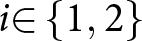 $i{\in }\left\{1,2\right\} $, under a central government. In region
 $i$, a representative firm
 $i$ emits pollution when producing, where
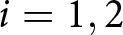 $i=1,2$. The actual level of firm
 $i$’s emissions is denoted by
 $e_{i}$. Following Sandmo (Reference Sandmo2002) and Macho-Stadler and Perez-Castrillo (Reference Macho-Stadler and Perez-Castrillo2006), we assume that firm
 $i$’s production function takes the form
 $\mu _{i}e_{i}^{1/2}$, where the coefficient
 $\mu _{i}$ denotes firm
 $i$’s marginal benefit of polluting. This function measures the direct revenue from production where the output is associated with the actual level of emissions
 $e_{i}$, or what firms can gain by avoiding the cost of reducing emissions.
To control emissions, firms are subject to environmental regulation and are required to self-report their levels of emissions.Footnote 3 Let  $z_{i}$ denote firm
 $i$’s self-reported level of emissions, which may or may not coincide with
 $e_{i}$. As there is no reward for over-reporting emissions, the reported level should never exceed the actual level (i.e.,
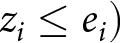 $z_{i}\leq e_{i})$. Thus,
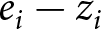 $e_{i}-z_{i}$ denotes firm
 $i$’s level of environmental violation. The full set of environmental regulations consists of a predetermined environmental policy and an enforcement strategy decided by the corresponding authority. The policy levies a tax rate
 $t$ associated with the level of reported emissions and a penalty rate
 $r$ for the under-reported level of emissions
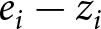 $e_{i}-z_{i}$. The policy is enforced in order to identify firms’ actual levels of emissions and applies to firms with an inspection intensity or probability
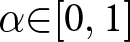 $\alpha {\in }[0,1]$. Upon being audited, a firm’s actual level of emissions may not be perfectly detected. Let
 $\theta $ denote the probability that an enforcement agency accurately identifies firms’ actual emissions and environmental deviations. These imperfections in detection may be due to pollution’s natural volatility, restrictions on inspection technology, or information manipulation or corruption. Correspondingly, the magnitude of imperfection in detection may vary across regions and agencies. Let
 $\theta _{i}^{C}$ and
 $\theta _{i}^{D}$ denote the inspection effectiveness of central agencies and regional agencies in region
 $i$, respectively. Differences in inspection effectiveness across levels of government may arise from institutional and informational advantages. For example, central environmental agencies may possess superior monitoring technologies, broader investigative authority or stronger insulation from local political influence, leading to higher detection effectiveness. In contrast, regional authorities may possess better local information regarding firms’ production processes and pollution patterns, which can improve the accuracy of inspections in specific jurisdictions. Such differences are consistent with the institutional settings discussed in the Introduction, including the EPA’s delegation arrangements across U.S. states and the coexistence of central supervision and local implementation in China’s environmental enforcement system.
Pollution is a public bad, resulting in environmental damages that can extend far beyond a given region. Assume that the pollutant is a global one (e.g., carbon dioxide), and that its damages to each region depend on the combined level of emissions 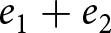 $e_{1}+e_{2}$. The damage function associated with emissions is given by
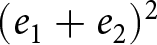 $(e_{1}+e_{2})^{2}$. The convex functional form indicates increasing marginal disutility of emissions, which is a common assumption in environmental economics (Hritonenko and Yatsenko, Reference Hritonenko and Yatsenko2013). In addition to environmental concerns, regulations also bring up concerns about business friendliness. Authorities thereby face a tradeoff between the environment and the economy. Let
 $\lambda$ denote the weight an authority assigns to the environment relative to the economy, which depends on political agendas, population size and other factors (Woods, Reference Woods2022). This weight may vary across different authorities;
 $\lambda ^{C}$ and
 $\lambda _{i}$ denote the central and local authorities’ environmental concerns, respectively. The central or regional authority chooses the inspection strategy to maximize social welfare, which in this model consists of firm profits and environmental damages (e.g., Glazer, Reference Glazer1999; Kunce and Shogren, Reference Kunce and Shogren2002; D’Amato and Valentini, Reference D’Amato and Valentini2011). If the inspection strategy is determined by the central authority, denoted by
 $\alpha^{C}$, it indiscriminately applies to both regions.Footnote 4 If the local authority of region
 $i$ determines its own inspection strategy, it chooses
 $\alpha _{i}^{D}$ to maximize social welfare of the region. In what follows, we use the generic notations
 $\alpha$ and
 $\theta$ when referring to the inspection intensity and effectiveness of any decision structure. Table 1 provides definitions for all parameters and decision variables.
Parameters and decision variables
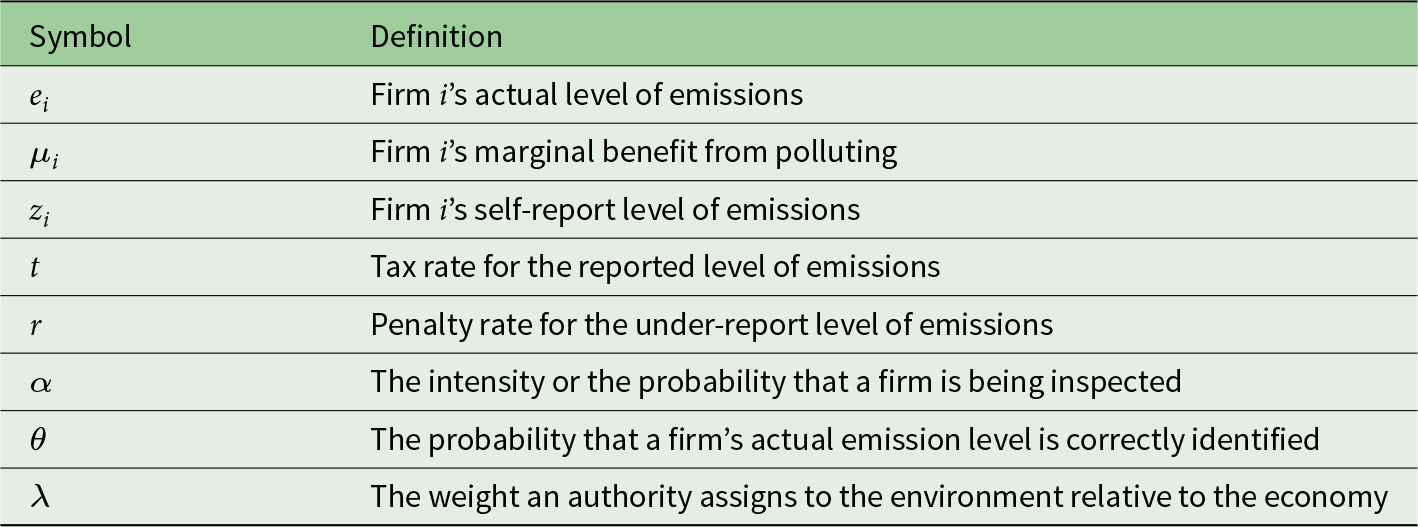
Table 1 Long description
To facilitate readability, Table 1 presents summary information for all variables, encompassing actual and reported pollution, marginal benefit, tax and penalty rates, inspection intensity, detection probability and environmental weight.
We propose a two-stage game, and the timing of the game is as follows. In stage  $1$, given the predetermined environmental policy
 $(t,r)$, either the central or regional authority decides on the inspection strategy. If the strategy is determined at the regional level, the authorities of both regions determine inspection intensities simultaneously. The inspection strategies are publicly observable. In stage
 $2$, after observing the environmental policy and the inspection strategy, firms choose their production plan
 $e_{i}$ and the level of emissions
 $z_{i}$ to report. We solve the game by backward induction.
2.2. The firm’s decision
In stage  $2$, after observing the environmental policy
 $(t,r)$ and the inspection strategy
 $\alpha ^{C}$ or
 $\alpha _{i}^{D}$, firm
 $i$ chooses
 $e_{i}$ and
 $z_{i}$ to maximize its profit. For each chosen pair
 $(e_{i},z_{i})$, firm
 $i$ pays an environmental tax
 $tz_{i}$. With probability
 $\alpha $, firm
 $i$ will be inspected by the corresponding authority, and its actual level of emissions will be detected with probability
 $\theta$. In the event of being caught underreporting, firm
 $i$ faces the consequences of paying back the amount of its tax evasion
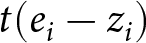 $t(e_{i}-z_{i})$ plus a fine
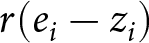 $r(e_{i}-z_{i})$ for noncompliance. Assume that the following condition holds throughout the paper:
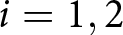
Assumption 1. 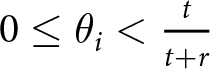 $0{\;\leq\;}\theta_i \lt \frac{t}{t+r}$ for
 $i=1,2$.
Assumption 1 means that the monitoring is never perfect. It follows that even if the firm is inspected with certainty – i.e.,  $\alpha=1$, it is still not optimal for the firm to report honestly. Firm
 $i$’s profit maximization problem reads:
 \begin{equation*}
\begin{aligned} & \underset{e_i, z_i}{\text{max}} & &
\mu_ie_i^{1/2}-tz_i-\alpha\theta_i(t+r)(e_i-z_i)\\
& \text{subject to}
& & z_i{\;\geq\;}0,\\
& & & z_i{\;\leq\;}e_i.\\
\end{aligned}
\end{equation*}
The following lemma characterizes firm  $i$’s decisions in stage
 $2$.Footnote 5
Lemma 1. Given policy parameters  $(t,r)$, the inspection intensity and effectiveness
 $\alpha $ and
 $\theta $, firm
 $i$’s optimal strategy is defined as:
 \begin{equation*}
e_{i}^{\ast }=\left( \frac{\mu _{i}}{2\alpha \theta (t+r)}\right) ^{2}\ \ \
\text{and}\ \ \ z_{i}^{\ast }=0,
\end{equation*}
resulting in firm profit:
 \begin{equation*}
\pi _{i}^{\ast }=\frac{\mu _{i}^{2}}{4\alpha \theta (t+r)}.
\end{equation*}
Lemma 1 shows that firm  $i$’s actual level of emissions
 $e_{i}$ decreases in the inspection intensity
 $\alpha $. That is, the stricter the enforcement, the more effectively it deters pollution. The same effect occurs with the environmental policy
 $(t,r)$ and the inspection effectiveness
 $\theta $, which decreases the equilibrium emission level and the firm’s profit. A higher
 $\mu _{i},$ suggesting higher benefits from pollution or a higher abatement cost, encourages the firm to pollute more. Regarding the optimal self-reported emissions level, the firm claims it is clean. Because the violation detection
 $\theta$ is not always efficient, the firm chooses to report the minimal possible level, which is
 $z=0$ in this model and could be positive in reality. According to the Toxic Release Inventory, though U.S. regulators added a large number of plants to their reporting programme, these facilities generally reported low pollution levels that accounted for only a small percentage (6 per cent) of the total releases (De Marchi and Hamilton, Reference De Marchi and Hamilton2006). Moreover, a self-reported level of zero could also be due to failure to file a report, which is prevalent in environmental compliance (Brehm and Hamilton, Reference Brehm and Hamilton1996).
2.3. Centralized enforcement
Anticipating firms’ reactions to certain inspection strategies, responsible authorities determine the inspection intensity in stage  $1$. We first discuss the scenario in which the central authority determines the inspection strategy. The central authority weighs firm profits and environmental damages of both regions, and its welfare-maximizing problem reads:
 \begin{equation}
\begin{aligned} & \underset{\alpha^C}{\text{max}} & &
\sum\limits_{i=1}^{2}\pi_i(\alpha^C)-\lambda^C(\sum\limits_{i=1}^{2}e_i(\alpha^C))^2.\\ \end{aligned}
\end{equation}
Substituting 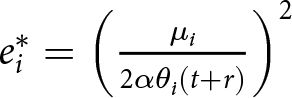 $e_{i}^{\ast }=\left( \frac{\mu _{i}}{2\alpha \theta_{i}(t+r)}\right) ^{2}$,
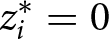 $z_{i}^{\ast }=0$ and
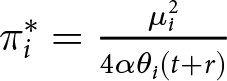 $\pi _{i}^{\ast }=\frac{\mu _{i}^{2}}{
4\alpha \theta_{i}(t+r)}$ obtained in Lemma 1 into maximization problem 1, the central government’s problem becomes:
 \begin{equation*}
\begin{aligned} & \underset{\alpha^C}{\text{max}} & &
\sum\limits_{i=1}^{2}\frac{\mu_i^{2}}{4\alpha
^{C}\theta^C_i(t+r)}-\frac{\lambda ^{C}}{[2\alpha
^{C}(t+r)]^{4}}(\sum\limits_{i=1}^{2}\frac{\mu_i^{2}}{\theta_i^{C^2}})^2.\\
\end{aligned}
\end{equation*}
Taking the first-order condition and solving for  $\alpha ^{C}$, we obtain the following lemma that characterizes the optimal centralized inspection strategy and the corresponding total surplus.
Lemma 2. The optimal centralized inspection intensity is given by
 \begin{equation*}
\alpha^{C^\ast}=\frac{1}{t+r}\left( \frac{\lambda^{C}\left( \frac{\mu
_{1}^{2}}{(\theta_1^C)^2}+\frac{\mu_2^2}{(\theta_2^C)^2}\right) ^{2}}{\frac{\mu _{1}^{2}}{\theta_1^C}+\frac{\mu_{2}^{2}}{\theta_2^C}}\right) ^{1/3},
\end{equation*}
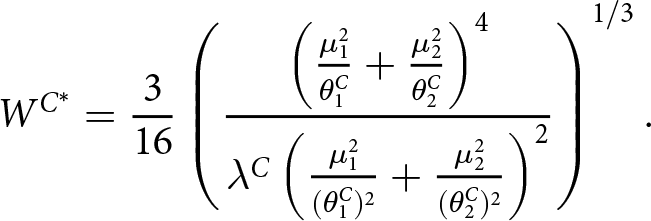
and the total surplus of both regions under centralized enforcement, denoted by  $W^{C}$, is given by:
 \begin{equation*}
W^{C^\ast}=\frac{3}{16}\left( \frac{\left( \frac{\mu _{1}^{2}}{\theta_1^C}+\frac{\mu_2^2}{\theta_2^C}\right) ^{4}}{\lambda ^{C}\left( \frac{\mu_1^2}{
(\theta_1^C)^2}+\frac{\mu_2^2}{(\theta_2^C)^{2}}\right) ^{2}}\right) ^{1/3}.
\end{equation*}
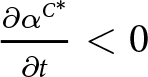
The optimal centralized inspection intensity decreases in both  $t$ (
 $\frac{\partial \alpha ^{C^\ast}}{\partial t} \lt 0$) and
 $r$ (
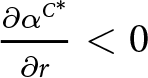 $\frac{\partial \alpha ^{C^\ast}}{\partial r} \lt 0$), suggesting that the inspection intensity and stringency of environmental policies are substitutes.
2.4. Decentralized enforcement
In a decentralized framework, each region is responsible for its own enforcement strategy. In stage 1, the regional authority chooses its inspection intensity to maximize the regional surplus. Region  $i$’s welfare-maximizing problem reads:
 \begin{equation*}
\begin{aligned} & \underset{\alpha_i^D}{\text{max}} &
&\pi_i(\alpha_i^D)-\lambda_i^D(e_1(\alpha_1^D)+e_2(\alpha_2^D))^2.\\
\end{aligned}
\end{equation*}
Substituting 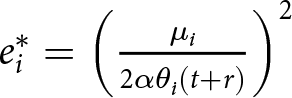 $e_{i}^{\ast }=\left( \frac{\mu _{i}}{2\alpha \theta_{i}(t+r)}\right) ^{2}$,
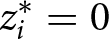 $z_{i}^{\ast }=0$, and
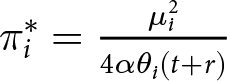 $\pi _{i}^{\ast }=\frac{\mu _{i}^{2}}{
4\alpha \theta_{i}(t+r)}$ obtained in Lemma 1 into the welfare maximization problem of region
 $i$, the local government’s problem can be written as:
 \begin{equation*}
\begin{aligned} & \underset{\alpha_i^D}{\text{max}} & &\frac{\mu
_{i}^{2}}{4\alpha _{i}^{D}\theta _{i}^{D}(t+r)}-\frac{\lambda
_{i}}{[2(t+r)]^{4}}\left( \frac{\mu _{1}^{2}}{(\alpha_{1}^{D})^{2}(\theta
_{1}^{D})^{2}}+\frac{\mu _{2}^{2}}{(\alpha_{2}^{D})^{2}(\theta
_{2}^{D})^{2}}\right) ^{2}.\\ \end{aligned}
\end{equation*}
Taking the first-order condition with respect to  $\alpha_i^D$, we obtain the best response function
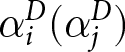 $\alpha_i^D(\alpha_j^D)$, where
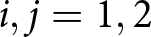 $i,j=1,2$ and
 $i\neq j$. Solving the system of best response functions, the following lemma characterizes the optimal decentralized inspection strategies and the corresponding total surplus of each region.
Lemma 3. The optimal decentralized inspection intensity of region  $i$ is given by:
 \begin{equation*}
\alpha _{i}^{D^{\ast }}=\frac{1}{\theta _{i}^{D}(t+r)}\left[ \lambda
_{i}\left( \mu _{i}^{2}+\frac{\mu _{j}^{2}\lambda _{i}^{2}}{\lambda _{j}^{2}}\right) \right] ^{1/3},
\end{equation*}
and the total surplus of region  $i$, denoted by
 $W_{i}^{D}$, is given by:
 \begin{equation*}
W_{i}^{D^{\ast }}=\frac{3\mu _{i}^{2}-\frac{\mu _{j}^{2}\lambda _{i}^{2}}{\lambda _{j}^{2}}}{16\left[ \lambda _{i}\left( \mu _{i}^{2}+\frac{\mu
_{j}^{2}\lambda _{i}^{2}}{\lambda _{j}^{2}}\right) \right] ^{1/3}},
\end{equation*}
where 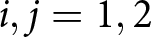 $i,j=1,2$ and
 $i{\;\neq \;}j$.
The optimal decentralized inspection intensity of region  $i$ decreases in both
 $t$ (
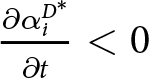 $\frac{\partial \alpha_i ^{D^\ast}}{\partial t} \lt 0$) and
 $r$ (
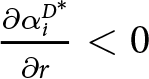 $\frac{\partial \alpha_i^{D^\ast}}{\partial r} \lt 0$). In the decentralized framework of enforcement, the inspection intensity and the stringency of environmental policies are substitutes as well.
If region  $j$ cares more about the environment, indicating a larger
 $\lambda_j$, region
 $i$ lowers its inspection intensity (
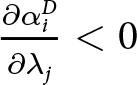 $\frac{\partial \alpha_{i}^{D}}{\partial \lambda _{j}} \lt 0$). The inter-region externalities provide region
 $i$ with an incentive to free ride on region
 $j$’s environmental efforts. As a consequence, region
 $j$ suffers a welfare loss due to region
 $i$’s increased pollution. Moreover, a stringent enforcement strategy harms both the firm profits and business attractiveness of region
 $j$. Both effects drive region
 $j$ to implement a less stringent enforcement strategy.
By the same token, region  $i$’s total surplus increases in region
 $j$’s level of environmental concern (
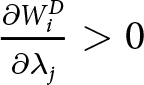 $\frac{\partial W_{i}^{D}}{\partial \lambda _{j}} \gt 0$). In the extreme case in which region
 $j$ cares exclusively about firm profits (
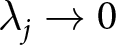 $\lambda _{j}\rightarrow 0$), it chooses a minimum level of inspection intensity (
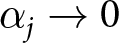 $\alpha _{j}\rightarrow 0$). Consequently, firm
 $j$ chooses the maximum level of emissions, causing region
 $i$ a considerable welfare loss. Moreover, if firm
 $i$ has a larger private benefit from polluting, it harms the social welfare of the other region (
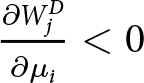 $\frac{\partial
W_{j}^{D}}{\partial \mu _{i}} \lt 0$) but not itself (
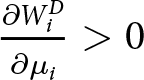 $\frac{\partial W_{i}^{D}}{\partial \mu _{i}} \gt 0$).
3. Comparisons between centralized and decentralized enforcement
In this scenario, authorities face the traditional tradeoff between centralized and decentralized enforcement. On the one hand, a centralized strategy can internalize the negative externalities of a global pollutant; on the other hand, decentralized enforcement can account for heterogeneity across regions (Sigman, Reference Sigman2005). On top of this, we also incorporate the heterogeneity between different levels of government. The comparison outcome thus depends on the relative size of heterogeneity across regions in  $\lambda $
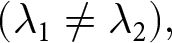 $(\lambda _{1}\neq \lambda _{2}),$
 $\mu $
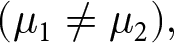 $(\mu _{1}\neq \mu_{2}),$
 $\theta $
 $(\theta _{1}\neq \theta _{2},\theta _{i}^{C}=\theta_{i}^{D})$, as well as heterogeneity across levels of government, represented by
 $\theta $
 $(\theta _{1}^{C}=\theta _{2}^{C},\theta _{1}^{D}=\theta
_{2}^{D},\theta ^{C}\neq \theta ^{D})$. We allow one parameter to vary at a time and keep other parameters symmetric across regions and agencies. In Sections 3.1 and 3.2, we consider two scenarios. In the first, the central authority’s level of environmental concern equals that of the regional authorities combined (i.e.,
 $\lambda ^{C}=\lambda _{1}+\lambda _{2}$). In the second, the central authority’s level of environmental concern exceeds that of the regional authorities combined (i.e.,
 $\lambda^{C} \gt \lambda _{1}+\lambda _{2}$).
3.1.  $\lambda^{C}=\lambda_1+\lambda_2$

We proceed by comparing centralized and decentralized enforcement setups along three dimensions: optimal enforcement policy, the total surplus of the country and the total surplus of the region. As local enforcement of environmental legislation has long been associated with the fear of environmental free riding, we first answer the question of whether (and under what conditions) local agencies put more or less effort into environmental protection compared to the central agency. The following proposition compares the optimal inspection intensity of the centralized strategy with that of the decentralized one.
Proposition 1. a. If regional heterogeneity in environmental concerns or in inspection effectiveness is relatively high (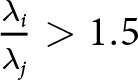 $\frac{\lambda_i}{\lambda_j} \gt 1.5$ or
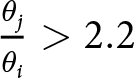 $\frac{\theta_j}{\theta_i} \gt 2.2$), one region imposes a more stringent decentralized enforcement policy than the centralized policy (
 $\alpha_j^{D^\ast} \lt \alpha^{C^\ast} \lt \alpha_i^{D^\ast}$). Otherwise,
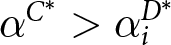 $\alpha^{C^\ast} \gt \alpha_{i}^{D^\ast}$.
b. If the central government is much more effective in detecting environmental violations than regional governments (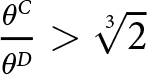 $\frac{\theta ^{C}}{\theta^{D}} \gt \sqrt[3]{2}$), the decentralized optimal enforcement policy is more stringent (
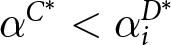 $\alpha^{C^\ast} \lt \alpha_{i}^{D^\ast}$). Otherwise,
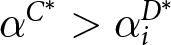 $\alpha^{C^\ast} \gt \alpha_{i}^{D^\ast}$.
Proposition 1 shows that fully symmetric regions impose less stringent enforcement strategies than the centralized one, which consequently results in higher pollution emissions. This illustrates that the negative externalities of the global pollutant cannot be fully internalized within a decentralized framework. If regional environmental concerns are highly heterogeneous (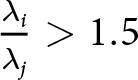 $\frac{\lambda _{i}}{\lambda _{j}} \gt 1.5$), region
 $i$, which values the environment more, imposes a more stringent enforcement strategy relative to the centralized one, whereas region
 $j$ is more lenient in enforcement relative to the centralized one. Similar conclusions can also be obtained if inspection effectiveness across regions is highly heterogeneous. The decentralized strategy can better account for regional heterogeneities. A region can compensate for its low inspection efficiency or volatile pollution rate with a higher level of inspection intensity. Other than policy-related parameters, the characteristic heterogeneity in the marginal benefit of polluting
 $\mu $ across firms does not affect the comparison, so the centralized enforcement is always more stringent. Therefore, non-cooperative decisions by individual regions that do not account for interregional externalities provide inadequate enforcement from a coordinated point of view. In contrast, nondiscriminatory enforcement imposed by the central authority can result in too much stringency in regions with high inspection effectiveness and too much leniency in regions with low inspection effectiveness.
If the central government is much more effective in detecting environmental violations than regional governments (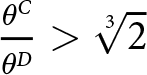 $\frac{\theta ^{C}}{\theta ^{D}} \gt \sqrt[3]{2}$), the agency that is less effective at detecting environmental violations imposes a more stringent enforcement strategy as compensation. Conversely, local governments may decrease their inspection frequency in the decentralized structure if they have more information on their own firms. In sum, only the heterogeneity between the two levels of government can possibly induce both regions to implement stricter enforcement than the centralized enforcement, while the heterogeneity across regions leads to one or both local agencies being more lenient in inspection.
Based on optimal enforcement strategies, we then evaluate centralized and decentralized enforcement from the welfare perspective.
Proposition 2. The decentralized enforcement strategy yields a higher total surplus when high heterogeneity exists in inspection effectiveness across regions (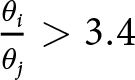 $\frac{\theta _{i}}{\theta _{j}} \gt 3.4$). Otherwise, the centralized enforcement strategy yields a higher total surplus.
Delegating enforcement powers to local authorities is superior from the welfare perspective when inspection effectiveness is highly heterogeneous across regions. The gains from addressing regional heterogeneity outweigh the welfare loss stemming from not fully internalizing the negative externalities of the pollutant. Comparing this to Proposition 1, though the heterogeneity in the level of environmental concern  $\lambda _{i}$ makes each region adapt its enforcement policy accordingly, the decentralized structure does not yield higher welfare as long as
 $\lambda ^{C}=\lambda _{1}+\lambda _{2}$. In addition, centralized enforcement is always preferred, regardless of the heterogeneity across levels of government.
Given that decentralized enforcement can yield a higher total surplus under certain conditions, we ask whether both regions can benefit from the decentralized structure. Alternatively, we ask whether both regions have an incentive to apply for enforcement delegation rights.
Proposition 3. Shifting from centralized enforcement to decentralized enforcement cannot be a Pareto improvement.
Without compensation or subsidy across regions, shifting from centralized to decentralized enforcement makes one region better off and the other worse off, even if decentralization yields a higher total surplus. This cannot be a Pareto improvement. Therefore, even if decentralization is preferable from the perspective of aggregate social welfare, it may not be feasible to implement.
3.2. λC>λ1+λ2
In this section, we consider the scenario in which the central authority’s level of environmental concern exceeds that of the regional authorities combined – i.e.,  $\lambda^{C} \gt \lambda _{1}+\lambda _{2}$. This might be due to pressure from the international community or a ruling party’s political agenda. We focus on whether the divergence of concern between central and regional authorities affects previous conclusions.
We conduct the comparison in two ways. First, from the central authority’s perspective:  $W^{C}$ versus
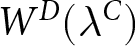 $W^{D}(\lambda ^{C})$. The former denotes the total surplus under centralized enforcement defined in Section 2.3, and the latter denotes the total surplus under decentralized enforcement associated with the central authority’s environmental concerns
 $\lambda ^{C}$. Specifically, the latter is given by
 \begin{equation}
W^{D}(\lambda ^{C})=\underset{i=1}{\overset{2}{\Sigma }}\pi _{i}(\alpha
_{i}^{D})-\lambda ^{C}(e_{1}(\alpha _{1}^{D})+e_{2}(\alpha _{2}^{D}))^{2}.
\end{equation}
This comparison corresponds to the central authority’s evaluation of both centralized and decentralized enforcement, with the same level of environmental concern  $\lambda ^{C}$. Second, from local authorities’ perspective:
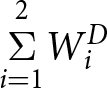 $\underset{i=1}{\overset{2}{\Sigma }}W_{i}^{D}$ versus
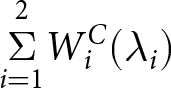 $\underset{i=1}{\overset{2}{\Sigma }}W_{i}^{C}(\lambda _{i})$. The former denotes the aggregate total surplus of both regions under decentralized enforcement defined in Section 2.4, and the latter denotes the aggregate total surplus of both regions under centralized enforcement associated with local authorities’ concerns
 $\lambda _{i}$ – that is,
 \begin{equation}
\underset{i=1}{\overset{2}{\Sigma }}W_{i}^{C}(\lambda _{i})=\underset{i=1}{\overset{2}{\Sigma }}\pi _{i}(\alpha ^{C})-\underset{i=1}{\overset{2}{\Sigma
}}\lambda _{i}(e_{1}(\alpha ^{C})+e_{2}(\alpha ^{C}))^{2}.
\end{equation}
This comparison reflects regional governments’ preferences for centralized and decentralized enforcement according to their own levels of environmental concern.
We assume that the regions are symmetric in their environmental concerns – i.e.,  $\lambda _{1}=\lambda _{2}=\lambda _{0}$, and in pollution benefit – i.e.,
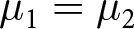 $\mu _{1}=\mu _{2}$,Footnote 6 but asymmetric in inspection effectiveness – i.e.,
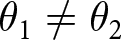 $\theta _{1}\neq \theta _{2}$ and
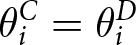 $\theta _{i}^{C}=\theta _{i}^{D}$. In this way, the analysis focuses on the effects of central–regional environmental concerns and heterogeneity in inspection effectiveness across regions. Note that when
 $\lambda ^{C} \gt \lambda _{1}+\lambda _{2}$, the comparison outcome of inspection intensity is similar to the case where
 $\lambda ^{C}=\lambda_{1}+\lambda _{2}$. The following proposition characterizes the welfare comparison from the perspectives of both the central and regional authorities.
Proposition 4. Given 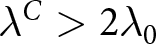 $\lambda ^{C} \gt 2\lambda _{0}$: a. The central authority prefers decentralized enforcement when regional heterogeneity in inspection effectiveness is high, and the environmental concern divergence is limited; otherwise, centralized enforcement is preferred.
b. The regional authority prefers decentralized enforcement when regional heterogeneity in inspection effectiveness is high, or the environmental concern divergence is substantial; otherwise, centralized enforcement is preferred.
This proposition shows that regional authorities also prefer decentralized enforcement when there is high heterogeneity in inspection effectiveness across regions. Together with the condition that the central authority’s level of environmental concern is similar to that of the regional authorities combined, the central and the regional authorities may agree on the enforcement structure. However, the preferences of central and local agencies do not always coincide. Regional authorities prefer self-enforcement when their level of environmental concern is low, whereas the central authority desires centralization. By relaxing enforcement intensity, regional governments can partially ignore negative externalities while enjoying the economic benefits firms bring, an outcome that deviates from more sustainable development guidelines set by the central government.
Figure 1 depicts the central and regional authorities’ views on both enforcement structures. The dashed curve in Figure 1 corresponds to the central authority’s preference for enforcement structures, whereas the solid curve represents the regional authority’s. The region labelled as  $C$ (
 $D$) represents the set of parameters upon which both tiers of authorities prefer centralized (decentralized) enforcement. In these regions, a consensus regarding which enforcement strategy should be implemented is achieved. Similar to the results in Section 3.1, the enforcement structure that yields a higher total surplus will gain more political support. We are interested in whether the central authority and the regional authorities would reach a consensus if they voted on the enforcement structure. The striped area in the figure represents the set of parameters upon which the central authority prefers centralized enforcement, whereas the regional authority opts for enforcement delegation. This happens when the regional authority’s level of environmental concern is relatively low and when regional inspection effectiveness is highly heterogeneous with moderate relative environmental concern. When the regional environmental concern is relatively low, the regional authority favours decentralization to exercise local discretion, whereas the central authority wishes to impose centralization to prevent lax enforcement, leading to a preference-driven divergence. In addition, when regional inspection efficiency is highly heterogeneous, and the relative environmental concern is only moderate, the regional authority prioritizes the efficiency gains of delegation, while the central authority remains cautious and prefers to retain control to ensure national standards. Hence, in these cases, the parties would not agree upon an enforcement setting.
Corollary. A conflict arises when the central authority favours centralization and the regional authority decentralization, under conditions of low regional environmental concerns or high heterogeneity of inspection effectiveness with moderate relative concerns.
Authorities’ preferences for enforcement structure.
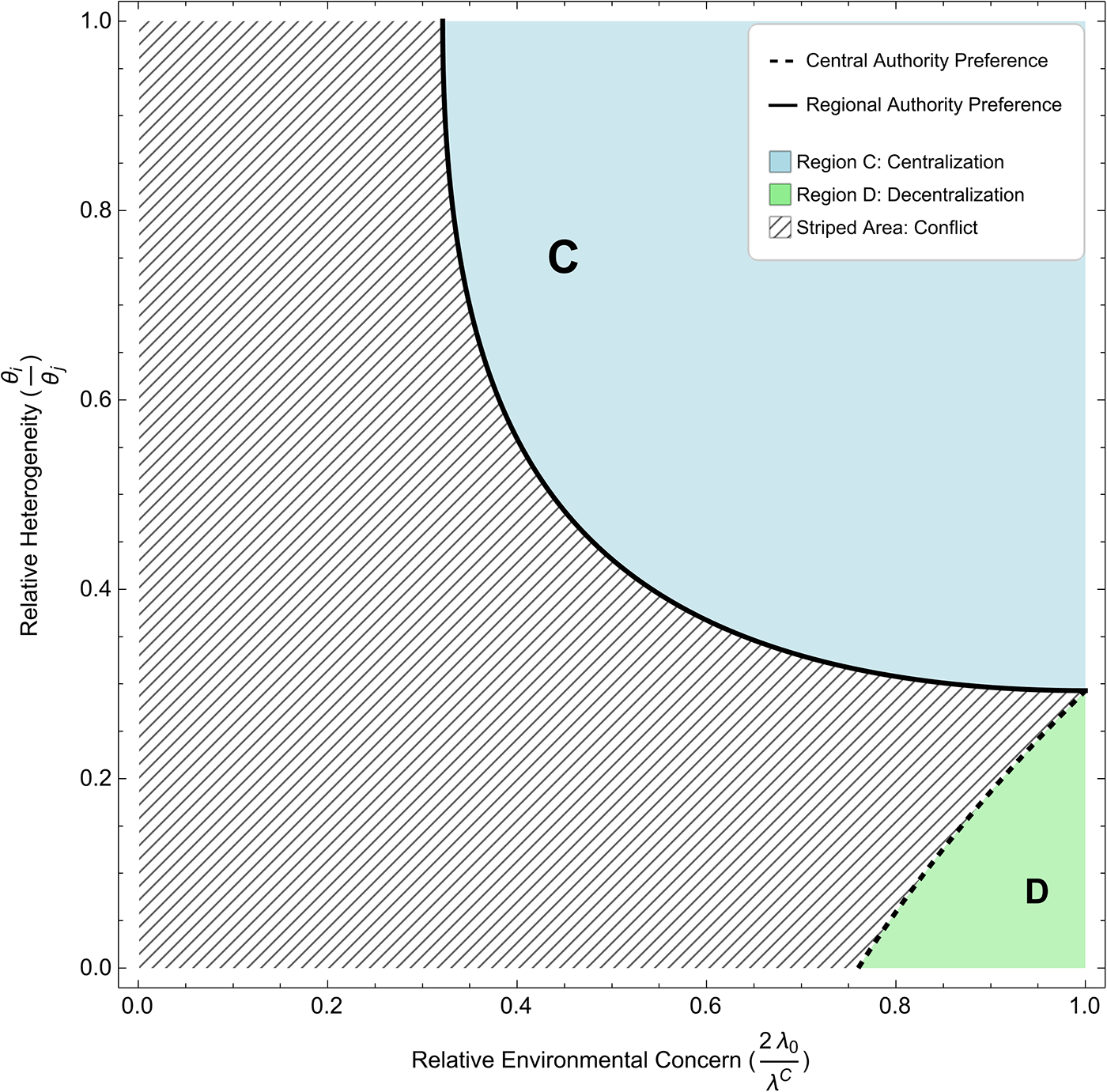
Figure 1 Long description
Legend: Central Authority Preference shown with a dashed line. Regional Authority Preference shown with a solid line. Region C: Centralization. Region D: Decentralization. Striped Area: Conflict. The horizontal axis is labeled, Relative Environmental Concern, open parenthesis 2 lambda subscript 0 over lambda superscript C close parenthesis. The axis runs from 0.0 to 1.0 with labeled ticks at 0.0, 0.2, 0.4, 0.6, 0.8 and 1.0. The vertical axis is labeled, Relative Heterogeneity, open parenthesis theta bar superscript I over theta bar close parenthesis. The axis runs from 0.0 to 1.0 with labeled ticks at 0.0, 0.2, 0.4, 0.6, 0.8 and 1.0. A solid curved boundary starts near x equals 0.35 at y equals 1.0, then curves down and right, passing near x equals 0.40 at y equals 0.60, near x equals 0.50 at y equals 0.45, near x equals 0.60 at y equals 0.38, near x equals 0.80 at y equals 0.31 and reaching near x equals 1.0 at y equals 0.29. The area above and to the right of this solid curve is labeled with a large letter C. A dashed curve appears in the lower right. It begins near x equals 0.78 at y equals 0.0 and rises toward the right edge, meeting near x equals 1.0 at y equals 0.29. A region in the lower right corner is labeled with a large letter D. The striped area covers most of the left and lower portion of the plot, extending up to the solid curve and also occupying the area above the dashed curve and below the solid curve on the right side.
This result is in line with the existing literature that environmental policy is likely to create tensions between levels of government (Wälti, Reference Wälti2004). Naturally, local authorities desire the power that comes along with decentralized authorization, while the central authority tends to limit regional power expansion. The tensions between different levels of enforcement agencies may induce higher noncompliance rates, more counteractions or other forms of conflicts; thus, effective negotiation that allows for the expression of concerns, monitoring rules and incentives for compatibility between different levels of government are essential to the decision-making around enforcement structure.
4. Robustness check
The baseline model defines the government’s objective function as the sum of firm profits and environmental damages, consistent with the literature that conceptualizes social welfare as a balance between economic activity and environmental outcomes (e.g., Kunce and Shogren, Reference Kunce and Shogren2002; D’Amato and Valentini, Reference D’Amato and Valentini2011). Such a formulation is particularly apt for analysing government authorities that must weigh local economic development against environmental protection.
In practice, environmental enforcement is sometimes carried out by specialized inspection agencies whose operational decisions may be constrained by administrative budgets. In this context, the government’s objective function might incorporate environmental damages and the costs associated with conducting inspections. However, if inspection costs are incorporated into the objective function of a government authority, a full fiscal accounting would also necessitate including penalty revenues, and these fiscal flows are often fragmented across different departments or administrative levels. To maintain focus on our core mechanisms without over-complicating the framework with these fiscal budgetary nuances, the baseline model adopts the standard welfare specification described above.
To ensure our findings are not sensitive to this modelling choice, we modify the objective function of inspection authorities considering both environmental damages and inspection costs (Heyes, Reference Heyes2002). We briefly discuss the welfare consequences of centralized and decentralized enforcement.
Let  $\phi$ denote the marginal cost of inspection, which is another measure of inspection effectiveness. Assume that the central authority incurs the cost
 $\phi^C\alpha^C$ of inspecting each firm with intensity
 $\alpha^C$, whereas the local authority of region
 $i$ incurs the cost
 $\phi_i\alpha_i$ of inspecting firm
 $i$ with intensity
 $\alpha_i$. The total surplus of the central authorities is given by
 \begin{equation*}
W^C=-\lambda^C(e_{1}(\alpha^C)+e_{2}(\alpha^C))^{2}-2\phi^C\alpha^C,
\end{equation*}
and the surplus of region  $i$ is given by
 \begin{equation*}
W_{i}^{D}=-\lambda_{i}(e_{1}(\alpha _{1}^{D})+e_{2}(\alpha
_{2}^{D}))^{2}-\phi _{i}\alpha _{i}^{D}.
\end{equation*}
The responsible authority chooses the inspection intensity to maximize the social welfare of its jurisdiction. In the same fashion as Section 3, we consider the following two scenarios:  $\lambda^C=\lambda_1+\lambda_2$ and
 $\lambda^C \gt \lambda_1+\lambda_2$.
When  $\lambda ^{C}=\lambda _{1}+\lambda _{2}$, the comparison of optimal centralized and decentralized enforcement strategies is similar to Proposition 1. A change in authorities’ objective function does not change the key tradeoff between centralized and decentralized enforcement. The fact that there is potential heterogeneity across regions and agencies indicates that decentralized enforcement may yield a higher total surplus under certain circumstances.
Proposition 5. If the inspection agency minimizes environmental damages and monitoring costs:
a. Centralized enforcement yields a higher total surplus, unless 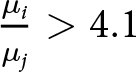 $\frac{\mu _{i}}{\mu _{j}} \gt 4.1$, or
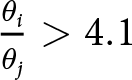 $\frac{\theta _{i}}{\theta _{j}} \gt 4.1$, or
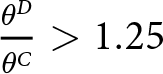 $\frac{\theta ^{D}}{\theta ^{C}} \gt 1.25$, or
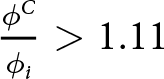 $\frac{\phi ^{C}}{\phi _{i}} \gt 1.11$.
b. A shift from centralized to decentralized enforcement is not Pareto-improving under regional heterogeneity, but may be so when 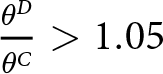 $\frac{\theta ^{D}}{\theta ^{C}} \gt 1.05$ or
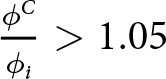 $\frac{\phi ^{C}}{\phi _{i}} \gt 1.05$.
The set of parameters upon which decentralized enforcement yields a higher total surplus expands given the modified objective function of authorities. Moreover, if regional agencies can provide more effective inspections relative to the central one, shifting from centralized to decentralized enforcement results in efficiency gains and consequently makes both regions better off. Therefore, if heterogeneity across regions and efficiency gains coexist, the difference in regional welfare under centralized and decentralized enforcement depends on the relative weight of both effects. It can be that both regions are better off due to strong efficiency gains, but one region gains more than the other due to the heterogeneity across regions. It can also be that one region is better off while the other is worse off, and the region that is better off (worse off) has more welfare to gain (less welfare to lose) relative to the case without efficiency gains.
Then we consider the scenario in which the central authority’s level of environmental concern runs higher than that of the regions combined ( $\lambda^C \gt \lambda_1+\lambda_2$). We evaluate centralized and decentralized enforcement from the perspective of both tiers of authority. The following proposition characterizes authorities’ preferences for enforcement structures.
Proposition 6. If the inspection agency minimizes environmental damages and monitoring costs:
a. The central authority prefers decentralized enforcement when the heterogeneity in polluting benefits or inspection effectiveness across regions or agencies is high, and the environmental concern divergence is limited; otherwise, centralized enforcement is preferred.
b. The regional authority prefers decentralized enforcement when the heterogeneity in polluting benefits or inspection effectiveness across regions or agencies is high, or the environmental concern divergence is substantial; otherwise, centralized enforcement is preferred.
Proposition 6 confirms that the insights obtained in Section 3.2 are robust even when authorities aim to minimize environmental damages and inspection costs. If a region’s level of environmental concern is high, together with high heterogeneity of polluting benefits across regions or inspection effectiveness across regions or agencies, both tiers of authority prefer decentralized enforcement. When either regional levels of environmental concern are low or local inspection effectiveness (local marginal inspection cost) is much higher (lower) than that of the central authority, the central and regional authorities do not reach a consensus on enforcement structure.
5. Conclusion
This paper studies the optimal enforcement strategy within centralized and decentralized frameworks for a given environmental policy. We analyse firms’ compliance behaviour, authorities’ optimal enforcement strategy and the welfare consequences of centralized and decentralized enforcement. The comparison between centralized and decentralized enforcement depends on the degree of internalization of externalities and heterogeneity across regions and tiers of authorities. Our model can account for various factors that affect enforcement regulation: inspection effectiveness, political preferences of the environment, abatement costs, inspection costs, etc.
We show that firms underreport their actual emissions in the presence of imperfect inspections from authorities. Centralized enforcement is more stringent when there is low heterogeneity across regions in their levels of environmental concern or inspection effectiveness or when regions are less effective than the central authority in detecting environmental violations. Decentralized enforcement yields a higher total surplus when there is high heterogeneity in inspection effectiveness across regions. However, moving from centralized to decentralized enforcement is not a Pareto improvement even when the latter yields a higher total surplus. We then consider the scenario in which the central authority is more concerned about the environment than the regions. The two tiers of authority cannot reach a consensus on enforcement structure when the regional authorities’ level of environmental concern is relatively low.
Central and local authorities’ interests are also often misaligned in the context of international environmental agreements. For instance, signatories of the Paris Agreement may not have sufficient incentive to ratify the agreement and commit to enforcing compliance. The agreement’s top-down architecture, based on multilateral agreements on targets and timetables, may not provide robust incentives for all nations’ participation and compliance (Aldy and Stavins, Reference Aldy and Stavins2008). Correspondingly, this lack of efficient enforcement and the lack of coordination at the international scale would, to an extent, result in regulation failure, though the policy is designed with the best of intentions. Our paper suggests that, for environmental regulations to be more effective, the policy design should consider the distribution of enforcement powers amongst tiers of authority and its consequences.
Though we apply this model of enforcement powers to the environmental theme here, the implications can be applied to other federalism enforcement issues with inter-jurisdictional externalities. Examples include patents and copyrights; in this case, unbalanced enforcement across countries or regions may hinder innovation. In addition, this paper considers fully centralized and fully decentralized enforcement structures. It would be particularly interesting to consider more flexible power-sharing enforcement structures amongst tiers of authority.
Supplementary material
The supplementary material for this article can be found at https://doi.org/10.1017/S1355770X2610076X.
Funding statement
The authors gratefully acknowledge financial support from the Social Science Foundation of Liaoning Province (Grant No. L20BJL011).
Competing interests
The authors declare none.






