The purpose of medical relief is to rescue patients, orchestrate timely evacuation, and most importantly, save lives in the aftermath of a disaster. In recent years, many natural disasters have occurred in China, such as the Wenchuan earthquake in Sichuan province in 2008, the Yushu earthquake in Qinghai province in 2010, the Zhouqu catastrophic debris flow in Gansu province in 2010 and the Ludian earthquake in Yunnan province in 2014. These disasters occurred suddenly, placing a very heavy burden on the medical rescue system. In disaster areas, many people may die; livestock may be buried; and mosquitoes, flies, mice, and other harmful organisms may multiply. These pests can carry a variety of pathogens and increase the risk of spreading infectious diseases. Therefore, it is important for China to establish an infectious disease surveillance system. After the earthquake in East Azerbaijan in 2012, Babaie et al established a surveillance system for 19 diseases.Reference Babaie, Farin and Ardalan 1 The surveillance system augmented the collection of important data, increased confidence in the health authorities, and improved the overall disaster relief efforts.Reference Xing, Hejblum and Valleron 2 Similarly, a mobile-device-based reporting system for the Sichuan earthquake-affected areas was established and proved to be useful for improving disaster relief.Reference Guo and Su 3 Because another important purpose of relief work is to prevent an outbreak of infectious diseases after a disaster to avoid secondary damage, the collection of epidemiological data must start as soon as possible after the event’s occurrence. If data collection is delayed, epidemiological responses that are detrimental to the understanding and control of the event must be considered.Reference Babaie, Farin and Ardalan 1 Therefore, in the disaster relief process, epidemiological investigations are important. The aim of this field investigation is to acquire information about the source of an infection, its route of transmission, and the presence of high-risk groups and other risk factors and to provide first-hand information for timely prevention and control measures to prevent the spread of infectious diseases.
The epidemiological questionnaire is the most commonly used and most effective tool for obtaining epidemiological information at the scene of disaster relief. Currently, in China, epidemiological investigation tools primarily consist of manually completed paper questionnaires, especially in economically undeveloped regions. For each epidemiological investigation, the investigators design a new questionnaire or adapt the original questionnaire, print and administer the questionnaire, and then manually input the responses into a computer for related analysis. This traditional approach requires a large amount of work, with low efficiency and high cost. In cases of a large-scale epidemiological or sudden outbreak investigation, the administration of a paper questionnaire is not applicable. Along with the development of computers, mobile communication and equipment technologies, infectious disease field investigation technology, which is based on networks and the use of personal digital assistants (PDAs), has begun to rise, resulting in a data-collecting technology that is fast, convenient, and inexpensive.
This study aimed to establish a system for collecting information at the scene of disaster relief to realize rapid questionnaire customization and rapid data collection, thereby providing a powerful tool for infectious disease prevention and control after a large-scale disaster.
Methods
Research Objective
This study focused on a variety of epidemiological questionnaires, including China’s national statutory infectious disease reporting questionnaire: categories A, B, and C, as well as other related questionnaires, concepts, information, and terminology. The law of the People’s Republic of China on the prevention and treatment of infectious diseases includes 39 types of infectious diseases, which are called statutory reporting infectious diseases. These diseases are divided into 3 categories, category A, category B, and category C. Category A infectious diseases include plague and cholera. They are acute and highly infectious. Category B includes 25 infectious diseases, such as SARS, AIDS, viral hepatitis, and polio. Category C includes 12 infectious diseases, such as influenza, mumps, and rubella. 4 The aim of this study was to establish an epidemiological database to obtain investigative data through the use of a PDA as well as field-based questionnaire customization. In this system, the types of options were preset and the survey data were written directly into the database, thus enabling investigators to directly obtain data and perform related analyses, improving the efficiency of the field survey at the scenes of disaster relief.
Implementation Method
To carry out this study, we collected existing national statutory reports of class A, B, and C infectious diseases and other epidemiological survey information. The survey content was classified and integrated. Then, we established the database by using SQL Server 2005 (Microsoft Corp, Redmond, WA) and established the relationship between the concepts and terminology for infectious diseases. Through the use of computer technology, we established a B/S (browser/server) structure to enable epidemiological questionnaire customization.
Next, we developed the system on the server and provided service to the user. Then, we developed the client-side application, installed it on a PDA, and accessed the server to obtain service. At the scene of disaster relief, the investigators used the PDA to collect information and to rapidly customize the questionnaire. The survey information was written directly into the server database, and the user was able to export the data into Microsoft Excel (Microsoft Corp, Redmond, WA) format for further statistical analysis.
Results
Infectious Disease Questionnaire Customization at the Scene of Disaster Relief
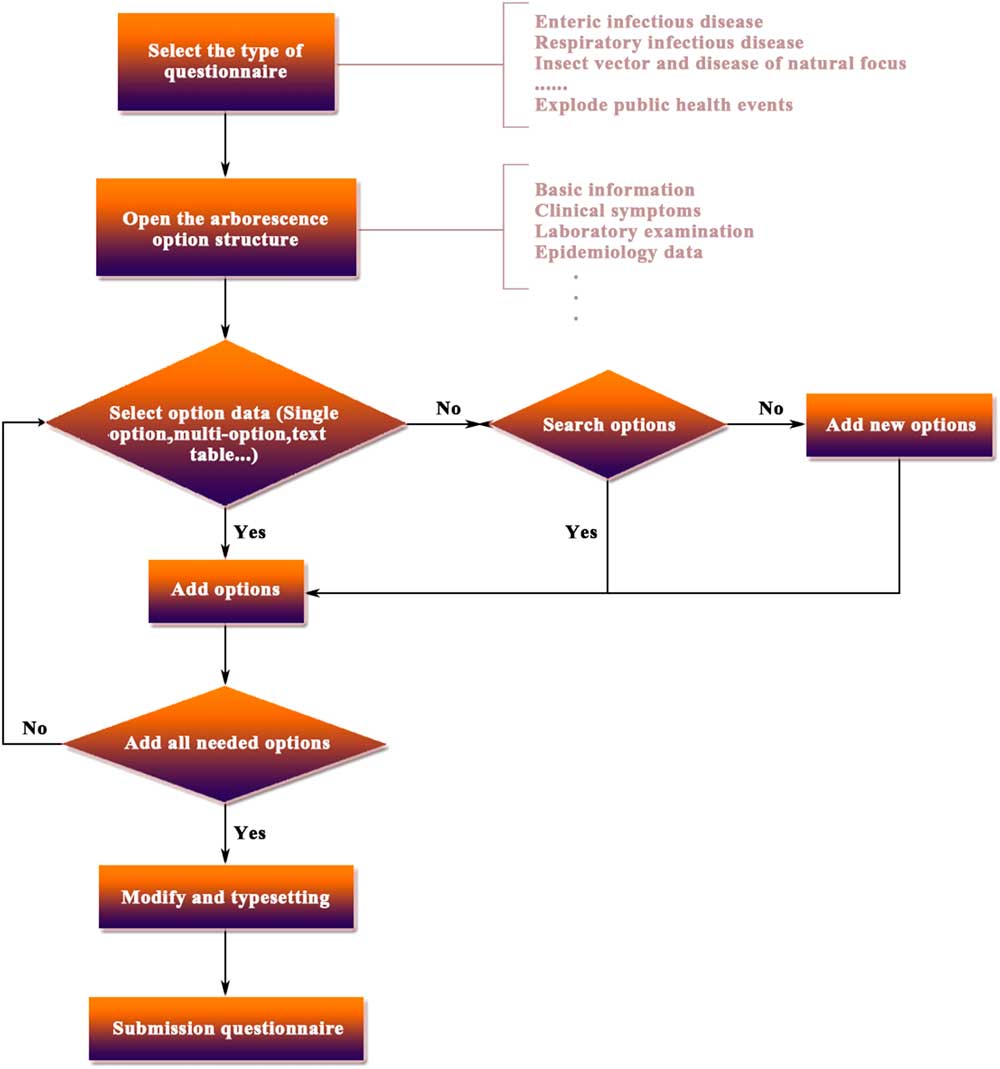
The epidemiological questionnaire is a powerful tool for epidemiological investigation and data collection. Because each investigation and its study content differ, there is no unified epidemiological questionnaire, so investigators must design a new questionnaire according to the content of each investigation. For a given epidemiological investigation, we can call the questionnaire in the system to record and obtain data. When there is no ready-made questionnaire available or the existing questionnaire cannot satisfy the needs of the investigation, users can customize a new epidemiological questionnaire. The process of questionnaire customization is shown in Figure 1.
Questionnaire Customization Process.

Construction of an Infectious Disease Investigation Option Database
At the scene of a disaster, epidemiological questionnaires include case questionnaires and epidemiological questionnaires. Case questionnaires are mainly used to determine the cause and conditions of diseases and to ensure that timely measures are taken to prevent the spread of infectious diseases. Epidemiological surveys are used to investigate the known causes of diseases and, through epidemiological investigation and analysis, to determine the specific cause of the outbreak. The aim of those 2 types of questionnaires is to obtain fundamental information for epidemiological analysis. According to the content of the questionnaire, we integrated the concepts and terms and built a database by using SQL Server 2005. Basic classification included basic information, general project information, main clinical manifestations, epidemiological history, exposure history, and so on.
The epidemiological investigational database contained all of the relevant vocabulary and terminology in the epidemiological survey field, and its function was to facilitate the sharing and reuse of epidemiological survey knowledge. It enabled the computer to understand language at the semantic level. By establishing a relationship between a specialized word and a concept, we were able to clearly define the concept of mutual recognition in terminology and provide a common understanding in this field.
Establishing an epidemiological option database is a process of continuous improvement and refinement. To build this database into an open knowledge system, it should be able to correspond with the development of knowledge and should be constantly updated with continuous developments from the field. For this purpose, this database should have vitality and be able to meet the actual needs of the user as well as continue to be perfected in its application.
Implementation of the Epidemiological Questionnaire Customization
The epidemiological information collection at the scene of a disaster is needed in a timely and accurate manner. Epidemiological surveys generally use traditional paper questionnaires that are filled out by hand. This method is inefficient and its use has difficulty meeting demands.
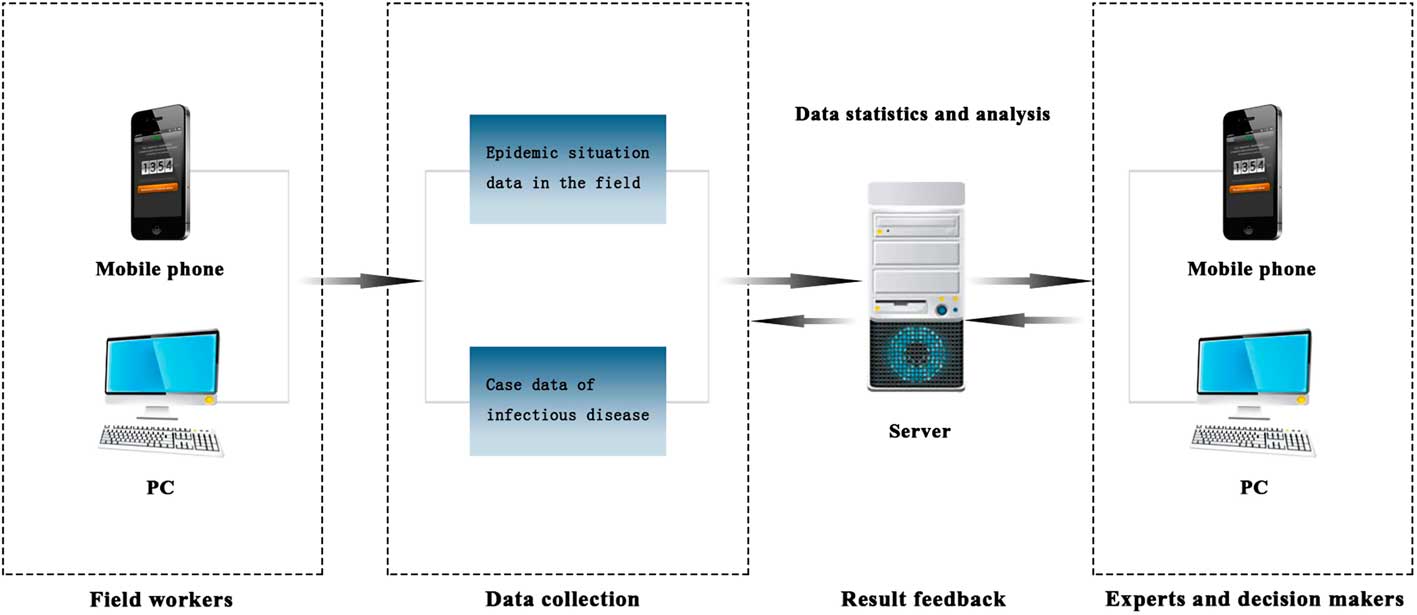
The use of computer and wireless communication technologies in epidemiology can improve the efficiency of the epidemiological investigation. In this article, we customized the epidemiological questionnaire by using a wireless transmission network based on the B/S (browser/server) architecture. The field investigator’s handheld PDA, over the course of the epidemiological investigation, sent orders to the server to customize the content via a wireless network while the server ran the specific program and the database to provide customized services. The server transfers a project based on the epidemiological customized content to the PDA, and the field epidemiological investigators can fill it out or choose the needed options. When the investigation is finished, the data can be returned to the server and stored in the database. Experts can extract the data to perform analyses in real time according to need and send the results to the field investigator. In this way, the method greatly improves the timeliness of epidemiological investigation and facilitates interactions between the field investigation and the experts. The investigators in the field can be supported by experts, and the experts can understand the situation in real time, thus enhancing the timeliness of the epidemiological investigation at the disaster relief scene. The work mode is shown in Figure 2.
Working Mode of the System.

Quality Control in the Epidemiological Investigation Process
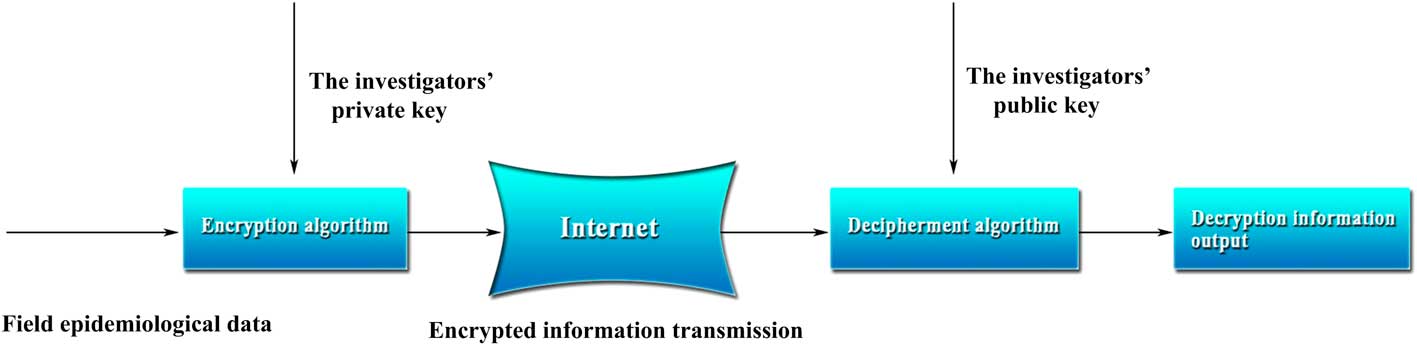
Epidemiology questionnaire customization and data collection removes the traditional paper-based questionnaire fill-and-review procedure and improves efficiency. Thus, the quality control of the investigation at the scene of disaster relief becomes more important. The authenticity and traceability of the data that the epidemiological investigators send back to the server must be guaranteed. To this end, the system uses digital signature technology for epidemiological information quality control. A digital signature is simply a numeric string that the message sender generates and others cannot forge. It is a certification of the authenticity of the information that the investigator sends back. By applying digital signature technology, the reliability and traceability of the epidemiological information can be guaranteed. Figure 3 shows the principle of the digital signature.
Principle of the Digital Signature.

From Figure 3 we can see that the digital signature is based on information encryption. The investigators’ public key can only decrypt the information that was encrypted by the investigators’ private key, so we can be sure that the information that uses the investigators’ public key for decryption must come from the investigators. Therefore, in the process of transmitting information, we can ensure both the security and traceability of the information. From this strategy we are able to realize the quality control of information in the field.
Discussion
During a disaster, specific information is required to rapidly plan a disaster response, especially in sudden-onset disasters.Reference Aung and Whittaker 5 Many mathematical and simulation models are used to evaluate health sector responses.Reference Brandeau, McCoy and Hupert 6 Therefore, field epidemiological investigations at the scene of disaster relief are important. Along with the development of epidemiology, the range of study of epidemiology is rapidly expanding, involving all aspects of human health. The amount of data that needs to be reviewed is also expanding. The epidemiological questionnaire is an important tool for collecting information at the scene of disaster relief. Epidemiological questionnaire customization and rapid collection of data at the scene of disaster relief is significant for infectious disease prevention and control.
Field information acquisition technology based on modern information technologies, such as computer technology, wireless communication technology, and network questionnaire technology, has gradually replaced the traditional paper media information collection method. These are efficient and beneficial for data storage and analysis. With the use of these new technologies, the speed of data acquisition is improved, as is direct access to electronic data. The use of these technologies can also avoid secondary electronic processes and reduce costs.Reference Bernabe-Ortiz, Curioso and Gonzales 7
Mobile health technology has been used effectively for health care delivery in many developing countries. In India, researchers have built some systems that have been used in infectious disease and noncommunicable disease data collection in which they have proven that mobile health has many advantages, including low cost, convenience, and ease.Reference Majumdar and Kar 8 In South Africa and Peru, a study showed that using a PDA for data collection can not only save cost but also improve efficiency.Reference Blaya, Gomez and Rodriguez 9 Tanzania has carried out a massive information collection and investigation using PDAs, collecting more than 80,000 cases over 7 weeks and completing a summary and setting up a database within 24 hours.Reference Shirima, Mukasa and Schellenberg 10 The Voxiva system is based on a mobile phone application of an infectious disease monitoring system; it is simple and cheap and suitable for undeveloped economic regions. 11
The World Health Organization and many health departments of countries throughout the world have also become committed to research on infectious disease monitoring systems. In 1997, the World Health Organization and the Public Health Agency of Canada established the disease outbreak verification system, which has been used in infectious disease outbreaks, water and food pollution, biological terrorism, and natural disaster early warning and is a comprehensive application platform.Reference Mykhalovskiy and Weir 12 Farrahi et al proposed a model for contact tracing, where an infectious disease spreads throughout the physical interpersonal network.Reference Farrahi, Emonet and Cebrian 13 It may be a viable option to arrest contagious outbreaks via mobile phone. In infectious disease surveillance at the scene of disaster relief, public health information, such as environmental, hospital, or census data, is important for the rescue worker. Incorporating these data into an epidemiological framework will enable people to learn more about infectious disease dynamics. It is necessary for the relief scene after a disaster.Reference Chunara, Smolinski and Brownstein 14 The Global Public Health Intelligence Network is an early forecasting warning system for potential public health threats facing the world. The service includes disease outbreaks, water pollution, food poisoning events, bioterrorism, chemical leaks, natural disasters, and medical equipment safety. 15
In this article, we explored electronic information gathering at the scene of disaster relief and established a database using SQL Server 2005 and the reuse and sharing of the infectious disease questionnaire. In our study, we established an epidemiological questionnaire option database. This database contains only a basic sampling of epidemiological questionnaires. Because the content of epidemiology involves a variety of known and unknown diseases, the content of each investigation differs. If a broad range of disease-related knowledge is brought to the customization process, it will be a very large system. If the relevant knowledge is not sufficient, the epidemiological questionnaire customization process is bound to be flawed. How to reuse the data and relate them to other related areas to establish a relevant knowledge database as well as how to screen out relative concepts and vocabularies need to be determined.
Conclusions
The rapid disposal of an epidemic is an important indicator to evaluate the capability of infectious disease prevention and control. In this study, we break the traditional epidemiological investigation model by using Wi-Fi technology to conduct epidemiological information transmission and storage, which is faster and more accurate. The expert can intuitively understand the situation of the epidemic scene and guide the investigation in the field in a timely manner.
This system integrated computer technology and mobile communication technology to the collection of infectious disease information and rapid customization of the questionnaire at the scene of disaster relief. The use of this system could improve the efficiency of infectious disease data collection in the field, and the decision-maker should be able grasp information quickly to provide strong support for the establishment of prevention and control measures.
The disaster relief field epidemiological survey is an exploration and reform method of traditional epidemiological survey methods, of which data quality control is a very important part. In this study, we used a digital signature strategy for quality control. This method can guarantee the security of the epidemiological investigation by the officers who are responsible for the information that is sent back to the server.
Acknowledgments
This study was supported by the National Natural Science Foundation of China (71473264), Projects of the Key Laboratory of Emergency and Disaster Medicine in PLA (JY1408), and the Affiliated Hospital Foundation of Logistics University of PAP (FYM 201409, WHTD 201305-2).