CHDs are the most common human birth defects, with an incidence of eight per 1000 births, and around 30,000–40,000 cases being diagnosed annually in the United States of America. Approximately one-third of children born with CHD will require early surgical intervention, often requiring extensive reconstruction with the use of cardiopulmonary bypass and/or circulatory arrest. Despite marked improvements in outcomes for surgical palliation of CHD over the last 50 years, morbidity and mortality remain significant, especially among those patients with more severe CHD.Reference Feinstein, Benson and Dubin 1 Recent research has focussed on identifying genetic factors that may alter the course of patients with CHD and the response to neonatal cardiac surgery.Reference Kirshbom, Mahle and Joyner 2 , Reference Mital, Chung and Colan 3 Our group and others have identified genetic variants involved in the vascular response to tissue injury that affect the long-term surgical outcome.Reference Kim, Kim and Burt 4 We have previously shown that the vascular endothelial growth factor A (VEGFA) single-nucleotide polymorphism rs833069 minor allele and superoxide dismutase 2 (SOD2) single-nucleotide polymorphism rs2758331 minor allele are both associated with improved long-term transplant-free survival in non-syndromic patients after surgical palliation of CHD and that they convey an additive protection in combination.Reference Kim, Kim and Burt 4
Vascular endothelial growth factor is a growth factor that mediates vascular permeability, endothelium growth and apoptosis inhibition, and its potential as a cardioprotective factor has been demonstrated in in vitro, animal, and retrospective human studies.Reference Vailati, Crispim, Sortica, Souza, Brondani and Canani 5 – Reference Zangi, Lui and Von Gise 8 The VEGFA single-nucleotide polymorphism studied, rs833069, is in strong linkage disequilibrium (r2=0.97) with a 5’UTR single-nucleotide polymorphism, rs2010963, whose minor allele – the “G” allele, frequency 0.346 – has been shown to be associated with higher intravitreous and serum VEGFA expression. The mechanism underlying such an increased VEGFA expression is not fully elucidated, and may be a direct result of the polymorphism or may be due to the linkage disequilibrium with another, unknown polymorphism at a different regulatory site. Despite the lack of a fully understood mechanism, the single-nucleotide polymorphism studied has been demonstrated to be associated with higher VEGFA expression.Reference Vailati, Crispim, Sortica, Souza, Brondani and Canani 5 Thus, there is an experimental, theoretical, and empirical basis for a clinically significant association to exist between the presence of the VEGFA minor allele and improved ventricular function, presumably due to the increased endogenous levels of vascular endothelial growth factor that this allele confers. Superoxide dismutase is an enzyme that catalyses the conversion of superoxide radicals into hydrogen peroxide, thus protecting cells from free radical-mediated injury and death. The SOD2 single-nucleotide polymorphism studied, rs2758331, is in strong linkage disequilibrium (r2=0.93) with SOD2 Val16Ala missense single-nucleotide polymorphism, rs4880, whose minor allele–the “G” allele, frequency 0.436 – is associated with increased levels of superoxide dismutase. Because cardiopulmonary bypass and cardiac surgery elicit a profound immune response and superoxide generation, increased levels of superoxide dismutase would, theoretically, help to ameliorate free radical-induced cellular damage in the postoperative period. The purpose of this study is to determine whether the previously demonstrated improvement in transplant-free survival associated with the VEGFA single-nucleotide polymorphism rs833069 and SOD2 single-nucleotide polymorphism rs2758331 minor alleles is secondary to preserved ventricular function.Reference Kim, Kim and Burt 4
Materials and methods
Ethics statement
The study was approved by the Institutional Review Board at the Children’s Hospital of Philadelphia. The patient enrolment processes for data collection within this cohort has been described elsewhere.Reference Kim, Kim and Burt 4
Study design
This is a secondary analysis of a previously described, prospective cohort of 550 subjects selected to study neurodevelopmental dysfunction after CHD palliation. The inclusion and exclusion criteria for this cohort, as well as information on data collection, operative management, and genotyping, have been described elsewhere.Reference Gaynor, Gerdes and Zackai 9 – Reference Kim, Stanaway and Rajagopalan 11 Diagnostic class was assigned on the basis of preoperative diagnosis according to a previously proposed scheme:Reference Clancy, McGaurn and Wernovsky 12 class I, two-ventricle heart without arch obstruction; class II, two-ventricle heart with arch obstruction; class III, single-ventricle heart without arch obstruction; and class IV, single-ventricle heart with arch obstruction. For this analysis, we excluded subjects with known or suspected genetic syndromes. We excluded these patients not only because they have a considerably poorer prognosisReference Patel, Hickey and Mavroudis 13 but also so that our data could be more applicable to the vast majority of CHD patients, who do not have genetic syndromes.
Whole blood or buccal swab samples were obtained before surgery, and were stored at 4°C. A total of 550,000 single-nucleotide polymorphisms were genotyped utilising the Illumina HumanHap 550k BeadChip (Illumina, San Diego, CA, United States of America) at the University of Pennsylvania Center for Applied Genomics. This chip assesses all single-nucleotide polymorphisms in parallel while preserving the quality of genotyping performed. Only a single single-nucleotide polymorphism was tested in this analysis. Because of this, correction for multiple comparisons was not needed. Quality control measures were taken to maximise the quality of the resulting single-nucleotide polymorphisms at the University of Washington, and included the following: filtering single-nucleotide polymorphism data for genotype call rate <99% and Hardy–Weinberg equilibrium p<10−6. These quality control measures ensured uniform and high data quality across all specimens. Systemic ventricular function was assessed using reports from existing, clinically indicated echocardiographies. Echocardiographic images were not reviewed. All available preoperative and postoperative echocardiographic reports were obtained from the network of inpatient and outpatient facilities within the Children’s Hospital of Philadelphia network for patients who were followed up within our system. For all other patients, medical records were solicited from any and all inpatient and outpatient physician encounters in the postoperative period. Data obtained from echocardiograms included qualitative and quantitative assessment of systemic ventricular function. Studies were deemed unacceptable for interpretation if they did not include at least a qualitative assessment of ventricular function. Because of significant variability in the frequency and quality of the echocardiograms, the most recent echocardiogram or the most recent echocardiogram before death or transplant was used to track the change in ventricular function over the study period. Qualitative measurements of systemic ventricular function were used because of variable and inconsistent reporting of quantitative measures such as ejection fraction and shortening fraction, and were scored on a 0–4 basis, with 0 indicating hypoplastic, 1 representing severely diminished function, 2 representing moderately diminished function, 3 representing mildly diminished function, and 4 representing normal or near-normal function.
Analysis
All analyses were performed in R (http://www.r-project.org/). Genotypes of VEGFA single-nucleotide polymorphism rs833069 and SOD2 single-nucleotide polymorphism rs2758331 were coded additively. Stepwise linear regression was performed with the numerous demographic, clinical, and genetic variables entering the model for the outcome of change in systemic ventricular function. The variables included in the stepwise regression model were the following: a dummy variable for race, with the Caucasian subgroup–the majority racial group–as the reference group; patient gender; gestational age; gestational weight; diagnostic class;Reference Clancy, McGaurn and Wernovsky 12 preoperative intubation; postoperative length of stay (LOS); age at first surgery, weight at first surgery; total cardiopulmonary bypass (CPB) time; use of deep hypothermic circulatory arrest; total deep hypothermic circulatory arrest time; haematocrit at first surgery;Reference Gaynor, Mahle and Cohen 15 VEGFA single-nucleotide polymorphism rs833069 genotype; SOD2 single-nucleotide polymorphism rs2758331 genotype; and total genetic risk score variable – a composite of VEGFA and SOD2 genotypes reflecting the number of previously demonstrated deleterious alleles for transplant-free survival.Reference Kim, Kim and Burt 4 Model comparison was performed using Akaike’s information criterion, beginning with a base model with no variables included. Only specific variables that improved model prediction of change in systemic ventricular function were retained in the final regression model.
Survival analyses were performed using a Cox proportional hazards model to evaluate the joint effect of the studied single-nucleotide polymorphism and potential covariates. Output from the Cox proportional hazards model was used for plotting survival curves – both by genotype and by change in ventricular function. Because of the mixed ancestry of the cohort, the first three principal component eigenvectors from principal components analysis were used as covariates to adjust for potential population stratification.Reference Price, Patterson, Plenge, Weinblatt, Shadick and Reich 14 Survival analyses were adjusted for the previously reported confounding variables: the first three principal component eigenvectors for race, gender, gestational age, birth weight, diagnostic class,Reference Clancy, McGaurn and Wernovsky 12 preoperative intubation, preoperative LOS, age at first surgery, weight at first surgery, total CPB time, use of deep hypothermic circulatory arrest, total deep hypothermic circulatory arrest time, and haematocrit at first surgery.Reference Gaynor, Mahle and Cohen 15 Diagnostic class was coded as a dummy variable for analyses, with those with diagnostic class of 1–that is, with the least severe pathology–as the reference group.
Results
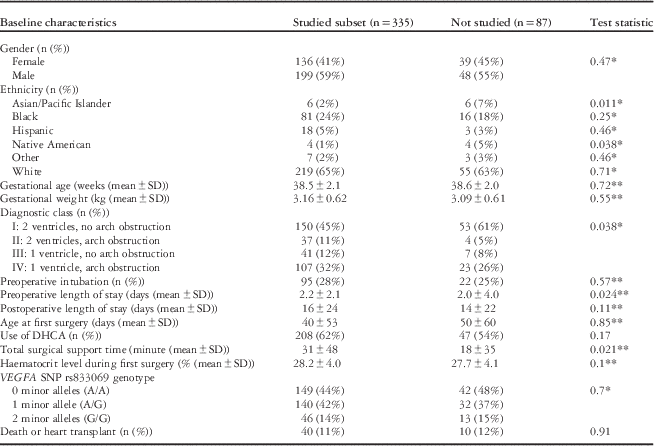
Of the 550 original participants, 56 were removed because of likely genetic syndromeReference Gaynor, Nord and Wernovsky 10 and an additional 72 were removed because of lack of high-quality genotype data,Reference Kim, Kim and Burt 4 leaving 422 potential participants. Of the 422 patients, 335 had undergone at least one echocardiography after 2009, or at least one postoperative echocardiography within 1 year of death or transplant. The remaining patients either had not undergone echocardiography recently, had not undergone further follow-up echocardiographies, or were lost to follow-up. As noted in Table 1, the studied population had a slightly different ancestry than the originally studied population. The studied population also had significantly more complicated pathologies, with a significantly higher incidence of diagnostic classes II, III, and IV, a longer length of stay, and longer total support times. Despite the differences in diagnostic class, the incidence of death or transplants and the use of deep hypothermic circulatory arrest were not statistically different. Importantly, there was no difference in the incidence of the various VEGFA alleles between the two groups. The mean follow-up time for the studied population was 13.5 years.
Baseline and operative characteristics of the cohort.

DHCA=deep hypothermic circulatory arrest; SNP=single-nucleotide polymorphism; total surgical support time=total CPB+DHCA time; VEGFA=vascular endothelial growth factor A
* Pearson test
** Wilcoxon test
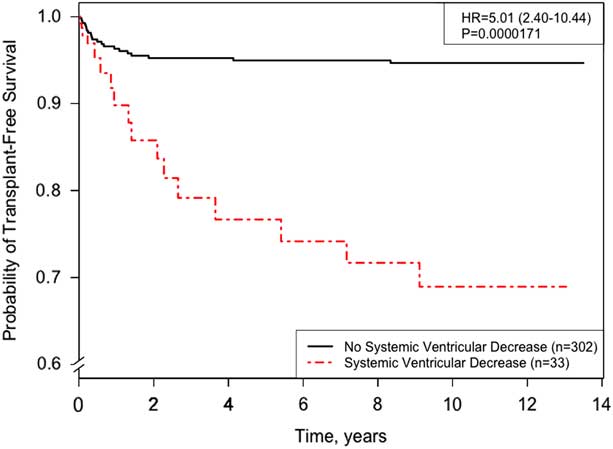
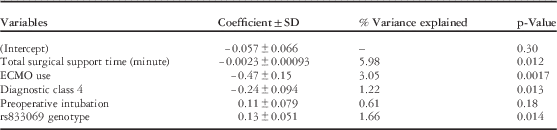
There were 33 instances of systemic ventricular functional decline (9.9%) and no instances of systemic ventricular functional improvement. There were 17 instances of functional decline in the A/A group, 10 instances in the A/G group, and six instances in the G/G group. There was no statistically significant difference in relative frequencies of ventricular functional decline by group. The results of the stepwise regression on change in ventricular function between the preoperative and most recent echocardiograms are shown in Table 2. The final model explains 12.52% of the variance in change in ventricular function. Surgical support time (p=0.012) and the use of extracorporeal membrane oxygenation (p=0.0017) were significant predictors of a decrease in ventricular function. These two variables in the model explained 9.03% of the variance. The presence of the VEGFA single-nucleotide polymorphism rs833069 minor allele was significantly associated with preservation of ventricular function (p=0.014) and explained an additional 1.66% of the variance. Of note, the SOD2 single-nucleotide polymorphism rs2758331 genotype, which was previously demonstrated to confer a significant survival advantage in this population, was not associated with ventricular function, nor was the additive risk score of VEGFA and SOD2 genotypes. Figure 1 illustrates the difference in transplant-free survival among those patients who experienced a decrease in systemic ventricular function and those who did not during the study period.
Transplant-free survival and change in ventricular function. HR=hazard ratio.

Stepwise regression on change in ventricular function between presurgery and most recent echocardiograms (n=335).

ECMO=extracorporeal membrane oxygenation; SNP=single-nucleotide polymorphism; total surgical support time=total CPB+deep hypothermic circulatory arrest time
Comment
The findings of this study suggest that one possible mechanism underlying the association between the presence of the VEGFA single-nucleotide polymorphism rs833069 minor allele and improved long-term, transplant-free survival in non-syndromic CHD patients may be the preservation of ventricular function. We demonstrate a statistically significant, systemic ventricular functional advantage for those patients with one or two copies of the VEGFA single-nucleotide polymorphism rs833069 minor allele.
Our findings are consistent with in vitro and animal experiments that demonstrated a cardioprotective effect of increased levels of vascular endothelial growth factor. We studied proxy single-nucleotide polymorphisms that are strongly correlated–that is, in linkage disequilibrium–with the postulated causative variants. The VEGFA single-nucleotide polymorphism studied, rs833069, is in strong linkage disequilibrium (r2=0.97) with one 5’UTR single-nucleotide polymorphism, rs2010963, whose minor allele has been associated with higher VEGFA expression.Reference Vailati, Crispim, Sortica, Souza, Brondani and Canani 5 In population genetics, linkage disequilibrium is the non-random association of alleles at different loci – for example, different loci alleles are more likely to be inherited together. Loci are said to be in linkage disequilibrium when the frequency of inheritance of their different alleles is higher or lower than what would be expected if the loci were independent and assorted randomly. We did not directly assess the functional single-nucleotide polymorphisms because we are limited to the single-nucleotide polymorphisms included on the chip used for genotyping; however, the very high linkage disequilibrium between the studied single-nucleotide polymorphisms and the functional single-nucleotide polymorphisms means that the VEGFA variant studied is strongly correlated with higher VEGFA expression. Although this approach of using proxy single-nucleotide polymorphisms would lead to a small loss of power due to imperfect correlation with the potentially causative single-nucleotide polymorphism, this loss of statistical power would not be expected to lead to false-positive results. Increased VEGFA gene expression is positively associated with both angiogenesis and cell survival,Reference Zangi, Lui and Von Gise 8 providing a potential biological basis for the observed improvement in the functional phenotype. Early experiments in which rats were injected with vascular endothelial growth factor led to an increase in vascular permeability and cellular damage, thereby suggesting a mechanism by which vascular endothelial growth factor could have a detrimental effect on cardiomyocytes after myocardial infarction.Reference Weis, Shintani and Weber 16 Additional studies were performed, however, fueled by the finding that low levels of endogenous vascular endothelial growth factor levels were also associated with an increased risk for adverse cardiovascular events after myocardial infarction;Reference Matsudaira, Maeda and Okumura 6 these studies demonstrated improvements in cardiac function after exogenous administration of vascular endothelial growth factor following myocardial infarction.Reference Guo, Cui and Yang 7 These experiments demonstrated that, in the long term, exogenous vascular endothelial growth factor expression leads to adverse cardiac remodelling after myocardial infarction through the aforementioned mechanisms of cardiomyocyte damage, but that, in the short term, pulse-like VEGFA expression improves survival without the negative cardiac-remodelling effects. These findings suggest that VEGFA may be triggered in such a way as to provide increased vascular endothelial growth factor protein to those patients with the minor allele after a period of ischaemic and surgical damage and can, through this pulsatile activation, lead to an improved response to these insults. Such a pulsatile increase in vascular endothelial growth factor protein levels, either through selective genetic activation or through pulsed exogenous administration, could represent a future therapeutic target for clinical follow-up after surgical palliation of non-syndromic CHD.
That we did not demonstrate a preservation of ventricular function associated with SOD2 single-nucleotide polymorphism rs2758331 despite its previously demonstrated improvement in transplant-free survival was not surprising. Increased levels of superoxide dismutase may result in a more robust global response to oxidative damage and may mitigate postoperative, postcardiopulmonary bypass, oxidative cellular damage, but there are little data to suggest that the SOD2 enzyme has a potential cardiomyocyte-specific, beneficial effect. Our previous finding that both SOD2 and VEGFA minor alleles were associated with improved transplant-free survival combined with our current findings suggests that the mechanisms by which each of these alleles confers a survival advantage – both individually and additively – are different, with the VEGFA possibly conferring a more cardiac-specific effect than SOD2.
There are several limitations to the present study. Our cohort comprised patients undergoing surgery at a single institution, and our analyses were all retrospective. Because there were no comparable cohorts, we could not perform pooled data analysis to minimise institutional bias. We minimised covariance through stepwise analysis, testing only those variables that were significantly associated with the outcome. Because we were not able to obtain echocardiograms of all members of the original cohort, we have outlined the similarities and differences between our studied cohort and the original cohort. The studied cohort’s more complex pathology, longer length of stay, and longer operative support time would tend to skew this population towards higher acuity and an inordinate mortality or transplant rate. Despite this potential confounder, there was no such skewing and, more importantly, there was no significant variation in the incidence of the various VEGFA single-nucleotide polymorphism rs833069 alleles in comparison with population reference values. Because of this, we felt confident that our studied population was a sufficiently random sample of the previously studied cohort. The multitude of diagnoses, cardiologists, and echocardiographic indications and parameters used throughout this 15-year cohort allowed for comparisons to be made only between the initial and the most recent echocardiograms before transplant or death. More consistent echocardiographic follow-up would have allowed for more of a longitudinal analysis, but this was not possible in our cohort. Postoperative echocardiographies were not routinely performed in many of the earlier patients in this cohort with less-complicated diagnoses such as ventricular septal defect (VSD), coarctation of the aorta, etc., and there was no consistent, regular schedule of postoperative echocardiographic follow-up even in those patients with more severe diagnoses. This lack of standardised echocardiographic follow-up throughout the cohort prevented longitudinal comparisons. Since the more widespread use of postoperative echocardiograms across patient populations in the interim period, we expect that future studies within this cohort and others will allow for a more robust analysis with a more standardised follow-up. Using the most recent echocardiogram before death or transplant introduces a source of bias in this analysis, as patients who die or require transplant will likely have depressed ventricular function. Although this is a potential bias, the purpose of this study was to assess whether the effect of the studied alleles on transplant-free survival was related to an effect on ventricular function, or whether there was predisposition towards non-cardiac causes of death in these patients. Although we cannot infer from our analysis whether certain patients died necessarily because of ventricular failure, our analysis suggests a correlation between ventricular failure and transplant or mortality. Further, the original echocardiograms were not available for the vast majority of patients in this cohort because of the significant geographical and chronological spread, making independent verification of echocardiographic findings impossible.
As is the case with all genetic studies, associations must be replicated in independent cohorts to validate findings, regardless of their statistical significance. It must also be noted that we were unable to assess absolute serum or tissue levels of vascular endothelial growth factor in our patients. Although experimental data suggest that the minor allele studied is associated with increased levels of vascular endothelial growth factor in other models, it is unclear whether the studied patients have such increased levels. We will be addressing this in future studies, and will look to validate our findings by investigating the presence of such an increase in vascular endothelial growth factor among patients with the minor allele.
In conclusion, we have followed up our previously demonstrated survival benefit with the presence of VEGFA single-nucleotide polymorphism rs833069 and SOD2 single-nucleotide polymorphism rs2758331 minor alleles with a study that demonstrates a possible association between the presence of the VEGFA single-nucleotide polymorphism rs833069 minor allele and preserved long-term ventricular function. The presence and statistical strength of these two findings provides preliminary evidence that the mechanism behind the previously demonstrated survival advantage of the VEGFA single-nucleotide polymorphism rs833069 minor allele may be preservation of cardiac function. The cardioprotective properties of increased endogenous vascular endothelial growth factor have been demonstrated in in vitro, animal, and human studies; thus, our findings have a basis in previous experiments. Our findings may represent a potential therapeutic target to improve ventricular function and long-term survival in a large percentage of non-syndromic CHD patients with the VEGFA major allele. Although surgical methods continue to improve palliation strategies and long-term outcomes of patients with CHD, successful treatment of CHD requires further elucidation of genetic and molecular pathways that alter the disease course both within and outside the operating room. It is our hope that this study, and other genetic studies investigating candidate genetic and molecular pathways that alter the disease course in patients with CHD, will help to define the role of vascular endothelial growth factor and other factors as potential treatment modalities to improve morbidity and mortality in non-syndromic patients undergoing surgical palliation for CHD.
Although there is a theoretical basis for survival and ventricular functional benefit from increased levels of VEGFA, we must exercise caution in interpreting our genetic association data. The association between the presence of the VEGFA single-nucleotide polymorphism rs833069 minor allele and preserved ventricular function reached statistical significance, but only accounted for 1.66% of the variance in the resulting model. As such, it is difficult to claim a direct mechanism for ventricular functional preservation, especially because the exact mechanisms of the studied single-nucleotide polymorphism and increased VEGFA expression are incompletely understood. Further, it must be noted that intraoperative factors explained considerably more of the variance than did the protective allele. With all of these caveats, this study remains the first attempt to explain a potential mechanism behind our previously reported survival benefit conferred by this VEGFA single-nucleotide polymorphism, and marks an important first step in clarifying the role that this and other genetic variants with downstream effects on vascular endothelial growth factor levels may play in surgical risk stratification and survival following neonatal cardiac surgery.
Acknowledgements
The authors thank Jennifer Raue, Sarah Limbach, and all participating paediatric cardiologists and their offices for their assistance in acquiring echocardiograms. The authors also thank all the subjects and their families for their participation.
Financial Support
This work was supported by a grant from the Fannie E. Rippel Foundation, an American Heart Association National Grant-in-Aid (9950480N), HL071834 from the National Institutes of Health, and a Washington State Life Sciences Discovery Award to the Northwest Institute for Genetic Medicine. D.S.K. was supported by 1F31MH101905-01. I.B.S. is supported by the National Institute of Environmental Health Sciences of the National Institutes of Health under award number T32ES015459.
Conflicts of Interest
None.