Introduction
In recent years, there has been a growing interest in investigating the effect of home-based palliative care programs on pain relief and unnecessary suffering as well as on improving the quality of the life of patients with life-limiting illness and their caregivers (Peters and Sellick, Reference Peters and Sellick2006; Wang et al., Reference Wang, Liu and Lee2019). Recent studies with large sample sizes showed several advantages of home-based palliative care programs such as reductions in hospitalizations and hospital days, satisfaction, quality of life, and significant reductions in cost per patient during the final 3 months of life compared with the traditional care in hospital (Totten et al., Reference Totten, White-Chu and Wasson2016; Lustbader et al., Reference Lustbader, Mudra and Romano2017).
In Colombia, there have been some improvements in palliative care provision during the last decade, including increased access to opioid analgesics, better education in palliative care, and the adoption of regulations and norms (Leon et al., Reference Leon, Florez and De Lima2011). However, currently, there is not broad access to palliative care for the Colombian population in need of life-end special care (Camargo-Casas et al., Reference Camargo-Casas, Suarez-Monsalve and Zepeda2018), and home-based palliative care programs are offered only by a few health providers.
Home-based palliative care programs have a priority interest, given the demographic challenge represented by the projected increase of the elderly population in Colombia (Borda et al., Reference Borda, Acevedo Gonzalez and David2016), as well as the high prevalence of chronic diseases in the adult and older Colombian population (Prada and Perez Castano, Reference Prada and Perez Castano2017; Camargo-Casas et al., Reference Camargo-Casas, Suarez-Monsalve and Zepeda2018).
Associated with the growing aging of the population and the elevated prevalence of chronic diseases and disabilities, family caregivers have experienced high levels of caregiver burden during an extended period (He Leow and Wai Chi Chan, Reference He Leow and Wai Chi Chan2011). Family caregivers of individuals under palliative care play an essential role in supporting the well-being and care of patients. Nevertheless, family caregivers often experience adverse physical and psychosocial outcomes which are often underestimated or poorly intervened (Adelman et al., Reference Adelman, Tmanova and Delgado2014). Recent evidence has shown that psychological distress is highly prevalent in caregivers of palliative patients and that clinical depression is even more frequent in caregivers than in patients when patient's condition declines (Hartnett et al., Reference Hartnett, Thom and Kline2016).
The current study's primary hypothesis is that caregiver burden could be related to the effectiveness of a home-based palliative care program, through an indirect effect on the palliative outcome, measured after 1 month. The rationale is based on the idea that high levels of caregiver burden and their consequences (e.g., poor quality of life, irritability, and lack of psychological well-being) would be associated with a poor quality care, neglect, and family malfunction, which in turn would increase the patient's physical, emotional, and psychological symptoms, thus making the end-of-life process more difficult.
Related with our hypothesis, some studies have found that caregivers who reported high levels of burden showed potentially harmful behaviors toward patients, such as verbal aggression and ignoring (Sasaki et al., Reference Sasaki, Arai and Kumamoto2007), which are relatively prevalent in caregivers (Arai et al., Reference Arai, Noguchi and Zarit2017). Besides, a recent study reported that patients who suffered from this kind of behaviors showed significant levels of agitation, apathy, irritability, nighttime behavior disorders, and eating disorders (Toda et al., Reference Toda, Tsukasaki and Itatani2018).
In spite of the large body of evidence showing the caregiver burden as an essential issue to address in palliative care; to our knowledge, there are no published studies evaluating the role of caregiver burden on home-based palliative care program outcomes, neither the evaluation of the impact of high levels of caregiver burden on the effectiveness of outpatient palliative care programs.
The current study aimed to assess the possible mediator role of caregiver burden on the relationship between pre- and post-1-month outcome measure for palliative care in a sample of Colombian subjects with a life expectancy of 3 months or less, enrolled in a home-based palliative care program.
Methods
Participants
Sixty-six patients enrolled in a home-based palliative care program were included in this study (53% women). Eligible patients were 18 or more years of age, diagnosed with at least one life-limiting disease. The mean age was 71.6 years (range: 33–101 years), and all participants live in Medellin, Colombia in rural and urban geographical zones (Table 1). Data from patients without complete pre- and post-information were not included. The application and coding of the results of the measurements were done confidentially, and all participants signed a written informed consent previously approved by the Institutional Ethics Committee of the Sies Salud IPS. This study was conducted following the principles embodied in the Declaration of Helsinki.
Sociodemographic information and patient characteristics

For the life-limiting diagnosis, there was no data available for two patients.
Measurements
Outcome measure for palliative care
Palliative outcome scale (POS) was applied at baseline and 1 month after the enrollment in a home-based palliative care program. It is a 10-item, multidimensional scale that measures aspects in palliative care such as physical and psychological symptoms, spiritual features, practical and emotional concerns of the patient and family, and psychosocial needs of the patient and family. Items are rated on a 5-point Likert scale ranging from 0 (problem absent) to 4 (the worst possible) (Hearn and Higginson, Reference Hearn and Higginson1999), with higher scores indicating a patient's worst state. It has been validated in Spanish language (Serra-Prat et al., Reference Serra-Prat, Nabal and Santacruz2004), and it has been reported good psychometric properties in the Latin American population (Eisenchlas et al., Reference Eisenchlas, Harding and Daud2008). A Cronbach alpha of 0.66 was found for POS at baseline.
Complexity in palliative care
This outcome was assessed with the Diagnostic Instrument of the Complexity in Palliative Care (IDC-Pal). This instrument rates 36 complexity conditions into three dimensions: (1) patient, (2) family and social environment, and (3) health organization. Then, the complex situation of the patient is classified into three levels of complexity: (1) highly complex, (2) complex, and (3) no complex (Comino et al., Reference Comino, Torres and Cejudo2017).
Physical status
Physical status was measured with the Palliative Performance Status (PPS) instrument which was designed to assess physical condition and progression in decline in palliative patients on five functional dimensions: ambulation, activity level, self-care, oral intake, and level of consciousness (Anderson et al., Reference Anderson, Downing and Hill1996). Scoring ranges from 0% to 100%; every 10% decrease shows a fairly significant reduction in physical function. The PPS has demonstrated good reliability in their Spanish translation (Barallat et al., Reference Barallat, Nabal and Canal2017).
Caregiver burden
We tested caregivers using the Zarit Burden Interview, which is a 22-item instrument for assessing the perceived burden of providing family care in five main areas: own health, psychological well-being, finances, social life, and the relationship between the caregiver and the patient (Flynn Longmire and Knight, Reference Flynn Longmire and & Knight2011). The items scoring is based on a 5-point Likert scale indicating the frequency of burden experience, ranging from 0 (never) to 4 (nearly always), with higher scores indicating a more significant burden. This instrument has shown good psychometric properties in its Spanish version (Martın et al., Reference Martın, Salvadó and Nadal1996) and has been successfully used in previous Colombian studies (Arango Lasprilla et al., Reference Arango Lasprilla, Moreno and Rogers2009; Moreno et al., Reference Moreno, Nicholls and Ojeda2015). For the current study, we used the following cutoff points to categorize caregiver's perceived burden levels: 0–20 points for “little or no burden,” 21–40 points for “mild-to-moderate burden,” 41–60 points for “moderate-to-severe burden,” and 60–88 points for “severe levels of burden” (Arango Lasprilla et al., Reference Arango Lasprilla, Moreno and Rogers2009).
The instruments were completed by health personnel during home interviews. Medical information was obtained from the patients’ medical file history.
Description of the home-based palliative care program
Pallium® is a Colombian palliative care program composed by a multidisciplinary team of certified professionals which includes a palliative care physician, a nurse, a hospital social worker, a psychologist, and a spiritual advisor. The team assessed each patient for symptom levels and management, psychosocial and spiritual support, end-of-life planning, and home care at entry and during patient's permanence in the program. The frequency of visits was determined jointly by the Pallium team during meetings carried out every two weeks to review the patient's progress. In average, each patient in the current sample was visited each 15–20 days.
Furthermore, Pallium® supplied a series of training sessions for caregivers in basic aspects such as subcutaneous administration of medicaments, feeding through a nasogastric tube, and cleaning simple wounds. The basic care of patients in terms of activities related to washing, bathing, and dressing was the responsibility of caregivers.
Data analysis
Normal distribution of data was assessed through the Kolmogorov–Smirnov test taking into account the published recommendations by Kim for evaluating normal distribution in small- to medium-sized samples (n < 300) (Kim, Reference Kim2013). Descriptive statistics were used to describe the basic features of the sample included in the study. To examine within-participants’ mean differences, POS data from pre-test and follow-up measures were analyzed using a paired t-test analysis, which is useful for an intergroup comparison of changes in pre- to post-treatment.
The effect size for mean differences analysis was assessed with Cohen's d av [Cohen′sd av = Mdiff /(SD1 + SD2)/2] (M diff: within-subjects’ mean differences; SD: standard deviation) according to available guidelines (Lakens, Reference Lakens2013). This measure used the average standard deviation of both repeated measures, and it is recommended for within-subjects’ designs.
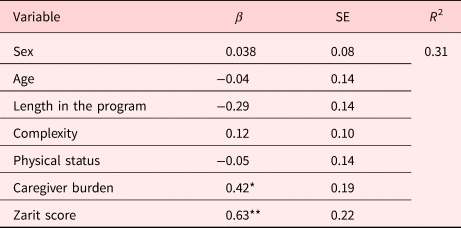
To evaluate the associations between POS score, caregiver burden, physical status, complexity in medical care, and duration in the program, we conducted a correlation analysis with Pearson coefficient and categorical regression analysis (CATREG) version 3.0 (DTSS, Leiden, The Netherlands). For the CATREG model, POS score in 1-month follow-up was included as the outcome variable, while sex, age, duration in program, complexity, physical status, and caregiver burden were included as predictor variables. CATREG analysis was conducted taking in consideration that some of the variables in the model were categorical or ordinal (Hartmann et al., Reference Hartmann, Van Der Kooij and Zeeck2009). CATREG analysis has shown to be appropriate for these cases since it quantifies categorical data by assigning numerical values to the categories, estimating the regression coefficients simultaneously in an iterative process. In addition, one of the most important advantages of CATREG is that for selecting a subset of stable predictors, it uses Lasso (least absolute shrinkage and selection operator) which is a regularized regression method that allows a high level of accuracy in prediction when multicollinearity exists.
The possible mediational effect of caregiver burden in the relationship between the outcome measure for palliative care in pre-test and post-test was examined through mediation in serial models analysis. Mediation analysis was conducted using model four of the PROCESS plugin for SPSS V.25 (Hayes, Reference Hayes2017). For the model proposed, the outcome measure for palliative care in pre-test was taken as the independent variable (IV), the outcome measure for palliative care in post-test as the outcome variable (DV), and caregiver burden as the mediator variable (MV). The primary hypothesis under analysis was that MV mediates the influence of IV on DV. This mediation effect is expected to be a sequence of causal steps in which IV affects MV, which in turn causally influences DV; as a result, we planned to found an indirect effect of IV on DV via MV different from zero. In the model four performed here, at least one causal antecedent or IV (POS in pre-test) influencing an outcome or DV (POS in post-test) through a single intervening variable or MV (caregiver burden) is expected. In addition, there are at two pathways by which IV influence DV: (1) a direct effect which is the effect of POS in pre-test to POS in post-test without passing through caregiver burden and (2) an indirect effect which is the effect of POS in pre-test to POS in post-test through caregiver burden. The indirect effect represents how POS in post-test is influenced by POS in pre-test through a causal sequence in which POS in pre-test influences burden caregiver, which in turn influences POS in post-test.
A complete mediation effect occurs when the association between the IV and DV is eliminated, and a partial mediation occurs when the association between the IV and DV is reduced when MV is introduced in the analysis (Morgan-Lopez and MacKinnon, Reference Morgan-Lopez and MacKinnon2006).
The direct, indirect, and total effects of the mediation model were calculated including bias-corrected bootstrapped standard errors with 1,000 repetitions and 95% confidence intervals. The indirect effect was considered significant if the confidence interval did not include zero. The effect size was calculated for indirect effect through the completely standardized effect which shows the direct and indirect effect in terms of the difference in standard deviations in by one standard deviation in IV via MV (Preacher and Kelley, Reference Preacher and Kelley2011).
The Statistical Package for the Social Sciences V.25 (SPSS Inc., Chicago, IL, USA) was used for all the analyses, considering a p-value < 0.05 as the threshold of significance.
Results
The scores obtained from the measures were mostly normally distributed (p > 0.05) except for duration in the program; therefore, this variable was transformed using the log transformation. No statistical differences were found according to sex and age for the variables under study. Twenty-eight patients died at their homes (53.5% men) and one in the hospital, while 38 remained alive after 1-month follow-up (Table 1).
Association between variables
The average of duration in the program for the total sample was 67.08 days, and the most common life-limiting diagnosis was cancer following by chronic obstructive pulmonary disease; also, the majority of the diagnoses were categorized as a complex disease in palliative care according to the IDC-Pal instrument (Table 1).
Bivariate correlation analysis showed that POS in pre-test and POS in post-test were significantly correlated as expected (p < 0.01) and both were associated with the Zarit Burden Interview (p < 0.05). Interestingly, POS in post-test was found to be more strongly correlated with Zarit Burden Interview (p < 0.01). Physical state measured with PPS was found to negatively correlate with POS in the post-test (p < 0.01) but not with POS in the pre-test. Furthermore, physical status showed a significant association with Zarit Burden Interview (p < 0.01) in a negative direction, indicating that the worst health status and poor functionality in patients were associated with the greatest caregiver burden (Table 2). Moreover, other expected correlations were found, such as physical state with duration in the program in a positive direction (p < 0.01), and POS in post-test with length in the program in a negative direction (p < 0.01).
Pearson's correlations coefficients between palliative-care related variables

*p < 0.05; **p < 0.01.
A paired t-test analysis showed a statistically significant difference between POS in pre-test and POS in the 1-month follow-up (t = 2.29; df = 66; p < 0.05), with a Cohen's d av effect size of 0.19 which is considered as a small effect size according to available guidelines (Cohen, Reference Cohen1992).
Categorical regression results support the hypothesis that caregiver burden is a significant predictor of the worst outcome in palliative care (β = 0.63; p < 0.01) even when controlled by relevant variables such as sex, age, complexity in palliative care, and physical status (Table 3). The model showed an explained variance of 31%.
Categorical regression for sociodemographic and palliative-care program variables, physical status, and caregiver burden in their numerical and categorical measure, taking the outcome measure for palliative care in post-test as the outcome variable in the total sample

SE, Standard error; Burden was coded as 1 = little or no burden, 2 = mild-to-moderate, 3 = moderate-to-severe, and 4 = severe.
*p < 0.05; **p < 0.01.
Mediation analysis
Caregiver burden was found to be a significant partial MV of the relationship between the outcome measures for palliative care in pre-test and post-test (direct effect coefficient = 0.609, SE = 0.094, p = 0.0001 vs. indirect effect coefficient = 0.551, SE = 0.094, p = 0.0001) (Figure 1). Albeit small, the effect size indicates that the outcome measure for palliative care in 1-month follow-up increases by 0.059 standard deviations for every one standard deviation increase in outcome measure in the pre-test, indirectly via caregiver burden (Table 4).
Simple mediation model for the total sample. The relationships between POS in pre-test (IV, independent variable) and POS in post-test (DV, dependent variable) mediated by the caregiver burden (MV, mediator variable). The path a is the effect of IV on MV, path b is the effect of MV on DV, path c is the direct effect of IV on DV, and path d is the indirect effect of IV on DV. The total effect of the mediation model was 0.057 CI [0.002 to −0.129]. *p < 0.05, **p < 0.001.

Mediation effects for the total sample

SE, Standard error; for total indirect effect is reported Bootstrapped SE.
Discussion
The current study aimed to evaluate the mediational effect of caregiver burden on the relationship between pre-test and post-test outcome measures for palliative care used as indicative of the effectiveness of a home-based palliative care program. The main finding from our analyses is that the improvement in symptoms of palliative care patients was influenced by the caregiver burden. Therefore, the positive effect of a home-based palliative care program on the reduction of physical, emotional, and psychological symptoms of the patient was reduced by an indirect effect of the caregiver burden.
According to previous studies, family caregivers provide an essential part of the care needed in the terminal phase of patients with chronic illness; therefore, caregiver burden is considered a relevant variable. Several studies have shown the negative impact of palliative care on caregiver's health, such as higher levels of stress and depression, lower subjective well-being (Hudson et al., Reference Hudson, Thomas and Trauer2011), and an increased risk of cardiovascular diseases (Capistrant et al., Reference Capistrant, Moon and Glymour2012). To our knowledge, however, this study is the first to be performed to assess the impact of caregiver burden on the outpatient palliative care outcomes in a Latin American sample.
Often in home-based palliative care programs, the psychosocial support that caregivers receive from health services is unsystematic and incomplete. Although an expected outcome of home-based palliative care programs is the relief of caregiver burden, the previous evidence shows that there were no significant differences in caregiver burden when patient-focused palliative care was compared with usual care (Clark et al., Reference Clark, Rummans and Sloan2006; O'Hara et al., Reference O'Hara, Hull and Lyons2010).
Our results suggest that the relationship between health deterioration in palliative patients and caregiver burden is not linear. Our findings, although newfangled, have support from previous results from specific patient-focused palliative care interventions that have indicated that specific interventions may inadvertently relate to an increased caregiver burden. Proposed explanations are that a more severe affective symptomatology in caregivers could be associated with having an outsider telling them how to approach the care of their ill family member in a different way (Kurtz et al., Reference Kurtz, Kurtz and Given2005), while the depressive symptomatology in caregivers is not reduced if the patient is suffering (Hebert et al., Reference Hebert, Arnold and Schulz2007).
Although we did not measure caregiver burden in repeated occasions during the program, one relevant interpretation of our results is that the conception that interventions focused primarily on reducing patient pain and suffering necessarily improve caregiver outcomes may perhaps be not entirely true. The above could be explained in part for the psychosocial challenges that caregivers must face when the patient is beginning a terminal phase of their illness. The main challenges are the limitations of time and economic resources of the caregivers, the loss of opportunities to maintain their social relationships with others, the loss of their jobs, and difficult to find additional jobs to pay for their patient's treatment. These worries can hardly be solved with a patient-focused palliative care program. Besides, a growing concern in caregivers is that will be highly likely that after patient's death, the remaining family members will have to take on the economic burden (Van Houtven et al., Reference Van Houtven, Ramsey and Hornbrook2010). In the Colombian population, economic concerns in caregivers are a relevant issue: a previous study conducted with Colombians caregivers showed the socioeconomic status as a significant predictor of depressive symptoms (Stevens et al., Reference Stevens, Arango-Lasprilla and Deng2012).
Another relevant explicative factor for our results is that although it could be expected that early palliative care leads to greater satisfaction with high-quality care (Bakitas et al., Reference Bakitas, Lyons and Hegel2009), palliative care often occurs too late in the illness trajectory when caregiver burden is high and has overpassed the coping resources of the caregiver. On this subject, since some associated factors of caregiver burden are mostly modifiable (e.g., time spent providing care per day, self-esteem, occupational aspects, and family functioning) (Yoon et al., Reference Yoon, Kim and Jung2014), home-based palliative care programs should also focus on psychosocial and occupational interventions directed to those modifiable factors.
The present study has some limitations that should be mentioned. First, our sample size was small, and the heterogeneity of the sample in terms of socioeconomic status, education level, and other relevant sociodemographic variables were not possible to control for. Therefore, we recognize the need to replicate this study on more diverse populations. Second, the absence of measures related to the mental and emotional status of the caregivers did not allow us to perform a more complex and complete mediational model according to psychiatric morbidity. Despite these limitations, our study includes follow-up assessments with validated scales commonly used in large palliative-based studies and offer new results that can guide the development of psychosocial and occupational interventions for caregivers within home-based palliative programs.
Further studies with larger samples sizes are needed to corroborate our findings. Future studies should also include potential mediator variables, such as resilience, personality traits, and psychiatric diagnosis (Palacio et al., Reference Palacio, Krikorian and Limonero2018), in order to provide complex and more complete mediational models that should allow a better understanding of the relationships between patient's quality of life, caregiver's burden, and effectiveness of palliative home-based programs. A deeper understanding of these features should be of relevant value for the design of better and more effective programs for end-of-life processes.
Acknowledgments
We are deeply grateful with the study participants and clinicians from the SIES. We also thank Luis Armando Sepúlveda M.D. (Palliative Program Director), and the palliative care team; Lina Elena Escobar, Lady Johana Tovar, Merly Paola Guarín, Guisella Andrea Rojas, Manuela Montoya Berrío, Johan Kenlly Guzmán, and Nataly Moncada who assisted in recruitment, and data collection.
Funding
This study was conducted as a result of an innovation project supported by The Administrative Department of Science, Technology and Innovation (COLCIENCIAS) (grant # 769-2017). The authors report no conflicts of interest. A.J.P.M., L.R., and L.E.V. were supported by Sociedad Integral de Especialistas en Salud (SIES), Bogotá, Colombia.