Introduction
Overall attrition rates in randomized controlled trials (RCTs) in schizophrenia frequently exceed 50% and appear to increase by 1% with each publication year in the period from 1960 to 2000.Reference Wahlbeck, Tuunainen, Ahokas and Leucht 1 As a result, trials have become increasingly inefficient, and sample sizes need to correct for this in order to preserve sufficient power. Better knowledge and understanding of the underlying factors contributing to dropout (e.g., baseline characteristics, trial procedures, and treatment effects) could be helpful to improve clinical trial design and enhance completion rates.
Patient withdrawal of consent (WOC) and investigator-rated insufficient therapeutic effect (ITE) are commonly observed in RCTs with antipsychotics. In several large-scale, long-term, antipsychotic RCTs conducted during the previous decade, dropout rates due to WOC varied between 29 and 40%.Reference Lieberman, Stroup and McEvoy 2 – Reference McEvoy, Lieberman and Perkins 5 Despite a consistently high percentage of dropouts due to WOC among patients with schizophrenia participating in an RCT, the underlying reasons causing a participant to withdraw from a clinical study have, to the best of our knowledge, never been systematically investigated. Can WOC perhaps be associated with and regarded as a form of poor compliance that is so commonly seen in patients with schizophrenia? In daily practice, treatment of schizophrenia is often challenged by various degrees of treatment disengagement or nonadherence.Reference Mert, Turgut, Kelleci and Semiz 6 Adherence rates in schizophrenia are substantially lower than those in other chronic (and potentially life-threatening) conditions. The median nonadherence rates to antipsychotics typically range from 40 to 55%,Reference Young, Zonana and Shepler 7 , Reference Fenton, Blyler and Heinssen 8 and lack of insight and poor satisfaction with treatment have repeatedly been identified as major determinants.Reference Fenton, Blyler and Heinssen 8 – Reference Cabeza, Amador, López and de Chávez 12 However, subjective well-being has also been shown to exert a separate and independent influence on compliance, irrespective of the presence of clinical symptoms.Reference Marder 13 – Reference Lambert, Schimmelmann and Naber 15 In contrast, the severity of baseline psychotic symptoms, illness duration, presence of mood symptoms (or diagnosis of schizoaffective disorder), inpatient status, history of substance abuse, and sociodemographic variables have yielded mixed results regarding associations with nonadherence.Reference Cabeza, Amador, López and de Chávez 12
Poor treatment response, leading to dropout, occurs on average in about 20% of the participants in long-term schizophrenia trials.Reference Lieberman, Stroup and McEvoy 2 , Reference Kahn, Fleischhacker and Boter 3 , Reference Haro, Suarez and Novick 16 Upon study discontinuation, investigators are usually requested to record the single most important reason for dropout. This can be either lack of efficacy, adverse events (AEs), WOC, or other reasons such as failure to return for follow-up visits. This raises the question of what makes a patient decide to withdraw from a trial when investigators are satisfied with the efficacy and tolerability of the treatment. It is also of interest to know the extent to which trial discontinuation due to WOC and ITE is specifically associated with a poor satisfaction with treatment of a patient (PST) and an investigator (IST). The factors that may be associated with patient satisfaction with treatment include measures of “distress,” “subjective well-being,” and “functional outcome.”Reference Chue 17 – Reference Hofer, Rettenbacher, Widschwendter, Kemmler, Hummer and Fleischhacker 20 Several longitudinal studies have reported a positive association between amelioration of depressive symptoms and a patient’s subjective well-being or quality of life.Reference Kim, Ann and Kim 21 – Reference Fitzgerald, de Castella and Filia 24 Interestingly, in standardized interviews, patients diagnosed with schizophrenia did not rank depressive thoughts and emotions as a high-priority treatment goal, whereas physicians particularly attached value to improved cognitive abilities and reduction of disease-related symptoms.Reference Kuhnigk, Slawik, Meyer, Naber and Reimer 18 Although factors determining satisfaction with treatment have become a research topic of growing interest, the majority of studies in this area so far had considerable limitations, such as small sample size, open-label treatment, and weighted selection of respondents toward those who had good experiences in the survey analysis.Reference Chue 17 , Reference Hellewell 25 – Reference Kohler, Unger, Hoffmann, Steinacher and Fydrich 27
In an attempt to identify the determinants of dropout from RCTs, we extracted baseline data and treatment results from a large-scale multiregional RCT for a post-hoc analysis. We hypothesized that dropout due to ITE is primarily the result and reflection of a clinician’s dissatisfaction with treatment and decision to discontinue, whereas dropout due to WOC is primarily the result and reflection of a patient’s dissatisfaction with treatment and decision to discontinue. We further hypothesized that IST and PST are driven by partly different treatment effects and not necessarily associated in the case of dropout.
Methods
A 52-week, double-blind, randomized, active-controlled, two-armed, multiregional study was designed to explore the long-term efficacy and safety of asenapine in comparison with olanzapine in a large sample of patients diagnosed with schizophrenia or schizoaffective disorder (registered as no. NCT00212784 at ClinicalTrials.gov). The post-hoc analysis reported here relies on the baseline data and treatment effects from all participants in the study, except those who had never before received treatment with antipsychotics. The details of the underlying study design and entry criteria are described elsewhere.Reference Schoemaker, Naber, Vrijland, Panagides and Emsley 28
Study participants
A total of 1,225 inpatients and outpatients fulfilling the criteria for schizophrenia (SCZ) or schizoaffective disorder (SAD) according to the Diagnostic and Statistical Manual of Mental Disorders (4th ed., text revision [DSM–IV–TR], 2000) were enrolled in 102 sites in Europe, Russia, Australia, and South Africa. They all received up to 52 weeks of double-blinded, double-dummy treatment with asenapine (5–10 mg bid) or olanzapine (10–20 mg qid). 29 A total of 83 of them had never been on antipsychotics and were excluded from the current analysis because satisfaction with treatment was measured in comparison with treatment received before (see below). From the remaining 1,142 enrolled patients with a non-first episode of schizophrenia or schizoaffective disorder, 6 were not treated further after screening, leaving a total of 1,136 participants for evaluation.
Outcome measures
For all study participants not completing the 52 weeks double-blinded treatment, investigators were instructed to record the single most important reason for dropout, selecting from the following: (1) adverse event or serious adverse event (including hospitalization related to worsening of disease), (2) lack of efficacy, (3) lost to follow-up, (4) withdrawal of consent, or (5) some other reason. Patients who dropped out due to lack of efficacy or due to the serious adverse event “hospitalization, related to worsening of disease” were considered as one group (i.e., dropping out due to ITE). Asymmetry in the data did not allow considering patients lost to follow-up (LFU) and patients withdrawing consent (WOC) as one group, with Positive and Negative Syndrome Scale (PANSS) total scores showing a mean reduction (at the last assessment prior to dropout) of approximately 30 points in the LFU group versus 14 in the WOC group and less than 1 point in patients dropping out due to lack of efficacy or hospitalization due to worsening. The WOC group thus comprised only patients who withdrew consent.
For assessment of satisfaction with treatment (PST and IST), patients and investigators were asked to rate their satisfaction with the treatment in comparison with previous medications administered for their disease on a 5-point Likert-type scale, ranging from 1 (much worse) to 5 (much better).
Dropout due to WOC and dropout due to ITE were used as dependent variables in multiple regression models, exploring the extent to which these specific outcomes could be predicted by particular baseline characteristics and treatment results. In a subsequent step, using similar multiple regression models, the influence of specific symptom dimensions, subjective well-being, and health impairment on satisfaction with treatment among patients and investigators was explored.
Outcome predictors
To explore the influence of patient characteristics on outcome, the following baseline data were collected: gender; level of education (number of years); marital status (with or without a partner); recent substance abuse (graded as abstinence, use without impairment, abuse, or dependence); diagnostic subtype (SCZ or SAD); number of years symptoms were present; hospitalization status (in- or outpatient); disease severity; and randomized treatment received. We additionally collected individual patient data for factors earlier described to be associated with dropout due to lack of efficacy or treatment disengagement, including clinical improvement, level of insight, occurrence of side effects (as reflected by total number of severe adverse events with a possible, probable, or definitive relationship with treatment according to the investigator), satisfaction with treatment, and subjective well-being.Reference Fenton, Blyler and Heinssen 8 – Reference Lambert, Schimmelmann and Naber 15
Variables were assessed and considered to collectively predict outcome in the current analysis as follows. Disease severity and change from baseline were rated by the clinician on the Clinical Global Impression Severity (CGI–S) and Improvement (CGI–I) subscales.Reference Guy 30 Together with IST scores and the occurrence of disturbing side effects, CGI–I ratings were considered as indices of clinician-rated treatment response, or “effectiveness.” Individual symptom severity was rated by clinicians on the 30-item PANSS.Reference Kay, Flszbein and Opfer 31 The item scores were clustered into five dimensions of core disease symptoms following Kelly et al.:Reference Kelley, White, Compton and Harvey 32 (1) the negative component (including the items “conceptual disorganization,” “blunted affect,” “emotional withdrawal,” “poor rapport,” “social apathy,” “lack of spontaneity,” “motor retardation,” and “active social avoidance”); (2) the positive component (“delusions,” “hallucinations,” “grandiosity,” “suspiciousness,” and “unusual thought content”); (3) the disorganized component (“conceptual disorganization,” “stereotyped thinking,” “mannerism and posturing,” “disorientation,” “poor attention,” “lack of insight,” and “preoccupation”); (4) the excited component (“excitement,” “hostility,” “uncooperativeness,” and “poor impulse control”); and (5) the emotional distress component (“anxiety,” “guilt,” “tension,” and “depression”). Cluster scores on these components at endpoint, together with the occurrence of disturbing side effects, were considered as indices of clinician-observed psychopathology, or “illness.” The clinician-rated PANSS cluster scores and patient self-ratings on two separate instruments were employed to confirm the earlier observations that patients attach more value to the amelioration of impairment and to alleviation of distress, whereas investigators attach more value to amelioration of cognitive abilities and symptoms.Reference Chue 17 – Reference Hofer, Rettenbacher, Widschwendter, Kemmler, Hummer and Fleischhacker 20 Scores on PANSS item G12 (“lack of judgment and insight”) and PST were used as indices of a patient’s “treatment engagement.” Patient self-ratings on the Subjective Well-Being under Neuroleptic treatment (SWN) scale and the physical and mental component scales of the Medical Outcomes Study 12-Item Short Form (SF–12) health survey were considered as indices of disease as experienced by the patient, or “impairment.”Reference Naber, Moritz and Lambert 33 , Reference Ware, Kosinski and Keller 34 The above-described indices of “effectiveness” and “treatment engagement” were entered into the regression models predicting dropout, whereas the indices of “illness” and “impairment” were entered into the regression models predicting satisfaction with treatment.
Compliance was assessed by the clinician through pill counts of returned medications at each follow-up visit and ranked as “excellent” when deviating by not more than 5%, “satisfactory” when deviating by not more than 25%, and “poor” when deviating by more than 25% of the prescribed dosages over the entire treatment period. Although it seemed to make sense to include measurements of compliance as an index of “treatment engagement” in the regression models, since clinicians judged compliance satisfactory in more than 95% of cases and excellent in more than 70% of cases, these rankings were not considered sufficiently informative to include as possible predictors of any of the outcome variables.
Preselected predictor variables were tested for independence and relevance through correlational analysis, whereby a Pearson correlation coefficient between variables of 0.25 or higher (at a statistical significance level of p<0.05) was considered to be meaningful. Predictor variables showing the lowest correlation with other predictor variables and the highest correlation with one or more of the outcome variables (WOC, ITE, PST, or IST) were preserved for the regression models. Thus, a tradeoff was made between available indices of medical history (e.g., age vs. years symptoms present, alcohol vs. substance abuse); efficacy (e.g., CGI–I vs. PANSS total score change from baseline, treatment duration, percentage of treatment period hospitalized, or hospitalized at last day of treatment); and safety (e.g., related, severe vs. serious or moderate AEs, AEs of any intensity or relationship with treatment, weight gain, or extrapyramidal symptoms). All analyses were carried out using SPSS (v. 23.0 for Windows).
Regression models and analyses
The independent (baseline and treatment response) variables were split into blocks and entered into a hierarchic multiple regression procedure according to the chronological order in which they became available. Adjusted R 2 was used as a measure of determination of the models and a change in R 2 as a measure of improvement obtained by adding the variables of the subsequent blocks. The sociodemographic data (gender, education, marital status) were entered first, followed by details of medical history (substance abuse, DSM–IV diagnosis, disease duration, hospitalization status); baseline severity (CGI–S); and treatment received in steps two to four. As there were no meaningful predictors identified in the analysis of the first four models (containing demographics, medical history, baseline severity, and treatment), blocks one to four were combined into one in the final regression analyses and referred to as model I, comprising all “risk factors.” In subsequent steps, variables measuring “effectiveness” and “engagement” or “illness” and “impairment” were entered as predictors of dropout (WOC, ITE) or satisfaction with treatment (PST, IST), respectively, and referred to as models II and III. Missing values were excluded pairwise, and preliminary analyses were conducted to ensure normality and linearity of the data, as well as an absence of interfering multicollinearity.
Results
Baseline characteristics, treatment response, and outcome
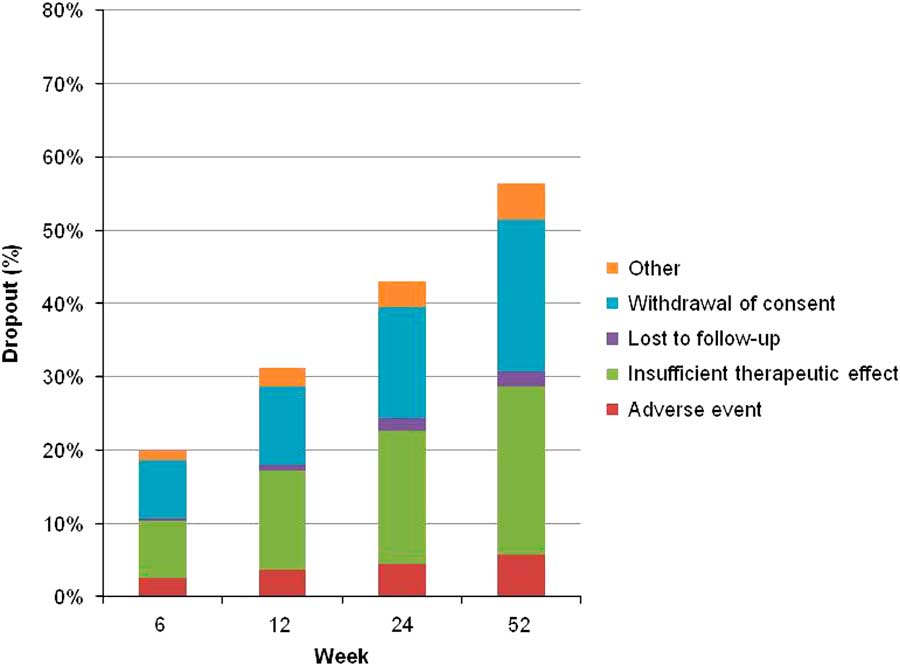
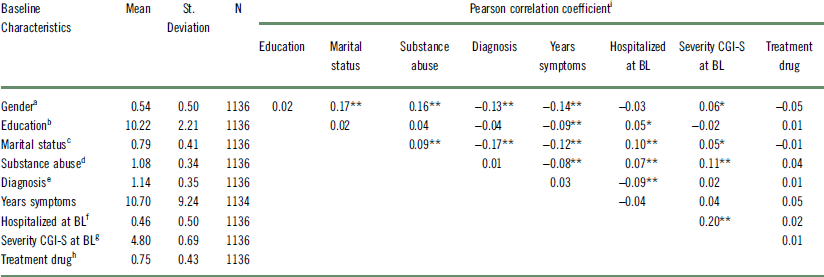
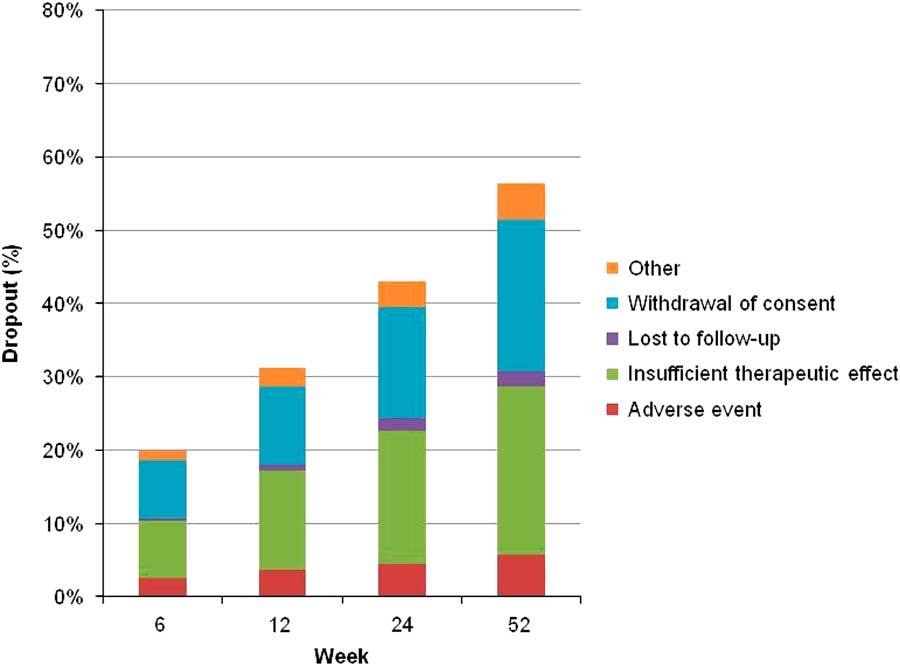
Descriptive statistics and intercorrelations of baseline characteristics are presented in Table 1. The mean total PANSS score at baseline was 92 (range = 50–146), indicative of a population of markedly ill patients.Reference Leucht, Kane, Kissling, Hamann, Etschel and Engel35 A minority of the participants were diagnosed with schizoaffective disorder (SAD = 159, 14.0%) and the great majority with schizophrenia (SCZ = 977, 86.0%). A total of 491 participants (43.2%) completed one-year double-blinded treatment. As shown in Figure 1, overall attrition was 20.0% during the first 6 weeks, gradually increasing to 56.8% at 52 weeks of treatment. The main reasons for study discontinuation over the entire treatment period were ITE (n = 260, 22.9%) and WOC (n = 235, 20.7%).
Dropout (%) over time (weeks) by reason (insufficient therapeutic effect, withdrawal of consent, adverse event, lost to follow-up, or other).
Descriptive statistics and intercorrelations of baseline characteristics in the study sample

a 0 = Female (n = 528), 1 = Male (n = 608);
b Number of years;
c 0 = Married, or with partner (n = 238), 1 = Single (n = 898);
d 1 = Abstinence (n = 1062), 2 = Use without impairment (n = 54), 3 = Abuse (n = 19), 4 = Dependence (n = 1);
e 1 = Schizophrenia (n = 977), 2 = Schizoafffective disorder (n = 159);
f BL = Baseline, 0 = Not hospitalized (n = 613), 1 = Hospitalized (n = 523);
g CGI-S = Clinical Global Impression-Severity scale: 3 = Mildly ill (n = 1), 4 = Moderately ill (n = 396), 5 = Markedly ill (n = 567), 6 = Severely ill (n = 169), 7 = Among most severely ill (n = 3);
h 0 = Olanzapine (n = 281), 1 = Asenapine (n = 855);
i * p<0.05, ** p<0.01.
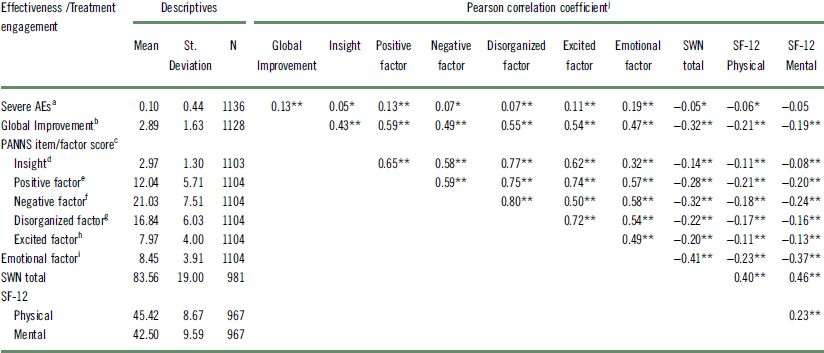
Descriptive statistics and intercorrelations of efficacy and safety parameters are presented in Table 2. CGI–I endpoint scores indicate that 45% of the participants were considered to have at least minimally improved at endpoint, 23% to have minimally worsened or not changed, and 10% to be much or very much worse since the onset of their treatment. The majority of participants (67.1%) experienced no or only mild adverse events, whereas 78 participants (6.9%) experienced one or more severe AE at least possibly related to treatment. In 156 cases, PST or IST scores were not available, leaving 980 participants for a cross-comparison of satisfaction with treatment.
Descriptive statistics and intercorrelations of efficacy and safety parameters
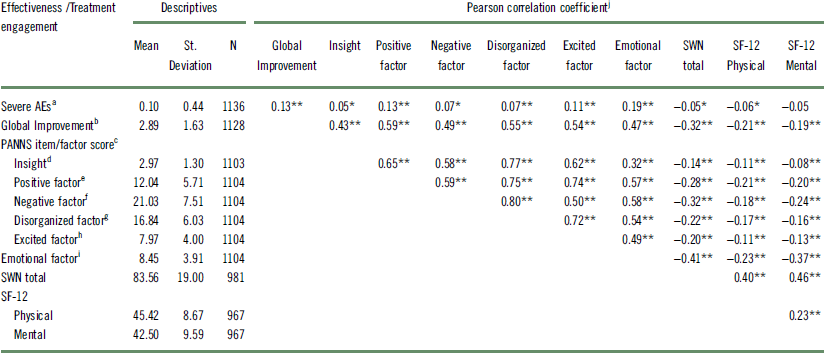
a Occurrence (number) of severe adverse events, at least possibly related to treatment: 0 in 1058 participants (pts), 1 in 59 pts, 2 in 10 pts, 3 in 5 pts, 4 in 3 pts, 6 in 1 pts;
b CGI-I at endpoint (EP): 1 = Very much improved (n = 252), 2 = Much improved (n = 327), 3 = Minimally improved (n = 184), 4 = No change (n = 144), 5 = Minimally worse (n = 109), 6 = Much worse (n = 99), 7 = Very much worse (n = 13), values missing n = 8;
c Positive and Negative Syndrome Scale (PANSS) scores at EP;
d PANSS item ‘lack of judgment and insight’ (range 1-7);
e Subtotal of PANSS items ‘delusions’, ‘hallucinations’, ‘grandiosity’, ‘suspiciousness’, ‘unusual thought content’ (range 5-35);
f Subtotal of PANSS items ‘conceptual disorganization’, ‘blunted affect’, ‘emotional withdrawal’, ‘poor rapport’, ‘social apathy’, ‘lack of spontaneity’, ‘motor retardation’, ‘active social avoidance’ (range 8-56);
g Subtotal of PANSS items ‘conceptual disorganization’, ‘stereotyped thinking’, ‘mannerism and posturing’, ‘disorientation’, ‘poor attention’, ‘lack of insight’, ‘preoccupation’ (range 7-49);
h Subtotal of PANSS items ‘excitement’, ‘hostility’, ‘uncooperativeness’, ‘poor impulse control’ (range 4-28);
i Subtotal of PANSS items ‘anxiety’, ‘guilt’, ‘tension’, ‘depression’ (range 4-28);
j * p<0.05, ** p<0.01.
Whereas there were no meaningful intercorrelations between baseline characteristics, a moderate correlation between the SF–12 mental component and PANSS emotional factor scores (r = –0.37, p<0.01) was observed. Also, SWN total scores showed a moderate correlation with CGI and PANSS factor scores, and fairly high correlations with the SF–12 physical (r = 0.40) and SF–12 mental (r = 0.46) component scores. Intercorrelations between CGI and PANSS factor scores were substantial to very high (range r = 0.47–0.80).
Factors associated with trial discontinuation
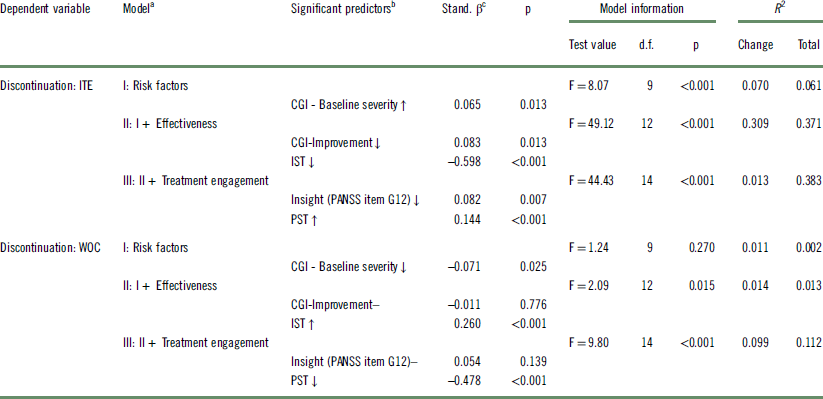
The results of the hierarchical multiple regression analyses are summarized in Tables 3A and 3B.
Joint effect of baseline characteristics, outcome, and satisfaction with treatment on study discontinuation (ITE, WOC)
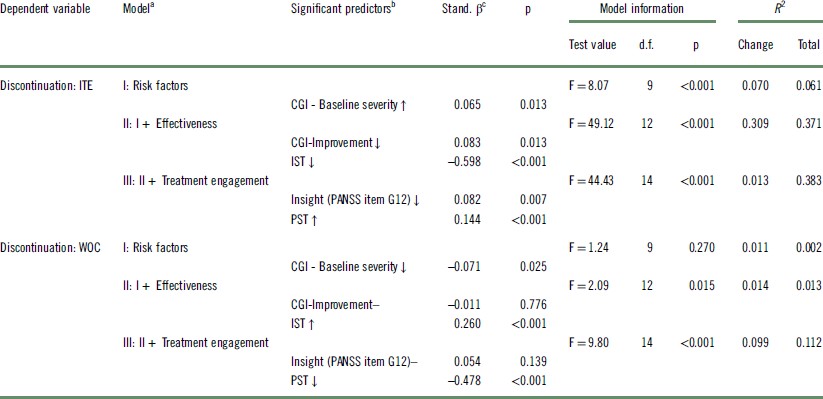
ITE Insufficient therapeutic effect; WOC Withdrawal of consent; IST Investigator’s satisfaction with treatment; PST Patient’s satisfaction with treatment; CGI Clinical Global Impression; PANSS Positive and Negative Syndrome Scale.
a Subsequent entering of blocks 1-4 in the models for ITE and WOC was associated with a R 2 total of less than 0.07 and not listed here. The + sign indicates that the variables listed are added to those in previous blocks.
b Only independent variables attaining a significant standardized β value in the full model for ITE or WOC are listed here. The direction of the effect is indicated by arrows (↑ positive effect, ↓ negative effect, ̶ no significant effect on dependent variable).
c Standardized β values in the final model.
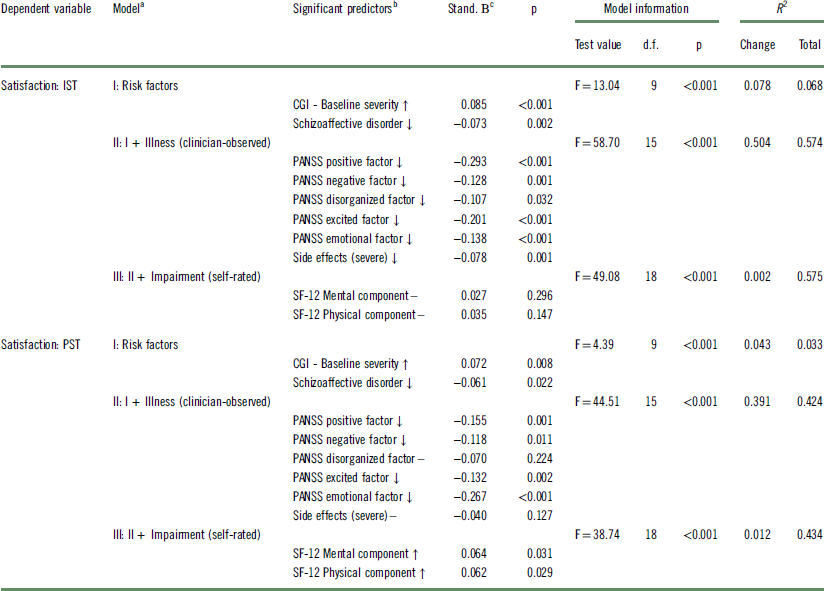
Joint effect of baseline characteristics, outcome, and satisfaction with treatment on satisfaction with treatment (IST, PST)
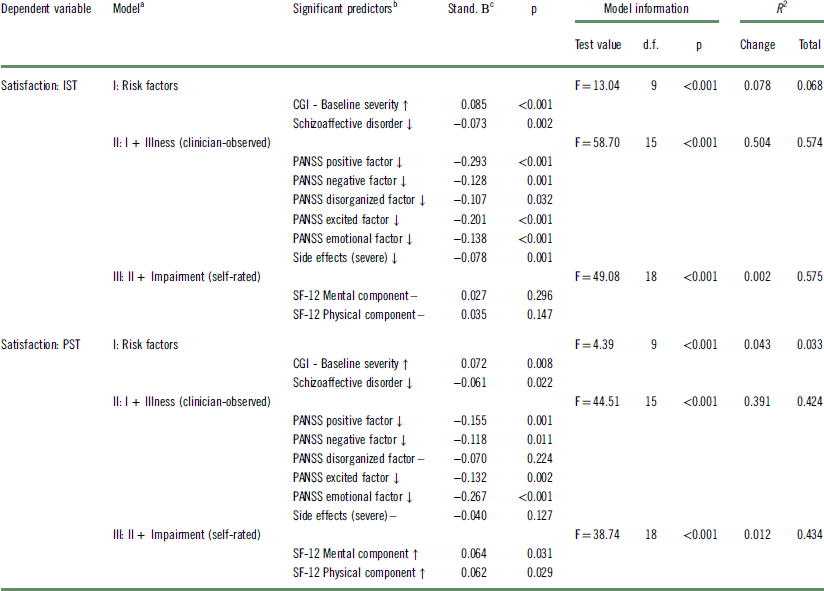
IST Investigator’s satisfaction with treatment; PST Patient’s satisfaction with treatment; CGI Clinical Global Impression; PANSS Positive and Negative Syndrome Scale;
SF-12 Short Form health survey (12-item).
a Subsequent entering of blocks 1-4 in the models for IST and PST was associated with a R 2 total of less than 0.07 and not listed here.
b Only independent variables attaining a significant standardized β value in the full model for IST or PST are listed here. The direction of the effect is indicated by arrows (↑ = positive effect, ↓ = negative effect, ̶ = no significant effect on dependent variable). The + sign indicates that the variables listed are added to those in previous models.
c Standardized β values in the final model.
The extent to which dropout due to ITE could be predicted on the basis of treatment response was moderate (R 2 = 0.383). A relatively high baseline severity and lack of improvement on CGI, as well as a lack of insight at endpoint (PANSS item G12) and a poor investigator’s satisfaction with treatment, were found to be significant predictors of study discontinuation due to ITE. Dropout due to ITE appeared to be positively associated with a patient’s satisfaction with treatment (standardized β = 0.144, p<0.001).
The extent to which dropout due to WOC could be predicted was very modest (R 2 = 0.112). Mild illness at baseline and poor patient satisfaction with treatment were identified as significant predictors (albeit with very weak power). Dropout due to WOC appeared to be positively associated with an investigator’s satisfaction with treatment (standardized β = 0.260, p<0.001). The occurrence and frequency of severe side effects were not predictive for dropout due to ITE or WOC.
Factors associated with satisfaction with treatment
Almost 60% of the variance in IST and more than 40% of the variance in PST could be explained by the investigator-rated scores on PANSS item clusters. Occurrence of severe side effects was only marginally associated with IST (standardized β = –0.078, p = 0.001) and not at all with PST (standardized β = –0.040, p = 0.127). High scores on the various PANSS factors predicted poor satisfaction with treatment, although the disorganized factor was found to have a modest, but significant, effect on IST only (standardized β = –0.107, p = 0.032) and not on PST (standardized β = –0.070, p = 0.224). The PANSS positive factor had the strongest association with IST (standardized β = –0.293, p<0.001), whereas PST was more strongly predicted by the PANSS emotional distress factor (standardized β = –0.267, p<0.001). A relatively mild illness at baseline and diagnosis of SAD contributed negatively to satisfaction with treatment, although these two variables together only explained about 8% of the variance in IST and around 4% of the variance in PST. Patient self-ratings did not show any significant effect on IST, but the SF–12 physical and mental component scores appeared to be significant predictors for PST (though only explaining 1% of the variance when the other variables were accounted for).
Discussion
The aim of the present study was to identify the major determinants of trial discontinuation in a multiregional RCT. We hypothesized that patients and investigators attach different values to the effects of treatment and that low patient satisfaction is the leading cause for WOC, whereas poor investigator satisfaction is the leading cause of ITE. These results were in line with our hypotheses: dropout due to ITE and WOC showed strongest associations with IST and PST, respectively, whereas the PANSS positive and excited factor scores at endpoint were the main determinants of IST, and the PANSS emotional factor score was the main determinant of PST.
As expected, dropout due to ITE was most strongly associated with poor treatment effectiveness. In contrast, dropout due to WOC appeared difficult to predict and was not meaningfully associated with attenuated clinical improvement, the occurrence of severe side effects, or a patient’s lack of insight. Considering WOC as an ultimate form of treatment nonadherence, our results failed to corroborate the findings of naturalistic studiesReference Dassa, Boyer, Benoit, Bourcet, Raymondet and Bottai 36 , Reference Ascher-Svanum, Faries, Zhu, Ernst and Swanson 37 that lack of insight has a negative impact on drug compliance or treatment adherence. Neither do our results confirm that undesirable side effects are a major contributor to WOC or PST, as could have been expected on the basis of surveys held among patients and psychiatrists.Reference Fakhoury, Wright and Wallace 26 , Reference Olivares, Alptekin and Azorin 38 , Reference Lambert, Conus and Eide 39 The present findings are also not in line with the earlier observations by Perkins et al. (2008)Reference Perkins, Gu and Weiden 40 showing that poor treatment efficacy and tolerability are predictors of poor medication adherence, and that both—in combination—are associated with an increased likelihood of discontinuation against medical advice. Both Perkins’s and our study entailed secondary analyses of a flexible-dose 52-week RCT with antipsychotics in patients diagnosed (according to DSM–IV criteria) with schizophrenia or schizoaffective disorder, concomitantly allowing for such adjunctive medications as benzodiazepines and anticholinergics. The main differences between the two RCTs were that the predictor analysis in Perkins’s study was done in first-episode patients (excluded from our analysis), a lower percentage of participants completed one-year treatment (29.8 vs. 43.2%), and more participants withdrew consent (28.8 vs. 20.7%). Adherence to prescribed drug intake was 50–75% in the Perkins study, and presumably lower than the adherence rates observed in our study. Although differences in completion rates and adherence between the two studies may have been due to chance, it could also be that these reflect an underlying difference in treatment effects or expectations among first-episode patients compared to more chronic patients. It is intriguing that, although dropout due to ITE was positively associated with poor treatment effectiveness, there was a remarkable trend visible in our data for a negative association between dropout due to WOC and CGI–I, suggesting a tendency toward improvement rather than worsening among those participants withdrawing consent. This is in line with the recognition by psychiatrists that patients feeling better and thinking that their medication is no longer necessary are important causes of medication discontinuation in schizophrenia.Reference Olivares, Alptekin and Azorin 38
IST and PST were not influenced to a similar extent by the perceived or experienced severity of symptoms in specific domains. Whereas IST was most strongly associated with severity of “positive symptoms” at discontinuation and (to a lesser extent) side effects, PST was predicted best by the severity of “emotional distress” and, to a lesser extent, an experience of impairment in functioning. The presence of mood symptoms, as reflected by a diagnosis of SAD, had a modest negative effect on both IST and PST.
These results are in line with earlier findings demonstrating that investigators and patients weigh the merits of antipsychotic treatment in partially different ways. For example, Fervaha and coworkersReference Fervaha, Takeuchi, Agid, Lee, Foussias and Remington 41 , Reference Fervaha, Agid, Takeuchi, Lee, Foussias and Remington 42 found that change in overall illness severity, as determined by clinicians, was not interchangeable with patients’ views of improvement of their illness status. In their study, a change in positive psychotic symptoms was the strongest predictor of clinician-rated illness severity scores, whereas improvement in depressive symptoms was the strongest predictor of improvement in illness severity, as rated by the patient.Reference Fervaha, Takeuchi, Agid, Lee, Foussias and Remington 41 , Reference Fervaha, Agid, Takeuchi, Lee, Foussias and Remington 42 These findings, together with our results, are in accord with the interview findings of Kuhnigk et al.Reference Kuhnigk, Slawik, Meyer, Naber and Reimer 18 demonstrating that clinicians are primarily focused on psychotic symptom control while patients diagnosed with schizophrenia rank fewer depressive thoughts and emotional distress of highest importance as treatment goals.
The strengths of our study are the relatively large sample size, the inclusion of diverse populations from multiple regions in which an RCT was executed, the reliable investigator ratings, and the relatively high level of compliance. More than a thousand patients were enrolled across three continents. There may have been various reasons for patients to participate, including economics (health insurance), poor response to previous treatment, as well as social reasons, each having a potential impact on overall motivation to stay in the trial. Region-specific differences in the main reason to participate may have been mitigated through the wide-ranging sample of patients enrolled. Although the assessment of adherence through pill counts is not always reliable and may underestimate medication nonadherence, compliance was satisfactory in the large majority of participants and substantially better than could normally be expected on the basis of commonly reported poor adherence rates to prescribed antipsychotics.Reference Young, Zonana and Shepler 7 , Reference Fenton, Blyler and Heinssen 8 , Reference Vanelli, Burstein and Cramer 43 Last, but not least, all investigators were required to participate in an interrater training program before trial execution, ensuring that all PANSS items were evaluated according to predefined criteria.
There are also several limitations inherent to our approach: (1) The original study was not designed to demonstrate the disparity in satisfaction with treatment among investigators and patients. Neither were investigators required to justify recorded reasons for discontinuation or trained to base their choice of primary reason on objective criteria. (2) Although the results seem to confirm the validity of our assumption that poor patient satisfaction is the leading cause of WOC and poor investigator satisfaction is the leading cause of ITE, they have to be interpreted with caution since our method of evaluation did not allow us to discriminate between cause and effect. More precisely, satisfaction with treatment was assessed after discontinuation, but a patient’s and/or investigator’s disappointment may well have preceded the decision to discontinue and even may have been its primary reason (regardless of overall clinical effectiveness). (3) IST and PST were used as independent variables in the predictive models for dropout, though both showed substantial overlap in the overall dataset. The same variables were also used as dependent variables in the predictive models for satisfaction with treatment, although we did not correct for multiplicity. (4) Regarding the use of PANSS factors as indicators of symptom severity in the different domains, it must be noted that underlying symptom clusters were derived from a single scale, designed to assess the severity of illness in its entirety. This may explain the relatively strong associations between factor scores, so that results obtained should be considered as merely indicative and requiring confirmation in follow-up research. (5) Since participants in an RCT may strongly differ from an epidemiologic sample, the results of this RCT may not be generalized to the average practice population of patients suffering from schizophrenia. (6) Extrapyramidal side effects and weight gain have repeatedly been identified as contributors to antipsychotic discontinuation.Reference Perkins 44 Although separate scales for the assessment of depressive symptoms, social functioning, extrapyramidal symptoms, and weight gain were used in the present study, the overall flat ratings on these measures did not allow us to include them as possible predictors in the regression models. Instead, we included the more generic PANSS factor scores and occurrence of severe AEs as main measures of psychopathology and tolerability. Our results can therefore not rule out the fact that specific symptoms (such as akathisia or weight gain) strongly influenced satisfaction with treatment and dropout. (7) Use of the SWN and SF–12 scales as measures of impairment has its limitations because it may prove difficult to obtain completed forms or reliable entries on these scales in the case of severe psychopathology. The relatively high variance in endpoint scores on these self-rated instruments (even among the almost 500 participants who completed the study) may be a reflection of that difficulty and could well have been prohibitive for identifying SWN or SF–12 scores as strong predictors of satisfaction with treatment.
Conclusions
In conclusion, our findings suggest that poor investigator satisfaction with treatment is the leading cause of an investigator’s decision to discontinue medication, and is additionally closely related to poor treatment effectiveness, whereas a patient’s decision to withdraw from an antipsychotic trial, though slightly associated with poor patient satisfaction with treatment, is rather unpredictable on the basis of clinician-rated clinical improvement. Emotional distress appears to have a relatively strong impact on patients’ satisfaction with treatment, so that close monitoring of, and adequate measures to mitigate stress factors might somewhat reduce the chance of patients withdrawing consent. These measures could include efforts by the clinician to: (1) foster a positive relationship with patients, encouraging patients to continue treatment as soon as improvement occurs; (2) promptly identify depressive and anxious feelings at onset; and (3) provide supportive treatment for these symptoms if necessary. Family members and caregivers may also be actively involved in the plan of care, ensuring a tension-free environment in which the patient could live, and adequately supporting a patient whenever habituation to new circumstances is necessary.
Ethical Standards
All participants provided written informed consent for the collection, processing, analysis, and reporting of their anonymous medical information as necessary for scientific purposes, including the use in future medical or pharmaceutical research, prior to their inclusion in the study. The RCT was approved by the appropriate ethics committees and therefore performed in accordance with the ethical standards laid down in the 1964 Declaration of Helsinki and its later amendments.