Background
The majority of clinical guidelines for antidepressant treatment of major depressive disorder (MDD) suggest clinicians should wait for 3–8 weeks before considering a change in treatment regimen, based on the delayed onset of antidepressant action (Association, Reference Association2017; Bauer et al., Reference Bauer, Severus, Köhler, Whybrow, Angst and Möller2015; Gelenberg et al., Reference Gelenberg, Freeman, Markowitz, Rosenbaum, Thase, Trivedi and Van Rhoads2017; Malhi et al., Reference Malhi, Bassett, Boyce, Bryant, Fitzgerald, Fritz and Murray2015). However, patients remaining on ineffective treatment with persistent symptoms results in a significantly increased risk of suicidal behaviour and increased economic burden (Greenberg, Fournier, Sisitsky, Pike, & Kessler, Reference Greenberg, Fournier, Sisitsky, Pike and Kessler2015). Recent reviews have suggested that, in fact, antidepressants could have efficacy within the first 2 weeks of treatment (Lam, Reference Lam2012; Posternak & Zimmerman, Reference Posternak and Zimmerman2005). Furthermore, growing evidence indicates that early improvement in depressive symptoms (e.g. ⩾20% reduction in depressive symptoms after 2 weeks of treatment) predicts later clinical remission and symptom reduction at weeks 6, 8 and 10 with high sensitivity (Katz et al., Reference Katz, Tekell, Bowden, Brannan, Houston, Berman and Frazer2004; Szegedi et al., Reference Szegedi, Müller, Anghelescu, Klawe, Kohnen and Benkert2003; Szegedi et al., Reference Szegedi, Jansen, van Willigenburg, van der Meulen, Stassen and Thase2009; Wagner et al., Reference Wagner, Engel, Engelmann, Herzog, Dreimüller, Müller and Lieb2017). These studies also report that of patients who do not demonstrate early improvement and remain on the same initial antidepressant treatment, only 4% become stable remitters. These results suggest that after 2 weeks of antidepressant treatment, clinicians should consider a change in treatment regimen for non-responders; in a recent meta-analysis of 17 RCTs, 38% of MDD patients did not show early improvement in response to antidepressant treatment and 43% did not show early improvement in response to SSRIs specifically (Wagner et al., Reference Wagner, Engel, Engelmann, Herzog, Dreimüller, Müller and Lieb2017); an earlier meta-analysis similarly reports that 37% did not show early improvement to SSRIs (Szegedi et al., Reference Szegedi, Jansen, van Willigenburg, van der Meulen, Stassen and Thase2009). However, although the newest clinical guidelines for the Canadian Network for mood and anxiety treatment suggest considering switching or augmenting treatment for MDD patients without improvement after 2–4 weeks of treatment (Kennedy et al., Reference Kennedy, Lam, McIntyre, Tourjman, Bhat, Blier and MacQueen2016), recent systematic reviews suggest that large, rigorous RCT studies are needed to compare common treatment interventions (such as augmentation, combination or switch strategies) delivered in early non-responders. There is currently inadequate evidence to determine the optimal strategy and timing for changing treatment at an early stage (Kudlow, McIntyre, & Lam, Reference Kudlow, McIntyre and Lam2014; Wagner et al., Reference Wagner, Engel, Engelmann, Herzog, Dreimüller, Müller and Lieb2017) as most existing findings come from post-hoc analysis of clinical trial data and it is unclear which treatment regimen is best for patients who do not show early improvement (Nakajima, Suzuki, Watanabe, Kashima, & Uchida, Reference Nakajima, Suzuki, Watanabe, Kashima and Uchida2010).
Only two prospective studies have been conducted to examine the efficacy of changes in antidepressant treatment for early non-responders to initial antidepressant treatment at 2 weeks. Nakajima et al. (Reference Nakajima, Uchida, Suzuki, Watanabe, Hirano, Yagihashi and Mimura2011) evaluated outcomes at 8 weeks for MDD patients who were either maintained on sertraline or switched to paroxetine after early non-response (<20% reduction in Hamilton Depression Rating Scale, HAMD-17) to sertraline treatment at week 2. They found that patients who switched antidepressant treatment during this acute phase benefited; however, this study had a small sample size and used an open-label design. More recently, Tadić et al. (Reference Tadić, Wachtlin, Berger, Braus, van Calker, Dahmen and Helmreich2016) conducted the first RCT to determine whether an early medication change (EMC) strategy is superior to guideline-based antidepressant therapy (treatment as usual, TAU) for MDD patients without improvement (<20% reduction in HAMD-17 score) after 2 weeks of escitalopram. One hundred and ninety-two patients were randomly assigned to either EMC (switch to venlafaxine XR for days 15–56, with lithium augmentation for days 29–56 if patients displayed no sustained improvement on days 28), or TAU (escitalopram continuation then switch to venlafaxine XR for days 28–56, if patients displayed sustained improvement at day 28). The authors reported that more than 40% of the EMC group showed no improvement on day 28 (week 4) and were given lithium augmentation treatment, while 74% of the TAU group showed no improvement on day 28 and were switched to venlafaxine XR. Ultimately, they found that the remission rate was not significantly different between the EMC and TAU groups at week 8. However, a potential limitation of this study (as well as a lack of placebo control) is that in both groups, there were two potential medication changes (at week 4 as well as week 2), meaning that more than 40% of patients changed their treatment strategy twice within 4 weeks and 74% of patients had discontinued their initial antidepressant at week 4. Both of these factors may have impacted on treatment efficacy, and limit the interpretation of the data as it is not representative of clinical practice for MDD. Thus, the authors suggested that future studies should use a design addressing these problems; our study aims to do so.
Mirtazapine is a noradrenaline and selective serotonin antagonist (NaSSA), which is suggested to have a faster onset of action and greater efficacy for MDD than SSRIs (Knud, Reference Knud2012). Switching to mirtazapine or combining SSRIs with mirtazapine is commonly considered a valid therapeutic approach to patients who do not respond to the first antidepressant (Blier et al., Reference Blier, Ward, Tremblay, Laberge, Hébert and Bergeron2009b; Carpenter, Yasmin, & Price, Reference Carpenter, Yasmin and Price2002; Fava et al., Reference Fava, Dunner, Greist, Preskorn, Trivedi, Zajecka and Cohen2001). A previous RCT found that combining mirtazapine with paroxetine was well tolerated and had a superior efficacy than either drug alone, from the beginning of treatment to remission maintenance (Blier et al., Reference Blier, Gobbi, Turcotte, de Montigny, Boucher, Hébert and Debonnel2009a). However, no previous studies have evaluated this combination therapy in the context of early non-responders.
Therefore, the objective of this study was to compare treatment outcomes for MDD patients with early non-response (defined as less than a 20% reduction in HAMD-17 after 2 weeks of paroxetine monotherapy), who were either maintained on paroxetine treatment, switched to mirtazapine treatment or given combination therapy of both paroxetine and mirtazapine. We hypothesized that mirtazapine and paroxetine combination therapy for early non-responders at 2 weeks would have superior efficacy at 8 weeks compared to mirtazapine or paroxetine monotherapy.
Methods
Study design and participants
The study was a multicentre clinical trial consisting of a 2-week open-label design (phase 1) and a randomized, double-blind, three-parallel group, placebo-controlled, fixed-dose design (phase 2). Patients were recruited from both general and psychiatric hospitals in five areas of China including Beijing, Guangzhou, Xi'an, Kunming and Shijiazhuang. The authors assert that all procedures contributing to this work comply with the ethical standards of the relevant national and institutional committees on human experimentation and with the Helsinki Declaration of 1975, as revised in 2008. All procedures involving human participants were approved by the Institutional Review Board (IRB) of Beijing Anding Hospital and an independent medical of ethics committee board for all sites. Written informed consent was obtained from all participants. The study protocol was registrated (ClinicalTrials.gov, no. NCT01458626) before the enrolment of any participant.
Inclusion criteria: Male or female outpatients, aged 18–60 years (inclusive), with a diagnosis of a major depressive episode (single or recurrent) according to DSM-IV criteria. Participants were required to have a total HAMD-17 score ⩾20, and score ⩾2 on item 1 (depressed mood) at enrolment in phase 1.
Exclusion criteria: Use of antipsychotics or mood stabilizers within the 5 days prior to screening. Use of depot antipsychotic medication within one cycle prior to screening. Known allergy or lack of response to mirtazapine and paroxetine. Participants receiving an investigational agent (including different formulations and generic agents of the investigational drug) within 3 months prior to screening. A current Axis I primary psychiatric diagnosis other than MDD. Lifetime history of alcohol abuse or dependence. Organic mental disease, including mental retardation. Current or recent (discontinued within the last 30 days) enrolment in a clinical trial involving an off-label use of an investigational drug. History of any cardiovascular, hepatic, renal, respiratory, haematological, endocrinological or neurological disease, or clinically significant laboratory abnormality that is not stabilized or is anticipated to require treatment during the study. Pregnant or lactating women, or women of child bearing potential without appropriate birth control measures. Previous treatment with ECT or MECT within 3 months prior to screening. Significant risk of suicidal and/or self-harm behaviours. Any systematic psychotherapy (psychoanalysis, cognitive comprehension, desensitization therapy, hypnosis therapy, Morita therapy) was prohibited.
Randomization
Phase 2 was a randomized, double-blind design and treatment assignment was based on a computer-generated randomization code with a block size of six provided by the biometrics department of R&G Pharma Studies Co., Ltd. Access to the treatment codes was restricted to personnel charged with generation and maintenance of randomization files, and packaging trial medication. A manufacturer with GMP qualification produced the placebo medication, and a technician prepared sequentially numbered packages that masked any information about test medication. When an eligible participant entered phase 2, a full-time pharmacist received the prescription and dispensed a medication package with a corresponding number, which was given to the participant. This process ensured that participants and physicians remained masked to the treatment allocation.
Interventions
The open-label preliminary phase lasted for 2 weeks, during which paroxetine was initiated at 10 mg/day and titrated up to 20 mg/day (day 5). Participants were excluded if they had taken an antidepressant within 5 half-lives of the antidepressant. The patients who did not show early improvement (⩾20% decrease of HAMD-17 total score at week 2), entered into phase 2 and were randomized into three 6-week treatment arms [mirtazapine (30 mg/day); paroxetine (20 mg/day); mirtazapine (30 mg/day) + paroxetine (20 mg/day)]. The patients who did demonstrate early improvement discontinued the study.
Investigational products included a mirtazapine tablet (30 mg), mirtazapine placebo tablet (30 mg), paroxetine tablet (20 mg) and paroxetine placebo tablet (20 mg). Mirtazapine or mirtazapine placebo tablets were administrated at night, and paroxetine or paroxetine placebo tablets were administrated in the morning.
Use of non-benzodiazepines such as zolpidem and zopiclone was permitted for patients with severe insomnia; benzodiazepines such as lorazepam, oxazepam, estazolam and alprazolam were permitted in patients with significant anxiety symptoms. The use of drugs for the treatment of somatic diseases was allowed throughout the trial. Antipsychotics, other antidepressants or mood stabilizers were prohibited during the study. Electroconvulsive therapy, transcranial magnetic stimulation, phototherapy, electroacupuncture, biofeedback and vagal nerve stimulation were also prohibited. Any systematic psychotherapy (psychoanalysis, cognitive comprehension, desensitization therapy, hypnosis therapy, Morita therapy) was prohibited, but general supportive counselling (listening, encouraging patients to express themselves and empathy, but not using special intervention techniques) was permitted.
Outcomes
The primary outcome was the change in the 17-item Hamilton Depression Scale (HAMD-17) total score from randomization (week 2) to endpoint (week 8).
Secondary outcomes included remission rate (the proportion of participants at endpoint with HAMD-17 total score ⩽7), response rate (the proportion of participants at endpoint with a reduction of HAMD-17 total score ≥ 50%), time to remission and response, the change in 16-item Quick Inventory of Depressive Symptomatology-self report (QIDS-SR16) total score, and the proportion of patients with ‘much improved’ or ‘very much improved’ scores on the Clinical Global Impression-improvement (CGI-I) scale at endpoint (week 8). A full list of primary and secondary outcome measurements is detailed in the Appendix.
Safety was assessed using adverse event (AE) reporting, clinical laboratory measurements and physical examinations.
Statistical analysis
Two hundred and four participants were included in the randomization phase, randomized with a ratio of 1:1:1, providing 80% power to detect clinically significant difference in mean changes from randomization to 6 weeks in HAMD-17 total score (assuming combined s.d. = 1.95) between the mirtazapine + paroxetine group and the mono-paroxetine group. Taking into account a predicted 5% attrition rate, at least 67 participants were needed in each group. For adequate sample size in the randomization phase, it was estimated 540 participants were required to be enrolled in the open-label phase (assuming the proportion of participants with early improvement is 63% at week 2). This calculation was based on a meta-analysis which reported clinical change in patients treated with SSRI antidepressants (Szegedi et al., Reference Szegedi, Jansen, van Willigenburg, van der Meulen, Stassen and Thase2009).
The pre-specified primary efficacy endpoint was the change from randomization (week 2) to endpoint (week 8) in HAMD-17 total score based on the intention to treat principle. The analysis used all available data for a repeated-measures ANCOVA with site and treatment baseline HAMD-17 total score as fixed effects, as well as an additional model with the interaction of site×group to detect the difference among sites. Last observation carried forward (LOCF) was used to impute missing values. Pre-defined secondary continuous endpoints (QIDS-SR16) were analysed using ANOVA (LOCF) models. The proportion of participants showing categorical improvement (defined by CGI-improvement as ‘much improved’ or ‘very much improved’) at week 6 was compared with the Kruskal–Wallis rank-sum test. Cochran and Mantel–Haenszel statistics were used to test the remission and response rates, which were classified, respectively, as a total score of less than 7 and a reduction of more than 50% in HAMD-17. We constructed Kaplan–Meier curves to display the time-related proportion of participants with response and remission.
We also did per-protocol analysis for supportive evidence including only participants who had good compliance (80–120%) and completed week 8 visit. Mixed-effects models for repeated measures (MMRM) were performed as sensitivity analysis of the primary efficacy endpoint. For all analyses, significance was set at 0.05 (two-side) and SAS9.4 (SAS Institute Inc., Cary, North Carolina, USA) was used. The Appendix details the statistical analysis plan.
Results
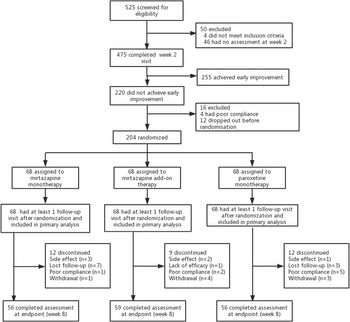
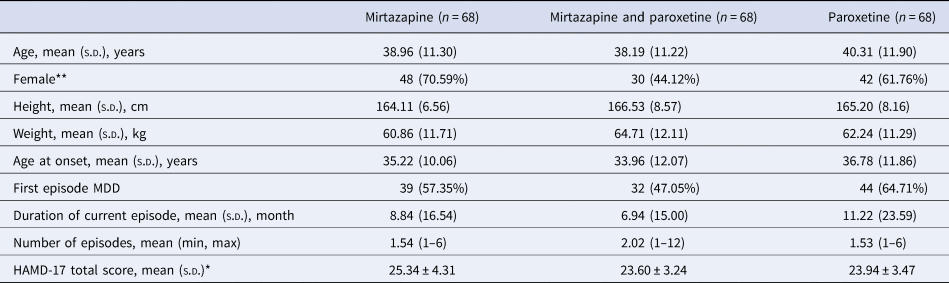
All outcome measures are detailed in the Appendix. Between 14 November 2012 and 11 August 2016, 525 participants with MDD were recruited and 475 completed assessment after 2 weeks of paroxetine treatment. Two hundred and fifty-five participants demonstrated early improvement at this stage and 16 participants were excluded/dropped out before randomization. The remaining 204 participants who did not demonstrate early improvement were randomly assigned to mirtazapine and paroxetine combination therapy (n = 68), mirtazapine monotherapy (n = 68), or paroxetine monotherapy (n = 68). After randomization, all participants had at least one follow-up, 164 (80.4%) of whom completed the week 8 follow-up visit (Fig. 1). The ratios of males and females were not equally distributed in the three treatment arms, and the baseline HAMD-17 scores were significantly different among three groups (F = 4.20, p = 0.0163) (Table 1). Approximately half of the sample were cases of first-episode MDD.
Trial profile.

Demographic and clinical characteristics of the intention-to-treat population

s.d., standard deviations; HAMD-17, 17-item Hamilton Depression Rating Scale.
*p < 0.05; **p < 0.01.
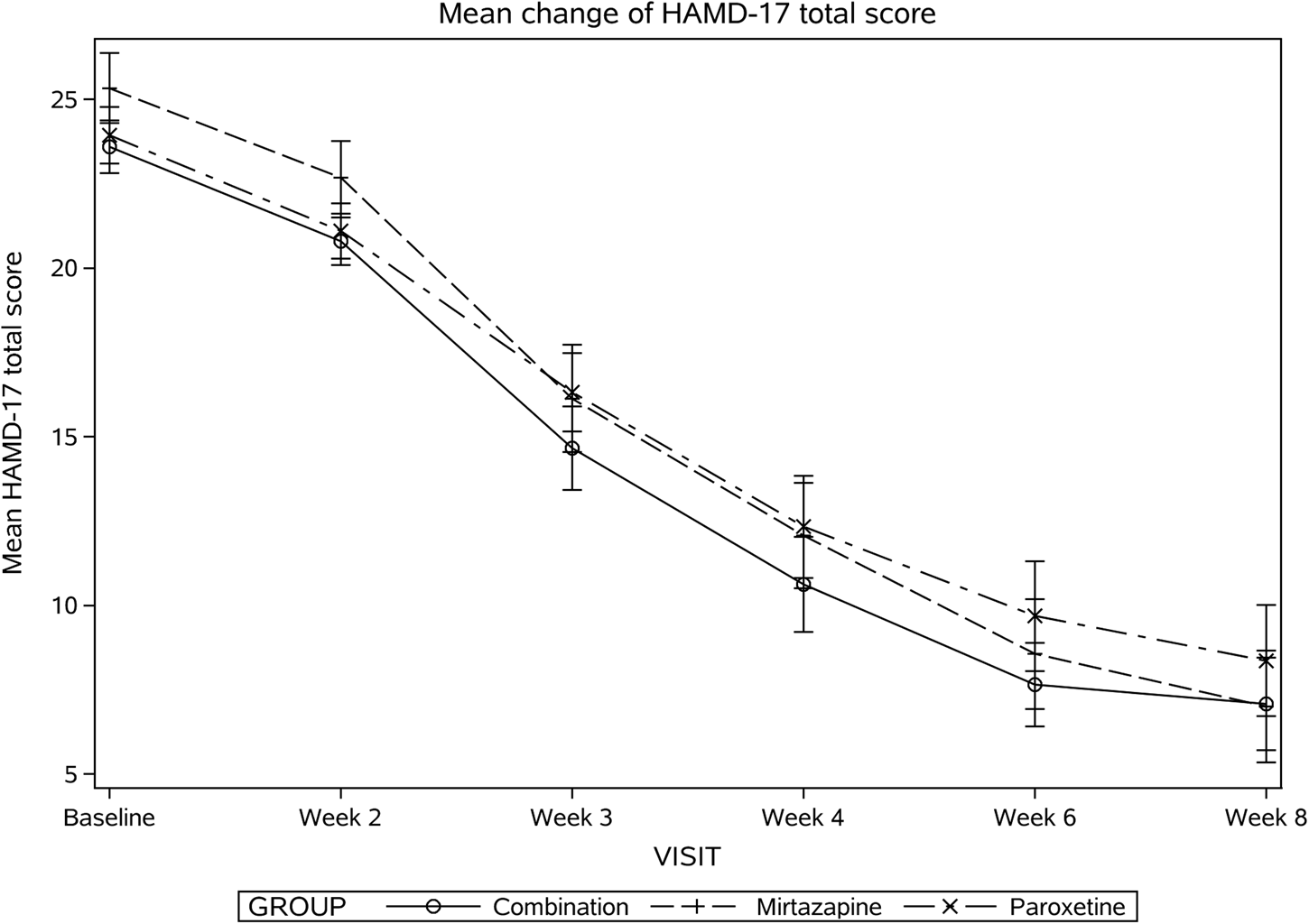
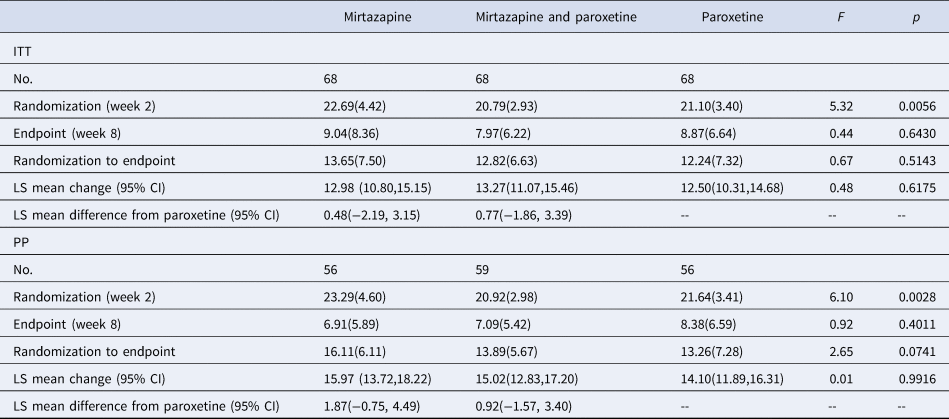
Figure 2 shows the HAMD-17 total scores of participants with complete datasets. The HAMD-17 total scores were significantly different among the three groups at randomization (F = 5.32, p = 0.0056). The mean HAMD-17 total score decreased from randomization (week 2) to endpoint (week 8) in all groups, with mean decreases ranging from 12.24 to 13.65, with no significant differences among the three treatment arms (F = 0.67, p = 0.5143). The HAMD-17 score at endpoint (week 8) did not significantly differ (F = 0.44, p = 0.6430), even after adjusting for baseline HAMD-17 score and site (ITT: F = 0.22, p = 0.8040; PP: F = 1.28, p = 0.2816). At week 8, the least squares (LS) mean change of HAMD-17 scores did not significantly differ among the three groups, (12.98 points, 95% CI 10.80–15.15) in the mirtazapine group, (12.50 points, 95% CI 10.31–14.68) in the paroxetine group and (13.27 points, 95% CI 11.07, 15.46) in the mirtazapine plus paroxetine combination group. The LS mean HAMD-17 difference when compared with the paroxetine group was 0.77 (95% CI −1.86 to 3.39) for the combination group and 0.48 (95% CI −2.19 to 3.15) for the mono-mirtazapine group (Table 2). Sensitivity analysis using MMRM consistently found no significant differences between groups; this included analysing only a sub-group of first-episode patients (see Appendix).
Hamilton Depression Rating Scale (HAMD-17) total scores over the entire study.

Primary efficacy outcome of the change in HAMD-17 total score from baseline to endpoint

CI, confidence interval; HAMD-17, 17-item Hamilton Depression Rating Scale; ITT, intent-to-treat; LS, least squares; PP, per-protocol.
Consistent with the primary outcomes, analysis of secondary outcomes (QIDS-SR16 and CGI-I) similarly showed no significant differences among the three treatment groups. Neither the proportion of patients who had a response at week 8 [48 (70.6%) in the combination group v. 43 (63.2%) in the paroxetine group v. 50 (73.5%) in the mirtazapine group], nor the proportion who achieved remission [34 (50.0%) v. 32 (47.1%) v. 38 (55.9%)], were significantly different between the three groups. Data regarding all secondary clinical outcome measures are detailed in the Appendix.
Time to response and remission
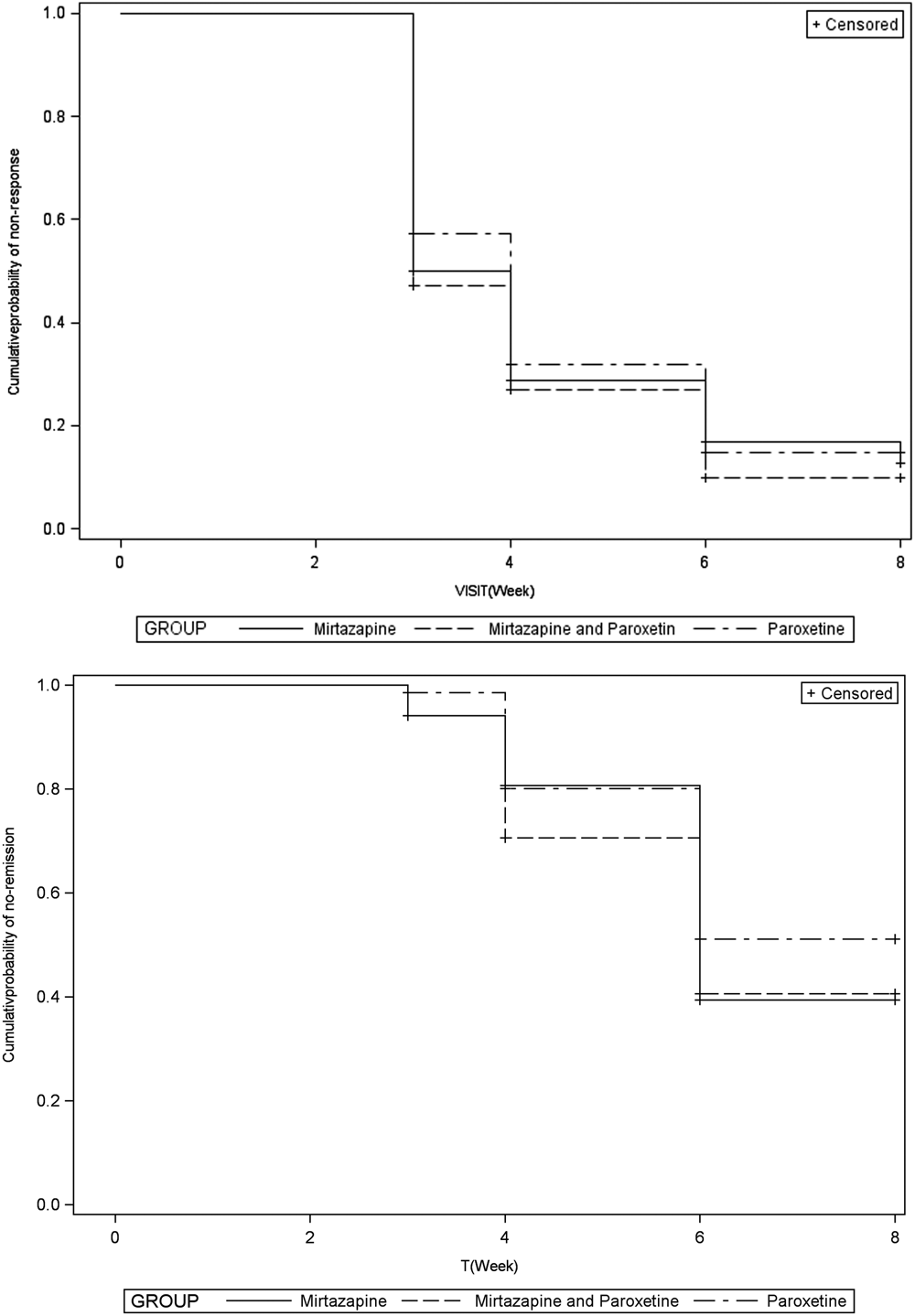
The average time to response was 4.9 weeks in the combination group, 5.2 weeks in the mirtazapine monotherapy group and 5.4 weeks in the paroxetine monotherapy group. The average times to remission were 5.5, 5.4 and 5.6 weeks for the three groups, respectively. The overall log-rank test of the time to response and remission in the Kaplan–Meier analysis was insignificant (log rank = 4.254, p = 0.119; log rank = 1.626, p = 0.444), and the Kaplan–Meier curves of response and remission were generally similar across groups (Fig. 3).
Time to response and remission by Kaplan–Meier Analysis.

Adverse events
Prior to randomization, 34 participants reported 48 AEs, of which 26 participants (76.47%) and 36 AEs were judged to be related to the test drug. After randomization, 29 (42.65%), 29 (42.65%) and 15 (36.76%) participants in the mirtazapine monotherapy group, combination group and paroxetine monotherapy group reported 125 AEs. The χ2 was used to compare the proportion of AEs, the results showed a statistically significant difference among the three groups (χ2 = 8.3622, p = 0.0153). Two serious adverse events (SAE) were reported by two participants (one in the mirtazapine monotherapy group and one in the combination group), neither of which were judged to be related to study drugs. The most frequent AEs were dry mouth, dizziness, constipation and increased AST/ALT (see Appendix).
Discussion
In this multicentre, randomized, double-blind clinical trial of patients with MDD who indicate no early improvement after 2 weeks of paroxetine, we found no significant group differences in mean depressive symptoms at the end of week 8, when comparing mirtazapine and paroxetine combination therapy, switching to mirtazapine monotherapy, or maintaining paroxetine monotherapy. The remission and response rates were also similar across all three groups. Our results indicate that mirtazapine, paroxetine, or mirtazapine and paroxetine combination therapy are all equally effective in the treatment of early non-responders to paroxetine treatment. Furthermore, the safety and tolerability data suggest that all three treatments were well tolerated, however the mirtazapine and paroxetine combination and mirtazapine monotherapy groups experienced more adverse effects than the paroxetine monotherapy group.
The overall remission and response rates in the present study were higher than two previous prospective studies, based on the change in HAMD score from baseline to the end of the study. We found 50% of early non-responders achieved remission and 69% of patients were responsive to treatment; however, only 19.75% of patients achieved remission and 32.25% of patients achieved response in a previous EMC study (Tadić et al., Reference Tadić, Wachtlin, Berger, Braus, van Calker, Dahmen and Helmreich2016) and 36.5% of patients achieved remission and 46.3% of patients achieved response in the Nakajima et al. (Reference Nakajima, Uchida, Suzuki, Watanabe, Hirano, Yagihashi and Mimura2011) study. In addition, previous studies have found that combined use of mirtazapine and paroxetine produces a greater and more rapid improvement than mirtazapine or paroxetine monotherapy in the context of initial treatment for patients with MDD (Blier et al., Reference Blier, Gobbi, Turcotte, de Montigny, Boucher, Hébert and Debonnel2009a). However, the current study did not find similar findings in the context of changing treatment for early non-responders. Our results indicate that patients who do not show early improvement after 2 weeks of paroxetine monotherapy will have comparable improvements in depressive symptoms and comparable likelihood of response or remission at 8 weeks whether they are maintained on paroxetine monotherapy, switched to mirtazapine monotherapy or given a combination therapy with mirtazapine.
However, these differences to previous literature may be explained by differences in study design. Firstly, our study required a HAMD-17 total score ⩾20 at baseline, whereas no cut-off score was included in the inclusion criteria for Nakajima et al. (Reference Nakajima, Uchida, Suzuki, Watanabe, Hirano, Yagihashi and Mimura2011), and other studies have required a baseline severity score ⩾ 18 (Blier et al., Reference Blier, Gobbi, Turcotte, de Montigny, Boucher, Hébert and Debonnel2009a; Tadić et al., Reference Tadić, Wachtlin, Berger, Braus, van Calker, Dahmen and Helmreich2016). This is significant as baseline severity of depressive symptoms could affect the treatment efficacy and proportion of early responders; however, despite the differences in inclusion criteria, mean baseline severity does not differ significantly between studies (approximately 23, 22 and 24 for Nakajima et al. Reference Nakajima, Uchida, Suzuki, Watanabe, Hirano, Yagihashi and Mimura2011; Tadić et al. Reference Tadić, Wachtlin, Berger, Braus, van Calker, Dahmen and Helmreich2016 and the current study, respectively), though different variance in baseline scores is observed. Furthermore, the difference between giving combination therapy as an initial treatment v. combination therapy following failed monotherapy may explain the different results. A recent meta-analysis (Galling, Sangroula, Ferrer, & Correll, Reference Galling, Sangroula, Ferrer and Correll2016) found that changing treatment strategy to antidepressant augmentation/combination in MDD patients who do not achieve a response from initial antidepressant monotherapy lacks evidence of efficacy, whereas immediate co-initiation of two antidepressants can increase response rate and symptom reduction. It is also possible that the lack of group differences found in the current study may be partially due to the fact that more patients in the combination group had a history of recurrent episodes and a greater average number of previous episodes than either monotherapy group, even though these differences were not statistically significant (Table 1). It is also possible that the overall higher rates of remission and response in the present study were due to elements of the study design, such as the inclusion of placebo, the 6-week period of fixed dose without change, the potential faster onset of mirtazapine, improved treatment adherence (targeted dose) and the lower dropout rate. Finally, differences to previous literature could be explained by cultural and/or biological differences between Chinese populations and White European populations (Fang et al., Reference Fang, Yuan, Xu, Chen, Wu, Cao and Jiang2010).
This study is in line with the only previous RCT (Tadić et al., Reference Tadić, Wachtlin, Berger, Braus, van Calker, Dahmen and Helmreich2016) which found that EMC did not show advantageous results compared to TAU in remission rate, time to remission, symptom response or time to response. The authors suggested that their lack of positive finding may have been explained by high dropout rates, low medication adherence or multiple changes in treatment strategy. Despite addressing these limitations in the current study, we similarly found a lack of evidence to support an early change in medication, whether switching monotherapy or offering combination therapy. Currently evidence does not support changing the treatment guidelines to encourage switching treatment strategy for patients with MDD who show a lack of response after the first 2 weeks of antidepressant treatment, but supports the current clinical guidelines regarding ensuring an adequate duration and dose of initial antidepressant treatment. Interestingly, a recent meta-analysis of individual patients data by de Vries et al. (Reference de Vries, Roest, Bos, Burgerhof, van Loo and de Jonge2019) found that patients with early non-response can still achieve remission or response after 12 weeks, thus the authors suggest that changing antidepressant treatment due to limited improvement in the first 2 weeks is premature.
Interestingly, although there were no significant differences in the secondary outcome measure among three groups, there was some indication that patients treated with mirtazapine and paroxetine augmentation had the greatest improvement on the QIDS-16 scores at week 4 from randomization (week 2). These findings indicate that while mirtazapine and paroxetine augmentation may not have better efficacy in the long term, they may provide accelerated onset of action. The enhanced norepinephrine (NE) release resulting from the combination of the two drugs may contribute to the greater efficacy (Blier et al., Reference Blier, Gobbi, Turcotte, de Montigny, Boucher, Hébert and Debonnel2009a). Delays to the onset of action in antidepressant drugs may leave patients vulnerable to an increased risk of suicide and increase the likelihood of discontinuing treatment, subsequently increasing medical costs (Gourion, Reference Gourion2008). For MDD patients with great severity or a high risk of suicide in the first 2 weeks of treatment, mirtazapine and paroxetine combination therapy may be a useful alternative treatment strategy, to more rapidly reduce symptoms compared to monotherapy. Unfortunately, this current study did not assess the speed of response as its primary outcome and also did not include suicide assessment, with significant suicide risk as an exclusion criterion. Future studies should consider using a similar study design but specifically assessing whether combination therapy has a more rapid effect, particularly in the context of more severe/higher risk patients, including assessment of suicide in patients with MDD. This would help us move towards a more individualized and measurement-based approach to treating depression. More broadly, these findings do suggest that the decision for early changes in treatment strategies should take into account other clinical factors, such as the need for rapid improvement (including suicide risk) (Chen, Reference Chen2018; Guo et al., Reference Guo, Xiang, Xiao, Hu, Chiu, Ungvari and Geng2015; Kudlow et al., Reference Kudlow, McIntyre and Lam2014).
Limitation
The present study has several limitations. Firstly, the participants were not routinely assessed for the previous history of antidepressant treatment, so unrecorded prior treatment resistance may have been unbalanced between groups and may have affected the response rates. However, a large proportion of patients (56.4%) presented with a first episode of depression and thus no previous antidepressant treatment, and the proportion of first-episode cases was equivalent between groups. Secondly, this study included a moderately depressed patient with ⩾20 points on the HAMD-17; limiting research studies to patients with more severe forms of depression may increase the likelihood of detecting significant differences between treatment groups. Thirdly, based on a Chinese study which found that intolerance and discontinuation of paroxetine at 1 week were significantly higher when initial dose was 20 mg per day, v. 10 mg per day (Li, Zhang, Tao, & Huang, Reference Li, Zhang, Tao and Huang2005), in this study paroxetine was initiated at 10 mg/day for 4 days then titrated up to 20 mg/day. However, this is half the standard dose recommended for paroxetine initiation in the treatment of MDD. Therefore, rates of early response at week 2 are likely to be somewhat lower than those observed in studies for which participants are given the full recommended dose at treatment initiation; in fact, we do see that 53.75% (255/475) of participants in our study reported early improvement which is lower than rates reported in other studies (Szegedi et al., Reference Szegedi, Jansen, van Willigenburg, van der Meulen, Stassen and Thase2009; Wagner et al., Reference Wagner, Engel, Engelmann, Herzog, Dreimüller, Müller and Lieb2017). The lower rate of early improvement may also be explained by a higher eligibility criterion for participants of scoring HAMD-17 ⩾20. However, we do not expect this to substantially change the conclusions drawn regarding between-group comparisons. Finally, while recent and concomitant use of medication and therapy was restricted, patients were permitted to use general supportive counselling and other medications in some limited scenarios (participants with severe insomnia were permitted use of non-benzodiazepines such as zolpidem and zopiclone, and patients with severe anxiety symptoms were permitted benzodiazepines such as lorazepam, oxazepam, estazolam and alprazolam).
Conclusions
In this large multicentre, double-blind, placebo-controlled randomized trial, we found no evidence that mirtazapine and paroxetine combination therapy is superior to mirtazapine or paroxetine monotherapy in the treatment of patients with MDD who were early non-responders to paroxetine. We do not recommend that clinicians switch patients who do not display improvement after 2 weeks of monotherapy to this combination treatment, unless further evidence confirms that mirtazapine and paroxetine combination therapy has a faster onset of action in MDD patients with a high risk of suicide. Also, at this stage, this trial does not support recommendations to routinely offer additional treatment or a switch in treatment strategy to early non-improvers with MDD. In the absence of new evidence, patients should continue to wait to assess response after a period of adequate duration with adequate dose as suggested in the previous treatment guidelines.
Supplementary material
The supplementary material for this article can be found at https://doi.org/10.1017/S0033291719004069.
Acknowledgements
The datasets used and/or analysed during the current study are available from the corresponding author on reasonable request.
Financial support
The study was funded by a grant from National Key Research & Development program of China (No 2016YFC1307200) and was partially supported by research funding from Merck & Co., Inc.; however, the views expressed in this paper are those of the authors and not represent those of the Merck & Co., Inc. Dr Gang Wang was supported in part by the Capital's Funds for Health Improvement and Research (2018-1-2121) and National Science and Technology Major Project for IND: 2018ZX09201-013. All the funding sponsors had no role in the design, conduct, analysis or write-up of the article.
Conflict of interest
Dr Gang Wang has received research support from Pfizer and Merck & Co., Inc. The other authors report no competing interests.
Ethical standards
This study protocol was approved by the Human Research and Ethics Committee of Beijing An ding Hospital, Capital Medical University. All participants were informed of the objective of the study and gave written consent before the investigation.