Child maltreatment is globally prevalent (Stoltenborgh, Bakermans-Kranenburg, Alink, & van IJzendoorn, Reference Stoltenborgh, Bakermans-Kranenburg, Alink and van IJzendoorn2015) with negative consequences for the victims as well as society (Gilbert, Widom, et al., Reference Gilbert, Widom, Browne, Fergusson, Webb and Janson2009). It has been suggested that child maltreatment is most likely to occur when risk factors accumulate (Mackenzie, Kotch, & Lee, Reference Mackenzie, Kotch and Lee2011; Patwardhan, Hurley, Thompson, Mason, & Ringle, Reference Patwardhan, Hurley, Thompson, Mason and Ringle2017; Thornberry et al., Reference Thornberry, Matsuda, Greenman, Bears Augustyn, Henry, Smith and Ireland2014). Risks may arise from different sources, including the parent, the child, and the family environment (Belsky, Reference Belsky1993; Sidebotham & Heron, Reference Sidebotham and Heron2006). Potential mechanisms of child maltreatment at the parent level are unresolved attachment (Reijman et al., Reference Reijman, Alink, Compier-De Block, Werner, Maras, Rijnberk and Bakermans-Kranenburg2017), low self-esteem (Mackenzie et al., Reference Mackenzie, Kotch and Lee2011), stress and emotion dysregulation, substance use, and mental health issues such as depression (Stith et al., Reference Stith, Liu, Davies, Boykin, Alder, Harris and Dees2009). Child factors increasing the risk of experiencing maltreatment are low social competence and high levels of externalizing and internalizing behavior (Stith et al., Reference Stith, Liu, Davies, Boykin, Alder, Harris and Dees2009). Low family cohesion and environmental risk factors such as poverty and low social support may also increase the risk of child maltreatment occurring in a family (Sidebotham & Heron, Reference Sidebotham and Heron2006).
With respect to parental factors, several risk factors, such as mental health issues, self-esteem, and emotion regulation, have been found to be in part heritable (Cross-Disorder Group of the Psychiatric Genomics Consortium, 2013; Hawn, Overstreet, Stewart, & Amstadter, Reference Hawn, Overstreet, Stewart and Amstadter2015; Neiss, Sedikides, & Stevenson, Reference Neiss, Sedikides and Stevenson2006; Nivard et al., Reference Nivard, Dolan, Kendler, Kan, Willemsen, Van Beijsterveldt and Boomsma2015; Stieger, Kandler, Tran, Pietschnig, & Voracek, Reference Stieger, Kandler, Tran, Pietschnig and Voracek2017). However, it is not yet known whether and to what extent perpetrating child maltreatment is heritable. There is evidence that parental physical discipline is genetically influenced (Wade & Kendler, Reference Wade and Kendler2000), which may point toward genetic effects partly accounting for variance in physical abuse. A comprehensive understanding of the underlying mechanisms of parental child maltreatment is essential to recognize at-risk families early and to develop interventions targeting central mechanisms. The aim of the current study is therefore to estimate the relative contribution of genetic and environmental factors to perpetrating maltreatment in order to provide a general etiologic framework of child maltreatment. It is crucial to elucidate the potential role of heritability in child maltreatment because research on environmental risk factors for child maltreatment may be confounded by gene–environment correlations (rGE) and interactions (Knafo & Jaffee, Reference Knafo and Jaffee2013). In the following, we review quantitative genetic research on parent and child effects on child maltreatment. Evidence suggests that child factors contributing to child maltreatment are in part genetically influenced (Fisher et al., Reference Fisher, Caspi, Moffitt, Wertz, Gray, Newbury and Arseneault2015; Schulz-Heik et al., Reference Schulz-Heik, Rhee, Silvern, Lessem, Haberstick, Hopfer and Hewitt2009), but little is known about on the heritability of parent factors. To approach this question empirically, we examine the etiology of child maltreatment in a parent-based extended family design, a quantitative genetic method.
Quantitative Genetic Studies on Parenting
The aim of quantitative genetics is to partition variance in traits into genetic and environmental components using genetically informative designs (Plomin & Simpson, Reference Plomin and Simpson2013). In parenting research, the most commonly used genetically informative family design is the child-based twin design (also known as children-as-twins design), but valuable insights have also emerged from studies using parent-based twin designs (also known as children-of-twins design), stepparent, adoption, in vitro fertilization, extended twin, and extended family designs (for reviews see Bakermans-Kranenburg & van IJzendoorn, Reference Bakermans-Kranenburg, van IJzendoorn, Cassidy and Shaver2016; Hatemi et al., Reference Hatemi, Hibbing, Medland, Keller, John, Smith and Virginia2010; Keller, Medland, & Duncan, Reference Keller, Medland and Duncan2010; McAdams et al., Reference McAdams, Neiderhiser, Rijsdijk, Narusyte, Lichtenstein and Eley2014; Mileva-Seitz, Bakermans-Kranenburg, & van IJzendoorn, Reference Mileva-Seitz, Bakermans-Kranenburg and van IJzendoorn2016). Note, however, that this list is restricted to genetically informative family designs. Molecular genetic designs, such as genome-wide complex trait analysis (GCTA; Yang, Lee, Goddard, & Visscher, Reference Yang, Lee, Goddard and Visscher2011), are also applied to answer quantitative genetic research questions. However, to our knowledge GCTA has not been used in the context of parenting yet and will therefore be omitted in the following review of quantitative genetic designs on parenting. Genetically informative family designs estimate heritability by taking advantage of variations in genetic relatedness and common environments between relatives. Heritability is the proportion of variation in a trait explained by (additive) genetic effects (Almasy & Blangero, Reference Almasy and Blangero2010).
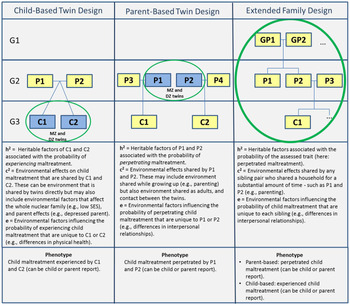
Genetically informative studies of parenting can be divided into child-based and parent-based designs (see Figure 1). In child-based designs the heritability of experiencing a particular type of parenting is estimated. Child-based designs are particularly informative about genetic effects on parenting that are driven by the child rather than by the parent (Klahr & Burt, Reference Klahr and Burt2014). In other words, child-based designs test an association between genes and parenting in which genes increase the likelihood that children will evoke particular responses from their parents. For example, a child with a genetic predisposition for conduct problems might be at a higher risk of eliciting maltreating behavior than a child without this predisposition (Schulz-Heik et al., Reference Schulz-Heik, Rhee, Silvern, Haberstick, Hopfer, Lessem and Hewitt2010). Child-based designs, thus, test whether experiencing maltreatment is in part heritable.
(Colour online) Three quantitative genetic designs to test the heritability of parenting. Child-based twin designs are also referred to as children-as-twins designs and parent-based twin designs as children-of-twins designs. An extended family design can be child based or parent based depending on the behavior assessed. In the current study, perpetrated child maltreatment is assessed (by using child reports). Hence, the design is parent based. GP, grandparent. P, parent. C, child.

In parent-based designs, estimates of heritability represent the influence of the parent's genotype on parenting. The heritability of displaying particular parenting behaviors (styles or dimensions) is estimated. This is commonly refered to as passive rGE because parenting is conceptualized as an environment. Passive rGE arises if parents provide both the genotype and the environment linked to a trait (Plomin, DeFries, & Loehlin, Reference Plomin, DeFries and Loehlin1977). Applying this to child maltreatment, theoretically, a parent may have a genetic predisposition to aggression, which may be inherited by the child (Miles & Carey, Reference Miles and Carey1997; Wesseldijk et al., Reference Wesseldijk, Bartels, Vink, Van Beijsterveldt, Ligthart, Boomsma and Middeldorp2017) and may also translate into abusive behavior toward the child (Stith et al., Reference Stith, Liu, Davies, Boykin, Alder, Harris and Dees2009). This inherited aggression may predispose the child toward perpetrating abuse later on (see Marceau et al., Reference Marceau, Knopik, Neiderhiser, Lichtenstein, Spotts, Ganiban and Reiss2016, for a detailed definition of passive rGE). In short, parent-based designs test whether the tendency to perpetrate maltreatment is in part heritable. Both child-based and parent-based designs provide important, complementary insights into genetic and environmental influences on child maltreatment.
Heritability of Child Maltreatment: Child-Based Designs
The majority of studies on the heritability of parenting and child maltreatment have employed child-based designs and suggest that children exert a substantial influence on the parenting they receive. For instance, genetically driven child factors such as internalizing and externalizing behavior may shape parenting behavior over time (Serbin, Kingdon, Ruttle, & Stack, Reference Serbin, Kingdon, Ruttle and Stack2015). A meta-analysis suggests that genetic child effects explain 23% of the variance in parenting overall, but effect sizes depend on the age of the child, the reporter, and the parenting dimension (Avinun & Knafo, Reference Avinun and Knafo2014).
The first study to investigate whether these findings extend to maltreatment examined the heritability of corporal punishment and physical maltreatment in 5-year-old twins (Jaffee et al., Reference Jaffee, Caspi, Moffitt, Polo-Tomas, Price and Taylor2004). Mothers were interviewed about their twins’ experiences of corporal punishment and physical maltreatment. This study found support for genetic child effects on experiencing corporal punishment but not physical maltreatment. The same cohort of twins was assessed again at 18 years of age for (self-)reported experienced maltreatment during adolescence. Based on this assessment, significant child-driven effects did emerge for maltreatment (i.e., abuse and neglect; Fisher et al., Reference Fisher, Caspi, Moffitt, Wertz, Gray, Newbury and Arseneault2015). The magnitude of these effects is notable, in particular for abuse, with a heritability component of 71% for abuse and 47% for neglect. Common environment explained about one-third of the variance in neglect but none of the variance in abuse. Using a similar design, Schulz-Heik et al. (Reference Schulz-Heik, Rhee, Silvern, Lessem, Haberstick, Hopfer and Hewitt2009) found that approximately one-quarter of the variance in exposure to physical abuse and neglect could be attributed to heritability and to a lesser extend to common environment. However, despite a large sample, none of the effects were significant. Confidence intervals were large, and most variance was explained by unique environment including measurement error. Moreover, physical abuse and neglect were assessed with one and two items, respectively, which might have affected reliability of the measure. South, Schafer, and Ferraro (Reference South, Schafer and Ferraro2015), in comparison, used the validated Conflict Tactics Scale (Straus, Hamby, Finkelhor, Moore, & Runyan, Reference Straus, Hamby, Finkelhor, Moore and Runyan1998) to measure abuse (a combination of physical and emotional abuse). Findings were similar with heritability explaining 28% of the variance in abuse. The point estimate for common environment was 17% but failed to reach significance. Again, unique environment explained more than half of the variance. Bivariate analyses suggest that the risk of experiencing child maltreatment shares genetic overlap with conduct problems (Schulz-Heik et al., Reference Schulz-Heik, Rhee, Silvern, Haberstick, Hopfer, Lessem and Hewitt2010) and chronic health problems (South et al., Reference South, Schafer and Ferraro2015).
Evidence whether exposure to child maltreatment is heritable in a child-based design is, thus, partly mixed. The divergence in findings may be attributed to two methodological aspects. Jaffee et al. (Reference Jaffee, Caspi, Moffitt, Polo-Tomas, Price and Taylor2004) assessed heritability in 5-year-olds, whereas the other studies assessed heritability in adolescents (Fisher et al., Reference Fisher, Caspi, Moffitt, Wertz, Gray, Newbury and Arseneault2015), late adolescence to early adulthood (Schulz-Heik et al., Reference Schulz-Heik, Rhee, Silvern, Lessem, Haberstick, Hopfer and Hewitt2009), and adulthood (South et al., Reference South, Schafer and Ferraro2015). Moreover, Jaffee et al. (Reference Jaffee, Caspi, Moffitt, Polo-Tomas, Price and Taylor2004) used parent report whereas the studies with significant heritability used child-reported maltreatment. This may affect the results in two ways: (a) in child-based designs, heritability estimates based on child reports may include genetic effects on the child's perception in addition to parenting received; and (b) parent report may lead to higher estimates of common environment because parents may view their parenting as impartial whereas children experience parenting as more differential (Avinun & Knafo, Reference Avinun and Knafo2014).
Overall, besides genetic effects, most of these studies found significant effects of common environment with estimates ranging from 6% to 94%. These estimates show a strikingly large range, possibly because estimates come from different populations in different developmental stages and different measures of child maltreatment were used. Common environmental effects in a child-based design are in line with genetically influenced parent effects, or, in other words, with a passive rGE (Klahr & Burt, Reference Klahr and Burt2014; Neiderhiser et al., Reference Neiderhiser, Reiss, Pedersen, Lichtenstein, Spotts, Hansson and Elthammer2004). An absence of common environmental effects in a child-based design would constitute a contraindication of parent effects (genetic or environmental). However, alternative explanations could also account for the presence of common environmental effects such as the effects of low socioeconomic status (SES) shared by siblings. Low SES might affect siblings directly or might affect parents who represent a common environment for siblings. This suggest that shared exposure to maltreatment might be one plausible explanation, but others are also possible. Therefore, a parent-based design is necessary to confirm this hypothesis. In sum, research shows that child-driven effects may play an important role in child maltreatment risk, but the findings are also consistent with heritability in a parent-based design (passive rGE). Nevertheless, ultimately a child-based designs provides insights mostly into child-driven effects and is not suited to test whether parents’ tendency to maltreat is heritable or affected by common environment.
Heritability of Child Maltreatment: Parent-Based Designs
The term parenting clearly points toward the active role parents play in the parent–child interaction. The same holds true for child maltreatment. Child maltreatment describes a pattern of actions committed or omitted by the parent. Even though research suggests that certain child characteristics may increase the risk of experiencing maltreatment, the full (moral and legal) responsibility for perpetrated child maltreatment lies with the parent. Accordingly, many of the risk factors identified concern the parent. For instance, in a meta-analysis Stith et al. (Reference Stith, Liu, Davies, Boykin, Alder, Harris and Dees2009) identified 17 parent characteristics as risk factors for abuse and 11 for neglect compared to 3 child characteristics for abuse and neglect. Interventions aimed at preventing and reducing maltreatment target parents by providing training in parenting skills and increasing support to the parent (e.g., Olds, Reference Olds2006; Oveisi et al., Reference Oveisi, Ardabili, Dadds, Majdzadeh, Mohammadkhani, Rad and Shahrivar2010; Sanders, Reference Sanders1999), although some interventions also target parent–child interactions (Moss et al., Reference Moss, Dubois-Comtois, Cyr, Tarabulsy, St.-Laurent and Bernier2011; Toth, Gravener-Davis, Guild, & Cicchetti, Reference Toth, Gravener-Davis, Guild and Cicchetti2013). Despite this important role of parents in the etiology and preventive interventions of child maltreatment, most quantitative genetic studies on parenting have used child-based designs rather than parent-based designs. To our knowledge, there are no parent-based studies with a focus on the heritability of child maltreatment. As a result, we currently do not know whether a tendency to perpetrate child maltreatment is heritable.
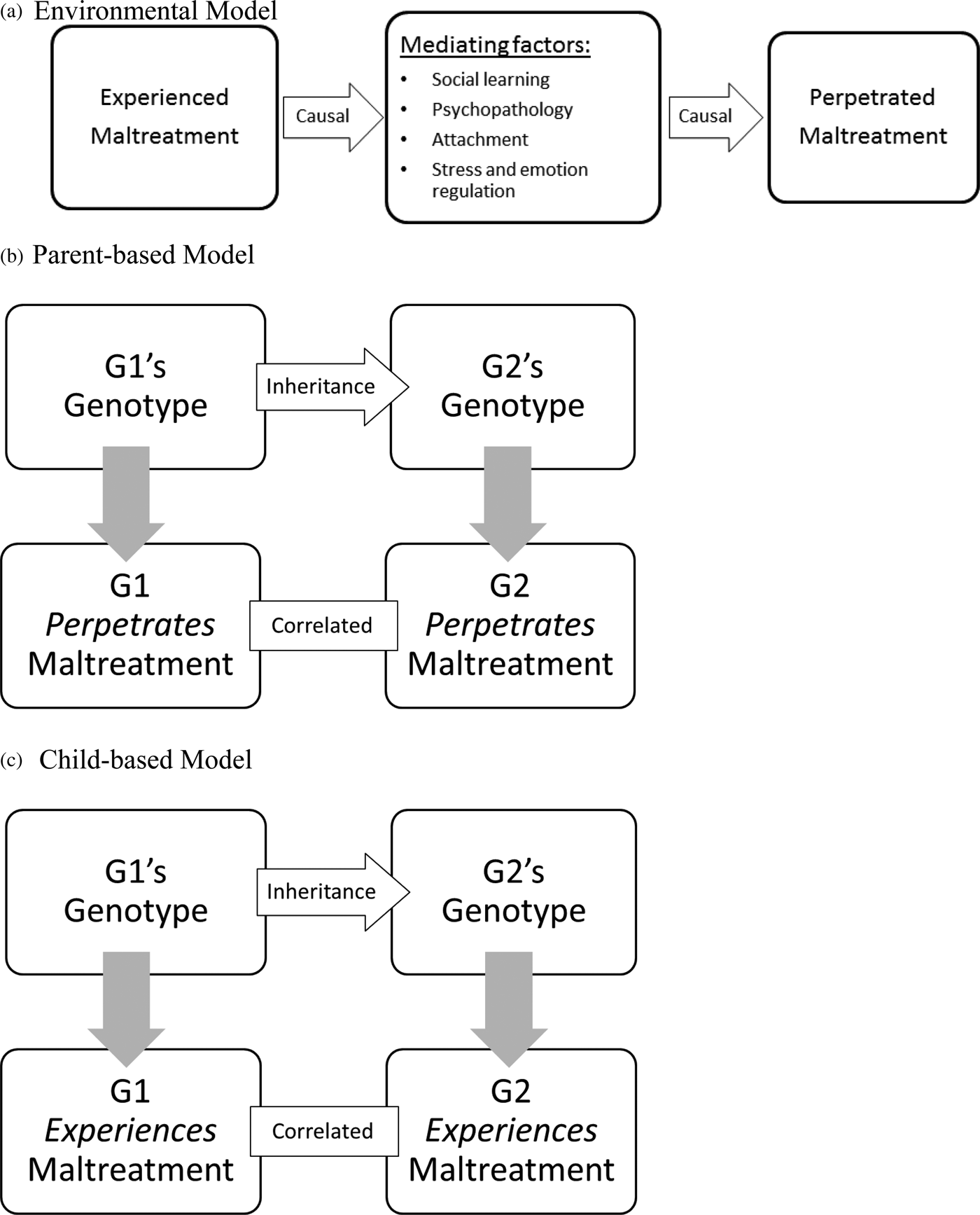
Even though passive rGE of child maltreatment (i.e., genetic effects on perpetration of child maltreatment) has never been tested explicitly, it may be an important factor in child maltreatment risk. Child maltreatment has been described to run in the family (Thompson, Reference Thompson2006) because children of maltreated parents are at an increased risk to be maltreated (Bartlett, Kotake, Fauth, & Easterbrooks, Reference Bartlett, Kotake, Fauth and Easterbrooks2017; Madigan et al., Reference Madigan, Cyr, Eirich, Fearon, Ly, Rash and Alink2019; Thornberry, Knight, & Lovegrove, Reference Thornberry, Knight and Lovegrove2012; Widom, Czaja, & Dumont, Reference Widom, Czaja and DuMont2015). This points toward either genetic or environmental transmission of child maltreatment, or a combination of the two (see Figure 2). An environmental model of transmission implies that the experience of maltreatment has a causal effect on, for instance, mental health or emotion regulation, which in turn increases the risk of perpetrated maltreatment. In support, harsh physical discipline and physical maltreatment have been shown to have an environmental effect on externalizing behavior problems and on drug and alcohol use in children even when controlling for genetic factors (Jaffee et al., Reference Jaffee, Caspi, Moffitt, Polo-Tomas, Price and Taylor2004; Lynch et al., Reference Lynch, Turkheimer, D'Onofrio, Mendle, Emery, Slutske and Martin2006). In a parent-based design environmentally causal effects would fall under the common environmental component. Other environmental factors such as cultural beliefs on parenting (Lansford et al., Reference Lansford, Godwin, Maria, Tirado, Zelli, Al-Hassan and Alampay2015) may contribute to the common environmental component as well.
Alternative (not mutually exclusive) models of intergenerational transmission. (a) The environmental model suggests that intergenerational transmission of child maltreatment is the result of exposure to child maltreatment. (b) The parent-based model suggests that intergenerational transmission of child maltreatment can be explained by genetic effects in consecutive generations increasing the probability of perpetrating maltreatment. (c) The child-based model suggests that intergenerational transmission of child maltreatment can be explained by genetic effects in consecutive generations increasing the probability of experiencing maltreatment (Knafo & Jaffee, Reference Knafo and Jaffee2013). G1, Generation 1. G2, Generation 2.

A genetic model of transmission is in line with passive rGE. Genes may have indirect effects on child maltreatment through affecting traits like verbal or physical aggression. Given that criminal and violent behavior are in part heritable (Kendler et al., Reference Kendler, Larsson Lönn, Morris, Sundquist, Långström and Sundquist2014; Olvera et al., Reference Olvera, Bearden, Velligan, Almasy, Carless, Curran and Glahn2011), it stands to reason that child maltreatment might also be heritable. Moreover, antisocial behavior is in part heritable (Wesseldijk et al., Reference Wesseldijk, Bartels, Vink, Van Beijsterveldt, Ligthart, Boomsma and Middeldorp2017) and one children-of-twins study has shown that the intergenerational transmission of antisocial behavior and conduct problems may partly be explained by passive rGE (Silberg, Maes, & Eaves, Reference Silberg, Maes and Eaves2012). These studies are relevant for our research question, whether perpetrating child maltreatment is heritable, because perpetrating child maltreatment is related to aggression, antisocial behavior, and delinquency (Thornberry et al., Reference Thornberry, Matsuda, Greenman, Bears Augustyn, Henry, Smith and Ireland2014). A similar argument can be made for depression, which is also heritable (Nivard et al., Reference Nivard, Dolan, Kendler, Kan, Willemsen, Van Beijsterveldt and Boomsma2015) and increases risk for child maltreatment (Mackenzie et al., Reference Mackenzie, Kotch and Lee2011; Stith et al., Reference Stith, Liu, Davies, Boykin, Alder, Harris and Dees2009).
A small number of studies have estimated the heritability of parenting behavior using parent-based twin designs (see Bakermans-Kranenburg & van IJzendoorn, Reference Bakermans-Kranenburg, van IJzendoorn, Cassidy and Shaver2016). However, results vary across parenting dimensions. While parental warmth and negativity have been found to be heritable in a meta-analysis, parental control was not found to be affected by genetic factors (Klahr & Burt, Reference Klahr and Burt2014). Common environment had little to no effect on these parenting dimensions. This may suggest that siblings’ exposure to the same parenting styles does not explain their own parenting behavior. Conversely, unique environmental effects were large and generally higher in parent-based than in child-based designs (Klahr & Burt, Reference Klahr and Burt2014). This is unsurprising because adult siblings who do not share a household anymore are likely to have encountered new and diverse unique environmental factors by the time they become parents (e.g., social interactions, romantic partners, trauma, and other stressors; Min, Chiu, & Wang, Reference Min, Chiu and Wang2013).
One study found that genetic effects explain 21% of individual differences in physical discipline of parents (Wade & Kendler, Reference Wade and Kendler2000). The assessed discipline strategies (e.g., hitting with a brush, belt, or stick) overlap with abusive behavior (Straus et al., Reference Straus, Hamby, Finkelhor, Moore and Runyan1998). As such, this study on physical discipline represents the most direct evidence from a parent-based design that parent effects on child maltreatment are partly heritable. However, this measure of physical discipline is not representative of a comprehensive assessment of child maltreatment, which was not its aim, and heavily focuses on physical abuse. The present study on the heritability of child maltreatment, therefore, includes an assessment of emotional and (severe) physical abuse, and neglect.
Reporter Effects
Studies about child maltreatment have used different sources to measure child maltreatment. The most commonly used ones are child report, parent report, and Child Protective Services (CPS) records. Estimates of child maltreatment prevalence have been found to heavily depend on the reporter (Euser et al., Reference Euser, Alink, Pannebakker, Vogels, Bakermans-Kranenburg and van IJzendoorn2013), and reporter agreement is often only moderate. Particularly, child reports seem to diverge from CPS records and parent or other reports (Chan, Reference Chan2015; Compier-de Block et al., Reference Compier-de Block, Alink, Linting, van den Berg, Elzinga, Voorthuis and Bakermans-Kranenburg2017; Everson et al., Reference Everson, Smith, Hussey, English, Litrownik, Dubowitz and Runyan2008; Sierau et al., Reference Sierau, Brand, Manly, Schlesier-Michel, Klein, Andreas and White2017). A better understanding of the effects of child and parent reports on child maltreatment is crucial, as CPS regularly use parent and child interviews to confirm suspected maltreatment (Gilbert, Kemp et al., Reference Gilbert, Kemp, Thoburn, Sidebotham, Radford, Glaser and MacMillan2009). Individual perspectives may provide crucial information. For instance, child reports of child maltreatment have been found to be uniquely predictive of later outcomes over and above CPS records (Everson et al., Reference Everson, Smith, Hussey, English, Litrownik, Dubowitz and Runyan2008).
Moreover, the disagreement between reporters may affect heritability estimates. Even measures as seemingly straightforward and objective as body height have been shown to have lower heritability when based on self-report than when based on clinical measures by an independent assessor. The discrepancy has been attributed to greater measurement error in self-report (Macgregor, Cornes, Martin, & Visscher, Reference Macgregor, Cornes, Martin and Visscher2006). In a meta-analysis, Kendler and Baker (Reference Kendler and Baker2007) compared heritability estimates of parenting based on child report to those based on parent report. On average, heritability estimates were comparable across reporters. However, of the studies including child reports of parenting behavior, only one study used a parent-based design (Neiderhiser et al., Reference Neiderhiser, Reiss, Pedersen, Lichtenstein, Spotts, Hansson and Elthammer2004). This study found support for passive rGE for maternal positivity, negativity, and monitoring, but not control. Overall, conclusions were consistent across parent and child reports, but estimates appeared to be higher for parent report (Neiderhiser et al., Reference Neiderhiser, Reiss, Pedersen, Lichtenstein, Spotts, Hansson and Elthammer2004). In sum, reporter effects may be important, but there is little empirical evidence for its impact on the heritability estimates of parenting in parent-based studies.
Present Study
This is the first study to estimate the genetic and environmental effects on physical and emotional abuse and neglect in a parent-based design. The current study used an extended family design. Extended family designs include pairs of relatives that vary in their genetic relatedness. The extended family design may be particularly suited to answer the question of heritability of maltreating parenting as it is not restricted to one particular type of family structure. Therefore, results may be more representative compared to other genetically informative designs. For instance, children in stepfamilies are at higher risk to experience maltreatment than children living with two biological parents (Turner, Finkelhor, & Ormrod, Reference Turner, Finkelhor and Ormrod2007; van IJzendoorn, Euser, Prinzie, Juffer, & Bakermans-Kranenburg, Reference van IJzendoorn, Euser, Prinzie, Juffer and Bakermans-Kranenburg2009).
The extended family design may represent a more feasible design to study passive rGE than the children-of-twins designs. There are only a few studies on parenting using parent-based designs, and all were children-of-twins studies. One reason for the smaller number of parent-based studies might be that this design is associated with substantial researcher investments because two nuclear families have to be recruited and tested (Klahr & Burt, Reference Klahr and Burt2014). In addition, only approximately 2% of the population are twins and only 0.3% are monozygotic twins (Hall, Reference Hall2003; Pison & D'Addato, Reference Pison and D'Addato2006). This severely decreases the size of the recruitment pool for any twin design. In addition, for a children-of-twins study on parenting, both twins must have children (ideally of similar age as child age may affect heritability estimates).
We used child reports as a primary data source for theoretical and pragmatic reasons. Theoretically, we were particularly interested in the genetic component, as this component indicates the role of passive rGE. If one expects social desirability or recall bias to be influenced by genetic factors, using parent report may inflate the heritability component. The heritability component in a parent-based design estimates the effect of parental genotype. If parent report is used, heritability may include genetic effects of self-report bias. The heritability in a parent-based design component is not affected by children's genotype, and any (genetically influenced) self-report bias in the child report is unlikely to appear in the heritability component, although it may increase the estimate of the unique environment (Avinun & Knafo, Reference Avinun and Knafo2014). From a pragmatic point of view, more child than parent reports were available in our study and maximizing sample size was prioritized. Hence, child reports were the primary source, but reporter effects were explored as well.
Research Question
Using a parent-based extended family design, we tested whether and to what extent perpetrating child maltreatment is explained by genetic factors, and to what extent it can be explained by common environment. Three types of child maltreatment were studied: physical abuse, emotional abuse, and emotional neglect. We expected that all types of child maltreatment are in part heritable, that is, we expected to find evidence of a passive rGE. We also expected that all types of child maltreatment would be affected by common environmental factors. Our secondary aim was to explore whether estimates of heritability and environmental influences would be different if, in a multi-informant approach, parent reports are incorporated.
Method
Sample
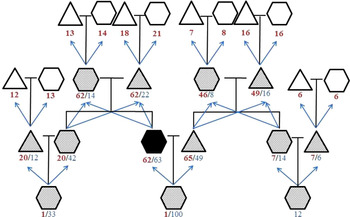
In the current study, level of perpetrated child maltreatment was reported for 556 parents (283 women; Figure 3) from 63 families with two or three generations. There were 413 parent–offspring, 39 siblings, 149 grandparent–grandchildren, and 1 avuncular pair. This sample is part of the 3G Parenting Study (Compier-de Block et al., Reference Compier-de Block, Alink, Linting, van den Berg, Elzinga, Voorthuis and Bakermans-Kranenburg2017). Reports were obtained from two sources: (a) child reports about whether mother or father perpetrated child maltreatment, and (b) parent reports about whether they had perpetrated child maltreatment. For 215 participants, parent reports were available and for all participants, child reports were available. The reporting children (N = 395, 225 female) were on average 39 years of age (SD = 20.37; rangeage = 7.5 to 88 years). Child-reported child maltreatment was in most cases based on the report of 1 (N = 378, 68%) or 2 (N = 158, 28%) children. In a few cases reports from more than 2 children were available (3 children: N = 14, 3%; 4 children: N = 4, 0.7%, 9 children: N = 2, 0.4%).
(Colour online) Overview of extended pedigrees from 63 families. Symbols without fill denote participants who did not participate but have been reported on. Red numbers refer to parents about whom child maltreatment reports were available and who were included in the analysis. Blue numbers refer to children reporting about child maltreatment. The black hexagon represents target participants (i.e., participants who were contacted first and around whom family members were recruited). Blue arrows symbolize about whom participants report. For simplicity, six parents and five children were omitted from this overview (but were included in the analyses) because they did not match the general family structure (e.g., fourth generation, stepparent).

Participants were recruited from three participant pools: (a) the Netherlands Study of Depression and Anxiety (Penninx et al., Reference Penninx, Beekman, Smit, Zitman, Nolen, Spinhoven and Van Dyck2008), (b) a study on parenting in relatively low SES families (Joosen, Mesman, Bakermans-Kranenburg, & van IJzendoorn, Reference Joosen, Mesman, Bakermans-Kranenburg and van IJzendoorn2013), and (c) the Longitudinal Internet Studies for the Social Sciences (LISS panel; Scherpenzeel & Toepoel, Reference Scherpenzeel and Toepoel2012). The participants from these three studies served as target participants. Two of these studies had assessed child maltreatment, and we invited participants who reported having experienced maltreatment during childhood. From the third study, all participants were invited. In order to protect the privacy of our participants, we cannot disclose from which study we recruited participants with maltreatment experiences. If the target participant agreed to take part in the study, family members of the target participant and of the target participant's partner were invited to participate (parents, children, siblings, nieces, and nephews). Family members had to be at least 7.5 years of age to be invited. Families were included if at least two first-degree relatives from two generations agreed to participate.
Procedure
We invited nuclear families to take part in a 7-hr lab visit at the Leiden University Medical Center. During the lab visit, participants completed questionnaires, computer tasks, and family interaction tasks. Furthermore, saliva, buccal tissue, and hair samples were collected. Approximately half of the participants attended an additional magnetic resonance imaging session. Informed consent was obtained from all participants. For participants under 18 years of age, parents cosigned informed consent. Ethical approval was obtained from the ethics committee of Leiden University Medical Centre.
Instruments
Child maltreatment
Children and parents (for part of the sample) reported on maltreatment perpetrated by the parent. Maternal and paternal maltreatment were assessed separately. Child maltreatment was measured using a combination of the self-reported Parent–Child Conflict Tactics Scales (CTSPC; Straus et al., Reference Straus, Hamby, Finkelhor, Moore and Runyan1998) and the Childhood Trauma Questionnaire (Bernstein et al., Reference Bernstein, Fink, Handeisman, Foote, Lovejoy, Wenzel and Ruggiero1994; Thombs, Bernstein, Lobbestael, & Arntz, Reference Thombs, Bernstein, Lobbestael and Arntz2009). The following subscales were used: physical assault (i.e., physical abuse; 13 items; CTSPC), psychological aggression (i.e., emotional abuse; 5 items; CTSPC), physical neglect (4 items; CTSPC), and emotional neglect (5 items; CTSPC and Childhood Trauma Questionnaire). The physical assault scale consists of three subscales: minor (5 items), severe (4 items), and very severe (4 items) physical abuse. For consistency in response options, a 5-point scale ranging from (1) never to (5) (almost) always was used for all items.
For participants under 12 years of age, experienced maltreatment was administered in interview form. The very severe physical abuse scale was not included in the interview. Participants who were 12 years or older and living with their parents at the time of the study indicated whether they had experienced maltreatment within the last year or in the years before. Per item, the higher score of these two was included. Subscale scores based on the higher score correlated significantly with subscales based on either last year, range: r (47) = .40–.88, or the years before, range: r (46) = .86–.99. The majority of the participants were adults (N = 302) and reported about childhood events retrospectively. Participants completed the questionnaires alone in separate rooms, but research assistants were always available for questions. For parent reports, child names were presented on the questionnaires.
For child and parent report, per scale and child, averages were computed. If multiple children reported on one parent or a parent reported on multiple children, the highest score per scale was included. Internal consistencies of the child reports were as follows: α = 0.91 for physical abuse, α = 0.78 for emotional abuse, α = 0.56 for physical neglect, and α = 0.91 for emotional neglect. For parent reports, the internal consistencies were α = 0.75 for physical abuse, α = 0.70 for emotional abuse, α = 0.36 for physical neglect, and α = 0.81 for emotional neglect. Physical neglect was excluded from the analyses as internal consistency was insufficient. This was likely because for three out of the four items more than 90% of parents never committed this type of physical neglect according to child and parent reports. The correlations between parent and child reports were significant, physical abuse: r (213) = .26, p < .001; emotional abuse: r (213) = .31, p < .001; emotional neglect: r (213) = .34, p < .001. No mean differences in parent and child reports were observed for physical abuse, t (214) = 0.69, p = .49, and emotional abuse, t (214) = –0.33, p = 75. However, children reported higher levels of emotional neglect than parents, t (214) = 9.01, p < .001. Mother and father reports were significantly correlated, physical abuse: r (126) = .46, p < .001; emotional abuse: r (126) = .24, p = .007; emotional neglect: r (126) = .40, p < .001, and there were no absolute differences in means between father and mother reports, physical abuse: t (213) = −0.52, p = .96; emotional abuse: t (213) = −0.79, p = .43; emotional neglect: t (213) = 1.27, p = .20.
Demographic information
The sex of the parent and age of the child (in the following referred to as age) were included as covariates. Note that the word “child,” in this context, does not refer to the developmental stage but rather to the relationship between parent and child (many of the children were adults at the time of the study). Child age was included as it is indicative of the time period during which maltreatment could have taken place and for the time passed since childhood, with the oldest child being 88 years of age. If more than one child reported on child maltreatment, child age was averaged. Participants of 18 years and older answered questions about household income and highest completed education. Yearly household income was measured on a 7-point scale ranging from (1) less than €15,000 to (7) more than €65,000. First- and second-generation participants rated education on a 7-point scale. Third-generation participants rated education on a 10-point scale to accommodate changes in the Dutch educational system. Both scales were rescaled to a 4-point scale. Based on standardized household income and standardized completed educational level, a composite household SES score was calculated. Data of two partners living in the same household was averaged for the household SES score. SES was available for 262 parents (47%). If SES was not available, child education was used as an estimate of SES as child education has been found to be associated with parental SES (Sirin, Reference Sirin2005; White, Reference White1982). If two or more children participated, the lowest child education score was used, because exploratory analyses demonstrated that this produced the highest, albeit still modest, correlation with parental education, r (118) = .24, p < .01.
Analyses
Heritability
We conducted descriptive and correlational analyses in SPSS Statistics 23.0 (SPSS Inc.). The statistical genetic analysis software SOLAR was used for all heritability analyses (Almasy & Blangero, Reference Almasy and Blangero1998). SOLAR is a comprehensive system for likelihood-based statistical analysis of variance components models. Heritability (h 2) is defined as the proportion of trait variance explained by additive genetic variance, estimated using a kinship matrix. A heritable trait is expected to have a greater covariance between participants who are more closely related compared to participants who are distantly related or not related. This is tested by estimating how much of the observed covariance matrix is predicted by the covariance matrix predicted by kinship. Kinship is entered into SOLAR by specifying the biological mother and father for each participant. On the basis of this information, a kinship matrix is constructed by SOLAR defining the genetic relatedness between all participants (for instance, .50 for parent and child, and .25 for aunt and nephew). Heritability is estimated under a polygenic model. To determine significance of the heritability component, the log likelihood for a model estimating heritability was compared to a model constraining heritability to zero. To estimate the common environmental variance (c 2), a household component was included in all models. Full siblings and half siblings were coded as sharing or having shared the same household if they had grown up in the same household for at least 5 years (n = 48). Significance of common environment was similarly determined by comparing models with and without constraining common environment to zero. Variance not explained by additive genetic or common environmental effects was attributed to unique environment.
We model a given quantitative phenotype as being additively determined by random genetic, shared common, and residual environmental effects. The vector v of phenotype values may be expressed in terms of a multivariate mixed effects linear model:
 $${\bf y} = {\bf X}{\bf \beta} + {\bf a} + {\bf c} + {\bf e}\comma$$
where  ${\bf X}$ is an incidence matrix augmented by a column of 1s,
 ${\bf \beta} $ is a vector of the grand trait mean, μ (so that β 0 = μ) and covariate effects, β 1, …, β n,
 ${\bf a}$,
 ${\bf c}$, and
 ${\bf e}$ are vectors of random additive genetic, shared common, and random residual environmental effects. The model for the mean is given as
 $$E[{\bf y}] = {\bf \mu} = {\bf X}{\bf \beta}\comma $$
which is the form we adopt in all of our mixed linear models.
For pedigrees, the covariance matrix formulation is
 $${\bf \Sigma} = 2{\bf \Phi} \sigma _a^2 + {\bf H}\sigma _c^2 + {\bf I}\sigma _e^2 \comma $$
where  $\sigma _a^2 $,
 $\sigma _c^2 $, and
 $\sigma _e^2 $ are, respectively, the additive genetic, shared common environmental, and residual environmental variances,
 ${\bf \Phi} $ is the kinship matrix of the pedigree,
 ${\bf H}$ is the common environment matrix, and
 ${\bf I}$ is the identity matrix. The ln-likelihood function under the polygenic model is therefore given as
 $$ \ln L\lpar {{\bf \beta}\comma \, \sigma_a^2\comma \, \sigma_c^2\comma \, \sigma_e^2 \vert {{\bf y}\comma \,{\bf X}} } \rpar = -{\textstyle{1 \over 2}} [{N\ln (2\pi ) + \ln \vert {\bf \Sigma} \vert + {\bf {\Delta}^{\prime}}{\bf \Sigma}^{-1}{\bf \Delta}}] \comma$$
where  ${\bf \Delta} = {\bf y}-E [{\bf y}] = {\bf y}-{\bf X}{\bf \beta} $ denotes the residuals vector.
On finding the maximum likelihood estimates, inferences are then made by way of the likelihood ratio statistic (LRT):
 $${\rm LRT} = -2\ln \left[ {\displaystyle{{L\lpar {{}_N} \rpar } \over {L\lpar {\hat{}} \rpar }}} \right] = -2 [{\ln L\lpar {{}_N} \rpar -\ln L\lpar {\hat{}} \rpar }] \comma $$
where  ${}_N = [{\theta_i = 0\comma \,\theta_j\comma \, \ldots\comma \, \theta_p}]^{\prime}$ denotes the null or restricted hypothesis vector of size p, where the ith parameter is constrained to its null while the other parameters (θ j, …, θ p) are estimated, and
 $\hat{} = [{{\hat{\theta}}_1\comma \, \ldots\comma \, {\hat{\theta}}_p}] $ denotes the alternative or general hypothesis vector of the same size, where the parameters take on their maximum likelihood estimates.
Preliminary polygenic model analyses were performed for the child-reported phenotypes physical abuse, emotional abuse, and emotional neglect with age, age2, sex, Age × Sex, and Age2 × Sex as covariates. The residuals from these three models (one model per trait) were transformed using inverse normalization. Transformation was necessary because normality is assumed for the present analysis (Almasy & Blangero, Reference Almasy and Blangero1998) and inverse normalization gives an exactly normal distribution (Blangero et al., Reference Blangero, Diego, Dyer, Almeida, Peralta, Jack and Göring2014; Diego et al., Reference Diego, Rainwater, Wang, Cole, Curran, Johnson and Blangero2007). Power analyses were conducted for effect sizes of 50% for h 2 and 25% for c 2 and showed that power was adequate for most parameters. The justification and detailed results of the power analyses are reported in the supplement (Supplement S.1 and Table S.1). Next, polygenic model analyses were performed for these residualized phenotypes. SES was not included as a covariate in the main analysis because for half of the participants, the variable was estimated based on child education because primary data was not available. In a sensitivity analysis, we explored whether adding SES as a covariate changed our findings.
Reporter effects
We explored reporter effects by comparing estimates from analyses using child reports and multi-informant reports. If child and parent reports were available, maltreatment scores from both reporters were averaged. This was the case for 215 participants. This approach allowed us to keep the sample size and relationship structure constant. Differences in estimates were considered relevant when 95% confidence intervals did not overlap.
Results
The occurrence of child maltreatment and descriptive statistics are presented in Table S.2 and S.3, respectively. For a better impression of the occurrence of severe maltreatment, we specifically explored whether parents had ever perpetrated severe or very severe physical abuse using child report. Thirty-two percent of parents perpetrated at least one act of severe or very severe physical abuse. Physical abuse, emotional abuse, and emotional neglect were significantly correlated, range: r (554) = .41–.67. Per maltreatment type, child report and multi-informant report were highly correlated, range: r (554) = .95–.98. Independent of reporter, women were more emotionally abusive but, according to multi-informant report, less physically abusive. Child age (ranging from 7.5 to 88 years) was positively correlated to physical abuse and emotional neglect. Low SES was associated with more physical abuse but not with emotional abuse or neglect.
Heritability
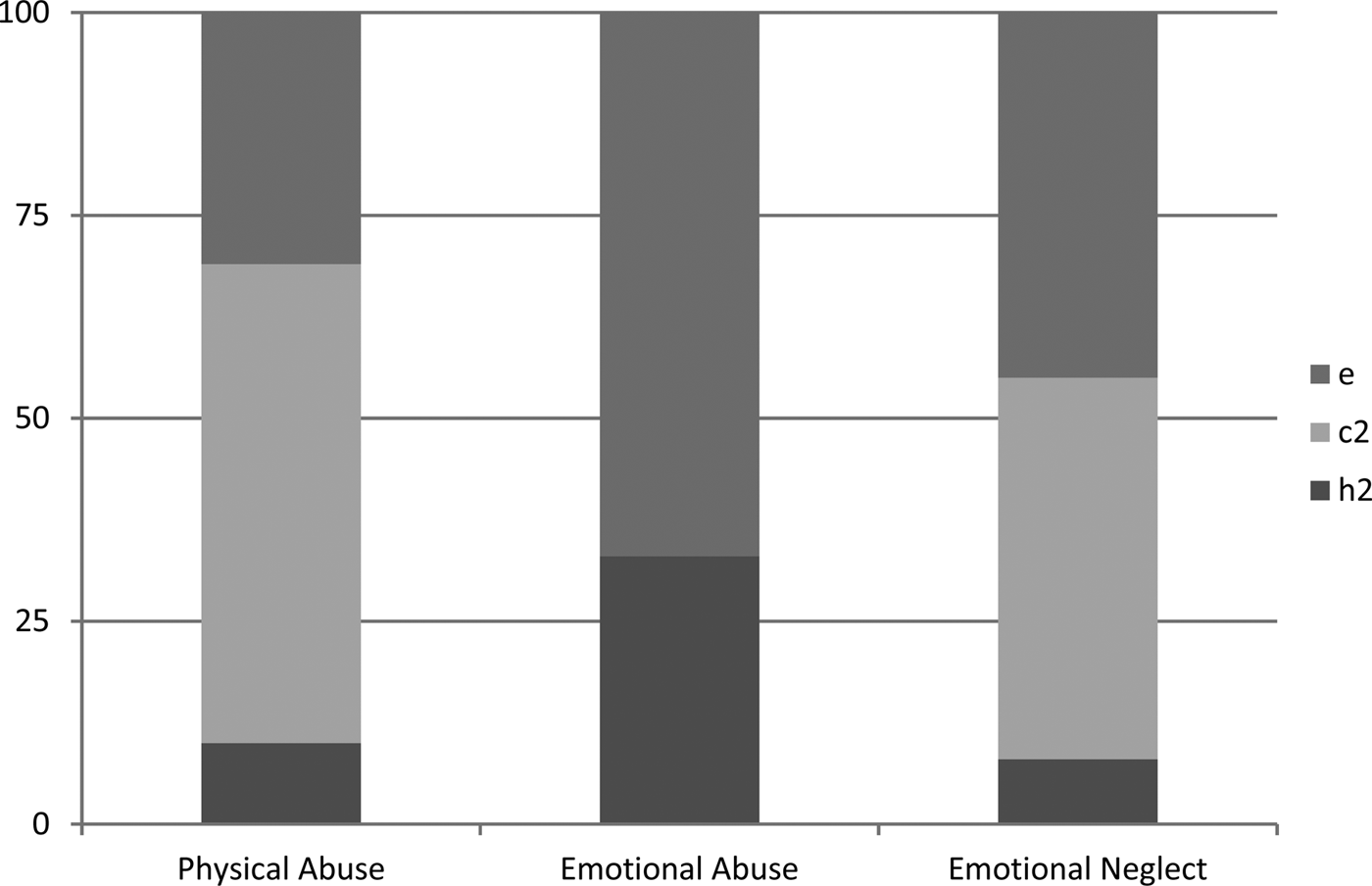
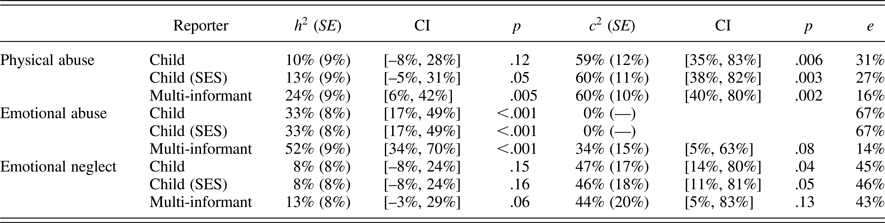
Based on the polygenic model analyses, perpetration of physical abuse and emotional neglect were associated with small, nonsignificant genetic effects, and most variance was explained by the common environmental component (physical abuse: c 2 = 59%, SE = 12%, p = .006; emotional neglect: c 2 = 47%, SE = 8%, p < .001; Tables 1, S.4, and S.5, and Figure 4). Emotional abuse was, however, influenced by genetic effects (h 2 = 33%, SE = 8%, p < .001) but not common environment. The same pattern of results was observed when controlling for SES.
Variance estimates of heritability (h 2), common environment (c 2), and unique (e) environment.

Reporter effects
Heritability and environmental effects for child multi-informant reports are also described in Table 1. Comparing child reports only to multi-informant reports, confidence intervals overlapped for physical abuse, emotional abuse, and emotional neglect for heritability and common environment with the exception of common environmental effects on emotional abuse. Higher estimates of common environment were observed on multi-informant than on child reports for emotional abuse. This indicates that estimates for genetic and common environmental effects were relatively similar. Moreover, for all maltreatment scales, the multi-informant reports led to the smallest estimates of unique environment, which includes measurement error.
Comparison of estimates derived from child report, child report corrected for SES, and multi-informant report

Note: SES, socioeconomic status. SE, standard error. CI, 95% confidence interval.
Discussion
The primary aim of the present study was to estimate genetic and environmental effects on perpetrated child maltreatment using a parent-based extended family design. Perpetrated child maltreatment was based on child reports to prevent inflation of heritability estimates. The main outcomes are that individual differences in emotionally abusive behavior were in part due to genetic factors. To our surprise, no effects of common environment on emotional abuse were found. Conversely, physical abuse and emotional neglect were entirely explained by common and unique environmental influences. No evidence of significant genetic effects on physical abuse or emotional neglect was found.
Heritability of emotional abuse in a parent-based design indicates passive rGE for emotional abuse. In passive rGE, genetically influenced parent factors inherited by the child account for the correlation between the environment of the child (i.e., child maltreatment perpetrated by parents) and child factors such as externalizing and internalizing behavior (Knafo & Jaffee, Reference Knafo and Jaffee2013). Genetic factors may affect emotional abuse through hormonal and neural pathways. For instance, oxytocin pathways are affected by genetic factors (Gimpl & Fahrenholz, Reference Gimpl and Fahrenholz2001) and play an important role in social interactions (Aspé-Sánchez, Moreno, Rivera, Rossi, & Ewer, Reference Aspé-Sánchez, Moreno, Rivera, Rossi and Ewer2016) including parenting (Bakermans-Kranenburg & van IJzendoorn, Reference Bakermans-Kranenburg, van IJzendoorn, Cassidy and Shaver2016; Feldman & Bakermans-Kranenburg, Reference Feldman and Bakermans-Kranenburg2017; Mileva-Seitz et al., Reference Mileva-Seitz, Bakermans-Kranenburg and van IJzendoorn2016). More indirectly, genetic factors may also affect child maltreatment through traits such as neuroticism, or psychopathology. For instance, one study found that the same genetic effects contributed to rejecting parenting and neuroticism, although, overall, the size of the effects was small (Spinath & O'Connor, Reference Spinath and O'Connor2003). Alternatively, depression and other psychopathologic symptoms might mediate genetic effects on emotional abusive behavior. There is strong evidence that psychopathology is in part heritable and represents a risk factor for perpetrating child maltreatment. However, psychopathology has been related to perpetration of different types of child maltreatment and not emotional abuse specifically (Mackenzie et al., Reference Mackenzie, Kotch and Lee2011; Stith et al., Reference Stith, Liu, Davies, Boykin, Alder, Harris and Dees2009). Furthermore, using child report, we did not find evidence for genetic influence on perpetrating physical abuse or emotional neglect. This implies that individual differences in perpetrating physical abuse and emotional neglect are mainly associated with environmental effects.
We found effects of common environment on physical abuse and emotional neglect, meaning that the environment shared by siblings, for instance during childhood, affects perpetration of maltreatment in adulthood. One well-established risk factor for child maltreatment is low SES. However, effects of common environment remained significant and similar in size when controlling for SES. This suggests that SES does not fully explain common environmental effects. Moreover, only physical abuse was related to SES. It should be noted, however, that we assessed current SES of offspring rather than SES while growing up. As such, SES might represent unique environment rather than common environment. This effect might have been further inflated by using child education to estimate SES if no primary SES data was available. Environmental factors beyond SES may play a crucial role in child maltreatment risk. For instance, lack of social support and neighborhood characteristics may elevate risk for child maltreatment, in particular if risk factors accumulate (Mackenzie et al., Reference Mackenzie, Kotch and Lee2011). Moreover, these environmental factors may be shared by siblings while growing up in the same household, but they may also be present in adulthood. Current contact between adult siblings or between other family members such as parents may also account for common environmental influences. While common environmental effects are theoretically and empirically plausible, the magnitude of these effects was surprising as earlier parent-based designs found little to no environmental effects on parenting in their meta-analysis (Klahr & Burt, Reference Klahr and Burt2014). However, this meta-analysis did not include studies assessing child maltreatment, and estimates varied across parenting dimensions, suggesting that generalization from one parenting dimension to the next may not be appropriate. This stresses the need for more research using parent-based designs. Moreover, a replication of the current findings using a twins-as-parents design would be highly valuable.
Both genetic and common environmental effects are in line with intergenerational transmission. Our findings suggest that the mechanisms underlying the intergenerational transmission of emotional abuse are different from those underlying the transmission of physical abuse and emotional neglect. For emotional abuse, children may inherit a predisposition for emotional abuse potentially through genetic effects, which may be related to psychopathology, or increased or decreased sensitivity of hormonal systems, such as the hypothalamic–pituitary–adrenal axis or oxytocin system. For physical abuse and emotional neglect, environmental factors, such as little social support and adversity in the neighborhood, may play a more causal role. Experiencing child maltreatment may increase the likelihood of perpetrating these types of maltreatment through social learning and effects on the stress system. Maternal history of child maltreatment may alter neural development of offspring already during pregnancy (Buss et al., Reference Buss, Entringer, Moog, Toepfer, Fair, Simhan and Wadhwa2017).
However, our study only shows that there was no common environmental effect on emotional abuse. This suggests that the social and economic environment that siblings shared growing up did not account for individual variation in emotionally abusive behavior across participants. No conclusions can be drawn about emotional abuse as an environmental risk factor. Emotional abuse may be one common environmental factor increasing the risk for perpetrating physical abuse or emotional neglect. Emotional abuse has been found to be detrimental to mental health with effects over and above physical and sexual abuse, and physical and emotional neglect (Cecil, Viding, Fearon, Glaser, & Mccrory, Reference Cecil, Viding, Fearon, Glaser and Mccrory2017).
Of note, for all child maltreatment phenotypes, we found considerable effects of the unique environment. Estimates of unique environmental effects on child maltreatment appear to be higher in this parent-based study compared to child-based designs (Fisher et al., Reference Fisher, Caspi, Moffitt, Wertz, Gray, Newbury and Arseneault2015; Jaffee et al., Reference Jaffee, Caspi, Moffitt, Polo-Tomas, Price and Taylor2004). This is in line with studies on other parenting dimensions. In parent-based studies, the majority of individual variation in parenting is explained by unique environment with estimates of up to 90%, whereas estimates of unique environment in child-based studies rarely exceed 50% (Klahr & Burt, Reference Klahr and Burt2014). This can probably be attributed to a difference in age. Participants in parent-based designs are always adults and have generally been exposed to different environments for a number of years. Unique environmental effects may be partly explained by genetic child effects. Siblings may be confronted with different parenting challenges if one has a child with a more difficult temperament than his or her brother or sister. In addition, part of the unique environment may be attributed to effects of the partner and co-parent. While partner choice is not independent of genetic effects (e.g., assortative mating; Krueger, Moffitt, Caspi, Bleske, & Silva, Reference Krueger, Moffitt, Caspi, Bleske and Silva1998), the co-parent may represent an important source of environmental variation. Relationship quality has been found to affect the level of intergenerational transmission of child maltreatment and may represent an environmental buffer (Jaffee et al., Reference Jaffee, Bowes, Ouellet-Morin, Fisher, Moffitt, Merrick and Arseneault2013). Parent couples in this study reported similar rates of perpetrating child maltreatment, which is consistent with research showing that parents tend to display similar parenting styles (Simons & Conger, Reference Simons and Conger2007). However, the explanation for similarity between parents cannot be established in the present study. Co-parents may be affected by the same child effects and may be exposed to the same environmental stressors. In addition, parents may influence each other's parenting behavior.
The secondary aim of this study was to test reporter effects by comparing child report to multi-informant reports. Child report yielded similar estimates for heritability as multi-informant report, but the unique environmental component was smallest with multi-informants, probably meaning that the amount of error variance was lowered. In child-based studies in general, the reporter moderates genetic effects on parenting with larger genetic effects for child than for parent reports (Klahr & Burt, Reference Klahr and Burt2014). In the present study, we found only low to modest convergence in child and parent perspectives on reported maltreatment. Nonetheless, estimates of heritability and environment were similar for child and multi-informant report. Consistently, estimates of unique environment were lower for multi-informant report. Given that the unique environment always includes measurement error, the reduction in unique environmental effects when using a multi-informant approach may indicate a reduction in measurement error. Single-informant data may be more vulnerable to temporary fluctuations. This effect was found even though parent reports were available for only less than half of the sample. A multi-informant approach might thus offer an advantage over single-informant data even when information is incomplete. However, by using multi-informant reports that also include parent reports, heritability estimates may be somewhat inflated.
The present study focused on child maltreatment from a continuous measurement perspective with a range from no child maltreatment, over milder forms of child maltreatment, to severe child maltreatment. In clinical and legal contexts, a dichotomization of child maltreatment is often used, but for research purposes this cutoff is arbitrary. A continuous perspective is also in line with developments toward continuous models of psychopathology (Markon, Chmielewski, & Miller, Reference Markon, Chmielewski and Miller2011). Moreover, quantitative genetics assume a polygenic model of inheritance (i.e., it is assumed that many genes influence behavior). A continuous measure might better reflect the polygenic etiology of abuse and neglect. In the present sample, while most participants clustered around the lower levels of harsh parenting and child maltreatment, a wide range of child maltreatment perpetration was reported, including severe child maltreatment. Analyses were done under the assumption that normative harsh parenting is caused by the same genes as severe child maltreatment. Future research should test this assumption, similar to the approach for depression, where minor and major depression have been shown to share a genetic etiology (Corfield, Yang, Martin, & Nyholt, Reference Corfield, Yang, Martin and Nyholt2017). A technical reason for using a continuous measure in the current study is that the variance component method for extended families as used in the present study is optimal for continuous traits (Almasy & Blangero, Reference Almasy and Blangero2010). Statistical models for discrete traits are available but would result in a loss of statistical power. Modeling a discrete trait, statistical power is greatest if the distribution is close to 50% affected and 50% unaffected, which was not the case for the present study.
Limitations and future directions
One limitation of this study was that there was relatively little variation in genetic relationships between family members. The majority of relationships were vertical: parent–offspring and grandparent–grandchild. Including more horizontal relationships (e.g., cousins, and half-siblings) increases statistical power (Docherty et al., Reference Docherty, Kremen, Panizzon, Prom-Wormley, Franz, Lyons and Neale2015) and reduces confounding genetic relatedness with common environment (Diego, Kent, & Blangero, Reference Diego, Kent, Blangero and Wright2015).
Child reports were used for the main analyses. For approximately half of the participants, information was available from both child and parent reports. However, while children systematically reported on child maltreatment perpetrated by their parents, no other information was collected about the parents. For parents not participating in the study, the only demographic data available were sex and child age, and we could not estimate heritability using parent report in the complete sample. A direct comparison between child and parent reports in a sufficiently large sample may give a more complete picture of reporter effects. Moreover, retrospective reports may be subject to greater measurement error and false negatives due to forgetting (Hardt & Rutter, Reference Hardt and Rutter2004). At the same time, false positives are rare in retrospective reports, and associations with psychopathology are comparable for retrospective and prospective reports, suggesting that reporting bias due to current psychopathology is negligible (Hardt & Rutter, Reference Hardt and Rutter2004; Scott, McLaughlin, Smith, & Ellis, Reference Scott, McLaughlin, Smith and Ellis2012).
The present study was mainly concerned with the extent to which genetic and environmental factors affect child maltreatment. In future studies, it will be crucial to explore how genetic and environmental factors affect child maltreatment. Multivariate studies might further illuminate the underlying mechanisms by exploring genetic and environmental overlap of child maltreatment and related traits. The costs of whole-genome sequencing have dropped drastically over the last years (Plomin & Simpson, Reference Plomin and Simpson2013). Future studies might use molecular genetic designs such as genome-wide association studies and GCTA to more precisely estimate heritability and examine genetic mechanisms underlying child maltreatment. The present study and most studies described above estimate narrow sense heritability. Narrow sense heritability only estimates additive genetic effects whereas broad sense heritability includes effects of dominance and epistatic interaction (Almasy & Blangero, Reference Almasy and Blangero2010). Narrow sense heritability may be inflated if a trait is affected by nonadditive genetic effects (Manolio et al., Reference Manolio, Collins, Cox, Goldstein, Hindorff, Hunter and Visscher2009), and molecular genetics might shed more light on nonadditive genetic effects on child maltreatment. However, reviews and studies by several quantitative geneticists have concluded that in most cases dominance and epistasis can be considered negligible (Crow, Reference Crow2010; Hill, Goddard, & Visscher, Reference Hill, Goddard and Visscher2008; Mäki-Tanila & Hill, Reference Mäki-Tanila and Hill2014; Zhu et al., Reference Zhu, Bakshi, Vinkhuyzen, Hemani, Lee, Nolte and Yang2015). Similarly, Hill (Reference Hill2010) observed that in genomewide association studies of 10,000 or more individuals, none of the identified variants showed evidence of dominance or epistasis.
It is further of note that due to oversampling for child maltreatment, the sample used in the current study is not representative of the general population. We oversampled for child maltreatment to compensate for the potential underrepresentation of maltreating parents in general population sampling. This underrepresentation can be observed in previous studies on using child-based designs in which the majority of the participants had never experienced the assessed forms of maltreatment (Fisher et al., Reference Fisher, Caspi, Moffitt, Wertz, Gray, Newbury and Arseneault2015; Schulz-Heik et al., Reference Schulz-Heik, Rhee, Silvern, Lessem, Haberstick, Hopfer and Hewitt2009). Nonetheless, as a result of oversampling, the heritability and environmental estimates may not generalize to the general population. A positive effect of the sampling strategy was a socioeconomically diverse sample, which is not self-evident in developmental research. Environmental effects may be underestimated in samples with a small range in environmental experiences.
The present study shows that environment is an important determinant of maltreatment risk independent of type. However, we can only speculate which specific factors contributed to these high estimates of environment. Genetically informative designs, such as adoption and in vitro fertilization studies, may be useful in studying specific environmental factors while eliminating genetic confounding. A better understanding of environmental factors contributing to maltreatment will have important implications for interventions. Studies about risk factors provide strong candidates, but genetically informative designs may provide more insight into directions of causality. The effects of common environment on physical abuse and emotional neglect is drawing attention to the importance of early intervention, while the effects of unique environment suggest that intervention later in life may still be fruitful and benefits may trickle down to the next generation.
Conclusion
This is the first parent-based quantitative genetic study of child maltreatment. Our findings suggest that emotional abuse is influenced by genetic and unique environmental factors. Individual differences in physical abuse and emotional neglect were due to common and unique environmental effects. These findings are consistent with intergenerational transmission of child maltreatment, but suggest different pathways for physical abuse, on the one hand, and emotional neglect and emotional abuse, on the other hand. Emotional abuse appears to be transmitted from one generation to the next through genetic factors while physical abuse and emotional neglect appear to be transmitted through common environmental factors such as the experience of child maltreatment. High estimates of unique environment, further, may point to importance of parents’ experiences as adults and may provide an important target for intervention. Although estimates from child and multi-informant reports were not drastically different, it is important to note that multi-informant reports resulted in less measurement error, and thus might be preferred in epidemiological and clinical studies of maltreatment as well as in legal and clinical decisions concerning child maltreatment.
Supplementary material
To view the supplementary material for this article, please visit https://doi.org/10.1017/S0954579418001608.