On May 27, 1933, Chicago's second world exposition opened with great pomp and electrifying grandeur. That first night, lights illuminating the monumental architecture on the fairgrounds were powered, it was advertised, by harnessing electricity from the star Arcturus. The star was 40 light years away from Earth, so the rays used to energize the fair would have been emitted at the time of Chicago's Columbian Exposition in 1893 (Findling Reference Findling1994, 57). Dramatically demonstrating the latest science and technology, this opening night event was a clever way to open a fair called A Century of Progress and provided a spectacular kick-off for the celebration of the city's centennial. Moreover, it presaged the kinds of tantalizing spectacles that fair organizers hoped to deploy in order to bolster Chicago's economy, which was still reeling from the Great Depression. Fair architects and designers decorated pavilions using a brilliant palette of red, green, orange, and blue. The Ford and Chrysler Exposition Buildings shone as futuristic, highly aestheticized shrines of industrial capitalism. Cars, planes, and the “House of Tomorrow” became shiny symbols of material progress. Fairgoers responded positively to these fantastic displays, and the expo proved to be a great success. Though originally slated to operate for just six months in 1933, the fair reopened for an additional five months in 1934.
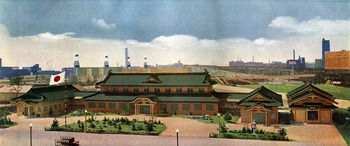
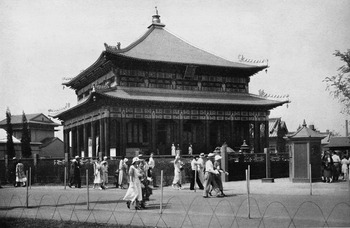
Tucked away on the northwestern edge of the fairgrounds, the Japanese exhibition site (see figure 1) was decidedly modest compared with the dynamic, monumental, and colorful displays that set the tone for the rest of the exposition. But the scale of the main pavilion, designed by architect Miyamoto Iwakichi, was not inconsiderable, and the style adequately expressed the distilled cultural “essence” expected of nations at such events. Consisting of a hip-and-gable roof over a main hall and two wings, the Japan pavilion was a pastiche of Kamakura- and Momoyama-period Japanese architectural motifs (Takenaka Reference Takenaka1990, 18). Three small karahafu (cusped-gabled roofs) marked entrances to each wing and the main hall, while two unobtrusive “fish tail” shibi ornaments decorated the ridge beam on the roof. The use of renjimado, or slatted windows, on the first level contributed to the flat and taut appearance of the façade. These details, together with the rather plain wood cladding and muted green tile roof, functioned as a subdued acknowledgment of Japan's rich and varied architectural past.Footnote 1
Illustration of the Japan exhibition complex, including the Manchuria pavilion (at far right). A Century of Progress Exposition in Chicago, 1933–34 (Yamashita Reference Yamashita1934). Yale University Library.

Nonetheless, the complex did not dazzle. Instead, it was an understated place where fairgoers could take in examples of Japanese export handicrafts such as porcelain, cloisonné, and silk work (Century of Progress 1933b, 96). Indeed, there were some popular attractions, too. Fairgoers could watch dainty Japanese ladies demonstrate tea ceremonies in a “typical Japanese tea garden” every afternoon (96). Also, the Japanese Exhibition Committee planned special events such as “Silk Day,” when attractive Japanese and foreign women modeled kimono in a fashion show, and “Pearl Day,” when Japanese fair organizers gave away pearls to 100 lucky winners (Yamaji Reference Yamaji2008, 162). According to cultural anthropologist Yamaji Katsuhiko, these events demonstrated the “showy” (hade) side of the Japanese exhibit (162). These events aside, the exhibit lacked spectacular appeal. This may be attributed to the lingering effects of the Great Depression or to the relatively last-minute planning of the Japanese exhibition grounds. Certainly it was not due to any lack of savvy regarding the best exhibitionary practices at such large-scale, international events. Japanese exhibits had been featured at world expositions for decades;Footnote 2 the Meiji government had sent a display to the world's fair in Vienna in 1873, while Japan's exhibit only three years later in 1876 at the Centennial Exposition in Philadelphia—the first Japanese exhibit in America—had helped to cultivate opportunities for export markets for its commercial goods, focusing on the exhibition of products made specifically for U.S. tastes (Hosley Reference Hosley1990, 30–33). Over the years, Japanese exhibition committees had proven masterful in commanding the spectacular lexicon of national display. However, when compared to the rich architectural detail of earlier Japanese exhibits such as, for example, the popular recreation of the Phoenix Hall featured in Chicago for the 1893 exposition or the enormous replica of the Yomei gate that towered more than 100 feet above the Pike in St. Louis in 1904 (Christ Reference Christ2000), the Japan pavilion and the surrounding grounds in 1933 seem remarkably unremarkable.
Yet, nestled on the Japanese exhibition grounds between the main pavilion and the chain link fence that marked the western edge of the fairgrounds stood a small building with tremendous political significance: the Manchuria exhibits hall. At just 50.25 tsubo, or approximately 1,800 square feet, the hall was diminutive by the grandiose standards of other exhibition pavilions and, consequently, was easy to miss. In fact, the Manchuria exhibits building entertained an average of just 5,000 visitors each day (Chicago Daily Tribune 1933), whereas the fair overall averaged around 118,000 (Findling Reference Findling1994, 133, 142). In other words, only about 2 percent of spectators visited this exhibit.Footnote 3 It was therefore neither the size nor the popularity of the little pavilion that made it so provocative; rather, the contentious political stakes of its very existence and its exhibitionary relationship to Japan on the fairgrounds compel further analysis. The Manchuria exhibit, which opened on June 10, 1933, exemplifies the complicated political landscape of the early 1930s. This was a crucial transitional time when some Japanese officials sought to mend international relations damaged by increasing Japanese militarism on the Asian continent, while others embarked on a path of increasing diplomatic isolationism that would ultimately lead to total war. An examination of the Manchuria pavilion exposes the simmering geopolitical tensions at work both at the fair and on the larger world stage.
This paper considers how the 1933 Manchuria pavilion operated as a locus for the complex symbolic, economic, and cultural negotiation of power between Japan, China, and the United States. First, I investigate the debate among different Japanese offices over the construction of the pavilion, the potential international effects it would have, and the ramifications of the decision to have the South Manchuria Railway Company (Minami Manshū testudō kabushikikaisha, hereafter “Mantetsu,” its abbreviated name) act as the screen through which the American public would encounter Manchuria on the fairgrounds. This last point demonstrates the comingling of the still emerging field of corporate public relations and national politics, a factor that would play a crucial role in the visual coding of the space itself. Next, an in-depth analysis of the building and its displays facilitates a better understanding of the multiple, complicated narratives at work in the pavilion and exposes the ways in which the Manchuria exhibition committee subtly posited the importance of Japanese occupation and development of the region. Of course, these claims would not go uncontested. The last section of this paper considers how the exhibition grounds became a site for competing subject positions by examining the recreation of the Chinese Lama Temple, the Potala of Jehol (or Golden Temple of Jehol) for the Chicago fair. Sponsored by Vincent Bendix, a Swedish-American industrialist from Chicago and one of the trustees for A Century of Progress, the Golden Temple brought the disputed territory of Jehol—a province invaded by the Japanese Kwantung Army and annexed by the new nation-state of Manchukuo the same month the fair opened—onto the public stage in a grand manner.Footnote 4 Operating as a cultural rather than an economic statement, it contested the new boundaries of Manchukuo advertised by Mantetsu in its exhibition hall. In the process, it unsettled the Japanese imperial claim to be the most suitable steward of East Asian interests.
“Manchukuo: Child of Conflict”
Planning for the small Manchuria exhibition building and, eventually, the opening of the fair itself in Chicago took place in a heated political atmosphere. At this time Manchuria was—to borrow the title of Kiyoshi K. Kawakami's Reference Kawakami1933 book—a “Child of Conflict” in the global arena. The Chinese and Soviet governments each vied to extend their respective political, military, and economic control of the region's strategic location and vast resources. British and American business interests were also attracted to the possibility of economic expansion in the region, particularly the relatively untapped market of approximately thirty million people. The Japanese army, capitalists, and politicians, however, each had their own agendas on the continent as well. By 1930, Japanese interests had extended their influence well beyond the Kwantung Leased Territory, a territorial sphere of influence in southern Manchuria on the Liaodong Peninsula, the rights to which Japan had won following the Russo-Japanese War (1904–5). This was due in no small part to the power and territorial reach of Mantetsu. As the company held firm control over all land abutting its railway lines, Mantetsu became the primary apparatus of Japanese imperial expansion in Manchuria.
International tensions increased following the Manchurian (or Mukden) Incident on September 18, 1931, in which the Kwantung Army accused the Chinese army of trying to blow up the railroad outside of Mukden. This provided the Japanese army with an excuse to invade Manchuria. Despite Japanese claims to the international community that the nation had no intention of assuming governmental control over the region (Japanese Chamber of Commerce 1933, 3), in February 1932 the army established the new state, called Manchukuo, which would be sympathetic to Japanese interests.Footnote 5 This ruse was not successful. As journalist H. B. Elliston makes clear, the Japanese army's report of Chinese insurgency, its consequent “defensive” actions in the region, and the supposed sovereignty of the new nation were all suspect from the beginning (Elliston Reference Elliston1933, 39). Indeed, Japanese interests in Manchuria and the nation's image on the world stage suffered a series of blows in 1932 and 1933. On January 7, 1932, the U.S. government issued the Stimson Doctrine, a policy of non-recognition for any changing state of affairs brought about by force (a contravention of the Kellogg-Briand Pact). Members of the League of Nations soon adopted the same position. In the autumn of 1932, the Lytton Commission finally reported to the League of Nations its suggestions for handling the ongoing conflict between Japan and China in Manchuria. While acknowledging Japan's right to protect its economic interests in the region, the commission's report labeled Japan as an aggressor in the Manchurian Incident in September 1931 and, drawing on the Stimson Doctrine, did not recognize Manchukuo. Instead, while acknowledging the need to create a largely autonomous state, the commission supported Chinese political authority in the region. In response to this affront to Japan's imperial ambitions on the Asian continent, the Japanese delegation led by Matsuoka Yōsuke formally announced Japan's withdrawal from the League on March 27, 1933. In time, a number of countries, including Germany, Italy, and even the Soviet Union, would recognize Manchukuo. However, at the time the Chicago fair opened in May 1933, Japan was the only major power to recognize the new nation.Footnote 6
Debates over the legitimacy of Manchukuo and Japan's military occupation of the region were entangled with competing economic concerns as well. For example, though the American government urged other nations to adopt the Stimson Doctrine in early January 1932, they did not immediately do so. According to F. P. Walters, a British reply to Washington cited concerns that such an action would shut foreign commerce out of Manchuria (Walters [1952] Reference Walters1960, 484). Perhaps concerned about similar issues, nations such as France remained silent. Walters writes that, in regard to “Far Eastern questions,” “[n]ot a word was said about the Covenant, or the Kellogg Pact; not a word about the integrity of China” (484). It was only after the bloody battle of Shanghai had begun, foreign correspondents had witnessed the fighting firsthand, and the violence had had a direct impact on foreign interests that Council members adopted the U.S. policy (484). In other words, it would seem that Council members only took a strong diplomatic stand against Japanese actions on the continent when the Japanese military advance threatened their own interests.
That said, even in the United States there was no clear consensus on how to respond to the bold actions of the Japanese Kwantung Army. Certainly, it gave politicians in Washington cause to reevaluate the readiness of the U.S. Navy to fight in “Far Eastern waters” and even influenced the creation of Senate Bill 51 in 1932, which provided authorization for building the American Navy up to treaty limits (Tupper and McReynolds Reference Tupper and McReynolds1937, 264). Despite growing concern about Japanese military movement in Asia, particularly in Manchuria, politicians such as Senator William H. King (Utah) claimed that Japanese policies seemed understandable in light of the growing Japanese population and Japan's position in Manchuria. Senator King did not excuse Japanese actions in Shanghai, but he nonetheless questioned whether Japan should be conceived of as the enemy (265).
American media treatment of Japan's conflict with China was equally divided. For example, publications such as the New York Times pondered the rupture between Baron Shidehara's supposedly pacifist foreign policy and the “out of hand” actions of the army; taking a different tack, the Boston Herald speculated that the conflict was the result of the ongoing Japanese desire to “lock up the northern territory” (296), while the Worcester Evening Gazette claimed China was at fault, as that government had proven unable to “protect foreign lives and property” (297). Regardless of the different position each newspaper or bureaucrat staked, all seemed to agree that hostilities should be stopped immediately, thereby fulfilling obligations held under internationally recognized treaties (297).
These numerous reactions to the “Manchuria problem” suggest that different Japanese interests such as the Kwantung Army, Mantetsu, and/or the Ministry of Foreign Affairs (Gaimushō) could still influence international political and popular opinion in 1932 and 1933. The world's fair in Chicago provided the perfect opportunity for damage control. Indeed, steering foreign public opinion was likely a motivator for Japanese participation in the 1933 Chicago fair. Initially, the Japanese government had announced its intention not to participate in the A Century of Progress Exposition. On learning that the Chinese government was organizing an exhibit, however, Japanese authorities quickly changed their minds, planning an exhibition complex that would counteract Chinese narratives and potential claims to the newly formed nation of Manchukuo (Takeba Reference Takeba1994). As such, it was critical to have not only a Japanese presence at the fair, but also specifically a display that addressed Manchuria. The Japanese organizers needed a vehicle that would reach a large audience and make their case on the world stage. According to film historian Hanae Kurihara Kramer, Mantetsu's motion picture division, headed by Akutagawa Kōzō, sent the film Survey of Manchoukuo (Manshūkoku no zenbō) to the Japanese consulate in Chicago in 1933 to be considered for a screening at the fair, but the request was rejected because “the United States did not officially recognize the state of Manchoukuo” (Kramer Reference Kramer2012, 99).Footnote 7 Furthermore, it was thought that showing this film “under the Japanese flag” would undermine any claims to the independence and sovereignty of the new state (99).
It seems, then, that a pavilion provided a space for a more subtle negotiation of meaning. Indeed, many officials saw a Manchuria pavilion as a perfect opportunity to introduce Manchurian industry, manners, and customs to the world, while seeking recognition for the new nation (Yamashita Reference Yamashita1934, 4). But what kind of Manchuria exhibit would adequately rebrand Japanese continental activities—most often associated in American media with advancing military aggression—in the eyes of the public? In other words, how could Japanese political, military, and business offices present (Japanese) “Manchukuo” as a palatable idea while still validating their own respective goals and actions?
To extract an invitation to include a Manchuria exhibit, representatives from the American consulate-general in Mukden, Major-General Itagaki Seishirō (the army advisor to the Manchukuo government), representatives from the Japanese government, and the Japan Exhibition Committee consulted with Dr. Allen Albert (advisor to the president of the Chicago Exposition, Rufus C. Dawes), who visited Tokyo in the summer of 1932 (Findling Reference Findling1994, 53; Yamaji Reference Yamaji2008, 164; Yamashita Reference Yamashita1934, 1). At first, Major-General Itagaki proposed a pavilion closely tied to the Japan pavilion and planned by the Ministry of Foreign Affairs, but this met with American opposition (Takeba Reference Takeba1994). Eventually, it was decided that Mantetsu and the Manchukuo government would sponsor the exhibit, providing 95,000 yen and 155,000 yen respectively for a total exhibition budget of 250,000 yen (or approximately $75,000) (Yamashita Reference Yamashita1934, 4–5).Footnote 8 This was a respectable investment in such a small space; it was exactly half the amount spent on the much larger Japan pavilion.Footnote 9 Moreover, that the Manchukuo government would pay for 62 percent of the exhibit was an important first step in demonstrating the new nation's independent agency. The participation of the Manchukuo government (which was closely tied to the Kwantung Army) was a way to perform a kind of authentic sovereignty on the world stage, a necessity given the emergence of the decolonization discourse that had emerged in the interwar period (Duara Reference Duara2003). Yet, as the United States did not yet recognize Manchukuo and had already rejected showing a film about it in Chicago, the image of the pavilion had to negotiate more delicate public relations ground. It was in this respect that Mantetsu would play a pivotal role.
The Ministry of Foreign Affairs believed that naming the space “The Manchuria Exhibit” might put the display at a disadvantage, as fairgoers might then negatively associate it with the “Manchuria problem” and the “Manchurian Incident,” which had dominated the news (Yamaji Reference Yamaji2008, 164). The Japanese Department of Commerce (Shōmushō), on the other hand, insisted that it would be fine; as a compromise, the newly formed Manchuria Exhibition Committee decided that the building would be called the “South Manchuria Railway Building” (Mantetsukan) and would be included as an annex to the Japan pavilion (Yamaji Reference Yamaji2008, 164–65; Yamashita Reference Yamashita1934, 4–5). Interestingly, photographs of the exhibit hall show that the sign at the front of the building read “Manchuria exhibits” even while textual references to the exhibit in newspapers and promotional literature referred to it as “The South Manchuria Railway Exhibit.” In other words, the name change was somewhat superficial. Nonetheless, the decision to rename the exhibit underscores how Japanese pavilion planners endeavored to shift focus away from the contentious politics of the new state and onto the economic projects that Mantetsu had undertaken in the region. In short, they made Mantetsu the screen through which the international spectators would view Manchuria in Chicago.Footnote 10
This was a stroke of genius. Mantetsu was the most important company in Manchuria, having its corporate hand in almost every aspect of the region's development. Moreover, with strong ties to Tokyo, it was the perfect means to bridge Manchurian and Japanese interests on the fairgrounds. Indeed, Mantetsu provided a plausible reason to include the exhibit in the Japanese exhibition complex without compromising claims of sovereignty for the new state. The company could also address concerns about foreign economic involvement in Manchuria. The U.S. government and American press had pondered extensively the problems of Japanese militarism on the continent. Ultimately, however, access to markets was the crucial issue. Mantetsu was in an ideal position to address trade debates and the perceived threat to the American Open Door Policy in Asia. Lastly, and perhaps most importantly, Mantetsu could promote the claim that Japan was best suited to develop Manchurian industry and infrastructure. This was a crucial point. After all, the exhibit was not just about mollifying foreign interests, it was also an important means to justify Japanese corporate and military actions in Northeast Asia.
Selling Japanese Manchuria
The Manchuria Exhibition Committee set the tone of the exhibit through architectural harmonization with the Japan pavilion and careful positioning on the fairgrounds. The annex was dressed in the same plain wood cladding and green tile roof as the main exhibition hall, providing unity and a visual flow between the two structures. There were some small differences, though. Gone were the karahafu. Also the hip-and-gable roof of the Manchuria pavilion featured tiered gabling and a slightly raised flat roof detail located over the large display window in the center of the front façade. These subtly distinctive characteristics marked the structure as aesthetically “independent,” a nod to Manchukuo's identity as a new, sovereign nation.
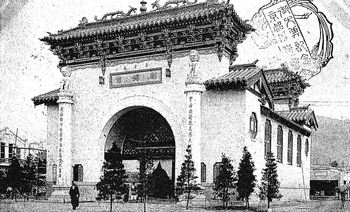
The architectural style of the pavilion was also a means to distance Manchuria from Chinese influence. Japanese designers had drawn previously on continental architectural motifs for Manchuria pavilions, a means of acknowledging the centuries-long connection between Han Chinese and Manchu cultures.Footnote 11 This is evident, for example, in the elegant and ornate Manchuria pavilion (see figure 2) designed by Moriya Nobuo for the Enthronement Commemoration Exposition (Taiten kinen Kyoto hakurankai) held in Kyoto in 1915. Sponsored by Mantetsu and the office of the Kwantung Governor-General (Kantō totokufu), the pavilion featured elaborate dragon roof-ridge ornaments, an ornate and complex bracketing system supporting the roof, and large stone lions sitting atop pillars framing the front entrance; Moriya's pavilion was a dramatic and compelling example of continental architecture, the form taken from multistoried imperial structures in Northern China (Yamaji Reference Yamaji2006, 45). More specifically, Moriya's design was strongly reminiscent of the towering gates at the seventeenth-century Beiling, or Northern Mausoleum, of the Qing Emperor Huang Taiji outside the city of Shenyang (also known as Fengtian and Mukden). Given that this pavilion was meant to speak to Manchurian culture and customs, it is fitting that Moriya drew on famous architectural landmarks from the Qing dynasty (1644–1912). Yet, though above-ground structures were more elaborate than those from the preceding Ming dynasty (1368–1644), imperial Qing tomb architecture bore strong Han Chinese influences as well. This may indicate why the Manchuria pavilion in Chicago looked so unlike earlier spaces. By avoiding overt continental architectural references in 1933, Japanese exhibition planners helped to disassociate Manchuria from China in the microcosm of the fair, leaving room for a cultural (and political) realignment of the region with Japan.
Manchuria pavilion, designed by Moriya Nobuo, at the Enthronement Commemoration Exposition (Taiten kinen Kyoto hakurankai), 1915 (Botsugo 80 nen 2007).

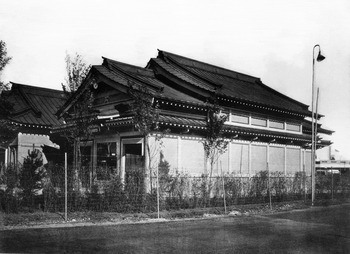
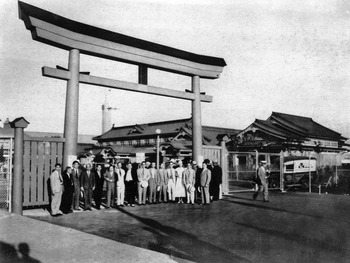
The tension between narratives of sovereignty and Japanese control were evident in the building's location on the grounds as well. A chain-link fence, which delineated the edge of the fair, bordered the pavilion on the west. Echoing strategic geographic positioning, the Japan pavilion flanked it on the eastern side. Based on photographs (see figure 3), it appears that there was not much more than 10 feet of clearance between the building and the fence on one side and the building and its neighboring pavilion on its other side, greatly limiting any movement around the building. Visitors from outside the fair could enter directly into the Japanese exhibition complex; a large torii gate marked a point of entry and gave immediate access to the Manchuria exhibition building (see figure 4). As the diagrams of the fair and photographs of the exhibition complex make clear, the Japanese mediated any access to the new state of Manchukuo, in both the context of the fair and the context of global geopolitics.
Manchuria pavilion and fenced boundary of the exposition grounds. A Century of Progress Exposition in Chicago, 1933–34 (Yamashita Reference Yamashita1934). Yale University Library.

Torii gate entrance to the fairgrounds and the Japan exhibition complex. A Century of Progress Exposition in Chicago, 1933–34 (Yamashita Reference Yamashita1934). Yale University Library.

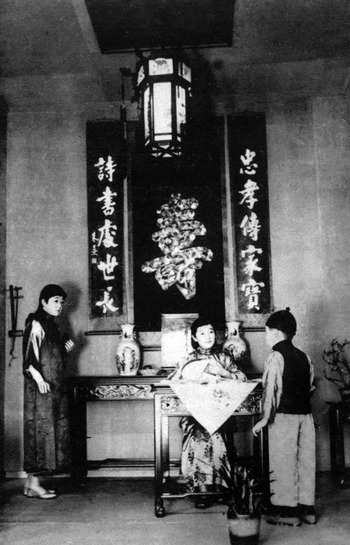
Further contributing to the complex negotiation of dominance and independence in the Manchuria pavilion was a diorama of an affluent Manchurian family in the front window display of the pavilion (see figure 5). The diorama was an important introduction to the pavilion, greeting fairgoers as they entered the building and figuring heavily in promotional print literature as well.Footnote 12 Interestingly, it was one of the only representations of Manchurians (or people in general) in the whole exhibit. Given that Japanese media repeatedly referred to the new state of Manchukuo as a land for the realization of the “harmony of the five races” (gozoku kyōwa), the dearth of displays referring to these populations may seem surprising. However, this points to the role the figures played in Chicago; they did not operate as signifiers of racial (Asian) harmony in the region, but rather functioned as economic and political symbols. The window display featured life-size figures of two women and a boy, ostensibly presenting a domestic scene of a mother and her two children. The older woman sits at a finely carved table, embroidering. Behind her are more fine furnishings, including several pieces of porcelain. The figures’ costuming and room decorations demonstrate the strength of Chinese cultural influences in Manchuria. This is reinforced by the Chinese calligraphy on the wall behind the figures, conveying “longevity” (shou) and a Confucian principle: “loyalty and filial piety are a cherished family tradition” (Zhongxiao chuanjiabao).Footnote 13 It is not clear whether or not the window display included a label that would have made the meaning of the characters legible to an American public. This speaks to the potential cultural ambiguity of this scene and how exhibit designers could make the case for Japanese mediation in the region.
Front window diorama, Manchuria pavilion. A Century of Progress Exposition in Chicago, 1933–34 (Yamashita Reference Yamashita1934). Yale University Library.

This image of quiet, affluent domesticity suggests that the people of Manchuria did not suffer in the (violent) transition to an independent state; rather, they flourished. Their homes were safe, and their children were thriving. While the diorama might speak to individual experience, it also acts as a symbol for Manchukuo as well, testifying to the robust prosperity of the new nation. Interestingly, however, this pleasant family scene does not include a father-figure. This conspicuous absence is an important factor in symbolically linking the family with the new nation, suggesting that Manchukuo requires leadership, a “patriarch” to guide it. The question was who it would be. The image of Japanese soldiers rescuing Chinese children abandoned by their parents had been recurrent since the first Sino-Japanese War (1894–95).Footnote 14 In Japan, such narratives became entangled in a larger discourse of empire in which Japan would play the role of a beneficent patriarch, guiding the family of Asian nations along the path of modernization and industrialization.
Of course, not all fairgoers knew these Japanese precedents. Others might therefore have projected an American presence onto this scene, filling the symbolic void. Yet, the inclusion of the calligraphy on the wall upsets the foreign occupation of this space. Few Americans would have been able to decipher the text on the wall or its Confucian meaning without the aid of explanatory text provided by the Japanese. Here, then, the Americans became cultural outsiders. Yamaji also points out this symbolic distance between the fairgoer and the Manchuria exhibits, stating that the visitors would not necessarily have had sufficient ethnological knowledge to properly recognize the complex Chinese and Manchurian cultural referents on display (Yamaji Reference Yamaji2008, 167), thereby collapsing the scene into a more abstract concept of “the Orient.” In contrast, Japan's cultural and geographic proximity to the continent made the Japanese a more suitable substitute “father” than the Americans. In short, the cultural “othering” of the Manchurian family effectively introduced Manchurian customs, inflected with Chinese culture, to the American spectators as something foreign. This helped to legitimize Japanese claims to a paternal guidance of the region.
The question of who would be a suitable “patriarch” for Manchuria mirrors the arguments made for Japanese-led economic development of the region. Kiyoshi K. Kawakami, the Washington correspondent for the Tokyo Hochi shinbun, addressed the issue of open door access to continental trade and Japan's disproportionate role in Manchuria in his 1933 book, Manchoukuo: Child of Conflict. He explained the situation to his American readers in the following way:
Most assuredly the open door does not, and should not, mean that all trading nations in a given area shall have an equal amount of trade. It is inevitable and logical that a nation which is more favorably situated than others, as Japan is in Manchuria, should have a relatively larger trade. Japan's position in Manchuria is a result of great sacrifices, both in blood and treasure, made in two wars. Besides, she has investments in Manchuria estimated at 1,900,000,000 yen, or 77 percent of total foreign investments there. British and American investments amount to 39,600,000 yen and 26,000,000 yen respectively. With all the advantage Japan enjoys in Manchuria by reason of her geographical propinquity, her vast investments, her great contribution to the development of the bean industry, it would indeed be strange and unnatural if she were not to forge ahead more rapidly than other nations interested in Manchurian trade. (Kawakami Reference Kawakami1933, 261)
Despite this rationalization of Japanese economic dominance in Manchuria, Kawakami assures his readers that Japan has in fact helped American business on the Asian continent. For example, whereas Manchurian railways under the “Russian régime were built and equipped exclusively with Russian materials” (255), Mantetsu had purchased from American suppliers 482 locomotives, 6,574 freight cars, 440 Pullman sleepers, and “no less than 90,000 tons of American steel rails” for its tracks (256). Japan, it would seem, was good for American business in Manchuria. Critical to growing these market demands and providing “open door” opportunities, argues Kawakami, is a “stable and honest government,” restoring order to the region. Lest another imperial “patriarch” step into this role, he strategically positions Japan as the means through which such order would come about, claiming that “[s]hould Manchoukuo, under Japanese tutelage, fulfill the promises it made to its own people and to the foreign nations, it is difficult to see how it could fail to advance the cause of the open door” (267, emphasis added).
Mantetsu made similar dual claims of honoring the Open Door Policy and strengthening Japanese interests in a pamphlet titled Economic Construction Program of Manchukuo, published in March 1933 through its New York office. Perhaps prefiguring the powerfully ambiguous language it would use at the world's fair in Chicago that same year, the pamphlet outlines four “Fundamental Policies for Economic Construction.” In this policy section, Mantetsu assures readers that “in the work of unlocking resources and encouraging industries, the principle of the open door and equal opportunity will be observed” (4). The language of the policy then becomes somewhat elusive, stating that “capital investments from parts of the world will be invited, while appropriate and effectual use will be made of the technical skill and experience and other essentials of civilization taken from advanced nations” (4). The passive tone of this passage suggests that Euro-American nations might find opportunities in the new state but only passively so. Their investments would need to be “invited”; their skills would be “taken.” It is not clear who would initiate these actions, but it would not be Euro-American powers. Another policy point makes clear that, amidst this investment ambiguity, securing a more “intimate relationship … of mutual assistance” between Japan and Manchukuo was critical to “harmonizing and rationalizing economic relations among Eastern Asiatic countries” (5). This last point is critical as it posits the plan to form a Japan-Manchukuo yen-bloc economy—an autarky—in which foreign investments are needed but closely regulated (Young Reference Young1998, 200).
Wording for Mantetsu's pamphlet The Progress of Manchuria, published specifically for the Chicago fair, took a slightly softer, more inviting approach. While the pamphlet details the economic development of the region undertaken by Japan, it leaves out explicit mention of anything a reader could interpret as a yen-bloc economy. Instead, it underscores the economic ties between Japan, Manchuria, and the United States, positing Japan as an important facilitator of American trade in Northeast Asia. Alluding to the contentious formation of the new nation, it highlights how American business had in fact benefited from recent developments, stating that “[c]ommercial relations between the United States and Manchuria scored a notable advance in the past year, imports of American commodities—chiefly iron and steel, petroleum, machinery and automobiles—gaining 58%” (South Manchuria Railway 1933–34, n.p.). With the assurance that the current state of military and political affairs in Manchuria had not threatened U.S. interests, the pamphlet further makes a case for recognition of the new nation by arguing that Manchukuo was founded on the same principles as the United States. On the reverse side of the pamphlet, next to a large map of the new state, the final sentence reads, “Here [the Chinese] found a land of peace and plenty until the war lords taxed and exploited them to the limit, so they declared their independence, as did the Americans in 1776” (n.p.). According to this pamphlet, Manchuria was not just a trade partner but also a sister nation founded by people who, like the Americans, supposedly longed for freedom.
As much as this pamphlet might have endeavored to forge American-Japanese bonds, the displays inside the pavilion provided little room for American intervention on the Asian continent. The most notable example of this can be seen in the main exhibition room of the Manchuria exhibit. On each of two facing walls were two pairs of large-scale oil paintings describing the transformation of Manchurian space in the urban centers of Mukden and Dalian.
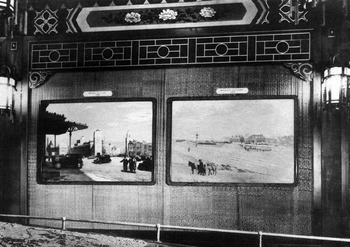
Two paintings of the city of Mukden dominated the right side of the room (see figure 6). The painting on the far right, titled Mukden of Yesterday, reveals a sparsely populated landscape with a vast, largely empty horizon. Two wooden buildings sit off in the distance. What appear to be two snow-covered sets of train tracks cut across the canvas on a diagonal toward the horizon. This diagonal expanse is almost completely empty save for the small figure of a man in the distance. A man and two donkeys laden with bags occupy the foreground, moving toward the left of the frame. Situated to the left of this painting is Mukden of Today. Here, new multistoried modern buildings completely fill the open, empty Manchurian horizon that had once stimulated Japanese imaginations only a few decades before. It is a bustling street scene with automobiles rather than donkeys. The painting asserts that Mukden has become a busy, thriving urban center.
Mukden of Yesterday (right), Mukden of Today (left), Manchuria pavilion. A Century of Progress Exposition in Chicago, 1933–34 (Yamashita Reference Yamashita1934). Yale University Library.

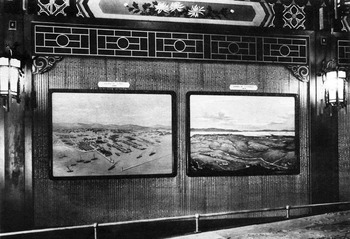
On the facing wall, fair planners employed a similar strategy of representing development in the city of Dalian (see figure 7). Unlike the paintings of Mukden, the perspective used to image Dalian is not at the eye level of the viewer. Rather the perspective is from high up in the air, creating a visual panorama of the changes made to this vital Manchurian port. The bird's-eye view allows the viewer to apprehend more fully the spatial potential that had been neglected in Dalian of Yesterday. In this painting, the land appears unused and only sparsely populated except for a handful of tiny buildings. In contrast, the perspective utilized in Dalian of Today creates a dramatic look into the massive urban infrastructure that has transformed the area. The port is now fully modernized and capable of handling the large volume of agricultural exports from the area. The once empty waters located on the distant horizon now teem with ships.
Dalian of Yesterday (right), Dalian of Today (left), Manchuria pavilion. A Century of Progress Exposition in Chicago, 1933–34 (Yamashita Reference Yamashita1934). Yale University Library.

Japanese newspapers and magazines frequently featured these kinds of “before and after” sequences as a means to stoke public interest in Japan's project of industrial and urban development in Manchuria. However, the way in which Japanese media deployed these themes for domestic audiences differed from exhibitionary methods utilized in Chicago. First, these publications posited the rural and urban as two harmonious aspects of Manchuria that could exist simultaneously; they were not separated by time in a predevelopment/development narrative. The dynamic coexistence of the rural and urban is evident in the inaugural issue of Mantetsu's flagship public relations magazine, Manshū Graph (1933–44), where rural Manchuria was the idyllic, village-farm ideal with smiling farmers and fields that produced a bountiful harvest. The same issue posited cities such as the new Manchukuo capital of Xinjing as markers of Japanese modern progress. These images each worked to enhance the meaning of the other as the vast space of Manchuria accommodated both metropolitan and agrarian fantasies.
More importantly, Japanese media presented the narrative of continental urbanization as “in progress” rather than already realized. This was no doubt due to the use of photography to show the dramatic development of space and infrastructure in Northeast Asia. A major five-year building initiative began in 1932 as part of building up the new state of Manchukuo; consequently, many of the photo sequences featured in Manshū Graph in 1933 showed the development of Manchurian cities as an ongoing process. Major milestones in city spaces like Xinjing and Mukden would not be complete for several more years. The photographs were documents of the spatial transformation. As such, these urban spaces invited imaginative completion. Japanese readers could virtually “fill in” those spaces that had yet to be transformed.
Conversely, the paintings Mukden of Today and Dalian of Today featured in Chicago did not show construction in progress; rather, they depicted completed spaces. These paintings suggested that the incredible potential that the vast, empty landscapes promised in Mukden of Yesterday and Dalian of Yesterday had already been realized. Therefore, there was very little room for the projection of American fantasies of development onto the rural landscape of Manchuria. The Chicago fairgoer could only look on and (passively) appreciate the monumental scale of the Japanese achievement. Through these “before and after” displays, the Manchukuo Exhibition Committee demonstrated the enormous investment Japan had already made in the region. As a consequence, the question was no longer who would be best suited to develop the Manchurian economy. It was already done. Instead, the issue was how others might benefit from this new (Japanese) infrastructure in Northeast Asia.
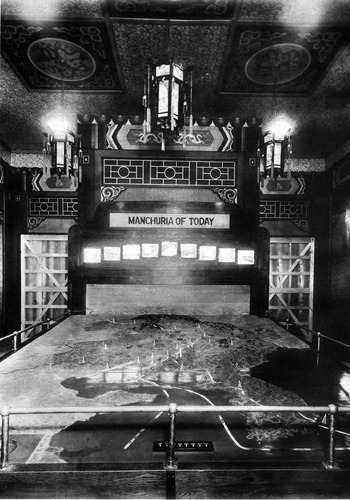
In addition to positing Japan as the “already determined” facilitator of Manchurian modernization, the Mukden and Dalian paintings hint at an additional significant message of the Manchuria pavilion: Japanese economic territorialization on the continent. Nowhere is this message more powerfully communicated than in the pavilion's main exhibit in the central chamber. Called “Manchuria of Today” (see figure 8), the display consisted of an enormous three-dimensional topographical map of Manchuria overlaid with the lines of the South Manchuria Railway. It repeated the message of progress seen in the Mukden and Dalian paintings on the flanking walls. Gone were the references to “yesterday,” however; instead, it was a massive, electric, glittering visualization of the region in its present moment. The map encompassed the whole of Manchuria and Korea, showing where the rail line terminated at the tip of the Korean peninsula. The map also represented parts of Mongolia and China, notable because they were shown without labels and, ostensibly, empty. This suggested that there was no equivalent system in those areas, thereby erasing Chinese transportation structures.
“Manchuria of Today,” Manchuria pavilion. A Century of Progress Exposition in Chicago, 1933–34 (Yamashita Reference Yamashita1934). Yale University Library.

The map had contentious geopolitical meaning as well. The focus on Japanese transportation infrastructure in the region resulted in the disappearance of clearly defined borders between the Japanese colony of Korea and the new state of Manchukuo. This was a risky juxtaposition as it blurred the lines between what was unequivocally within the Japanese military and political purview and what was supposed to be independent. Arguably more scandalous was the inclusion of Jehol in the territory of Manchukuo. The Kwantung Army had only just completed the occupation and annexation of the Mongolian province of Jehol in May 1933, the same month the fair opened. Even before it was seized, Jehol had been a contentious region. According to historian Louise Young, Foreign Minister Uchida Yasuya had asked the army in 1932 to demonstrate restraint in its plans to occupy the territory while the League of Nations discussed the Lytton Report. Uchida knew that a military seizure of Jehol would precipitate Japan's withdrawal from the League (Young Reference Young1998, 126).
Yet, although Uchida called for caution in the region, the Manchuria pavilion at the Chicago fair suggested that the annexation of the province was inevitable. The pamphlet The Progress of Manchuria, referring to this region, stated that “[t]he total area of Manchuria including Jehol, is about 460,000 square miles”; the pamphlet's reverse side shows a map of Manchukuo that clearly locates Jehol within its borders. The same pamphlet lists the population of Manchuria at 34,460,000 and reminds the reader that this number includes the people of Jehol (South Manchuria Railway 1933–34). Most telling of the inevitability of annexation, however, is the enormous “Manchuria of Today” display. Though pamphlets could have been redesigned and printed quite quickly to reflect important geopolitical changes in the region, the inclusion of Jehol in the enormous, electrified, three-dimensional map speaks to the intention to claim the new territory at the fair.
Certainly, the inclusion of Jehol in these maps underscores the extent to which Major-General Itagaki and the Kwantung Army influenced the scope of the display; it was also a provocative decision as many American officials had been concerned about the Japanese occupation of the region for months. E. T. Williams, former U.S. diplomatic officer in China and chief of the Division of Far Eastern Affairs in the Department of State, argued that allegiances in Jehol were more closely aligned with Manchuria than with China in April 1933. He addressed the military implications of occupation, stating, “Japan, with an army in Jehol in possession of important gates of the Great Wall, would necessarily be regarded as a perpetual menace to Tientsin and its winter port, Ch'inwantao” (Williams Reference Williams1933, 215). Williams's article indicates that Japan promised not to occupy Tientsin should military action in China escalate. Yet, he cautioned, “we can not [sic] forget that Japan's military leaders have not hesitated to ignore promises given by Japan's Foreign Office” (216). Taken in the context of this diplomatic perspective, the addition of Jehol to Japan's maps of Manchuria tainted its displays with militarism, precisely the kind of association the exhibit had been otherwise careful to avoid.
Although the Manchuria pavilion lacked the kind of monumental scale seen elsewhere on the fairgrounds in Chicago, its displays were exemplary tools for diplomatic negotiation. But to what extent was the exhibit successful? While audience reception of the Manchuria pavilion is difficult to quantify, evidence suggests that the positive image Japanese fair organizers attempted to cultivate for recent developments in Manchuria was not wholly accepted. In fact, while the Chicago fairgrounds was a public relations stage for Japanese interests in Northeast Asia, it was also a nexus for debate and contestation, a site for the expression of unofficial diplomatic voices. Using fair catalogs and exhibition spaces, American fair organizers found ways to respond to Japanese domination in Manchuria. The most provocative site at the fair that challenged Japan's economic and cultural claim to the region was undoubtedly the Chinese Lama Temple, the Golden Temple of Jehol.
Contested Boundaries: The Golden Temple of Jehol
Although the Japanese government had been eager to exhibit in Chicago in order to counter any possible Chinese exhibitionary narratives addressing continental politics, in fact the Chinese exhibition grounds at A Century of Progress were not overtly political. Guidebooks indicate that besides the display of “porcelain, lacquer ware, silks, embroideries, carved ivories, and old jades dated many centuries B.C.,” the premier attraction was an elaborate Chinese pagoda that stood over 50 inches high and was carved out of a single piece of jade (Century of Progress 1933b, 95). In effect, the Chinese display was much like that of the main Japan pavilion, offering up cultural wares for American consumption.
While the China exhibit did not directly challenge Japan's, the presence of the Golden Temple of Jehol (see figure 9) completed a political circuit that charged the entire group. More to the point, the American-sponsored Temple of Jehol became a site that challenged the borders of Manchukuo claimed by Japanese fair organizers. The temple was located at the intersection of two perpendicular roads. To continue down one road would take the fairgoer to the Japan pavilion; to follow the other would lead to the China exhibition complex. The temple was therefore a conduit through which the physical and political relationship between Japan and China could travel.
The Chinese Lama Temple, Potala at Jehol (also called “The Golden Temple of Jehol”) as included in The Official Pictures of A Century of Progress Exposition, 1933 (Century of Progress 1933b). David M. Rubenstein Rare Book & Manuscript Library, Duke University.

Interestingly, fair literature makes no mention of the geospatial implications of that site selection for the temple. According to Lenox R. Lohr, vice president and general manager of the fair, China had accepted the invitation to participate in the fair in April 1931, but did not concretize plans until early 1933 (Lohr Reference Lohr1952, 138). Consequently, it is difficult to ascertain when the location for the China pavilion was chosen. Japan had confirmed its participation in the fair later in 1931 (Yamashita Reference Yamashita1934, 1). Therefore, it is more than likely that Bendix and the executive committee for the fair selected the site for the temple not just for its proximity to the Hall of Science and Soldier Field (described as “a most conspicuous and favorable site”; Chinese Lama Temple Potala at Jehol 1932, 13), but also because of larger geospatial issues. Of course, the kind of political significance the temple would command in 1933—when the Kwantung Army invaded Jehol Province—may not have been evident in 1932. Regardless, the temple's location was more “conspicuous” than the temple exhibitors could have anticipated.
The Golden Temple of Jehol featured in Chicago was a replica of the Golden Pavilion, itself a reproduction of the “Dalai Lama's monastic citadel in Lhasa” (Hedin Reference Hedin1932, 9). The official catalogue of the Chicago fair gives a slightly more simplified history of the temple, stating that the original was the summer home of the Manchu emperors from the eighteenth century until “abdication of the dynasty” in 1911 (Century of Progress 1933a, 44). Dr. Sven Hedin, the head of the Sino-Swedish expedition into Jehol, selected this particular temple at the behest of Vincent Bendix. Bendix was a wealthy Swedish-American industrialist from Chicago, the owner of Bendix Aviation, and one of the trustees for the 1933 Chicago fair. Hedin was an internationally recognized explorer, photographer, and travel writer by the late 1920s, having conducted numerous expeditions through Tibet and Mongolia, and to the Great Wall of China (Kish Reference Kish1984). Bendix hired Hedin in 1929 to “purchase” two complete temples (or copies), one for the Stockholm Museum of Ethnography and the other for Chicago, “making available these exponents of Oriental cults for Western study” (Hedin Reference Hedin1932, 8; Kish Reference Kish1984, 117).Footnote 15 The lama temples were to be educational and cultural artifacts.
In addition to being culturally edifying, the Golden Temple was a fantastic architectural spectacle in Chicago. It was 65 feet long and cost $25,000 (Chinese Lama Temple Potala at Jehol 1932, 13). Compared to other displays in Chicago, the cost was quite modest; however, the visual effect was dazzling. Outside the hall was an enormous Ming dynasty incense burner made of bronze. The temple roof—clad in shining copper with 23.12-carat gilding—was supported by twenty-eight outer columns, twenty wall columns, and twelve inner columns that surrounded the central hall (13). The structure was painted in brilliant red, yellow, and blue mineral pigments. According to the temple guide, inside the temple was a “gigantic gilded dragon carved in wood, which looks down fiercely from the center of the ceiling upon the human beings that dare to disturb his peace, and listening to the melodious tinkling of the golden bells in the eight corners of the two rooms” (15). The Golden Temple was adorned with prayer rugs, paintings, lacquered prayer tables, benches, lamaistic symbols, and even a drum “made of two human skulls joined together and covered with skins” (16). According to the exposition guide book, this exotic and visually sumptuous temple was posited as a way for spectators to “transport” themselves to “China of the eighteenth century” (Century of Progress 1933a, 44).
Documentation of the temple's replication in Chicago emphasized Chinese participation in assembling the structure. Hedin brought in W. H. Liang, a Chinese architect, to make arrangements for the temple's reproduction, including the preparation of plans, taking of measurements, and notation of details from the original temple (Hedin Reference Hedin1932, 9). Eighty Chinese craftsmen created 28,000 pieces for the temple that would be fitted together in Chicago without nails. Chinese painters Hwa-Ting Shun and Ping Chen Chang decorated the interior. The replica of the temple was largely constructed in Beijing. Therefore, as Hedin proclaimed, “the Golden Pavilion in Chicago was made in China” (9), although it was taken apart and reconstructed on-site in Chicago. Throughout the Golden Temple of Jehol, literature reinscribed the site as Chinese in the geopolitical exhibitionary paradigm of the Chicago fairgrounds, despite the fact it was claimed by Manchukuo and militarily secured by Japan.
On one hand, such a claim would have been practical: in order to attract visitors, the temple required a mark of authenticity. Given that the temple was openly known as a replica, constructing a sense of the “authentic” around it would have been a nontrivial task. By employing a noted Chinese architect and Chinese artisans who all meticulously reproduced the temple by hand, it took on the aura of an authentic Chinese object and became an art object of esteem. In this way, the aura of the authentic provided a useful hook with which to market the site as a must-see spectacle of the fair. The authenticity of the space had an additional effect with notable political implications. Bendix, the donor of the temple and the collection housed within, became a facilitator of Chinese culture and history, a benefactor through which vulnerable treasures of China and Mongolia might be saved. Hedin underscored this point by stating that “[w]hen the original Golden Pavilion of Jehol has become a pile of crumbling ruins and its glory is no more, its faithful replica on the shores of Lake Michigan will still withstand the ravages of time” (12).Footnote 16 Thus, in this role as conservator of Sino-Mongolian culture, Bendix (and, by symbolic extension, America) challenged Japan's symbolic position as the ideal keeper or “substitute father” of East Asian interests.
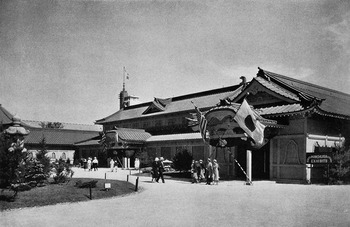
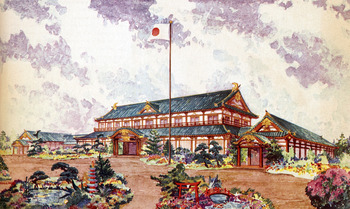
Through the Bendix Golden Temple, Jehol and Chinese culture figured prominently at the fair, both on the physical grounds and in the accompanying catalogues. The temple commanded two and a half pages of images and text in the fair's official guidebook. Additionally, the guide devoted an entire page to a photograph of the interior. Only seven photographs in the guide commanded such space, five of which were expansive outdoor photographs of major exhibition halls like the Hall of Science or panoramic views of the fairgrounds. The guide thus marked out the Golden Temple of Jehol as one of the premier attractions on the fairgrounds. This was in marked contrast to the guidebook's treatment of the Manchuria pavilion. Photographs from the official guidebook and the commemorative album, The Official Pictures of A Century of Progress Exposition, show the erasure of the pavilion from photographic representation of the fair. Only the Japan pavilion is legible in the Official Pictures album (Century of Progress 1933b; see figure 10), though close inspection reveals a small sign for the Manchuria exhibit on the right of the frame in front of the main hall. The Official View Book of the fair removed reference to the Manchuria exhibit through more thorough and creative means; in the colorful illustration of the Japan pavilion and surrounding grounds (Century of Progress 1933c; see figure 11), beautiful gardens replace the contentious display and any reference to them. These representations show how official texts effectively eliminated the Manchuria pavilion from the fairgrounds. Given this treatment, it would seem that the Chicago fair organizers rejected the positive, palatable image of a Japanese Manchuria. Perhaps Bendix's position as a trustee of the fair afforded his project visibility over that offered by the Japan Exhibition Committee and Manchuria Exhibition Committee. Or perhaps the heated news of recent activities by the Kwantung Army on the continent simply could not be overlooked. Whatever the reason, it is clear that Mantetsu and the Manchukuo government failed to sell the idea of a Japanese Manchuria and the new nation of Manchukuo.
Japan pavilion as included in The Official Pictures of A Century of Progress Exposition, 1933 (Century of Progress 1933b). David M. Rubenstein Rare Book & Manuscript Library, Duke University.

Japan pavilion as included in The Official View Book, A Century of Progress Exposition, 1933 (Century of Progress 1933c). Duke University Library.

Conclusion
The Temple of Jehol demonstrates how the stakes of exhibiting Manchuria extended beyond the boundaries of the Japanese exhibition complex, entangling representation of this region in the contentious politics of the microcosm of the fairgrounds and on the larger world stage. The Manchuria pavilion worked to promote the new name “Manchukuo” while advertising how a Japanese company, Mantetsu, had effectively transformed the region into a thriving industrial center. Yet, it should be noted that nowhere in the official literature for the fair or the “A Century of Progress Notes” featured in the Chicago Daily Tribune did the name “Manchukuo” actually appear. Therefore, it would seem that the whitewashed vision projected by the Manchurian Exposition Committee, Japan Exhibition Committee, Mantetsu, Kwantung Army, Japanese Foreign Ministry, and Manchukuo Government did not persuade its American audience. No doubt this was because the production of knowledge about Manchuria and, more specifically, the contentious geo-polity of Jehol was not entirely left up to Japanese fair organizers. With the inclusion of the Temple of Jehol by the Swedish-American Bendix, the politics of Manchurian representation took on new multivalent meaning and ruptured the message of unity behind the carefully planned spaces of the Manchuria exhibits and their associated advertising ephemera. Indeed, these various displays signal the impossibility of exhibiting a singular idea of “Manchuria” in 1933. The geopolitical idea of “Manchuria” featured at the Century of Progress exposition was in flux. It was a fluid idea lodged in the liminal space between multiple perspectives and interests both in Chicago and beyond.