This is an article about power relations in the workplace: how they function, how they change over time, and how we can analyze them. I argue that, rather than conceptualizing power in the workplace as a pyramid, it is more useful to see it as a dynamic matrix within which the distribution of power is continually shifting. Precisely because power relationships form an integrated web, a shift in the distribution of power in one part of the matrix has implications for the whole. If we are to understand the workplace experiences of any specific social group, it is therefore necessary to reconstruct the position of that group relative to the overall system of power relations, and not just to individual kinds of power relationship.
In order to demonstrate my point, I use a specific case study, namely, female workers in the Soviet zone of occupied Germany between the fall of the Nazi regime in 1945 and the onset of Stalinization in 1948. In due course I shall explain why I chose this case study, and what it tells about power in the workplace. First of all, however, I need to make some comments of a general nature about how power relations can be conceptualized, not just in East Germany after the war, but in all workplaces everywhere, including the ones in which we ourselves are employed.
Conceptualizing Power Relations in the Workplace
The idea that society is pyramid shaped is deeply embedded in people's minds.Footnote 1 The language that we use to describe social relations is saturated with words that assign people to ranks within hierarchies. Terms such as upper class, middle class, lower class, social climbing, upward social mobility and so forth are all predicated on the idea of pyramidality. Because historians are just as much part of society as anybody else, they frequently organize knowledge about the past using the same hierarchical categories. Historians are thus said to adopt top-down or bottom-up approaches to their topics. Political and military historians generally focus on leaders (history from above). Social historians are usually more interested in the day-to-day lives of nonelite groups (history from below).Footnote 2 When trying to explain to students how societies in the past functioned—from ancient Egypt to the Aztec Empire to nineteenth-century America—the authors of textbooks and educational websites portray these societies as pyramids.Footnote 3 The same metaphor is thus applied to diverse historical societies regardless of the fact that they were so different.
The dominance of the pyramid model is especially clear in the language that is used to describe power relationships in the workplace. There are few other social domains in which people could be referred to as superiors or subordinates without causing offence. We speak of senior, middle and junior managers, all of whom can be located at a specific rung on the career ladder. Every department in the workplace has a head, who wields power over those who are located further down the pecking order. Ambitious individuals who rise through the ranks are referred to as high flyers. If they are women or members of an ethnic minority, they may well encounter glass ceilings. The vertical character of power relations in the workplace is explicitly theorized by the authors of management-science textbooks. According to one typical textbook for aspiring managers: “The most important characteristic of the line organization is the authority line that runs vertically from top to bottom in the hierarchy. Each head of department or line functionary has line authority to give orders to subordinates. Line authority includes direct control over subordinates… . Line authority originates with the board of directors and moves hierarchically downwards to those physically responsible for the production activities.”Footnote 4
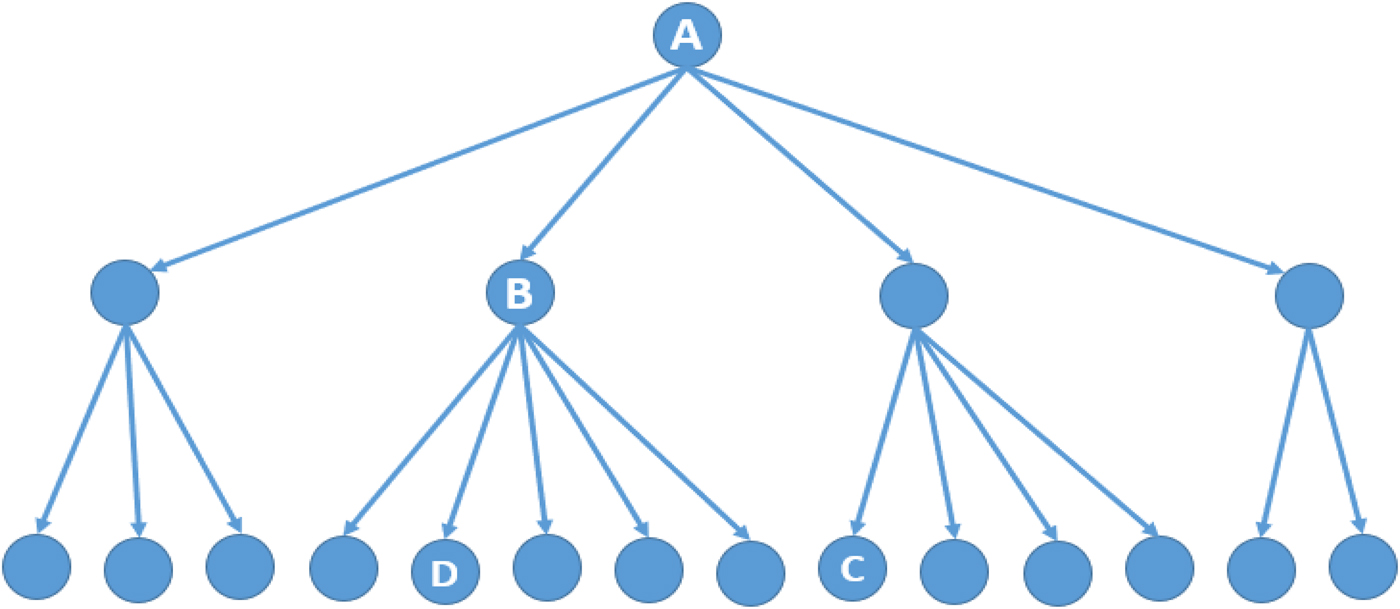
The usual diagrammatic representation of power relations in the workplace is a line-management structure laid out in a pyramid format. The assumption that underpins such a diagram is that authority in the workplace emanates from the apex and cascades down the various tiers of the organization. In Figure 1, person A—the manager—is placed at the top of the pyramid to reflect her or his authority. Person B, located on the second tier, not only has less power than A, but her or his power is also derivative of the power that is bestowed from above by A. On the other hand, B has more power than C or D, both of whom are located at the third tier of the structure. On a day-to-day basis, B would normally exert more power over D, who is situated directly beneath her or him in the line-management structure, than over C, who is line-managed by somebody else. This is the workplace as it appears to management scientists and human resources managers.
A typical representation of line-management structure.

As a method of portraying how power functions in the workplace, the pyramid model has clear advantages. It is simple, neat, and rational. It highlights a fundamental feature of social organization, namely, the asymmetrical distribution of power.Footnote 5 However, there are also three major problems with thinking about power in this way.
First, the pyramid model is monocratic. In an organization of any size, including the workplace, there are multiple and overlapping centers of power which collaborate with each other, but which frequently have different interests and objectives. This was true even in totalitarian dictatorships such as Nazi Germany, which has famously been described as a polycratic state.Footnote 6 An even more fundamental problem with seeing power as a monocracy is the assumption that all power emanates from the top. In the real world, the power of any organization is generated by the combined behaviors of every person who is a member of that organization. As Foucault points out, “power is everywhere” and it “comes from everywhere.”Footnote 7 In short, the pyramid model is flawed because it fails to take into account the polycratic and dispersed nature of power in any social formation.
Second, the pyramid is static. In a real workplace, power is constantly shifting between individuals and groups in ways that cannot be accommodated by the pyramid model. For example, a managing director who, for whatever reason, loses de facto, but not de jure, authority over his or her subordinates, nonetheless retains exactly the same position within the line-management diagram. If workers join a trade union and thereby improve their ability to assert their collective interests, the structure depicted in the diagram likewise remains unchanged. If a government introduces anti-union legislation, which tips the balance of power back in favor of management, there is no room in the pyramid model for representing this diagrammatically. The most that we can do is to flatten the pyramid somewhat, or to make it more vertical, but this does not substantially change the way that power in the workplace is portrayed, even where the distribution of power has shifted dramatically.
Third, the pyramid model only takes in to account formal relationships within an authoritarian power structure. This is not a problem if we define power purely in terms of the ability to dominate others, which, indeed, a number of theorists have done.Footnote 8 But power can be soft as well as hard, and can include the power to persuade, to influence, and to inspire. It can include power over one's own life as well as power over other people. For this reason, Peter Morriss has distinguished between power-over and power-to and argues that the former is a subset of the latter. What really defines power, in Morriss's view, is “the ability to affect outcomes, not the ability to affect others.”Footnote 9 Achieving the desired outcome may involve the domination of others, but it may not. In many cases, people work with each other as equals voluntarily because they realize that they can achieve more together than the sum of what they could achieve individually. Theorists sometimes refer to this kind of power as social power or power-with.Footnote 10 From such a perspective, the pyramidical model of power is clearly inadequate because it fails to take into account the friendships, rivalries, antagonisms, and alliances that influence how decisions are made and executed in the workplace.
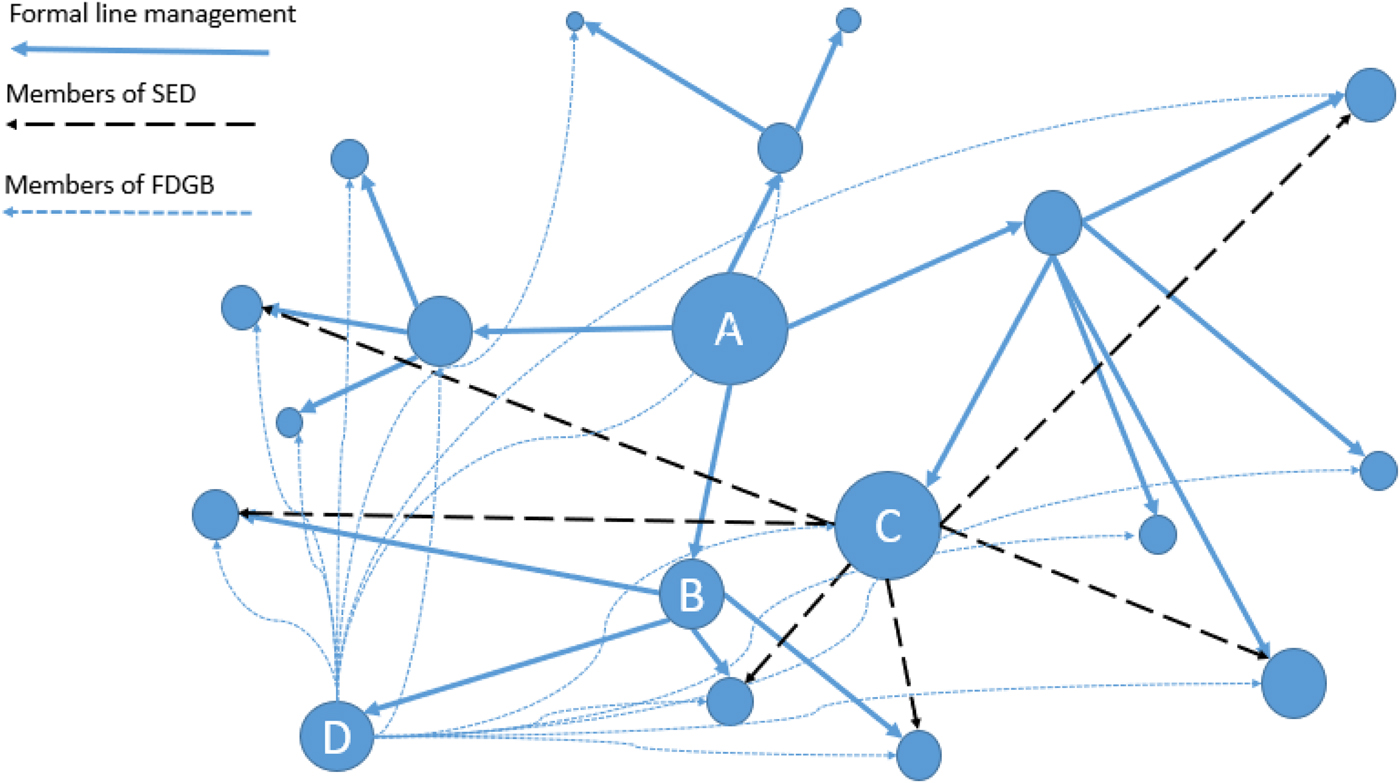
An alternative way of conceptualizing power relations is to see them as a forming an integrated but horizontal matrix that comprises all the various kinds of relationships that exist between individuals and groups in a workplace. Figure 2 depicts the same workplace as Figure 1, only laid out as a matrix. There is no above and below in this diagram, simply a collection of people who work in the same organization but who have varying degrees of access to power and resources. The larger dots represent power holders, who may owe their privileged position to their place in the structure of line-management, but who can also accrue power through informal relationships, including networks of patronage, kinship, alliances, and friendships. The smaller dots represent power donors. These are people who have relatively little influence over outcomes in the workplace, either because they have voluntarily yielded a degree of autonomy to others, or because they are induced to obey the power holders through threats of punishment or promises of rewards.
Power relations as a horizontal matrix.

There are many reasons why the actual power-to of individuals might be greater than or less than what one might expect based on their position in the line-management structure. In the Soviet zone of occupied Germany, for example, the authority of the manager (person A) was often weakened because he or she had blotted their copybook in some way during the Nazi period. By contrast, a key individual in almost every workplace was the secretary of the local branch of the Sozialistische Einheitspartei Deutschlands (Sociality Unity Party, SED), which was backed by the Soviet occupation authorities. In Figure 2, person C, who is an SED secretary, has almost as much power-to as the manager, despite his or her lowly position in the formal line-management pyramid (see Figure 1). Person D, meanwhile, is the secretary of the workplace branch of the official trade-movement, the Freie Deutsche Gewerkschaftsbund (Free German Trade Union Federation, FDGB). Though not as powerful as the SED secretary, an official of the FDGB was another key player in the ecology of the East German workplace. Both C and D have more effective power-to—that is, more influence over workplace outcomes—than their respective line managers. Moreover, the interests and objectives of managers, SED, and FDGB officials did not always align. On many issues the party and trade union formed a united front against managers, but it was not uncommon for a manager to work with the local SED against the FDGB, or vice versa. Neither the SED secretary nor the FGDB official derived their authority from the manager.
I must emphasize the point that Figure 2 significantly simplifies the actual power relations that obtained even in a small workplace in the Soviet zone. For example, I have made no attempt to include the wide range of informal power relationships that exist in any social group. Moreover, in larger workplaces, there was a dense network of other mass organizations alongside the SED and FDGB. In theory, the SED harmonized the activities of all these bodies in the task of reconstruction. The mass organizations were supposed to act as transmission belts, providing SED political leadership to parts of the population that the party itself could not reach. In reality, all the various workplace organizations had their own agendas. Some of the most important of these mass organizations included: the official youth movement in the Soviet zone, called the Freie Deutsche Jugend (Free German Youth, FDJ); the Gesellschaft für Deutsch-Sowjetische Freundschaft (Society for German-Soviet Friendship, DSF), which was a cultural organization that aimed to foster good relations between the German and Soviet peoples; the Betriebsräte (workplace councils), which were open to all workers, regardless of union or party affiliation; and the Demokratischer Frauenbund Deutschlands (Democratic Women's League of Germany, DFD), which claimed to represent the specific interests of women in the workplace and to provide practical support to make their lives easier. I shall say more about the workplace councils and the DFD in due course.
Power relations in East German workplaces in the aftermath of World War II were unusually complex and fragmented, but they nonetheless illustrate my basic point. Workplace power is always a matrix and it is always polycratic. Within this matrix, power is constantly circulating in much the same way that money circulates in an economy.Footnote 11 The distribution of power, however, is never equal. Just as money accumulates at specific points in an economic system, so power tends to concentrate at particular locations within the workplace matrix. Barriers regulate the flow of power in the workplace. These barriers act like dams in the sense that they create reservoirs of power. The single most important barrier is usually that of rank. In any workplace, a formal system of titles and job specifications is used to control the flow of power and restrict the ability to affect outcomes. However, many of the barriers are informal and cultural. Depending on the context, people of a particular social background, ethnicity, religious, sexual, or political orientation, and so forth can experience discrimination. Of all such informal social barriers, perhaps the most universal is discrimination on the basis of gender. Systemic discrimination against women is still a feature of almost all industrialized economies.Footnote 12
Despite the existence of such barriers, the distribution of power within the matrix is continually shifting. Sometimes these power transfers are caused by the internal dynamics of power politics within the organization itself. More often they are the result of exogenous factors such as employment legislation, educational trends, changing social attitudes, the dissemination of new technologies, levels of unemployment, and the ability of workers to migrate across state borders in pursuit of better opportunities. Such changes can strengthen or weaken barriers, remove them altogether, or create new ones. Understanding how these barriers are constructed and deconstructed over time is therefore the key to understanding trends in the distribution of power. In the words of Moisés Naím: “When such barriers go up and stay up, incumbents become entrenched and consolidate their control. When they go down or stay down, new players gain an edge and can challenge the existing power structure. The more drastic the erosion of any given barrier to power, the more unusual or unexpected the new players, and the faster they may attain prominence. Identify the barriers to power and whether they are coming up or going down, and you can solve a large part of the puzzle of power.”Footnote 13
Female Labor in the Soviet Zone, 1945–1948
In order to explore in detail the operation of power relations in the workplace, I shall now discuss the experiences of female workers in the Soviet zone of occupied Germany. In part, I selected this case study because this was a period in German history when class, gender, ethnic, and other kinds of power relationship were profoundly destabilized. In the spring of 1945, both the Nazi regime and the German state disintegrated. Shortly thereafter, the Red Army installed a military government called the Sowjetische Militäradministration in Deutschland (Soviet Military Administration in Germany, SMAD). At first, the Soviets promised a return to parliamentary party politics, and they permitted the establishment of four political parties: The Christlich Demokratische Union (Christian Democratic Union, CDU), the Liberal Demokratische Partei Deutschlands (Liberal Democratic Party of Germany, LDPD), the Sozialdemokratische Partei Deutschlands (Social Democratic Party of Germany, SPD), and the Kommunistische Partei Deutschlands (Communist Party of Germany, KPD). The KPD, however, was the favored child of the Soviets, and from the very beginning it enjoyed a decisive advantage over the other parties.Footnote 14
A key milestone on the road to the creation in East Germany of a Communist dictatorship was reached in April 1946, when the KPD forced through a merger with the SPD in the Soviet zone to create a new, united working-class party—the SED—within which the former Communists held a whip hand.Footnote 15 Shortly afterward, after disappointing election results in the autumn of 1946, the SED abandoned parliamentary politics and started instead to construct the mechanisms of dictatorship. Former Social Democrats in the SED were persecuted, and the two “bourgeois” parties were marginalized.Footnote 16 At the same time, the Communist regime introduced Stalinist economic practices such as central planning and the prioritization of heavy industry.Footnote 17 As we shall see, all these developments had a massive impact on how female workers experienced power.
Throughout this period of change and instability, the authorities in the Soviet zone demonstrated an intense interest in the internal life of workplaces. The East German state, the KPD and SED, as well as the trade unions and other mass organizations, compiled innumerable reports which discussed day-to-day events on the shop floor. Authors did not hold back when it came to describing poor working conditions, unpopular trade union and party officials, negative attitudes towards the Soviets, and the hostility of many workers to the economic policies of the new authorities. The sources on which this article is based provide a remarkable window through which we can observe the ebb and flow of power within specific workplaces.
In addition to the richness of the sources, a further reason for studying female labor in East Germany is that, between 1945 and the onset of full Stalinization in 1948, the Soviets and leadership of the KPD/SED attempted to bring about an unprecedented revolution in gender relations within the workplace. Their stated goal was nothing short of complete gender equality. They argued that all pay differentials between male and female workers should be abolished. The doors to all professions should be thrown open to women, except for those that required the heaviest physical labor, such as mining. All obstacles to the entry of women into higher education and vocational training should be removed. Women should be fully represented amongst skilled, professional, and managerial staff. Inefficient forms of casual, home-based female employment based on the putting-out system should be replaced with regular jobs. According to the SED, the very concept of “women's work” would have no place in the new Germany, and there would be no limits of any kind on what women could achieve in their careers. Men would have to get used to taking orders from women even in those industries that had always been dominated by men. In their public pronouncements, SED leaders repeatedly stressed that the lack of economic mobilization of women was “the central problem of the German economy,” and it could not be remedied without gender equality in the workplace.Footnote 18
On paper this was a truly radical program. Indeed, female workers in Germany today are still far from achieving the levels of workplace equality that the SED demanded in the second half of the 1940s.Footnote 19 It is important to note, however, that leaders of the SED, almost all of whom were men, were not motivated by a principled commitment to gender equality. Most of them had never previously shown the slightest interest in women's rights.Footnote 20 The real driving force behind the official campaign for workplace gender equality was the politics of the early phases of the Cold War. The mobilization of female labor was a core part of the strategy of both SMAD and the SED leadership to ensure that German politics developed along lines that were favorable to the interests of the Union of Soviet Socialist Republics (USSR). Of central importance was the assumption that the pace of reconstruction in the Soviet zone would outstrip that of the western zones. The leaders of the SED genuinely believed that socialism was a superior system to capitalism, and they fully expected that the capitalist world would experience the same kinds of economic problems after the Second World War that it had after the First. As economic conditions in the Soviet zone improved relative to those in the West, so would the population of the western zones begin to demand closer integration with the Soviet zone, and ultimately the reunification of Germany on terms that were favorable to the SED and the Soviet Union.Footnote 21
For demographic reasons, none of this could happen without the effective mobilization of female labor. According to a census carried out in December 1945, there were 16 million people living in the Soviet zone, 9.5 million of whom (59 percent) were women.Footnote 22 Since women now constituted a clear majority of the adult population, the construction of a dynamic socialist economy would be impossible without them. In the words of a circular issued by the women's section of the KPD in Saxony in January 1946: “We must always be conscious of the fact that, without the active participation of women, the reconstruction of a democratic Germany will not be possible.”Footnote 23 This message was driven home in countless newspaper articles, public speeches, party meetings, and internal party documents.Footnote 24
Bringing women into paid employment was also seen as necessary for the political education of East German women. Like most people at the time, leaders and functionaries of the working-class parties assumed—wrongly—that women had been more likely to vote for the Nazis before 1933, and were more likely to support them thereafter. According to a circular released by the women's section of the KPD in Leipzig in 1945: “Of the millions of votes that were cast for Hitler, 70% were cast by women. Hitler won the women over with promises about family happiness, mother and housewife, etc.”Footnote 25 Two years later, a pamphlet published by the SED claimed that: “Since they [women] were less experienced and less well schooled than the men, they believed all the lies about the racial superiority of the German people, the lack of living-space, etc.”Footnote 26
The underlying problem, it was believed, was that German women had been either excluded from the workforce altogether, or, even if they worked, were much less likely to be organized in the labor movement. As a result, women had a low level of political consciousness and were more vulnerable to reactionary ideas. The best antidote to the low political level of women was to bring as many as possible both into the workforce and into the ranks of the labor movement.Footnote 27 As a female SED functionary told a meeting in Leipzig in September 1946: “The participation of women in economic life determines the social position of the woman. Only through her incorporation in the production process will the woman have a say in political questions and gain understanding of what is going on.”Footnote 28 The underlying assumption was that turning women into workers would raise their class consciousness, which would not only inure them against reactionary ideas but bring them into the political orbit of the KPD/SED. This in turn was essential if the KPD/SED was to be able to compete successfully with the other political parties.
In order to achieve their objectives, SMAD and the SED introduced a suite of polices that were designed to remove the barriers that obstructed women in the workplace. These barriers included the pay gap between male and female labor, the exclusion of women from training and vocational opportunities, and the “double burden” of domestic chores and paid employment which made life extremely difficult for working women.
The key point is that the degree of progress towards removing these barriers was dependent on wider trends in the distribution of power in East German society. Three of the most important of these trends were: (1) the transfer of power from German citizens to the Soviet occupiers, (2) the devolution of power from the center to the periphery, and (3) the shift of power from wage earners to black marketeers.
Shift #1: From German Citizens to Soviet Occupiers
The most obvious transfer of power in East Germany at the end of World War II was from the occupied population to the Soviets. When the Nazis were in charge, the power differential between ethnic Germans and the millions of foreign workers and prisoners who had been brought to the Reich was extreme. With the arrival of the Red Army in 1945, the balance of power was radically inverted. Thenceforth, the dominant power holders in East German society were the Soviet forces of occupation. In every sphere where German people came into contact with Soviet personnel—whether in the politics, on the street, in the marketplace, or at work—the balance of power was almost always on the side of the men in Red Army uniforms.
Though all German citizens everywhere in the Soviet zone were impacted by this power shift, the negative consequences of occupation were felt disproportionately by women. As soon as the Red Army soldiers arrived on German soil in 1945 they began to rape German women indiscriminately and in massive numbers.Footnote 29 Though attacks on women were particularly frequent during the spring and summer of 1945, they continued into the later 1940s. Norman Naimark estimates that perhaps as many as two million women were raped by Soviet soldiers during the postwar period.Footnote 30 Like all East German women, female workers had to endure episodes of extreme and intimate powerlessness. Even if they did not personally suffer rape, they had to live with the constant fear of sexual violence. In some places, female workers were so scared to travel to and from work, especially during hours of darkness, that workplaces had to provide them with escorts.Footnote 31
The issue of rape cast a shadow over the lives of all German women, regardless of age, class, and political affiliation. In other ways, however, the experiences of women in the Soviet zone were very diverse. Some sections of the female population, in particular women workers, benefited materially from the policies towards gender equality that were introduced by the new authorities.
One of the most important of these policies was the introduction of equal pay. From the outset of the occupation, the KPD had identified equal pay as an important objective. Upon the merger of the KPD with the SPD in April 1946, a commitment to the equality of women in the workplace was incorporated into the program of the newly founded SED. By the first half of 1946, equal pay had already been implemented in some of the larger enterprises. But the key moment in the campaign for equal pay came in August 1946, when SMAD issued Befehl 253 (Order 253) stipulating the introduction of equal pay for men and women in all five regions of the Soviet Zone.Footnote 32
Alongside the campaign for equal pay, the Soviets and SED leadership launched an energetic campaign to provide training and vocational opportunities for women. In the construction industry, for example, large numbers of women were recruited as trainee bricklayers, carpenters, electricians, glaziers, painters, plumbers, and so on. Their progress was closely monitored by the Women's Secretariat of the SED, the women's section of the FDGB, by relevant branches of local government, and by the East German press. For the most part, these schemes worked well. Though there was a high dropout rate, this was usually because of difficulties with childcare arrangements or transport, and not because the work was too physically demanding or because women were unable to learn the necessary skills. Party and state officials who visited building sites were frequently told by supervisors that the performance of female trainees was just as good as that of the men and sometimes better, particularly in tasks that required close attention to detail. Many of the female trainees reported that they enjoyed the work and took pride in their achievements.Footnote 33
Another scheme that proved rather successful involved the training of “new teachers.” After 1933, the teaching profession in Germany had been thoroughly Nazified. Of 39,000 teachers in the Soviet zone in 1945, 29,000 (71 percent) had been members of the Nazi Party, almost all of whom were dismissed during the course of denazification. To fill the gaps, 40,000 volunteers, the majority of whom were women, were sent on crash courses and then deployed into schools. There were teething problems with the scheme, and many of the “new teachers” had to be sent back on further courses to solidify their teaching skills. Overall, however, the program did provide tens of thousands of women, many of whom came from humble backgrounds, with an opportunity for rapid professional and social advancement. Teaching had traditionally been a highly respected profession in Germany, yet by 1947 women made up 50 percent of the teaching staff in the Soviet zone.Footnote 34
Both Soviet and SED propaganda trumpeted the successes of vocational training schemes for women. The underlying message was that the Soviet zone, like the USSR, provided women with opportunities for career advancement and personal fulfilment that were denied to women in the capitalist world. In April 1946, for example, the Täglicher Rundschau, which was the main German-language newspaper issued by SMAD, ran an article about women in the post office. Women had traditionally worked as clerks and switchboard operators but now, as a result of the physical destruction of infrastructure, there were fewer positions available for these kinds of workers. The post office had therefore set up courses to train women for new jobs that had previously performed by men, such as laying cables.Footnote 35 In May 1946, the Berliner Zeitung published articles about the training of the women police officers who were now appearing on the streets in ever greater numbers, and who were successfully coping with all the various aspects of the job.Footnote 36 In September 1946, the Leipziger Volkszeitung highlighted the success of women at the Möbius engineering plant in Leipzig. Nearly half the workforce at Möbius was now made of up women, many of whom had previously worked in offices, shops, or kindergartens. Not only had these women been successfully trained as metal workers, drillers, painters, and molding cutters, but their performance was as good as the men's and sometimes better, particularly when it came to precision work.Footnote 37
Overall, the campaign to mobilize female labor enjoyed a modest degree of success. During the first two years of Soviet occupation, there was a substantial increase in the numbers of working women, and industries that had hitherto been dominated by men were partially feminized. By December 1946, there were 3,364,000 women in paid employment in the Soviet zone, an increase of 30 percent over the previous year. Around three-quarters of these women were blue- or white-collar workers. Between July and December 1946, there was an increase of women by 20 percent in the brown coal industry, 48 percent in iron and steel production, 50 percent in metallurgy, and 81 percent in shipbuilding.Footnote 38 In Saxony, which was East Germany's most densely populated and industrialized region, women made up 44.7 percent of the workforce in September 1946.Footnote 39
Some of the women who flourished in this new environment began to penetrate to positions of hard power in the formal line-management structure, for example by being appointed as managers of industrial enterprises.Footnote 40 Though this remained unusual, there were plenty of examples of women who took on managerial or highly skilled technical jobs.Footnote 41 Women also began to establish themselves as power holders in the apparatus of the state. In the various administrative departments that oversaw the Soviet zone, there were, by March 1948, seven women presidents, vice-presidents, and departmental leaders and a further ninety-seven in senior positions. Twenty-three of these women worked in the Department of Education, but there were also twenty women in highly responsible positions in the Department of Industry, and six in Agriculture and Forestry.Footnote 42
Above all, membership of the SED gave women opportunities for career advancement in local government. By 1946, there were fifty female Bürgermeisterinnen (executive mayors) in the Berlin-Brandenburg region. In Thuringia in 1946, there were twenty women mayors and four women occupying central positions in the state administration.Footnote 43 A year later, there were 180 female Bürgermeisterinnen in the Soviet zone and 2,127 women in responsible posts in local government and the state apparatus.Footnote 44 Overall, far more women occupied such prestigious jobs in the Soviet zone than was the case in the western zones of occupation.Footnote 45
For those women who benefited from Soviet and SED policy towards female labor, the years after the war were an exciting period of new opportunities and challenges. In an oral history project conducted by Elizabeth Tobin and Jennifer Gibson in the early 1990s, thirty-one women were interviewed about their experiences of work during the transition from Nazism to Communism. Many of the women recalled how hard it had been to combine paid employment with family life. Nonetheless, they spoke with enthusiasm about how they had embarked on new careers in the postwar period. All the women whom Tobin and Gibson interviewed “emphatically rejected the argument that their paid work was only a burden to them… . Woman after woman presented an overwhelmingly positive view of her paid work, describing personal growth, accomplishment, and just plain enjoyment.”Footnote 46 None of this would have been possible had East Germany not been under Soviet occupation.
Shift #2: From the Center to the Periphery and from Management to Labor
A second important shift in the matrix of power relations was from the center to the periphery. At the end of World War II, the total collapse of the Nazi state led to a radical decentralization of power in Germany. The fragmentation of power was exacerbated by the devastation of the communications infrastructure and by the severing of economic links by the division of Germany into zones of occupation. None of the occupying powers, including the Soviets, had the necessary human resources or expertise to fill the vacuum.Footnote 47 As a result, individual enterprises were left to their own devices to an extent unprecedented in modern German history.Footnote 48
Within each workplace, there was a further devolution of power from management to workers on the shop floor. Many employers and managers had been members of the Nazi Party or had colluded in some way with the Nazi regime. Some of the most incriminated had fled East Germany in 1945 in terror of the Red Army.Footnote 49 Those employers and managers who remained were nervous about taking any measure that might bring them into conflict with the Communists and their Soviet patrons.Footnote 50 The primary beneficiaries of the shift of power were veteran functionaries of the German labor movement. The primary vehicles through which workers exercised their new-found powers were the workplace councils, the trade union movement, and workplace cells of the SPD, KPD, and SED.
First to re-emerge were the workplace councils. These bodies had a long tradition in German labor history. The workplace council was elected directly by the employees in a particular enterprise, and its principle function was to negotiate with management over day-to-day matters that affected that workplace. The councils had always been less bureaucratic and more responsive to the immediate concerns of workers than the trade unions. The Nazis had suppressed the workers’ councils, but in 1945 they re-emerged almost everywhere in the first days and weeks after liberation. It was not unusual for former workplace council delegates from the Weimar period to be re-elected to their old positions.Footnote 51
It took a little longer to re-establish a formal trade union movement, and the initiative to do so often came as much from outside as from workers on the shop floor. Nonetheless, by the autumn of 1945 a complete structure of industrial trade unions had emerged under the umbrella of the FDGB. The work of the FDGB was closely monitored both by the Soviets and the SED. Its function was not just to represent the workers but also to control them. Nonetheless, many of the workplace functionaries of the FDGB were veterans of the German trade union movement rather than Stalinist apparatchiks, and they genuinely attempted to promote the interests of their members.Footnote 52
The two working-class political parties, the KPD and SPD, were formally re-established in Berlin in June 1945, though by this time they were already reconstituting themselves unofficially in the localities. Both grew rapidly and soon had significantly more members in East Germany than they had possessed in 1933. Many people who had never before belonged to a political party became involved, including many women. But the real driving force in the revival of the workers’ parties in the localities were men over the age of forty, the majority of whom had years of political experience behind them. Many of these men had suffered persecution of some sort at the hands of the Nazis and had been embittered by the experience.Footnote 53 The KPD and the SPD, and from 1946 the SED, were all active in the workplace and established themselves as important players in the matrix of shop-floor power relations. Employers and managers were unlikely to risk a head-on confrontation with local party officials.
The decentralization of power in postwar East Germany had a very contradictory impact on female labor. On the one hand, with the active encouragement of the SED party leadership, women were able to carve out a political niche for themselves that had never existed before. The initiative for this came from the center, and in particular from the Women's Secretariat of the SED, but the opportunity was seized enthusiastically by a whole new cadre of functionaries and activists. The goal of the SED leadership was to establish a system of transmission belts designed to connect with women of all levels of political development. Women who already possessed a good level of political understanding were to be recruited directly to the workplace cells of the SED and, if possible, be trained to take on functionary positions. Wherever there were three or more female SED members in a workplace cell, they were encouraged to establish Frauenaktive (women's action groups), which would work to ensure that women became a central focus of the SED's activities in the enterprise. SED women were to be represented in every aspect of running an enterprise and provide the leadership for all activities pertaining to women.Footnote 54
Alongside the Frauenaktive, there were major campaigns to recruit women to the trade unions, and to persuade women to put themselves forward for election as union officials or workplace council delegates. Already, by 1946, approximately 23,000 women were elected onto workplace councils (20 percent of the total), and by 1947 this number had risen to nearly 30,000.Footnote 55 Female activists in factories were also encouraged to establish “women's commissions,” which were supposed to work with management and trade union officials to address the grievances of female workers. Some of these commissions appear to have functioned rather well. At the Brabag plant in Zeitz, for example, a women's commission was established in April 1946 for the plant's 962 female workers. Meeting once a week, the commission was consulted by management on all work business that was relevant to women. During lunch breaks, the chair of the women's commission visited all the various departments of the plant to speak with female workers.Footnote 56
The final cog in this system of transmission was the DFD, which was founded in March 1947. The purpose of this cross-party organization was to appeal to women of all class backgrounds and levels of political understanding, including the most apolitical. Even former nominal Nazis were allowed to join.Footnote 57 A major focus of the DFD was establishing branches in workplaces, where its functions were at least partly ideological. Through meetings, discussion circles, and the distribution of literature, the DFD attempted to raise the political consciousness of women. Another key function, which was seen as closely connected to its ideological work, was improving the facilities that were available to female workers. SED leaders believed that improving women's material conditions would make them more receptive to the political program of SMAD and the SED. Moreover, raising women's understanding of the political struggle in Germany would impact their enthusiasm and productivity.Footnote 58
The emergence of this network of female activists in East German workplaces had important implications for the distribution of power. To a greater extent than ever before, women were becoming power holders in the workplace. It is important to note, however, that most of these women were gaining power as representatives of shop-floor female workers (soft power) and not because they held a ranking position in the formal line-management structure (hard power). Therefore, the degree to which female activists could intervene successfully in the decision-making process was dependent on their ability to win the support and inspire the enthusiasm of the women workers whom they represented.
The transfer from the center to the periphery also created problems for working women and in some ways reinforced the barriers that confronted them in the workplace. To begin with, the middle-aged, male veterans of the labor movement who now held so much power on the shop floor were rarely enlightened when it came to matters of gender equality. Indeed, their whole socialization had taken place in the interwar period within a political culture that was profoundly masculine and, to a degree, misogynistic. Before 1933, the majority of members of the KPD, the SPD and the trade unions, and the vast majority of functionaries, had been men.Footnote 59 Though women had played an important role in the day-to-day activities of the workers’ parties, they were rarely regarded by their male comrades as equals. Particularly in the KPD, participation in street brawls was an important part of the culture of the party. Since women members rarely got involved in the actual fighting, they were unable to win for themselves the prestige that accrued to those who were willing to use their fists in the service of communism.Footnote 60
What gave the misogynistic attitudes of male functionaries an added, bitter twist was the widespread perception that, in the words of one KPD functionary from Leipzig, “it was precisely the women who, on account of their mentality, fell prey to Hitler's ideology and promises.”Footnote 61 As we have seen, the official position of the SED was that the women before 1933 had a very low level of political consciousness because they were excluded from paid employment and from the ranks of the labor movement. This, it was claimed, made it possible for the Nazis to exploit their political ignorance and to turn women into the most ardent supporters of the Third Reich. It was a very short journey from arguing that women had been manipulated into supporting the Nazis to holding that women were to blame for the Nazis. At the founding meeting of the KPD in Reichenbach, one of the speakers asserted that women had voted for the Nazis because of their fetish for uniforms.Footnote 62 In Chemnitz, the demand was even raised by Social Democrats that female voters should be disenfranchised because: “Women are to blame for the Nazis!” (An den Nazis sind die Weiber Schuld!)Footnote 63 Such views were frequently expressed by male functionaries and activists, much to the annoyance of the party leadership and female activists.Footnote 64
The deeply embedded “proletarian antifeminism” of male workplace functionaries, coupled with the relative autonomy of enterprises due to poor communications and the weakness of the state, made it very difficult for the central authorities to implement their policies towards female labor. A good example of this problem is the failure of the campaign to introduce equal pay. According to Donna Harsch, “Male resistance to 253 crossed every social and political boundary in many factories, uniting workers, foremen, managers, trade union functionaries and SED officials.”Footnote 65 When representatives of the SED Women's Secretariat and the women's section of the FDGB toured the Soviet zone, they frequently found that little or nothing had been done to implement Befehl 253. Officials of regional governments and managers made excuses to delay the implementation of equal pay, or found technical loopholes that enabled them to get around the legislation altogether.Footnote 66 Worse still, male trade-union functionaries and workplace council delegates—the very people who were supposed to represent the interests of female workers—often colluded with management and tried “by every means … to prevent the equal payment of women for equal work.”Footnote 67 As Friedel Malter, a member of the executive committee of the FDGB, lamented in February 1948, one of the main obstacles to the equalization of wages were the “obsolete attitudes” that were common amongst male comrades.Footnote 68
The campaign to provide training and vocational opportunities for women likewise ran into stiff resistance from a masculine united front of managers, workers, trade union officials, and party functionaries. For example, visiting delegations to building sites in Berlin found that the supervisors who had been put in charge of training women were unenthusiastic about the task and resented the presence of female apprentices.Footnote 69 In the manufacturing sector, women were usually confined to unskilled or semiskilled work, and relatively few women were trained or retrained for more challenging and rewarding jobs. In the Mecklenburg region in 1947, of 4,170 people in retraining programs, only 658 (15.8 percent) were women.Footnote 70 In its annual report for 1949, the women's section of the FDGB in Saxony reported that of 11,042 workers being retrained in the state, only 907 (8.2 percent) were women, 435 of whom worked in the clothing industry. According to the report: “So long as we do not succeed in freeing the minds of our men and women from the dross of tradition, the retraining and vocational education of women is, and will remain, a problem child. It is precisely here that the lack of class consciousness of many [party] members in the factories and amongst officials manifests itself.”Footnote 71
Over time, the East German authorities gradually built up the mechanisms which would allow them to intervene more successfully in the day-to-day life of the workplace. In the autumn of 1946, most larger enterprises were nationalized thereby bringing them—at least in theory—under state control. In June 1947, the Soviets established a centralized institution called the Deutsche Wirtschaftskommission (German Economic Commission, DWK), dominated by the SED, the purpose of which was to coordinate economic activity in the Soviet zone. In February 1948, the SMAD granted the DWK the power to issue orders to all German state institutions in the Soviet zone, including the nationalized industries. In the second half of 1948, a Soviet-style central economic plan was adopted with a focus on heavy industry.Footnote 72 All these developments substantially increased the ability of the state to impose its will on the shop floor. But, for reasons I shall explain shortly, the issue of gender equality by the later 1940s was no longer so important to the Soviets and the SED leadership.
Shift #3: From Wage Earners to Black Marketeers
One of the most salient trends in the power matrix at the end of World War II was the transfer of power from wage earners to black marketeers, and—linked to this—from the towns to the countryside. These power shifts were a result of the disastrous economic situation in postwar Germany, and, in particular, the shortage of food. The official currency, the Reichsmark, had lost most of its value, and trade was conducted either through barter or by means of some form of substitute currency, usually cigarettes. Under these circumstances, the relative importance of paid employment was diminished. Much more important was people's ability to engage with the black market. For most townsfolk, especially if they were working class and therefore poor, access to food also required long trips into the countryside to procure what they needed by barter or theft. This activity was referred to at the time as hamstering (hamstern).Footnote 73
The impact of this trend on working-class women was no less contradictory than the other power transfers that we have explored. On the one hand, participation in the black market gave many women a degree of economic independence and a relative advantage over men, many of whom had spent the war years in the armed forces or POW camps and who therefore had much less experience dealing on the black market. Moreover, the traditional division of labor in the domestic economy placed consumption, including the buying of goods in the marketplace, in the “feminine sphere.” On the black market, however, many women began to sell as well as buy, thereby establishing themselves as de facto entrepreneurs.Footnote 74
On the other hand, the need to participate in the black market and to go hamstering in the countryside to procure food was a major obstacle to the ability of women to assert themselves in the workplace. Such activities added considerably to the “double burden” that female workers had to shoulder. When delegations of SED or DFD functionaries visited workplaces, they frequently noted that the morale of female workers was low, that they were exhausted, or even fainting, at their work stations.Footnote 75 Moreover, the need for working women to devote so much time to fulfilling their domestic chores and participating in the black-market economy led to a major problem with absenteeism. At the Buna chemical works in Schkopau, for example, rates of absenteeism amongst the firm's 2,200 female workers were often as high as 30 percent.Footnote 76 At the Witt spinning factory in Chemnitz, which employed mainly women, a spot check in October 1946 found that 348 out of 1,344 workers (25.9 percent), above all young women, were absent.Footnote 77
How Power Shifts Interact: The Example of the DFD
The distribution of power in East German workplaces in the immediate postwar period was thus influenced by a number of shifts in the distribution of power in wider society. Three important power shifts were (1) from German nationals to the Soviet occupiers, (2) from the center to the periphery and from management to labor, and (3) from wages earners to black marketeers. The lived experiences of female workers were in large part shaped by the complex ways in which these power shifts interacted in the workplace environment.
A good example of the complexity of these interactions is furnished by the history of the DFD. Although it had been founded as an organization for all women, the DFD was soon identified by the SED leaders as a mechanism for raising the productivity of female labor. The DFD was tasked with providing women with a range of workplace facilities that would help women cope with the double burden.Footnote 78 Accordingly, the authorities began to aggressively promote the DFD in East German enterprises, often in the face of stubborn resistance on the part of managers, local SED party cells, and workplace councils. In particular, FDGB officials saw the DFD as a rival and resented its presence on the shop floor. Between 1947 and 1948, an ongoing and bitter turf war was fought between the FDGB and DFD, in which SMAD and the SED leadership often intervened on behalf of the DFD.Footnote 79
The flow of power in the matrix here was as follows: The Soviets were using the power that they had taken by force from the German population as a whole (shift #1), channeled through the SED leadership, to try to empower a specific social group (female workers). However, because of the relative weakness of the central apparatus in postwar East Germany (shift #2), the authorities were in no position to control what was happening in individual enterprises. Recognizing that management and the male-dominated party and trade unions would be unlikely to show much initiative in the provision of facilities for women, the Soviets and the SED leaders constructed a coalition with female shop-floor activists, who had also been empowered by the shift of power from capital to labor (shift #2). One of the primary goals of this intervention was to redress the negative impact on female workers of the shift of power from wage earners to black marketeers (shift #3).
Female activists took up the challenge with gusto. In workplaces throughout the Soviet zone, they set up small shops where women could purchase basic commodities, thereby reducing the need to spend hours queuing in the streets or travelling into the countryside to beg or barter food from farmers.Footnote 80 In some places, activists arranged for local shops to offer special hours when women with trade-union cards would be given preferential treatment.Footnote 81 Many workplaces established “sewing rooms” (Nähstuben), where female workers could get their old clothes repaired by groups of volunteers.Footnote 82
For women with children, the biggest single barrier to paid employment was the lack of childcare facilities. In order to help women cope with the burden of child care, workplace activists throughout the Soviet zone established hundreds of kindergartens. In Leipzig alone, seventy-four of these had been established by 1947, with places for 5,563 children.Footnote 83 Female activists negotiated with management for the release of rooms in which they could set up kindergartens. They begged or improvised furniture and other facilities.Footnote 84 They painted and decorated the rooms and either staffed the kindergarten themselves or, in larger enterprises, persuaded management to hire professional staff. The kindergarten at the Buna works in Schkopau, for example, could accommodate 150 children at a time. It was open twenty-four hours a day and employed five fully trained kindergarten teachers. Attached to the Buna kindergarten was a sick bay, and a doctor was on call day and night. Similar facilities were established at the giant Leuna works in Merseberg. For a few Marks, the children got warm food and coffee. The smallest ones had a nap at midday and the older ones were supervised as they did their school work.Footnote 85 The campaign to improve childcare facilities is a good example of how female power holders, with the support of Soviet and SED hard power, were able to mobilize the social power (power-with) of female shop-floor workers.
Nonetheless, like the campaigns to implement equal pay and to provide training opportunities for women, the campaign for workplace social facilities soon ran into severe problems that were created by the very same power shifts that empowered female activists in the first place. The decentralization of power to individual enterprises meant that the support of SMAD and the SED leadership counted for little when it came to day-to-day struggles for better facilities. Female activists often found it extremely difficult to persuade managers or male functionaries to take women's issues seriously. A typical example is furnished by the female workplace councillor at Kammgarnspinnerei, a spinning mill in Eisenach, who complained that when she attempted to represent grievances of women workers to managers, she was accused of sabotage.Footnote 86 When female functionaries tried to organize meetings for women during factory hours, they were frequently prevented from doing so by management, often with the connivance of male party and trade-union functionaries. At the Klara-Zetkin spinning mill in Brandenburg, female activists complained: “When we want to begin to work, then the (male) comrades stab us in the back.” At the train repair workshop (Reichsbahnausbesserungswerk) in Eberswalde, not one single woman was allowed by the men to sit on the kitchen committee (a key body).Footnote 87 At the cloth factory (Tuchfabrik) in Malchow, Frau B., a functionary of the DFD, fell out with the manager and the technical director because of what they regarded as her unwarranted interference in the running of the plant. Frau B. had not only campaigned vigorously for better provision for the children of workers, but she also had protested against the bullying of female workers by male managers. Eventually, Frau B. was transferred to a different and less well-paid job on the grounds that her behavior was disruptive. The factory's trade union official meekly went along with the transfer.Footnote 88
An even more fundamental problem for female activists was that in most workplaces they failed to gain the support of the majority of women workers. Most internal reports compiled by SED and DFD activists acknowledged quite frankly that the DFD was running into serious difficulties.Footnote 89 At the Kleiderwerke factory in Schwerin, the work of the DFD had “ground to a halt.”Footnote 90 Things were even worse at the sugar refinery in Wismar where, despite the fact that the enterprise employed eighty women, thirteen of whom were SED members and all of whom were in the trade union, there was no DFD group at all.Footnote 91 At the Zellwollbetrieb factory in Wittenberg, the DFD had eighty members, which on paper was quite healthy. In reality, however, the women were paying no subscriptions and had attended no meetings.Footnote 92 In some workplaces, such as the Agfa-Seide factory in Premnitz, female activists had set up a workplace DFD group but they had failed to recruit anybody else because the overall attitude of the workforce was hostile. Meetings of the DFD therefore consisted of exactly the same women who attended SED and trade-union meetings.Footnote 93 One report, summing up the DFD's activities in the region of Thuringia in October 1948, concluded sadly: “On the whole the work of the DFD in Thuringia is very weak.” Particularly disappointing was the penetration of the DFD into the factories. Though sixty-six workplace groups of the DFD had been established, only three of these were “really capable of life.”Footnote 94
One of the most important reasons why the DFD failed to connect with working women was that the organization was closely tainted by its close association with the SED leadership, which—in the eyes of most women—was responsible for the miserable economic situation.Footnote 95 The patronage of the SED leadership, which benefited female activists in their conflicts with male functionaries and managers, simultaneously drove a wedge between the DFD and the bulk of the female workforce. In Weimar, for instance, the DFD activists noted in May 1947 that their political work was proving very difficult because women held them responsible for food shortages.Footnote 96 When the DFD organized a meeting at the Löffler & Co. printing factory, the sixty to eighty female workers who turned up were “extremely hostile” and they articulated “with ruthless severity” their dissatisfaction with various deficiencies of the rationing system.Footnote 97
Most damaging of all for the DFD was the fact that female workers associated it with the Soviets. From the point of view of most East German women, including working-class women, the soldiers of the Red Army had arrived in East Germany, not as liberators, but as rapists and plunderers. Women who got involved in one of the political organs that were sponsored by the Soviets were widely seen as Russenfreunde (friends of the Russians).Footnote 98 The issue of rape was an almost insuperable obstacle to the forging of bonds of solidarity between female activists and the rest of the female workforce. According to Lisa Ullrich, a field organizer, in January 1947: “Even if attacks and harassment occur only occasionally, fear and worry spread among all women and cripple all our work, not only in the women's committees but in the unions and the party.” Out of loyalty to the Soviets, and dependent on the Soviets for much of their power, female activists of the DFD and SED almost never raised the issue of rape in public. The most they could do was to champion abortion reform and sexual-health clinics. By contrast the two “bourgeois parties,” the CDU and LDPD, in the words of Donna Harsch, “could appeal unreservedly to women's sense of injury.”Footnote 99
An important consequence of the isolation of female activists is that they were usually overworked. Because there were not enough activists to do the jobs that needed to be done, female activists often exercised numerous functions. At Kleiderwerke Schwerin, for example, one activist was simultaneously an active member of the SED and DFD, chair of the literature club, a member of the “Committee for Unity and a Just Peace,” a functionary of the “Society for the Study of the Culture of the Soviet Union,” and a leader of the workplace youth group.Footnote 100 The ten female activists who worked at the Klara-Zetkin-Werke in Elsterberg were equally overworked, for they had to spread themselves over the numerous committees such as the women's commission, the kitchen committee, the planning committee, and so forth. As a result, “the individual [female] comrade is so burdened … that she cannot properly perform her functions.”Footnote 101 What made all this even worse was the fact that female activists and functionaries often had their own families to take care of and suffered from the same shift of power from wage earners to black marketeers, and the same material problems, as other working women.Footnote 102
Under these conditions, it was exceptionally difficult for female activists and functionaries to assert themselves against the solid wall of masculine opposition. Despite their heroic efforts, only limited progress could be made in terms of providing workplace social facilities. In 1948, in the whole of Saxony, there were still only 613 workplace sewing rooms, 102 workplace shops, 146 shoe repair kiosks, 127 workplace hairdressing salons, and 36 workplace launderettes.Footnote 103 Though each of these facilities represented a huge investment of time and enthusiasm on the part of female activists, the amount of help that could be offered to working women was still woefully inadequate. The lack of childcare facilities, in particular, remained a serious problem throughout the period of Soviet occupation and beyond. In 1952, seven years after the campaign to provide workplace childcare facilities had begun, kindergartens in workplaces in Saxony could accommodate 75,000 children. Yet the number of children under the age of fourteen in Saxony at that time was 1.2 million.Footnote 104
Shift #4: From Workers to the Stalinist Bureaucracy
The one significant advantage of female functionaries in their day-to-day skirmishes along the gender frontier was that they generally enjoyed the support of the SED leadership and SMAD. Unfortunately, neither proved to be reliable patrons. In the later 1940s, a major change of political orientation on the part of the authorities led to a fourth important power shift: from the periphery to the center and from workers to Stalinist apparatchiks. This transfer of power benefited a small number of female functionaries who were able to take advantage of the new opportunities for ambitious, unprincipled careerists in the Stalinized power structure. For most female workers and activists, however, Stalinization impacted negatively on their experience of power relations.
One reason for this was that Stalinization led to a downgrading of the importance of gender equality in the workplace. As a result of poor election results in the autumn of 1946, the SED never again dared to test its popularity in a genuine election and resorted increasingly to bureaucratic and authoritarian methods of governance. This meant that winning the votes of women was no longer the priority that it had been during the first two years of the occupation.Footnote 105 At the same time, the shift towards Stalinist economic policies in the later 1940s further eroded the position of women in the workplace. Thenceforth, available resources were channeled toward heavy industry. Skilled workers in these industries were prioritized at the expense of less-skilled workers and workers in industries that were deemed to be of lesser importance. For most working women this was a negative development because, overwhelmingly, they were concentrated in light industry and white-collar work, and (thanks to male prejudice) they were still predominantly confined to unskilled or semiskilled jobs. Thus, despite the existence in theory of equal pay and equal rights, women remained at a disadvantage in the workplace. They enjoyed fewer opportunities and were paid wages that were generally lower than those of men.Footnote 106 In the words of Donna Harsch, the labor policy adopted by the Soviets and SED leadership in the later 1940s “effectively buttressed the real and symbolic value of male over female labor.”Footnote 107
Conclusion
The experiences of female workers in East Germany between 1945 and 1948 cannot be properly understood if we try to analyze them purely in terms of one kind of power relationship, be it gender, class, ethnicity, or political orientation. To make sense of the highly contradictory experiences of female workers, we must situate them in the context of wider shifts in, and conflicts over, the distribution of power. The complex impact of power shifts on female workers in the Soviet zone is summarized in Figure 3.
The impact of power shifts on female workers in the Soviet zone

These important changes in the functioning of power in East German workplaces often had little direct impact on the formal line-management structure. Between 1945 and 1948, it was quite possible for a female activist to experience radical changes in her actual power-to within the workplace without ever changing her titular job. For this reason, the traditional line-management pyramid is a hopeless tool for studying female labor power in the Soviet zone of occupation. The pyramid model simply fails to register most of the important power transfers that were taking place.
Only by thinking of power relations in terms of an integrated matrix within which power is continually in flux, and within which all the various kinds of power relationship continually interact, can we make sense of the experiences of an individual or social group. This is certainly true of workplaces in the Soviet zone of occupation, in which power was dispersed between a range of competing agencies. But I believe that it is also true of workplaces everywhere, including our own. Power is not a pyramid and, no matter how much our managers might like to think otherwise, nobody in the workplace is superior to anybody else.