Introduction
Of persons admitted to nursing homes, between 50% and 80% live with dementia (Matthews and Dening, Reference Matthews and Dening2002). Many of these older people scream. This behavior is manifested by 12–50% of nursing home residents (Zimmer et al., Reference Zimmer, Watson and Treat1984; Ryan et al., Reference Ryan, Tainsh, Kolodny, Lendrum and Fisher1988; Cohen-Mansfield et al., Reference Cohen-Mansfield, Werner and Marx1990). Screams are often designated as “agitation” and defined as a behavior that seems inappropriate from the point of view of an observer (Cohen-Mansfield et al., Reference Cohen-Mansfield, Marx and Werner1992). It has also been referred to as “vocally disruptive behavior” (Hallberg et al., Reference Hallberg, Norberg and Ericksson1990). We use the term “scream” in this paper to avoid ascribing any preconceived meaning to the behavior.
Various factors associated with screams have been documented in the literature (Cohen-Mansfield et al., Reference Cohen-Mansfield, Werner and Marx1990; Reference Cohen-Mansfield, Marx and Werner1992). People who scream have been found to be depressed, to be more prone to falling than other older people, and to be more often restrained. It has also been demonstrated that they slept less well and felt more pain. Moreover, their cognitive functioning and autonomy were reduced and they had a poor social network. However, these factors explained only about 12% of screams (Cohen-Mansfield et al., Reference Cohen-Mansfield, Werner and Marx1990; Reference Cohen-Mansfield, Marx and Werner1992).
Other studies have evaluated interventions intended to reduce screaming. These interventions can be classified into four categories: biomedical treatments, behavioral approaches, changes to the environment, and multi-component interventions. Little evidence of efficacy has been found for these interventions. They have proved ineffective or their effects have lasted only the duration of the intervention (Doyle et al., Reference Doyle, Zapparoni, O'Connor and Runci1997; Bourbonnais and Ducharme, Reference Bourbonnais and Ducharme2008; von Gunten et al., Reference von Gunten, Alnawaqil, Abderhalden, Needham and Schupbach2008). This suggests that intervening appropriately with older people who scream is not easy. According to Sloane et al. (Reference Sloane1997), interventions should be selected based on the meanings of screams. Though these meanings are often elusive, particularly as it is generally difficult to have access to the thoughts of older people living with advanced dementia, it seems possible to gain a better understanding of this behavior with the help of their families and formal caregivers.
Studies have shown family caregivers to have a good biographical expertise of older family members and to want to play a role in their life even when these members live in a nursing home (Bowers, Reference Bowers1988; Caron et al., Reference Caron, Hepburn, Luptak, Grant, Ostwald and Keenan1999). On the other hand, formal caregivers have a specialized expertise. Their daily work with older people allows them to develop new knowledge that can be described (Häggström et al., Reference Häggström, Jansson and Norberg1998).
Against this backdrop, the purpose of our study was to explore, with the help of the older persons and their family and formal caregivers, the meanings of screams in older persons living with dementia and their influencing factors. The middle-range theory developed by Adams and Gardiner (Reference Adams and Gardiner2005) on communication and interaction within dementia care triads was used to understand these meanings. The theory, which draws on a triadic approach and conversation analysis, specifies that the older person belongs to a triad that includes family and formal caregivers. Communication in the triad is revealed by the social context, positioning and inferences made about behaviors. The social context is the local social environment, that is, the nursing home, which is a dynamic structure that can be considered a social and organizational culture (Henderson and Vesperi, Reference Henderson and Vesperi1995). The social context is also the broader society that can influence communication in the triad. Positioning refers to the role that each person assumes within the triad. Inferences made on behaviors describe how each member of the triad can construct meanings from conversations and what they observe.
Methods
A qualitative research design – critical ethnography– was selected. This form of inquiry is considered useful in psychogeriatrics to advance understanding of older persons living with dementia (Black and Rabins, Reference Black and Rabins2007). Conventional ethnography describes what goes on in a culture. Critical ethnography uses the same methods but goes further by describing also what could happen, in order to stimulate reflection, empowerment and changes in the culture (Thomas, Reference Thomas1993). The addition of this critical component is in line with the recommendations made by Nolan et al. (Reference Nolan, Davies, Grant, Nolan, Davies and Grant2001) to develop a critical gerontology in order to have a positive influence on the social context of older people. Triangulation is an integral part of this iterative method, which requires going back and forth between sampling, data collection and data analysis (Spradley, Reference Spradley1979; Boyle, Reference Boyle and Morse1994).
Setting and participants
Participants were recruited in a Quebec (Canada) urban and multi-ethnic nursing home endowed with a team specialized in psychogeriatrics. Authorizations were obtained from the nursing home's management and the Research Ethics Committee. Head nurses served as facilitating agents to identify participants. All persons contacted agreed to take part in the study.
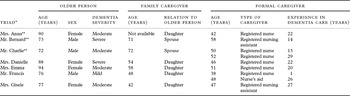
A theoretical sampling method was used to diversify the sources of knowledge of different sorts of screams. Seven triads, each composed of an older person, a family member and one or two formal caregivers, were recruited to reach theoretical saturation (Spradley, Reference Spradley1979; Boyle, Reference Boyle and Morse1994), with 23 people involved in all (see Table 2). The older persons had to meet the following selection criteria: they had dementia as per nurse report; they manifested vocal behaviors that did not seem appropriate in their context and that were observed by people in the environment; and they had at least a primary family caregiver. The family member was the one most involved with the older person. To be selected, the person had to have good knowledge of the nursing home, speak French and be capable of introspection. One or two formal caregivers of each older person were also identified for a total of nine. They were registered nurses, registered nursing assistants or nurses’ aids. They were recruited based on their knowledge of the older person and the nursing home culture, their introspection and their desire to communicate their knowledge. Data were collected from all participants. However, the data were partial for three triads in which the older person died after being included in the study. In two cases, the planned semi-structured interview with the family caregiver did not occur out of respect for their loss and their need to mourn. However, informal conversations had taken place with these caregivers. In the third triad, systematic observations of the older person while screaming were not possible. This was taken into account during theoretical sampling, among other measures, by increasing the number of triads recruited.
All participants signed a consent form approved by the Research Ethics Committee that authorized the publication of details about participants as long as they could not be recognized. Family members gave consent for the older persons living with dementia.
Data collection
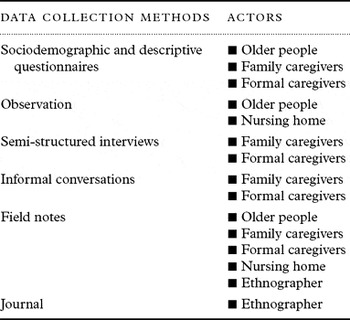
During data collection, the role of the ethnographer (A. Bourbonnais) was to learn from participants and stimulate their reflection. In keeping with the principles of ethnography, many data collection methods were used to increase depth (see Table 1; Spradley, Reference Spradley1979; Boyle, Reference Boyle and Morse1994). These various data collection methods were not used in a specific order and were often concomitant in accordance with the research design. However, the process always started with general observations of the nursing home.
Data collection methods with actors

Sociodemographic and descriptive data were collected via specific questionnaires for each group of participants. Based on their specific expertise, questions about the older persons were included in the family and formal caregivers questionnaires. Biographical data were collected from family members and health information was collected from formal caregivers.
Each older person was observed screaming for 30 minutes with an observation tool developed for the purpose on the basis of a literature review (Bourbonnais and Ducharme, Reference Bourbonnais and Ducharme2008) and content-validated by experts. The observations concerned, among other things, the characteristics of the screams (intensity, type, duration) and elements of the social and physical environment (e.g. number of people in the vicinity and level of noise). General observations on the nursing home environment and its functioning were also collected.
An individual semi-structured interview was conducted with each family and formal caregiver. Each interview began with an explanation of its goal and procedure. During the interview, a guide was used to ensure no topic was overlooked. One version of the guide was designed for family caregivers and another for formal caregivers. These two versions included general questions on screams and on the key concepts derived from the theory of Adams and Gardiner (Reference Adams and Gardiner2005) in relation to this behavior: social context, inferences about the screams, and positioning within the triad. The following is an example of the questions on the social context: “Could you describe what for you is a typical visit to your family member?” The following, by contrast, is an example of the questions on positioning aimed at stimulating the reflection of caregivers in accordance with the critical aspect of the research: “Do you think there is something else you could do or change in your interaction with this older person who screams?” Finally, an example of the questions related to inferences is: “Could you describe your family member's behaviors that help you understand why he/she screams?” General questions on screams allowed meanings of screams to be distinguished as understood by the family member, by the formal caregivers and by the older person living with dementia. Thus, triangulation of these data reflects the meanings of screams for the triad. In the course of data collection and analysis, questions were modified or added to verify with other participants what was learned previously. Interviews were conducted in the nursing home, lasting 75 minutes on average. They were recorded with the participants’ consent and transcribed verbatim.
During the research process, informal conversations also took place with staff members and families in the nursing home. They involved study participants but also other people who were interested in the study, such as head nurses, other nurses or nurses’ aids. Field notes were taken during data collection and analysis. These documented ideas, descriptions or elements that the ethnographer wished to investigate in greater depth. The notes guided the subsequent cycles of sampling, data collection and analysis. A journal was kept to document the ethnographer's reflections on the phenomenon, the research process and relations with participants. All data were considered in the analysis.
Data analysis
Data analysis was performed following each data collection activity and guided the recruitment of new participants. First, data were reduced by assigning codes – 600 in all – to the data. The coded data were then sifted for similarities and differences. This was done following the method proposed by Spradley (Reference Spradley1979), which entailed carrying out domain, taxonomic, componential and theme analysis. The triad was the analysis unit and a strategy was developed to allow intra- and inter-triad analyses.
Domain analysis consisted of grouping terms with at least one common characteristic. Then, taxonomic analysis organized all the terms associated with a domain. This allowed identifying similarities between data. Domain and taxonomic analyses were carried out intra-triad and then repeated inter-triad in an iterative manner. Componential analysis involved seeking out characteristics that distinguished complex elements of the inter-triad taxonomy, taking into account multiple relations between terms and highlighted differences. Finally, theme analysis served to raise the level of abstraction through various strategies, including the creation of a cultural inventory and the search for universal themes in the data (Spradley, Reference Spradley1979).
The last step in our analysis involved verifying the results obtained by recontextualizing new knowledge within the existing literature. Throughout the entire research process, we sought to respect seven “rigor criteria” for qualitative research: credibility, confirmability, meaning-in-context, recurrent patterning, saturation, transferability and criticality. Credibility implies that results correspond to knowledge transmitted by participants; this was ensured through triangulation and the iterative process. Confirmability is demonstrated when findings are grounded in the data; this was documented in verbatim evidence. Meaning-in-context refers to considering what is important for participants through immersion in their culture. Recurrent patterning concerns the identification of repeated themes in the culture; this was achieved by applying Spradley's analysis method. Saturation refers to the depth of findings; this was ensured through theoretical sampling, triangulation and the iterative process. Transferability refers to the possibility of obtaining similar findings in other contexts; this can be assessed by the explicitness of findings. Finally, criticality involves considering contradictions in the data; this was ensured by the researcher's reflexivity (Leininger, Reference Leininger1997; Whittemore et al., Reference Whittemore, Chase and Mandle2001).
Results
Key characteristics of the seven triads are summarized in Table 2. The older persons comprised four women and three men, with a mean age of 81 years. According to the registered nurses, most suffered from moderate-to-severe dementia and all took many medications to control their screams. Family caregivers were all women (mean age 58 years). Five were daughters and the others, spouses. They all visited their family member at least once a week. On average, formal caregivers were 48 years old. Seven of the nine were women. Most were nurses, but two were registered nursing assistants and one, a nurses’ aid. They had an average of 19 years’ experience working with older people living with dementia.
Sociodemographic and descriptive characteristics of triads

*All names are pseudonyms.
**Triads with incomplete data.
Various results emerged from this data analysis, creating an ethnography of the meanings of screams in older people living with dementia in a nursing home. This ethnography is particular as it describes the behavior of people with altered cognitive capacities which make it more difficult to validate the inferences made on their behavior. To take into account this reality, the results are sometimes presented in a hypothetical manner, which is coherent with the critical aspect of this ethnography. The findings reported here relate to the core themes of this study. Two themes regard the meanings of screams for the triad, one regards the singularity of screams, and six regard factors influencing the meanings of screams for the triad. They are supported by extracts from the data. All names used are pseudonyms. Extracts from the data (presented below) were originally in French; they were translated for the purpose of this paper.
Meanings of screams
Living between two worlds: vulnerability, suffering and loss of meaning
This theme of living between two worlds presents various meanings of screams related to the experience of older people. Older persons who scream are living in a paradox – they continue to evolve in a highly cognitive world but no longer have the capacity to interpret it. The external world seems frightening to these older persons. On the other hand, their internal world is characterized by exacerbated affectivity and confusion, making their contacts with the external world difficult. To escape from this frightening external world, they seem at times to retreat into their solitary internal world. This state was described as being in a “bubble” or a “shell” allowing older people to protect themselves and to have more control toward the external world:
A bubble to try and protect herself [. . .], it's a form of defense mechanism. That's it! That is because they don't have any control on the environment and she always was a person very in control of herself and her environment, so when she becomes completely dependant, she has nothing left, no control on her life [Mrs. Emma's daughter].
This retreat into their own world can manifest in various ways, including through screams. It can also interfere with their awareness of screaming. Mrs. Emma's daughter explained this in the following way:
If I say to her “mom, you shouldn't scream like that”, she'll stop. Then I'll say, “you were screaming”, and she'll say “no”, she'll say “I'm not aware of it. I was screaming?” [. . .] This one time, she was in bed, I said, “mom”, I said, “you were screaming a lot”. She said, “Ah, that's strange, I could hear someone screaming”. I thought that was odd [. . .], she didn't realize she was the one doing it.
This paradox between the external and internal worlds generates vulnerability that is also expressed through screams. Many aspects of the life of older persons who scream contribute to this vulnerability, including loss of physical and cognitive capacities and fluctuations in the capacity to understand and communicate situations. One older person expressed this vulnerability by calling out for her mother:
Sometimes, it happens at 7 a.m., she's a little agitated and, ah yes, a favorite word is “mom, mom, mom”, and even if we correct her or we come to her help [. . .] and I say, “I'm not your mother”, she'll say “ah, but it soothes me to call you mom” and she'll keep on with “mom, mom” (Mrs. Gisele's formal caregiver).
Being caught between two worlds seems to make older persons anxious and afraid or to give them the impression of being an object. These experiences contribute to suffering that can be expressed through screams and that is not related to a specific need. According to Mrs. Emma's daughter, her mother “was in a constant state of panic”.
Past and present events in the older persons’ life seem to be conducive to this suffering and their cognitive difficulties make it difficult to self-soothe. This combination of vulnerability and suffering probably brings on a loss of meaning that is also manifested through screams. This lack of meaning can be limited to certain aspects of the life of the older persons. For example, they may not understand why they need to stay in a nursing home. However, it can also be a more generalized phenomenon and give rise to suicidal thoughts even in people with severe dementia. This is what Mrs. Gisele's daughter had to say in this regard:
The last time she said it, she said it here. The first week, she had abdominal pains I think: “now, I want to die, I want to die, help me”. She took my hand “help me, help me” [. . .]. She was always telling me “press the pillow down my face”.
Screams express the depth of the distress that can be felt by older people with dementia.
Modulations in the meanings of screams: when the end explains the means
Screams can have many other meanings regarding the concrete daily reality of older people. These are teleological, that is, screams can be explained by their final outcomes rather than by a cause. Data analysis showed that screaming is a useful means to communicate final outcomes, regardless of the neurological components or factors involved in the fact that the message is expressed that way. One caregiver even referred to these screams as a “calling bell”.
Screams can express seven categories of final outcomes: dissatisfaction, satisfaction, pain, emotions, physical needs, desire to modify environment, and enigmatic. Screams express dissatisfaction or disapproval about situations or specific care. Exceptionally, they also express satisfaction with actions done by people in the surrounding. All the older people in this study screamed to express pain, emotions and physical needs. Some of them also screamed when they wanted something in their environment modified. Finally, screams were sometimes enigmatic for family and formal caregivers although they believed they had a specific meaning not yet deciphered. This category of screams often occurs in the end-of-life stage or is associated with neurological dysfunctions by caregivers. The older people themselves could express perplexity over their behavior:
At some point, I was surprised, he said to me, “I know that I scream, but I can't stop, I don't know why, I can't” and it made me sad a little because it was surprising that he said that. [Mr. Francis's daughter]
Among the final outcomes manifested by screams, emotions and physical needs have sub-categories. Regarding emotions, screaming can express fear or anxiety, frustration and solitude. For example, Mrs. Emma often screamed to express emotions, mostly fear, but also solitude. Her daughter mentioned this about her mother's fears:
I have the impression that everything scares her that she doesn't see things coming, that they come too fast, that maybe they're not explained enough for her to understand. It would take a great deal of time to help her understand [. . .]. But even then, would she accept it better? Maybe it wouldn't be as bad, but it would take so much time and tenderness to help her understand.
Screams can also express different physical needs: feeling too hot or cold, being fed and hydrated, resting, changing position or place, and eliminating. For example, here is what Mr. Charlie's formal caregiver observed:
Caregiver: Maybe he's tired, so we let him sleep, I would say almost once a month. It would take 24 hours [. . .] to come back, I don't know, from exhaustion [. . .].
Interviewer: He would stay in bed almost the whole day and during this time, he didn't scream?
Caregiver: He didn't scream at all [. . .]. It's like he needed to make up a full day's sleep per month.
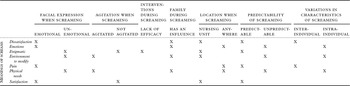
Through various modulation criteria, family and formal caregivers are able to distinguish between the seven categories of meanings (see Table 3). For example, when older people scream to express dissatisfaction, they present an emotional facial expression that they do not have when expressing physical needs. Some criteria have a stronger discriminant effect. In other cases, it is not possible to determine whether a criterion is applicable or not to a category of meanings. This explains the absence of information for some criteria.
Modulation criteria for the meanings of screams

Singularity of the meanings of screams
Three aspects make the meanings of screams singular. First, many types of screams are heard in nursing homes, including moaning, crying and word repetition. Second, the multiplicity of meanings makes this behavior unique. This means that the same older person can utter screams with various meanings in the same time frame. This is how Mr. Charlie's formal caregiver described it:
There were more screams at the beginning OK, it went from satisfaction, to dissatisfaction, pain, let's say these three themes. We could recognize these easily. Eventually, the pain scream decreased because we added a fentanyl patch to his medication, so at that point, I would say, we were down to two.
Also, meanings can be juxtaposed, that is, an older person's screams can have two at the same time. For example, Mr. Bernard screamed almost continuously to express his vulnerability. However, sometimes a second meaning, thirst, modified the characteristics of his screams. When the staff recognized and met that physical need, the screams reverted to baseline characteristics related to vulnerability. Third, the meanings of screams not only change within the same day, but also over time. Screams were said to evolve, that is, new types of screams emerge while others disappear.
Factors influencing the meanings of screams
Stability and flexibility in the nursing care organization: conditions influencing the meanings of screams
As a contextual factor, stability and flexibility in the nursing care organization have an impact on the meanings of screams. When the same formal caregivers are assigned to the same older people, it fosters trust not only between the two, but also between caregivers and the family. Often, older people react better with certain caregivers who are present regularly. Mrs. Anna's formal caregiver gave this example: “Sometimes, she wouldn't eat all day if I wasn't there. I would come in and she ate everything and she laughed, smiled, she always answered me.”
When this trust is present between family and formal caregivers, it allows formal caregivers to benefit from the biographical expertise of family members to shed light on the screams. Failing this trust, staff tend to modify their care to try increasing it, for example, by waiting for the family to be present to deliver some nursing care.
Flexibility, also, emerges as an important characteristic of the care organization. For many older people in the study, a formal caregiver of the opposite sex was a troubling element that influenced screams. This often required reorganizing the planned care to limit the impact on the older persons while trying to maintain stability. The schedule of care sometimes had to be adjusted to fit an older person's preference. This was the case for Mrs. Emma, according to her formal caregiver:
She doesn't scream during the night, so when we arrive, we install her last because we don't want her to be screaming for a long time [. . .]. We install everybody else first, her, she's the last one we install for breakfast.
These interventions to limit the impact of screaming are usually not part of the pre-established daily routine in the nursing home.
The home environment of an older person is also the home of other older persons, as well as a work environment: reciprocal effects on the meanings of screams
The social context in the nursing home is characterized by the fact that it is also the older person's home environment. What's more, the environment is shared with numerous many older persons and their families, aside from being the work environment of many people.
The presence of an older person's family member has a great influence on the meanings of screams. Three of the older persons in our study systematically stopped screaming in their company. The four others kept screaming, but could stop temporarily when their family caregiver asked them to do so.
Older people who scream have strong effects on others. Some families complain about the screams or experience negative emotions toward those who scream. Family members of these older people are sensitive to the problem and try to protect others from the behavior. However, it is not always possible to do so and this has repercussions on other residents. For example, a formal caregiver explained the effect of Mr. Charlie's screaming on other residents sharing his room:
Mr. Thomas, no [was not bothered] because he's a little deaf [. . .], actually we could even say quite deaf, so he couldn't hear him. With Mr. Lucian [. . .] it was, I wake up and what is this, so he starts yelling and the other one [Mr. Charlie] would scream [even louder].
The demands of the nursing home as a work environment also have effects on what screams mean. For example, staff “agitation” during shift changes has an impact on screams, just as screams disturb the work of caregivers. These social influences contribute to the various inferences made in the triads about the meanings of screams.
Learning the unique language of each older person and its influence on the interpretation of the meanings of screams
Inferences made by family and formal caregivers about the behaviors of older people contribute to interpret the meanings of screams. Older people also probably make inferences about behaviors they observe, and this influences the meanings of their screams. Inferences made by family and formal caregivers seem to allow them to learn the unique language that is the older person's screams:
Interviewer: So the screaming has more individuality than other behaviors?
Caregiver: Yes. And what's very difficult is that it takes a long while before understanding the differences, it's like learning a new language: In the beginning I can figure out one word, than two words [Mrs. Gisele's formal caregiver].
Learning this “language” brings about changes in their ways of understanding and intervening with people who scream. In time, it helps caregivers make more useful inferences to decode the meanings of screams. This is achieved primarily by observing the non-verbal communication of older people when they scream. Voice characteristics such as tone, intensity and speed are elements that influence inferences about meanings. The look in the older people's eyes seems to be an especially powerful element in this regard as well. Other concurrent behaviors also help determine the meanings of screams once observers have learned to interpret them.
The interpretations made by family and formal caregivers about the meanings of screams are also influenced by their hypotheses regarding the inferences made by the older persons about the external world. This understanding based on inferences about the meanings of screams guides caregivers in their interventions.
“Being with” older persons by respecting their personality, wishes and needs: repercussions on the meanings of screams
Family and formal caregivers have repercussions on the meanings of screams by choosing interventions that allow them to “be with” the older persons. Participants revealed that the most useful ways of “being with” usually involve getting to know the older persons and sharing this knowledge. They pay special attention to the personality, wishes and needs of the older persons. This also influences their inferences about the meanings of screams.
Family members can describe past personality traits of the older persons that seem to be implicated in their screaming, for example a dislike of solitude or anxiety. At times, formal caregivers discover personality traits through their daily contact with the older people. However, it is often the older person's response to various interventions that confirms or invalidates the inferences made about their behavior by family and formal caregivers.
Formal caregivers usually try out interventions that correspond to the older person's wishes or needs. This has repercussions on screams: When the intervention matches the meaning, screaming often stops. Mrs. Anna's formal caregiver put it thus: “She sometimes screamed at 11 a.m., I figured she was wet or something, so we changed her and then she would stop”.
Family and formal caregivers can also “be with” the older person by offering a personalized presence that takes various forms: touching, reassuring, being humorous, paying attention and doing an enjoyed activity. Even if family and formal caregivers use a variety of interventions, it is mostly their way of being during these interventions that seems to have significant repercussions on screams. This underscores the importance of reciprocity and affection in interactions with the older person. For example, signs of affection are sometimes used to help the older person deal better with specific care and reduce screaming. This way of being is often described by formal caregivers as a reassuring approach. This is how Mr. Charlie's formal caregiver described her way of being with him: “I'd say . . . [that my role is to provide] a soothing presence. Soothing, it seems to me, like a security blanket that makes you feel better”. Learning the language, the personality and the best ways to intervene with older persons occurs in a context where each person has his or her own position within the triad.
Shifts in power relations within the triad (to relinquish, to impose or to be imposed upon) and its outcomes for the meanings of screams
The positioning of each member in the triad influences power relations. These relations are not static; they shift, thereby allowing each member in the triad to influence the others. Each member, including the older person, at times imposes on others, is imposed upon or can seek to relinquish power. These shifts have outcomes on screams.
Even if older people living with dementia are generally perceived to be in a social position that limits their power, they still sometimes impose on others to influence their actions. Some older persons seem to shift their position to protect the well-being of a family member. By doing so, the older person reverses the predominant position with the family member, which is often surprising for the caregiver, as expressed by Mrs. Emma's daughter:
Once recently she said, because she saw I felt bad for her, she said, ah I find this so sad [. . .], she said, “think about you, think about you, don't think about me” [. . .], it's sad [crying].
Given that the people around them have difficulty controlling their screams, the older persons use this also to influence their care. In other cases, however, family and formal caregivers interpret the screams as a powerful call for help.
Family caregivers seem to have the most influence within the triad. They often impose on their older family member their decisions regarding care, activities and visiting hours. These decisions have an impact on screams. For example, some older persons start screaming the moment their family caregivers leave. Family caregivers are not always at ease with this role as they thus become “their parent's parent”. They also influence formal caregivers, sometimes to facilitate their interventions, but also to impose their decisions on them. Formal caregivers seem to respect this authority even when they disagree with the decisions. Family members also position themselves to receive support from formal caregivers.
Moreover, formal caregivers try to relinquish some power to families by working in partnership with them both to share their understanding of the meanings of screams and to guide families. These strategies to help families contribute to the shift in power relations within the triads and have positive outcomes for the older persons as a result of combining biographical expertise and specialized expertise. With older persons, formal caregivers tend to impose their ways, sometimes for what they think is their own good and other times more to respect the culture in the nursing home. This positioning has repercussions on older persons, for example, by triggering screams of dissatisfaction. Formal caregivers also seek to relinquish some power to the older persons. This is done by recognizing their experience, establishing reciprocity or including them in conversations. As in this example involving Mrs. Gisele, screams can sometimes be reduced when a formal caregiver includes the older person in a conversation with a family member. “Caregiver: You can have the same conversation, but all you have to do is throw in once in a while “isn't that so, Mrs. Gisele? Isn't that right?”, you know. Interviewer: It changes the dynamics and they stop screaming? Caregiver: They stop screaming”. Positioning within the triad, also, has repercussions on the experience of family and formal caregivers with older persons who scream.
Feelings of powerlessness and guilt: a shared experience for family and formal caregivers derived from the meanings of screams
Positioning and the meanings ascribed to screams contribute to elicit a sense of powerlessness and guilt in family and formal caregivers. This shared experience influences their way of being and behaving with older persons. For family caregivers, screams are especially painful and elicit a sense of powerlessness. For example, Mr. Bernard screamed continuously even in the company of family members, who visited daily for several hours. One of his formal caregivers commented on his daughter's experience:
It's terrible, terrible, his daughter once told me, word for word, she said: “It breaks my heart to come here and to see my father screaming like that, it's like being stabbed, these screams, it's like someone was stabbing you.”
Families spend a lot of time visiting. The visits have instrumental goals, but they also aim at comforting older persons and maintaining continuity in the relationship. However, family members can feel guilty if they are torn between responsibilities, stay for only a short while or if they are unable to visit.
Formal caregivers experience a similar sense of guilt when they do not have enough time to spend with older persons, especially when their presence could stop the screaming or help understand the behavior. They also feel powerless when they are unable to make screams stop and they fear families and peers might judge them to be incompetent. Feelings of guilt and powerlessness are exacerbated when caregivers are uncertain of the best intervention for specific types of screams. Among these, nurses have strong misgivings about using medication. This is what Mr. Charlie's formal caregiver explained:
You know, sometimes, when you're a nurse and you administer medication [as needed], you feel like you're not doing the right thing, you ask yourself, is it OK to do that? Is it because he's getting on my nerves that I do that? Maybe he doesn't really need it? Maybe it would be better if I let him scream, you know [. . .], but there's also the context, other patients and maybe it will make him feel better because it takes a lot of energy to scream like that, I presume, it means that you won't sleep [. . .] if you're feeling anxiety, you can't be well either.
Positioning and the older person's screams influence the feelings of family and formal caregivers. This probably influences their way of being and acting with the older person.
In sum, even though this ethnographic description is obviously incomplete, it reveals that screams in older people living with dementia can have many different meanings, some metaphysical and others more concrete. Screams are also found to be fundamentally singular, reflecting the uniqueness of each older person. Finally, the description of various factors influencing the meanings of screams allows us to see that this behavior occurs in the context of dynamic relations. The vigor in these relations demonstrates that family and formal caregivers can have an influence on the meanings of screams and that older people can touch them.
Discussion
This research is original in the method applied to arrive at a better understanding of screams, of the older people who manifest such behavior, and of the people around them. Some of our findings are new and others add to existing knowledge. They provide perspectives on the approaches to adopt with older people who scream and the people around them. This should contribute to offer higher quality care in nursing homes.
The theme of living between two worlds underscored the suffering and vulnerability of older people living with dementia who scream. Few studies have examined these aspects. Our findings established an association between older people calling out for a parent and this suffering and vulnerability. Miesen (Reference Miesen, Jones and Miesen1992) is one of the rare authors to have explored this behavior in a study of parental fixation. This author found that, in older people with dementia, calling out for a parent could be a sign of emotional problems and possibly a fear response reactivating a parental attachment. This type of calling out probably constituted a distress call about a current situation and not the effect of memories. Moreover, these screams were believed to have a self-soothing function. This is in accordance with our findings.
For family caregivers, screaming was clearly an expression of suffering in older people who are unable to understand their situation and, in some cases, the suffering even led to suicidal thoughts. Some studies found a significant association between depressive symptoms and screams in older people (Cohen-Mansfield et al., Reference Cohen-Mansfield, Marx and Werner1992; Dwyer and Byrne, Reference Dwyer and Byrne2000) that could explain suicidal thoughts in some older people in our study. However, there is little account in the literature of direct expression of suicidal thoughts in people living with severe dementia. Our findings suggest that these people have the capacity to feel an existential distress and that families can witness it. This aspect of the life of older people living with severe dementia warrants greater attention in the aim of developing appropriate interventions to alleviate this suffering.
Our finding that screams could express final outcomes confirmed existing knowledge regarding agitation (Cohen-Mansfield et al., Reference Cohen-Mansfield, Marx and Werner1992; Algase et al., Reference Algase1996; Cohen-Mansfield and Werner, Reference Cohen-Mansfield and Werner1997). However, we also added to existing knowledge by identifying modulation criteria that help discriminate the various meanings of screams.
The singularity of the meanings of screams might explain why this behavior is often referred to as complex both by clinicians and in the literature (Cohen-Mansfield et al., Reference Cohen-Mansfield, Werner and Marx1990; Sloane et al., Reference Sloane1997; von Gunten et al., Reference von Gunten, Alnawaqil, Abderhalden, Needham and Schupbach2008). These characteristics have important implications for the choice of interventions used with older people who scream. They require being sensitive to rapid fluctuations in screams that can give an indication of the well-being and needs of older people. The singularity of this behavior might also explain the limited success of researchers in evaluating standardized interventions and the difficulties of clinicians in intervening with these patients.
Our findings also highlight elements amenable to change that can have a positive effect on screams. For example, screaming was identified as a language that is unique to an older person but that can be learned. This learning process is not documented in the literature. However, our study indicates that the more contact caregivers have with an older person, the better their chances of learning from them and decoding their behavior.
Though the research did not aim to evaluate interventions, participants described many of their actions to explain what influenced both older people and their way of interpreting the meanings of screams. Some of these interventions have already been reported in the literature (Cohen-Mansfield and Werner, Reference Cohen-Mansfield and Werner1997; Doyle et al., Reference Doyle, Zapparoni, O'Connor and Runci1997), but others have not been documented. A central element concerned the importance of having good knowledge of the life history and current reality of older people. The contribution of families in this regard is under-documented. In trials evaluating interventions, the importance of establishing trust with older persons living with dementia who scream has been neglected. We found that older people reacted better to some family and formal caregivers than to others. In this regard, the possibility of developing a therapeutic relation with older people living with severe dementia had already been demonstrated in a study by Williams and Tappen (Reference Williams and Tappen1999).
The value of reciprocity during interactions with older persons who scream is another aspect that is ill described in the literature. Given that a nursing home is not only a care environment but also a home environment and that older people living with dementia maintain an affective memory, affectionate and reciprocal relations are believed to contribute to their quality of life and care. This is in keeping with notions developed by Schultz and Carnevale (Reference Schultz and Carnevale1996) regarding engaged caregiving. These authors point out that during caregiving it is important to know the other well and to “be with” the other even if this implies running the risk of feeling the other's affliction.
Our findings also show that positioning in a triad is not static. This is reflected in shifts in the power relations. This description of relational shifts in a culture concurs with Foucault's (Reference Foucault1976) definition of power as a complex strategic situation in a given society manifested in all relations. This conception of power is in agreement with our results showing that older people living with dementia can contribute to power relations and that their screams can be considered a form of empowerment over their daily routines and environment, albeit an unconscious one.
Based on these findings, critical ethnography proved a relevant and holistic research method for gaining a better understanding of a complex behavior in older people living with dementia, especially if we consider the limits imposed by their altered cognitive capacities. However, this study presents certain limitations that might have influenced results.
One of these is the absence of direct communication with the older persons. This limit, imposed by Quebec law, was partially offset by observation from a distance and by the interviews with family and formal caregivers. There is also the possibility that family and formal caregivers projected their own emotions or perceptions when they were questioned about an older person's screams. Another limit concerns some atypical characteristics of the nursing home (multi-ethnic and endowed with a psychogeriatrics team) that participated in the study; it is unclear how this affects the transferability of results to other settings. In keeping with the research design, participants were the ones with the best knowledge of screams and of the nursing home culture; this means that the formal caregivers in our sample might not reflect the experience and skills of most caregivers in nursing homes. Also, a larger sample might have allowed examination of whether the modulation criteria identified were applicable to a broader variety of screams.
Based on our findings, some recommendations can be made that could contribute to caring and culturally congruent care for older persons with dementia and the people around them. Future research aimed at testing interventions should seek to match these with the meanings of screams. It would probably be relevant to consider the quality of the relation between the person applying the intervention and the older people, as this seems to have an impact on screams and their meanings. The singularity of screams and the importance of reciprocity with the older person should also be taken into account. The efficacy of some interventions could then be clarified or made more evident. Modulation criteria distinguishing the meanings of screams could also be refined and verified to ensure they apply to a variety of older persons and screams. The development of interventions to alleviate the existential suffering of older people living with dementia should be considered. Clinicians, too, could apply most of these recommendations in their daily practice. It would be important for them to share the present understanding of the meanings of screams with the other persons in the nursing home in order to avoid ostracizing older people who scream and to reduce the guilt felt by their family caregivers.
In sum, this study revealed screaming as an audacious behavior that shows the liveliness of older people living with severe dementia. The meanings expressed by older people who scream could be manifested differently by other older persons. This is why it is important to pay attention to the silent ones as well. Finally, in a society that values youth and productivity and where the fact of living in a nursing home is rarely a deliberate choice, we hope that our results contribute in some way to reveal the value of people living, visiting and working in nursing homes.
Conflict of interest
None.
Description of authors' roles
Anne Bourbonnais designed the study, collected and analyzed data and wrote the paper. Francine Ducharme supervised the design, data collection and analysis and assisted with writing the paper.
Acknowledgments
We wish to thank the older persons, the families, the caregivers and the managers of the nursing home who took part in this project. The study was supported by grants from the Desjardins Research Chair in Nursing Care for Seniors and Their Families, the Fondation de recherche en sciences infirmières du Québec (FRESIQ) and the Ministère de l’Éducation, du Loisir et du Sport du Québec.