


INTRODUCTION
Li, Lewin, Witt, and Välikangas (Reference Li, Lewin, Witt and Välikangas2021) recently revitalized the discussion of the rivalry between China and India by suggesting that deglobalization and decoupling may provide a rare opportunity for India to catch up with or even overtake China. They identified the outside (‘pull’) and inside (‘push’) forces that India can leverage to build competitiveness. They specifically point to three major outside forces that may synergize with internal factors such as foreign policy and a young labor force to boost India's competitiveness. One is the reconfiguration of global supply chains. The growing suspicion of Chinese foreign investment is second along with the increasing overseas springboarding opportunities of Indian firms.
Their inference about competition in Africa inspired us to examine the foreign direct investment (FDI) from China and India in the past as a guide to what the dynamics may be in the future. Africa today is one of the most active regions for FDI. That makes it an ideal context for investigating the links between business history and the evolution of various economic paths (Murmann, Reference Murmann2015). China and India have adopted distinct strategies in Africa, making an appreciation of their different strategic choices important for both scholars and practitioners (Bhagavatula, Mudambi, & Murmann, Reference Bhagavatula, Mudambi and Murmann2017). We show with our analysis that the assertion by Li et al. (Reference Li, Lewin, Witt and Välikangas2021) that India now has a rare opportunity to catch up with China in some areas seems sound, but at least in Africa, it is unlikely that China will lose its advantages.
CURRENT CHINA-INDIA RIVALRY IN AFRICA
China and India both seek access to raw materials and markets in Africa, but China enjoys stronger economic ties both in terms of trade volumes and the rate of growth rates. Another common interest is to seek political support. There India has special concerns about unrestricted access to the Indian Ocean and protection of substantial Indian diaspora communities (see Table 1). There is a sense, in which each country can consider the other a ‘new challenger’ in Africa (Narayanan & Shin, Reference Narayanan and Shin2019). After a long history of maritime trade, India stepped up its engagement with Africa during the colonial era, the anti-colonial struggle, and the Cold War. As the most populous Commonwealth member and leader of the anti-colonial and non-aligned movements, India's position in Africa has long been quite strong. China held a Forum on China-Africa Cooperation in 2006 seeking to strengthen its ties, and two years later India replied by holding a similar India-Africa Forum. In recent years, African votes at the United Nations align more often with that of India than with China.
Engagement of India and China in Africa

Notes:
† China National Petroleum Corporation Economics & Technology Research Institute. 2020. 2019 Report on Petroleum Industry Development.
§ National Bureau of Statistics of China. 2001, 2019. China Statistical Yearbook 2000, 2020.
¶ Ministry of Commerce and Industry of India. 2021. Available from URI: https://tradestat.commerce.gov.in/
** Ministry of Commerce of China. 2018. Statistical Bulletin of China's Outward Foreign Direct Investment 2018.
†† Reserve Bank of India. 2021. Available from URI: https://rbi.org.in/Scripts/Data_Overseas_Investment.aspx Data before 2008 are not available.
INDIA'S COMPETITIVENESS: SOCIAL EMBEDDEDNESS AND INSTITUTIONAL PROXIMITY
India and many African countries share a colonial history, and the similar legacies are reflected in both social characteristics and political structures. The shared colonial experience has brought both regions the common law system, democratic politics, similar ways of doing business, and Western languages and culture (Bhattacharya, Reference Bhattacharya, Cheru and Obi2010). Colonial history has also left large Indian diaspora communities in several African countries. There are roughly two million persons of Indian descent in Africa's anglophone countries (Paul, Reference Paul2014). More than 1 million of them are in South Africa. In Mauritius, more than 60% of the population is of Indian descent (Xu, Reference Xu and Zhang2019). In Nairobi, the proportion is 30%, and persons with an Indian heritage dominate the manufacturing and processing industries there. The largest business group in Tanzania – Mohammed Enterprise Tanzania Ltd – is also Indian-owned.
Such businesses in Africa mainly focus on their domestic markets, but cultural similarity is an important reason why they prefer to work with suppliers from India (Tang, Reference Tang2014). Within the diaspora local connections and networks provide business opportunities and lend legitimacy to firms from India. When the rapid development of domestic manufacturing pushes firms in India to turn their attention overseas for new markets and/or supply, they are naturally drawn to Africa. Ethiopia, a country with centuries of trade history with ancient India and thousands of Indian English teachers and scholars, received independent India's first FDI into Africa in 1959 when the Indo-Ethiopian Textiles Share Company was established by the Birla Group (Anwar, Reference Anwar, Rogerson and Szymańska2014). Tata Group, one of India's largest multinational conglomerates, now has investments in 19 countries in Africa.[Footnote 1] Fifteen of these countries are English-speaking Commonwealth nations with high institutional proximity with India.
CHINA'S COMPETITIVENESS: INTER-GOVERNMENT RELATIONSHIPS AND STATE-OWNED ENTERPRISES
China's relations with Africa have been government-led (Karim, Kamal, & Haroon, Reference Karim, Kamal, Haroon, Syed and Ying2019). China's government has shown great patience in ‘[making] friends first, then to reinforce understanding, and finally to establish official relations naturally’ (People's Republic of China, 1990: 406). Not only the central government, but also China's provincial and even municipal governments have played active roles in building relationships with Africa (Verma, Reference Verma2017). All levels of government have provided various development assistance in various ways, sometimes despite extreme difficulties at home (Morgan & Zheng, Reference Morgan and Zheng2019).
Stable and friendly inter-government relationships minimize the likelihood of hostile actions from host governments, confer legitimacy, and build social capital and mutual understanding in both countries (Shapiro, Vecino, & Li, Reference Shapiro, Vecino and Li2018). Chinese state-owned enterprises (SOEs) first entered Africa to carry out aid-financed large-scale development projects such as infrastructure building and natural resource exploitation. But over the past two decades, private-sector Chinese firms have become the majority among Chinese enterprises in Africa (Gu, Reference Gu2009). Some of them followed Chinese SOEs as their sub-contractors, suppliers, or partners (Wang, Cui, Vu, & Feng, Reference Wang, Cui, Vu and Feng2022). Some came to provide services to Chinese expatriates (Barnard, Cuervo-Cazurra, & Manning, Reference Barnard, Cuervo-Cazurra and Manning2017). Others were simply motivated by growing local markets.
THE FUTURE RIVALRY
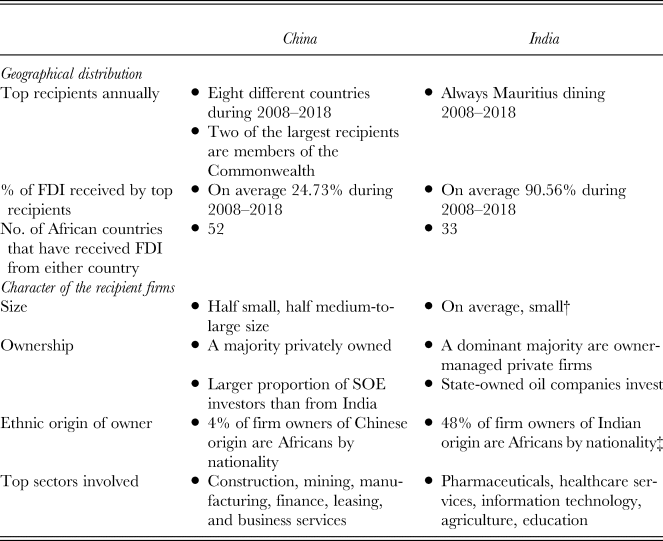
The above comparison helps to explain the distinct patterns of Chinese and Indian FDI in Africa (see Table 2 for a summary). Indian investment has been strongly concentrated in Commonwealth countries and others with large Indian diaspora communities. The overwhelming majority of Indian firms are stand-alone, owner-managed, small-to-medium-sized firms (Kanungo, Reference Kanungo2010), much smaller than the Chinese firms. This reflects a strong entry barrier to small Chinese investors. FDI from China is more broadly and evenly distributed across Africa, as Chinese businesses tend to face similarly large institutional distance in all these countries. The industry distribution shows that FDI from both countries bring distinct home-grown competitive advantages that fit the demand of host markets in Africa.
Patterns of FDI in Africa from China and India

Notes:
†The World Bank.
‡Broadman, H. G. (2007). Africa's Silk Road: China and India's New Economic Frontier.
Li and his colleagues (Reference Li, Lewin, Witt and Välikangas2021) must be correct in suggesting that deglobalization and decoupling will influence Chinese firms and Indian firms differently, but their view of the potential outcome of such influences in Africa may be faulty. (Reference Li, Lewin, Witt and Välikangas2021) They argue that, Chinese firms face ‘mounting sanctions and export controls’ (Li et al., Reference Li, Lewin, Witt and Välikangas2021: 390), which not only hastens foreign firms’ efforts to shift operations out of China, but also drive Chinese firms to move their operations to other countries enjoying preferential tariff treatment in advanced countries, as many African countries do. The state of developmental in many African economies complements that of China. That encourages Chinese firms to move labor-intensive operations there while upgrading domestic operations. As Li et al. (Reference Li, Lewin, Witt and Välikangas2021) suggested, India also wants to absorb these labor-intensive low-cost operations, making them competitors to many African countries. Therefore, the global value chain reconfiguration driven by the decoupling efforts of the US may even strengthen, rather than weaken, the Sino-African relationship.
As a supplier of strategic natural resources, Africa is more important for China than for India. Both as highly populous, fast-developing countries seeking natural resources of great strategic importance in Africa, but the largest resource concessions in a number of African countries have gone to Chinese SOEs rather than Indian private firms (Verma, Reference Verma2017). The more advanced state of China's industrial developement creates more demand for such resources. And at the same time, Chinese SOEs have the scale, experience, and government backing to manage large projects involved in extracting them. India's government consolidated the nation's resource-seeking efforts after it lost out to China in bidding for a large oil block in Angola in 2004. Now state-owned Videsh Limited is the largest Indian investor in natural resources in Africa. However, China has already obtained a massive head-start. As decoupling makes it increasingly difficult for China to acquire natural resources from advanced economies, China is more motivated to strengthen its positions in Africa.
India has for a long time considered Africa strategically important in a way that China has not, for its national security and because a higher proportion of its international trade and FDI involves Africa. However, deglobalization and decoupling increase the strategic importance of Africa for Chinese firms and the Chinese government. That escalates the rivalry between India and China in Africa. The Indian government has started to adopt approaches similar to those of China, stressing inter-government relationships by opening more consulates and providing more support to Indian private-sector firms in Africa. Prime Minister Modi showed his strong commitment to the India-Africa relationship by maintaining vaccine shipments to Africa even when the pandemic was out of control domestically in 2021. However, the segmentation of domestic politics might limit the Indian government's ability to coordinate and support its business consistently in foreign countries (Gupta, Reference Gupta2021). Without backup with inter-government relationships, Indian private firms are hesitant about the sort of large-scale, long-term investment in infrastructure that African countries seek.
Whereas the economic muscle and sustained backing of the Chinese government may provoke geopolitical concerns, especially as the governments in African countries are forced to take their side between China and US (Li et al., Reference Li, Lewin, Witt and Välikangas2021), India's government does not necessarily always stand with the US, as shown by their attitudes toward Russia (Tan, Reference Tan2022). The challenge for India is the risk of getting drawn into ethnic conflicts in African countries (e.g., in 1970s Uganda). It is sometimes difficult for India's government to take a neutral position due to its social connections with diaspora communities. Considering the competitive edge China has already obtained and its increasing strategic emphasis on Africa, it will not be easy for the Elephant to catch up with the Dragon in this battle for Africa even during the deglobalization and decoupling era.




Target article
When Dragon Meets Elephant in Africa: The Rivalry on Distinctive Competitiveness
Related commentaries (1)
India and China: Distinct Paths to Global Businesses