The story of Ong Wing, a penniless immigrant from China who later became the first Asian American to be elected to a state office in 1946, was reported in a 1950 issue of America Today (Jinri Meiguo), a United States Information Service (USIS) publication.Footnote 1 The first major periodical to target sinophone readers, America Today was an important United States propaganda effort that aimed to gain the hearts and minds of Chinese in Asia and elsewhere.Footnote 2 The USIS–Hong Kong (USIS–HK) employees translated Ong's story, originally published in the San Francisco Chronicle, for Chinese readers in Asia, the main distribution area. A proud father of six children, Ong's example starkly contrasted with another article entitled “Condemning Parents: Life in the Red Purgatory,” discussing Chinese children who denounced and disowned their parents in the People's Republic of China (PRC), penned by a Chinese refugee, possibly commissioned by the USIS, in a 1951 issue.Footnote 3 These two articles sought to showcase that the US system was a superior alternative for Chinese men, because they could realize their career ambitions, form a conjugal family, and enjoy parental authority there, as opposed to the suppression of capitalism and of Confucian values in the PRC.Footnote 4
While Chinese Americans continued to face discrimination, World War II and the subsequent Cold War brightened their lives, as many entered the mainstream job market and moved outside ethnic enclaves. Although the law limited the quota for Chinese to a dismal 105 immigrants per year, since 1943, when the Chinese Exclusion laws were repealed, the Chinese population had grown “by 51·8 percent to reach 117,629 in 1950,” with the majority of them immigrating “through nonquota statuses such as family reunification and as refugees.”Footnote 5 Among them were Ku T. J. and Tai Chen-To, two Chinese scholars trapped in the US after the Communist victory in China, who received assistance from US private funding and a Congressional measure to change their status from holders of nonimmigrant visas to permanent residents. Anticommunism cracked a slight opening in America's immigration gate for a small number of well-educated Chinese, although the federal government refused to lift Chinese immigration restrictions. The stories of Ong, Ku and Tai, according to a US propagandist, were “homely stories of democracy at work,” which could help influence Southeast Asian Chinese and win the battle of anticommunism in that region.Footnote 6
Only recently have scholars begun to focus on the cultural Cold War in Asia and the importance of Chinese Americans in the campaign.Footnote 7 The US government established the Office of Civil Information and the USIS in Asia in 1947 to disseminate anticommunist ideology and present the allegedly superior American way of life through films, exhibits, radio, publications, and cultural exchange programs.Footnote 8 US officials deemed Chinese in Southeast Asia susceptible to the influence of Communist China, thereby considering them major targets for propaganda. To combat the PRC's criticism of the ill-treatment of Chinese immigrants in the US, the State Department publicized the success stories of Chinese Americans in the Voice of America (VOA), Free World Magazine, and America Today, and sent Chinese Americans to tour different parts of Asia as living evidence of racial equality.Footnote 9 Few scholars have investigated print materials in depth in the Asian campaign. USIS published America Today in various languages. The Russian version, Amerika, has received the most attention. The USIS–HK produced a Mandarin edition between 26 October 1949 and 20 February 1952, right after the “fall” of China and in the midst of the Korean stalemate. In March 1952, the USIS replaced the magazine with World Today (Jinri Shijie).Footnote 10 It is important to analyze America Today because it revealed the strategies that the State Department deployed in attempting to enhance the image of the US during the highest tensions in East Asia.
Although Elaine Tyler May has argued that Cold War politics only strengthened traditional white American gender roles, which has since become the predominant narrative of Cold War history, this article contends that America Today magazine promoted the idea that the US provided humanitarian assistance to stranded Chinese students and abundant opportunities to them and other Chinese American men to achieve successful careers, form a heterosexual family, and enjoy patriarchal power. The magazine similarly accentuated the career opportunities available for female students but downplayed their domesticity, which is discussed elsewhere.Footnote 11 The strategy of stressing upward mobility attempted to cater to those well-educated Chinese readers in Southeast Asia that a democratic and capitalist system could provide an economic opportunity to them, because the masculinity of Chinese immigrants was often determined by the size of remittance back to China. Moreover, they could also realize their manhood through achieving a conjugal family, exercising parental authority, or controlling community affairs.Footnote 12 In contrast, as US propaganda accentuated, the Chinese Communist Party (CCP) compelled Chinese men to engage in hard labor, denounce filial piety, and forfeit their parental power.Footnote 13 Therefore the attempt was to inspire them to advocate the United States and the “free world,” as well as to discourage them to support Communism and the PRC.
Building on the work of Madeline Hsu, who has declared that US immigration and foreign policies welcomed and favored Chinese students and scholars, this article asserts that the success stories of this group became a powerful tool for US officials to gain the support of educated Chinese readers in Asia, whom the magazine and US policymakers considered “leaders” or “future leaders.”Footnote 14 Washington created various means to garner their support, including print materials, USIS libraries, English-language programs, and exchange programs. The Fulbright Act of 1946 and other funding from US government and private organizations encouraged the surge of Chinese and other Asian students to seek further education or training in the US. Unsurprisingly, America Today devoted most attention to them.
The portrayal of Chinese American men seemed to evoke the modern Chinese male identities that emerged in China's May Fourth movement (the New Culture Movement). Facing the urgency to transform China under the humiliation of repeated defeats by foreign imperialist powers, Chinese student radicals, on 4 May 1919, formed an anti-imperialist, cultural, and political movement to protest the weak response from the Chinese government about the unfairness in the Treaty of Versailles. Believing that only democracy and sciences could save China, the radicals rebelled against patriarchy and encouraged Chinese men to “embody foreign middle-class virtues such as individualism, thrift, diligence, tenacity, pragmatism, self-discipline, and a rational scientific mind-set.”Footnote 15 Meanwhile, imperialism and industrialization also motivated Chinese men to value the “capitalist masculine ideal.” Business people, traditionally perceived to be low in social status, began to garner tremendous respect, because the Chinese deemed their capitalist acumen pivotal in building a new China. Both ideals embraced individualism and rejected meddling from the extended family over the choice of wives and jobs. Except for a rational scientific mind-set, the ideal of modern Chinese men, especially that of “self-made” men, seemed to parallel the concepts embodied by the heroes in Horatio Alger's novels.Footnote 16
Alger wrote more than a hundred juvenile novels that embodied the quintessence of American social mobility and integration. Alger's heroes are poor white boys whose virtue and hard work are compensated with success, acclaim, and modest wealth during the era of industrialization and urbanization. The story of “rags to riches” became a prototype of the American ideal of economic opportunities.Footnote 17 The USIS appropriated this narrative and applied it to Chinese male immigrants. This carefully crafted propaganda implies that Uncle Sam or other US private organizations, similar to the rich patrons who helped Alger's protagonists, assisted the Chinese to be successful in the US. After Communists took over China, Congress allocated ten million dollars to help stranded Chinese students remain in the US. Because the Horatio Alger-type narrative helped to illustrate upward mobility and racial equality, America Today magazine included minorities such as African Americans and Chinese Americans among the ranks of Alger-type heroes, who had formerly been white only.Footnote 18 Before investigating the ways in which America Today represented Chinese American men, this study will first explain how the Chinese perceived the mistreatment of Chinese in the US.
CHINESE PERCEPTIONS OF CHINESE AMERICAN TREATMENT
When the Chinese started to venture to the US in the mid-nineteenth century, news of their mistreatment quickly spread to the other side of the Pacific through immigrants’ letters and petitions, diplomats’ diaries, investigative reports, public speeches, local Chinese newspapers and magazines, fiction, and poems.Footnote 19 The 1875 Page Act, barring the admission of Chinese, Japanese, and Mongolian contract laborers, prostitutes, and felons, created tremendous difficulties for Chinese women to migrate, because immigration officers suspected all of them as prostitutes. Antimiscegenation laws further eliminated opportunities for male immigrants to form conjugal families, while legislations, boycotts, and vigilantism drove them out of many industries. The passage of the Chinese Exclusion Act of 1882, forbidding the migration of Chinese workers, gave many Chinese an impression of “selfish Americans” because they exploited Chinese immigrants to build pivotal infrastructure such as railroads but excluded them when their cheap labor was dispensable.Footnote 20 The introduction of social Darwinism in China further crystalized racial self-awareness among Chinese intellectuals that the white race exploited the yellow race. In 1905, this resentment led to a nationwide boycott of US goods in response to immigration exclusions, the first Chinese boycott against any foreign country.Footnote 21
The unfair treatment of Chinese immigrants remained a highly contested issue in the first half of the twentieth century. Chinese persisted in criticizing their mistreatment by US customs officials.Footnote 22 Japanese propaganda especially capitalized on the racist Chinese exclusionary laws enacted since 1882 to gather support from the mainland Chinese, prompting even conservative Americans to reconsider the immigration law to defuse the accusation. Once the US entered World War II after Japan attacked Pearl Harbor, Americans needed the Chinese as allies to battle Japan, which prompted the US Congress to repeal the Chinese Exclusion Act in 1943. The Congressional initiative enabled Chinese immigrants to gain the right of naturalization but granted China a token 105-person annual quota. Meanwhile, Chinese migrants continued to endure humiliating treatment and long detentions at the US border.Footnote 23 During the Korean War, Beijing and Moscow stoked resentment resulting from the immigration restriction to entice anti-Americanism in Korea and Southeast Asia. For example, a program on Radio Moscow broadcasted the anti-Asian prejudice in the McCarran-Walter Act of 1952, which only granted a nominal hundred-person immigration quota per Asian country. The white supremacy exhibited in the law, according to the program, was “very similar to the Nazi theory of racial superiority.”Footnote 24
In spite of facing continuous racial barriers, Chinese Americans gained some unprecedented opportunities during World War II and the postwar years. Strong demands in the defense industry and later technical and professional sectors helped Chinese Americans attain white-collar jobs, with some even reaching the managerial level. The repeal of the Chinese Exclusion Act enabled Chinese immigrants to gain citizenship and voting rights. The War Brides Act of 1945 and the Fiancées and Fiancés of the War Veterans Act of 1946 granted five thousand Chinese women entry with a non-quota status. The Chinese Alien Wives of American Citizens Act of 1946 also provided the same benefits to nonveterans to bring their wives from China.Footnote 25 The GI Bill allowed many Chinese American veterans to enter college or purchase a house. In 1948 the Supreme Court declared that housing covenants, preventing minorities from moving into white neighborhoods, were unconstitutional. The ruling permitted many Chinese to relocate into suburbs, although white resistance persisted to hinder some from living in certain neighborhoods.
In addition, Cold War politics motivated Congress to accept a small number of well-educated Chinese immigrants to enhance the image of anticommunism and humanitarianism. In 1947 alone, eleven thousand Chinese departed from Hong Kong to go to the US. Although the initial objective of the 1948 Displaced Persons Act was to help European refugees, it permitted 3,645 Chinese residents who had lived in the US before April 1948 to gain permanent residency. The PRC's entry into the Korean War in October 1950 further encouraged the US government to drastically shift the policy from demanding that Chinese students return to China to stopping them from departing, which the 1952 McCarran-Walter Act legalized.Footnote 26 The 1953 Refugee Relief Act reserved two thousand visas for Chinese refugees and allowed “several thousand Chinese residing in the United States on or before August 7, 1953, to become eligible for adjustment of status to permanent residence and citizenship.”Footnote 27 From 1948 to 1955, Congressional funding benefitted 3,517 Chinese students and 119 Chinese scholars stranded in the US.Footnote 28 The 1962 parole program permitted 15,011 Chinese to immigrate to the US, with a quarter of them working in professional or technical fields.Footnote 29 US government funding, funneled through private organizations such as the Aid Refugee Chinese Intellectuals Inc., assisted well-educated Chinese refugees in Hong Kong to resettle in the US. According to Meredith Oyen, the US employed migration diplomacy as “a form of public diplomacy” to enhance its image in Asia.Footnote 30 Unsurprisingly, these outstanding and well-assimilated Chinese “good immigrants,” as Madeline Hsu has called them, along with their highly achieved American-born Chinese counterparts, become the source for US Cold War propaganda accentuating US democratic superiority over Communism.
THE CULTURAL COLD WAR IN ASIA
US policymakers retained the World War II policy of psychological warfare in the battle to contain Communism and to integrate the “free world” into the US sphere of influence in the early Cold War years. President Harry S. Truman created the Office of International Information and Cultural Affairs, referred to as the USIS abroad, in December 1945, its goal to promote US foreign policies among foreigners in order to win their support for containment. In 1947, the State Department launched USIS offices in Asia to enhance operations in cultural diplomacy. The following year, Congress passed the Smith-Mundt Act to promote further “mutual understanding between Americans and other peoples in the world.” The outbreak of the Korean War and the entry of the PRC into the conflict in 1950 again encouraged the expansion of information services, as lawmakers perceived Communist China as a threat, second only to the USSR, to national security and anticommunism.Footnote 31
US policymakers used the term “overseas Chinese” to refer to the approximately ten million ethnic Chinese living in Burma, Vietnam, Cambodia, Laos, Indonesia, Malaya, Singapore, Thailand, and the Philippines as pivotal in the battle against Communism, because the PRC similarly waged a vigorous campaign to gain support for itself and against American imperialism. Even before its establishment, a US intelligence report already declared that “the overseas Chinese ‘represent[ed] an important tool that China might use in extending its economic and political influence in Southeast Asia.’”Footnote 32 After the Communists took over China, the fear of a domino effect intensified among US policymakers because the Chinese in Southeast Asia might support local Communist revolutions, as in the example of the Malayan Communist Party uprising beginning in 1948, thereby jeopardizing “US security and foreign policy interests.”Footnote 33 US officials also deemed the Chinese diaspora a possible conduit in influencing mainland Chinese to resist Communism and in strengthening the support for the Republic of China (ROC), which retreated to Taiwan after the loss of the Chinese Civil War in 1949.Footnote 34 Therefore it was imperative to persuade the Chinese diaspora to support anticommunism and the “free world” led by the US.
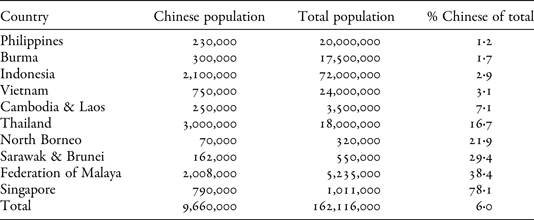
Although US propagandists treated the Chinese overseas as a singular group, the latter were very diverse. For example, the Philippines assimilated Chinese immigrants into local society while Dutch East Indies segregated Chinese residents, thereby resulting in differences in the degree of their retention of Chinese identity. The Chinese population within Southeast Asian countries ranged from 1·2 percent in the Philippines to 78·1 percent in Singapore (see Table 1). Although the situation in each host country was different, the Chinese in Southeast Asia all encountered anti-Chinese measures such as restrictions in occupations, immigration laws, and Chinese-language schools. The mistreatment helped solidify their Chinese identity and contributed to their support of the PRC, even though the majority of them were not procommunism. Many, indeed, were apolitical or fence sitters, caught between local politics and the rivalry between the PRC and the ROC. The majority of local-born Chinese in the diaspora also increasingly perceived the competing Chinese identities asserted by Beijing and Taipei as irrelevant in their own lives.Footnote 35
Estimates of overseas Chinese population in Southeast Asia, 1950. Source: G. William Skinner, Report on the Chinese in Southeast Asia, December 1950 (New York: Cornell University Department of Far Eastern Studies, 1950), 79.

While the Chinese diaspora in Asia was heterogeneous, the US embassy in Hong Kong designed a single campaign, rather than differentiating them according to their countries of residence, to attain their backing. It coordinated, produced, and distributed propaganda materials based on a common language – Chinese – while work in other offices was based on a specific geographic area. Because of Hong Kong's proximity to mainland China and Southeast Asia and the availability of local talent and rich firsthand information about the PRC, the USIS–HK produced and disseminated various Chinese-language materials, ranging from radio broadcasts to publications, motion pictures, textbooks, and popular English books, which were translated into Chinese. Offices in Bangkok, Singapore, and Manila also published periodicals, pamphlets, and leaflets, as well as translating books from English into Chinese.Footnote 36
America Today was the first major USIS periodical for sinophone readers. A propaganda report indicated that native-language publications were far more pivotal than VOA English programs because the majority of Chinese had no English proficiency.Footnote 37 Vincent Shui, a former USIS employee in Nanjing during the Republican period, was in charge of the editorial work.Footnote 38 The magazine's circulation reached 20,000 copies in April 1950, rose to 69,020 in July 1950, and increased again to 124,600 in April 1951, dwarfing its renowned Amerika counterpart, whose peak production was 50,000 copies.Footnote 39 Its distribution was also higher than a rival USIS publication, Free World Chinese, with a circulation of 43,000 copies.Footnote 40 A column, “Readers’ Mailbox,” in America Today reflected readers’ interest in the content, especially in the topics of US governmental institutions, the United Nations, Korean War prisoners of war (POWs), and oppression in China.
The Hong Kong office secretly mailed the magazine into mainland China and distributed it through other major US posts in Southeast Asia, including Manila, Taipei, Singapore, Kuala Lumpur, Djakarta, Surabaya, Medan, Saigon, Bangkok, Rangoon, and Hanoi, as well as Latin America, particularly Lima. Each city received a different number of copies, depending on its strategic importance and Chinese population.Footnote 41 Politicians, business people, union leaders, educators, students, schools, bookstores, secret societies, and social and political associations received copies for free. Vendors also sold a small portion of the magazine's total sales. To compensate for the limited number of images, the USIS produced America Today Pictorial, inserting it as a supplement in every second issue.
Many articles in America Today were reprints from US domestic magazines and newspapers. Christina Klein has skillfully argued that US Cold War politics encouraged the domestic media to launch “sentimental education,” an attempt to use popular culture to inform Americans about Asians to create bonds between them, and convince Americans to support the expansion of US military and economic influences in Asia.Footnote 42 Domestic production also became important in the State Department's “Campaign of Truth” program.Footnote 43 The proliferation of coverage about China and Chinese Americans provided ready and significant sources for US propagandists in the cultural Cold War in Asia. The massive effort to promote US ideals of democracy, capitalism, ethnic equality, family values, and anticommunism as universal beliefs in postwar propaganda enabled middle-class Asian readers to easily recognize the ideas expressed in US domestic writing.Footnote 44 Moreover, the targeted readers were already familiar with major US mainstream publications. The Department of State purchased over 50,000 annual newspaper and magazine subscriptions for USIS libraries worldwide. They were often the most-read items in the libraries.Footnote 45
The USIS also appropriated articles from more than 250 weekly and monthly domestic periodicals for their publications. America Today included reprints of articles chosen from major newspapers such as the Christian Science Monitor and the New York Times, and popular magazines such as Collier's, American Mercury, Popular Mechanics, Reader's Digest, and the Saturday Evening Post. Each week, field offices received fifteen reprints. Officers then supervised their translation into local languages and subsequently sent the translated articles to editors of USIS publications, both covert and overt.Footnote 46 All articles in America Today were in Chinese, except for one article in each issue, which included the original English text and a Chinese translation, and focussed mostly upon US Cold War ideology and its foreign policies in East Asia.
Moreover, the Hong Kong office produced a small portion of articles and purchased some from indigenous Hong Kong and Taiwan publications.Footnote 47 These pieces usually were about Asian news concerning the PRC, Taiwan, and the Korean War. They also included US news, politicians’ profiles, or examples of the democratic system. For example, a Hong Kong Standard reprint described how a Korean War POW from China lamented his suffering in Korea and was overjoyed with his captivity by the US military because of his improved living conditions.Footnote 48
The main themes focussed on anticommunism, the United Nations, the American way of life, and the US democratic system and foreign policies, especially ones regarding East Asia. The major topics included current affairs, life behind the Iron Curtain, life in the US, and developments of US science, medicine, arts, and letters. After the Korean War broke out, war reportage constituted nearly one-fifth of the magazine. While many featured stories or commentaries conveyed hardcore anticommunist and pro-US messages, soft propaganda entries that introduced Hollywood, Christmas, US schools, scientific inventions, and suburban houses similarly expressed the superiority of US democracy and capitalism.
One central emphasis was to refute US imperial and territorial ambitions in Asia and accentuate its altruistic contributions in the region, as opposed to Russian imperialism, which USIS officials categorized as “foreign dictation.”Footnote 49 While Russians pillaged heavy industrial equipment from Manchuria, the US provided monetary aid and advanced medical and agricultural technologies and goods to assist Asians. To showcase the Russians’ ungratefulness, one article asserted that the US provided them famine relief from 1921 to 1923. When reporting US governmental and private organizations’ humanitarian and economic aid to poor countries, America Today firmly upheld their altruistic purpose and denied any imperial intention.Footnote 50
Other articles also tirelessly sought to distinguish the US from other western imperialist powers. One declared the death of colonialism when discussing the independence of Indonesia. It attributed its success to the pressure that the United Nations and the US exerted on the Netherlands, while in reality the Marshall Plan helped fund the latter's effort to suppress the independence movement.Footnote 51 More than one article stressed that the US was a benevolent colonizer in the Philippines – building infrastructure on the islands and teaching Fillipina/os freedom and self-government. It further credited the liberation of other Southeast Asian countries to the Americans’ decision to grant and support Philippine independence. Moreover, to win the hearts and minds of Asians, the magazine praised the ability of Asians to govern themselves. For example, it portrayed Pakistani prime minister Liaquat Ali Khan as a capable politician and a strong advocate of Pakistan's military role in containing Communism.Footnote 52
Attacking the PRC was another main focus, because it initially gained wide support among Chinese in Southeast Asia. US propagandists crafted a strategy to “stimulate Chinese nationalism,” “to arouse Chinese fear and hatred of Soviet imperialism,” and to persuade the Southeast Asian Chinese that Beijing was only the pawn of Moscow.Footnote 53 To demonstrate that the PRC was a virtual satellite of the Soviet Union, one article detailed how the Russians controlled the Chinese government through advisers, ideology, and Sino-Soviet treaties.Footnote 54 The magazine, nonetheless, suggested a contradictory message, which pointed out the intensifying rift between the PRC and the Soviet Union.Footnote 55 To warn readers that the PRC was not “a true expression of Chinese nationalism,” articles emphasized prevalent corruption; rampant famine and disease; and how the new government persecuted landowners, implemented hard labor, killed nonconformists, attacked patriarchy, and allowed women to work in jobs traditionally held by men.Footnote 56 Another accentuated how the PRC jeopardized its people's well-being by refusing US funds to aid the blind, while several articles underscored the benefit of the “open-door policy,” by which the US promoted the principle of equal commercial opportunity in China, thereby discouraging territorial control by Western imperial powers and Japan.Footnote 57 After the PRC entered the Korean conflict, many articles denounced its aggression.Footnote 58
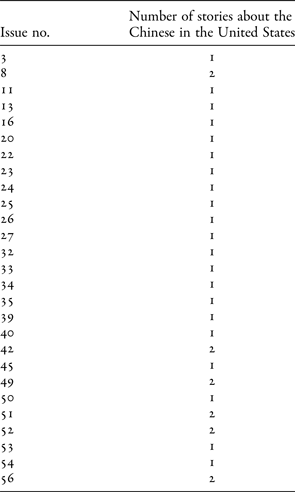
After three months of production, the magazine added a new column, “Chinese in America.” The change was a response to the criticism of one State Department official who asserted that the previous issues contained excessive anticommunist materials, which sinophone readers disdained.Footnote 59 In fifty-four out of the fifty-seven total issues of America Today, twenty-seven issues reported on Chinese in the United States (see Table 2).Footnote 60 The featured men included Ku T. J. (a professor of political science), Ma Si-hon (a musician), Feng Zhou (an artist), Dr. Tai Chen-To (a physicist), Dr. Li Choh-Hao (a biologist), Xie Deyi (a court clerk), Pan Enling (a businessman), Luo Zhanshui (a cook), Ong Wing (a politician), Benson Fong (an actor), Dr. Thomas Hongwaye Lee (an assistant attorney), Wang Youxin (a teacher), Dong Kingman (an artist), Huang Zongzhan (a photographer), and Chen Shou (a restaurant owner).Footnote 61 Due to the limited space, I will only discuss the men who were most relevant to the USIS's efforts in enhancing the US image through demonstrating its humanitarian efforts, upward mobility, and freedom to preserve the Chinese family.
America Today issues that reported on the Chinese in the United States (issues 36, 46, and 47 are missing from the national archives.)

IMAGE OF HUMANITARIAN EFFORTS
To contrast with the endeavors of the PRC to destroy higher education, America Today publicized Americans’ humanitarian efforts to assist Chinese students to continue their education in the US. The magazine described how Communism dominated college curricula and how the regime punished political dissent. It also warned Chinese scholars of the dire consequences if they chose to return to the PRC.Footnote 62 Communist China indeed drastically reorganized higher education and adopted the Soviet education system for nation building.Footnote 63 To counter the persecution of scholars and students in China, America Today showcased the assistance provided by the US to them. While the initial intention of the Fulbright and Smith-Mundt Acts was to enhance the US global image, the magazine stressed their altruistic value for Chinese students to further their studies in the US.Footnote 64 Another article reported that the John Hay Whitney Foundation awarded scholarships to a Chinese American to demonstrate the equal opportunity provided for minority students to advanced education in the US.Footnote 65 The “Chinese in America” column introduced Ku T. J., a PhD student at Columbia University who received a $1,100 scholarship contributed by Centre College students in Kentucky. The program originally funded Chinese universities but shifted to aid Chinese scholars in the US, after the PRC victory.Footnote 66 Another scholarship recipient was Ma Si-Hon, a violinist and a Jasche Heifetz Awardee, who received six weeks of training at the prestigious Berkshire Music Center at Tanglewood in Massachusetts. Born into a musical family in Canton, Ma studied at the New England Conservatory, after the Chinese Civil War.Footnote 67 Feng Zhou was also an outstanding artist. While a student at the School of the Museum of Fine Arts in Boston, he already exhibited work in watercolor, woodcarving, sculpture, and ceramics at the Museum of Fine Arts in Boston.Footnote 68 The examples of Ku, Ma, and Feng in America Today demonstrated the generous opportunities available to them to foster their talents.
Chinese scientists attracted similar, if not more, attention from the magazine. The competition with Communist countries in military and scientific innovations motivated the US to encourage the migration of scientists. Several articles profiled renowned scientists and medical research, including new drug developments, the invention of medical devices, and the use of radiation to treat cancer.Footnote 69 Moreover, practical skills had long been considered monumental in building a modern China. The Republican government, since its establishment, had encouraged and sponsored students to receive further scientific and technical training in the US.Footnote 70 The magazine introduced Drs. Tai Chen-To and Li Choh-Hao. The former was an expert in electromagnetics and antenna theory, who joined the Stanford Research Institute in 1949 after receiving a PhD from Harvard University in 1947.Footnote 71 Achieving international acclaim at the young age of thirty-eight for discovering human pituitary growth hormone, Dr. Li received a job offer at the Institute for Experimental Biology after attaining a PhD degree from the University of California, Berkeley, in 1935. His success prompted him to enthusiastically endorse the US: “In my job, I have never encountered any racial, religious, or age discrimination … The US treats me very well.”Footnote 72
Xie Deyi was another fortunate Chinese immigrant. Although a newly naturalized citizen, he received an appointment as a Justice of the Peace, the first Chinese to assume such a position. As a former Chinese embassy official in Thailand and Malaya, the article reported, his success would please his friends in these areas.Footnote 73 His speedy naturalization and appointment to public office showcased US hospitality to Chinese immigrants, although most of his peers were not so lucky.
While the magazine emphasized the great opportunities Chinese students could attain in mainstream professions, some resorted to entrepreneurship. America Today highlighted Pan Enling as an exemplar of the supposedly easy transition for a Chinese immigrant seeking to adapt to American society. Originally an English professor in Shanghai, Pan later became a lecturer teaching Chinese culture at the American School. He then became a manager at the Bank of Shanghai, and subsequently the supervisor of a travel agency. In 1944, he came to the US to study the hotel industry with the hope of opening a hotel in China. World War II and the ensuing Chinese Civil War never deterred Chiang Kai-shek's government from sending students to further their training in the US. After unloading Lend–Lease supplies in China, the empty returning US ships provided transportation for Chinese students.Footnote 74 Pan probably attained assistance from the Committee on Wartime Planning for Chinese Students, formed in 1942, or other similar organizations, which helped Chinese students to continue their studies in the US, when their funding from home was discontinued because of the war. By the end of the war, 4,700 Chinese students received subsidies.Footnote 75
Stranded in the US, Pan opened two modern laundromats in 1949, one in New York City and the other in Long Island. More than just thriving businesses, they also served as a gathering place for neighbors.Footnote 76 As a modern businessman, Pan was a sharp contrast to the old depictions of the Chinese laundry operators and their stores as clandestine means for public health issues and social and sexual transgressions.Footnote 77 Fully aware of the old imagery of Chinese laundries, the article introduced Pan this way:
On the surface, a man named Pan Enling and his association with the laundry business is a natural outcome because the Chinese had monopolized the trade in the US for many years. However, Pan is different from his fellow Chinese; his laundry is not operated by hand, but by machine.
Moreover, his sleek attire and fluent English set him apart from the previous generation of Chinese immigrants. Pan's next plan was to write articles in Chinese newspapers to encourage other Chinese to assimilate. Although Pan's success demonstrated the entrepreneurial opportunity available to Chinese immigrants, it equally showcased that he had to confine himself to a stereotypical ethnic trade. Nonetheless, his economic success was manipulated by US propagandists as an attempt to inspire diasporic Chinese men to advocate capitalism, as many of them linked their masculinity to material achievement.
In addition, the above stories demonstrated an image that the federal government and private organizations wholeheartedly embraced stranded Chinese students and scholars and provided needed assistance to them, just as those of Horatio Alger's heroes who received timely support from wealthy patrons. None revealed immigration restrictions facing Chinese, except for one article that accentuated the heroic efforts of a US soldier to adopt a Chinese boy. In 1944 Lieutenant Colonel Taylor, who served in the famous Flying Tigers, the first American Volunteer Group of pilots to aid Chinese war efforts, wanted to adopt an orphan. Trekking thousands of miles to obtain a copy of the boy's birth certificate and spending a large sum on legal fees, Taylor finally legalized the adoption in October 1947 and planned to take the boy back to the US the following January. Regretfully, the US embassy informed Taylor that Michael, the adoptee, could only enter the country two years later because of the immigration quota restriction. With President Harry Truman's special parole, however, the father and son arrived in San Francisco in February 1948. Rather than jeopardizing the democratic image because of the discriminatory immigration law, the coverage instead showcased the laudable and humanitarian efforts of individual Americans and the US government.Footnote 78
CHINESE PATRIARCHS
Condemning patriarchy and female domesticity and inequality, the PRC encouraged Chinese men and women to follow “militarized masculinity as an antidote to China's previous humiliations.” Compelled to assume hypermasculinity, men and women donned military-style uniforms, moved to dormitories, and ate at collective canteens. They also transferred their filial piety from familial patriarchs to the CCP and Chairman Mao.Footnote 79 This radical gender ideal unsurprisingly became the target of US criticism because it drastically differed from Americans’ long-cherished ideal of two separate spheres and upset the esteemed position of the nuclear family as the basic unit of society.
Therefore US post-World War II propaganda, including America Today, widely denounced Communist China for destroying families, domesticity, and patriarchy. Excerpting Arthur Goodfriend's account of new China, a USIS-commissioned book entitled When the Communist Came, in three volumes, the magazine illustrated how the CCP policy harmed families through the voice of a Chinese refugee who fled to Hong Kong. Only the elders inhabited the village, because the CCP killed or jailed young villagers or compelled them to flee the area to avoid persecution.Footnote 80 Another article cited a Yale professor who asserted that the PRC rejected the traditional Confucian familial system as feudal and barbarian and encouraged children to disrespect their parents, denounce them publicly, and in some cases condemn them to death.Footnote 81 Although it is valid that the new government attacked Confucian values, it encouraged men from the lower socioeconomic class to fulfill their desires to establish a conjugal and heterosexual family. Moreover, while the PRC attempted to promote women's rights, many CCP cadres hindered women from seeking divorce under the 1950 Marriage Law.Footnote 82
Meanwhile, US officials insisted on demonstrating US superiority in preserving the familial system through constructing an image of Chinese American men who could form a conjugal family under US democracy, even though Chinese immigrants had been denied such an opportunity historically. Luo Zhanshui exemplified the government's efforts, as the article introduced him this way: “Luo Zhanshui cannot use the abacus to measure his success. Rather, it can only be measured by his ten children.” Born in the Puget Sound area in Washington State to an immigrant father who worked on the transcontinental railroad, Luo only received a grade-school education before he worked as a cook on a ship. He longed to establish a family and finally saved enough money to look for a bride in China because few Chinese women were in the US. He married but had to leave his bride behind due to a shortage of money, as the article claimed. A loving husband, Luo visited his wife when financially possible. While in Washington, he secured a job as a cook in a hospital. When the hospital director, Dr. J. Tate Mason, overheard his dream of bringing one of four sons over to the US, he encouraged Luo to move his whole family instead. With Mason's help, his wife and children arrived in 1923.Footnote 83 Nonetheless, the article failed to disclose how the family had migrated to the US. His sons would be permitted entry because they were the children of an American citizen. In spite of their status, they still had to experience long detention and a grilling interrogation at Angel Island. His wife's fate was uncertain because the Chinese Exclusion Acts failed to specify immigration requirements relating to the wives of American citizens of Chinese origin, thereby subjecting her to the mercy of judges. According to Sucheng Chan, “in the first three years of the 1920s, approximately … three hundred of [the wives of US citizens] sought admission each year” and “initially, judges favored the wives of U.S. citizens.”Footnote 84 Luo's wife was among the fortunate ones.Footnote 85
The coverage emphasized the upward mobility that Luo enjoyed in the US, as encapsulated in the article's subhead: “The US as the ‘Golden Country’ was evident in Luo Zhanshui's story: while Luo's father emigrated from China to work on the railroad in the US, Luo's ten children all received an education and one even became a renowned physician.” The article concluded with the elder Luo's statement: “I had no means to help my son to acquire a medical degree. He did this on his own. Americans had helped me previously; now my son was able to pay back the favor by treating American patients.”Footnote 86 The Luos’ story of rags to riches, a Chinese version of one of Horatio Alger's narratives, illustrated the benefits of US capitalist democracy. Nonetheless, his large family distinctly differed from mainstream white nuclear families.
Ong Wing, mentioned at the beginning of this article, was another featured man whose ethnic difference was emphasized by the magazine, in spite of celebrating his assimilation. His ethnic characteristics rested on his arranged marriage and a China-born wife. Although the article claimed that Ong never saw “his bride from a neighboring village in China prior to the wedding day in Seattle,” he had an opportunity to correspond and spent a few days with Rose Wong before their marriage in Phoenix. While born in China, Rose was not a fresh-off-the-boat immigrant. She immigrated to Seattle, Washington in 1920 when she was nine years old, as a child of a merchant, an exempted class under the Chinese Exclusion Act. Rose's father, Toy, came to the US as a student but later became a partner in an import–export business, a common practice during the exclusionary era. The family subsequently relocated and opened a restaurant in Yakima, Washington, where Rose attended local public schools. When she was fourteen years old, her father's sudden death interrupted her schooling. She and her family departed to China to bury her father. During this time, Rose's grandfather arranged her marriage. With a valid passport, Rose encountered no problem in returning to the US in 1928. She, however, was detained along with her US-born daughter and China-born son when they sought reentry to the US in 1932. There, she witnessed humiliating treatments inflicting on Chinese immigrants. While Ong successfully resorted to personal connections to get the family released after thirty-six hours, he himself had previously been detained for three months in 1919 although the son of an American citizen – Ong's father was born in the US.Footnote 87 The article conveniently omitted these details.
Instead, the article emphasized Ong's political career to demonstrate the democratic practice in US electoral politics. Praised as “the Honor of China” and depicted as an embodiment of the combined values of Confucius and Horatio Alger, Ong immigrated to the US when he was fourteen years old. Refusing to enter the laundry industry, well known to be among the few jobs available to Chinese laborers, Ong eventually enrolled in an elementary school in Phoenix when he was fifteen years old. While finishing elementary and high schools in five years, he worked at a few odd jobs. Afterwards, Ong purchased a grocery store and married a China-born woman.Footnote 88
The article then described Ong's involvement in community and mainstream politics. In 1940, he ran for the Arizona House of Representatives as a Democrat. His prospect of winning was dim, because he ran in an all-white district with only one Chinese family (his own) in the area. But he lost by only a small margin, seventeen votes, to his white rival. After the defeat, he went back to school and finished his college and law degrees in five years. In 1945, he passed the Bar exam and opened a law firm next to his grocery store. During World War II, he and his wife sold more than a million war bonds. In 1946, he ran again for the state House of Representatives. This time, he won. He was reelected in 1948. The coverage then used Ong's own testimony to demonstrate that the US was a land of opportunity for every immigrant. According to Ong, “In the US, everyone can enjoy upward mobility, as long as the person works hard.” He further stressed in the interview that he faced no racial discrimination. As he put it, “Although I was embarrassed by my pronunciation and little education, I was never made to feel that I should be embarrassed because of my race. On the contrary, people love to assist me because I am a self-reliant immigrant from China.” Even though Ong was refused service in restaurants and barred from joining a white apartment association in San Francisco, he did not attribute these ill treatments to racial discrimination. Instead, he appreciated the upward mobility in the US. As he concluded, “Of course, the US is not a perfect country. However, it is the best country in the world … [and] always making progress.”Footnote 89 Ong's testimony squarely showcased US superiority. Nonetheless, the coverage never revealed the fact that California public schools denied Ong an opportunity for public education and that the Phoenix public school was a segregated institution. It also concealed his long and arduous detention at Angel Island, in spite of his citizenship status as aforementioned. To accentuate the democratic superiority, it falsely claimed that Ong ran in a white-only district, but in reality the majority of the eligible voters were African Americans and Hispanics.Footnote 90 The article situated Ong in a Horatio Alger-type narrative; it emphasized his diligence and perseverance, as well as the opportunities available to immigrants. The story was part of a larger tactical effort that attempted to accentuate that even a poor Chinese immigrant could succeed and become a successful politician. The US State Department, as the article pointed out, publicized Ong's story in dozens of domestic newspapers and broadcast it in twenty-eight languages to foreign listeners.Footnote 91 While there was no official data to assess the reception, one could surmise a positive response: because 75 percent of diasporic Chinese leaders were self-made men, they could probably aspire to Ong's success.Footnote 92
While Luo and Ong represented the patriarchs of traditionally large Chinese families, actor Benson Fong exemplified modern Chinese households. In an article introducing motion pictures, a regular feature in the magazine, the author listed Fong's most recent films, Peking Express and Submarine Command, and depicted him as a rising young star in Hollywood. In addition to acting, Fong owned a Chinese restaurant, Ah Fong's, located on Hollywood Boulevard, which attracted many celebrity patrons.Footnote 93
The ten accompanying photos situated Fong squarely in the role of a professionally accomplished father who differed from the portrayals of Chinese men deprived of career ambitions and family lives in Communist China. Four photos featured Fong in his workplace – a movie set, a movie studio, and his restaurant. Another four portrayed Fong as a family man – a family meal, a family outing to an amusement park, Mrs. Fong toting a golf bag for her husband, and Fong playing the ukulele for his two children. The remainder showcased the Fongs with their neighbors or clients at the restaurant.Footnote 94 The portrayals of the Fongs seem to be in line with the modern May Fourth Chinese family life. The reformers in 1919 China criticized patriarchy, foot binding and arranged marriages and adopted middle-class, Western gender norms, emphasizing “a nuclear family consisting of a father, mother, and children living in their own home apart from other kin.” The career-ambitious man “could choose a spouse who fit his modern urban lifestyle” and devote his free time to middle-class leisure activities.Footnote 95 Through the representation of the Fongs, the article strategically showcased a Chinese father as the breadwinner and a Chinese mother as the housewife in a democratic US, conforming to white middle-class gender norms. Meanwhile, whereas the Chinese Nationalist government encouraged women to pursue jobs and obtain vocational or professional skills to assist in nation building, it also prioritized married women's role as “virtuous wives and good mothers (xianqi liangmu).”Footnote 96 This emphasis might have appealed to certain Chinese immigrants in Southeast Asia because they were more likely to maintain patrilineal households even if they married local women.Footnote 97 Nonetheless, Mrs. Fong's representation firmly stood against the efforts of the PRC to encourage women to take on the responsibilities traditionally assumed by men.Footnote 98
The narrative of democracy, nonetheless, failed to reveal the inconvenient facts about Fong's life in the US. Although cast in many films, Fong seldom played a lead role because movie directors mostly employed cosmeticized white actors as Asians. Displaying a shrewd business mind, Fong decided to rely on his restaurant business to provide for his family, rather than depending on unsteady acting income.Footnote 99 The article revealed none of this information.
To further celebrate Chinese patriarchal authority, an article lauded the Chinese Consolidated Benevolent Association (CCBA) for its effectiveness in governing New York's Chinatown, and highlighted the fact that the ethnic enclave had the lowest crime rate in the city. Ironically, anti-Chinese agitators had accused the CCBA of being a “quasi-government,” ruling and settling internal affairs and disputes since the second half of the nineteenth century. This time, America Today commended male community leaders for resolving disputes internally and establishing a Chinese language school to preserve Chinese culture. Boasting of a graduate of Princeton University and the University of Chicago as executive secretary, the article emphasized the CCBA as being composed of intelligent patriarchs who skillfully employed both American and Chinese strategies to attend to the well-being of the ethnic community and used both the Chinese and English languages to cater to the linguistic differences in the community. One example depicted CCBA leaders as wisely solving a marital dispute between a war bride and her Americanized husband and emphasized men's status as patriarchs. The four accompanying photos similarly stressed the patrilineal system, only featuring men in Western suits and including no women. One illustration that showcased a middle-aged man teaching a boy an abacus also reinforced the male line.Footnote 100 The above depictions situated Chinese American men in powerful paternal roles, thriving in the US, as opposed to the destruction of patriarchy in Communist China. Some Chinese male immigrants in Southeast Asia also attempted to maintain their Chinese identity and patriarchal power through sending their sons back to China or to a Chinese language school, in spite of the pressure to assimilate to the local society.Footnote 101
Additionally, the acclamation of the CCBA and the commendation of patriarchy and Chinese language schools shored up the support of the US government for Nationalist China because it considered the latter an ally and the true carrier of Chinese traditions. Anticommunism and McCarthyism compelled Chinese American organizations to pledge their allegiance to the ROC. Likewise, US government officials deemed Chinese language schools a vital battleground in containing Communism among Chinese diasporas as these schools could mold Chinese children's political ideology. The US government thus assisted the ROC's effort in supplying textbooks to Chinese language schools in Southeast Asia as the majority of poorly paid Chinese language teachers there were PRC sympathizers.Footnote 102
ANTICOMMUNIST COLD WARRIORS
Information strategists portrayed Chinese American men as cold warriors, although the anticommunist hysteria in the US often made them targets of suspicion and harassment. The agents of the Federal Bureau of Investigation and the Immigration and Naturalization Service hounded them, and the Trading with the Enemy Act, barring any monetary transfers to the PRC, punished them for remitting money to their loved ones in China. When the US battled with China in the Korean peninsula, many Chinese Americans were afraid of internment, especially in light of the Japanese American precedent during World War II. Rather than denouncing them for being Communists or Communist sympathizers as conservative Americans did, several America Today articles instead portrayed them as brave fighters who refused to pay ransom to the PRC when the latter kept their relatives as hostages.Footnote 103 The magazine nonetheless left out a discomforting truth – these extorted victims actually could not send money to the PRC to save their relatives because they would violate the aforementioned Trading with the Enemy Act, although they could remit money via Hong Kong. Nonetheless, the story of captives, coupled with horrific tales of land reform in China that persecuted landlords, scored a victory for the anticommunist effort because many Chinese in Southeast Asia similarly suffered from the extortion scheme.Footnote 104
America Today further used Chinese Americans’ anticommunist convictions to encourage other diasporic Chinese to engage in the same battle. For instance, two thousand Chinese Americans in Washington, DC asserted their wholehearted support for the effort to contain Communism. Representing seventeen political, business, and religious organizations, the group adamantly declared its stalwart advocacy of democracy and denounced Communist Chinese for uprooting nascent democratic developments in China. Proclaiming that they were fortunate to live in a true democracy in the US, the members assured their Asian counterparts that US friendship and monetary aid were derived from altruistic motives, not colonial ambition. Their attempt, however, seemed to reveal the widespread belief among Asians that the US was an imperialist power. A group of Chinese Americans in Sacramento, California similarly pledged their allegiance to freedom and democracy. While highlighting their US birthplaces and residences, many members boasted of their status as veterans of World War II.Footnote 105 Chinese students in the US also denounced the PRC for entering into the Korean War.Footnote 106 US propagandists perceived diasporic Chinese as Communist sympathizers and attempted to use the above examples to encourage them to throw their support behind the anticommunist battle led by the US. However, the majority of them were not procommunists, including those poor Chinese squatters coerced by Malayan Communist insurgents to provide them supplies.Footnote 107 In contrast, many were “disinterested” in Chinese politics and were more concerned with anticolonialism or local governments’ policies.Footnote 108 Moreover, because US politicians supported British, Dutch, and French colonialism and undermined self-determination in Third World countries, they damaged the United States’ reputation abroad and the efforts to combat Communism.Footnote 109
CONCLUSION
During the height of the Cold War, the desire to assume a position of global leadership led officials in Washington to promote a democratic system, champion racial progress, and highlight US family values. The motivation to contain the PRC and to enlarge the US influence in Asia encouraged US propagandists to publicize US humanitarian efforts to assist Chinese students to remain in the US after the Chinese Communist victory, even though the US government failed to repeal Chinese immigration restrictions. Because the PRC suppressed patriarchy and personal freedom, information strategists showcased the stories of Chinese American men who could take pleasure in family lives, assume parental power, achieve career ambitions, and support an anticommunist conviction to demonstrate the superiority of US democracy.
The representations in America Today, however, portrayed contradictory ideals of male Chinese gender identity, which might have produced mixed reactions from readers in Southeast Asia. While the majority of the magazine articles celebrated modern, westernized Chinese male identity and the upward mobility of Chinese Americans cast in Horatio Alger-type narratives, the emphasis on patriarchs, arranged marriages, and large families continued to exoticize Chinese American masculinity. Many diasporic Chinese men might have enjoyed reading the success stories of Chinese American men, because their masculinity was also shaped by their economic success. Others might have found the upward mobility elusive, because they faced daunting challenges in dealing with physical violence, unjust legislation, and various political rivalries in host countries. Meanwhile, some might have identified with the Chinese identity and patriarchy as they chose to honor filial piety and maintain their parental authority, while others followed indigenous gender practices that observed a matrilineal system.Footnote 110
In the end, the thriving stories of Chinese American men created mixed results in the cultural Cold War in Asia. In a February 1951 State Department report, William Skinner, a sinologist recruited by the State Department to investigate the effectiveness of US propaganda on Southeast Asian Chinese populations, had “serious reservations” about its success because very few non-Kuomintang presses adopted USIS materials as they failed to “fit in with local preoccupations.”Footnote 111 For example, the Hong Kong-produced America Today failed to address specific predicaments facing the Taiwanese.Footnote 112 The USIS therefore replaced it with World Today in March 1952. By 1957, US propagandists had adopted “a more nuanced, country-by-country approach, treating the overseas Chinese as part of the domestic politics of the host countries.”Footnote 113
Meanwhile, the number of students or scholars attending US higher-education or other training programs increased tremendously. For example, in 1959, 17,000 Asian students attended US universities. A few thousands participated in other training or exchange programs.Footnote 114 Many of their stories were incorporated into USIS publications, including World Today.
While the new magazine continued to stress US democracy and racial equality, it reduced US coverage to 53 percent and increased Asian-country reportage to 36 percent. (In America Today, about 65 percent of the articles were on the US while the rest centered on the horrible conditions behind the Iron Curtain.) In World Today, of the articles on the US, about 12 percent again accentuated the achievements of Chinese Americans. For the Asian coverage, it added more contributions from indigenous authors, such as a serialized novel from Eileen Chang's The Rice-Sprout Song, criticizing food shortages in the PRC. These strategies paid off handsomely – World Today became the largest Chinese-language magazine in the world and ran from 1952 to 1980.Footnote 115