Introduction
The NGARL&A special collections and archives are detailed in this paper through highlighting the users and, subsequently, the use of collection content through time. In addition, we will also provide insight into the reasons why art researchers request items, demonstrating a shift in the users and use of collections, which has, subsequently, impacted our roles of managing these collections. The users and the uses of the NGARL&A special collections and archives have grown in the past decade and have, ultimately, expanded our reach.
Special Collections: Users and use
The NGA RL&A is committed to documenting the stories generated, daily, by the artists, events and organizations that make up Australia's vibrant world of contemporary visual art. And it's not a simple task. The art world tends to disseminate information through impermanent, momentary documents and digital ephemera, which, like waves, disappear as fast as they arrive. We rely on gallery staff, mailing lists, artists, libraries and donors to cast a collective net over this ocean of material, and then, each week, we pick through the catch—tossing duplicates and filing exhibition invites, posters and leaflets—adding to our collection of over 100,000 art and artist files. But obvious questions emerge: why collect this material? What value does it have? And how is it used?
To answer these questions, it's useful to drill down to one example. NGA curator, Lara Nicholls, recently asked for any information we hold on the artist Mary Morton Allport (brace yourself—our reason for singling her out will be explained further on). In Allport's artist file we found newspaper clippings, invitations and catalogues with biographical information. A catalogue for the commemorative exhibition held at the Allport Library, Hobart, in 1981, to mark the 150th anniversary of her arrival to Hobart Town, tells us she was born Mary Morton Chapman, in Birmingham, in 1806, and attended a school run by Mrs William Allport at Cedar Court, Aldridge, Staffordshire. The school had been under the artistic influence of John Glover, its former drawing master.
At the school Mary learned to sketch, write poetry and play music. In 1826, Mary Morton Chapman married Joseph Allport, established a farming partnership with four others, including the Chapmans, and on July 1831 sailed the Platina for Van Diemen's Land. The catalogue mentions that:
At Black Brush in the Brighton district where the partners purchased land, the Allports and the Chapmans, and, at times, one or more of the others, lived in what were no more than large dog kennels. Not only did M.M.A. survive, but she even began painting in these primitive conditions.Footnote 1
On 13 July 1832, Mary placed an advertisement in the Hobart Town Courier announcing she was prepared to paint miniatures, on commission. The first woman in the Australian colonies to embark on such an enterprise, she is now considered the first colonial woman lithographer, etcher and engraver by the University of Tasmania in their Companion to Tasmanian History.Footnote 2
When her husband realised that he was a terrible farmer, he resumed his profession as a lawyer, and they moved from Black Brush to Hobart Town. As a result, Mary's work became largely related to domestic duties. However, she was able to continue studying natural history, draw landscapes and exhibit locally. In fact, one of her lithographs appeared in the Tasmanian Journal of Natural Science, which plays into this article's answer to why we collect this material and how it is used.
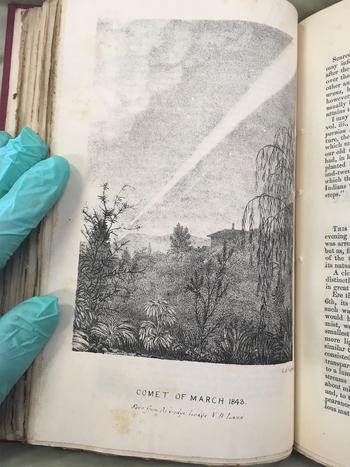
In addition to holding a plethora of art related material, our collections wield enormous potential for any Australian art researcher wishing to reactivate seldom heard voices. Lara Nicholls, as acting curator of 19th-century Australian art, in addition to Allport's artist file, requested The Tasmanian Journal of Natural Science, Agriculture and Statistics, 1846, which is held in the Rare Serials section of our library. The volume features Mary Morton Allport's lithograph, Comet of March—seen from Aldridge Lodge, Van Diemen's Land (see Fig. 1).Footnote 3 Lara told me she wanted to display the serial in the NGA's exhibition Earth/Sky.
Comet of March—seen from Aldridge Lodge, Van Diemen's Land - The Tasmanian Journal of Natural Science, Agriculture and Statistics, 1846

In anticipation of our Art Research Libraries Australia and New Zealand (ARLIS/ANZ) conference, we asked her why she chose this image by Allport. She responded:
“I selected the image of Comet of March for a number of reasons. I was working on a 19th-century colonial display for our permanent galleries, which I had decided would have a focus on Tasmania. I was particularly drawn to this image because it is by a female artist—a very rare thing in colonial Tasmania—and, also, because it highlights the critical importance of scientific discovery and observation during this period. But there was a further purpose to my investigation. I originally discovered it in the collection when I began to research a larger exhibition for the NGA called Earth/Sky. The Curatorial premise of the exhibition is to explore the documentation and inspiration of the night sky in Australian art looking at early mapping of the stars through to contemporary responses to the sky as a site of imagination and spirituality.”
Work produced in the 19th century tended to have a scientific underpinning and Mary Morton Allport's Comet, […] like many scientific based illustrations, is also a remarkable and beautiful work of art, which reveals much about the artist and the settlement of Tasmania in the colonial era. In the end the two displays clashed and we have decided to show the work in the Earth/Sky exhibition.” Lara Nicholls, email to author, 28 June 2018.
Our curatorial team regularly exhibit items from the library collection, but Lara's response reminded us of the value of our material and revealed how our collections are used to tell the story of Australian art. This is powerful, and it signals the need to continue capturing artistic output in its printed and digital forms, so future researchers can access and use it.
Special Collections highlights
The 2016 book, Some posters from the NGV—an exploration into the National Gallery of Victoria's poster archive—asserts that, ‘the aesthetic and technical properties of these posters unintentionally state certain things about their time, and things about this place.’Footnote 4 Their statement resonates, because in recent years we have rehoused, catalogued and photographed National Gallery of Australia exhibition posters going back to the 1970's, before the building opened, and traced the development of the institution back to its formative roots, when ambitious art purchases were being made. The posters we've uncovered reflect those ambitions and say a great deal about not only the gallery's history, but arguably Australian art history as well.
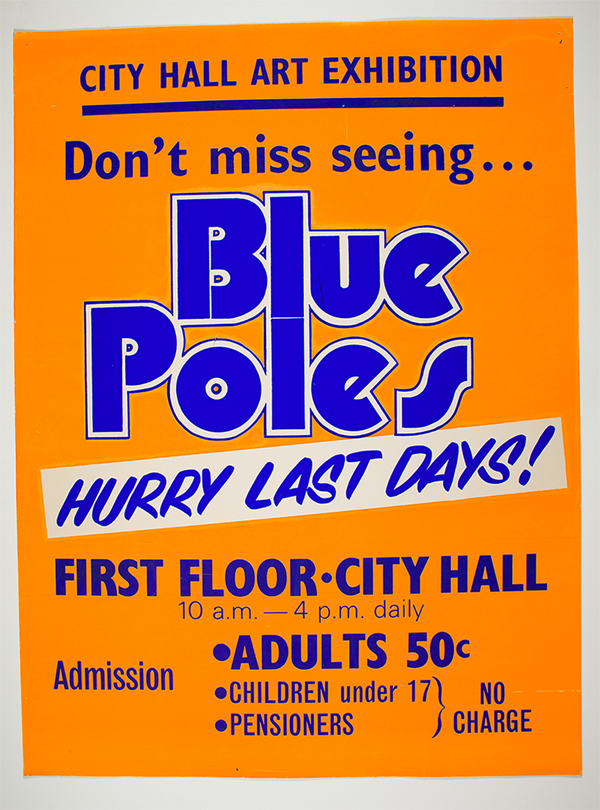
One of our favourite items is the bright and bold, Brisbane City Hall poster (Fig. 2) Footnote 5, advertising the arrival of Jackson Pollock's Blue poles Footnote 6 to Australia in 1974. Before entering the custodianship of the National Gallery of Australia, the controversial painting toured four destinations as part of a travelling exhibition. This poster captures the excitement and anticipation that preceded the painting's arrival. The price paid in 1972, A$1.3 million, was a world record for a work by a 20th-century artist, causing media and subsequent public controversy.Footnote 7 It has since become one of the most famous paintings in our gallery's collection. Five years ago, we found this stunning poster—a time capsule from one of Australia's biggest cultural moments—atop old map cabinets in our off-site storage facility. Immediately, we knew it was special and that it had to be digitized. It has since become a collection highlight.
Don't miss seeing…Blue Poles - travelling exhibition poster, c.1974
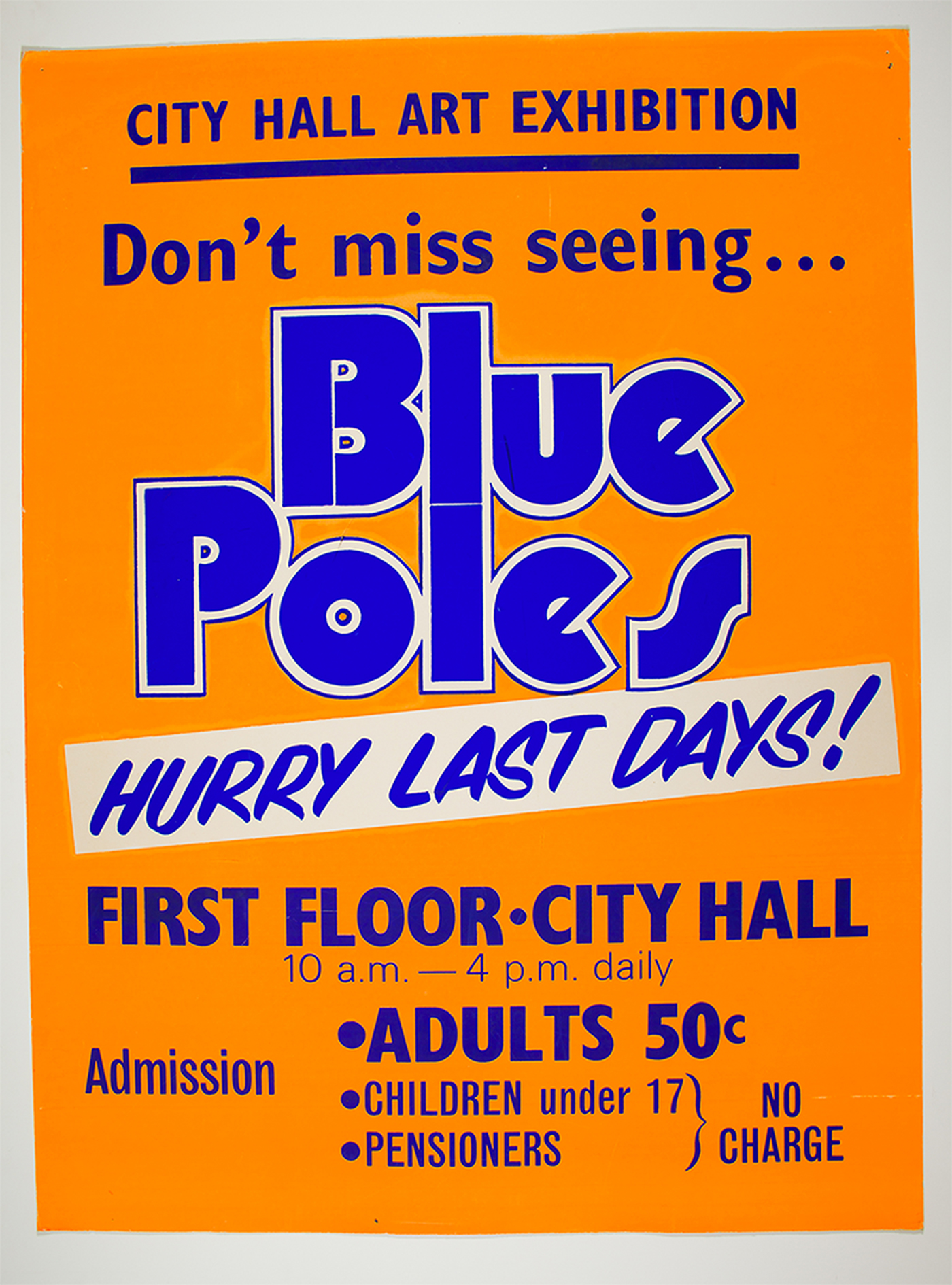
Charged with popping graphics and colours to catch the eye, the posters in our collection visually document the contemporary art world in a way no other medium does, covering a range of art exhibitions held throughout Australia and the world from the 1960's onwards. For example, posters and ephemera from local, socially concerned, artist collectives and galleries, such as Bitumen River Gallery, are some of our most treasured items because they tell us stories about alternative art movements that took place in Australia.
In Manuka, one of the wealthier suburbs of Canberra, Bitumen River Gallery ran out of a repurposed, renovated, shed and operated with no real policy, except that it was totally open access and that the work would not be exhibited if it was sexist or racist. The posters and ephemera produced for the gallery's exhibitions reveal its counter culture voice, reflecting its aim—to change into whatever the individual or group wanted it to be.Footnote 8 We are fortunate to hold posters and ephemera from this now defunct gallery and others like it in the NGA Research Library. But posters are large format visual objects, not easily accessed by researchers, which is why, over the past five years, we've digitized them.
To expand the reach of this collection, we have digitized nearly 5000 posters, with the goal of making them discoverable online. We have been working with the gallery's imaging department and collection management team to produce high quality metadata and photographs, all searchable inhouse on the gallery's collection management system, EMu. The project is an important step towards two goals: enhancing physical and intellectual control over our special collections and making them discoverable to a wider user base.
Archives: Users and use
The NGARL&A hold approximately 150 archive collections containing unique, unpublished, primary resource material that contextualizes visual arts in Australia and, as decreed by our collecting policy, enables the research and greater understanding of the works of art held in the National collection (works of art held by the NGA). The majority of the archive collection comprises papers of significant Australian artists including Inge King, Mike Parr, Arthur Streeton (the Streeton Family) and Fiona Hall. In addition, there are archives of art organizations, art galleries, exhibitions (including the Raminging Artists Aboriginal memorial), art collectors, art gallery directors and art writers/researchers.
These art archives contain a remarkable assortment including correspondence, diaries, sketches and objects, all of which offer unique evidence for past artistic lives and creative endeavours. The research potential and contextual capability of these archives enables education, study, prompts creative responses, can affirm identity and may simply offer wonder. The way these collections have been used, and will continue to be used, has developed in the past decade as the unique ‘one-of-a-kind’ physicality of archives becomes on-trend, increasingly popular and more accessible with greater online visibility. Evidence for this can be seen with the inclusion of archival material in art exhibitions, education programs, public talks and as artist inspiration.
The shift in archive users and use has required adaptability from the archivist, as the original role of, mainly, attending to the physical collection management has grown and developed to include collection initiatives (NGA institutional archive), collection content management, an archive reference service, managing an exponential increase in archival holdings and facilitating the use of archives and archival content in exhibitions.
Formerly the archivist's role consisted mainly of sorting through the backlog of archives already acquired (some over three decades ago), determining provenance, rehousing and collection description. Archive acquisition during this time period had been a result of passive collecting: archives were acquired as ‘residual’ material from art acquisition and through staff connections with artists and families associated with artists; no active collecting for the archives was undertaken. The archivist had to designate time to item level description and, although laborious in hindsight, this level of detail has proven to be an excellent research resource. As a result of this intense scrutiny through description, a comprehensive knowledge of the archive and the collections’ strengths and limits was garnered. In addition, the power of connections between archive collections also became evident, not only between the artists and their archives, but between the art and the archives, and between the archive collections themselves. Despite the production of these detailed descriptions the archive collections were not being utilized to their full potential, the main users were curatorial staff who were reliant on pre-existing knowledge. The user base was limited, but at the same time it was becoming apparent that these collections were of significant value.
The archive collections have entries in the library catalogue, recently updated to Resource Description and Access (RDA) standards. With an increase in content however, this platform does not fully represent the archives and the connections they hold. With the collaboration of curators, through workshops undertaken with the National Archives of Australia, and following best practice as offered by other contemporary cultural institutions, an archival finding aid specific to the needs of the NGA, was created. The hierarchical structure of a finding aid allowed for connections from various levels to be recognized before the more granular descriptions were given. A powerful finding aid created during this time, the Papers of Marion Kaselle: Max Hutchinson, provides a comprehensive guide to the holdings of this archive, documenting a particular point in the history of visual art in Australia which influenced the foundation collection of the NGA. The Max Hutchinson collection documents the deals that resulted in the purchase of some iconic works of art including Jackson Pollock's Blue poles (as previously discussed) as Max Hutchinson brokered the purchase and was friends with James Mollison from when they both worked at Gallery A.
After acknowledging the growing need to harvest corporate knowledge and manage the memory of cultural institutions it was decided to develop an institutional archive. Departments within the NGA were asked to offer any archival material they held to contribute to an NGA/ANG institutional archiveFootnote 9 (the NGA was titled the Australian National Gallery prior to 1992). Material received included audio-visual items, plans, sketches, photographs and other institution specific content. Through this process a bounty of building related material, including a photograph of the Queen of England opening the gallery and documents covering the architectural design of the building, were brought together. In addition, prints from the commission by the Commonwealth Arts Advisory Board for Max Dupain to photograph the ANG prior to its first hang of art are included, where architect Col Madigan's monolithic building is fully realized, including the tri-grid ceiling. Connections to this were later strengthened with the donation of the Col Madigan archive. These collections feed into one another, the connections are extensive and offer a foundation on which to view the growth of contemporary visual art in Australia.
During this period when the archives were being rediscovered through processing and description, the need to develop an acquisition workflow and standard operating procedures was highlighted. The archives were processed and stored in the same space as works of art, making preventive conservation training essential. As a result of this training, incoming collections are now managed to gallery standard, which is compliant with Australian Quarantine Inspection Standards (AQIS). This ensures archive collections are checked and treated accordingly without impacting heavily on the workflow of the conservation and registration departments. Preventive treatments for archive collections have included freezing, isolating audio-visual items displaying vinegar syndrome, and the laborious, 18-month treatment of an archive heavily infested with mould that required each surface of every archive item to be dry-cleaned using both brush and a vacuum, in a fume cupboard.
The role of the archivist developed and grew to include understanding the pre-existing collections, their extent, strengths and limitations; producing finding aids; developing standard operating procedures; undertaking preventive conservation practice to AQIS standards; releasing the content via finding aids published online; and presenting at conferences and at staff forums. The use of the archives started to evolve, and the users of the archive began to broaden, archive donations increased dramatically, and a dedicated archive reference service was required, tapping into the burgeoning collection knowledge. Curators became more involved and excited about archival material and its potential uses, consequently this led to greater archival inclusion in exhibitions such as Happy Birthday Inge King (2015-2016), Mike Parr: Foreign Looking (2016-2017), Arthur Streeton: The art of war (2018) and Marion Hall Best Interiors held in the Sydney Living Museum (2017).
Archive Collection highlights
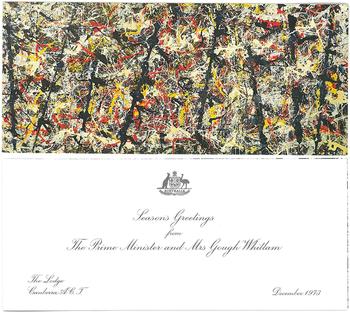
The archives hold contextual material relating to the iconic work of art purchased in 1972 by the founding director James Mollison, Jackson Pollock's Blue poles. As previously discussed, it was a controversial purchase and the government at the time, under Prime Minister Gough Whitlam, attempted to promote the acquisition as a cultural boon; and in the year Blue poles was received an image of the painting was used for the prime minister's Christmas card (Fig. 3).Footnote 10
Jackson Pollock's Blue poles reproduced for Gough Whitlam's Christmas card, 1973. Papers of Frances English, Research Library and Archives, National Gallery of Australia.

This highly criticized purchase is now considered a visionary acquisition and is a major drawcard for visitors to the gallery. The correspondence in the Frances English archive highlights the controversy around the purchase of Blue poles evident in correspondence written in response to Frances English who wished for artists and patrons of the arts to condemn the government's decision to acquire Blue poles by writing letters to create a petition. Patrick White (Nobel Prize recipient for literature), responds to English's request by stating, ‘I regret to say it, Mrs English, you are the (perhaps) well-meaning, but destructive, Australian busybody we must continue fighting against in the arts.’Footnote 10
Other Blue poles related material can be found in the Papers of Marion Kaselle: Max Hutchinson which documents the negotiation, acquisition and transport of the work. Max Hutchinson (original director of Gallery A) moved from Australia to set up a gallery in the high-ceilinged SoHo district of New York in 1968 (Max Hutchinson Gallery New York). He was good friends with James Mollison, who also was involved with Gallery A before he became the inaugural director of the then Australian National Gallery. These connections, documented in the archive, were instrumental in developing the national art collection, including Pollock's Blue poles as Max Hutchinson helped broker the purchase. Correspondence from this archive also offers context surrounding this iconic purchase as communication from Hutchinson to the removals firm, regarding the movement of the painting, states they are to ‘remove via a window’ and to ‘stay stretched, not folded’.Footnote 11
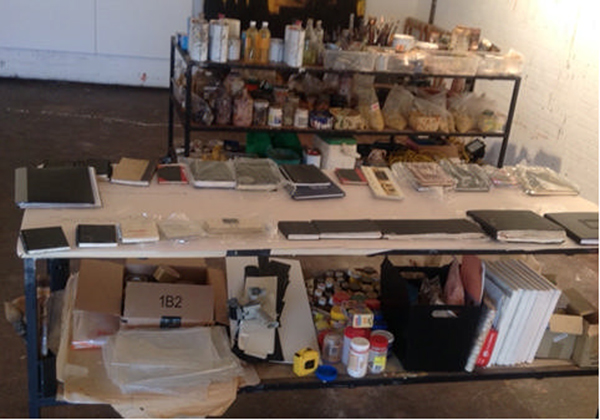
Closer to home these collections are treasure troves for Australian art, as is evident with this image of sketch books from the archive of Mandy Martin (Fig. 4),Footnote 12 a contemporary Australian painter known for her environment and conservation themed work. Some of these sketch books and other items from her archive were recently loaned to Parliament House, home to the Australian Parliament, where she had an interview and wanted to refer to her own archive to provide greater context to her work.
Mandy Martin studio with archive material (sketch books). Papers of Mandy Martin, Research Library and Archives, National Gallery of Australia. Image courtesy of the Research Library and Archives, National Gallery of Australia

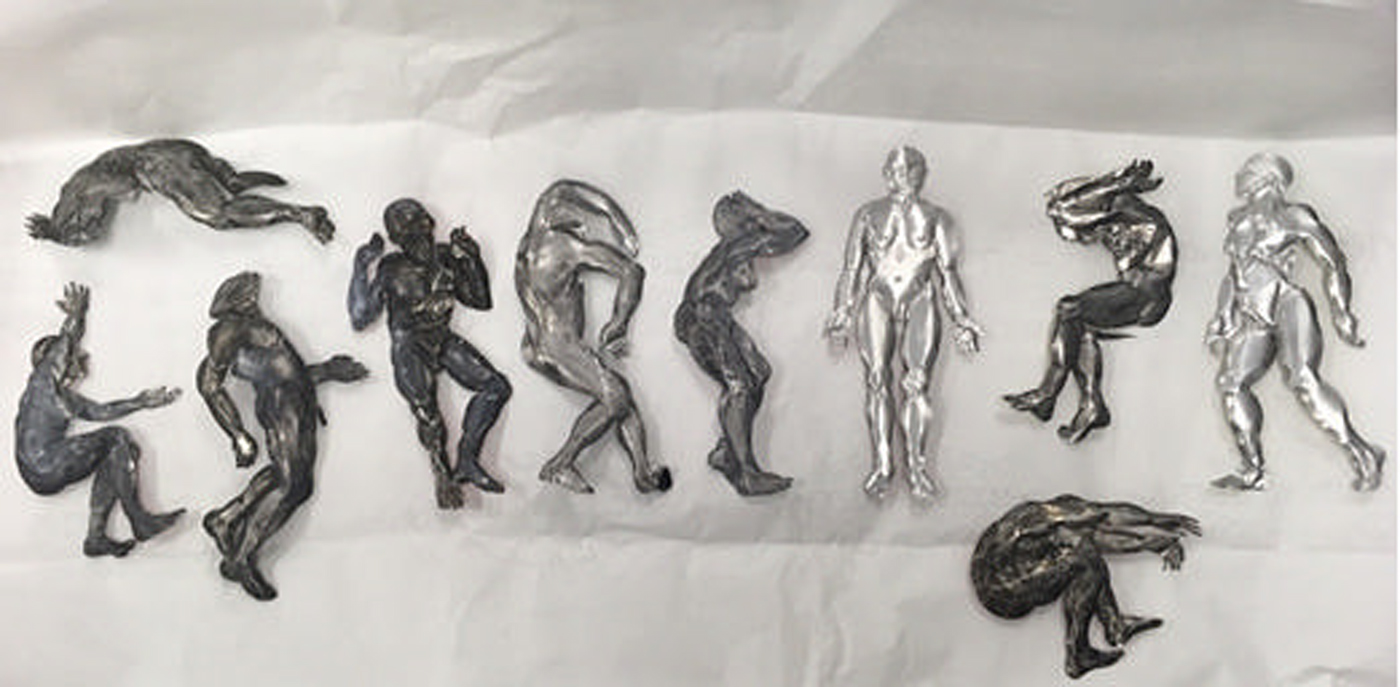
Another significant Australian artist is Fiona Hall, whose work crosses a broad range of media based on the themes of globalization, the relationship between ecology and economy and includes painting, photography, sculpture and installation. For her photographic series titled ‘Illustrations to Dante's ‘The Divine Comedy’ series she cut human figures from flattened soft drink cans, sculpted topographic features to form human figures and painted them before photographing them (Fig. 5).Footnote 13 The archive holds some of these delicate figurines that allow a ‘behind the scenes’ view of her creative process, which has proven popular with all audiences (both public and non-public) who have attended presentations on this topic.
Aluminium figurines from the archive of Fiona Hall. These figurines were created from soft drink cans, assembled and photographed to create works of art. Papers of Fiona Hall, Research Library and Archives, National Gallery of Australia. Image courtesy of Peta Jane Blessing

Recently, coinciding with the research library and archives inclusion under the public program and education section, there has been greater opportunity to broaden the exposure of the special collections and archives through public programs, teacher talks and presentations to the general public. In this regard the archive collections have reached further, beyond the internal and academic users. Charles Merewether's offers an articulate reminder of the importance of these collections.
Among art's most significant developments worldwide since the 1960s has been a turn to the archive - the nexus of images, objects, documents and traces through which we recall and revisit individual and shared memories and histories. The archive has become central in visual culture's investigations of history, memory, testimony and identity.Footnote 14
Expanding our reach: Conclusions
The NGARL&A special collections and archives support the past, present and future of the visual arts in Australia as seen in the increased diversity of users and subsequent use. Our roles as managers of these collections has grown and adapted to suit the unique and very visual nature of the collection content. As the collections grow further as do the uses and those who use them, it is inconceivable to predict how these can and will be used as in such a visual environment anything is possible and, in our ever-evolving roles, we will enable and encourage their use.
This is an edited text of a paper originally presented at the 2018 ARLIS/ANZ Conference: Expanding Our Reach, National Portrait Gallery and National Gallery of Australia, Canberra, October 2018.