INTRODUCTION
Tetrarogidae is a small family belonging to the order Scorpaeniformes. They are called wasp fish due to the painful sting of their dorsal spines, or leaf fish due to the capability of the most common species to mimic a dead leaf. The body is compressed laterally, the mouth is small and the fins are rather large. They are benthic fish, often hidden among the detritus and when observed, pushing alternatively with the 2 pectoral fins, they rock sideways as though pushed by a surge. With this system they also approach their prey, normally shrimps and other invertebrates. Many species are nocturnal, during the day they can bury themselves into the sediment. They can be distinguished from the fish of the Scorpaenidae family by the smaller mouth. According to Prokofiev (Reference Prokofiev2008), the systematic composition of scorpionfish from the families Apistidae, Tetrarogidae and Aploactinidae of the fauna of Vietnam is inadequately studied and the same is the case with the family Tetrarogidae of Indian fauna too.
About 40 valid species in 15 genera are reported so far under this family; all are venomous and should be considered dangerous (Poss, Reference Poss, Smith and Heemstra1986). According to Poss (Reference Poss, Smith and Heemstra1986), three species of the genus Ablabys Kaup, 1873 viz. Ablabys binotatus (Peters, Reference Peters1855), Ablabys taenianotus (Cuvier, 1829) and Ablabys macracanthus (Bleeker, 1852) are recorded so far. They are characterized by strongly compressed body, with small scales, pelvic fin with 1 spine and 5 rays, dorsal fin origin over or before front margin of eye and dorsal and anal fin rays branched. The holotype of Ablabys binotatus, ZMB 814 is in the Humboldt University, Museum of Natural History, Berlin, Germany. The original report of this species appeared in monthly reports of the academy of sciences at Berlin (Peters, Reference Peters1855). Ablabys binotatus is not reported from India so far and the specimen collected in the present study is deposited in the Marine Biodiversity Referral Museum at CMFRI, Cochin (Accession No. GB.38.24.3.1).
MATERIALS AND METHODS
One specimen examined in the present study was collected from the Gulf of Mannar, at 09°12′37.75″N 79°07′ 34.48″E caught by a trawler during November 2007. The photograph and information on diagnostic characters of the holotype of this species received from the Museum of Natural History, Berlin was compared with that of the present specimen collected from Indian waters. The morphometric measurements were taken following Richard & Bond (Reference Richard, Bond, Schreck and Moyle1990). Morphometric measurements were compared with those of the same species collected from different geographical areas as well as with other species known under this genus. The systematic position of Ablabys binotatus is given in the Result section.
RESULTS
SYSTEMATICS
Order SCORPAENIFORMES sensu Imamura & Yabe, 2002
Family TETRAROGIDAE Cuvier, 1829
Genus Ablabys Kaup, 1873
Species Ablabys binotatus (Peters, Reference Peters1855)
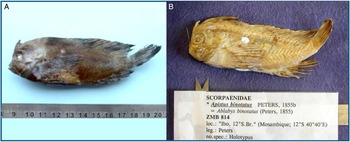
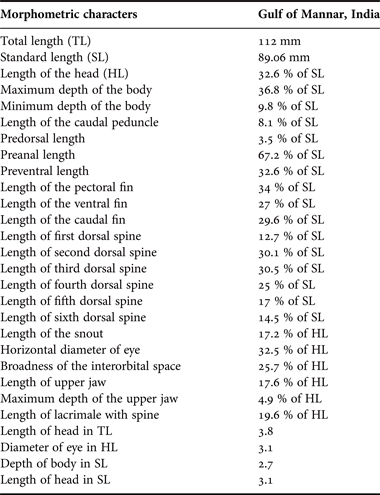
The diagnostic, morphometric and meristic characters of the specimen collected during the present study and that of the holotype are presented in Table 1 and Figure 1.
(A) Ablabys binotatus: 112 mm total length (TL) (Gulf of Mannar, India); (B) holotype of Ablabys binotatus: 120 mm TL (Museum of Natural History, Berlin, Germany).

Morphometric characters of Ablabys binotatus collected from the Gulf of Mannar.

SYNONYMS
Apistus binotatus Peters, Reference Peters1855: p. 434 (original description).
Amblyapistus binotatus (Peters, Reference Peters1855)—cited from Whitley (Reference Whitley and Whitley1958); Froese & Pauly, Reference Froese and Pauly2013.
Amblyapistus marleyi Regan, Reference Regan1919: p. 202, figure 5.
Amblyapistus taenionotus (Fowler, Reference Fowler1934): p. 77, figure 19 (misapplied name).
DESCRIPTION
Dorsal fin with 16 spines, nine rays; anal fin with three spines, five rays; pectoral fin with 11 rays; pelvic fin with one spine, five rays and caudal fin with 13 rays. Dorsal and anal fin rays are branched. Anterior profile of head nearly vertical, slightly concave, preorbital and preopercular spines strong, maxillary extending to below anterior 1/4th of eye. First spine on dorsal fin is short, located above anterior margin of eye, second and third spines longest, twice as long as the sixth and seventh spines, which are the shortest. Lateral line scales 26, gill rakers 6. The specimen has a dark brown coloured body with a prominent white or silvery blotch above pectoral. The morphometric characters of Ablabys binotatus from the Gulf of Mannar, India are presented in Table 1.
DISTRIBUTION
Ablabys binotatus is reported from the western Indian Ocean: Maldives, Mozambique, South Africa and Tanzania. The current record adds India to the range of distribution of A. binotatus.
DISCUSSION
Ablabys binotatus differs from other representatives of the genus by number of spines on dorsal fin and count of anal fin rays. Ablabys taenianotus has 17 dorsal spines and six rays on the anal fin whereas Ablabys macracanthus has 16–17 dorsal spines and at least nine rays on the anal fin (Prokofiev, Reference Prokofiev2008). But, Ablabys binotatus has 15 dorsal spines (16 in the present specimen) and five anal fin rays. This species can also be differentiated by the presence of a prominent white or silvery blotch on the body above the pectoral fin. While comparing the morphological characters of the specimen collected from India with other species, it is confirmed that the present specimen is Ablabys binotatus.
When compared to morphometric characters of Ablabys taenianotus and Ablabys macracanthus, it is observed that, as % of standard length (SL), the length of head, maximum depth of body, predorsal length, preanal length, length of ventral fin, length of first dorsal spine and length of fourth dorsal spine are the highest while, the length of caudal peduncle, length of caudal fin and length of second dorsal spine are the lowest in the case of Ablabys binotatus (Prokofiev, Reference Prokofiev2008). Also, as % of length of head (HL), the horizontal diameter of eye and broadness of the interorbital space are maximum and the length of upper jaw and maximum depth of upper jaw are the minimum for Ablabys binotatus reported from India.
The morphometric characters of Ablabys binotatus collected from India are compared with a few measurements available for specimens of the same species collected from Inhaca Island (Poss, Reference Poss, Smith and Heemstra1986) as well as from the Natal coast, South Africa (Regan, Reference Regan1919). The measurements of the present specimen are almost the same as in the case of the specimens collected from Inhaca Island and the Natal coast (Table 1). Some minor differences noticed were that of HL in total length (TL) and body depth in SL. Length of head in TL was slightly higher in Indian specimen (3.8) when compared to that from the Natal coast (3.6), which indicates that HL is slightly less in the Indian specimen. Body depth in SL is slightly less in the Indian specimen (2.7) when compared to that collected from Inhaca Island (2.8–3.2) which points out that the depth of body of the specimen collected from India is slightly more.
The only difference between the present specimen with that of the holotype and other specimens collected from other geographical areas is the presence of 16 spines on the dorsal fin in the present specimen instead of 15, which points out the need for further revision of this species. Thus, the comparison of the diagnostic characters, description and morphometric characters of the specimen collected in the present study with those of the holotype and other specimens known from other geographical areas of this species confirms the identification of the current specimen as Ablabys binotatus (Peters, Reference Peters1855).
ACKNOWLEDGEMENTS
The author is grateful to Dr G. Syda Rao, Director, CMFRI and Dr Rani Mary George, Head, Marine Biodiversity Division, CMFRI, Kochi for their encouragements. The author expresses her sincere gratitude to Dr Peter Bartsch, Head of the Collection Department & Curator of Fishes, Museum of Natural History, Humboldt University, Berlin, Germany for providing digital images of a holotype specimen and a scan of the description from Peters Reference Peters1855. The author is thankful to Dr Jeff Johnson, Manager—Ichthyology, Queensland Museum, for confirming the identification of the specimen and to Dr Eschmeyer Bill for guidance and support extended for this work. The author is deeply indebted to Dr K.K. Joshi, Shri.V.J. Thomas, Smt. P.M. Geetha, Shri. M. Seeni and Shri. K.M. Sreekumar of CMFRI for their help rendered during the course of this study.