Introduction
No problem in psychiatric epidemiology is more important or more difficult than that of clarifying the causal relationship between disorders and the experience of adversity. Such relationships cannot be studied in a controlled manner. Of the various adversities, childhood sexual abuse (CSA) is especially problematic. Only a small percentage of cases are reported to legal authorities, so relying on official records produces an unrepresentative sample (Ammerman, Reference Ammerman and Lutzker1998). Legal reporting requirements for suspected CSA in many countries make it challenging to study using prospective designs. Therefore, an important tool in understanding the potential pathogenic effects of CSA has been to examine its effect using retrospective designs from adult samples. Using this approach, a strong association has consistently been shown with a wide range of psychiatric and substance use disorders and particularly major depression (MD) (Fergusson & Mullen, Reference Fergusson and Mullen1999; Kendler et al. Reference Kendler, Bulik, Silberg, Hettema, Myers and Prescott2000; Cong et al. Reference Cong, Li, Shao, Chen, Wu, Shang, Wang, Liu, Liu, Gao, Li, Wu, Deng, Liu, Sang, Liu, Rong, Gan, Li, Li, Pan, Li, Cui, Sun, Liu, Liu, Zhao, Zhang, Zhang, Chen, Wang, Li, Chen, Lin, Kendler, Flint and Shi2011).
However, accurately estimating the direct effect of CSA on lifetime MD (LTMD) using a retrospective design is challenging and requires examining biasing influences that might upwardly and downwardly alter the true causal relationship. Downward biases are probably more easily corrected. Lifetime histories of both MD and CSA are reported with only moderate reliability (Aneshensel et al. Reference Aneshensel, Estrada, Hansell and Clark1987; Fergusson et al. Reference Fergusson, Horwood and Woodward2000). This unreliability can be corrected for with multiple reports.
More challenging is to correct for non-causal sources that upwardly bias the CSA–MD association. Two are noteworthy. Potential confounders such as low social class, parental psychopathology or poor parenting behaviors could independently increase risk for both CSA and MD. If well measured, these confounders can be corrected with standard statistical approaches and co-relative designs. A previous analysis in the Virginia Adult Twin Study of Psychiatric and Substance Use Disorders (VATSPSUD) showed that rates of psychiatric disorders including MD were elevated in twins exposed to CSA compared to their unexposed co-twins (Kendler et al. Reference Kendler, Bulik, Silberg, Hettema, Myers and Prescott2000).
A more problematic source of non-causal association between CSA and MD arises from reporting bias. A substantial proportion of women with officially recorded CSA fail to report abuse when interviewed in adulthood (Widom & Shepard, Reference Widom and Shepard1996; Maughan & Rutter, Reference Maughan and Rutter1997; Widom & Morris, Reference Widom and Morris1997). Of particular concern is that, for individuals with CSA, their psychological state at the time of interview, particularly their level of depressive affect, could impact recall and reporting (Lewinsohn & Rosenbaum, Reference Lewinsohn and Rosenbaum1987). A dysphoric mood can, through a psychological process termed mood-congruent recall (or mood-congruent memory), increase the salience of prior negative experiences leading to improved recall (Bower, Reference Bower1981; Blaney, Reference Blaney1986; Ellis & Moore, Reference Ellis, Moore, Dalgleish and Power1999). Mood-congruent recall is defined as ‘a phenomenon in which emotional material is remembered more reliably in moods that match the emotional content of the memories.’ (Lewis & Critchley, Reference Lewis and Critchley2003, p. 431). A good example of this process arose when, in the VATSPSUD, we examined individuals who had reported a lifetime history of MD at an earlier interview. In accord with prior research (Aneshensel et al. Reference Aneshensel, Estrada, Hansell and Clark1987), their probability of reporting a depressive episode at a subsequent interview was strongly influenced by their level of current depressive symptoms (Kendler et al. Reference Kendler, Gardner and Prescott2001). The more depressed they were at second interview, the more likely they were to recall the depressive episode they had reported previously.
Mood-congruent recall might upwardly bias the association observed between CSA and MD problems because individuals with LTMD, on average, have higher levels of current depressive symptoms (Foley et al. Reference Foley, Neale and Kendler2001). Thus we might have a non-causal pathway that runs from LTMD → current depressive symptoms → increased recall of CSA.
In this study, we developed a sequence of latent variable structural models using data from VATSPSUD to investigate the relationship between CSA and LTMD. First, we accounted for errors of measurement in CSA and MD variables using a common factor model from two reports for each measure. Second, we included key background covariates to determine the degree to which these sources altered the magnitude of the estimated CSA → MD effect. Third, we examined the potentially biasing influence of current mood state on recall of self-reported CSA.
Method
Sample
Participating twins came from female–female pairs from the VATSPSUD, the details of which have been outlined elsewhere (Kendler & Prescott, Reference Kendler and Prescott2006). The twin pairs, born from 1934 to 1974, became eligible to participate if both members responded to a mailed questionnaire, the response rate to which was around 64%. Of the eligible sample, 92% were first interviewed face to face in 1987–1989, at which time their mean age was 30.1 (s.d. = 7.6, range 17–55) years. These participants were the subjects of three additional telephone interview waves, with participation rates of 88–92%. The last of these waves was completed in 1995–1997, an average of 92 ± 7 months after their first assessment. As approved by the Virginia Commonwealth University Institutional Review Board (VCU IRB), written consent was obtained in this study for all face-to-face interviews and assent was obtained for telephone interviews and mailed questionnaires.
LTMD was diagnosed based on personal interview by clinically experienced interviewers using an adaptation of the SCID (Magee et al. Reference Magee, Eaton, Wittchen, McGonagle and Kessler1996) that included DSM-III-R criteria (Fawcett, Reference Fawcett1997) at the first and fourth waves. At each interview, the risk for MD was assessed separately for the past year and for time periods prior to the past year, and added together to produce a lifetime prevalence. We also used multiple prompts to encourage ‘effortful recall’.
During our third-wave interview, we examined the willingness of twins to answer questions about CSA and their preferred method of assessment. A large majority of women (75%) said they would be happy to participate and preferred to respond using a self-report questionnaire. Therefore, we assessed CSA by questionnaire at our fourth-wave interview using items developed by Martin et al. (Reference Martin, Anderson, Romans, Mullen and O'Shea1993). Our initial question was: ‘Before you were 16, did any adult, or any other person older than yourself, involve you in any unwanted incidents like (i) inviting or requesting you to do something sexual, (ii) kissing or hugging you in a sexual way, (iii) touching or fondling your private parts, (iv) showing their sex organs to you, (v) making you touch them in a sexual way, or (vi) attempting or having sexual intercourse?’ We term these forms of CSA sexual invitation, sexual kissing, fondling, exposing, sexual touching, and intercourse respectively. We subdivided CSA into three exclusive, hierarchical categories: (i) no genital contact (sexual invitation, sexual kissing and/or exposing), (ii) genital contact but no intercourse (fondling and sexual touching) and (iii) intercourse. We refer to these as non-genital CSA, genital CSA and intercourse, respectively. We also asked each twin to respond to the same questions about CSA in her co-twin, adding the response option ‘Not sure’.
We used four covariates in our analyses. Parental loss was assessed at the first interview and recorded dichotomously according to whether or not the twin lived with both biological parents continuously up to the age of 16. Parental socio-economic status (SES) was operationalized at the first interview by years of education of the breadwinner and ranged from 2 to 17. Parental warmth was defined from the Parental Bonding Instrument (PBI; Parker et al. Reference Parker, Tupling and Brown1979) using items outlined previously (Kendler, Reference Kendler1996), as reported by the twins at the second interview. An average of the maternal and paternal warmth sum scores was created. Lifetime parental MD was assessed at personal interview of parents using the same interview as that used with the twins for those who were alive and among the 87% who were cooperative (Kendler & Prescott, Reference Kendler and Prescott2006) and by family history from the twins using Family History Research Diagnostic Criteria (FH-RDC) criteria (Endicott et al. Reference Endicott, Andreasen and Spitzer1975) for those who were not interviewed. This was a binary variable that reflected whether one parent or both parents versus neither parent had a lifetime history of MD.
Current depressive symptoms (CDS) were assessed by nine items from the Symptom Checklist 90 (SCL-90; Derogatis et al. Reference Derogatis, Lipman and Covi1973) completed by the twins as part of their fourth-wave interview. These items describe the intensity of depression-related symptoms experienced over the past 30 days. Representative items were ‘Loss of sexual interest or pleasure’, ‘Feeling low in energy or slowed down’, ‘Feeling blue’ and ‘Feelings of worthlessness’.
Statistical analysis
All structural equation models were fit to ordinal data using the limited information robust weighted least-squares mean- and variance-adjusted estimator in Mplus version 6.12 (Muthén & Muthén, Reference Muthén and Muthén2007). Fit indexes and standard errors were adjusted for the non-independence of twin members using the complex sampling approach in Mplus. An initial exploratory factor analysis was performed on the self/co-twin items coding the three forms of CSA.
Three fit indices and the Mplus robust χ 2 difference test were used to evaluate model fit and comparison among restricted models. The Tucker–Lewis Index (TLI; Tucker & Lewis, Reference Tucker and Lewis1973) and the Comparative Fit Index (CFI; Bentler, Reference Bentler1990) are relative fit indices ranging between 0 and 1, with values ⩾0.95 considered to indicate good-fitting models. The root mean square error of approximation (RMSEA; Steiger, Reference Steiger1990) was developed from the understanding that no model is an exact representation of data. RMSEA values of ⩽0.05 are considered to be good approximations.
Three different models were developed to examine the relationship between CSA and LTMD. The models progressively estimated the CSA → LTMD structural effect (1) with no background covariates, (2) including covariates, and (3) adding congruent recall bias effects. Additional hypotheses were tested by placing restrictive constraints on specific pathways and testing the misfit incurred using robust χ 2 difference testing.
Results
Our sample included 1493 women who had completed information on CSA and LTMD and had reports from their co-twins. The rate of total CSA from self- and co-twin reports in this sample was 26% and 10% respectively, broken down as follows: self-report: non-genital 5%, genital 13% and intercourse 8%; co-twin report: non-genital 3%, genital 5% and intercourse 2%. The prevalences of LTMD reported at the first and fourth wave interviews were 30% and 29% respectively.
Model 1
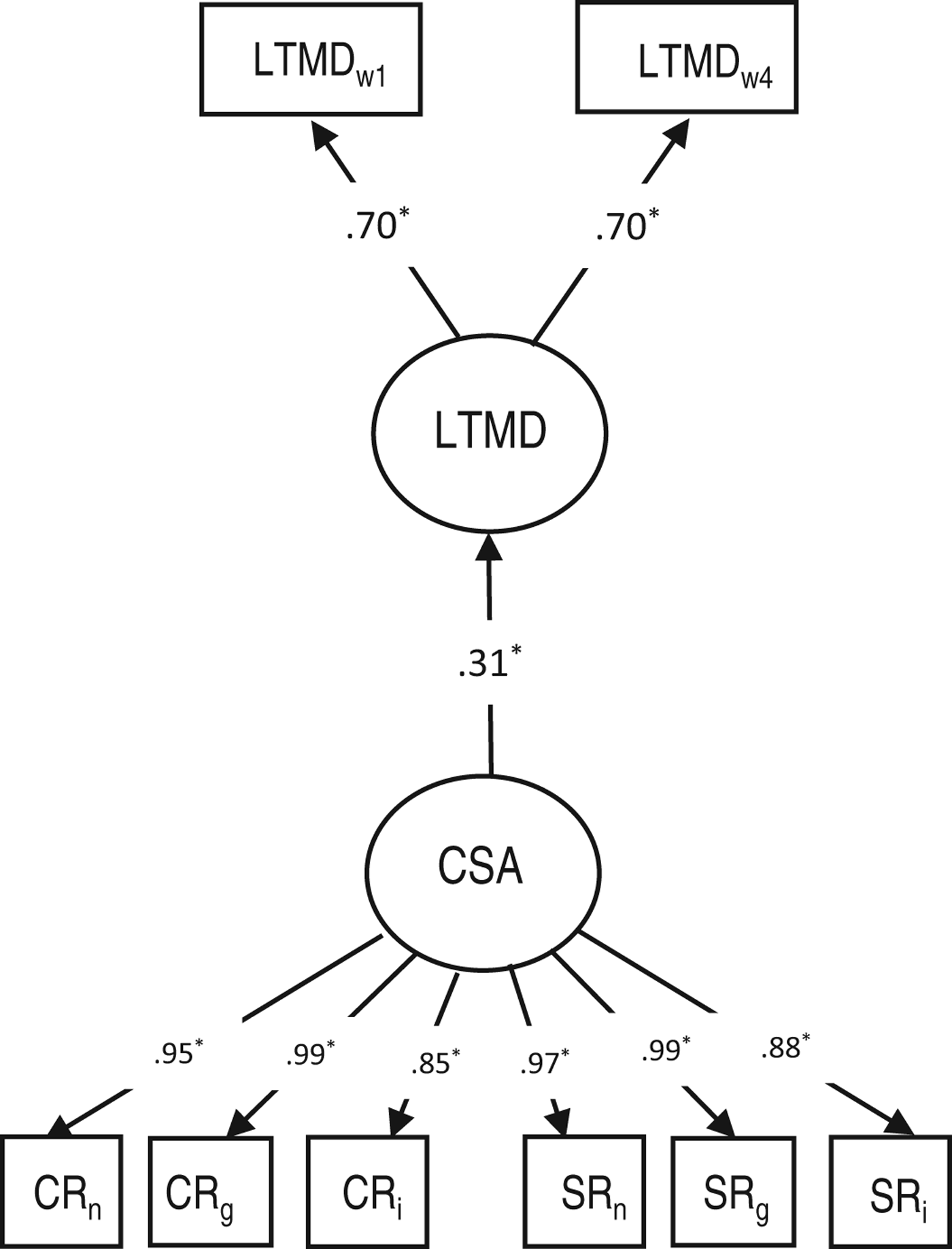
Our first model, as depicted in Fig. 1, has three noteworthy features. First, the latent construct of experienced CSA displayed high loadings for both self-report (SR) and co-twin report (CR) and of non-genital (n), genital (g) and intercourse (i) levels of abuse. For both self- and co-twin report, genital-level sexual abuse (both +0.99) was the strongest indicator of the CSA factor. Second, LTMD had estimated equated factor loadings of +0.70. Third, the standardized estimated path from the CSA factor to the LTMD factor was +0.31, indicating that CSA accounted for 9.6% of the variance in liability to LTMD. This model fits these data well according to the relative fits (CFI = 0.99, TLI = 0.99) but the approximate fit was marginal (RMSEA=0.08).
The prediction of lifetime major depression (LTMD) in women from the experiences of childhood sexual abuse (CSA). The CSA is a latent variable indexed by co-twin report (CR) and self-report (SR) of three levels of CSA: non-genital (n), genital (g) and intercourse (i). LTMD is a latent variable indexed by the lifetime history of MD reported at the first and fourth waves of interviews (w1 and w4 respectively) in the Virginia Adult Twin Study of Psychiatric and Substance Use Disorders (VATSPSUD). The path values are standardized partial regression coefficients and so need to be squared to equal the proportion of variance in the dependent variable accounted for by the independent variable. Path coefficients with an asterisk (*) are individually statistically significant.

Model 2
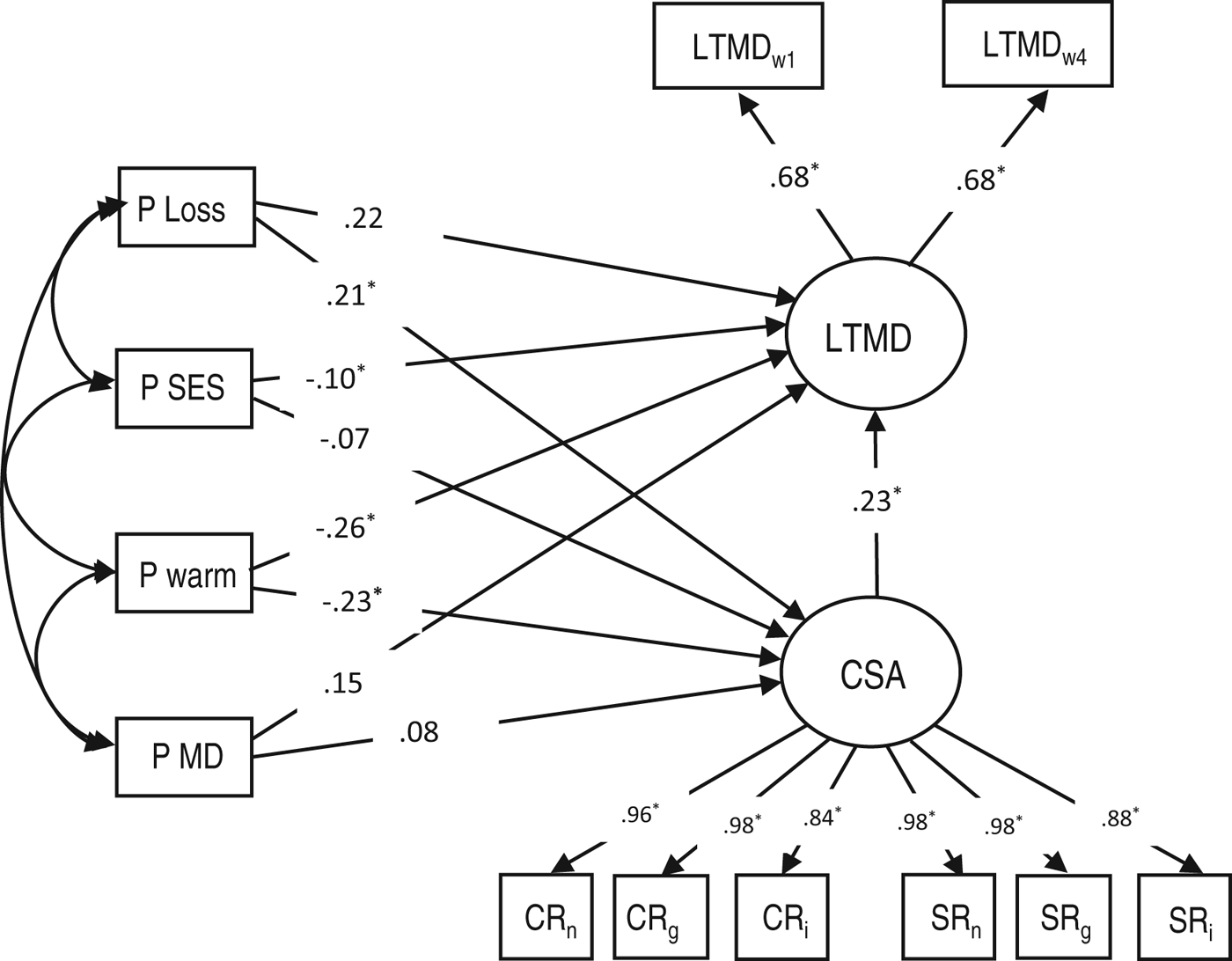
The second model, depicted in Fig. 2, adds to our first model four potentially important background variables that might predict both CSA and LTMD and hence bias upward our estimates of the CSA–LTMD association. The strongest associations with CSA and LTMD are negative from parental warmth (P warm) and positive from a history of parental loss (P loss). Weaker effects are seen for a parental history of MD (P MD) and parental SES (P SES). Including these covariates reduces the direct path from CSA to LTMD to +0.23 so that, in this model, CSA is explaining 5.3% of the variance in liability to LTMD. Overall model fit indexes were again very good (CFI = 0.99, TLI = 0.99), with some improvement in approximate fit (RMSEA = 0.07).
The prediction of lifetime major depression (LTMD) in women from the experiences of childhood sexual abuse (CSA) and four potentially important confounder variables. The model is identical to that depicted in Fig. 1 with the addition of a history of parental loss before the age of 16 (P loss), parental socio-economic status (P SES), as indexed by the highest education of the breadwinner in the home of origin, parental warmth (P warm), as measured by the Parental Bonding Instrument (PBI; Parker et al. Reference Parker, Tupling and Brown1979), and a lifetime history of parental major depression (P MD), as assessed by personal interview and DSM-III-R criteria (Fawcett, Reference Fawcett1997) or the Family History Research Diagnostic Criteria (FH-RDC; Endicott et al. Reference Endicott, Andreasen and Spitzer1975). Path coefficients with an asterisk (*) are individually statistically significant.

Model 3
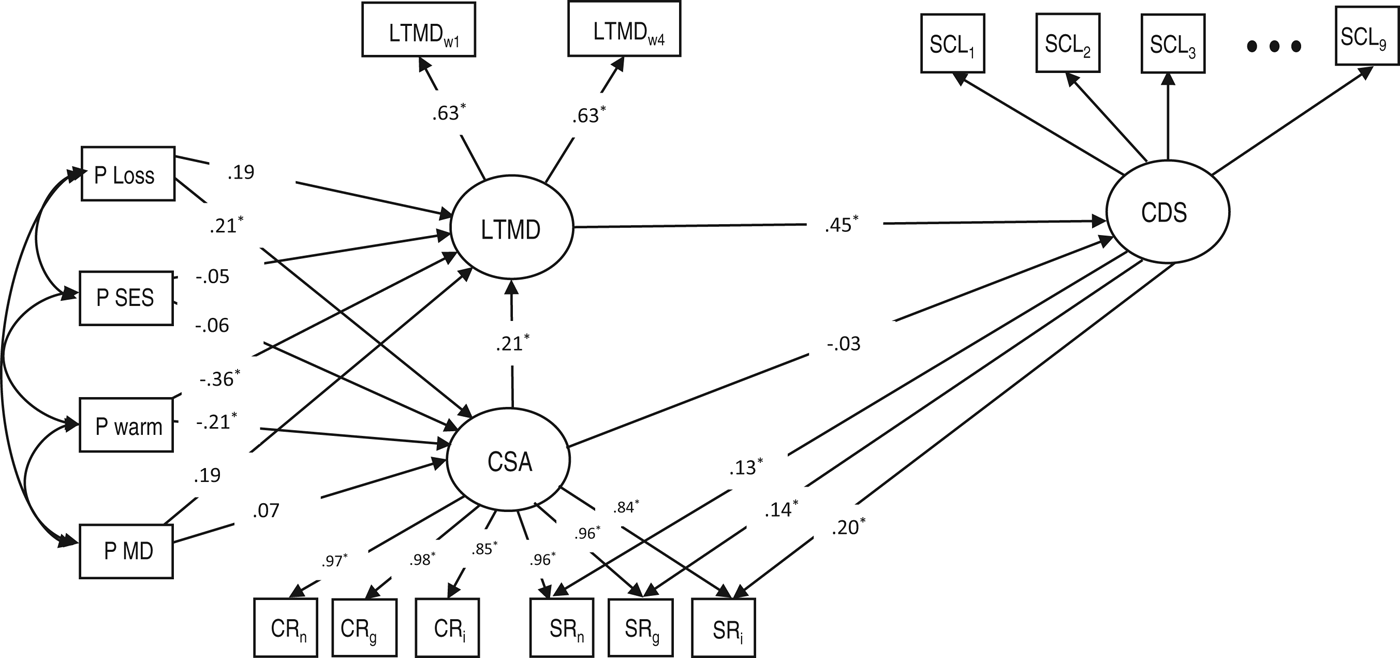
In the third model, shown in Fig. 3, a factor representing the potential impact of mood-congruent recall was added. Reporting bias was modeled as direct pathways from the CDS factor defined by nine SCL items assessing depressive symptoms at the time that the self-report history of CSA was obtained. This model includes both mediated and direct paths between CSA, LTMD and CDS. The mediational pathway (LTMD → CDS) point estimate was +0.45 whereas the direct effect (CSA → CDS) was −0.03 (and not significantly different from zero). Most importantly, the pathways from the CDS factor to the self-report of having experienced the three forms of CSA were all positive and significant. That is, this model suggests that individuals with higher levels on the CDS factor are more likely to recall and report CSA. Although the CDS bias parameters differed in their effect size across the three forms of experienced CSA, a test constraining the parameters to be equal was non-significant (Δχ 2 = 3.1, df = 2, p = 0.21). Including the potential impact of mood-congruent recall further reduced the direct path coefficient from CSA to LTMD to +0.21, accounting for 4.4% of the variance in liability to LTMD. This model maintained good relative fit (CFI = 0.99, TLI = 0.99) and there was a clear improvement in the approximate fit (RMSEA = 0.04).
The prediction of lifetime major depression (LTMD) in women from the experiences of childhood sexual abuse (CSA), four confounding variables and a correction for the effects of mood-congruent recall. The model is identical to that depicted in Fig. 2 with the addition of current depressive symptoms (CDS) as indexed by nine items from the Symptom Checklist 90 (SCL-90; Derogatis et al. Reference Derogatis, Lipman and Covi1973) assessing current symptoms of depression with paths representing the effect of mood-congruent recall from CDS to non-genital (n), genital (g) and intercourse (i) forms of CSA. The model also contains paths from LTMD and CSA to CDS. Path coefficients with an asterisk (*) are individually statistically significant.

Discussion
The goal of this study was to clarify the relationship between CSA and LTMD by examining their association in three different models. In a model accounting for measurement error, background covariates and mood-congruent recall bias, CSA predicted risk for LTMD accounting for 4.4% of the population variance in liability. However, background covariates and reporting bias together accounted for more than half of the uncorrected association between CSA and LTMD. Thus, not considering these additional sources of covariance would lead to a substantial overestimate of the magnitude of the impact of CSA on depression.
Five more detailed results are also noteworthy. First, the latent liability to experience CSA was strongly indexed by reports of both the responding twin and her co-twin. As expected, retrospective reports by relatives provide useful information about a history of CSA.
Second, as shown previously (Bromet et al. Reference Bromet, Dunn, Connell, Dew and Schulberg1986; Prusoff et al. Reference Prusoff, Merikangas and Weissman1988; Kendler et al. Reference Kendler, Neale, Kessler, Heath and Eaves1993), the reliability of the assessment of LTMD is moderate. Considerable additional information about the underlying risk for MD is obtained in longitudinal studies by interviewing subjects twice.
Third, model 3 had a non-significant direct effect of CSA on the current depressive symptom factor but showed a significant mediated effect (+0.45) going through LTMD. That is, allowing for an indirect effect of CSA on CDS through LTMD, CSA had no additional prediction on current depressive status. Our results are consistent with prior studies suggesting that individuals with CSA are, on average, somewhat more symptomatic than unexposed individuals (Kendall-Tackett et al. Reference Kendall-Tackett, Williams and Finkelhor1993), although the magnitude of this effect may be modest (Rind & Tromovitch, Reference Rind and Tromovitch1997).
Fourth, of our four covariates, parental loss and low parental warmth each predicted non-trivial proportions of variance of the risk for both CSA and LTMD, and thus reflected important confounders of the CSA–MD association. By comparison, parental SES and parental history of MD both had much smaller impacts on the relationship between CSA and LTMD.
Fifth, we found positive and significant paths from current depressive symptoms to reporting a history of CSA. That is, controlling for all other variables in our model, subjects with high levels of depressive symptoms were significantly more likely to report CSA than those with few depressive symptoms. However, the magnitude of these effects overall is relatively modest. By comparing models, we can estimate that reporting bias accounts for only about 17% of the observed covariance between CSA and LTMD, controlling for the effects of the confounders included in the second model. Our results are consistent with the predictions of mood-congruent recall. They are also in accordance with our prior finding that the association between CSA and LTMD was moderately stronger using self-report measures of CSA [odds ratio (OR) of 1.93 for any CSA and 3.14 for intercourse] than using co-twin reports (OR of 1.58 for any CSA and 2.65 for intercourse) (Kendler et al. Reference Kendler, Bulik, Silberg, Hettema, Myers and Prescott2000). The association between current depressive symptoms and CSA reporting could arise in two different ways that cannot be discriminated definitively in our study. High levels of depressive symptoms could be associated with an increased rate of true positive reporting of CSA so that the overall accuracy of CSA assessment is higher in symptomatic than in asymptomatic individuals. Alternatively, high levels of depression could increase false-positive reporting of CSA so that the overall accuracy of reporting CSA is higher in asymptomatic than in symptomatic individuals. We consider the first mechanism to be considerably more plausible than the second for three reasons.
First, throughout survey research, false-negative reporting is much more commonly biased that false-positive reporting (e.g. Coughlin, Reference Coughlin1990; Brown & Adams, Reference Brown and Adams1992; Wu et al. Reference Wu, Li and Ke2000). This is especially true for traits or behaviors that are socially stigmatizing and potentially shame inducing such as drug use, sexual behaviors or personal and family histories of psychiatric illness (Siemiatycki, Reference Siemiatycki1979; Orvaschel et al. Reference Orvaschel, Thompson, Belanger, Prusoff and Kidd1982; ACSF, 1992; Roy et al. Reference Roy, Walsh and Kendler1996; Hser, Reference Hser1997; Moffitt et al. Reference Moffitt, Caspi, Taylor, Kokaua, Milne, Polanczyk and Poulton2010). Second, applying sophisticated modeling to assessments of CSA at two time points in a population-based cohort, Fergusson et al. (Reference Fergusson, Horwood and Woodward2000) found that reporting of experienced CSA in adulthood is relatively unreliable, with approximately 50% of subjects who report CSA at one wave denying it at the next wave. Importantly, their modeling suggested that nearly all this unreliability resulted from false-negative and not false-positive reporting. Third, a considerable body of empirical work on mood-congruent recall supports the plausibility of this hypothesis. An earlier review of this area concluded that ‘the support for claims of such a phenomenon is impressive in its size, consistency, and diversity’ (Blaney, Reference Blaney1986). For example, individuals with depressive symptoms tend to display an even-handed recall of positively and negatively valenced stimuli whereas asymptomatic individuals are typically biased toward the recall of positive stimuli (Bradley & Mathews, Reference Bradley and Mathews1983; Mathews & Bradley, Reference Mathews and Bradley1983; Gilboa et al. Reference Gilboa, Roberts and Gotlib1997; Geerlings et al. Reference Geerlings, Beekman, Deeg, van Tilburg and Smit1998). In more naturalistic settings, depressed mood has been associated with enhanced recall of negative information including parenting behavior (Lewinsohn & Rosenbaum, Reference Lewinsohn and Rosenbaum1987). A distinct body of work on cognitive theories of depression suggests that, as individuals enter into a depressed state, negative memories gain in salience (Dalgleish & Watts, Reference Dalgleish and Watts1990; Lemogne et al. Reference Lemogne, Piolino, Jouvent, Allilaire and Fossati2006). We hypothesize that the paths in our model from current symptoms to recall of CSA reflect the process of mood-congruent recall whereby individuals in a depressed state are better able to recall and report prior CSA.
The overall impact of CSA on MD, correcting for errors of measurement, confounders and effect of mood congruent recall, was moderate, explaining slightly less than 5% of the population variance in liability. At a population level, CSA therefore explains about one-eighth as much of the overall risk for MD as total genetic effects (given a best estimate of heritability of 37%; Sullivan et al. Reference Sullivan, Neale and Kendler2000). From the path estimates and our prevalence figures for CSA and MD from our best-fit final model, the OR between CSA and MD can be estimated to equal 1.83. This substantial effect reinforces the importance of traumatic environmental experiences as risk factors for MD. In comparison, all of the genome-wide significant genetic variants found in the largest such study to date for MD (which emerged when including bipolar illness) had ORs for the pathogenic allele of around 1.10 (Major Depressive Disorder Working Group of the Psychiatric GWAS Consortium, 2013).
Our results can be usefully compared with a recent study with similar aims by Fergusson et al. (Reference Fergusson, Horwood and Boden2011). The authors constructed a path model examining retrospective reports of CSA and current mental health in a population-based cohort assessed at ages 18 and 21 years. They modeled recall bias for CSA and found it to be present but small in magnitude, accounting for less than 1% of recall bias. Consistent with our own findings, they suggest that retrospective recall bias for childhood abuse may not be large enough to pose a major threat to study validity.
Although we should be most concerned about aspects of our analyses that upwardly bias the CSA–MD association, it is worth considering the reverse possibility. In particular, in a proportion of cases, parental separation or MD could be a result of, rather than contributing to, CSA. If this is the case, then we have overcorrected and are at risk of underestimating the direct component of the CSA–MD relationship.
Our results suggest that CSA has a direct effect on increasing risk for MD in women. How confident should we be about this conclusion based solely on observational data? The greatest concern is that we have inadequately captured the confounding variables, and that had a larger set of covariates been considered, the association between CSA and MD would have disappeared. Two prior studies in the VATSPSUD argue against this concern. First, using more traditional regression analysis, we have previously examined a more complete set of potential covariates and shown that they had very little additional impact on the association between CSA and MD (Kendler et al. Reference Kendler, Bulik, Silberg, Hettema, Myers and Prescott2000). Second, confounding due to unknown and unmeasured variables is always a possibility in observational data. We also conducted a previous co-twin control analysis looking at the 53 twin pairs in our sample discordant for exposure to CSA (Kendler et al. Reference Kendler, Bulik, Silberg, Hettema, Myers and Prescott2000). Within those pairs, who were matched for all features of their rearing environment and partly or entirely for their genotype, the exposed twin was significantly more likely to report MD with an OR (2.43) only moderately lower than that observed in the entire population. These results, which were broadly replicated in an Australian twin sample (Nelson et al. Reference Nelson, Heath, Madden, Cooper, Dinwiddie, Bucholz, Glowinski, McLaughlin, Dunne, Statham and Martin2002), are inconsistent with the hypothesis that, with proper correction for confounding variables, the association between CSA and MD would disappear. In summary, although caution is always indicated in attempting to infer causal processes from non-experimental data, we would argue that our analysis provides substantial evidence that the experience of CSA in women causally increases risk for the subsequent experience of LTMD.
Limitations
Our findings should be considered in the light of five potential methodological limitations. First, our subjects are all white twins born in Virginia. Although the VATSPSUD has been shown to be broadly representative of the USA for a range of relevant traits (Kendler & Prescott, Reference Kendler and Prescott2006), the degree to which these findings extrapolate to other samples is uncertain. Second, our subjects were all female. The experience of CSA may differ considerably between the sexes (Fergusson & Mullen, Reference Fergusson and Mullen1999) so our results may not extrapolate to males. Third, our rates for LTMD are higher than those found in many epidemiological surveys. However, we had trained mental health professionals as interviewers, asked in two separate interview sections about LTMD and used several prompts to encourage effortful reporting. Given that false-negative reporting is so much more of a problem than false-positive reporting for lifetime psychopathology (Moffitt et al. Reference Moffitt, Caspi, Taylor, Kokaua, Milne, Polanczyk and Poulton2010), we are inclined to think that our assessment of LTMD is in general fairly accurate. Fourth, rates of CSA based on co-twin reports were considerably lower than those based on self-report. However, this discrepancy can be largely explained by the fact that more than one-third of women in our sample reported that they had never told anyone about their CSA (Kendler et al. Reference Kendler, Bulik, Silberg, Hettema, Myers and Prescott2000). Of note is that, in our models, co-twin report of CSA was almost as strong an index of the latent liability to CSA as was self-report. Fifth, we assessed CSA by mailed questionnaire. This, however, was the clear preference of this sample. Survey data suggest that more ‘anonymous’ response modes may obtain better cooperation and reporting of highly sensitive material such as CSA (Siemiatycki, Reference Siemiatycki1979).
Acknowledgments
This study was supported in part by National Institutes of Health (NIH) grants MH-40828 and MH/AA/DA-49492.
Declaration of Interest
None.