Introduction
Severe sepsis and septic shock are common and expensive medical problems. With an estimated incidence of 751,000 cases (3.0 per 1000 population) in the United States each year, severe sepsis and septic shock are associated with significant mortality and consumption of health care resources with estimated costs of US $16.7 billion dollars annually.Reference Adrie, Alberti and Chaix-Couturier1-Reference Dellinger, Levy and Carlet4 Although the case fatality rate has declined, with the aging of the population, the incidence of severe sepsis has increased and is expected to continue to increase,Reference Dombrovskiy, Martin, Sunderram and Paz2 making sepsis care a critical issue.
The initial component of the sepsis continuum is the systemic inflammatory response syndrome (SIRS). As a proinflammatory state, SIRS is associated with clinical findings that include tachycardia, tachypnea, alterations in white cell count, and thermal dysregulation.Reference Dellinger, Levy and Carlet4, Reference Bone, Balk and Cerra5 Sepsis, defined as SIRS with a suspected or confirmed source of infection, may progress rapidly to severe sepsis and septic shock, characterized by hypoperfusion with hypotension, oliguria, and altered mental status, culminating in multi-organ failure.Reference Bone, Balk and Cerra5, Reference Levy, Fink and Marshall6
The mortality rate of severe sepsis and septic shock is significantly higher than other states of recognized time-sensitive critical illness, such as myocardial infarction or stroke,Reference Dombrovskiy, Martin, Sunderram and Paz2, Reference Anderson, White and Ohman7, Reference Ali, Smith, Bhatt, Fonarow and Schwamm8 making prompt recognition and diagnosis essential. Previous work has focused on assessing vital sign abnormalities to allow prehospital providers to identify patients with sepsis.Reference Seymour, Cooke and Heckbert9-Reference Berger, Green and Horeczko11 These vital signs include hypotension, variably defined by systolic blood pressures (SBP)Reference Seymour, Cooke and Heckbert9 or mean arterial pressures (MAP), increased respiratory rate,Reference Seymour, Kahn and Cooke10, Reference Seymour, Band and Cooke12, Reference Guerra, Mayfield, Meyers, Clouatre and Riccio13 and the shock index (SI), defined as the heart rate divided by the SBP, with a normal being 0.5-0.7.Reference Berger, Green and Horeczko11 Recognition of abnormalities in these parameters could allow for more rapid diagnosis, possibly occurring in the prehospital setting before arrival in the emergency department (ED).
Numerous hospital systems have developed protocols for out-of-hospital providers to give advanced notice to emergency departments when they are transporting patients who will require prompt attention and numerous resources, such as patients with multiple injuries, stroke, or patients with myocardial infarctions.Reference Le May, So and Dionne14, 15 Recently, there has been increased interest in the role of Emergency Medical Service (EMS) providers in similarly recognizing and initiating treatment of sepsis.Reference Band, Gaieski, Hylton, Shofer, Goyal and Meisel16-Reference Suffoletto, Frisch, Prabhu, Kristan, Guyette and Callaway21 Improved recognition of sepsis may decrease time to treatment, allowing EMS providers to initiate the critical interventions in early sepsis including aggressive, goal-directed resuscitation and early antibiotic administrationReference Guerra, Mayfield, Meyers, Clouatre and Riccio13, Reference Band, Gaieski, Hylton, Shofer, Goyal and Meisel16, Reference Seymour, Cooke and Mikkelsen18, Reference Studnek, Artho, Garner and Jones20, Reference Wang, Weaver, Shapiro and Yealy22 to mitigate the rapid progression of the sepsis syndrome. Additionally, improved recognition could allow for advance notice to be provided to the receiving ED to improve prompt mobilization of resources.Reference Band, Gaieski, Hylton, Shofer, Goyal and Meisel16, Reference Seymour, Cooke and Mikkelsen18, Reference Studnek, Artho, Garner and Jones20
The Prehospital Sepsis Project (PSP) is a multifaceted study that aims to improve the overall care of the septic patient by focusing on the initial point of contact with the health care system, the EMS system. Understanding opportunities for intervention in sepsis in the out-of-hospital setting is important for improving outcomes. Previous work of the PSP has assessed the existing knowledge of EMS providers regarding sepsisReference Baez, Hanudel and Perez23, Reference Hanudel, Wilcox, Cadin, Hou, Giraldez and Baez24 to identify areas for improved education. The objective of this study was to assess the association of physiologic elements commonly reported in the out-of-hospital setting on morbidity and mortality in the outcomes of patients transported with sepsis.
Methods
The study consisted of a cross-sectional, descriptive design, using retrospective chart review of EMS patient care reports linked with ED and hospital admission records for the years 2004-2006 in a US academic medical center. Adult patients 18 years of age and above were identified using ICD-9 codes for sepsis, septic shock or severe sepsis. Data extracted from the medical records included patient demographics and diagnosis. Emergency Medical Services charts were reviewed and the following data collected: referral source; level of provider; vital signs including the temperature, heart rate, MAP, RR, and the SI; serum glucose level; interventions initiated in the prehospital setting; the need for airway management, cardiopulmonary resuscitation, or fluid resuscitation; and total prehospital time. The out-of-hospital physiologic variables of interest included a MAP <65, HR >90, RR >20, and an SI >0.7. Primary outcomes studied included mortality and admission to an Intensive Care Unit (ICU), with secondary outcomes of ventilator days, ICU length of stay, and hospital length of stay. Brigham and Women's Hospital Institutional Review Board approval was obtained.
A retrospective review of three years (2004-2006) of hospital data was used to select cases of admitted adult patients (≥18 years old) with a diagnosis of SIRS, sepsis or septic shock who were transported to the hospital by EMS. Diagnosis was based on ED admission criteria and ICD-9 codes:
• 038.9 Sepsis/Septicemia NOS
• 995.9 SIRS
• 995.91 SIRS w/o organ failure
• 995.92 SIRS with organ failure
Statistical significance was set at the .05 level. For all analyses, JMP IN 5.1 (SAS Institute Inc., Cary, North Carolina USA) was used. Descriptive statistics and standard deviations were used to present group characteristics. Chi-square was used for statistical significance and OR to assess strength of association. Physiologic variables studied included MAP, HR, RR and SI.
Results
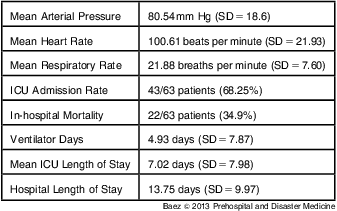
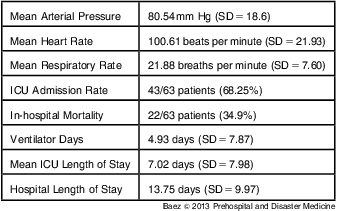
Sixty-three (63) patients were identified, of which 43 (68.25%) were admitted to ICUs. The mean out-of-hospital physiologic variables were a MAP of 80.54 mmHg (SD = 18.6), HR of 100.61 beats per minute (SD = 21.93), and RR of 21.88 (SD = 7.6) (Table 1). The in-hospital mortality for this cohort was 22 of 63 (34.9%). Other outcome variables included mean ventilator days of 4.93 (SD = 7.87), a mean ICU length-of-stay (ICU-LOS) of 7.02 days (SD = 7.98), and a mean hospital length of stay (HLOS) of 13.75 days (SD = 9.97).
Patient Characteristics (N = 63 patients)
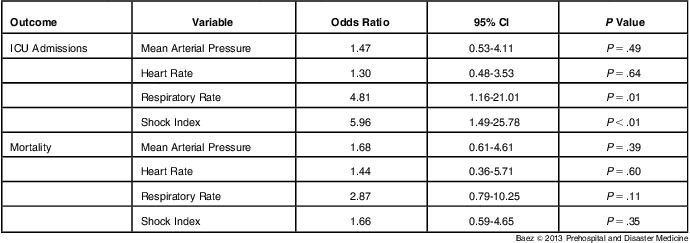
The out-of-hospital SI was the strongest predictor of ICU admissions, with an OR of 5.96 (CI = 1.49-25.78; P = .003) (Table 2). Elevated RR also was found to predict ICU admissions (OR 4.81 (CI, 1.16-21.01; P = .0116)). Conversely, HR and the MAP did not predict ICU admissions (P = .639 and P = .49 respectively). No physiologic variables studied were found to predict mortality (MAP: P = .39; HR: P = .60; RR: P = .11; SI: P = .35).
Primary Outcomes (N = 63 patients)

Discussion
As the care of acutely ill patients often begins in the prehospital setting, the role of the EMS provider is considerable in the care of patients with numerous time-sensitive critical illnesses, including acute myocardial infarctions, strokes, and trauma.Reference Le May, So and Dionne14, 15 Appreciation of the patient's condition allows the EMS crew to both initiate prompt interventions and notify the receiving ED that they will be arriving with a patient requiring rapid management and significant resources.
Sepsis is a similarly time-sensitive condition, as systemic inflammation can rapidly progress to hypoperfusion and frank shock. In 2001, Rivers and collaboratorsReference Rivers, Nguyen and Havstad25 demonstrated that aggressive resuscitation and early goal-directed therapy (EGDT) of patients with severe sepsis or septic shock resulted in an absolute mortality reduction of 16%, an effective reduction in the incidence of multi-organ dysfunction, and a decline in the use of health care resources. Similarly, mortality in septic shock is directly correlated with a delay in receiving antibiotics,Reference Kumar, Roberts and Wood26 making early recognition and appropriate treatment potentially lifesaving.
Recently, with improved understanding of the progression of sepsis, the potential role for EMS involvement in managing septic shock has similarly evolved. Improved recognition of sepsis would allow the EMS team to appreciate the patients’ acuity, and may allow for improved care in both the prehospital and ED settings. Several components of EGDT are amenable to initiation in the prehospital setting, which could lead to earlier, more aggressive resuscitative care and the potential to positively affect outcomes. As sepsis is an illness that requires immediate treatment and a large amount of resources, advance notification from EMS providers that they are transporting a septic patient may allow the receiving hospital to prepare for their arrival.
Although EMS providers are extremely knowledgeable about many aspects of caring for critically ill and injured patients, many do not fully understand sepsis and septic shock. Previous work from the PSP has found that while EMS providers realize that sepsis is an important disease process and would like to learn more,< 10% of providers gave correct answers when questioned about sepsis. Their levels of training and number of years on the job did not correlate with their performance. In another survey of prehospital providers, respondents stated that they felt that emergency medical technicians (EMTs) and paramedics frequently do not recognize sepsis.Reference Seymour, Carlbom and Engelberg27 These results indicate that further education on sepsis is broadly needed.
Further complicating the care of septic patients is that, unlike many other etiologies of critical illness, even severe sepsis may be subtle on initial presentation and may require laboratory data, such as the white blood cell count or a lactate level, for diagnosis. Although some EMS systems have used point-of-care lactate testing in the field,Reference Guerra, Mayfield, Meyers, Clouatre and Riccio13 this is not a routine part of out-of-hospital care. A recent study by Guerra and colleaguesReference Guerra, Mayfield, Meyers, Clouatre and Riccio13 found that after initiation of a Sepsis Alert Protocol for EMS providers, less than half of patients with documented severe sepsis on arrival to the ED were recognized by EMS teams. Although many of these patients were later defined by their laboratory values in the ED, approximately 25% were simply unrecognized as meeting criteria for severe sepsis. For these reasons, EMS providers need an improved way to detect sepsis in the prehospital setting.
In this study, the association between out-of-hospital vital signs and in-hospital outcomes in patients diagnosed with sepsis in the ED was evaluated. Although the mean MAP for the patients in this study was over 80, these patients represented a critically-ill cohort, with a nearly 70% ICU admission rate and 35% mortality rate, similar to other studies of severe sepsis and septic shock.Reference Rivers, Nguyen and Havstad25 In this study, hypotension and tachycardia were not associated with ICU admission. Although hypotension is a widely-recognized vital sign abnormality known to correlate with poor outcomes, prior work in the prehospital setting has shown that cut-offs for hypotension in the field are inadequate to identify high-risk patients.Reference Seymour, Cooke and Heckbert9
Despite the lack of correlation of SBP and HR, an elevated SI (the SBP divided by the HR) did correlate with ICU admission. In this series, patients with an SI of >0.7 were nearly six times more likely to be admitted to the ICU. This finding is consistent with prior data, as the SI has been demonstrated to be predictive of critical illness in the ED,Reference Berger, Green and Horeczko11 and this parameter likely deserves more attention in the out-of-hospital setting. Interestingly, RR also was strongly associated with increased ICU admissions in this series. This finding emphasizes the value of dedicatedly measuring RR in patients and paying close attention to this often overlooked vital sign.
Proper identification of these variables in patients with suspected or confirmed sepsis can assist EMS in potentially notifying hospitals and making point-of-entry decisions. Additionally, identifying vital sign abnormalities associated with increased morbidity can augment future educational efforts on sepsis for EMS providers.
Limitations
The limitations of this study include the small sample size as well as limitations intrinsic to retrospective studies, such as the possibility of incomplete or inaccurate data, both in the out-of-hospital and hospital settings. The use of ICD-9 codes to identify patients with sepsis may have led to failure to identify improperly coded patients.
Conclusions
This study demonstrated that the out-of-hospital shock index and respiratory rate are highly predictive of ICU admission, whereas other physiologic variables failed to predict outcomes in a critically-ill cohort of patients with sepsis transported by EMS. Further work is needed to improved education and recognition of sepsis in the out-of-hospital setting. Future directions of the PSP include the development of educational models, an out-of-hospital sepsis score, and point-of-care lactate testing.