Summary at glance
∙ The literature on health insurance tends to focus on its design and impact rather than on the structures and process of implementation that may have a larger effect on the performance of the program.
∙ For a health insurance program to be effective, implementation structures and processes need to be aligned with the program’s design.
∙ Specifically, it is necessary to establish a governance structure for containing and channeling opportunistic behavior on the part of different stakeholders.
1 Introduction
With over 100 million people around the world driven into poverty each year by health care costs, governments have understandably focused on universal health coverage in recent years (Vega, Reference Vega2013). Many countries have reformed and strengthened existing programs while establishing new programs to reach uncovered population and illnesses. Given the large resource requirements and political sensitivities surrounding health care, it is vital for policymakers to ensure that the programs are designed well and implemented effectively. In reality, however, analysts and policymakers have focused more on design of programs rather than their implementation. The aim of this paper is to remedy the lacunae by analyzing the implementation of the national health insurance scheme – Rashtriya Swasthya Bima Yojana or RSBY – in India.
The design of health insurance programs and its effects on outcomes has received extensive attention in the literature (see, e.g. Liu Qiaobing and Junqiang, Reference Kumaranayake, Lake, Mujinja, Hongoro and Mpembeni2014; McIntyre and Kutzin, Reference Lu and William2016; Reich et al., 2016). Studies have focused on issues such as resource collection (Jowett et al., 2016), benefit package design (Penteli and van Ginneken, Reference Nayak and Behera2016), purchasing arrangements (Hanson, Reference Hanson2014) and payment mechanisms (Atuoye et al., Reference Atuoye, Siera, Roger, Sylvester and Isaac2016). In comparison, implementation of health programs has received only cursory attention (Mathauer and Carrin, Reference Liu, Qiaobing and Junqiang2011; Gilson et al., Reference Gilson, Helen and Marsha2014; Sato and Gilson, Reference Robinson2015) despite the broad recognition that even well-designed programs may fail to achieve their intended goals if not implemented effectively (Ridde, 2008; Agyepong and Richard, Reference Agyepong and Richard2011). To fully understand the performance of a program, it is necessary to understand not only the program’s design but also the associated implementation process, especially the alignment between the program design and the arrangements governing implementation.
At the root of implementation challenges lies the principals’ difficulties in designing programs – especially social service programs – precisely enough to clearly indicate what the agents need to do, giving rise to what is described as ‘incomplete contract’ between them. In health care, programs typically allow considerable leeway regarding task allocation, output specification, payment mechanisms, residual rights allocations and so on. As a result, it falls upon implementing agents themselves to develop governance arrangements to put the program into effect. This is a difficult task in policy sectors comprising large number of contending agents because it requires complex formal and informal arrangements with respect to enforcement and compliance (O’Flynn et al., 2013; Brown et al., Reference Brown, Potoski and Slyke2015; Carey et al., Reference Carey, McLoughlin and Crammond2015).
Contracts, outside simple commercial transactions, are always incomplete to varying degrees (Hart et al., Reference Hart and Moore1997; Hart and Moore, Reference Hart, Shleifer and Vishny1999). This is particularly the case in health care, which is characterized by pervasive and deep information asymmetry and outcome uncertainty that limit measurement of deliverables (Robinson, Reference Reddy, Selvaraj, Rao, Chokshi, Kumar, Arora, Bhokare and Ganguly2001; Sanderson et al., Reference Ridde2017). Deep information asymmetries allow stakeholders to exploit their information advantage, which are difficult to detect and monitor by other parties. The conflicting opportunistic behavior on the part of stakeholders reduces trust, satisfaction and motivation, increases conflicts and transaction costs, and eventually erodes performance (Hawkins et al., Reference Hawkins, Wittmann and Beyerlein2008; Caniels et al., Reference Caniëls, Gelderman and Vermeulen2012). Even when opportunistic behavior is detected, litigation cost, ineffectiveness of contract law, poor third-party verifiability and corruption limit the use of legal dispute resolution mechanisms (Gow et al., Reference Gow, Deborah and Johan2000; Gryzmala-Busse, 2010). The problem is particularly acute in developing countries due to weak political and administrative institutions and processes (Kumaranayake et al., Reference Jain2000; Sheikh et al., Reference Sanderson, Allen, Gill and Garnett2015).
While the conditions promoting sub-optimal performance due to innate features of the health sector cannot be eliminated, their undesirable effects can be contained and even overcome through careful design of effective governance arrangements (Williamson, Reference Wong2005). Effective governance of implementation includes formal mechanisms such as monitoring, authority and penalty, as well as informal mechanisms such as reciprocity, trust and relational norms (Wong, Reference Williamson2008).
A number of empirical reviews have identified governance as a key factor shaping performance of social programs (Romzek and Johnston, Reference Reich, Harris, Ikegami and Maeda2005; Fernandez, Reference Fernandez2009; Amirkhanyan et al., Reference Amirkhanyan, Kim and Lambright2011; Bali and Ramesh, Reference Bali and Ramesh2015). Studies on health financing have focused extensively on the links between program design and performance, especially the effects of specific design elements such as resource collection, risk pooling and purchasing functions on performance measures such as financial protection, service utilization and financial sustainability (Lu and William, Reference La Forgia and Nagpal2003; Llyod-Sherlock, Reference Kwon2006; Bansak and Raphel, Reference Bansak and Raphel2007; Ekman et al., Reference Ekman, Liem, Duc and Axelson2008; Kwon, Reference Jowett, Maria Petro, Gabriela and Jonathan2009; Witter and Garshong, Reference Witter and Garshong2009; Liu et al., Reference Kumaranayake, Lake, Mujinja, Hongoro and Mpembeni2014). While studies on the implementation of social health insurance do exist (Feder, Reference Feder1977; Bascolo and Natalia, Reference Báscolo and Natalia2009; Agyepong and Richard, Reference Agyepong and Richard2011; Bertone and Bruno, Reference Bertone and Bruno2013; Witter et al., 2013), they do not directly deal with the interactive relationships between the design of the program and how it is implemented. These studies largely focus on deviant behavior of implementing agencies, ignoring the interaction between governance mechanisms and program design that drives these deviations. Mathauer and Carrin’s (Reference Liu, Qiaobing and Junqiang2011) otherwise comprehensive conceptualization of the performance of health financing programs places undue emphasis on rules (absence, inadequacy, conflict) and the implementation agencies’ capacity. As a result, they miss out on the dynamics of the myriad relationships among implementing agencies that emerge to fill the gaps in program design. Social insurance programs, especially in federal and decentralized contexts, are multi-agency efforts with vast scope for opportunistic behavior on the part of implementing agencies, which have a vital impact on how the program is interpreted and executed. It is the objective of the paper to study the design of the RSBY program and, more importantly, explain the factors that account for the differences in performance during implementation. It will argue that alignment of the implementation mechanisms with the program design is a critical determinant of a program’s performance.
2 Case Background
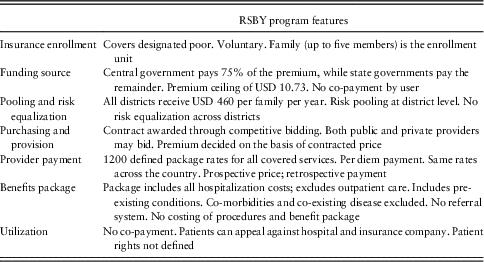
Government of India launched RSBY in 2008 to address the problem of lack of access to health care, which drove about 40 million people in India to poverty every year (Selvaraj and Karan, Reference Romzek and Johnston2009). The program gradually expanded to cover over 41 million poor families throughout the country. All families that are on poverty registers are eligible to enroll in the program, though accuracy of the poverty registers and awareness among beneficiaries vary across states. The program offers free hospitalization for up to a maximum of USD 460 per year through a network of 12,000 hospitals (both public and private) across India. The program is jointly financed by the central and state governments in the ratio of 75:25, with enrollees paying only a modest one-time registration fees of USD 0.5. The contribution to the premium of the central government is capped at USD 10.73 per family across all districts in the country notwithstanding the vast differences in demographic and epidemiological status and health services utilization rates. The key design features of the RSBY program are summarized in Table 1. Many state governments have launched their own versions of the health insurance program, which differ in terms of design. Here we focus only on health insurance programs labeled as RSBY.
Program design and contextual factors in Rashtriya Swasthya Bima Yojana (RSBY)

Source: Authors.
Enrolled beneficiaries may seek services from any listed (‘empaneled’) hospital, which must provide all necessary and covered services without charge to user. Shortage of qualified providers, limited information on their qualification and low illiteracy among users limit the exercise of choice available to users. The benefit package covers inpatient care for most medical conditions, including pre-existing conditions, categorized into 1200 packages. Outpatient care expenses are excluded, regardless of their expensiveness. Packages only include disease condition, and there are no standard treatment guidelines in spite of extensive variation in treatment procedures. Packages are also uniformly priced across states even though input costs vary significantly.
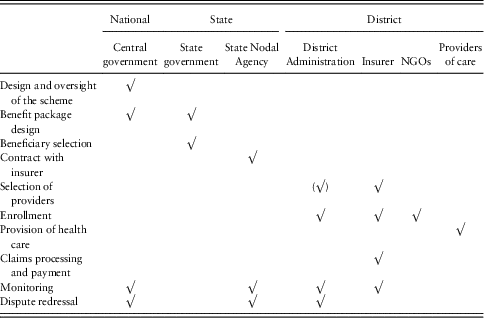
Table 2 lists the names and roles of the large number of agencies involved in implementing the RSBY program. It shows that the central government is in charge of the program’s overall design, including defining insurance contracts and oversight of the program, while the State governments are responsible for selecting beneficiary groups and facilitating implementation. The task of monitoring the implementation of the program and adjudicating disputes rests primarily with State Nodal Agency (SNA). The responsibility for implementing the program is devolved to the District Administration (DA), whereas Insurance Company (IC) is responsible for selecting providers, enrolling members and managing insurance claims. The premium amount is decided at the district level through competitive bidding organized and awarded by the SNA. There are 17 insurance companies approved to bid for contracts.
Rashtriya Swasthya Bima Yojana implementation structure: role of different stakeholders

Source: Adapted by the authors from Reddy et al. (Reference Penteli and Ginneken2011).
The vast overlaps in implementation responsibilities – evident when one looks across the rows in the above table – call for tight coordination among the concerned agencies.
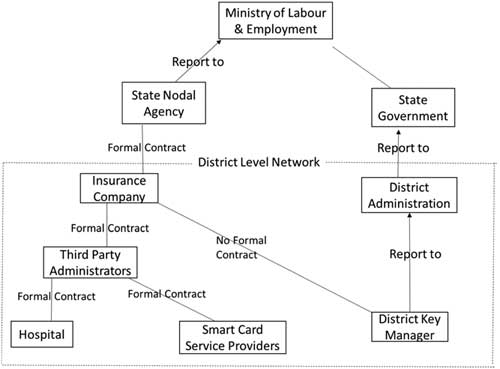
Figure 1 provides the program’s organization and reporting structure. The key instrument for implementing the program is the contract between the IC and the SNA, which specifies the roles, relationships and responsibilities of the different parties. The ICs are ultimately responsible for the delivery of services to members.
Implementation structure Rashtriya Swasthya Bima Yojana scheme.

The RSBY program has evolved over the years as program designers have repeatedly refined contract and implementation guidelines based on the feedback from the field. Some of the reforms post 2013 (after data collection for this study) included introduction of performance incentives and disincentives for the IC in enrollment, empanelment and claims management. However, no changes have been made to the roles, responsibility and accountability mechanisms for DA. The RSBY was reorganized and renamed as the Rashtriya Swasthya Suraksha Yojana in 2016 and then to the National Health Protection Scheme in 2017. The coverage under the scheme has also increased from 30,000 INR per family per year to 100,000 INR as announced in the central government budget 2017–2018.
3 Materials and methods
The uniform design of the RSBY program across all states in India offers a convenient methodological device for controlling for the structural determinants of the program’s performance, allowing to tease out the mediating role of implementation processes and practices. Process tracing is used to map out program design and implementation issues, while comparative case analysis is used for cross-validation.
The paper begins with mapping of the salient formal design features of the RSBY program with respect to resource collection, risk pooling, purchasing and accountability. Data collection was done in two rounds: preliminary interviews (from March 2012 to August 2012) and main interviews (October 2012 to March 2013). Data for mapping the program design were derived from document analysis and interviews with five members of the RSBY core team at the Ministry of Labour, Government of India, and four staff members of field-level agencies of state governments.
The second stage of the analysis focuses on the interactions between the formal design and actual implementation of the program. As all jurisdictions have similar design, states for study are selected based on variations in implementation. Based on the preliminary interviews, three states – Uttar Pradesh, Himachal Pradesh and Punjab – were selected as these states differed in implementation process. This allowed causal inferences to be drawn regarding how variations in implementation lead to difference in the program’s performance (King et al., Reference King, Keohane and Verba2004: 140). Variation in program performance was assessed against on the basis of achievement of program objectives and extent of partner opportunism.
To map implementation, the relevant processes, contextual factors and inter-organizational relations are assessed during four critical events in implementation of the RSBY program: planning, enrollment of beneficiaries, empanelment of hospitals and claims management. Since all implementation units are structured similarly, only one district in each state is selected for study. The selected district is an average-performing district of that state. Within-district data were collected from all stakeholders through semi-structured interviews and field observations, yielding data with high informational content regarding implementation issues. All the stakeholders that were involved in the management of the scheme in the selected district – officials of SNA, IC, third-party administrator (TPA) and DA – were interviewed in order to generate multiple perspectives and find convergent viewpoints. A total of 42 interviews were done in the selected three states. The researcher also attended two state-level meetings and four field observations. Data were collected on four critical milestones of the program implementation: planning for implementation, hospital empanelment, enrollment of beneficiary and claims management. For each implementation milestone of the program, the data were collected on the following dimensions: preparing plans, decision-making processes, problems during implementation, approaches to manage problems, types of possible opportunistic behaviors by each partner and management of opportunistic behavior at each milestone. For each of the themes of a milestone, all the involved stakeholders were asked to share their perspective. This generated multiple perspectives on each theme, improving validity of the data collected. Given the sensitive topic of the research, anonymity was maintained in order to get candid response. These qualitative data (interviews and observations) are complemented with secondary data available in the form of agency reports, published and unpublished articles and data.
In data analysis process, tracing was used to understand the interaction between program design and implementation. This involved mapping inter-organizational governance during various stages – planning, enrollment, hospital empanelment, claims management and grievance redressal – and its evolution over a period of time. For each stage, the analysis was conducted to identify (i) the agencies involved; (ii) the context and structure driving the behavior of agencies; and (iii) the governance mechanisms used in response to the behavior observed and the effectiveness of governance tools at each step.
Thus, the study traces the governance mechanisms used by stakeholders to control opportunism arising from gaps in program design. The study reveals how the dynamics of implementation influences behavior of agents trying to exploit the opportunities for aggrandizement extant in program design. The conclusions indicate the extent to which governance is effective in filling the design gaps.
Finally, the study conducts a comparative case analysis of the implementation of RSBY in three states – Himachal Pradesh, Punjab and Uttar Pradesh – to learn about the effects of implementation processes on program performance. Indicators of program implementation rather than its outcomes are used for assessing performance because the latter is shaped by a variety of factors unrelated to the program. Linking gaps in program design to variation in program performance generates valuable inferences about the mediating role of implementation governance.
4 Results
4.1 RSBY: interaction between program design and implementation
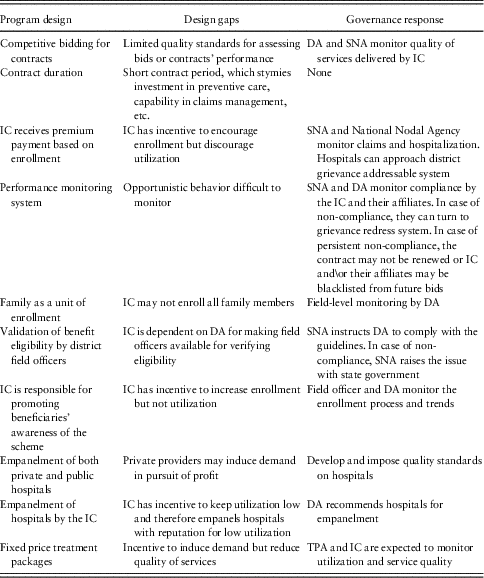
Table 3 presents a summary of the salient design features of RSBY, the gaps and shortcomings that characterize them and the governance mechanisms in place to address them during implementation. As mentioned earlier, all contracts, especially health insurance contracts, are complex and unavoidably incomplete due to limitations to assessing quality, costs and outcomes. Consequently, program administrators must develop processes and practices that fill, offset or minimize the gaps if the program is to be effective.
Program gaps and implementation governance in Rashtriya Swasthya Bima Yojana

Note: DA=District Administration; SNA=State Nodal Agency; IC=Insurance Company; TPA=third-party administrator.
Insurance companies participating in the scheme are selected through competitive bidding and are paid premium on per-family basis. The amount of payment the insurers receive is based on the number of enrolled households rather than service utilization, which incentivizes them to increase enrollment but not utilization because they bear the entire financial risk. Furthermore, there are no incentives for empanelment of hospitals, health care utilization or claims management. Given the clear incentives to increase enrollment and decrease utilization, insurers have little motivation to promote program awareness and quality of service or even honor claims. Moreover, since profit-oriented private hospitals are paid fixed package rates only for inpatient care, they have incentives to induce demand by converting outpatient to inpatient care, choosing higher price packages and providing low quality or insufficient care.
To address the gaps in program design, a number of implementation mechanisms have been put in place. Detailed performance indicators, both quantitative and qualitative, are defined. National-level nodal officers meet every month while state-level nodal officers meet with Insurance companies every 6 months to review the program’s implementation. Field key officer and district administrators are required to monitor implementation through regular field visits. The contract document includes detailed guidelines for processes mentioned in the contract. However, the program administrators are aware of the limits of contract and, hence, engage in informal collaboration and trust-building to supplement the formal arrangements. Agencies are expected to work as a ‘team and facilitate and support each other’ and are advised to ‘sit together and discuss’ in case of dispute (Swarup, Reference Selvaraj and Karan2012). In case of dispute, agencies are expected to use a three-tiered internal grievance redressal mechanism rather than the judiciary.
4.2 Governance of opportunism in implementation
As seen above, effective implementation of RSBY requires compliance with program requirements by all key stakeholders: insurers, DA, nodal agencies and contracted hospitals. However, the numerous failures intrinsic to social health insurance foster opportunistic behavior on the part of implementing agents, necessitating formal and informal collaboration among them if the program is to be implemented as intended.
Thus, the IC is mainly responsible for enrollment of beneficiary, empanelment of hospitals and managing claims. However, for the IC to perform its function, it needs the support of DA, which is responsible for selecting location for beneficiary enrollment, validating beneficiaries’ identity, managing enrollment disputes and recommending hospitals for empanelment. DA also monitors implementation and addresses all grievances at the district level as a Chair of the District Grievance Committee. The SNAs further complicate the relationship as it is they that select ICs, monitor implementation and address grievances at state level as a chair of the State Grievance Committee.
In reality, collaboration among the different implementing agencies faces numerous difficult hurdles. Thus, the IC’s revenues are based on the number of families enrolled in the program but it cannot complete the enrollment without the support of DA. The IC’s dependence on DA allows the latter to exploit its position and engage in opportunistic behavior, including corruption. DA officials are believed to accept bribes from hospitals in return for recommending them for empanelment, a recommendation the IC cannot turn down due to its dependence on the DA. Anecdotal evidence suggests that many empaneled hospitals are either related to DA officials or collude with DA to get empaneled even if they do not qualify (Asher et al., Reference Asher, Vora and Maurya2015; Maurya, Reference Lloyd-Sherlock2015). Once empaneled, such hospitals are believed to engage in fraudulent claims (Reddy et al., Reference Penteli and Ginneken2011; La forgia and Nagpal, Reference King, Keohane and Verba2012).
Opportunistic behavior on the part of private hospitals, which deliver around 60% of all inpatient care but are subject to almost no regulation regarding quality or price, is also common. They are known to induce demand, especially in case of insured patients (Bhat, Reference Bhat2005; Bearing Point, 2008; Reference DesaiDesai, 2009). In the case of RSBY, hospitals are paid fixed package rates, which are generally low and poorly designed (La Forgia and Nagpal, Reference King, Keohane and Verba2012) and which incentivize them to induce demand. The beneficiaries do not resist the hospitals’ behavior due to absence of co-payment. Thus, hospitals turn ambulatory care into inpatient care, select higher-paying packages (DRG Creep), provide low-quality services, select low-cost cases (cream-skimming) and accept informal payments. Hospitals also collude with DA to engage in blatant fraudulent behaviors like treating ghost patients, colluding with beneficiaries to make claims for services not provided and claiming multiple packages (Press Trust of India, Reference O’Flynn, Blackman and Halligan2013). Supplier-induced demand by private hospitals is a major reason for high claims ratio, exceeding 100% in many states (Ministry of Labour and Employment Government of India, Reference Mathauer and Carrin2014). Districts with a large number of hospitals colluding with DA have witnessed claims ratio as much as 700% (Ministry of Labour and Employment Government of India, 2012a). Private ICs cover their losses by the profits earned in other districts where they have managed to keep claim ratio low by various ways as discussed earlier, whereas public sector insurance companies cover up their losses by other segments of insurance business.
RSBY’s claims monitoring system is geared at detecting fraudulent claims rather than controlling subtle opportunistic behaviors such as DRG creep and supplier-induced demand.
Though the private health insurance started in India in 1986, the sector was monopolized by public sector insurance companies until 1999 when the sector was liberalized. Given the small market size, and specialized nature, health insurance policies were offered as an add-on product to other insurance policies. Given the specialized nature, low profitability and small size, Insurance companies did not invest in developing the specific expertise needed to run these policies (Bearing Point, 2008).
In general, health insurance industry in India lacks capacity to manage claims and traditionally have relied on unethical measures to control claims, such as rejecting claims on minor technical grounds (Bearing Point, 2008). Lack of standardization in treatment, records, billing process, limited data on disease burden (Chandrashekhar, Reference Chandrashekhar2009) and slim profit margins for the insurers have prevented investment in capacity building. One of the officers of the IC commented
At the time of signing agreement, there is clause on minimum % of the claims that will be investigated by TPA. But the TPA would like to go the nearby hospital. This has to be monitored by district manager. I feel almost impossible to monitor each and every hospital.
ICs have no formal contract with DA, which undermines the former’s position. In case of non-compliance by DA, the insurer can approach the SNA, but there is little it can do if the latter do not assist. Moreover, the relationship between SNA and National Nodal Agency varies across states, ranging from close collaboration to aloofness. State governments also vary in their support for RSBY, ranging from active support in some states to neglect in others.
Unable to control fraudulent hospitals, ICs resort to counter-opportunistic behaviors, including suspension of hospitals, delay in claims payment and payment of amount lower than the claim. Anticipating opportunistic behaviors by IC, fraudulent hospitals submit inflated and false claims, often in collusion with audit agencies. This leads to a vicious cycle of opportunism and counter-opportunism. Faced with the vicious conditions – low package rate, claim rejection for frivolous reasons and delayed claims payment – genuine hospitals often do not participate in RSBY, leaving fraudulent hospitals in the scheme (The Hindu, Reference Sheikh, Saligram and Krishna2011; Deccan Herald, 2013; Amar Ujala, 2014).
DAs for their part do not monitor or contain opportunistic behaviors of IC or hospitals during enrollment or claims management. In addition, if IC anticipates fraudulent behavior by DA (common in states with high corruption rate), they behave opportunistically during enrollment and claims management to control hospitalization. During enrollment, they may not include details of all family members, or issue the cards or provide incomplete information about accessing benefits in order to reduce cost of operation. During empanelment, they empanel few hospitals, avoid facilities that are popular among beneficiaries or designate hospitals located in remote places. In claims management, they reject claims on trivial reasons, delay payment and dis-empanel hospitals without proper investigations. Fraudulent behavior by DA induces other agencies to behave opportunistically, which aggravates the flaws in the program design and undermines the effectiveness of the program.
DA and SNA are entrusted with the responsibility for supervising and monitoring performance, as well as adjudicating disputes. However, they have little motivation for performing these functions due to the absence of reward for it (Vaishnav and Khosla, Reference Vaishnav and Khosla2016). Similarly, although there is a three-tier grievance redressal mechanism, there is no provision for penalty other than non-renewal of contract (Swarup, Reference Selvaraj and Karan2012). There is also no penalty for lapse on the part of public functionaries. The program beneficiaries also have no practical mechanism for raising grievances given their low literacy and social status. All these shortcomings undermine the RSBY’s implementation and effectiveness.
4.3 Accounting for the differences in implementation performance
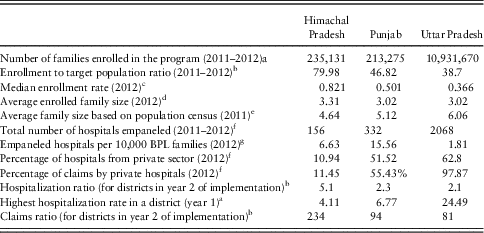
Most of the factors determining RSBY’s implementation – eligibility, benefit levels, financing and payment arrangements, etc. – are defined in the program and hence uniform across the country. Yet the program’s performance varies significantly across jurisdictions, as evident in Table 4, which presents key performance indicators for three states: Himachal Pradesh, Punjab and Uttar Pradesh.
Implementation performance in Himachal Pradesh, Punjab and Uttar Pradesh

Note:
a Based on data provided by Ministry of Labour, Government of India.
b Jain (2013).
c Nandi et al. (2013).
d Ministry of Labour and Employment Government of India (Reference Maurya2013a).
e Nayak and Behera (2014).
f Ministry of Labour and Employment Government of India (Reference McIntyre and Kutzin2013b).
g Estimated from the data.
The table shows that Himachal Pradesh is the best performer along all dimensions and Uttar Pradesh the worst, with Punjab somewhere in between the two. Thus, 80% of the eligible household population in Himachal Pradesh is enrolled in RSBY, compared to only 38% in Uttar Pradesh. Similar difference is evident in the quality of enrollment, which is measured by the average number of members enrolled per card. Although Uttar Pradesh has the largest family size (6.06), it has the lowest number of family members enrolled per card (3.02), whereas Himachal Pradesh has the smallest family size (4.64) and the highest number of family members enrolled per card (3.31). In terms of hospital empanelment, Punjab has the best performance (15.56 per 10,000 card holders) while Uttar Pradesh has the worst (1.81 per 10,000 card holders). In terms of utilization, Himachal Pradesh (5.1) again has the best record and Uttar Pradesh (2.1) the worst. The level of corruption also affects performance. Thus, the best-performing Himachal Pradesh also has the lowest level of frauds in RSBY among the three states while Uttar Pradesh has the highest level of fraud and worst performance. Out of 158 hospitals de-empaneled for fraudulent activities by January 2012, 110 were from Uttar Pradesh alone (Ministry of Labour and Employment Government of India, 2012a). In Himachal Pradesh the highest hospitalization rate in a district was very close to the average hospitalization rates, whereas in Uttar Pradesh the hospitalization rate was as high as 24% (ten times the average hospitalization rate). Many districts in Uttar Pradesh had a hospitalization rate more than 10%, which could not be explained by any reason other than fraud (Government of Uttar Pradesh, Reference Grzymala-Busse2011). In-depth Interviews, media reports (Political and Business Daily, 2010; The Indian Express, Reference Srivastava2011a, Reference Swarup2011b; Times of India, 2012, 2013) and secondary data suggested high level of fraud in Uttar Pradesh compared to Himachal Pradesh. Punjab is a middling performer with moderate performance, as well as incidence of fraud. In the following paragraphs, we provide details on governance of RSBY’s implementation in the three states.
The State government in Uttar Pradesh has strongly supported the program and actively participated in its implementation right from the start. It established an autonomous agency – Himachal Pradesh Swasthya Bima Yojana Society – under the Department of Health to coordinate the implementation of RSBY. The agency has developed the skills and resources necessary to coordinate implementation, limiting the scope for opportunism by IC or DA. SNA considers empanelment as a process ‘between Insurance Company and private Hospital (and) we (State Nodal Agency) do not have any role’. Insurance Company has complete autonomy in hospital empanelment…. ‘In case of hospital empanelment, We used to get initially request for empanelment. We just listen but we do what we want’ (Zonal Head Insurance Company).
The agency ensures that ICs enjoy complete autonomy in empanelment of hospitals while DA’s role is largely advisory. That around 90% of empaneled hospitals are from the public sector, with no incentives for profit-driven fraud, makes the task simpler. The state government has also deployed crime investigation agency to investigate suspicious transactions, which further curtails fraud. Low corruption and turnover of ICs and empaneled hospitals make for stability in service provision, which has promoted utilization. Over time, service utilization under RSBY in the state increased from a hospitalization ratio of 2% in the first year to 5% in the second year (Ministry of Labour and Employment Government of India, 2012b).
While Uttar Pradesh too established an autonomous agency with adequate staff to monitor implementation, its ability to not carry out its functions was compromised for a variety of reasons. Disputes due to poor quality of poverty register and non-availability of field officers made insurance companies considerably dependent on the DA, increasing the latter’s leverage over them. The DA enjoyed the power to veto empanelment of hospitals, an authority it used to promote the interests of private hospitals colluding with them. The SNA was powerless in exercising its formal authority because it was at par with DA in the administrative hierarchy. As a result, SNA had to route all instructions to DA through the highest level of bureaucracy in the state. The IC has limited decision-making power in hospital empanelment as observed by Regional Manager of an IC: ‘We don’t have complete decision making power. We try our best by providing information at various level. We can fight but we are going to be here. If one has to live in water, he cannot fight with the crocodile’.
In the absence of effective restraints on their behavior, DAs in Uttar Pradesh abused their veto power to empanel fraudulent hospitals, which led to counter-opportunism by other agencies. In many districts, hospitalization rate was more than 10%, which is difficult to explain merely on the basis of pent-up demand (Government of Uttar Pradesh, Reference Grzymala-Busse2011). Collusion, rent seeking and bribe payments were reported in award of contracts, enrollment of beneficiaries, empanelment of hospitals, claims settlement, audit of hospitals and so on (Indian Express, Reference Swarup2011b; Zee News, 2014). The situation was aggravated by the poor conditions at public hospitals, leaving the government with no choice but to rely on private hospitals for services, confirmed by the fact that more than 95% of the RSBY claims were by private hospitals.
In Punjab, the program is managed by a corporatized SNA – Punjab Health System Corporation – with offices in all districts, which gives it access to in-depth information and control over field operations. The corporation enjoys broad support among stakeholders, which was confirmed by award of the prize ‘Outstanding performance in providing facilitation to stakeholders under RSBY’ (Ministry of Labour and Employment Government of India, 2013c). It also actively promoted empanelment of public hospitals and instructed DAs to not interfere in the empanelment process so as to give ICs autonomy in selecting hospitals (Srivastava, Reference Sato and Gilson2012). However, the DAs continued to interfere in the process in collusion with private hospitals, emboldened by their job security as public servants and easy opportunities for collusion. All DAs in Punjab are doctors, with close linkages with private hospitals, which provided easy opportunities for collusion. Because of limited number of poor families in the state (as Punjab is an economically developed state with relatively low poverty), ICs depended on DA’s support for identifying beneficiaries, creating program awareness and making field officers available. As a result, DAs were able to interfere in hospital empanelment and claims management about which the ICs could do little. As a TPA put it: ‘If we want any work done, the first thing he would tell us is to empanel these hospitals. So that was affecting on all our activities and our enrollment will not happen’ (sic). Such a pattern of behavior led hospitals and ICs to engage in opportunistic behaviors of their own, which in turn triggered counter-opportunism by others.
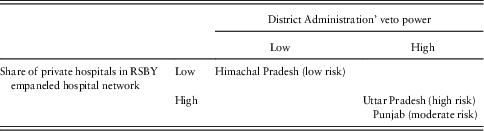
In principle, DAs’ role is limited to only suggesting hospitals for empanelment but, in reality, it has veto power, which they abuse for corrupt purposes. In return for informal payments for empanelment, private hospitals engage in fraudulent claims that lead to a cascade of opportunism and counter-opportunism by other parties. The extent of DAs’ veto power and dominance of private hospitals thus affects scope for opportunistic behavior and ultimately performance.
As shown in Table 5, the DA enjoyed broad veto power in Uttar Pradesh and Punjab and little in Himachal Pradesh. The opportunity to engage in opportunism also varied across states according to private hospitals’ share of the RSBY contracts. Thus, Uttar Pradesh relied heavily on private hospitals, which gave DAs in the state expanded opportunities for colluding with them. The SNA in Punjab, on the other hand, preferred public providers but had to accommodate users’ and DAs’ preference for private hospitals. As a result, over half of all empaneled hospitals in the state were private, which allowed ample scope for opportunism. In contrast, public providers account for around 90% of empaneled hospitals and 97% of the claims in Himachal Pradesh, which allowed little scope for opportunism. The combination of the extent of DA’s veto power and the dominance of private providers is closely reflected in the performance record of the three states.
Variations in risk of opportunism

Note: RSBY=Rashtriya Swasthya Bima Yojana.
5 Discussion and conclusion
All programs, especially social programs in developing countries, feature characteristics that make it difficult to identify and address all eventualities they will encounter during implementation. The incomplete performance contracts that emerges as a result necessitate governance measures to minimize or address the gaps during the course of the program’s implementation. If the governance measures match the core imperatives of the program design, then the program will be implemented as intended and its goals are likely to be achieved. Misguided governance response, on the other hand, will not only fail to bridge the gaps in program design but may actually aggravate them. The study of implementation of the RSBY program in the states of Himachal Pradesh, Punjab and Uttar Pradesh in India confirm these stylized expectations. The paper found that governance of implementation of the RSBY scheme was consistent with the program design in Uttar Pradesh while the opposite was the case in Uttar Pradesh, with Punjab in between the two. Variation in implementation capacity across these states played a limited role. Himachal Pradesh with only few officers at SNA could deliver high performance compared to Uttar Pradesh, which had a full-fledged team.
The extent of the DA’s veto power and the share of the contracts awarded to private hospitals were found to be particularly salient in affecting performance. With ample rent-seeking opportunities extant in the program design, DAs abuse their veto power in empanelment of hospitals and monitoring their performance, which triggers counter opportunist actions by other parties that cumulatively erode the program’s effectiveness. Their veto power forms an explosive mixture when private hospitals are the dominant providers in the state because they have material interest in engaging in corrupt behavior in collusion with DAs.
In developing countries, public–private partnerships (PPPs) and similar tools are extensively used as part of health sector reforms. However, to deliver public value, these reforms must be implemented effectively. But, implementation of reforms has received limited attention. In health policy reforms, program design has been highly emphasized but the role of implementation process in improving outcomes is consistently downplayed. The case of RSBY clearly shows that program designers need to recognize the importance of aligning the implementation process with the reform design. The reforms outcome could significantly improve if the implementation process is aligned At the same time, in many reform strategies, a particular implementation process, for example, networks, is advocated as a better approach without consideration of the context and settings, leading to incongruent governance and failures. Further public managers need incentives to adopt governance approaches like collaboration, as these are effort- and time-intensive (Frazier et al., Reference Frazier, Spekman and O’Neal1988; Lambe, Reference Lambe, Spekman and Hunt2000). In the absence of incentives, managers may end up using the governance approach that requires limited efforts. In case of RSBY, public managers, especially at the district level, continued using their old style of management (bureaucratic approach) even when new structures and processes were put in place.
This study contributes to the scant literature on effective implementation as a determinant of programs’ performance by highlighting the links between program design and implementation governance. Policymakers and scholars need to consider not only program design but also implementation design in their policy work. This study also contributes to the scant literature on governance of PPPs that have proliferated in the health care sector in emerging economies without full appreciation of the challenges they face in reality.
Acknowledgment
The author thanks the two anonymous reviewers for their critical comments.
Conflicts of Interest
None.
Funding
This work was completed as a part of PhD thesis at Lee Kuan Yew School of Public Policy, National University of Singapore, and was supported by Graduate Research Scholarship of National University of Singapore.
Ethical Standards
Ethical approval for this study was received from Institutional Review Board – National University of Singapore Institutional Review Board.