1. Introduction.
This paper analyzes the choice of the perfect auxiliary in Yiddish dialects of the 20th century. I examine the geographic distribution of zayn and hobn and show that in many cases, auxiliary selection depends on the region: Some regions prefer zayn, while others prefer hobn. As inno-vations spread across regions, synchronous geographical data provide an insight into historical developments. If an area shows a clear variation, it is reasonable to assume that one of the two forms is an innovation. Yet the coexistence of the two auxiliaries may also be systemic. To account for the use of zayn and hobn in the latter case, I apply Sorace’s Auxiliary Selection Hierarchy (ASH), which proves to be a useful tool to describe variation across varieties based on semantic categories.
It has been repeatedly claimed that many morphosyntactic structures in Yiddish were borrowed from the Slavic languages and that Eastern Yiddish is, beneath the Germanic lexical surface, a Slavic language (for example, Wexler Reference Wexler1991, Geller Reference Geller, Röll and Neuberg1999). Structures such as multiple negation, relative particles, and even analytic tense and mood construc-tions, have been declared “Slavic” although these structures are also known from Germanic varieties. The linguistic issue with such a view of Yiddish structures is that many scholars tend to ignore the strength of internal language change and are only focused on contact-induced changes. In the phenomenon of auxiliary selection discussed here, an influence of Slavic contact languages can be ruled out. Thus, this contribution shows, on the one hand, how developments in Eastern Yiddish dialects fit into the continental West Germanic continuum, and, on the other, how the present findings help one understand how language change can happen without external influences.
The data analyzed come from the Language and Culture Archive of Ashkenazic Jewry (LCAAJ). The LCAAJ is, in a sense, a still unfinished atlas project launched by Uriel and Bina Weinreich. It started in the early 1960s with interviews of over 600 Jewish immigrants born in central and eastern Europe around 1900. These interviews are based on a 200-page question book, which includes over 300 translations of full sentences into Yiddish. The LCAAJ is the largest source of data from the European Yiddish dialects spoken before the Holocaust that no longer exist. In addition to the sound recordings, the answers of the informants are documented in systematic notes the interviewers took during the interview. The interviewers used a form for their notes that orders the individual questions and applies a special transcription that aims to cover phonological subtleties (see Herzog et al. Reference Herzog, Vera Baviskar, Robert Neumann, Sunshine and Weinreich1995:1–28). These field notes have been available online since 2018.
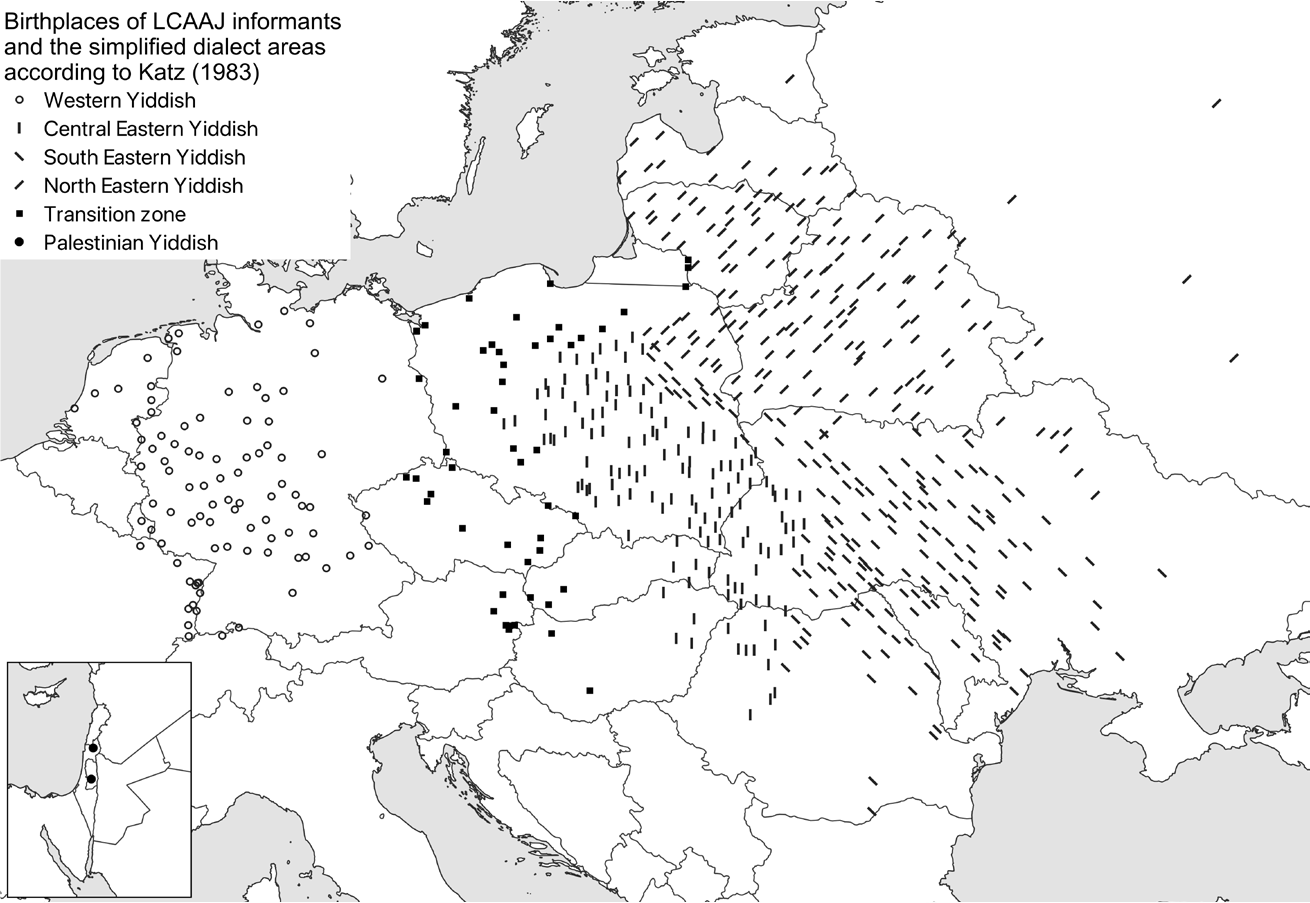
The LCAAJ material provides important evidence for the linguistic history of Yiddish. The speech of the informants reflects the state of the Yiddish dialects spoken around 1900 in Europe, where the informants were born and grew up (apart from 3 speakers who were born in Palestine).Footnote 1 Thus, the collected data can be mapped based on the birthplaces of the informants, as shown in figure 1.Footnote 2
Basemap of the LCAAJ informants.

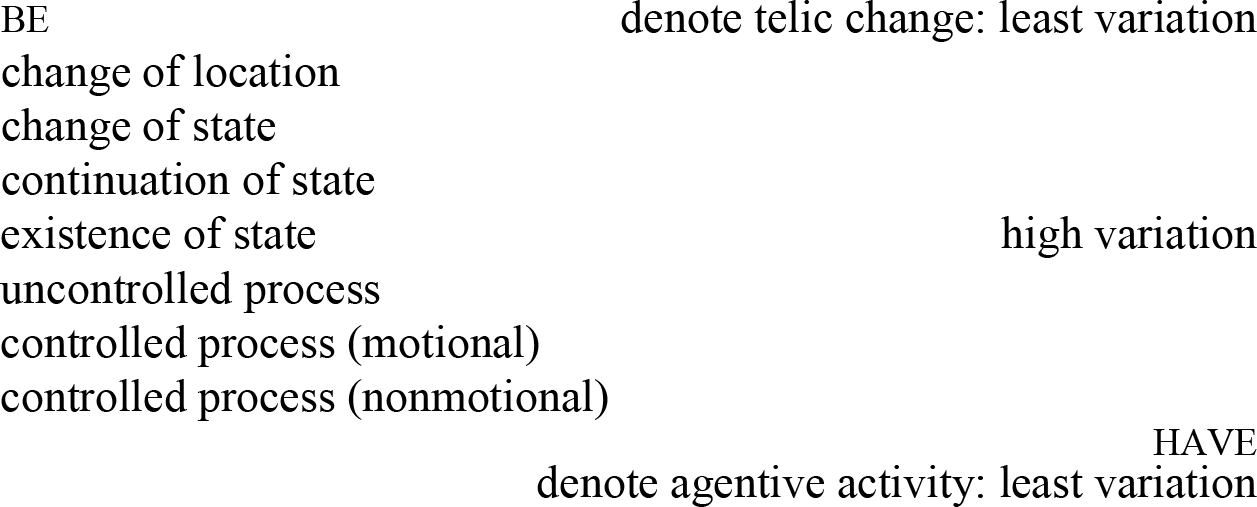
The ASH (Sorace Reference Sorace1993, Reference Sorace2000).

Since very few speakers passed their dialects on to their children, many of the varieties have already died out or merged with other dialects. The material primarily provides data on the Eastern Yiddish dialects; Western Yiddish, which was in contact with the German varieties, was largely abandoned in the course of the 19th century. In the middle of the 20th century, there were still a few speakers of Western Yiddish only in Alsace, and interviews with some of them are found in the LCAAJ. Thus, the LCAAJ does provide some data from this small area. The project Syntax of Eastern Yiddish Dialects (SEYD 2017–2022) evaluates the LCAAJ translation tasks regarding syntactic and morpho-syntactic structures, based on the field notes the interviewers took during the interviews (see Schäfer Reference Schäfer2019, Reference Schäfer, Christen, Ganswindt and Herrgen2020a). These field notes also served as the main source for the present investigation.
Following this short introduction to the topic, section 2 briefly discusses the development of the past tense auxiliaries in Yiddish and other Germanic languages and introduces the ASH. Section 3 describes the data used in the study and presents individual analyses of different verbs in the context of the ASH. Section 4 focuses on factors relevant for auxiliary selection in change-of-state verbs. Section 5 compares the findings of the present study with results obtained for other West Germanic varieties. Section 6 is a conclusion.
2. Germanic BE/HAVE and Auxiliary Selection Hierarchy.
Due to phonological changes such as unstressed vowel reduction to schwa and to a wider trend in the European Sprachbund, the Germanic languages developed analytical constructions to express tense, mode (modality), and aspect. A common development is the loss of a synthetic simple past leading to an analytic perfect construction. Initially, BE was the only past tense auxiliary, with HAVE developing later. Eventually, Yiddish inherited both auxiliaries—zayn ‘be’ and hobn ‘have’—from Middle High German (henceforth MHG).
While Modern Standard German has retained both BE (sein) and HAVE (haben), with their use being determined by syntax and semantics (see, among others, Roehm et al. Reference Roehm, Sorace and Bornkessel-Schlesewsky2013), Modern Standard English, Swedish, and some Norwegian varieties have given up BE, and so HAVE is now the only auxiliary in these languages (see Haugen Reference Haugen1976:80, Bandle et al. 2005:1592, Harbert Reference Harbert2007:304). According to Jacobs (Reference Jacobs2005:70), the Northeastern Yiddish dialects belong to this latter category and have “generalized use of hobn ‘have’ as the sole auxiliary for past tense formation”:

Jacobs’ claim is based on Herzog (Reference Herzog1965:147 and maps, p. 148), who states, on the basis of the past tense forms of three verbs (shlofn ‘sleep’, geyn ‘go’, zitsn ‘sit’), that zayn “has been almost completely eliminated” in the Yiddish of northern Poland.
The remaining Yiddish varieties, however, still use both auxiliaries, hobn and zayn. Yet, until today there has been no research on what governs the choice between hobn and zayn in these dialects. It is possible that the selection is driven by semantics and syntax, as it is in Modern German, where transitive verbs always occur with haben, while intransitive verbs vary between sein and haben (see Paul Reference Paul1902:182, Grewendorf Reference Grewendorf1989, Roehm et al. Reference Roehm, Sorace and Bornkessel-Schlesewsky2013). However, the situation in German is not that simple either: For example, there is regional variation in the use of auxiliary with stative verbs, as in Ich bin/habe gestanden ‘I stood’. This variation reflects an opposition that was originally based on (im)perfectivity: In MHG, HAVE used to express imperfectivity, as in 2a, while BE used to express perfectivity, as in 2b (see Paul 1902:172, Reference Paul2007:287–316). The examples in 2 are from MHG, cited in Szczepaniak Reference Szczepaniak2011:138–139.

In modern continental West Germanic languages, a systematic distinction between perfective and imperfective aspect no longer exists. Reflexes of the old systematic expression of im/perfectivity via auxiliary, however, still echo, as is evident from the data from the old Yiddish dialects.
Another unlikely explanation that has been discussed for the hobn/zayn variation in the Yiddish dialects is their contact with Slavic languages. This idea is held by Geller (Reference Geller, Röll and Neuberg1999:75). Modern Slavic languages are characterized by a synthetic simple past, where the past tense morpheme developed from an older analytic construction with the auxiliary bye ‘to be’. Geller’s idea is that the older analytical structure was borrowed from Yiddish. However, this historical development from the 15th century was not transparent for the emigrating Jews and could not have had any influence on Yiddish. It is therefore much more likely that Yiddish inherited analytical tense constructions (as well as mode and aspect constructions) from German: For example, perfect constructions with HAVE and BE are common already in Old High German and Old Saxon (Gillmann Reference Gillmann2016).
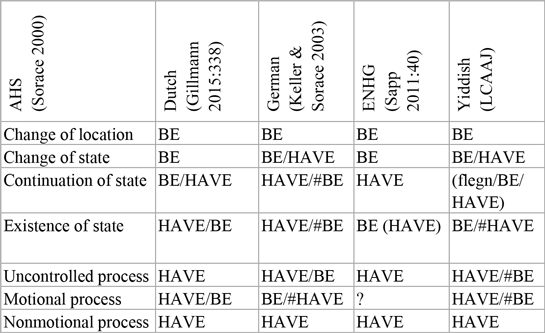
In this paper, I propose accounting for auxiliary selection in Yiddish dialects in terms of Sorace’s (2000) Auxiliary Selection Hierarchy (ASH). This hierarchy is based on her findings from Romance and Germanic languages, as well as other non-Indo-European languages, such as Japanese (for a summary, see Sorace Reference Sorace2000 and Keller & Sorace Reference Keller and Sorace2003). The ASH is a hierarchy of semantic verb classes that captures “the differential susceptibility of (monadic) intransitive verbs to gradient syntactic behavior” (Keller & Sorace Reference Keller and Sorace2003:60):
Verbs at the BE end of the Auxiliary Selection Hierarchy are core unaccusatives and denote telic change; verbs at the HAVE end are core unergatives and denote agentive activity in which the subject is unaffected. Intermediate verbs between the two extremes incorporate telicity and agentivity to lesser degrees, and tend to have a less specified (basically stative) event structure.
(Keller & Sorace Reference Keller and Sorace2003:60)
Thus, the ASH predicts that the degree of telicity determines auxiliary selection: A higher degree of telicity makes it more likely for the verb to select BE and a lower degree of telicity makes it more likely for the verb to prefer HAVE. Moreover, individual verbs within the same verb class encode telicity to variable degrees, which leads to variation within verb classes (especially within change-of-state verbs, as I show below; Sorace Reference Sorace2000:867).
The aim of this paper is to demonstrate that the Yiddish dialects fit in with the ASH: Whenever a choice is available between zayn and hobn, telic verbs tend to select zayn, whereas atelic verbs tend to select hobn. I also compare the Yiddish data on auxiliary selection with existing data from two other continental West Germanic languages, namely, German and Dutch. This comparison shows that Yiddish fits into the continental West Germanic continuum.
It should be noted that there are a number of other theories and models that have been developed specifically for Germanic languages (usually German; for example, Perlmutter Reference Perlmutter, Jeri, Anthony, Ackerman, Christine Chiarello, Gensler, Eve, Thompson and Kenneth1978, Grewendorf Reference Grewendorf1989, Shannon Reference Shannon, Joseph Emonds, Samiian and Thornburg1989, Gillmann Reference Gillmann, Kailuweit and Rosemeyer2015, Reference Gillmann2016; see also Kailuweit & Rosemeyer 2015). These, however, rely on additional assumptions that the ASH does not need (for example, form=function; broader concepts of ergativity and aspect). For purposes of this study, the ASH is the most neutral and practical tool. It allows to make fine-grained descriptive distinctions between verbs and can be applied across modern languages as well as diachronically, thus making data comparable (see Sapp Reference Sapp2011:31). Yet, as discussed in section 3.4, in some respects the ASH is not fine-grained enough either.
3. The Yiddish Data.
The LCAAJ material contains many contexts with intransitive verbs in the past tense. For the present investigation, the following 17 translation tasks were analyzed in detail (the numbers refer to the page number in the questionnaire followed by the question number):

Since the questions were not designed for this purpose, the LCAAJ data do not allow precise statements about the influence of the context on the auxiliary selection. Only controlled questions in which the same verb is tested in different contexts affected by different factors (such as animation) could yield results bearing on this. The LCAAJ data can only be used as a rough compass to determine which class of verbs prefers which auxiliary. For finer results, finer data are needed.
The selection of the specific auxiliaries in the sentences in 3 fits quite well with the ASH. As in other languages, in Yiddish there are core verbs that show categorical auxiliary selection behavior: zayn is used with change-of-location verbs, while hobn is used with controlled nonmotional process verbs. At the same time, as to be expected under Sorace’s (2000) analysis, there is a vast array of variation (indicated throughout by #) among verbs located in the middle of the hierarchy. This variation is analyzed in more detail in the following sections. An overview of the variation found in examples from the field notes is provided in Appendix.Footnote 3
3.1. Existence-of-State Verbs (Positional).
State verbs are atelic, and so according to the ASH they are expected to select HAVE as their auxiliary. However, in Yiddish, as in Southern German varieties, existence-of-state verbs mostly use zayn for past tense formation, as shown in 4. Yet there is a small region in the northern area, where Yiddish dialects do use hobn, as shown in 5.


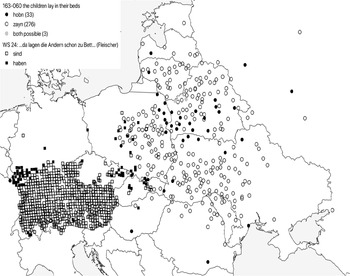
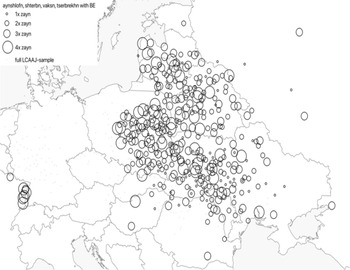
The variation exemplified in 4 and 5 shows a clear geographic pattern, as shown in maps in figures 3 and 4. Figure 3 maps the auxiliary selection in German dialects spoken in late 19th century and in the Yiddish dialects as recorded in the LCAAJ. The German data were elicited by Georg Wenker (1852–1911) using a dialect survey. Figure 3 reflects translations of sentence 24 in the survey, …da lagen die Anderen schon zu Bett… ‘the others were already lying in bed’.Footnote 4 The Yiddish data come from translations of LCAAJ question 163-060 (see 3n above).
Auxiliary selection in [the children/they] lay in bed in 19th century German dialects and in Eastern Yiddish dialects.

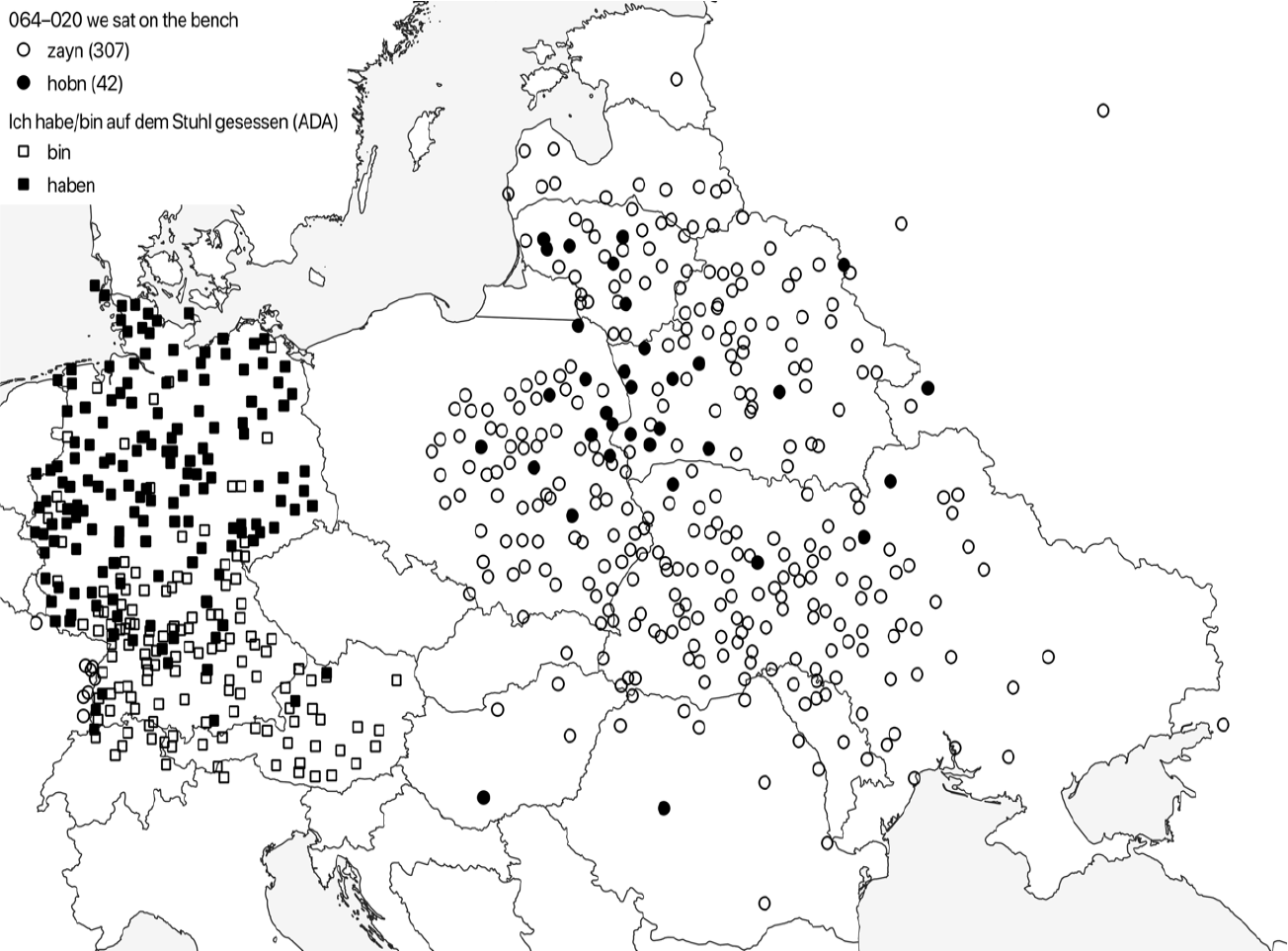
Auxiliary selection in [we/I] sat in contemporary German and Eastern Yiddish dialects.

Figure 4 maps the auxiliary selection in contemporary German and in Yiddish dialects. The German data come from lay judgments of contemporary speakers presented with a sentence from Atlas zur deutschen Alltagssprache (Atlas of Everyday German), ich habe/bin gesessen ‘I sat’.Footnote 5 The Yiddish data come from translations of LCAAJ question 064-020 (see 3e above). From the language use of German dialects in the 1880s (see Appendix) and acceptability judgments of contemporary colloquial German speakers a pattern emerges: While the southern dialects (of Yiddish and German) tend to prefer BE, some of the northern dialects prefer HAVE. This can be interpreted as a reflex of a West-Germanic dialect continuum that crosses language borders.
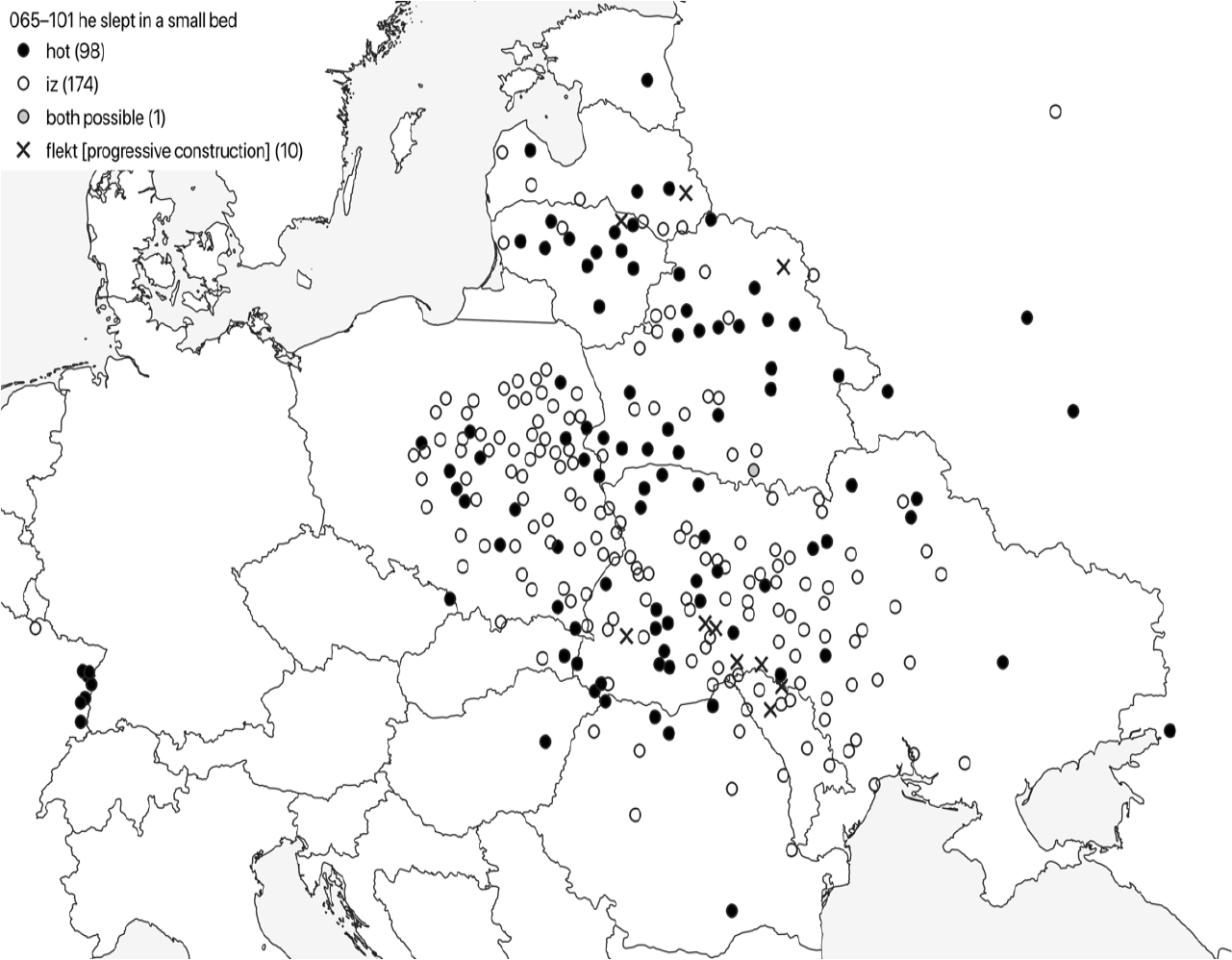
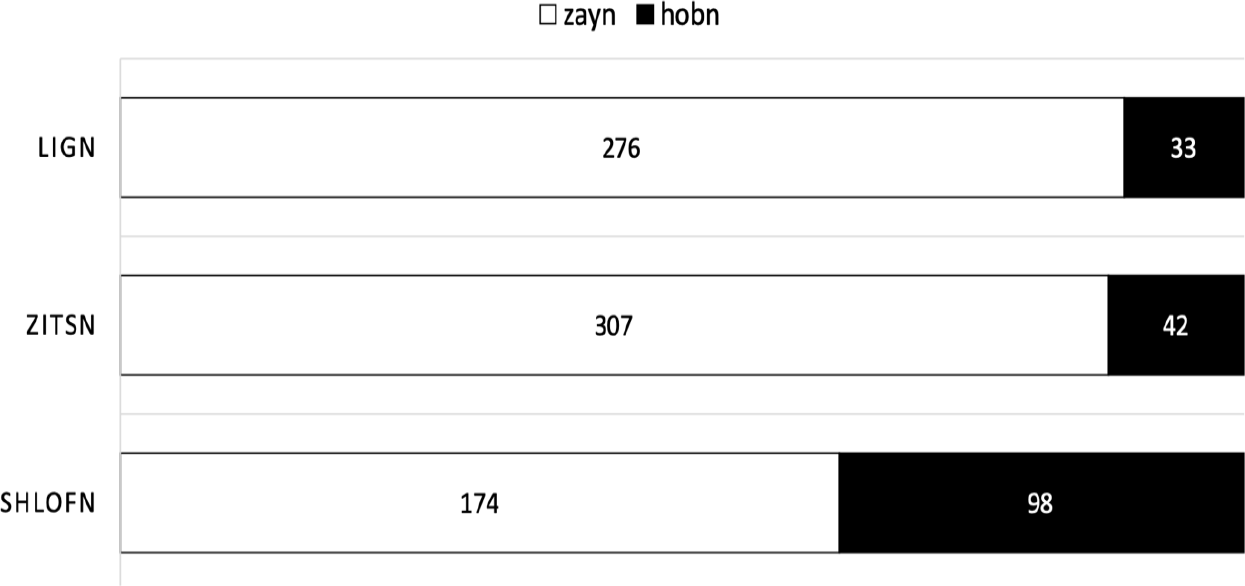
As figures 3 and 4 show, variation in auxiliary selection follows clear dialect boundaries. However, one also finds evidence for free variation within dialects. Figure 5 demonstrates the choice of auxiliary for the atelic verb shlofn ‘sleep’ while translating he slept in a small bed (see 3f above). From figure 6 it is obvious that shlofn is much more often used with hobn than lign ‘lie’ and zitsn ‘sit’—the other two verbs that can be clearly assigned to the existence-of-state semantic class. This could be due to the more atelic meaning of shlofn, especially in the context of sentence no. 065-101. From an aspectual perspective, this sentence can describe an imperfective, habitual situation. The progres-sive reading of the auxiliary HAVE when it appears with imperfective verbs is attested as early as MHG (Zeman Reference Zeman2010:195).
Auxiliary selection in LCAAJ question no. 065-101.

Auxiliary selection with (to) lie, (to) sit, and (to) sleep in the LCAAJ.

This idea is supported by the fact that question 065-101 was often translated as ‘he used to sleep in a small bed’ using the habitual construction flegn + infinitive ‘used to (V)’. It expresses a “habitual past action” (Jacobs Reference Jacobs2005:222) and is attested in the southern dialects (an example is given in Appendix). In this sense, the construction is expected to be used with continuation-of-state verbs. Under Sorace’s (2000) approach, they constitute a separate verb class and are more perfective than existence-of-state verbs. Thieroff (Reference Thieroff and Dahl2000:296–297) notes that many languages in Western and Southern Europe mark habitual aspect. Thus, Eastern Yiddish fits in very well with this Sprachbund.
It should be noted that (to) sleep is not listed in Sorace’s list of intransitives, unlike (to) sit and (to) lie, as an existence-of-state verb. In fact, (to) sleep seems to be a problematic verb for the ASH. There are several possible classifications of this verb. For example, Perlmutter (Reference Perlmutter, Jeri, Anthony, Ackerman, Christine Chiarello, Gensler, Eve, Thompson and Kenneth1978:162–163) classifies (to) sleep together with (to) cough and (to) sneeze as verbs expressing “involuntary body processes”, which would correspond to Sorace’s class of uncontrolled process verbs. This could be an explanation why the preference for hobn is higher with shlofn ‘(to) sleep’ than with the two remaining existence-of-state verbs in the Yiddish dialects. In contrast, Aranovich (Reference Aranovich2007:14) and Sapp (Reference Sapp2011:38) classify it as a continuation-of-state verb. Continuation-of-state verbs in Yiddish usually appear in the flegn-construction, as can be seen in some translations of 065-101 (he slept in a small bed). I conclude that shlofn as used in translations of 065-101 should be classified as a continuation-of-state verb. However, there are no further contexts in the LCAAJ material that would allow to make stronger statements about continuation-of-state verbs in Yiddish. On the basis of this single example—and considering that the flegn-construction might alter the verb’s semantics—no generalizations on the auxiliary selection by continuation-of-state verbs can be made.
3.2. Controlled Motional Process Verbs.
Another class of verbs that show regional variation in auxiliary selection is controlled motional process verbs. Here, the southeastern Yiddish dialects prefer zayn, as in 6, while the northern dialects prefer hobn, as in 7.


Note that this pattern is the opposite of the one found in German. In their discussion of controlled process verbs (motional), Keller & Sorace (Reference Keller and Sorace2003:87) report a significantly stronger preference for the auxiliary sein ‘be’ (p<.01) among speakers from northern Germany, while speakers from the very south did not show any significant preference for either auxiliary.
Keller & Sorace Reference Keller and Sorace2003 followed by Gillmann (Reference Gillmann2011:212) differ from older works that report a preference for sein in the south (Upper German). It is proposed that this Upper German preference for sein is an aftereffect of different shifts in the grammaticalization of the two auxiliaries between High German and Low German, in their respective historical language stages: In High German, the auxiliary sein developed earlier than hobn, whereas in Low German, sein developed later than hobn. However, these grammaticalization processes are of lesser relevance for Yiddish, which, as a daughter language of High German, remained unaffected by Low German developments.
These data demonstrate that auxiliary selection in Yiddish may not have resulted from language contact. The southern Yiddish dialects behave surprisingly less like the southern German varieties (Upper and Middle German): The Yiddish dialects prefer zayn, whereas the High German varieties show no preference. Instead, the southern Yiddish dialects are closer to the system of German speakers from the north in that they both prefer the auxiliary zayn. By the same token, the northern Yiddish varieties behave differently from the northern varieties of German in that they prefer hobn. These observations exclude a contact-induced change and are indicative of polygenetic developments.
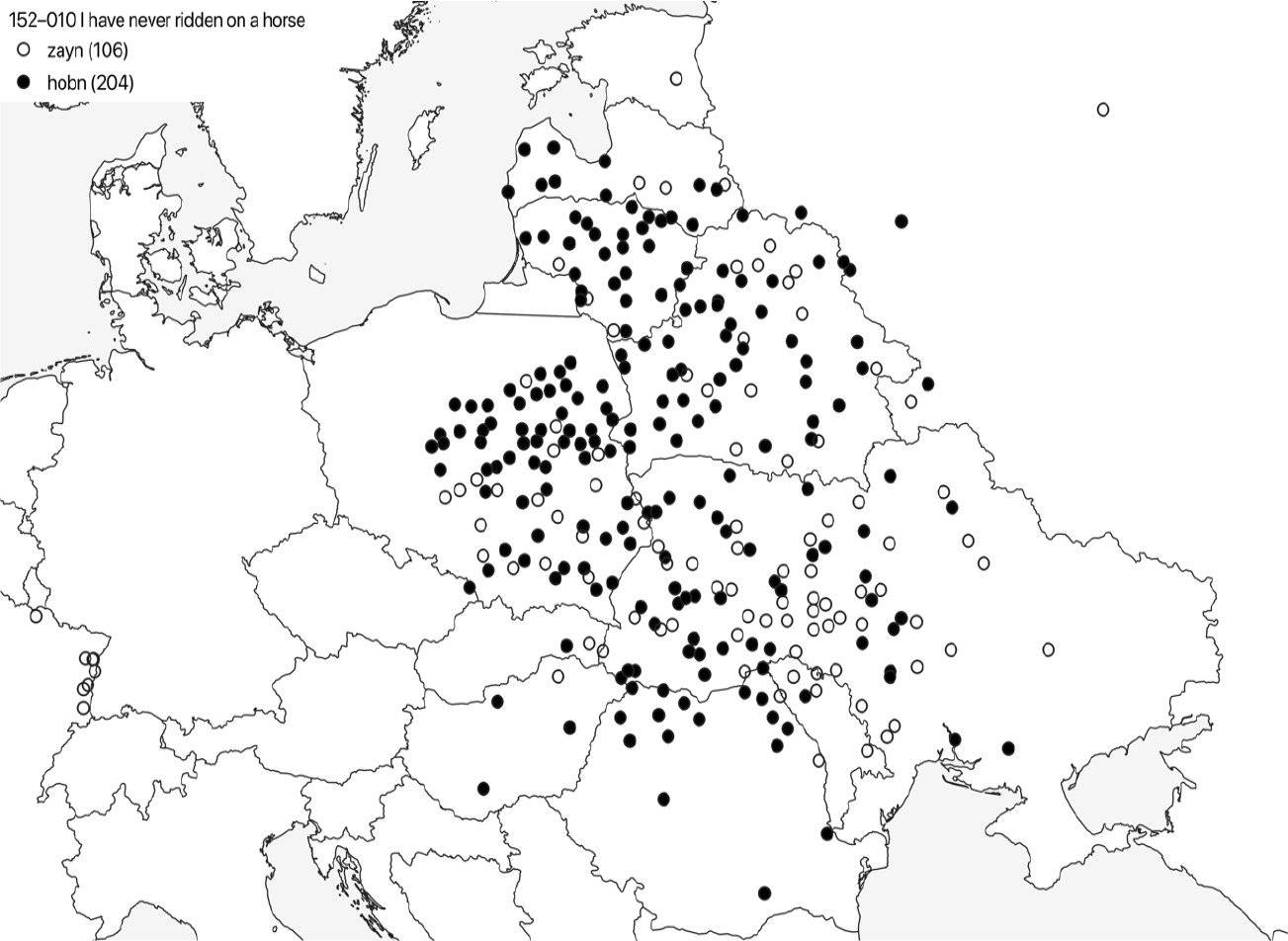
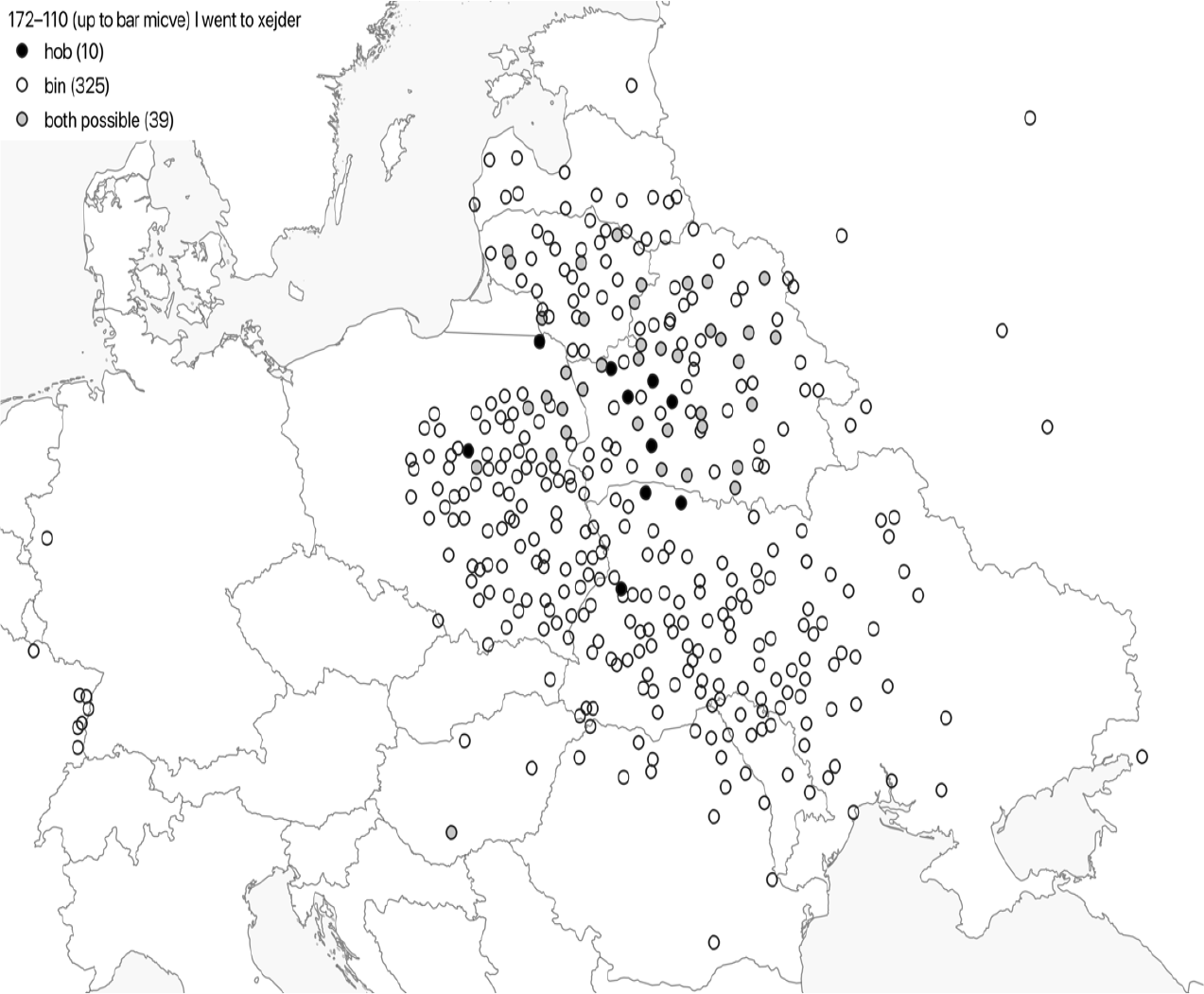
The data in figures 7 and 8 shed light on what may determine the choice of auxiliary in Yiddish. From the comparison of the translations of the LCAAJ sentences I have never ridden a horse (152-010 in 3j above) and (up to bar micve) I went to xéjder (172-110 in 3p above) a pattern emerges: Although they both contain controlled motional process predicates, that is, ride a horse and go to xéjder, Yiddish speakers from the north show a clear preference for different auxiliaries, hobn and zayn, respectively. This pattern suggests that a fine semantic distinction is at play here. Ride a horse is an atelic predicate, that is, there is no specified end point. In contrast, go to xéjder in this case is arguably a telic predicate, with the end point specified by up to bar micve. Thus, hobn is preferred with atelic predicates, whereas zayn is preferred with telic ones. These data show that the choice of auxiliary—at least, in the northern dialects of Yiddish—is governed by the telic/atelic distinction, independent of the semantic verb class.
Auxiliary selection in LCAAJ question no. 152-010.

Auxiliary selection in LCAAJ question no. 172-110.

3.3. Uncontrolled Process Verbs.
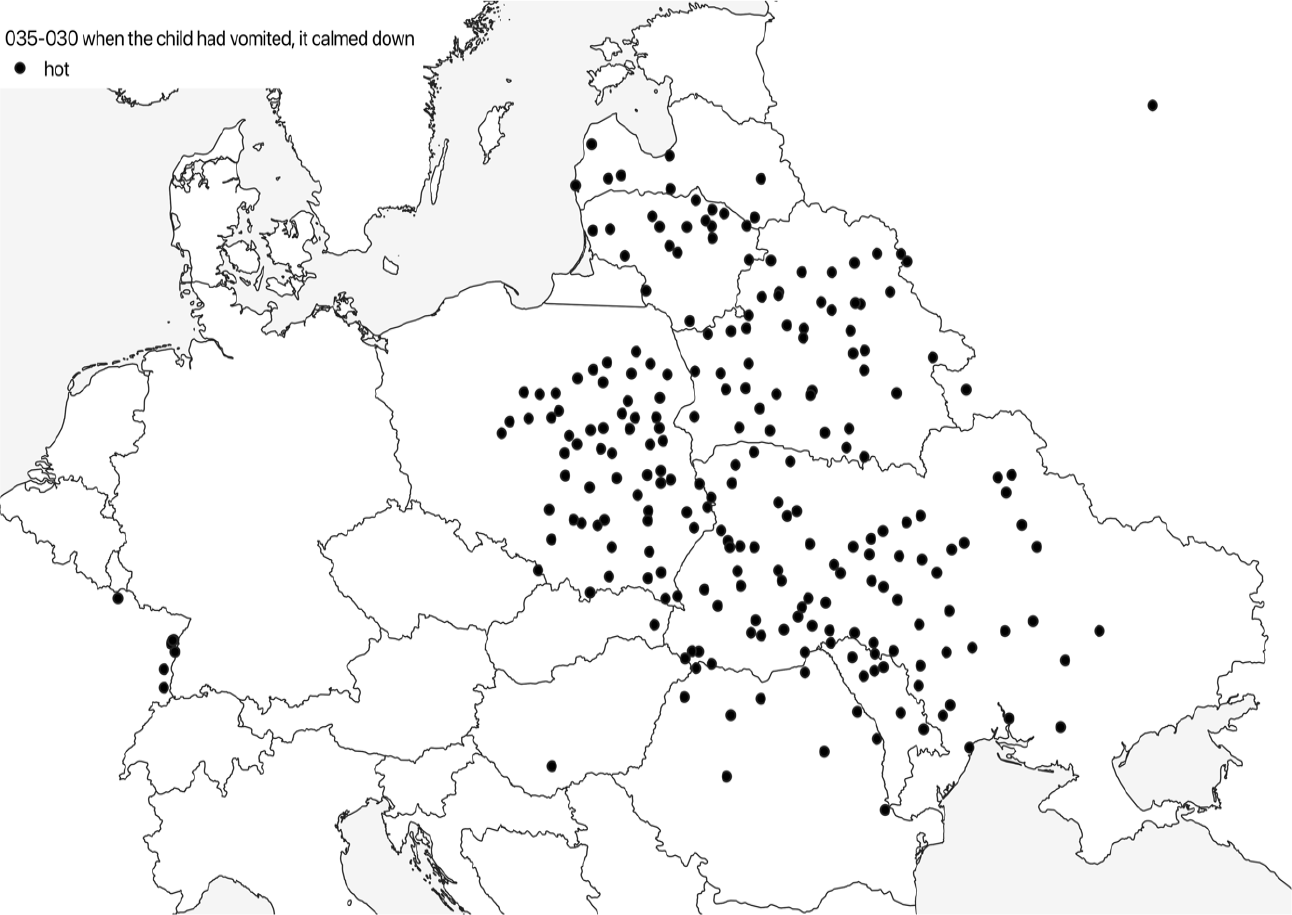
The LCAAJ material contains only a few examples of uncontrolled process verbs. In the present study, two of them were analyzed: vomit in the child had vomited (035-030 in 3c above) and happen in something happened along the way (008-030 in 3a above). Translations of sentence no. 035-030 (past perfect) systematically use hobn as the only possible auxiliary in the Yiddish dialects, as shown in figure 9.
Auxiliary selection in LCAAJ question no. 035-030.

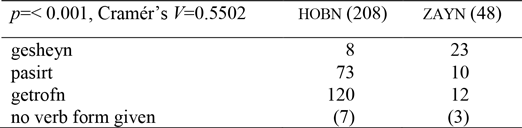
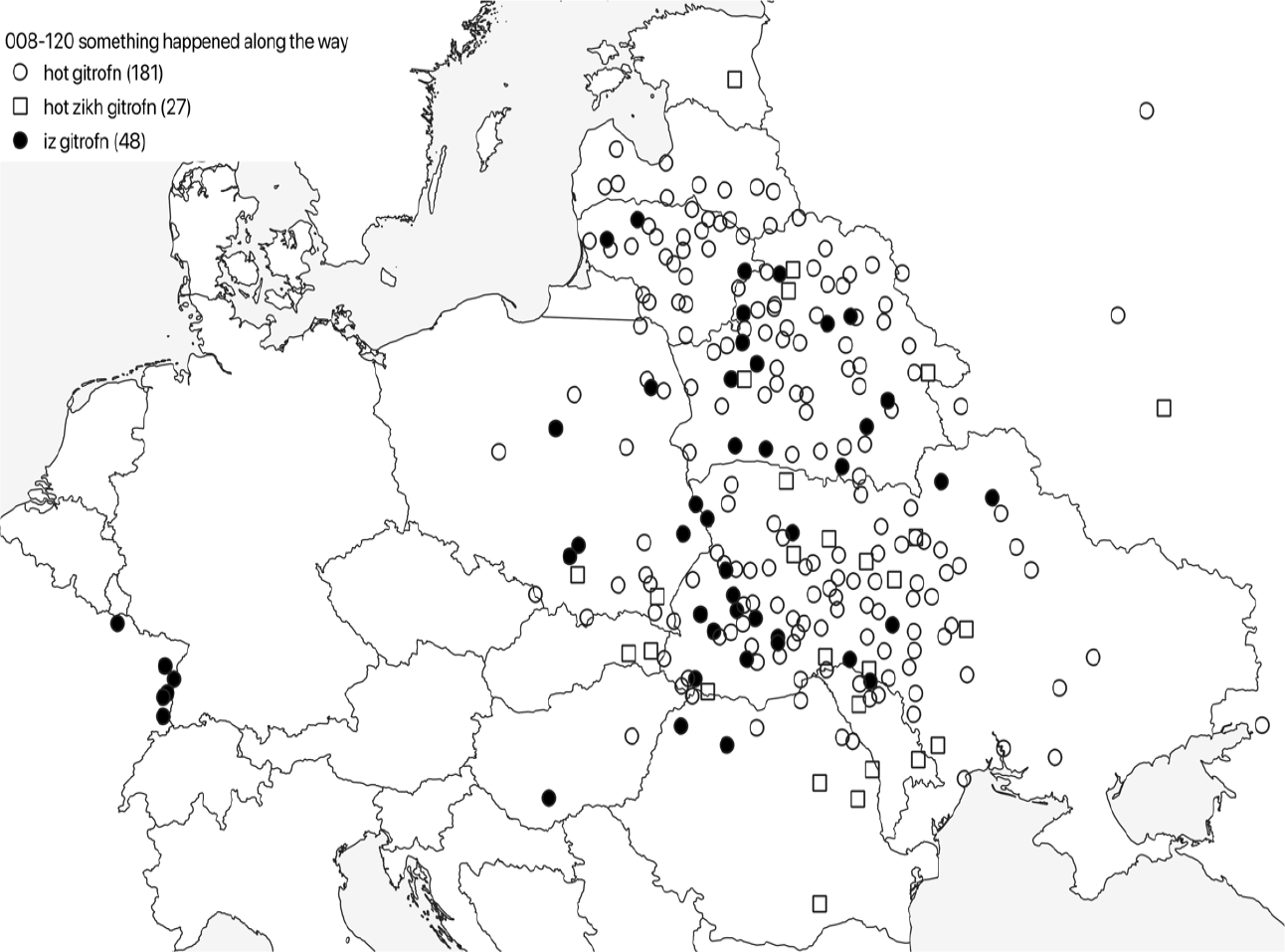
In contrast, translations of sentence no. 008-120 (simple past), something happened along the way, show dialectal variation with respect to auxiliary selection. As table 1 shows, in most cases the auxiliary hobn is used (208/256), with zayn being mainly used in the western part of the southeastern dialects, as shown in figure 10. It is possible that there are particular verbs in Yiddish that do allow only zayn (like German taumeln ‘to stagger’), but these verbs are absent in the material (see Keller & Sorace Reference Keller and Sorace2003:45).
χ2 testing a correlation between the usage of lexeme for happened and the past tense auxiliary.

Auxiliary selection in LCAAJ question no. 008-120.

Note that the verb happen can be rendered by three different verbs in Yiddish. As table 1 shows, the zayn/hobn variation appears to depend on the lexical verb: gesheyn prefers zayn, whereas pasirt and getrofn prefer hobn. However, this lexical variation is geographically motivated: The verb gesheyn, which is mainly used with zayn, is limited to the western region of southeastern Yiddish (today it is Western Ukraine), while the other two lexemes show free variation all over the language area. Thus, the choice of auxiliary is determined not by which of the three verbs is used, but by geography. Interestingly, in sentence 035-030 (see figure 9), there is no variation in the choice of auxiliary, although there are forms with verb particles (for example, oys=gebrokhn lit. ‘out=break’, op=gebrokhn lit. ‘off=broke’) and forms without.
3.4. Change-of-State Verbs.
The situation with Yiddish change-of-state verbs appears to be more complex. These verbs show the most variation in auxiliary selection. The choice between zayn and hobn seems to be affected not only by telicity but also by voice. In addition, in some contexts Yiddish seems to have preserved the (im)perfective opposition of MHG, which is also conveyed by the auxiliaries. In what follows, I examine five change-of-state verbs found in the LCAAJ: aynshlofn ‘to fall asleep’, (oyf-)vaksn ‘to grow’, tsebrekhn ‘break (in two)’, shtarbn ‘to die’, and geboyren vern ‘to be born’. In most cases, these verbs appear with zayn. However, in some contexts (see, for example, 160-160 in 3l above) hobn is used, which needs to be explained.
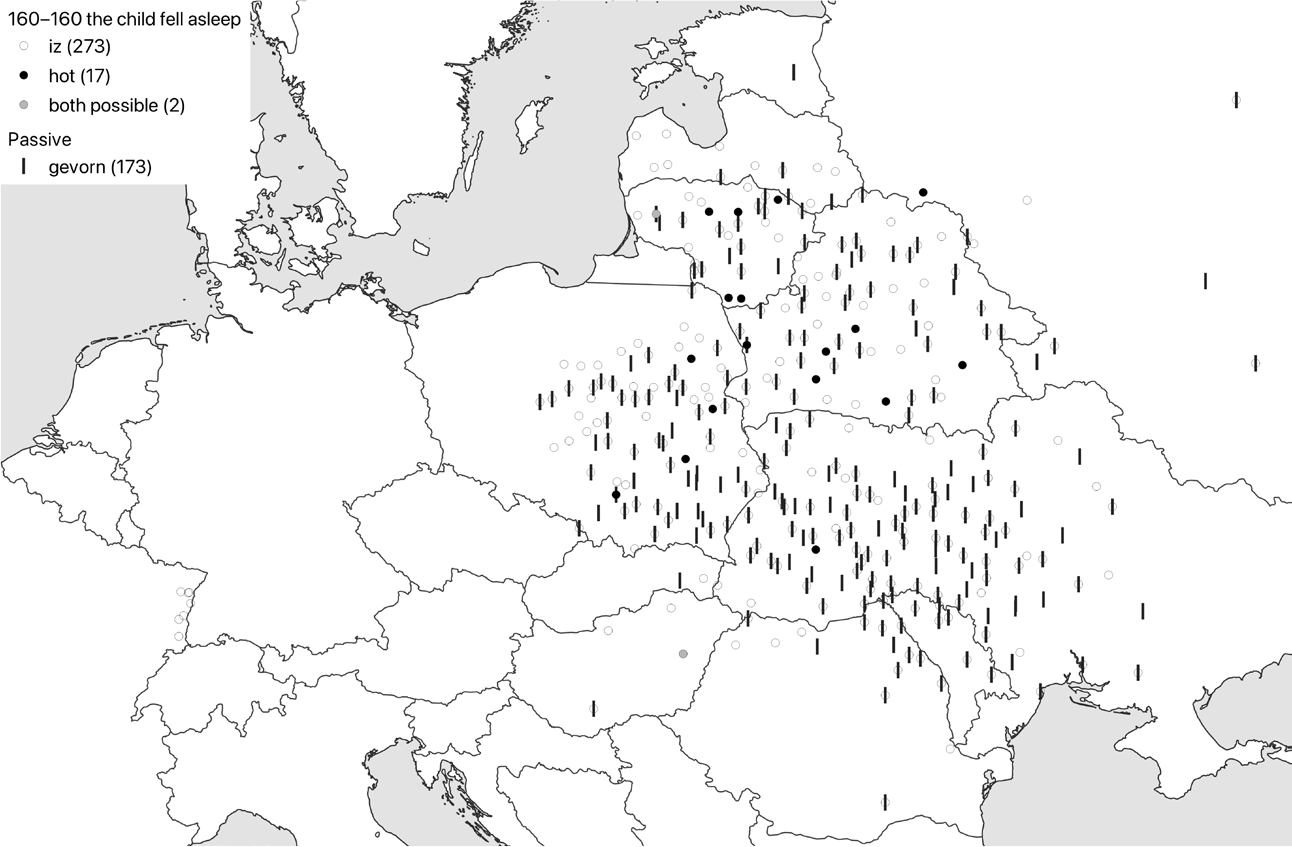
The first verb, the telic verb aynshlofn ‘fall asleep’, is used in the translations of the sentence the child fell asleep (160-160 in 3l above). The auxiliaries hobn and zayn show a slight diatopic distribution: Over-all, all dialects widely prefer zayn. However, as shown in figure 11, in the north both auxiliaries are used; in addition, two informants use both auxiliaries in the same context. This suggests that there might be semantic factors that govern the choice between hobn and zayn in this region.
Auxiliary selection in LCAAJ question no. 160-160.

As predicted by the ASH, the choice of auxiliary does appear to depend on telicity. In the case of change-of-state verbs, particles play a role: The same verb shows slightly different preference for the auxiliary zayn depending on the particle it combines with. For example, as shown in table 2, the verb ant-shlofn was used only with zayn and never with hobn (33/33); the verb ayn-(ge)shlofn was mostly used with zayn (88/18), and an-(ge)shlofn almost exclusively with zayn (144/1). Note, however, that the distribution of the particles ant- and ayn- has a geographic dimension. In particular, ant- is only used in the western area of Central and Southern Eastern Yiddish and is nearly absent from the northern dialects.
Correlation between particle and auxiliary (p=<.0001, Cramér’s V=0.3179).

In 8, the atelic verb shlofn ‘sleep’ appears with a particle, which makes it more telic, ‘fall asleep’ (on the event structure of (to) sleep and (to) fall asleep, see Teuber Reference Teuber2005:103). From the aspectual point of view, hobn in 8a conveys the imperfective meaning, whereas zayn in 8b makes the predicate perfective.

It is possible that Yiddish inherited the ability to mark the perfective/imperfective opposition using auxiliaries from older stages of German. As mentioned in section 2 (see the examples in 2), MHG marked the opposition between imperfective and perfective with HAVE (haben/hebben) and BE (sein/zijn), respectively. The auxiliaries convey the (im)perfective contrast in New High German (NHG) as well, as shown in 9.

This old (im)perfective distinction is still visible in change-of-state verbs such as trocknen/drogen ‘to dry’ and rotten ‘to rot’ (see Gillmann Reference Gillmann, Kailuweit and Rosemeyer2015:340).
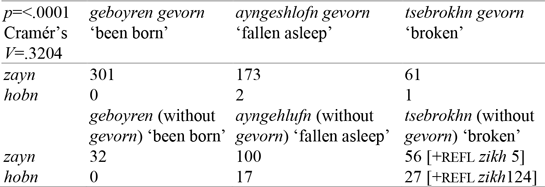
Another factor that seems to determine the choice of auxiliary is voice. The statistics shows that there is a significant correlation between the use of zayn and rendering the sentence the child fell asleep as a passive with the auxiliary gevorn ‘become’, although the effect strength (Cramér’s V) is only minimal. As shown in table 3, out of 290 translations, 175 were passive constructions with gevorn, and only two of them contained hobn. In the remaining 115 translations, the passive without gevorn was used, and 15 of those translations contained hobn. It appears from table 3 that at least for the verb aynshlofn, passive voice has more influence on auxiliary selection in periphrastic tense than the semantic properties of this verb captured by the ASH.
χ2 testing a correlation between the usage of passive auxiliary and past tense auxiliary.

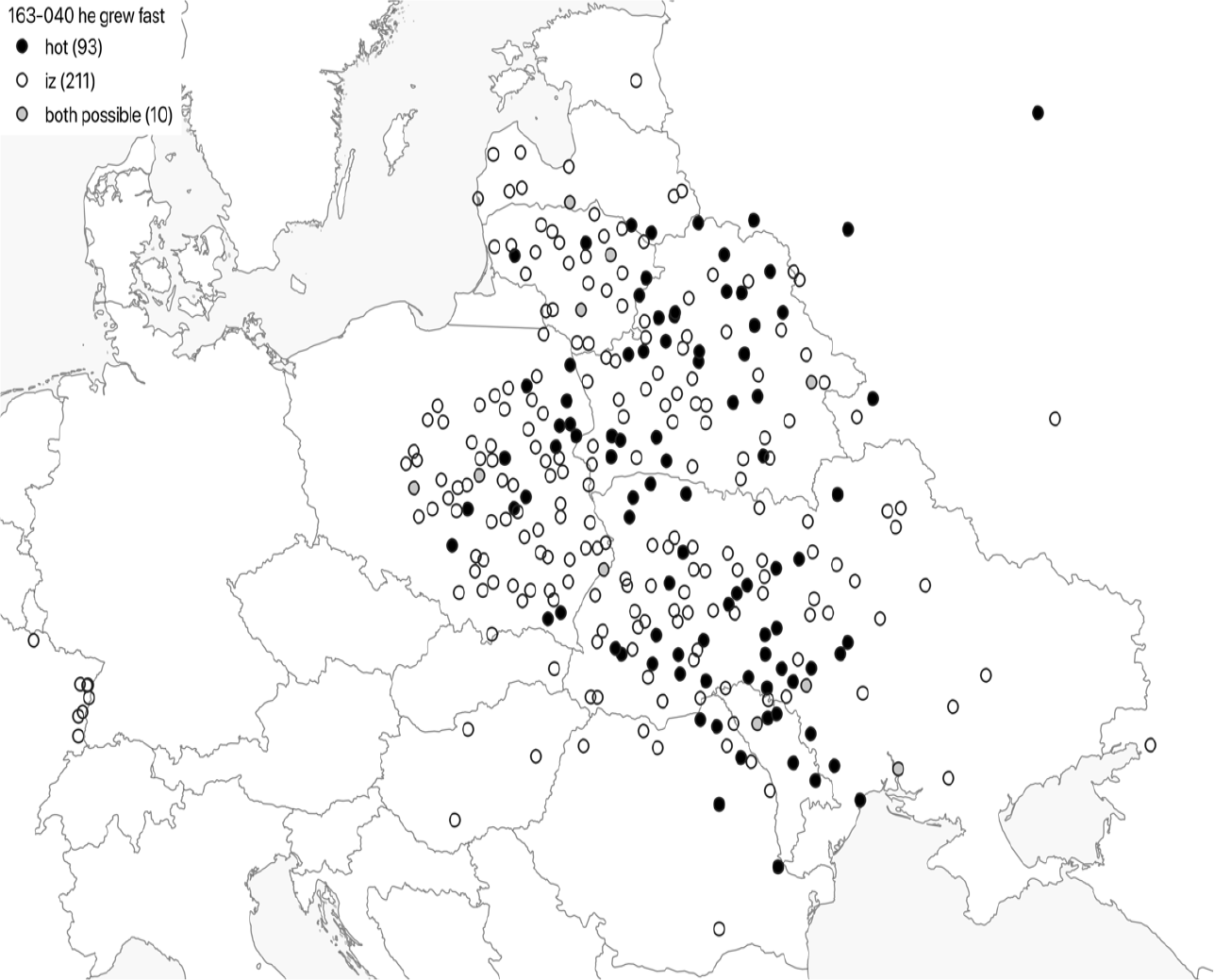
The next verb is vaksn ‘(to) grow’. Figure 12 demonstrates that the variation between hobn and zayn when used with vaksn shows nearly no geographic effect: Although there is a slight accumulation of hobn in the south, generally, hobn is possible everywhere alongside zayn. Ten informants gave both options, but without any further explanation of the difference. As it was the case with aynshlofn, it is precisely these answers that provide both variants that suggest that the sentence may have two possible readings—the change-of-state reading and the uncontrolled process reading, and that the choice of auxiliary depends on the reading the verb receives in each given case. However, the distinction between the semantics of change-of-state and uncontrolled process is not always easy to make. The question is how to interpret the semantics of vaksn in the translations of the sentence he grew fast (163-040 in 3m above). Is it necessarily a change-of-state verb or can it be an uncontrolled process verb? The manner adverb fast, in particular, could trigger an uncontrolled process reading that highlights an ingressive act (see Alexeyenko Reference Alexeyenko2022).
Auxiliary selection in LCAAJ question no. 163-040.

The English intransitive verb grow in the original sentence can be either telic or atelic, that is, it can be used to describe a change of state or a change in progress. Since according to the principles of ASH telicity matters for auxiliary selection, it is reasonable to suppose that the interpretation of English grow would determine the use of auxiliary in translation: Under the atelic reading, the translated sentence would contain hobn and under the telic reading it would contain zayn. However, there is no way of knowing whether the informants interpreted grow in the original English sentence as telic or atelic, and so in this case, it is impossible to use their translations as evidence for the role of telicity in auxiliary selection. This is where the limitations of the LCAAJ data become apparent.
The fact that certain verbs are too semantically vague to be assigned to one (and only one) verb class shows a weakness of Sorace’s model; accordingly, the verb classes used by Sorace are not to be seen as absolute categories, and they were not thought of as such by Sorace. Each verb class can be further divided into subclasses since several readings are possible. Interestingly, the verbs in the center of the ASH are the verbs that allow the most variability. They are more sensitive to the influence of different kinds of semantic factors compared to the verbs at the two end points of the scale. The choice of the auxiliary is modulated gradually by semantic features of the verb and of the predicate in which it appears (telic/atelic). Moreover, when selecting an auxiliary, unergatives are also sensitive to the animacy degree of their agent (Vernice & Sorace Reference Vernice and Sorace2018). In other words, the choice of an auxiliary is determined by where the verb is located along the continuum. Process verbs are especially sensitive to these factors when it comes to auxiliary selection (Vernice & Sorace Reference Vernice and Sorace2018:14).
Apart from the (a)telic properties of English grow, what could have influenced the choice of auxiliary in the translations is the history of Yiddish vaksn itself. Yiddish is a daughter language of High German, which, in turn, is based on MHG and Early New High German (ENHG). In the latter, wachsen ‘to grow’ was often used with HAVE, as shown in 10.

Furthermore, according to Verdam (Reference Verdam1911:241), in Middle Dutch—another continental West Germanic language—groeyen ‘to grow’ could also form its perfect tense with hebben, as in 11a. De Rooij (1988) shows that there was a change from hebben to zijn in the Dutch dialects in the 20th century, as the Modern Standard Dutch example in 11b shows.

The examples in 10 and 11 suggest that the Yiddish dialects could have preserved an older stage, in which the verb grow had a wider range of meanings. This would explain the observed variation in auxiliary use.
The LCAAJ translations also show uses of vaksn with the particle oys- ‘(to) grow up’ (with no regional bias). Note that this particle triggers a perfective reading, as shown in 12b. In the examples in 12, either auxiliary is possible, and what determines the aspectual interpretation is the particle.

Based on the percentage values alone, it looks like there is no correlation between the use of the particle and the auxiliary. However, the χ2-test suggests a significant distribution of the feature ±particle and the choice of auxiliary; but again, the effect is not very strong, as shown in table 4: Overall, zayn appears in 211 translations, with 48 of them containing the particle oys-; hobn appears in 93 translations, with 10 of them containing the particle.
Correlation between the particle oys- and auxiliary selection.

Auxiliary selection and passivization.

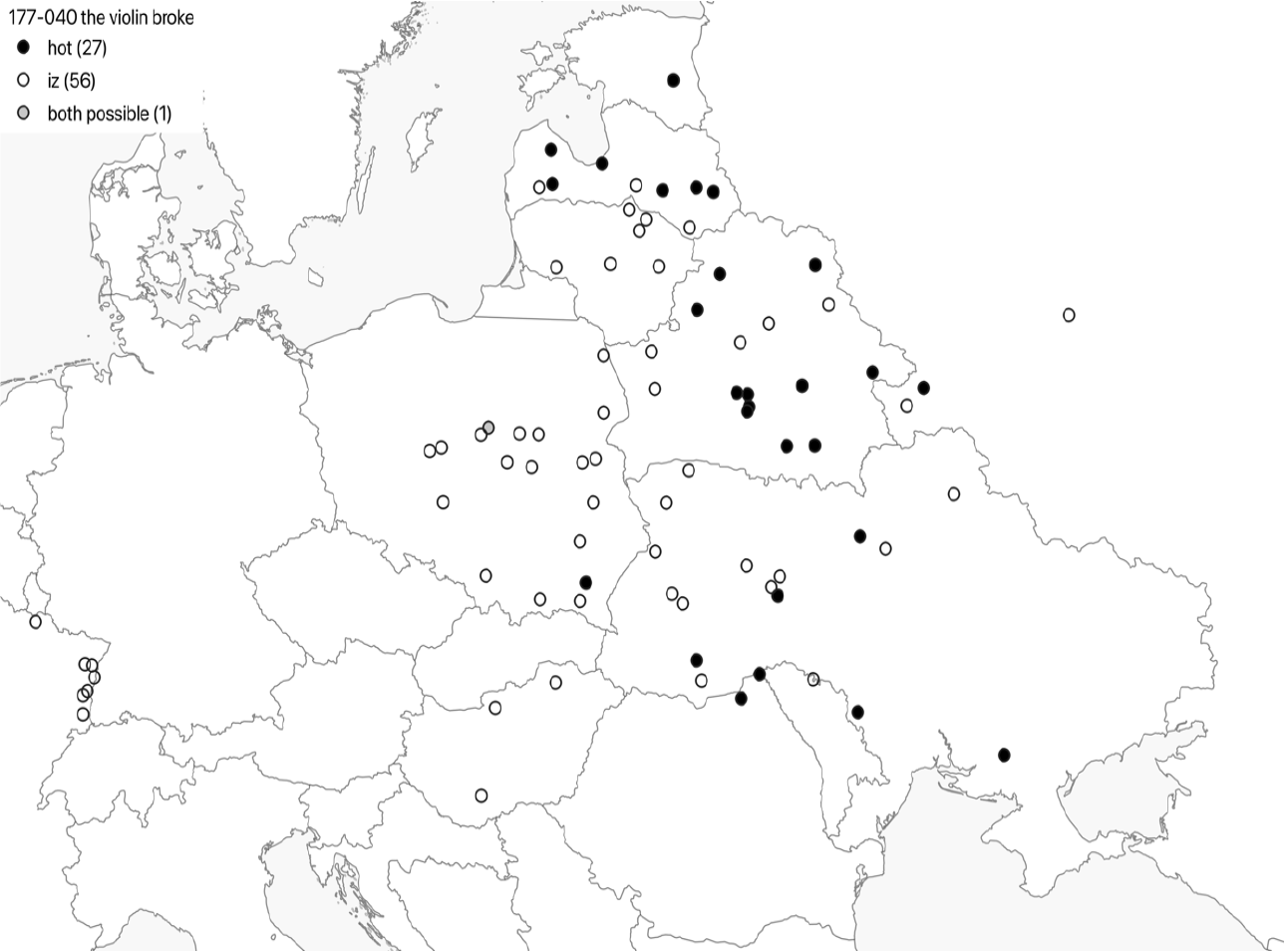
The next verb on the list is tsebrekhn ‘(to) break’. In translations of the sentence the violin broke (in 3o, 177-040), a completely different spatial distribution can be recognized: New formations with hobn are especially frequent in the east, while zayn is frequent in the west, as shown in figure 13.
Auxiliary selection in LCAAJ question no. 177-040.

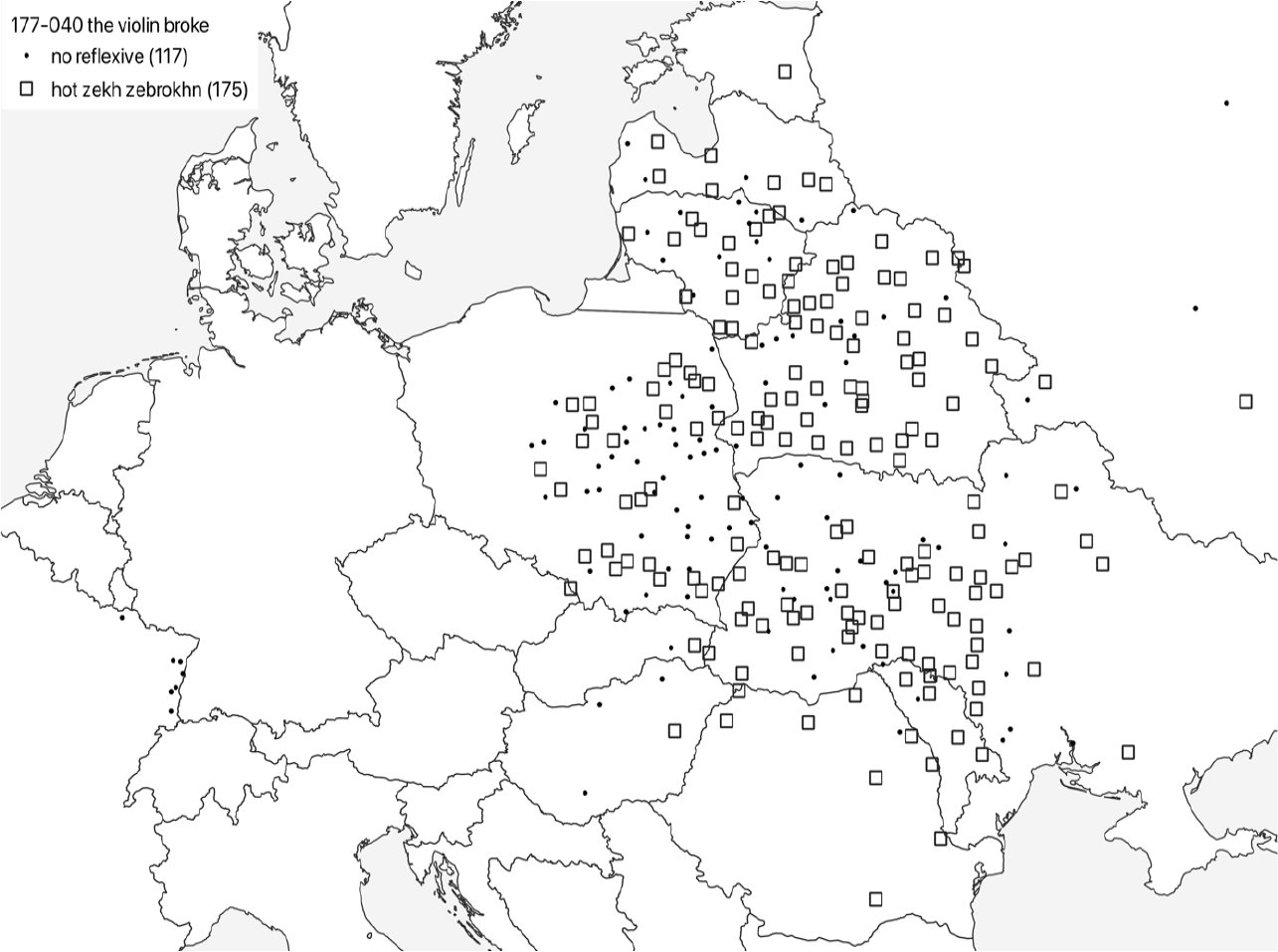
However, there are alternative constructions with tsebrekhn, such as constructions with the reflexive zikh, for example, di fidl hot/#is zikh tsebrokhn, and passive constructions, as in di fidl iz/#hot (zikh) tsebrokhn gevorn, that are not captured in figure 13. In the reflexive constructions, hobn is used (see figure 14). There is also only one case of passivization, hot tsebrokhn gevorn (in Northeastern Yiddish). This passivization construction is discussed in more detail below.
Auxiliary selection in reflexive constructions in LCAAJ question no. 177-040.

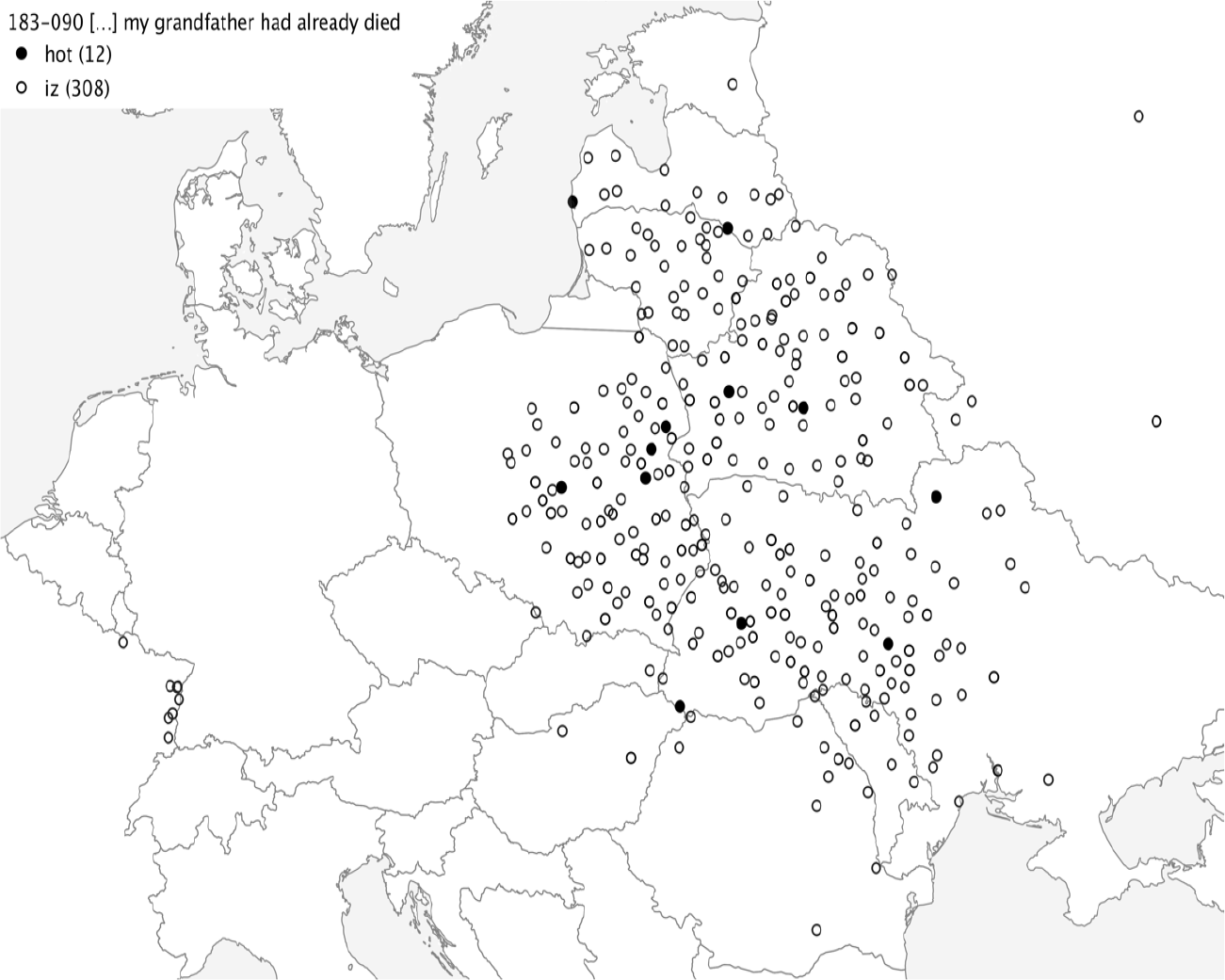
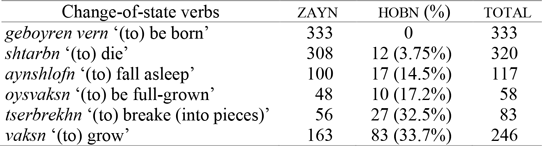
The two final verbs are shtarbn ‘(to) die’ and geboyren vern ‘(to) be born’. These two change-of-state verbs were used in the translations of the sentence when I was born my grandfather had already died (3r, 183-090). The verb shtarbn was used 308 times with zayn and only 12 times with hobn, with absolutely no geographic preference. Note that shtarbn is used in the pluperfect, which could have influenced the choice of auxiliary: As discussed earlier in this section, passive structures have an overwhelming preference for zayn as well, regardless of the semantic properties of the main verb. It is possible that the pluperfect tense works in a similar way, that is, the marking of tense using a particular auxiliary is more important than the grammatical expression of telicity. The verb geboyren is part of a fixed passive structure in Yiddish, that is, geboyren vern, which in the entire data set is formed exclusively with zayn. The results on shtarbn and geboyren vern are provided in figure 15.
Auxiliary selection in LCAAJ question no. 183-090.

To sum up the discussion so far, in section 3 perfect tense contexts from the LCAAJ material were investigated. I examined auxiliary selection among Yiddish intransitive verbs that belong to the following semantic classes: existence-of-state verbs, controlled process verbs, un-controlled process verbs, and change-of-state verbs. According to Sorace (Reference Sorace2000), verbs that belong to these semantic classes occupy different locations along the ASH, which predicts their behavior with respect to auxiliary selection. It turns out that the Yiddish dialects vary, sometimes significantly, when it comes to auxiliary selection among these verbs. Most notably, change-of-state verbs exhibit significant variation depend-ing on the context of use, although geographic variation is also observed. In the next section, I analyze Yiddish change-of-state verbs in more detail to gain a better understanding of what actually governs this variation.
4. Auxiliary Selection Factors in Change-of-State Verbs.
Yiddish change-of-state verbs show most variability with respect to auxiliary selection compared to the other verb classes examined in this study. Their auxiliary selection depends not only on telicity, but also on voice and perfectivity. This section contains a more detailed discussion of the factors that influence auxiliary selection in case of the change-of-state verbs geboyren ‘(to) be born’, aynshlofn ‘(to) fall asleep’, tsebrekhn ‘(to) break’, vaksn ‘(to) grow’, and shtarbn ‘(to) die’. The questions that emerge from the LCAAJ data are as follows:
-
(i) What is the influence of passivization?
-
(ii) What role does telicity play?
-
(iii) What is the impact of (im)perfectivity?
-
(iv) (iv) Can systems (and even system areas) be identified?
First, it is well known that voice and valency matter for auxiliary selection in general (Keller & Sorace Reference Keller and Sorace2003, Plank & Lahiri Reference Plank and Lahiri2015). It is reasonable to suppose, therefore, that in Yiddish, the auxiliary might change when the construction is passivized. In my data, three of the change-of-state verbs are frequently used in their passive forms. In the Yiddish dialects, passivization seems to trigger the use of zayn. Yet the data do not show a statistical effect for a correlation between auxiliary selection and the passivization of the verbs aynshlofn and tsebrekhn (p=0.7083, Cramér’s V=0.0184). This result may be related to the size of the sample. If the data on geboyren vern, which is never used with hobn, are included, one is tempted to simply say that passivization boosts the use of zayn. However, this preference for zayn can also be caused by the semantics of the verb class (change of state).
Moving on to telicity, to test its role in auxiliary selection one needs to examine the first and most important factor, that is, the particle. It is known that particles affect the telicity of the predicate, at least in the case of morphologically simple atelic verbs: The addition of a particle tends to make such verbs telic (see van Hout Reference Hout1996, Reference Hout, Tenny and Pustejovsky2000). If telicity plays a role in auxiliary selection, then particle verbs in Yiddish are expected to show preference for the same auxiliary. The LCAAJ data suggest that this is indeed the case: Two particle verbs, oysvaksn and aynshlofn, behave in the same way with respect to auxiliary selection. They show a strong tendency to appear with zayn, although there are still about 15% of cases when hobn is used (see table 6). The particle verb tsebrekhn, in contrast, shows a different behavior and appears with hobn more frequently. This may be because the simple verb brekhn is telic, whereas the verbs vaksn or shlofn are atelic (or at least can have an atelic reading in the case of vaksn).Footnote 6 Thus, the telicity effect of the particle tse- in tsebrekhn is less transparent than that of the particles oys- and ayn- in oysvaksn and aynshlofn, respectively.Footnote 7 Overall, the data show that in Yiddish, the auxiliary zayn is used more frequently with telic verbs—with or without a particle—than hobn, as shown in table 6.
Auxiliary selection and change-of-state verbs.

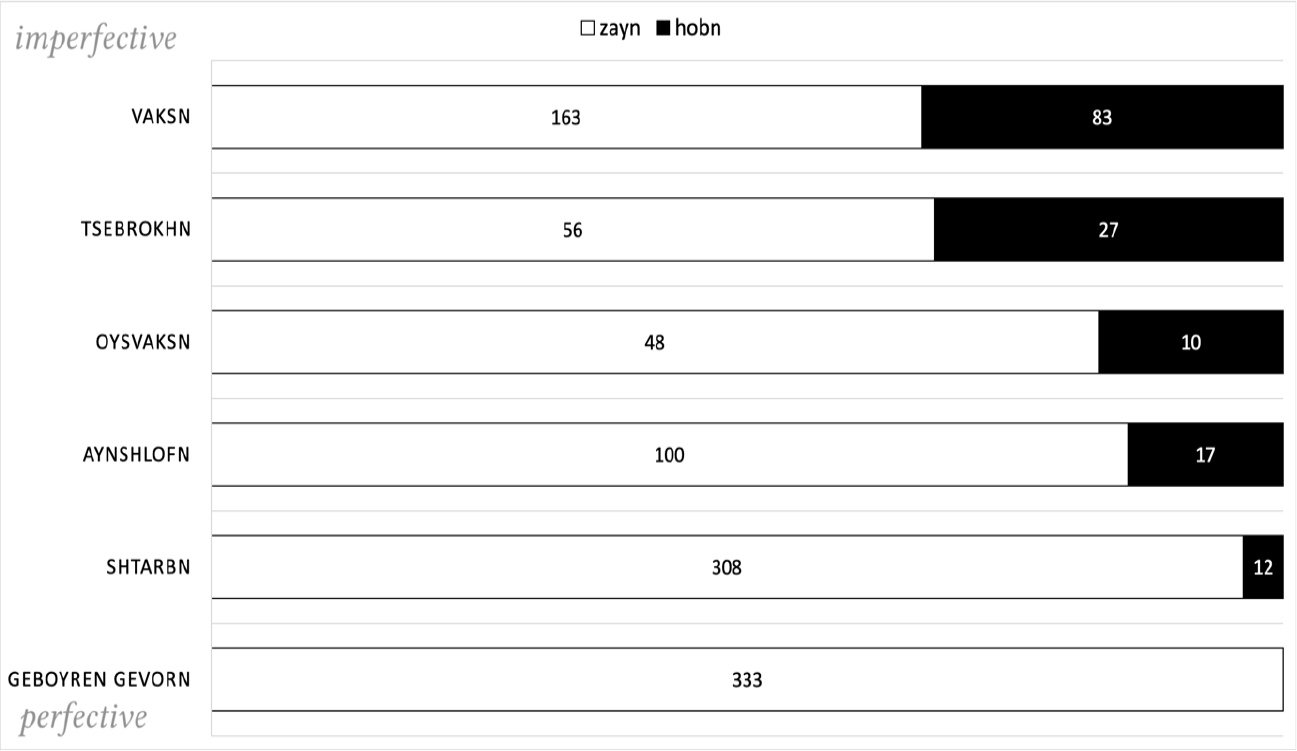
The third factor that may determine auxiliary selection in change-of-state verbs is (im)perfectivity. As mentioned earlier, I assume perfec-tivity to be a matter of degree (by analogy with transitivity or telicity; see Hopper & Thompson Reference Hopper and Thompson1980), which is determined by the semantic properties of the verb, and in particular, the nature of the change the verb denotes. For example, I consider a verb such as shtarbn ‘die’ to be more perfective than a verb such as vaksn ‘grow’. The verb shtarbn denotes an unambiguous and irreversible change: Someone is either dead or not, and when someone dies they remain dead. In contrast, the verb vaksn denotes a change that is a matter of degree: One can grow fast or slow, one can stop growing, be more grown, etc. The verb tsebrokhn ‘break’ can also have different interpretations: For example, the degree of perfectivity of broken in the violin is broken depends on whether or not the violin could be repaired.
The morphologically simple verbs in figure 16 are ordered along a range of perfectivity based on their inherent semantics. A look at their auxiliary selection shows that the principle known from MHG is still slightly at work here: Verbs with a more perfective meaning require zayn and verbs with a more imperfective tendency show a higher number of hobn. Overall, it appears that the MHG (im)perfectivity principle still continues to operate in the 20th-century Yiddish dialects. However, the LCAAJ survey method and the context of the sentences are not designed to capture these semantic nuances clearly and without fault. This methodological limitation may also be the reason why the areal distribution of hobn with change-of-state verbs appears not to be systematic.
Zayn/hobn with change-of-state verbs (excluding passive forms other than geboyren gevorn).

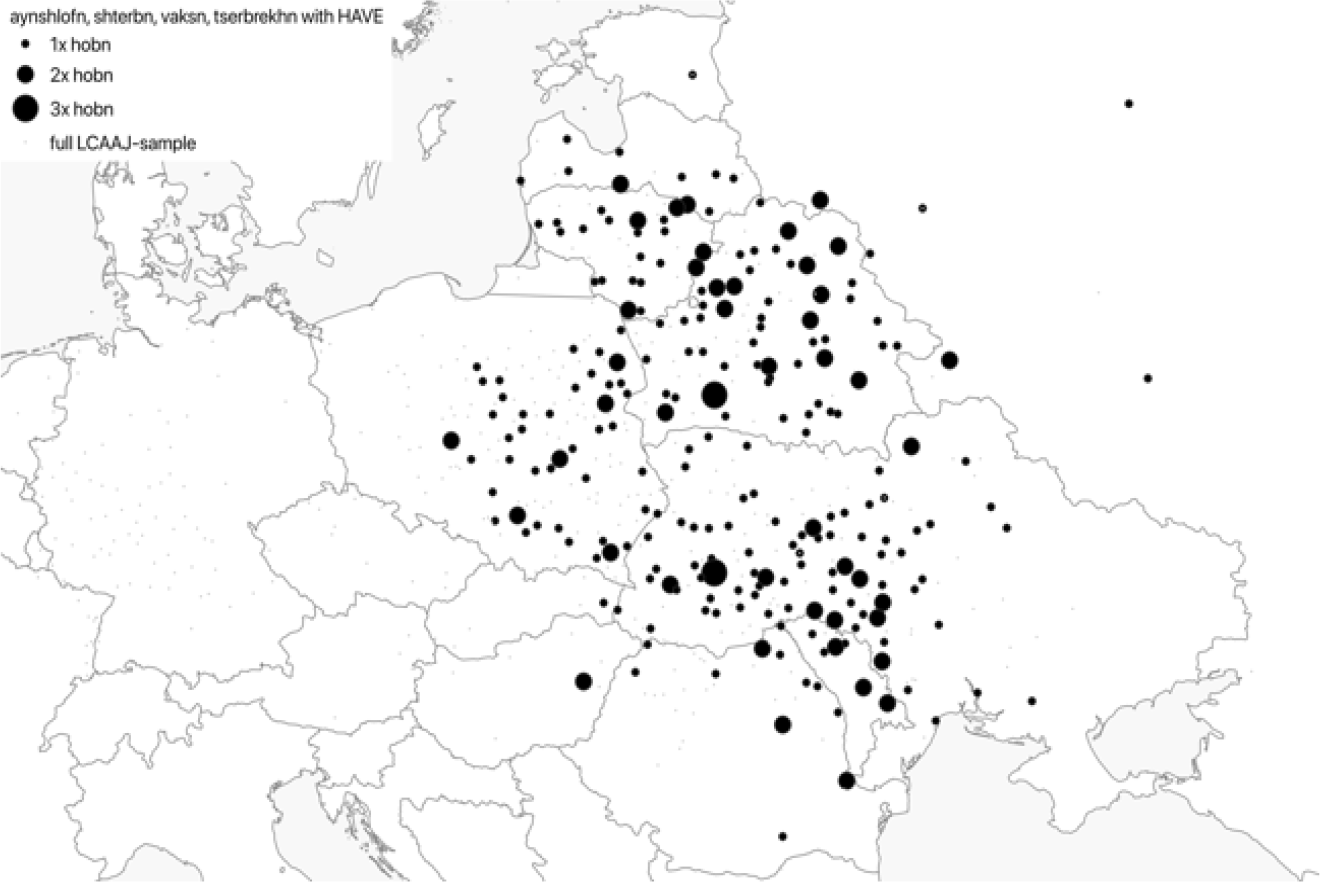
This brings me to the last question, namely, whether any system areas can be identified. As the maps in figures 17 and 18 show, hobn and zayn can be used everywhere in the Eastern Yiddish dialects with change-of-state verbs.Footnote 8 The auxiliary selection is neither location- nor speaker-specific. Only a slightly higher frequency of hobn in the eastern part of the language area can be seen, in particular in the southern and northern regions. This is, in a way, a more conservative area, which is not that much influenced by Modern German. In contrast to the dialects of the eastern language area, the more western dialects were in closer contact with Modern German. It is possible that in the conservative regions, the MHG perfective/imperfective distinction was still maintained at the time of the survey. An important result is that no interview shows an exclusive use of hobn with all of the verbs examined; zayn is the most frequent auxiliary with change-of-state verbs. This is to be expected, according to the ASH.
Hobn as an auxiliary with change-of-state verbs.

Zayn as an auxiliary with change-of-state verbs.

To account for the high variability in auxiliary selection among Yiddish change-of-state verbs, I propose an interpretation of the ASH as a self-similar structure. In a self-similar structure, the structure of any of its parts is similar to the structure of the whole. In the context of the ASH, this means that the general principle to place telic verbs on one end and atelic ones on the other would apply to any portion of the hierarchy, including its central part. Under this view, change-of-state verbs are placed in the middle, with the most telic ones occurring at one end of the central part and the most atelic ones occurring at the other end. Accordingly, the most telic change-of-state verbs select the auxiliary zayn, whereas the atelic ones select hobn. At the same time, these verbs still belong to the same semantic class, which creates the variability effect. This proposal can be easily tested in detailed studies on other verb classes and, of course, in other languages.
5. Yiddish and Other Germanic Languages.
The auxiliary use with intransitive verbs in the LCAAJ data is consistent with the ASH, and in most cases, the Yiddish dialects function like related varieties. The ASH has already been tested on a broad typological basis and is flexible enough to allow for language-specific assumptions. I have shown that in the Yiddish dialects, the use of auxiliaries with controlled motional process verbs and existence-of-state verbs shows a geographic distribution. Yet these results do not suggest a geographic continuum of the West Germanic languages, but rather a systemic continuum. Although the Yiddish dialects have followed their own development path, from the microtypological perspective, their auxiliary selection pattern fits perfectly into the general system of continental West Germanic languages (see table 6 below). In existence-of-state verbs and controlled motional process verbs, Yiddish, unlike other modern Germanic varieties, seems to maintain the perfective/imperfective oppo-sition marked by the auxiliaries zayn and hobn, respectively. This means that the variation in auxiliary selection in the Yiddish dialects could be system-related: In some dialects, the MHG (im)perfectivity contrast is more robust in some verb classes than in others.
Focusing on the diatopic variation in the findings, two variation patterns stand out. First, one auxiliary is preferred over the other in a relatively clearly defined geographical area—namely, the western North-eastern and the eastern Central East dialects prefer the auxiliary hobn slightly more often than the dialects spoken in the rest of the language area. This preference for hobn is especially noticeable with existence-of-state verbs and some controlled process motional verbs. However, there is no variety in those regions that uses hobn exclusively.
Second, there is general, geographically uncoordinated, or so-called fuzzy variation between zayn and hobn, which is found in all the other regions. The second variation pattern is only exhibited by verbs from the middle of the ASH, that is, verbs that are more flexible with respect to (a)telic/(im)perfective interpretation. This observation suggests two possible explanations. First, it is possible that at the time of the survey the language was undergoing a change, and so there was variation among speakers with respect to interpretation of different verbs. As a result, one and the same verb could occupy different positions along the ASH, depending on the meaning assigned by a particular speaker. This would explain the coexistence of forms, that is, the use of both zayn and hobn in the same context. This hypothesis could be tested with new surveys, but since the dialects no longer exist in this form, a direct comparison with dialects of modern Yiddish would not be valid: The new dialects represent a mixture of the old dialects and are very much influenced by new contact languages.
An alternative explanation proposed at the end of section 4 is to understand the ASH as a self-similar structure. This view of the ASH makes it flexible enough to accommodate the verbs in the center, which allow for either telic or atelic reading. Each speaker applies the principle of the ASH—that is, telic verbs on one end and atelic ones on the other—to the central portion of the ASH, and assigns an auxiliary based on where any given verb is placed within the central portion.
The present study has provided evidence for a more nuanced semantic system that controls the usage of the two auxiliaries, in particular, with change-of-state verbs. This evidence is consistent with the ASH and is one of the contributions of this paper. In my opinion, a finer differentiation within the change-of-state class is necessary to capture the variation in the West Germanic varieties. Overall, however, the validity of the ASH could be confirmed once again (now with data from Yiddish dialects). The findings also undermine earlier statements that there are dialects in the north where hobn has become the only past tense auxiliary. Such a Yiddish dialect, with hobn as the sole perfect tense auxiliary, could not be found in the LCAAJ.
Comparing the data from Yiddish dialects and Standard German from the 20th century with ENHG data (Sapp Reference Sapp2011), it is noticeable that German and Yiddish have not developed differently in principle, as shown in table 7. At least early ENHG still had a very strong influence on Yiddish, and so in a certain sense it is reasonable to consider ENHG a donor language for Yiddish (see Timm Reference Timm2005). Sapp (Reference Sapp2011:40–41) concludes that German has remained relatively stable diachronically compared to other (Germanic) languages, and so has Yiddish.
The ASH in Germanic languages (#=dialectal variation).

The synchronic and microtypological (that is, inner Germanic) vari-ation in Yiddish dialects may shed light on diachronic developments: It is reasonable to suppose that synchronic and micro-typological vari-ables are more involved in diachronic processes than linguistic features that appear stable. Under this approach, language change would be expected to occur primarily in verbs at the center of the ASH and less so at the “stable” edges. The strong variation in the verb classes in the middle of the ASH indicates that in Yiddish, auxiliary selection is hardly done via lexicalized constructions, as is the case, for example, in the standard Germanic languages. Yet, in Yiddish, (a)telicity and (im)per-fectivity are still at work as it was in MHG and later in ENHG (Sapp Reference Sapp2011:38).
6. Conclusion.
In the present analysis of data from the LCAAJ, I demonstrated that Yiddish dialects show clear variation geographically and systemically in the choice of their perfect auxiliary, as is also the case in other Germanic varieties. Yiddish thus fits into the Continental West Germanic dialect continuum. Particularly regarding change-of-state verbs, I have proposed to understand the ASH as a gradual and self-similar structured scale. However, it also became clear that there is interaction between various analytic elements that convey telicity and mark tense, mood, aspect, and voice, which needs to be investigated in more detail. Here, the limits of the LCAAJ are encountered. The LCAAJ material provides large-scale data; due to the limited and semantically not always well-balanced contexts, however, stronger statements about auxiliary selection in the old Yiddish dialects are not possible. Yet, the results obtained here can serve as a starting point for more detailed surveys, conducted, for example, among speakers of the modern Yiddish dialects.
APPENDIX Evidence from the LCAAJ and the ASH