INTRODUCTION
The mollusc-transmitted parasitic nematode Angiostrongylus vasorum (Nematoda: Metastrongyloidea) has been reported to infect various species of canid definitive host (Bolt et al. Reference Bolt, Monrad, Koch and Jensen1994) including dogs (Canis lupis familiaris), red foxes (Vulpes vulpes), pampas foxes (Pseudalopex gymnocerus) (Fiorello et al. Reference Fiorello, Robbins, Maffei and Wade2006), hoary zorro (Pseudalopex vetulus) (Lima et al. Reference Lima, Guimaraes and Lemos1994), crab-eating foxes (Dusicyon thous), wolves (Canis lupis) (Segovia et al. Reference Segovia, Torres, Miquel, Llaneza and Feliu2001) and coyotes (Canis latrans) (Bourque et al. Reference Bourque, Whitney and Conboy2005). Its distribution extends through Europe (Bolt et al. Reference Bolt, Monrad, Henriksen, Dietz, Koch, Bindseil and Jensen1992; Gortazar et al. Reference Gortazar, Villafuerte, Lucientes and Fernandez-de-Luco1998; Sreter et al. Reference Sreter, Szell, Marucci, Pozio and Varga2003; Staebler et al. Reference Staebler, Ochs, Steffen, Naegeli, Borel, Sieber-Ruckstuhl and Deplazes2005) and South America (Lima et al. Reference Lima, Guimaraes and Lemos1994; Fiorello et al. Reference Fiorello, Robbins, Maffei and Wade2006) and has also been reported in isolated foci in Canada (Jeffery et al. Reference Jeffery, Lankester, McGrath and Whitney2004) and Uganda (Bwangamoi, Reference Bwangamoi1972). Recent reports suggest an increasing incidence and broader distribution of this nematode in Europe (Morgan et al. Reference Morgan, Shaw, Brennan, De Waal, Jones and Mulcahy2005, Reference Morgan, Tomlinson, Hunter, Nichols, Roberts, Fox and Taylor2008). There have also been reports of imported cases into non-endemic countries such as Australia and the USA (Williams et al. Reference Williams, Lindemann, Padgett and Smith1985; Tebb et al. Reference Tebb, Johnson and Irwin2007). Pathogenesis of the infection is highly variable with respiratory disease most common but bleeding and neurological disorders can also occur which can be fatal (Koch and Willesen, Reference Koch and Willesen2009).
Historically, much confusion has surrounded the taxonomic status of Angiostrongylus vasorum and Angiocaulus raillieti particularly in relation to South America. Angiostrongylus raillieti was first described by Travassos (Reference Travassos1927) and was identified in D. thous in southern Brazil. Dougherty (Reference Dougherty1946) also reported this species in D. thous and domestic dogs, while decades later, Goncalves (Reference Goncalves1961) identified Angiostrongylus vasorum in D. thous in Columbia and in domestic dogs in Brazil. To add to this confusion, Grisi (Reference Grisi1971) re-described Angiostrongylus raillieti as Angiocaulus raillieti. The validity of the species status of Angiocaulus raillieti has been questioned throughout the last century, with Dougherty (Reference Dougherty1946) and Rosen et al. (Reference Rosen, Ash and Wallace1970) reporting that Angiocaulus raillieti was likely to be synonymous with Angiostrongylus vasorum. Most recently Costa et al. (Reference Costa, de Araujo Costa and Guimaraes2003) published a re-description of Angiostrongylus vasorum with particular reference to South America and included Angiocaulus raillieti as a synonym of this species on the basis of morphological similarity. In summary, the most recent taxonomic revision recognizes only one species infecting hosts throughout the world, Angiostrongylus vasorum.
The purpose of this study was therefore to characterize various isolates of A. vasorum from Europe and South America to determine the level of molecular variation within the second ribosomal internal transcribed spacer (ITS-2) and the mitochondrial cytochrome c oxidase subunit I (COI) locus and to assess whether A. vasorum in South America may represent separate species. Both genetic loci have previously been considered suitable candidate markers for species differentiation in nematodes (Romstad et al. Reference Romstad, Gasser, Nansen, Polderman and Chilton1998; Blouin, Reference Blouin2002). Two hypotheses for the presence of A. vasorum in South America are also considered. The appearance of A. vasorum in South America has been either (i) a recent event, potentially as a result of the importation of dogs or exotic gastropod species, or (ii) an ancient event, potentially as a result of the evolutionary radiation of the definitive host species or host transfer.
MATERIALS AND METHODS
Nematode isolates
Adult A. vasorum (n=7 nematodes) were collected post-mortem from the pulmonary artery or right cardiac ventricle of foxes and dogs from Denmark, Germany, Portugal and the United Kingdom and stored at −20°C until DNA was extracted. Individual adult worms were morphologically identified to species level using light microscopy according to Costa et al. (Reference Costa, de Araujo Costa and Guimaraes2003). Extracted genomic DNA from Angiostrongylus cantonensis (n=2 nematodes) collected from the Philippines was kindly provided by Chris Wade and Ian Fontanilla, University of Nottingham, UK.
DNA extraction and PCR amplification
Individual worms were macerated with a sterile pipette tip before DNA was extracted using a QIAamp® tissue kit (QIAGEN, Germany) following the manufacturer's instructions. PCR amplification was conducted using the previously described primers COIF 5′ TAAAGAAAGAACATAATGAAAATG 3′ and COIr 5′ TTTTTTGGGCATCCTGAGGTTTAT 3′ for a partial region of the COI gene (Bowles et al. Reference Bowles, Hope, Tiu, Liu and McManus1993; Hu et al. Reference Hu, Chilton and Gasser2002), and NC2 5′ TTAGTTTCTTTTCCTCCGCT 3′ and NC1 5′ ACGTCTGGTTCAGGGTTGTT 3′ (Gasser et al. Reference Gasser, Chilton, Hoste and Beveridge1993) for the entire ITS-2. PCR assays were performed in a final reaction volume of 25 μl that consisted of 2·5 μl of 10× polymerase buffer (TrisCl, KCl, (NH4)2 SO4, 15 mm MgCl2, pH 8·7) (QIAGEN, Germany), 0·5 μl of dNTPs (10 mm each), 0·5 μl of each primer (12·5 ng/ml), 0·1 μl of EasyTaq DNA polymerase (5 U/ml) (QIAGEN, Germany), 19·4 ml of dH2O and 2 μl of DNA. Reactions were thermo-cycled at 94°C for 5 min, followed by 40 cycles of (94°C for 30 sec, 55°C for 30 sec and 72°C for 1 min) followed by a final extension step of 72°C for 5 min. PCR products were electrophoresed on a 1% (w/v) agarose gel and visualized using ethidium bromide and UV illumination. Amplified products were purified using a QIAquick PCR Purification Kit (QIAGEN, Germany). Sequencing reactions were performed using an ABI Prism DyeTerminator Cycle Sequencing Core kit (Applied Biosystems, USA) and sequence data were analysed using BioEdit v7.0.5 (http://www.mbio.ncsu.edu/BioEdit). Independent amplification and sequencing was conducted at least twice for each sample to minimize the risk of nucleotide errors as a consequence of PCR and sequencing artifact.
Sequence alignment and phylogenetic analysis
The ITS-2 nucleotide sequences for isolates from Denmark, UK, Portugal and Germany were aligned with sequences of A. vasorum from Brazil (Caldeira, R. L., Carvalho, O. S., Graeff-Teixeira, C., Lima, W. S., Monteiro, E., Simpson, A. J. G. and Lenzi, H. L., unpublished data) available from the GenBank database (Accession numbers DQ028994, DQ028995, DQ028996) together with sequences of A. costaricensis (DQ028987, DQ028988, DQ028989, DQ028990, DQ028991, DQ028992, DQ028993) and A. cantonensis. Aelurostrongylus abstrusus (DQ372965) was initially used as an outgroup species (also a member of the family Angiostrongylidae). Homologous COI nucleotide and translated amino acid sequences for isolates from Europe were also aligned with those from Brazilian isolates (Caldeira et al. unpublished data), along with other members of the order Rhabditida (Caenorhabditis elegans (AY171203), Caenorhabditis briggsae (EU407797), Ancylostoma tubaeforme (AJ407940), Ancylostoma duodenale (NC003415), Heterorhabditis bacteriophora (NC008534)) and Aphelenchoides xylocopae (AJ537512) as an outgroup species. Sequence alignments were conducted using CLUSTALw and further edited manually using BioEdit v7.0.5. Sequences for A. vasorum were deposited in the GenBank database under Accession numbers EU493161-67 for COI and EU627592-98 for the ITS-2 sequences. ITS-2 sequences for A. cantonensis isolates from the Philippines were deposited under Accession numbers EU636007 and EU636008.
Phylogenetic relationships based on a 275 bp region of the ITS-2 and a 360 bp region of the COI gene were determined using MEGA 4 (maximum parsimony and neighbor-joining) (Tamura et al. Reference Tamura, Dudley, Nei and Kumar2007) and Phylip (Phylogeny Inference Package) 3.67 (maximum likelihood) (Felsenstein, Reference Felsenstein2005). The Close-Neighbor-Interchange and maximum composite likelihood algorithms were used for maximum parsimony and neighbor-joining analyses respectively and default settings were used for each program. At least 1000 bootstrap replicates were used to infer statistical support at branch nodes. Estimates of pair-wise percentage differences between nucleotide sequences were calculated using the maximum composite likelihood method (MEGA 4).
Molecular evolutionary rates
To test the hypotheses that the introduction of A. vasorum into South America has either been a recent or an ancient event, further analysis of the COI gene was conducted to measure the evolutionary rate and estimated divergence times of the two A. vasorum genotypes and their canid hosts. COI sequences for A. vasorum from Brazil and Europe were analysed along with those for C. elegans and C. briggsae as previously described, using H. bacteriophora and A. xylocopae as outgroup species. Partial fox COI nucleotide and amino acid sequences (homologous region to the A. vasorum sequences) were obtained from the GenBank database for the known Brazilian host species Dusicyon thous (AF028193) and Pseudalopex vetulus (AF028196) and the European species Vulpes vulpes (AF028206). Urocyon cinereoargenteus (AF028204), Canis lupus (AF028189), Canis latrans (AF028188) and Canis familiaris (AY656741) were also included for analyses using Procyon lotor (AM711899), a member of the suborder Caniformia, as an outgroup species.
Estimates of divergence times were calculated using MEGA 4. The equality of evolutionary rate based on nucleotide sequences for nematode and canid species was calculated separately using the Tajima's relative rate test (Tamura et al. Reference Tamura, Dudley, Nei and Kumar2007). A p-value less then 0·05 was used to reject the null hypothesis of equal rates between lineages. If there was no significant violation of a ‘molecular clock’, then a calibration was applied to each group. A separate calibration was performed for each of the nematodes and canids to infer times of divergence.
RESULTS
ITS-2
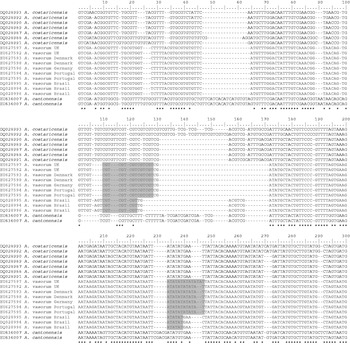
Alignment of the A. vasorum ITS-2 sequences with A. costaricensis and A. cantonensis (alignment length=300 bp, 84 of which were variable and 73 parsimony-informative) revealed the presence of 2 microsatellites (CGT)n and (AT)n, (Fig. 1) and could be used to discriminate isolates from Brazil (AT3 and CGT3) and isolates from Europe (AT6–7 and CGT5). The same microsatellites were also observed in A. costaricensis (AT3 and CGT2–6) and A. cantonensis (AT2 and CGT2). Intraspecific variation based on pair-wise distance, ranged from 0 to 3·5%, and distinct genotypes were observed for A. vasorum (Brazil and Europe) and A. costaricensis (2 from Brazil and 1 from Costa Rica). Pairwise differences of 2–2·3% existed between A. vasorum genotypes, with 5 transitions, 3 transversions and 7 insertion/deletions observed. The average genetic difference on the basis of the partial ITS-2 between each of the 3 Angiostrongylus species ranged from 12·1 to 29·3%.
Alignment of a 300 bp region of the ITS-2 sequences of Angiostrongylus vasorum isolates from Brazil and Europe (shown in grey), along with A. costaricensis and A. cantonensis. Microsatellites that discriminate between A. vasorum genotypes are highlighted. Asterisks indicate conserved nucleotides across all aligned sequences.

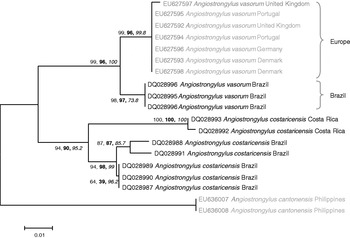
Initial alignment of the Angiostrongylus species sequences with Aelurostrongylus abstrusus for phylogenetic analysis proved problematic due to a high level of sequence divergence between taxa (data not shown). Phylogenetic trees were therefore constructed without the use of an outgroup species. The grouping of geographically separate isolates of A. vasorum was supported by high bootstrap values (>73%) for neighbor-joining, maximum parsimony and maximum likelihood analyses and all isolates of A. vasorum formed a distinct clade separate from the other Angiostrongylus species (Fig. 2). The phylogenetic relationship of A. vasorum with A. costaricensis or with A. cantonensis could not be accurately resolved due to the absence of an outgroup species.
Midpoint-rooted phylogenetic tree constructed with ITS-2 sequences and inferred using the neighbor-joining method. Numbers above branches represent bootstrap percentages of 1000 replicates (neighbor-joining, maximum parsimony, maximum likelihood). Scale bar represents number of nucleotide substitutions per site for NJ analysis and new sequences from this study are shown in grey.

COI
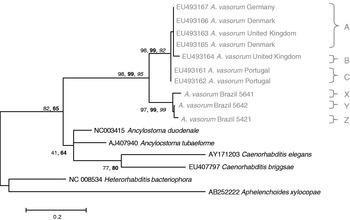
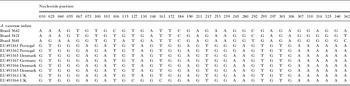
Alignment of the partial COI sequences for the A. vasorum isolates (alignment length=360 bp, 34 of which were variable and 28 parsimony-informative) and amino acid sequences (2 of 120 variable) also revealed 2 distinct groups, namely isolates from Brazil and Europe (data not shown). Variable nucleotide positions are shown in Table 1. This was again supported by phylogenetic analysis using other nematode species (Fig. 3). Pair-wise differences for the COI between these groups ranged from 8·7–10·3% and within groups was 0·5% for isolates from Europe and 1·6% for those from Brazil. Three individual haplotypes (each differing by 1 to 6 nucleotide substitutions) were observed for each of the isolates from Europe (A, B, C) and from Brazil (X, Y, Z) (Fig. 3). As a means of comparison, genetic variation between Ancylostoma duodenale and Ancyclostoma tubaeforme was 14·7% (27/360 bp variable) and between Caenorhabditis elegans and Caenorhabditis briggsae was 17·3% (52/360 bp variable).
Rooted phylogenetic tree constructed using partial COI gene sequences and inferred using the neighbor-joining method. Numbers above branches represent bootstrap percentages of 1000 replicates (neighbor-joining, maximum parsimony, maximum likelihood). Individual haplotypes are represented by A-C for Europe isolates and X-Z for Brazil isolates. Scale bar represents number of nucleotide substitutions per site and new sequences from this study are shown in grey.

Variable nucleotide positions within the COI gene of Angiostrongylus vasorum from Brazil and Europe

Molecular evolutionary rates
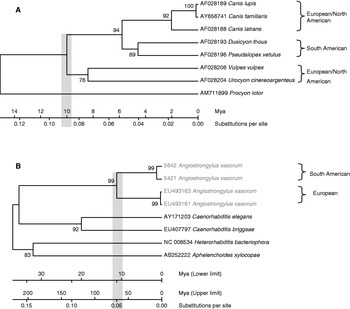
Alignment of the COI sequences of the South American fox species with Vulpes vulpes and the Canis species revealed 87/360 bp and 58/360 bp variable respectively. Lower levels of amino acid variation were observed, with only 1/120 variable between Dusicyon thous and Vulpes vulpes. Using Procyon lotor as an outgroup, the equality evolutionary rate between Dusicyon thous and Vulpes vulpes was 0·78 (p=0·37634 with 1 degree of freedom) and Pseudalopex vetulus and Vulpes vulpes was 1·14 (p=0·28575), suggesting similar rates of evolution between these lineages. Based on previous studies of fossil evidence and genetic analysis, divergence between the Vulpes species and the South American fox species occurred over 10 million years ago (Wang et al. Reference Wang, Tedford, Van Valkenburgh, Wayne, MacDonald and Sillero-Zubiri2004). A linearized evolutionary history was inferred using the neighbor-joining method (Fig. 4A).
Evolutionary rates between Angiostrongylus vasorum and its fox host inferred using the neighbor-joining method. Phylogenetic trees were constructed using partial COI gene sequences (360 bp) for the canid species (A) and A. vasorum and other nematode species (B). Each tree was linearized assuming equal evolutionary rates in all lineages. Shading represents the estimated divergence times for Vulpes vulpes from other canid species (A) and South American and European A. vasorum (B). Evolutionary distances were computed using Maximum Composite Likelihood method and are in the units of the number of base substitutions per site. The clock calibration (time/node height) to convert distance to time was 108·36 for A and 224·21 (lower limit) and 1345·35 (upper limit) for B.

The equality of evolutionary rate (x2) for A. vasorum partial COI sequences from Europe and South America was determined as 0·80 (p=0·37109 with 1 degree of freedom) using Tajima's relative rate test and Heterorhabditis bacteriophora as an outgroup species. The rate between C. elegans and A. vasorum was 1·85 (p=0·17357), between C. briggsae and A. vasorum was 0·18 (p=0·66824) and between C. briggsae and C. elegans was 1·14 (p=0·28575), thus suggesting a similar rate of evolution across each of these lineages. A linearized neighbor-joining tree was produced assuming equal evolutionary rates (Fig. 4B) and molecular clocks were set based on the upper and lower limits of the estimated divergence time of C. elegans and C. briggsae, 20–120 million years ago (Gupta and Sternberg, Reference Gupta and Sternberg2003; Stein et al. Reference Stein, Bao, Blasiar, Blumenthal, Brent, Chen, Chinwalla, Clarke, Clee, Coghlan, Coulson, D'Eustachio, Fitch, Fulton, Fulton, Griffiths-Jones, Harris, Hillier, Kamath, Kuwabara, Mardis, Marra, Miner, Minx, Mullikin, Plumb, Rogers, Schein, Sohrmann, Spieth, Stajich, Wei, Willey, Wilson, Durbin and Waterston2003). The divergence between the South American and European A. vasorum was therefore estimated to have occurred between 11 and 67 million years ago (Fig. 4B).
The estimated time of the divergence of the European and Brazilian A. vasorum is therefore similar to the postulated divergence time for the South American canids from V. vulpes and predates the separation of the Canis and South American canid groups. This observation is consistent with the ancient introduction of A. vasorum into South America as it co-evolved with its canid host, although slower molecular evolutionary rates were observed for the parasite when compared to the host.
DISCUSSION
For the first reported time, European isolates of A. vasorum have been genotyped at a mitochondrial and nuclear genomic region and compared with South American-derived specimens. This analysis defined 2 separate phylogenetic clades, representing putatively distinct genetic populations from Brazil and Europe. Whilst comparable morphology has been described for both A. vasorum in Europe (Guilhon and Cens, Reference Guilhon and Cens1973) and Brazil (Grisi, Reference Grisi1971; Costa et al. Reference Costa, de Araujo Costa and Guimaraes2003), the level of genetic variation between these populations suggests potential cryptic speciation. The synonomy of A. vasorum and A. raillieti as a single species, as proposed by Costa et al. (Reference Costa, de Araujo Costa and Guimaraes2003) may therefore be premature, as 2 separate species may actually exist pending further biological evidence.
Detection of cryptic species, that is, morphologically similar, yet genetically distinct species has been previously reported for multiple nematode taxa (Romstad et al. Reference Romstad, Gasser, Nansen, Polderman and Chilton1998; Blouin, Reference Blouin2002) and taxonomic changes within genera have also been postulated based on genetic differences (e.g., Mattiucci and Nascetti, Reference Mattiucci and Nascetti2006). Similarly, sequence data could be used to delimit species within the genus Angiostrongylus; however, this would require analysis using a larger sample size and the inclusion of additional species before definitive conclusions can be made on the taxonomic status of this group. The multiple genotypes observed for A. costaricensis may also represent cryptic species and require further taxonomic delineation.
The multiple microsatellites observed between and within the species of Angiostrongylus studied, make the ITS-2 a potentially useful diagnostic marker, supporting previous research by Caldeira et al. (Reference Caldeira, Carvalho, Mendonca, Graeff-Teixeira, Silva, Ben, Maurer, Lima and Lenzi2003). Similar discrimination of the South American and European isolates of A. vasorum was also observed within the COI gene with a range of 8·7 to 10·3% nucleotide variation between isolates within the South American and European groups, respectively. Such a level of variation supports classification as separate species and is in agreement with mitochondrial sequence differences reported between other co-generic nematode species (Blouin et al. Reference Blouin, Yowell, Courtney and Dame1998). The high number of haplotypes observed using the COI gene makes this a promising candidate for population genetics-based studies.
The genetic variation observed between South American and European populations of A. vasorum is consistent with the hypothesis that the appearance of A. vasorum in South America is an ancient event. Divergence of the South American foxes from the Vulpes and Canis groups of canids based on fossil and molecular evidence is estimated to have occurred over 10 million years ago (Wang et al. Reference Wang, Tedford, Van Valkenburgh, Wayne, MacDonald and Sillero-Zubiri2004). Based on evolutionary divergence times for C. elegans and C. briggsae, the divergence between the South American and European A. vasorum populations is predicted to have occurred between 11 and 67 million years ago, a time frame that is closer to the canid divergence then the comparatively recent introduction of the first dogs into South America less than 10 thousand years ago. Interestingly, the most ancestral fox species, namely those belonging to the genus Urocyon (Wang et al. Reference Wang, Tedford, Van Valkenburgh, Wayne, MacDonald and Sillero-Zubiri2004), have been reported to be infected with an Angiocaulus gubernaculatus-like nematode (Faulkner et al. Reference Faulkner, Patton, Munson, Johnson and Coonan2001), which may share a common ancestor with A. vasorum. Genetic characterization of this nematode species is imperative to further confirm the evolutionary history of A. vasorum.
Infections in domestic dogs may complicate such a hypothesis of host/parasite co-evolution, as dogs may become infected with either genotype depending on the geographically distinct sylvatic life cycle to which they are exposed. This may be reflected in potential host switching between Vulpes vulpes and the Canis related species in the same geographical locations and similarly, A. vasorum from the South American canids may have recently infected C. lupis familiaris. Ultimately, multiple host switching events have likely occurred throughout the evolutionary history of A. vasorum considering the diverse range of species capable of becoming infected with this parasite.
The authors thank Drs Roberta Caldeira, Walter Lima and Omar Carvalho for providing Brazil A. vasorum sequences, Drs Fiona Thompson and Dawn Marshall for technical assistance and Drs Jakob Willesen, Juan Matias Segovia and Frank Just for providing nematode material. Funding for this study was provided in part by the Morris Animal Foundation, First Award D06CA-308.