Introduction
Bilateral breast cancer (BBC) is a rare presentation. The bilateral disease can have synchronous or metachronous presentation depending upon the timing of detection with respect to the index cancer. The oncological principles of management of BBC are exactly similar to unilateral cancers. The synchronous cancers needing adjuvant radiotherapy on both the sides pose challenges for the delivery of adjuvant radiotherapy. This is because of the large and multiple targets leading to dose in homogeneity, especially in the region of field junctions and increased dose to the heart and lungs. This makes radiotherapy planning for BBC relatively complex as well as time-consuming.
Traditionally, tangential radiotherapy has been the standard worldwide for unilateral as well as BBC. However, modern radiotherapy practice has moved towards conformal techniques for most of the disease sites including breast cancer. A wide range of radiotherapy techniques are currently available which have made the delivery of conformal radiotherapy possible. This is particularly relevant for BBC as multiple targets can be treated without junctions and differential doses can be delivered at the same time. Various techniques described for BBC include conventional tangents (using dual or mono-isocentric technique) and inverse plan intensity-modulated radiotherapy (IMRT) using photons helical tomotherapy (HT) or volumetric-modulated arc therapy (VMAT).Reference Seppälä, Heikkilä, Myllyoja and Koskela1–Reference Kim, Lee and Youn4 We have earlier published the dosimetric and clinical feasibility of treating BBC using HT which is now routinely used at institute.Reference Wadasadawala, Visariya, Sarin, Upreti, Paul and Phurailatpam2,Reference Wadasadawala, Jain and Paul5 Seppälä et al., had implemented VMAT technique with a single isocentre in the treatment of BBC and had also shown its advantages over conventional tangential technique plans in terms of target coverage and quick dose delivery without hotspot in the field overlapping area.Reference Seppälä, Heikkilä, Myllyoja and Koskela1 Fiorentino et al., had also reported that VMAT is feasible and safe in the treatment of BBC with simultaneous integrated boost (SIB) and nodal irradiation.Reference Fiorentino, Mazzola and Naccarato3 Many authors had observed dosimetric advantages of VMAT, IMRT or tomotherapy for treatment of BBC compared to three-dimensional conventional radiotherapy (3DCRT) and field-in-field (FIF) techniques.Reference Seppälä, Heikkilä, Myllyoja and Koskela1,Reference Wadasadawala, Visariya, Sarin, Upreti, Paul and Phurailatpam2,Reference Kim, Lee and Youn4,Reference Lauche, Kirova and Fenoglietto6,Reference Nicolini, Clivio, Fogliata, Vanetti and Cozzi7 However, there are only a few studies on dosimetric comparison between VMAT and HT in BBC.Reference Sun, Lin and Tong8–Reference Zedef, Şilem, Oguzhan, Fikri, Ayse and Deniz10 Cheng et al., had conducted dosimetric comparison for BBC among different treatment modalities HT, VMAT, intensity-modulated radiation therapy (IMRT) and FIF. They had undertaken retrospective analysis on 10 patients with early-stage unilateral breast cancer for simulating the patients with BBC. Therefore, their study did not indicate the real case scenario.Reference Cheng, Chang, Shiau, Wang and Tsai9 Dağ et al., compared the technical feasibility and benefits of two different helical IMRT techniques (rapid arc VMAT and tomotherapy) with 3DCRT with FIF and multi-field dynamic (sliding window) IMRT for BBC patients. However, only two patients were studied in the dosimetric analysis.Reference Zedef, Şilem, Oguzhan, Fikri, Ayse and Deniz10 Another dosimetric comparison between intensity-modulated proton therapy (IMPT) and photon-based techniques (IMRT, VMAT, HT) showed superior cardiac and lung sparing in synchronous bilateral breast radiotherapy with IMPT.Reference Sun, Lin and Tong8 In this study 11 post-lumpectomy node negative patients of BBC were planned without the irradiation of the regional nodes or tumor bed boost. The dosimetric comparisons in the above-mentioned studies did not include SIB.Reference Sun, Lin and Tong8–Reference Zedef, Şilem, Oguzhan, Fikri, Ayse and Deniz10 In the current study, we have conducted dosimetric comparison on the BBC patients with SIB of 61 Gy/25 fractions for tumour bed along with 50 Gy/25 fractions to breast/chest wall and supraclavicular fossa (SCF). Here, we intend to compare HT and VMAT with respect to doses to the targets and organs at risk (OARs), dosimetric indices, IDs and treatment efficiency. Considering the few publications on the direct dosimetric comparison of BBC treatment using VMAT and HT, on clinical patients, this study will give some valuable resources for treatment planning for BBC involving tumour bed and nodal irradiation. It has the potential to guide the new beginners in order to understand the intricacies of treatment planning in this relatively rare indication of breast radiotherapy.
Methods and Materials
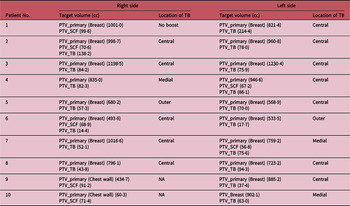
We had selected 10 patients who had been treated with HT for BBC between 2015 and 2016 at our institute for this retrospective study. Replanning was undertaken on these patients for VMAT technique. Among the 10 patients, 8 patients had undergone breast-conserving surgery on both sides while the remaining two patients had mastectomy on the right side and lumpectomy on the left side. Thus, SIB to the tumour bed (TB) was included on at least one side in all 10 patients. Eight patients also underwent SCF irradiation on at least one side in view of positive axillary lymph nodes. Three patients received bilateral supraclavicular irradiation. Seven patients received SIB on both sides while the remaining three patients received on any one side. Treatment plans were generated on 5 mm slice thickness of computerised tomography (CT) scans acquired in free-breathing (FB) mode from the angle of mandible to upper abdomen. Table 1 describes the patient characteristics with respect to the target volumes, location of tumour bed and laterality of TB.
Detailed patient characteristics

Contouring
Contouring for target volume delineation was done on Varian Eclipse workstation (Eclipse TPS v13.5.37, Varian Medical Systems, Palo Alto, CA, USA). The clinical target volume (CTV) for the breast and/or chest wall, tumour bed and SCF was contoured according to the European Society for Radiotherapy and Oncology (ESTRO) guidelines for volume delineation.Reference Offersen, Boersma and Kirkove11 A 5-mm margin to the CTV was given to grow on the PTV_primary and PTV_SCF. The PTV_primary was cropped from the skin by 5 mm in case of lumpectomy and 3 mm in case of mastectomy. OARs such as the lung on each side, total lung, oesophagus, spinal cord and heart were contoured. Both lungs were delineated using automatic segmentation. The heart was contoured from the level of the pulmonary trunk to the apex and included the pericardium but not the major vessels. In addition, for lumpectomy cases, seroma, surgical clips and post-operative changes were collectively used to define the tumour bed volume. This was increased by 5 mm to make PTV_TB which was contained within the PTV_primary volume as described in our earlier publication.Reference Wadasadawala, Jain and Paul5
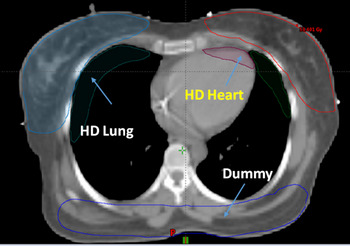
Dummy structures were created by the medical physicist within the body volume and outside the PTV (where significant hotspots were likely to occur), for example, high dose (HD) volumes of heart (HD_Heart) and lungs (HD_Lung). These structures constitute the overlap volume between the 2·5 cm margin around the PTV and the heart or lung. A horizontal dummy was also drawn along the posterior part of the body for directional blocking of the beamlets in HT. The dummy structures are shown in Figure 1 for a case of bilateral breast-conserving surgery. The structure set and CT images were exported to the planning stations.
Dummy structures created by the physicist to control hotspot, OARs doses and spillage.

Dose prescription
For all plans, the dose prescription was to 50 Gy/25 fractions to whole PTV_primary and PTV_SCF along with SIB of 61 Gy/25 fractions to the TB in patients who had breast-conserving surgery (BCS). The criteria for plan evaluation were with reference to International Commission on Radiation Units and Measurements 83 (ICRU 83), that is, 95% of the target volume should be covered with 95% of the prescribed dose with minimum spillage of 107%. Dose constraints to OARs were decided such that mean dose to heart and bilateral lungs should be less than 6 Gy and 14 Gy, respectively. Percentage volume of 5 Gy (V 5) and 30 Gy (V 30) to heart should be less than 30% and 5%, respectively. While for bilateral lung, percentage volume of 5 Gy (V 5) and 20 Gy (V 20) should be less than 70% and 20%, respectively.Reference Nicolini, Clivio, Fogliata, Vanetti and Cozzi7
Planning techniques
HT planning
Helical Tomotherapy® (Hi-ART System v 5.1.3, Accuray Incorporated, Sunnyvale, CA) used 6-MV linear accelerator mounted on a ring gantry delivers intensity-modulated beams.Reference Mackie, Holmes and Swerdloff12 For each patient, planning was done in the tomotherapy planning system (version 4.2.3) with the treatment parameters such as field width (FW), pitch and modulation factor (MF) chosen as 5·02 cm, 0·3 and 3·0, respectively. Grid size used both in the optimisation and calculation processes was (256 × 256 pixels). The detailed report of tomotherapy planning for BBC has been described in our earlier publication.Reference Wadasadawala, Visariya, Sarin, Upreti, Paul and Phurailatpam2
Volumetric-modulated arc therapy (VMAT) planning
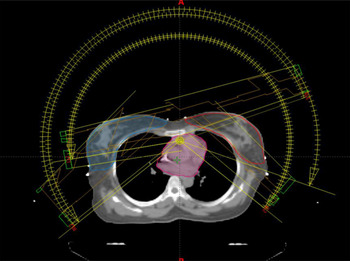
Retrospectively, VMAT plans were generated on the Varian Eclipse-treatment-planning system (TPS version 13.5). The plans were made with 6 MV photon beams for the TrueBeam Linac (Varian Medical Systems, Palo Alto, CA, USA) which is equipped with the millennium multi-leaf collimator (mMLC) with 120 leaves. Spatial resolution of mMLC are of 5 mm at isocentre for the central 20 cm and of 10 mm in the outer 2 × 10 cm. The maximum leaf speed is of 2 cm/s with a leaf transmission of 1·8%. All plans made were with four partial arcs with single isocentre (Figure 2). The isocentre of the beam was kept at the middle of the sternum and just posterior to it. A maximum dose rate of 600 MU/min dose rate had been selected for VMAT plan optimisation. Photon optimiser is used for the dose optimisation and dose calculation was done using Accuros XB 13.5. Helping structures for the heart and lung created for HT planning were used in optimisation while the horizontal posterior dummy was not used for VMAT planning. Segmentation of the OARs as mentioned previously is useful for optimisation as separate constraints and penalty given to these structures help to increase the degrees of freedom in controlling the OARs doses. Additionally, this also limits the hotspots within and outside the target volumes arising from the use of hard constraints to the whole structures of heart and lungs. The technical details of rapid arc planning, optimisation and dose delivery are available in literature.Reference Cozzi, Dinshaw and Shrivastava13–Reference Fogliata, Yartsev and Nicolini15 An optimal dose distribution is achieved by varying beam delivery parameters like the dose rate, leaf position and speed of gantry rotation. The collimator rotation remains fixed to a value different from zero in order to minimise the tongue and groove effect. In the present study, collimators rotated to 5–10° depending on the patient geometry.
Beams arrangement for VMAT plans.

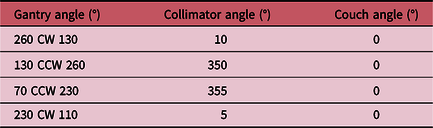
The choice of gantry angles, collimator rotation and couch angle used for all the plans is shown in Table 2.
Planning parameters chosen for VMAT plans

Plan evaluation
Plans were analysed on the basis of dose–volume histogram (DVH). For the PTV, we report the value of mean dose, V 95% (the volumes receiving at least 95% of the prescribed dose) and V 107% (the volume receiving 107% of the prescribed dose).
The homogeneity of the dose distribution evaluated by using homogeneity index (HI). It was calculated as:
 $${\rm{HI}} = \left( {\left( {{D_{2\% }} - {D_{98\% }}} \right)/{D_{{\rm{presciption}}}}} \right) \times 100,$$
where D 2% and D 98% represent the doses received by 2% and 98% volumes of PTV, respectively.Reference Wu, Mohan, Morris, Lauve and Schmidt-Ullrich16
The lower the value of HI of plan, the more homogenous is the dose distribution across the target volume. HI equal to zero indicates perfect homogenous dose distribution.
Conformity of the dose distribution evaluated by using the conformity index (CI) using the Radiation Therapy Oncology Group (RTOG) formula.Reference Shaw, Scott and Souhami17
 $${\rm{Conformity\, inde}}{{\rm{x}}_{{\rm{RTOG}}}}\left( {{\rm{CI}}} \right) = {V_{{\rm{RI}}}}{\rm{/TV}},$$
where V RI represents the volume encompassed by the reference (95%) isodose line and TV represents target volume.
The ideal value of CI is 1. If the value of CI is greater than 1, the irradiated volume is greater than the target volume and it includes normal tissues lying outside the target. When the target volume is not properly covered by the reference isodose line, value of CI is less than 1.
For analysing the dose to OARs, we compared the mean dose and a set of V x Gy (OAR volume receiving at least x Gy) such as V 5, V 20 for the lung and V 5, V 30 for heart.
ID
The ID to whole body and OARs from VMAT and HT were evaluated. ID was calculated using the following equation:
 $${\rm{I}}{{\rm{D}}_j} = {r_j}{V_j}{D_j},$$
where r j , V j and D j are the density, volume and mean dose of the organ, respectively, for subvolume j.Reference D’Souza and Rosen18
Here, we had considered uniform density (mean density) throughout the whole volume of OARs and it was also assumed that all subvolumes of OARs also received dose equal to its mean dose D mean.
Delivery time
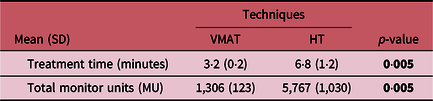
For evaluation of efficiency of different techniques VMAT and HT, delivery parameters, viz., treatment time and total MU were compared.
Statistical analysis
To compare the dosimetric and treatment parameters of both the techniques VMAT and HT, we had analysed the statistically using the Wilcoxon-matched-paired signed-sum rank test with a significant criteria of p-value of ≤0·05. It is a non-parametric test which ranks the data and computes the inferential statistics based on the difference (between the pairs for each patient) in ranks. SPSS software (Release 22.0.0.0, SPSS Inc., Chicago, IL, USA) was used for performing the statistical analysis.
Results
Dosimetric comparison of target volumes
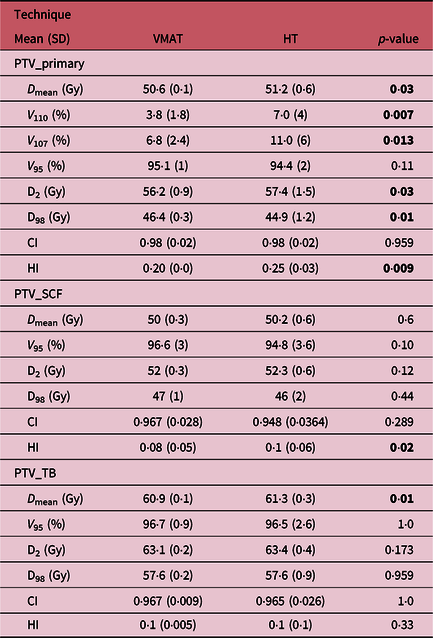
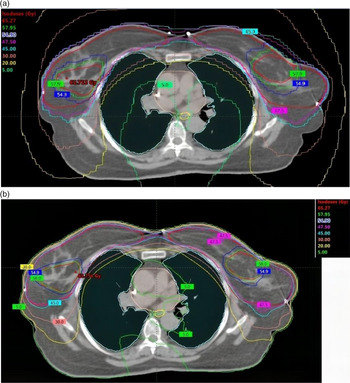
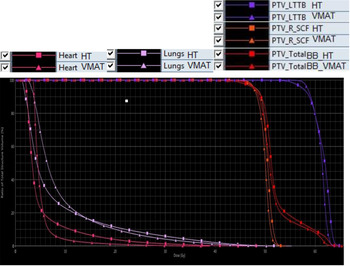
Table 3 represents that majority of the dosimetric parameters of PTV_primary, PTV_SCF and PTV_TB. There was no significant difference in CI for both the techniques for all the targets. In terms of HI, for the PTV_primary and PTV_SCF, VMAT plans were significantly homogenous than HT plans. However, for PTV_TB, there is no statistically significant difference for CI as well as HI, in both the techniques. Figure 3 represents the dose distributions in axial views for one randomly selected patient. Figure 4 represents a comparative DVH for target volumes and OARs for a patient.
Dosimetric analysis based on DVH for the PTV_primary, PTV_SCF and PTV_TB

Axial CT slice showing the isodose lines (a) HT, (b) VMAT.

Comparative DVH for target volumes and OAR.

Bilateral lungs
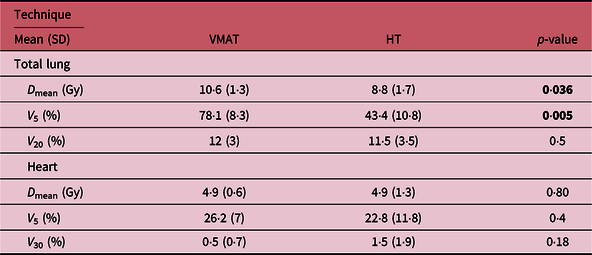
DVH analysis for total lung and heart is shown in Table 4. Mean dose (SD) in Gy to total lungs VMAT and HT are 10·6 (1·3) and 8·8 (1·7) respectively, with p-value of 0·036. The low dose spillage of V 5 from VMAT and HT are 78·1% (8·3) and 43·4% (10·8) respectively, with p-value of 0·005. HT shows better control over low dose spillage in terms of V 5 as compared to VMAT thereby leading to reduced mean lung dose. There was a statistically significant difference between the two techniques with respect to the mean dose and V 5. However, both the techniques could achieve the dosimetric goals V 20 (12% and 11·5%) with p-value of 0·5 so it is not statistically significance.
Dosimetric parameters for total lung and heart

Heart
All the defined dose constraints D mean, V 5 and V 30 were achieved in both the techniques and there was no significant difference between these parameters. Average D mean (SD) in Gy from plans by VMAT versus HT are 4·9 (0·6) Gy versus 4·7 (1·3) Gy with p-value of 0·80. Low dose V 5 (%) achieved from VMAT and HT are 26·2% and 22·8%, respectively, with p-value of 0·4 while HD spillage represented by V 30(%) from VMAT and HT is 0·5% and 1·5%, respectively, with p-value of 0·18.
ID
The ID to the whole body and various OARs from the two planning techniques is shown in Table 5. ID (Gy kg) of the whole body and heart were comparable for both the techniques, viz., 289 versus 299 with a p-value of 0·71 and 2·9 versus 2·8 with a p-value of 0·80, respectively. Whereas, ID (Gy kg) of lungs was significantly more in VMAT than in HT with 7·9 versus 6·3 with a p-value of 0·03.
ID for whole body and OARs

Delivery time
In Table 6, the comparison of delivery parameters were represented in terms of delivery time (minutes) and total monitoring units (MU). In terms of treatment delivery parameters, when VMAT plans is compared to HT, there was a reduction by 53% in the treatment time (minutes), viz., 3·2 versus 6·8 with a p-value of 0·005 and 78% reduction in monitor units, viz.,1306 versus 5767 with a p-value of 0·005, as shown in Table 6.
Comparison of delivery parameters

Discussion
It is a known fact that BBC is a rare breast cancer disease. Treatment of BBC with external radiotherapy aiming for breast conservation is very challenging as the target volume is very large and complex and there is always a requirement for minimising dose to critical organs like heart and lungs. Many authors have reported the used of IMRT, VMAT and HT techniques in BBC patients and their dosimetric advantages in compared to conventional tangential 3DCRT and FIF techniques.Reference Wadasadawala, Visariya, Sarin, Upreti, Paul and Phurailatpam2–Reference Wadasadawala, Jain and Paul5,Reference Nicolini, Clivio, Fogliata, Vanetti and Cozzi7 There are very few papers reporting the direct dosimetric comparisons of VMAT and HT on BBC cancers.Reference Sun, Lin and Tong8–Reference Zedef, Şilem, Oguzhan, Fikri, Ayse and Deniz10 Our study reports dosimetric comparison of VMAT and HT of BBC with SIB for tumour bed and along with nodal irradiation. The cases we had used are real clinical cases already treated with HT. We have conducted this dosimetric study to gain confidence in use of VMAT on BBC in our clinic and evaluate the efficiency of VMAT with HT. The dose constraints used in this study are based on reported literatures.Reference Wadasadawala, Visariya, Sarin, Upreti, Paul and Phurailatpam2,Reference Wadasadawala, Jain and Paul5,Reference Valli, Cekani, Cima and Richetti19–Reference Choi, Munden and Erasmus22 As larger volume of lungs is irradiated in adjuvant radiotherapy for BBCs, lung doses should be specifically restricted so that there will be no possibility of late lung injury manifesting as radiation pneumonitis with resultant radiation fibrosis.Reference Choi, Munden and Erasmus22 Ipsilateral mean lung dose and V 20 are considered the most important factors for pulmonary toxicity.Reference Valli, Cekani, Cima and Richetti19 Lee et al., reported that V 20 is the greatest risk predictor and defined a dose–volume percentage constraint of V 20 < 37% for the irradiated ipsilateral lung to maintain the incidence of mild symptomatic radiation pneumonitis below 20% as defined by the Common Terminology Criteria for Adverse Events (CTCAE) in a cohort of breast cancer patients who received hybrid IMRT technique.Reference Lee, Chao, Chang, Ting and Huang20 Similarly, Darby et al., reported that radiation-induced heart disease is related to both mean heart as well as high doses >30 Gy.Reference Darby, Cutter and Boerma21 We used V 5 for heart and lung to compare the low dose spillage.Reference Wadasadawala, Jain and Paul5
The second objective of our study was to compare potential differences between VMAT and HT dosimetrically. The results of our study show that dosimetric parameters of VMAT plans were satisfactorily comparable with those of HT plans. VMAT could achieve better homogeneity over HT plans for PTV_primary and PTV_SCF. There was no significant difference in dose conformity achieved for all the targets between the two techniques. For heart also, there was no significant difference in the dosimetric parameters achieved from both the techniques. However, VMAT did not result in sparing of lung, especially with respect to the low dose spillage (V 5). Thereby, we could see significantly higher mean dose to lungs in VMAT compared to HT. Similarly, Lauche et al., also reported that though HT and VMAT are feasible techniques in cases of complex target volumes for breast and nodal irradiation, both cause a large low dose spillage. So, a careful follow-up regarding lung, heart, contra-lateral breast is warranted in both the techniques.Reference Lauche, Kirova and Fenoglietto6
To investigate further the impact of distribution of both low and high doses, we had considered the third objective. It is to compare the IDs to the whole body and OARs from both the techniques VMAT and HT. Many authors had evaluated the IDs of OARs and whole bodies from different techniques (3DCRT, IMRT, VMAT and HT) for different disease sites.Reference Sharma, Gupta, Jalali, Master, Phurailatpam and Sarin23–Reference Patel, Drodge, Jacques, Warkentin, Powell and Chafe26 The IDs are found to be comparable with no statistically significant variation between the two techniques. Other authors also reported comparable IDs of HT with different techniques of IMRT and 3DCRT for different disease sites.Reference Sharma, Gupta, Jalali, Master, Phurailatpam and Sarin23,Reference Aoyama, Westerly and Mackie24 Yang et al., also evaluated IDs of OARs and whole body for post-operative whole pelvic radiation therapy (WPRT) of endometrial cancers and found out that IMRT and HT were more conformed thereby gave lower IDs to OARs compared to 3DCRT. However, for whole body, they observed that that IMRT plans gave lowest ID and there was no difference between HT and 3DCRT.Reference Yang, Xu, Jiang, Xie and Wang25 In our study, the IDs for whole body and heart are found to be comparable with no statistically significant variation between VMAT than HT. However, ID to lung is found to be significantly higher in VMAT. In another planning study on craniospinal irradiation for paediatric medulloblastoma, Patel et al., had found that VMAT may reduce the ID while providing comparable normal tissue sparing with HT.Reference Patel, Drodge, Jacques, Warkentin, Powell and Chafe26
The fourth objective was to assess the treatment time efficiency. VMAT technique was found to reduce the treatment time and total MU delivered by 53 and 78%, respectively, compared to HT. Our finding is in accordance with other studies.Reference Pasquier, Cavillon, Lacornerie, Touzeau, Tresch and Lartigau27–Reference Kinhikar, Pawar, Mahantshetty, Murthy, Dheshpande and Shrivastava31 We had observed that VMAT can deliver physical dose to BBC which is comparable with HT in a reduced delivery time. The lower the delivery time, the reduced possibility of treatment being affected by intra-fractional movement of the patient. Therefore, VMAT has a potential in improving the treatment accuracy.
Luca Cozzi et al., had also reported that there is limited data for VMAT in breast cancer with short follow up.Reference Cozzi, Lohr and Fogliata32 Many authors had reported the feasibility of VMAT for breast cancer for technically difficult cases like BBC with nodal irradiations. They had also reported modest and compatible toxicity profiles from VMAT compared to other techniques.Reference Fiorentino, Mazzola and Naccarato3,Reference Lauche, Kirova and Fenoglietto6,Reference Nicolini, Clivio, Fogliata, Vanetti and Cozzi7
Fiorentino et al., reported their experience of the use of VMAT for BBC with SIB of tumour bed without comparison with HT. They reported mean heart and lung dose of 8·3 ± 3·3 Gy and 11·8 ± 2·3 Gy, respectively. The average V 5 and V 20 total lungs reported by them were 78·9 ± 15·3 and 15·7 ± 5%, respectively.Reference Fiorentino, Mazzola and Naccarato3 With our VMAT plans, we could achieve dose parameters which are lower than their mean doses with the heart mean dose (D mean = 4·9 ± 0·6 Gy) and lung mean dose (D mean = 10·6 ± 1·3 Gy). The average V 5 and V 20 (Table 4) from our study are 78·1 ± 8·3 and 12 ± 3%, respectively. Dağ et al., also had reported that V 5 in VMAT planning was on average 85%, whereas in HT, it was only 45·5%.Reference Zedef, Şilem, Oguzhan, Fikri, Ayse and Deniz10 The average V 5 of lungs achieved by our HT plans is 43·4%. As the series reported by Kaidar-Person et al., entailed inclusion of internal mammary targets, very high heart mean doses to the tune of 20 Gy (range 13–28) have been reported with acceptable lung V 20 and V 5.Reference Kaidar-Person, Kostich and Zagar33 Similarly, Karthik Raj et al., reported mean dose, mean V 5 and V 20 to the heart as 4·7 Gy, 24·9 and 16·7%, respectively, using the 3DCRT employing mono-isocentre bitangential beam arrangement in six cases of BBC.Reference Mani, Basu and Bhuiyan34 The mean heart dose achieved from our HT and VMAT plans are comparable to mean heart dose achieved from 3DCRT by Mani et al. (Table 3). However, in their study, the mean V 5 and V 20 for the total lung were 36·6% and 16·7%, respectively. In our study, the mean V 5 for HT and VMAT plan was 43·4% and 78·1%, respectively, which is comparatively higher. This is the result of the use of inverse plan IMRT.Reference Lauche, Kirova and Fenoglietto6 However, we could achieve mean total lung dose of 8·4 and 10·6 Gy with HT and VMAT plans, respectively, which is quite lower than their result of 15·7 Gy. Franco et al., has also reported the promising clinical feasibility of TomoDirect for bilateral breast irradiation.Reference Franco, Migliaccio and Torielli35 But we had not explored the used of TomoDirect in the current study. Dosimetric results of this study for HT plans are quite similar to the previous dosimetric study conducted by our group.Reference Wadasadawala, Visariya, Sarin, Upreti, Paul and Phurailatpam2,Reference Wadasadawala, Jain and Paul5
Many published papers have reported the reduction in the dose to heart and lung in left breast radiotherapy using deep inspiration breath-hold (DIBH) compared with FB.Reference Bruzzaniti, Abate and Pinnarò36–Reference Gaudino, Cima and Frapolli40 Dumane et al., had reported that VMAT combined with DIBH could reduce low dose to the OARs in the treatment of breast cancer patients with implant reconstruction receiving regional nodal irradiation.Reference Dumane, Saksornchai, Zhou, Hong, Powell and Ho39 However for HT, real-time motion management and breath control system is not available in the current time. In this study, we have not explored the role of motion management and breath control. Even though there is no report about the long-term clinical data from modern radiotherapy techniques on morbidity and mortality of cardiac structures, DIBH leads to a significant reduction in cardiac doses with as compared to FB plans. Hence, it is expected that cardiac morbidity will be reduced with the increased use of modern techniques including DIBH. Hong et al., had also reported average lower heart dose of 1·44 Gy in those patients treated with DIBH than those treated with FB.Reference Hong, Rahimy and Gross38 Similar dosimetric study was conducted by Gaudino et al. on synchronous bilateral breast cancer (SBBC) treated with adjuvant radiotherapy with DIBH. The authors reported a reduction in the maximum (19·2 Gy vs. 13·3 Gy) and the mean (6·5 Gy vs. 8·0 Gy) dose to the heart as compared to FB thus inferring improved OAR sparing from VMAT with DIBH in BBC adjuvant RT.Reference Gaudino, Cima and Frapolli40 VMAT with DIBH has got more potential in reducing dose to OARs compared to HT. However, it is important to note that the mean heart dose in the current study done on FB scans is still lower than the values reported by Gaudino et al. This suggests that the experience and skill of the planner plays an important role in the quality of plans.Reference Cilla, Ianiro and Romano41
Sun et al., had also observed that different modern radiotherapy techniques (VMAT, IMRT and HT) could provide comparable good coverage dosimetrically to PTV while IMPT plans could provide the best dose coverage of target and sparing OARs in radiotherapy treatment of BBC. He suggested that VMAT and HT could be considered as a suboptimal technique for BBC patients as proton therapy being not commonly available technique and also more expensive.Reference Sun, Lin and Tong8 Cheng et al., also had concluded in their dosimetric study that because of longer treatment time in HT, there is a possibility of treatment uncertainty as patient discomfort will increase with longer treatment time. They had also observed that VMAT plans can deliver a plan with a better CI than did FIF and IMRT in shorter treatment time with acceptable doses to OARs.Reference Cheng, Chang, Shiau, Wang and Tsai9
Limitation of the Study
The current study has been conducted on a small sample size. Given the rarity of BBC, this study was conducted on the available patients. However, we would continue the study by adding a greater number of patients and report in the future. Though the results of FB planning was encouraging compared to published reports, the potential of VMAT with DIBH needs to be investigated further.
Conclusion
The results of dosimetric comparison of HT and VMAT for BBC shows that clinically acceptable and good quality plans can be obtained using VMAT. HT showed better control over low dose spillage in the lungs. In terms of ID to OARs and whole body, both the techniques show an insignificant difference in ID of whole body and heart but ID to lungs is higher in VMAT. It is also observed that both the techniques could achieve similar CI for all the targets while HI for VMAT is better for PTV_primary and PTV_SCF. Both CI and HI are similar for PTV_TB in both the techniques. VMAT technique dramatically reduces the treatment time and requirement for monitor units as compared to HT. Motion management can help further in reducing the dose to OARs in VMAT plans.
Acknowledgements
None.
Funding
This research did not receive any specific grant from funding agencies in the public, commercial or not-for-profit sectors.