Swan Point contains the oldest accepted human occupation in Alaska to date and consists of a microblade and burin industry dating to circa 14,000 cal BP. The site has major implications for the first colonization of Alaska, Beringia, and the New World. Indeed, as discussed elsewhere (Gómez Coutouly Reference Gómez Coutouly2011a, Reference Gómez Coutouly and Desrosiers2012; Hirasawa and Holmes Reference Hirasawa and Holmes2016; Holmes Reference Holmes2001), Swan Point has strong technological ties with the Siberian Upper Paleolithic Diuktai Culture. Available archaeological evidence shows that late Pleistocene populations in Siberia, the Russian Far East, and Beringia, that is, Diuktai, had long-standing terrestrial-oriented economies and technologies; coastal and maritime adaptation in Beringia is documented much later (Potter et al. Reference Potter, Reuther, Holliday, Holmes, Shane Miller and Schmuck2017). Through the systematic use of the Yubetsu method for the production of microblades, Cultural Zone 4b (CZ4b) is technologically more similar to microblade sites in Siberia than to the microblade sites in Alaska that come later. Our goal in analyzing the collection is to better understand how it relates to Siberian Diuktai assemblages and to later Alaskan Denali sites. We seek to recognize the nature of the occupation by understanding whether the assemblage represents a single occupation or a palimpsest and by examining the technological and typological variability within the collection.
There is general agreement that the major spread of microblade technology emanated from northeast Asia. Some researchers believe that pressure knapping microblade technology probably emerged in the southern Far East (China, Korea, or Japan) around 30,000 to 25,000 cal BP (Gómez Coutouly Reference Gómez Coutouly2011a; Graf Reference Graf, Camps and Chauhan2009); others argue that it emerged in southern Siberia 40,000 to 35,000 years ago (Bae Reference Bae2010; Derevianko et al. Reference Derevianko, Agadjanyan, Baryshnikov, Dergacheva, Dupal, Malaeva, Markin, Molodin, Nikolaev, Orlova, Petrin, Postnov, Ulianov, Fedeneva, Foronova and Shunkov1998; Keates Reference Keates, Kuzmin, Keates and Chen2007; Kuzmin Reference Kuzmin, Kuzmin, Keates and Chen2007; Seong Reference Seong2011; Yi et al. Reference Yi, Gao, Li and Chen2016). This cultural system relied upon microblade and burin technology that proved to be an efficient adaptation to the environmental conditions of the “mammoth steppe” (Guthrie Reference Guthrie2001) for thousands of years. The osseous projectile point with microblade insets was essential to the successful hunting of high-ranked animals, such as mammoth, bison, and horse. Microblade technology (in various modes) continued to be an important part of tool kits in various complexes and traditions on both sides of the Bering Strait after the disappearance of the Bering land connection (e.g., Sumnagin in Siberia, Denali and Northern Archaic in Alaska, Paleo-Eskimo in the Canadian Arctic, etc.).
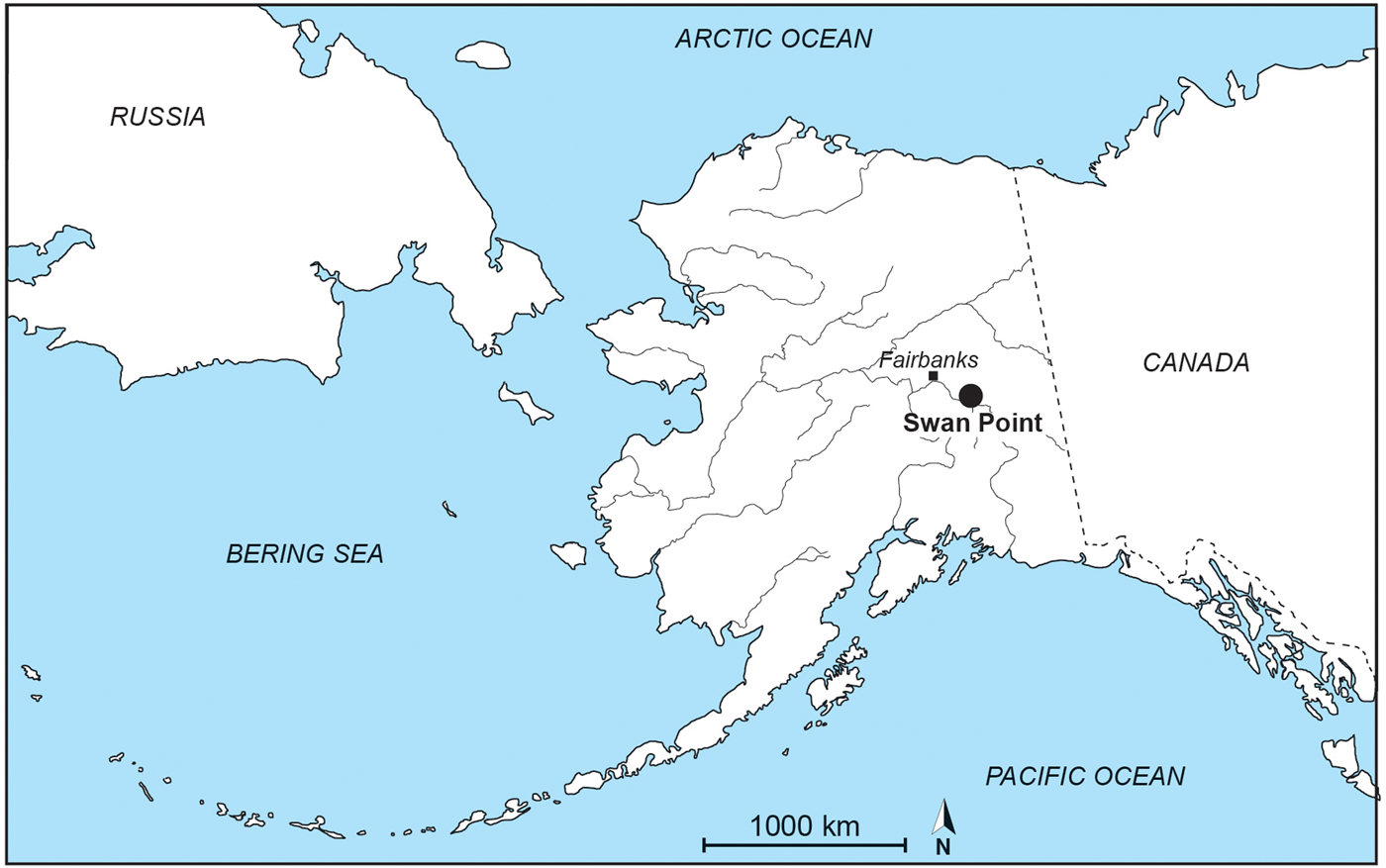
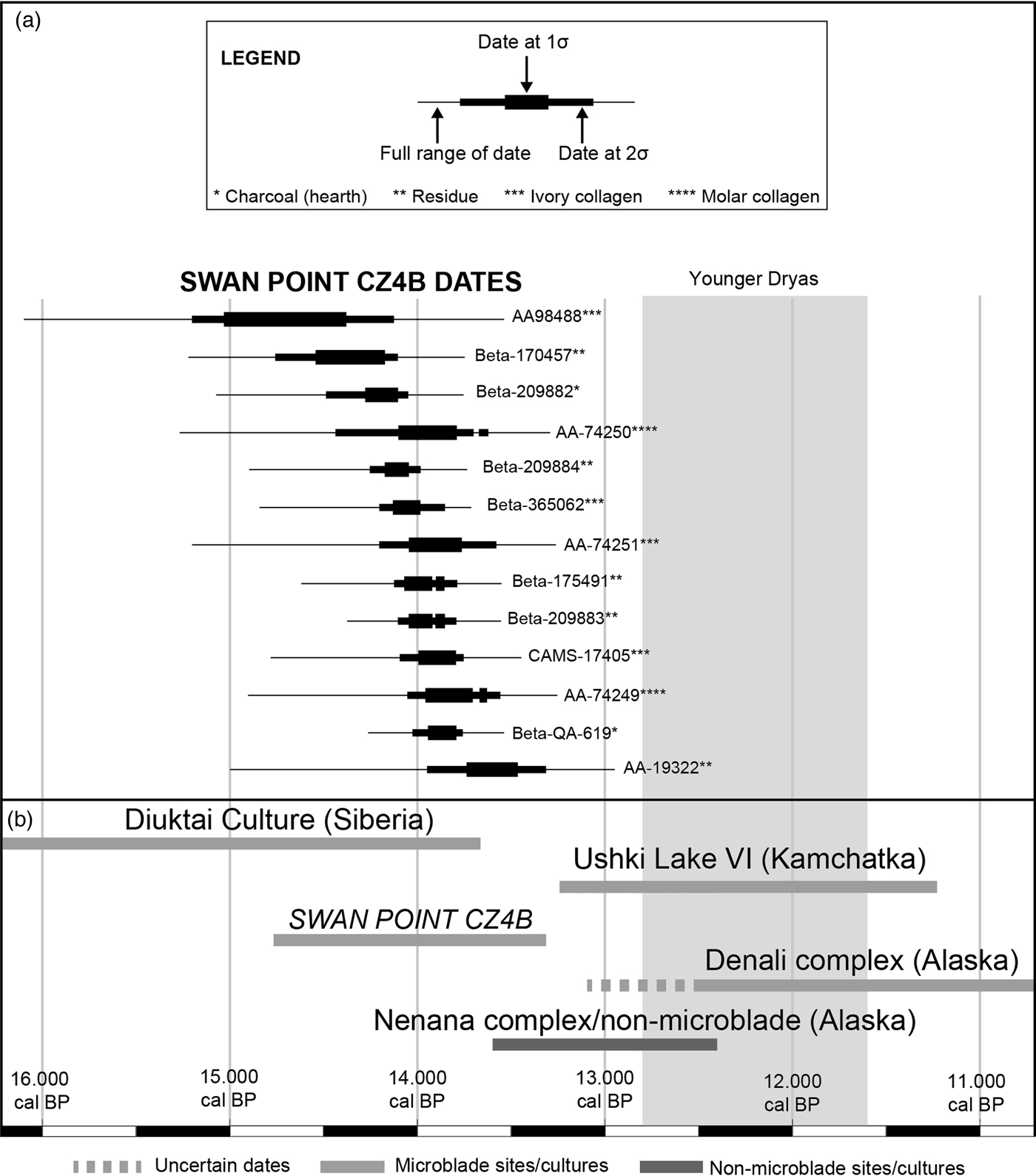
Swan Point is located in the Shaw Creek Flats in the central Tanana Valley (Figure 1). First discovered in 1991, the site was excavated periodically until 2017. The archaeological record at Swan Point is long (14,000 calendar years) and is divided into four main cultural zones (CZ1 to CZ4), which are described elsewhere (Holmes Reference Holmes2001, Reference Holmes2008, Reference Holmes, Goebel and Buvit2011). CZ4b is the oldest human occupation at the site and the focus of this study. Thirteen accelerator mass spectrometry (AMS) 14C dates currently exist for CZ4b (Figure 2; Supplemental Table 1). The oldest date may correspond to the acquisition of scavenged subfossil ivory and could be several centuries older than the actual occupation (Lanoë and Holmes Reference Lanoë and Holmes2016). Fauna recovered from CZ4b suggest that large herbivores (mammoths, horses, bison, and caribou) along with lagomorphs and birds were hunted at this site (Lanoë and Holmes Reference Lanoë and Holmes2016).
Location of Swan Point in the Tanana Valley, Central Alaska. (Color online)

Chronology of Swan Point Cultural Zone 4b (CZ4b): (a) accelerator mass spectrometry radiocarbon dates from Swan Point CZ4b indicating 1σ and 2σ confidence levels and full range of dates, based on data from Supplemental Table 1; (b) Swan Point CZ4b dates compared with the chronology of the Diuktai Culture, Ushki Lave VI, Denali complex, and Nenana complex. Note that this figure does not include all nonmicroblade sites from Beringia; the Nenana complex and late Pleistocene nonmicroblade sites from central Alaska are figured, but not other nonmicroblade sites from Beringia, a discussion outside the scope of this article.

We compared these dates with the chronology of other microblade complexes and sites from western and eastern Beringia, as well as with the nonmicroblade Nenana complex from Alaska (Figure 2). The chronology of the Diuktai Culture presented here is based on radiocarbon dates from Diuktai Cave (Gómez Coutouly Reference Gómez Coutouly2011a; Mochanov and Fedoseeva Reference Mochanov, Fedoseeva and West1996a), Verkhne-Troitskaya (Mochanov and Fedoseeva Reference Mochanov, Fedoseeva and West1996b), and Ezhantsy (Mochanov and Fedoseeva Reference Mochanov, Fedoseeva and West1996c). Based on these dates, the Diuktai Culture could potentially be as old as 22,000 cal BP; older dates for this culture (Ust’-Mil-2 and Ikhine-2 sites) are conventional assays made on wood not found in hearths, and various researchers consider them unreliable (Gómez Coutouly Reference Gómez Coutouly2011a, Reference Gómez Coutouly, Goebel and Buvit2011b; Yi and Clark Reference Yi and Clark1985). We have included the Ushki Lake VI chronology separately given its younger age, although we believe that this site should also be assigned to the Diuktai Culture (Gómez Coutouly Reference Gómez Coutouly2011a; Mochanov Reference Mochanov1977). The chronology here is based on the latest published AMS dates (Goebel et al. Reference Goebel, Waters and Dikova2003) rather than the earlier conventional dates (Dikov Reference Dikov and West1996). Although once calibrated the dates are in excess of 13,000 cal BP at 2σ, the authors mention that mean dates for this component range from about 12,300 to 12,000 cal BP. Most Denali complex sites (West Reference West1967) in Alaska are younger than 12,500 cal BP (Bever Reference Bever2006; Graf and Bigelow Reference Graf and Bigelow2011). Older dates from Dry Creek II exist (Bigelow and Powers Reference Bigelow and Roger Powers1994), although recent AMS dates place this component circa 11,000 cal BP at the earliest (Graf et al. Reference Graf, DiPietro, Krasinski, Gore, Smith, Culleton, Kennett and Rhode2015). The Denali complex lasted into the early Holocene, and microblade technology continued in some regions of Alaska well into the late Holocene (Holmes Reference Holmes2008). Currently, there is little microblade evidence documented between Swan Point CZ4b and the onset of the Denali complex. Comparison of the Swan Point CZ4b dates with the chronology of Diuktai and Denali sites shows that CZ4b falls into the last stages of the Siberian Diuktai Culture. This may only reflect the present state of research, and discovery of new microblade sites in Alaska might fill in the gap between Swan Point and the Denali complex. Moreover, this “hiatus” relates to the lack of microblade sites in Alaska but not to human occupation in eastern or western Beringia, given that many nonmicroblade sites are assigned to this time period in Alaska (e.g., Broken Mammoth CZ4, Dry Creek I, Walker Road, Mead, Owl Ridge, Moose Creek) and Siberia (e.g., Ushki Lake VII).
More detailed comparisons of dates on microblade and nonmicroblade sites appear elsewhere (Bever Reference Bever2006; Graf and Bigelow Reference Graf and Bigelow2011; Wygal Reference Wygal2018). In Alaska, among nonmicroblade sites, there are various occupations relating to the Nenana complex or other unassigned sites. One of the ongoing debates in Beringia, and central Alaska in particular, relates to the exact relationship between microblade and nonmicroblade sites (Goebel Reference Goebel, Goebel and Buvit2011; Wygal Reference Wygal, Goebel and Buvit2011, Reference Wygal2018; Yesner and Pearson Reference Yesner, Pearson, Eltson and Kuhn2002). In this respect, Swan Point CZ4b was a turning point in this debate, since it was the first example in Alaska of a pre–Nenana complex site with an undisputable microblade technology. Therefore, understanding whether Swan Point CZ4b should be technologically and culturally related to the Siberian Diuktai, to the Denali complex, or to the Nenana complex is relevant to understanding the later stages of the colonization process in eastern Beringia.
The Lithic Industry from Swan Point CZ4b
The lithic tools at Swan Point CZ4b are quite limited because the assemblage is primarily restricted to the production of microblades and burins. Other than artifacts relating to their manufacture (microblade cores, microblades, preforms, tablets, burins, and burin spalls)Footnote 1, only a handful of other tool forms have been recovered at CZ4b: three large blade or bladelike tools, some examples of biface-trimming flakes, and a possible endscraper (although it could represent a burin preform; Supplemental Figure 1). The three, large bladelike tools have unique weathering with rounded edges and do not conform to the rest of the assemblage. They appear to have been used as scrapers, or they could be interpreted as rejected preforms or blanks for microblade cores. The assemblage also yielded hammerstones and manuports (possible anvil stones), as well as utilized flakes. The main focus of this study is on microblade cores, which have the most information potential, although burin technology will also be presented briefly.
Raw Material
The vast majority of the microblade and burin technology observed at CZ4b is made on one specific type of raw material, described by Hirasawa and Holmes (Reference Hirasawa and Holmes2016) as a grayish green igneous rock (GGI). The precise nature of this raw material is still undetermined, but it has characteristics similar to basalt or rhyolite. Preliminary portable X-ray fluorescence analyses on this raw material are inconclusive but still under way. GGI is unique to CZ4b and amounts to over 70% of the production (Hirasawa and Holmes Reference Hirasawa and Holmes2016). Most diagnostic artifacts at CZ4b are made from GGI, including one microblade core preform, nine out of the 10 microblade cores, and 10 burins examined during this study (the assemblage contains 33 burins that are currently undergoing a separate study). GGI is very specific to CZ4b, given that in later components of the site, where chert, basalt, chalcedony, rhyolite, and obsidian are common raw materials, GGI is not present (Hirasawa and Holmes Reference Hirasawa and Holmes2016). If it is of local origin, this might mean that this raw material was no longer available (buried etc.) during subsequent Swan Point occupations.
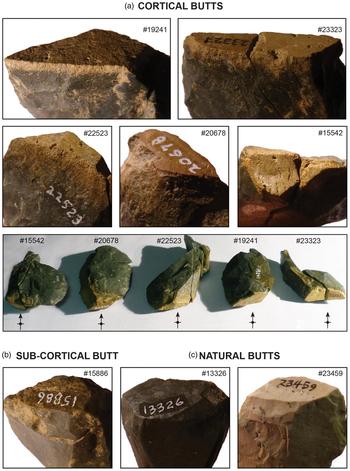
This raw material is not yet reported (to our knowledge) at other late Pleistocene sites from central Alaska, and the source is unknown. However, some aspects of the raw material may provide some clues as to the proximity of the source and its natural shape. Based on various cortical surfaces, some raw material originates from ventifacts and stream-rolled cobbles. However, the flat and patinated cortical surfaces on some artifacts suggest that this raw material could also be found in the shape of tabular or cubic geologic formations (greater than 15 cm in length, based on the largest flake blanks). These flat cortical surfaces can especially be seen on some microblade cores (on the butt of the flake blank; Figure 3), on a microblade core cortical tablet (Supplemental Figure 2b), and on a cortical flake. The similarity of these cortical surfaces (same flat patinated surface, most located on the butt) and the same overall size of, for example, the butts and the flake blank (Figure 3) suggest to us that the flake blanks of various microblade cores could actually come from one single raw material block: in other words, a succession of thick flakes from one single flake core, with each flake turned into microblade cores. Therefore, the flake blanks of some microblade cores could have been struck off a single raw material nodule. To test the hypothesis, we tried—unsuccessfully—to refit some of the microblade cores together. Even if the original flake blanks could refit, the bifacial shaping of the cores complicates this task. Thus, the idea that some of the cores come from one single raw material nodule of grayish green igneous rock is a working hypothesis that has yet to be demonstrated. Several factors suggest a local origin for GGI: (1) Thus far, it appears unique to Swan Point CZ4b; (2) the majority (70%) of CZ4b lithics are made on this raw material; (3) cortical flakes are present in the assemblage, indicating primary reduction at the site; and (4) many of the artifacts (microblade cores, preforms, burins, and tablets) retain cortex on their surfaces, even after bifacial reduction and modification.
Cortical and natural butts of flake blanks from microblade cores, Swan Point Cultural Zone 4b: (a) flat cortical surfaces; (b) subcortical; (c) natural butts. See other figures for sizes of cores. (Color online)

The other main raw materials from CZ4b are rhyolite (~20%, including one microblade core) and chalcedony (>10%; Hirasawa and Holmes Reference Hirasawa and Holmes2016). Obsidian is virtually absent from CZ4b; however, three microblades were recovered (Holmes Reference Holmes, Goebel and Buvit2011), all assigned to unknown obsidian source Group H (Cook Reference Cook1995; Speakman et al. Reference Speakman, Holmes and Glascock2007).
The Microblade Component
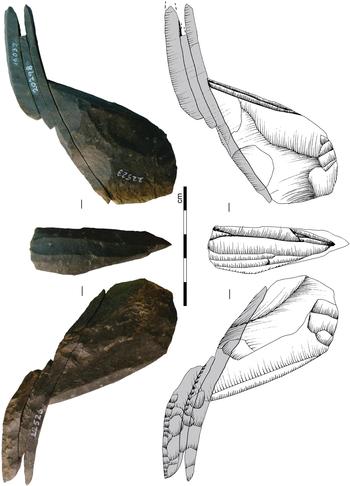
The microblade assemblage from CZ4b contains 10 microblade cores, two microblade core preforms, tens of ridge spalls and tablets, and more than 900 microblades. A ridge spall, the first long removal along the ridge of the core to create a platform, is sometimes called a crested blade. Here, the term crested blade refers to the primary spall created on the front or face of the core prior to the production of microblades; tablets from Yubetsu cores are also called ski spalls. Thus far, 12 tablets and one crested blade have been refitted to seven different microblade cores (Figures 4–5; Supplemental Figures 3–6), while others (especially ridge spalls) are yet to be refitted to microblade cores (Supplemental Figure 2). Nine microblade cores and one microblade core preform are made of the GGI raw material (Figure 4; Supplemental Figures 3–6), one microblade core is made of a white rhyolite (Supplemental Figure 6), and one microblade core preform is made of a different black raw material (possibly chert). All analyzed microblade core ridge spalls and tablets are made of the GGI raw material. Study of the microblade cores and microblades indicates that pressure flaking was the technique employed for the removal of microblades; details concerning the pressure flaking of microblades have been published elsewhere (Flenniken Reference Flenniken1987; Flenniken and Hirth Reference Flenniken, Hirth and Hirth2003; Gómez Coutouly Reference Gómez Coutouly, Goebel and Buvit2011b, Reference Gómez Coutouly2016; Pelegrin Reference Pelegrin1988, Reference Pelegrin and Desrosiers2012; Pelegrin and Yamanaka Reference Pelegrin and Yamanaka2007).
Microblade core (#22523) with refitted tablets, Swan Point Cultural Zone 4b. (Color online)

Theoretical reconstruction of all the microblade cores from Swan Point Cultural Zone 4b.

Systematic Use of the Yubetsu Method
As previously described (Gómez Coutouly Reference Gómez Coutouly2011a, Reference Gómez Coutouly and Desrosiers2012; Holmes Reference Holmes2001), microblade cores from CZ4b are made according to the Yubetsu method (Supplemental Figure 7). New microblade cores found after these publications appear to confirm that this method was the only one employed at CZ4b. The Yubetsu method was first described in the context of the Japanese Paleolithic by Yoshizaki in 1961, although Sato had previously mentioned the existence of wedge-shaped cores made on split bifacial blanks in Mongolia (Kobayashi Reference Kobayashi1970). In eastern Beringia, Morlan (Reference Morlan1970, Reference Morlan1976) first described microblade technology in Alaska by using Japanese terms for production methods (Yubetsu, Horoka, Oshorokko, etc.). As described by various authors (Gómez Coutouly Reference Gómez Coutouly and Desrosiers2012; Inizan et al. Reference Inizan, Reduron-Ballinger, Roche and Féblot-Augustins1999; Kobayashi Reference Kobayashi1970; Morlan Reference Morlan1976; Tixier Reference Tixier, Tixier, Inizan and Roche1984), this method of reduction entails (1) shaping of an asymmetrical bifacial preform, (2) removal of the less convex ridge of the biface (ridge spall) followed by one or several tablets (ski spalls) to create a flat pressure platform, (3) removal of a crested blade, (4) removing microblades through pressure flaking at one end of the bifacial core along the width of the biface.
The Swan Point CZ4b microblade cores and microblade core preforms are all typical of the Yubetsu method. A detailed description for each core can be found in Supplemental Text 1. In summary, the GGI microblade cores were all made on a large flake blank, as was the white rhyolite core. Three of the GGI microblade cores have a damaged microblade removal front, which caused their abandonment. All cores have bifacial shaping. One of the preforms, also from a large flake of GGI material, has a refitted flake, either during the bifacial shaping of the core or during an attempt to remove a ridge spall. The second microblade core preform is of rather poor quality, and the front of the preform is broken.
Reconstructing Microblade Cores
At Swan Point CZ4b, many ridge spalls and tablets have been refitted to microblade cores, thereby reconstructing the early stages of microblade core manufacture and preform production. These refits demonstrate that core preforms were sometimes over twice as long as the abandoned core. With so many refits, we have the opportunity to reconstruct in detail the different stages of microblade core preform manufacture within a coherent assemblage; therefore, we have made theoretical reconstructions of the whole manufacturing sequence for each core, not only to provide a detailed analysis but also to show consistency in core production (overall size, tablet removal, direction of flake blank, etc.). These theoretical reconstructions make it possible to estimate the original shape and minimal size for each core (Figure 5) by evaluating the following conditions. First, the scars from previous tablets were evaluated. If the top removal is a tablet, then at least one ridge spall was added; reconstruction was started along the scars from previous removals. Second, based on refitted cores and examples of refitted tablets with no core, the standard procedure at Swan Point CZ4b seems to have been the removal, minimally, of one ridge spall and two tablets. Hence, when no refits were available for cores (cores #15886 and 13326), at least two tablets and one ridge spall were represented. Third, in the sample, most analyzed ridge spalls/tablets measure between 7 and 9 cm in length and 0.5 to 1.0 cm in thickness. Reconstruction was based on that average.
No meaningful reconstructions for the white rhyolite core were possible, because no technical pieces (ridge spalls, tablets, crested blades, etc.) for this type of raw material were recovered. However, the presence of rhyolite microblades indicates that microblades of this raw material were being manufactured at the site.
How Many Microblades Were Produced?
Refits allowed for the reconstruction of microblade core production, and these reconstructions were also used to estimate how many microblades were produced for each core. Estimating the number of microblades per core provides a general understanding of this technology. The assemblage offers a rare opportunity to appreciate the productivity and efficiency of microblade technology, one of the most distinctive technologies in Beringia. Analysis of a random sample of 26 microblades yielded a mean thickness of about 1.75 mm, close to the 1.61 mm mean thickness measured on a larger sample by Hirasawa and Holmes (Reference Hirasawa and Holmes2016). This information helps estimate how many microblades were produced for each core that has refitted tablets. The cores with refits give us an approximation of the original size of the core before being discarded, thus revealing the length of the core that produced microblades. For this calculation, only the length of refitted tablets was taken into account, not the theoretical reconstructions from Figure 5. By combining this information with the number of microblade facets still present on the core and the mean thickness of microblades, we can conservatively estimate a core's size. The calculation to obtain the productivity of the core is as follows: The distance between the discarded core face and the proximal end of the tablet (in millimeters) is divided by the thickness of the microblade; the result is then multiplied by the number of microblade facets of the core. For example, if the length between the face of the core and the tip of the tablet is 50 mm, the core has four facets, and the mean microblade thickness is 1.75 mm, the calculation is (50/1.75) × 4 = 114.2 microblades. Thus, the core produced about 114 microblades. Using this method, we estimated the number of microblades produced for each of the six microblade cores with long refitted tablets (Supplemental Table 2).
The data from Supplemental Table 2 allow us to extrapolate a rough number of produced microblades at the activity areas identified at CZ4b. The estimates from Supplemental Table 2 indicate that about 400 to 500 microblades could have been produced from the six microblade cores with refitted tablets. The remaining four cores could have produced 70 to 100 microblades each. Therefore, the total number of microblades produced at CZ4b for the 10 microblade cores is estimated at 700 to 900 microblades. As a reminder, more than 900 microblade fragments have been recovered from component CZ4b (Hirasawa and Holmes Reference Hirasawa and Holmes2016), although refits could reduce this number (microblades tend to break: medial segments dominate, followed by proximal and distal segments; complete microblades are rare). Another factor to consider, of course, is how many microblades were selected for use and removed from the site. Also, at least four initial spalls (three ridge spalls and one cortical tablet) not refitting to cores have been recovered at CZ4b (Supplemental Figure 2). Thus, there are fewer ridge spalls than cores, so at this point it is uncertain whether other microblade cores were present at some point during the site's occupation. The only indication comes in the form of three obsidian microblades with minor edge modification, but in the absence of obsidian cores or technical pieces, these microblades could represent weaponry refurbishing and not in situ reduction.
Unfortunately, no grooved or slotted osseous points have yet been found at CZ4b, which could be used to estimate how many microblades could fit in them and thus how many such points were being processed. However, at those sites where osseous points with microblade insets have been preserved, such as Zhokov Island (Pitul'ko Reference Pitul'ko1998) and Bol'shoi Yakor’−1 (Ineshin and Teten'kin Reference Ineshin, Teten'kin, Goebel and Buvit2011) in Siberia, tens of microblade segments are sometimes inserted in one single-grooved antler/bone point. In the case of the slotted point from Chernoozerie-2 (Omsk, Siberia; Zenin et al. Reference Zenin, Leshchinskiy, Zolotarev, Grootes and Nadeau2006), 65 microblade segments were recovered still inserted in the bilaterally grooved point, suggesting that there were close to 100 microblade pieces when the gaps were filled.
Burins
Thirty-three burins have been recovered from CZ4b, most being dihedral and transverse burins. Although the analysis of CZ4b burin technology has not been completed at this time, it is clear that burins were essential for working hard material such as antler and mammoth tusks, and several forms were manufactured for specific applications, as indicated by patterns of wear, for example, thin dihedral types to groove or incise and thick transverse ones for scraping and carving (Holmes Reference Holmes, Goebel and Buvit2011). About 34% of burins had refitted spalls (Lanoë and Holmes Reference Lanoë and Holmes2016), and some of them had multiple rejuvenation/sharpening spalls refitted to a single burin. In one instance, at least five consecutive burin spalls were refitted together, although the actual burin is missing; in another example, up to four spalls were refitted to a single burin (Supplemental Figure 8c). Preliminary analysis reveals that more than five spalls could be produced on one single burin (Supplemental Figure 8), based on the negatives of missing spalls.
Spatial Analysis
The spatial distribution of artifacts (Figure 6) shows the presence of two loci around two distinct hearths only 3 m apart, possibly indicating different activity areas. The backplot (cross-section view) distribution of the CZ4b artifacts (Figure 6) shows that they are mostly distributed within a 10 to 20 cm band. There is a slight downward slope trending southward toward the southern locus. The few artifacts located between the hearths follow this slope and connect both areas (Figure 6). Numerous microblade cores, tablets, and burin spalls have been refitted to their corresponding cores and burins, confirming the synchronicity of both areas. In some cases, burin spalls found together at one hearth could be refitted to a burin discarded at another hearth, and likewise, tablets from one hearth were refitted to microblade cores found at the other hearth. When observing the connecting refits on a map, in both zenithal (Supplemental Figure 9) and cross-sectional (Supplemental Figure 10) views, the coherence and synchronicity of the whole level is apparent. Microblade technology (cores, tablets, and microblades) is primarily represented at the southern locus; however, microblade core tablets are also found at the northern locus, and burin technology (burin and burin spalls) is well represented at both loci. Refits of both artifacts and faunal elements support this assessment (Lanoë and Holmes Reference Lanoë and Holmes2016).
Spatial distribution of the stone tool assemblage from Swan Point Cultural Zone 4b.

In the southern locus, the 10 microblade cores are positioned around the hearth, as are one microblade core preform and most microblade core tablets and microblades. The other microblade core preform of lesser quality is located between the two hearths. All microblade technology from the southern hearth is found within a 5 m diameter area, and all microblade cores are situated less than 2 m away from the hearth (seven of the 10 are less than 1 m away).
The site's function as a specialized workshop for the production of composite (organic plus lithic) weaponry (microblades inset into slotted osseous projectile points) has been put forward previously (Gómez Coutouly Reference Gómez Coutouly2011a; Hirasawa and Holmes Reference Hirasawa and Holmes2016; Holmes Reference Holmes, Goebel and Buvit2011; Lanoë and Holmes Reference Lanoë and Holmes2016). The CZ4b fauna (Lanoë and Holmes Reference Lanoë and Holmes2016) along with lithic artifacts corroborate this specialized activity. This evidence consists of microblade cores used for the production of microblade insets, burins that are usually associated with the shaping and grooving of antler/ivory/bone projectile points and other tools, remains of ungulates probably used for sinew extraction, remains of birds probably used for their feathers and fletching, and signs of antler and ivory work at the site.
Discussion
One Single Event?
Our analysis of the Swan Point CZ4b microblade technology supports the interpretation of a brief single event. When studying an assemblage or comparing sites, it is important to understand whether each assemblage represents a very brief event or whether it represents a palimpsest of occupations. In each case, the implications and the information are not equivalent. Some archaeological sites have a coherent set of tool types, such as Dry Creek II (Powers et al. Reference Powers, Dale Guthrie and Hoffecker2017), where microblade technology is well represented by tens of microblade cores. It is representative of a specific technocomplex, and the numerous cores clearly indicate the general trend for producing microblades. However, cultural remains from large seasonal campsites such as Dry Creek are palimpsests created by groups of people occupying the site repeatedly. Indeed, if the presence of tens of microblade cores at Dry Creek II reveals a coherent trend, it also shows variability in terms of raw materials, the size of cores, the selection of blanks, types of tablets, and so on (Gómez Coutouly Reference Gómez Coutouly2011a, Reference Gómez Coutouly and Desrosiers2012).
In contrast, we interpret all of the data presented here as evidence that the assemblage from CZ4b represents one single event, where all of the materials were made by a very restricted number of knappers, over only a few days or weeks. Rasic has argued that small “clusters of lithic debris on the scale of 2–6 m in diameter … have a good likelihood of being behaviorally related” (Reference Rasic, Goebel and Buvit2011:135). We base our interpretation on the following arguments:
One Main Raw Material. The majority (~70%) of the lithic technology (microblade and burin) is made of one single raw material (grayish green igneous rock), which is thus far unique to CZ4b.
Two Types of Production. The assemblage is made up of two very restricted types of production: microblade cores and burins, which were essential for composite tool production.
One Single Method for Microblade Production. All microblade cores were prepared with the same Yubetsu method, the only known case in Alaska.
Same Core Volumetric Conception. All cores have the same volumetric conception, with preforms made on large thick flakes with cortical butts on most of them, which we consider possibly derived from a matching primary raw material nodule for some of them (yet to be demonstrated).
Uniform Size and Morphology of Cores and Consistency of Microblades. Microblade cores with refitted tablets exhibit fairly similar initial blanks, around 7–10 cm long and 4–5 cm high, and this suggests conformity to a specific standard outcome for microblade cores resulting in uniformity of microblade size. Hirasawa and Holmes (Reference Hirasawa and Holmes2016) have found high consistency in CZ4b microblade width and thickness.
Spatial Analysis. The spatial distribution of the artifacts is very restricted (all microblade cores are located within a 5 m diameter in proximity to a hearth), and numerous refits on microblade cores and burins have been made across the site linking two separate hearths.
Dating of Component. This component has provided a coherent set of AMS 14C dates on a variety of materials (horse and mammoth teeth, tusk ivory, charcoal, and hearth residue), most of which overlap at circa 14,000 cal BP.
Analysis of the faunal assemblage has also suggested “that food preparation and consumption was not a major activity at CZ4b and that length of stay at the site was limited” (Lanoë and Holmes Reference Lanoë and Holmes2016:684). This interpretation is based on the low nutritional value of the recorded faunal elements and their probable use for other activities, such as skin and sinew extraction (for ungulate remains) or for fletching (for bird remains).
Our interpretation does not preclude the existence of a larger, yet to be discovered, seasonal campsite in the vicinity, but the data recovered thus far correspond to a single, very brief occupation. Lanoë and Holmes suggest that CZ4b could be “a logistical foray, dedicated to resupplying on composite tools, within a larger settlement strategy at the landscape level” (Reference Lanoë and Holmes2016:692). There is compelling evidence that people at Swan Point were comfortable in their surroundings, capable of sophisticated microblade core production with uniform results and other tool fabrication, and able to quickly procure the resources (lithic raw material, ivory, feathers, antler, bones, and food) they needed. The purpose (to manufacture and refurbish their tool kit) must have been planned and organized in advance, because the group accomplished the task in a short period of time and abandoned the site.
Yubetsu Method and Ties to the Siberian Diuktai Culture
The Yubetsu method is the hallmark of the Upper Paleolithic Diuktai Culture in Siberia (Supplemental Figure 11). In Alaska, Swan Point CZ4b is the only occupation with a systematic production of Yubetsu microblade cores. Indeed, other late Pleistocene (and Holocene) microblade sites from Alaska are made of Campus-type microblade cores (Supplemental Figure 12; Gómez Coutouly Reference Gómez Coutouly and Desrosiers2012; Mobley Reference Mobley1991) or conical and tabular cores (Holmes Reference Holmes2008). Some sites in Alaska may have an occasional microblade core similar to the Yubetsu method in their assemblages (such as at the Campus and Dry Creek sites); however, no other site in Alaska, to our knowledge, has provided a systematic production of Yubetsu cores. Moreover, these rare “Yubetsu” cores at other sites do not have refits giving a clear sense of the whole reduction process of the cores in order to clarify whether the variation from the general Campus method was intentional. Although it was widespread in Siberian late Pleistocene sites, in Alaska the Yubetsu method was abandoned entirely and replaced by the Campus method (Gómez Coutouly Reference Gómez Coutouly and Desrosiers2012; Holmes Reference Holmes2001, Reference Holmes2008) and other conical and tabular microcore forms. It is undeniable that the Denali complex has clear ties with the Siberian Upper Paleolithic. Yet, from a technological and typological point of view, Swan Point CZ4b is an even closer candidate for a direct link with the Diuktai Culture. Therefore, the most ancient known human occupation in Alaska, Swan Point CZ4b, is the only occupation in eastern Beringia to comprise a whole microblade tool kit exclusively made by the Yubetsu method, thus indicating possible technological as well as cultural ties with the Diuktai Culture of Siberia. Both Diuktai and Swan Point CZ4b were well adapted to hunting large mammals such as mammoth, bison, horse, and caribou, as well as smaller animals. In other words, Swan Point CZ4b may represent a time when physical/environmental connections across Beringia still existed. The Campus method had not yet been generalized among early microblade-bearing populations of Alaska, and thus Swan Point CZ4b represents a late Diuktai facies in Alaska, rather than an early Denali complex site. In previous publications, one of us described the influence of raw materials on microblade technology (Gómez Coutouly Reference Gómez Coutouly2007, Reference Gómez Coutouly and Desrosiers2012) and proposed that the abandonment of the Yubetsu method in favor of the Campus method in central Alaska might have been related to the locally available raw materials (mainly cobble). In the same way, we can consider whether GGI raw material played a role in the production of these Yubetsu cores. As described previously, this raw material (source unknown) may have been present in the form of large blocks, thus allowing for large flakes compatible with the bifacial shaping of cores. However, the GGI raw material alone cannot explain the use of the Yubetsu method, given that at least one core made on white rhyolite also corresponds to this method of reduction.
The Only Yubetsu Microblade Production Workshop in Alaska May Represent a Single Event: What Are the Implications?
Swan Point CZ4b is, so far, the only Yubetsu-producing site in Alaska, and because Swan Point CZ4b is also the oldest site in Alaska, a direct relationship with the Yubetsu-based Diuktai Culture is easy to support. The East Beringian tradition (Holmes Reference Holmes2001, Reference Holmes2008, Reference Holmes, Goebel and Buvit2011) is divided into two phases: Swan Point Diuktai (Phase 1) and Nenana/Chindadn complexes (Phase 2). However, since there are no contemporaneous microblade sites in Alaska to compare with Phase 1, it is rather difficult at present to confirm whether Swan Point CZ4b represents a distinct technological facies from the later Denali complex or a single-site variation. Moreover, if we postulate a single-event occupation hypothesis, we are not confronted with a palimpsest of occupations, where Yubetsu cores may have been produced over the course of multiple seasons or years by different generations or groups. Therefore, one can wonder whether CZ4b represents a real technocultural facies or just the variation of a handful of knappers. Only future research and new sites from the same chronocultural background will reveal whether there are more late Pleistocene microblade sites in Alaska with the systematic use of the Yubetsu method.
Swan Point CZ4b is not only much older than the Denali complex but also older than the Nenana complex and other nonmicroblade sites from eastern Beringia. Therefore, CZ4b stands alone in Alaska in terms of technological features but also from a chronological standpoint and at this juncture can hardly be understood in relationship to either the Denali or the Nenana complex. Because both of these complexes are thought to have antecedents in Diuktai, the East Beringian tradition was proposed in anticipation “that seemingly different assemblages will turn out to be more alike after more data are assessed” (Holmes Reference Holmes, Goebel and Buvit2011:183).
If we accept that the expansion of Diuktai Culture into Alaska was blocked from continuing into North America by the Laurentide and Cordilleran Ice Sheets, then Swan Point CZ4b may have been isolated on the eastern frontier about the time when the ice-free corridor was beginning to open (Potter et al. Reference Potter, Reuther, Holliday, Holmes, Shane Miller and Schmuck2017). The “Beringian Standstill” model (Mulligan et al. Reference Mulligan, Kitchen and Miyamoto2008; Tamm et al. Reference Tamm, Kivisild, Reidla, Metspalu, Smith, Mulligan, Bravi, Rickards, Martinez-Labarga, Khusnutdinova, Fedorova, Golubenko, Stepanov, Gubina, Zhadanov, Ossipova, Damba, Voevoda, Dipierri, Villems and Malhi2007) proposes that human populations were isolated in Beringia long enough (several thousand years) for founder lineages (haplotypes) to differentiate. This would have happened prior to the CZ4b occupation; however, descendants of CZ4b would have carried the Beringian genetic lineages when first encountering Paleoamericans from the south after the ice-free corridor was available, that is, Clovis-related and their descendants.
Conclusion
The evidence is sufficient now to suggest that the entire Cultural Zone 4b occupation at Swan Point represents a single brief occupation created by a few individual knappers focused on renewing their tool kit. This interpretation is based on a series of arguments, including limited raw materials, limited tool categories, the exclusive use of the Yubetsu method in producing microblade cores, a generalized volumetric management or standardization of the cores, the spatial distribution of microblade cores and burins and corresponding refits, and the cohesive set of AMS 14C dates. We are now able to say with confidence that Swan Point CZ4b is contemporary with, and technologically similar to, Siberian Diuktai Culture. Thus, given the geography of Beringia, and until future discovered sites in central Alaska prove otherwise, Swan Point CZ4b should be considered the eastern branch of Diuktai Culture.
The proposition that the Alaskan Denali complex is related to the microblade-based Diuktai Culture from Siberia has been acknowledged by many archaeologists for decades. In 1996, West stated that if a Denali site
had been found in northeastern Siberia by Yuri Mochanov or Svetlana Fedoseeva there is no question but that it would be classified as Dyuktai. Equally, an errant (geographically) Dyuktai site discovered in interior Alaska would assuredly be identified as Denali [Reference West and West1996:547].
With Swan Point CZ4b, new questions arise. Does CZ4b represent an extension from the Diuktai Culture, a transitional facies between Diuktai and Denali yet to be identified in Alaska, or just an on-site variation from the larger but later Denali complex? Does the hiatus in microblade sites between Swan Point CZ4b and the onset of the Denali complex represent a real hiatus in this technology, or is it simply the result of the present state of research? What are the climatic implications, given that Swan Point CZ4b dates to the Bølling-Allerød period and the Denali complex was established around the Younger Dryas period? Future discoveries of late Pleistocene microblade sites in Alaska (whether in the central or in more western regions) will reveal either new Yubetsu-style production sites like Swan Point CZ4b or Denali-type sites contemporaneous with CZ4b. We will then be able to deepen our understanding of the early colonization process of the American continent and its technological and cultural implications regarding its Siberian predecessors.
Acknowledgments
Study of the Swan Point collection in 2013 was supported by the French Ministry of Foreign Affairs through funding of the Mission archéologique française en Alaska project. We would like to thank the three anonymous reviewers for their careful reading of our manuscript and their many insightful comments and suggestions.
Data Availability Statement
The Swan Point collection is currently housed at the Alaska Office of History and Archaeology, State Historic Preservation Office, in Anchorage, Alaska.
Supplemental Materials
For supplementary material accompanying this article, visit https://doi.org/10.1017/aaq.2018.38.
Supplemental Text 1. Description of Microblade Cores
Supplemental Table 1. Accelerator Mass Spectrometry Radiocarbon Dates from Swan Point Cultural Zone 4b.
Supplemental Table 2. Estimated Number of Microblades Based on Microblade Cores with Refitted Tablets.
Supplemental Figure 1. Miscellaneous tools, Swan Point Cultural Zone 4b.
Supplemental Figure 2. Ridge spalls and cortical tablets, Swan Point Cultural Zone 4b.
Supplemental Figure 3. Microblade cores with refitted tablets, Swan Point Cultural Zone 4b.
Supplemental Figure 4. Microblade cores with refitted tablets, Swan Point Cultural Zone 4b.
Supplemental Figure 5. Microblade cores with refitted tablets, Swan Point Cultural Zone 4b.
Supplemental Figure 6. Microblade cores and microblade core preforms, Swan Point Cultural Zone 4b.
Supplemental Figure 7. Yubetsu method (theoretical model).
Supplemental Figure 8. Burins and refitted burin spalls, Swan Point Cultural Zone 4b.
Supplemental Figure 9. Refitted artifacts (zenithal view), Swan Point Cultural Zone 4b.
Supplemental Figure 10. Refitted artifacts (cross-section view), Swan Point Cultural Zone 4b.
Supplemental Figure 11. Examples of Yubetsu cores in Russian Far East and Siberian assemblages.
Supplemental Figure 12. Campus method (theoretical model).