Introduction
Wide phenotypic variation in fruit quality (shape and size, rind and flesh colour, flesh texture, aroma, flavour and nutrient composition) exists among American heirloom cultivars of watermelon. However, analysis using isozymes (Navot and Zamir, Reference Navot and Zamir1987) and randomly amplified polymorphic DNA (RAPD) markers (Levi et al., Reference Levi, Thomas, Wehner and Zhang2001b) revealed low DNA polymorphism among these cultivars, implying that they share a narrow genetic base while the divergence in fruit quality is a result of gene mutations that may not be readily detected by RAPD marker analysis. Our experiments with sequence-related amplified polymorphism (SRAP) markers, known to be associated with gene sequences (Li and Quiros, Reference Li and Quiros2001), produced polymorphism among watermelon cultivars (Levi et al., Reference Levi, Thomas, Trebitsh, Salman, King, Karalius, Newman, Reddy, Xu and Zhang2006b; Levi and Thomas, Reference Levi and Thomas2007), indicating that considerable polymorphism exists in the vicinity of coding regions of the watermelon genome. To date, only a few DNA markers were reported to be linked to gene loci in watermelon (Hashizume et al., Reference Hashizume, Shimamoto and Hirai2003), and there is a need to develop markers related to genes controlling fruit quality in this crop.
Recently, we conducted high-throughput sequencing of a cDNA library derived from watermelon fruit flesh, and produced over 4700 non-redundant expressed-sequenced tags (EST unigenes) (Levi et al., Reference Levi, Davis, Hernandez, Wechter, Thimmapuram, Trebitsh, Tadmor, Katzir, Portnoy and King2006a) (http://www.icugi.org) representing a wide array of genes expressed in watermelon fruit. Identifying, mapping and characterizing these genes will be useful to research and breeding efforts in this crop. Analysis of the 4700 EST unigenes revealed over 400 ESTs that contain simple sequence repeat (SSR) motives (EST-SSRs). To identify polymorphism associated with EST-SSRs, we designed the forward and reverse primers flanking the SSRs in 40 of these ESTs. Also, following an approach shown to be successful in differentiating among blueberry genotypes (Rowland et al., Reference Rowland, Mehra, Dhanaraj, Ogden, Slovin and Ehlenfeldt2003), we designed primer pairs for 60 customary ESTs (not containing SSR motives) of watermelon fruit (Levi et al., Reference Levi, Davis, Hernandez, Wechter, Thimmapuram, Trebitsh, Tadmor, Katzir, Portnoy and King2006a). These primer pairs were used in PCR experiments to amplify genomic DNA (EST-PCR markers) and examine polymorphism among 25 closely related watermelon cultivars and 13 US Plant Introductions (US PIs) of Citrullus sp.
Our objectives in this study were: (1) to determine to what extent the EST-PCR markers representing fruit genes differ between Citrullus PIs and watermelon cultivars; (2) to assess to what extent these EST-PCR markers are polymorphic among heirloom cultivars; (3) to identify and construct a set of polymorphic EST-PCR markers associated with watermelon fruit that can be useful in genetic analysis of watermelon heirloom cultivars known to share a narrow genetic base and (4) to identify those cultivars having high EST-polymorphism between them that can be used as parental lines in genetic mapping of watermelon employing the EST-derived markers, and in the discovery of single nucleotide polymorphism (SNP) markers using pyrosequencing technology (Barbazuk et al., Reference Barbazuk, Emrich, Chen, Li and Schnable2007).
Materials and methods
Plant material
Twenty-five American heirloom cultivars (diploids; 2n = 22), with low DNA polymorphism (Levi et al., Reference Levi, Thomas, Wehner and Zhang2001b), four C. lanatus var. lanatus, five C. lanatus var. citroides, and four C. colocynthis PIs were selected for this study (Tables 3 and 4). Young leaves were collected from 3-week-old plants and stored at − 80°C for DNA isolation.
Isolation of DNA
An improved procedure for isolation of DNA from young leaves of watermelon (Levi et al., Reference Levi, Thomas, Keinath and Wehner2001a) was employed in this study.
ESTs, primer design and generation of EST-PCR markers
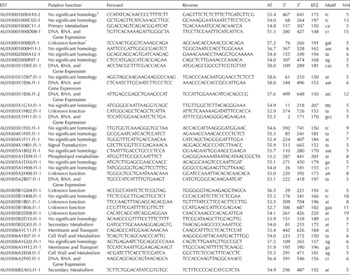
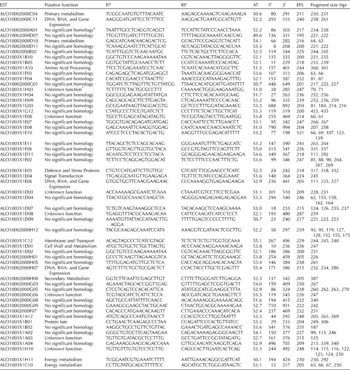
A large number of ESTs were developed from a cDNA library constructed for watermelon fruit [12 (early stage), 24 maturing stage) and 36 d post-pollination (ripe fruit)]. The cDNA library was first normalized to enrich the presence of the less abundant and rare mRNA sequences. Then the library was subtracted with leaf cDNA to enrich the presence of the mRNAs that are uniquely expressed in watermelon fruit (Levi et al., Reference Levi, Davis, Hernandez, Wechter, Thimmapuram, Trebitsh, Tadmor, Katzir, Portnoy and King2006a). Simple sequence repeat motives were identified in the watermelon EST unigenes (watermelon EST data are published in the ‘International Cucurbit Genomics Initiative’ (ICuGI) web site http://www.icugi.org) using the simple sequence identification tool http://www.gramene.org/db/searches/ssrtool. Forty ESTs, each containing at least five SSR motives, were selected for this study (Table 1). Using the Integrated DNA Technologies web site (http://www.idtdna.com), the forward and reverse primers were designed to amplify SSR containing fragments ranging in size from 150 to 220 bp (Tables 1 and 3). In addition, we selected 60 EST unigenes with different putative functions (Tables 2 and 4; Levi et al., Reference Levi, Davis, Hernandez, Wechter, Thimmapuram, Trebitsh, Tadmor, Katzir, Portnoy and King2006a), based on their sequence homology to gene sequences discovered in other plant species (Table 2; Levi et al., Reference Levi, Davis, Hernandez, Wechter, Thimmapuram, Trebitsh, Tadmor, Katzir, Portnoy and King2006a), and designed primer pairs to amplify fragments ranging in size from 180 to 360 bp for each these ESTs (Tables 2 and 4). The primer pairs were used in PCR experiments with genomic DNA of the 25 cultivars and 13 PIs (Tables 3 and 4), representing genes expressed in watermelon fruit as previously described for SSR markers (Levi et al., Reference Levi, Thomas, Trebitsh, Salman, King, Karalius, Newman, Reddy, Xu and Zhang2006b). The annealing temperature in each PCR experiment ranged from 52 to 59°C, based on the T m for each primer pair (Levi et al., Reference Levi, Thomas, Trebitsh, Salman, King, Karalius, Newman, Reddy, Xu and Zhang2006b; Levi and Thomas, Reference Levi and Thomas2007). The markers were analysed using a CEQ-8800 (capillary system) DNA sequencer (Beckman Coulter, Fullerton, CA). For visualization of DNA fragments on the CEQ-8800, the forward primers were labelled with one of three WellRED dye labels (D2, D3 or D4; Proligo, Boulder, CO) as previously described for SSR markers (Levi et al., Reference Levi, Thomas, Trebitsh, Salman, King, Karalius, Newman, Reddy, Xu and Zhang2006b).
The expressed sequence tag (EST) designation and their putative function, the forward and reverse primers designed around simple sequence repeat (SSR) motives in 40 (ESTs). The annealing temperature °C (AT), the nucleotide on which the forward (5′) and reverse (3′) primers start and the expected fragment size (EFZ) in each EST, the motif and number of motives (NM) of each SSR

* EST has significant homology to a gene discovered in other plant species. However, the function has not been determined yet.
† EST has no significant homology to all genes discovered so far in other plant species.
EST designation, their putative function, the forward (FP) and reverse (RP) primers, their annealing temperature °C (AT), the nucleotide on which the forward (5′) and reverse (3′) primers start and the expected fragment size (EFS) amplified for each EST. The size of polymorphic fragments that were produced in polymerase chain reactions (PCR) with genomic DNA of watermelon cultivars and Citrullus PIs (Table 4)
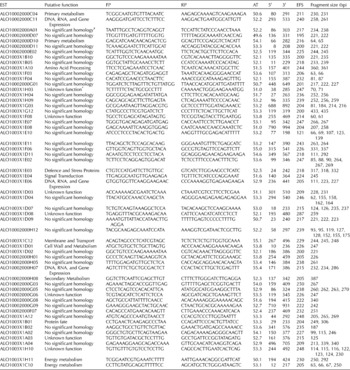
* EST has significant homology to a gene discovered in other plant species. However, the function has not been determined yet.
† EST has no significant homology to all genes discovered so far in other plant species.
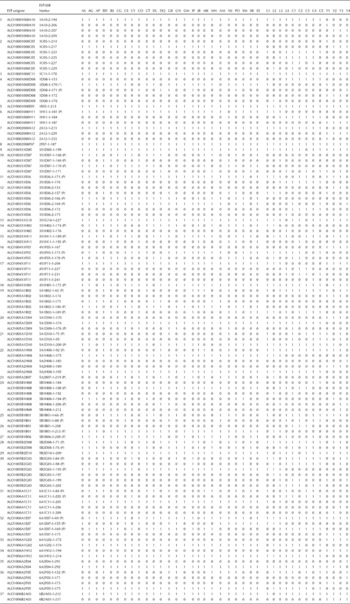
Polymorphic and non-polymorphic EST-SSR markers among 25 American watermelon heirloom cultivars and 13 US Plant Introductions (PIs) of Citrullus sp.

AS, Allsweet; AG, AU-Golden Producer; AP, AU- Producer; BD, Black Diamond; BS, Blackstone; CG, Calhoun Gray; CS, Calsweet; CY, Charleston Gray; CO, Congo; CT, Crimson Sweet; DL, Dixielee; DQ, Dixie Queen; GR, Garrison; GN, Garrisonian; GM, Golden Midget; IP, Iopride; JB, Jubilee; MK, Mickylee; MN, Minilee; NM, New Hampshire Midget; NS, Northern Sweet; PO, Peacock; SM, Stone Mountain; SB, Sugar Baby; S5, Stone mountain no. 5; L1, Citrullus lanatus var. lanatus PI 189317; L2, PI 248178; L3, PI 270550; L4, PI 482377; C1, Citrullus lanatus var. citroides Griffin 14113; C2, PI 296341; C3, PI 271773; C4, PI 299379; C5, PI 482257; Y1, Citrullus colocynthis PI 386015; Y2, PI 220778; Y3, PI 269365; Y4, PI 525082. *P = Marker is polymorphic among the 25 cultivars.
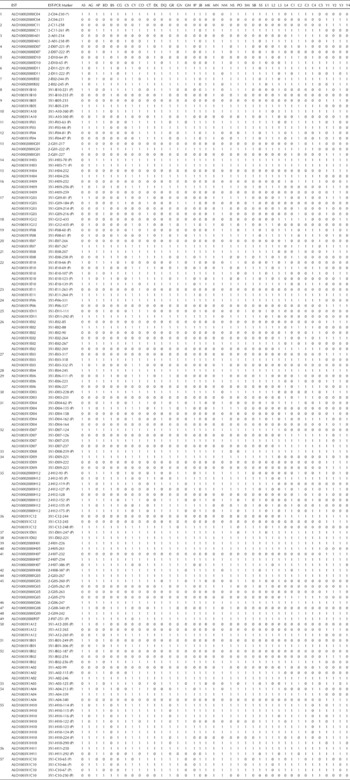
Polymorphic and non-polymorphic EST markers among 25 American watermelon heirloom cultivars and 13 US Plant Introductions (PIs) of Citrullus sp.
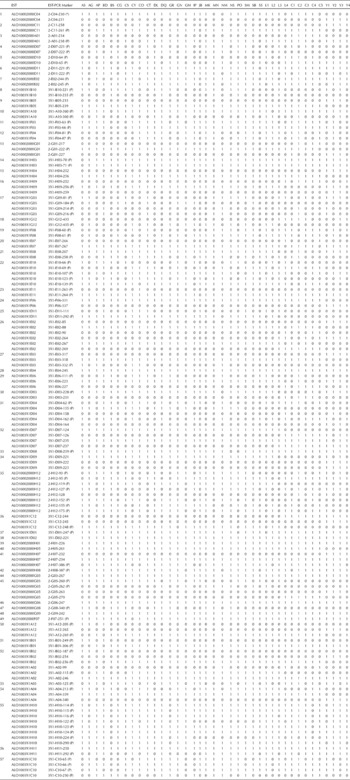
AS,Allsweet; AG, AU-Golden Producer; AP, AU- Producer; BD, Black Diamond; BS, Blackstone; CG, Calhoun Gray; CS, Calsweet; CY, Charleston Gray; CO, Congo; CT, Crimson Sweet; DL, Dixielee; DQ, Dixie Queen; GR, Garrison; GN, Garrisonian; GM, Golden Midget; IP, Iopride; JB, Jubilee; MK, Mickylee; MN, Minilee; NM, New Hampshire Midget; NS, Northern Sweet; PO, Peacock; SM, Stone Mountain; SB, Sugar Baby; S5, Stone mountain no. 5; L1, Citrullus lanatus var. lanatus PI 189317; L2, PI 248178; L3, PI 270550; L4, PI 482377; C1, Citrullus lanatus var. citroides Griffin 14113; C2, PI 296341; C3, PI 271773; C4, PI 299379; C5, PI 482257; Y1, Citrullus colocynthis PI 386015; Y2, PI 220778; Y3, PI 269365; Y4, PI 525082. *P = Marker is polymorphic among the 25 cultivars.
Marker scoring and data analysis
The markers were scored using fragment analysis software (provided with the Beckman CEQ-8800 system) for EST fragments. Polymorphic markers were scored for the presence or absence of the corresponding bands among the cultivar and PI genotypes. The scores ‘1’ and ‘0’ indicate the presence and absence of the bands, respectively. A pairwise similarity matrix was generated using the Nei–Li similarity index (Nei and Li, Reference Nei and Li1979) as follows: similarity = 2N ab/(N a+N b), where N ab is the number of fragments shared by two genotypes (a and b) and N a and N b are the total number of fragments analysed in each genotype. A cluster analysis was performed based on the marker data using the NTSYS-PC version 2.02 (Rohlf, Reference Rohlf1993) with the unweighted pair group method on arithmetic averages (UPGMAs) method.
Results
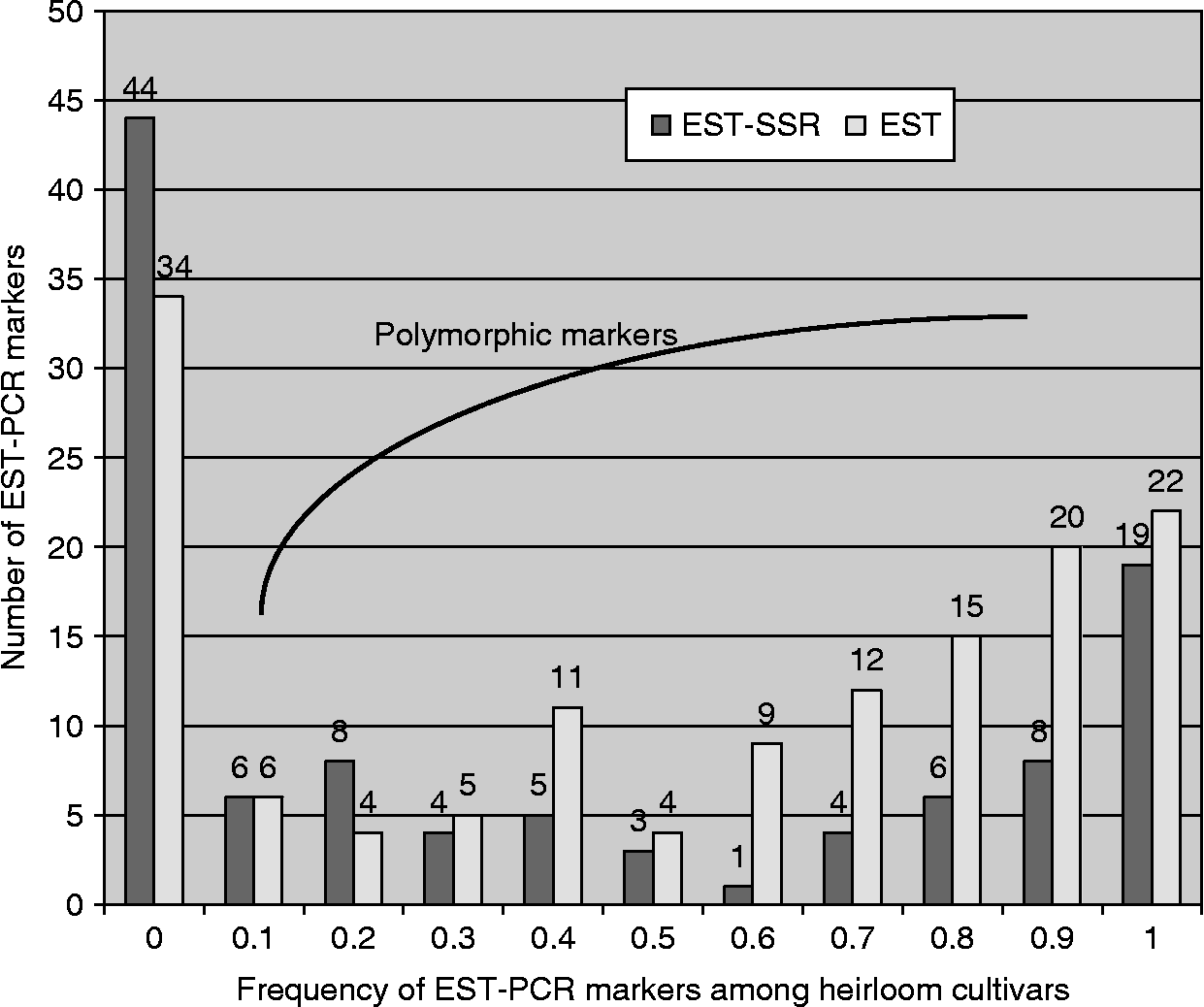
The primer pairs in this study produced a large number of EST-PCR markers that are polymorphic between the groups of C. colocynthis and C. lanatus var. citroides PIs and the C. lanatus var. lanatus group that includes watermelon cultivars and PIs. A large number of these markers are unique to the C. colocynthis PIs and a few markers are unique to the C. lanatus var. citroides PIs (Tables 3 and 4). A large number of EST-PCR markers (31.7%) that were identified in Citrullus PIs (particularly in C. colocynthis) were not found in the watermelon cultivars (Tables 3 and 4; Figs 1 and 2). However, the majority (75.6%) of the EST-PCR markers that were found in the cultivars appeared to be polymorphic among them (Tables 3 and 4; Fig. 1).
Frequency of EST-PCR markers (associated with EST-SSRs and with customary ESTs) among the 25 heirloom cultivars (Tables 3 and 4). The value ‘0’ is the number of EST-PCR markers that exist in the PIs but not found in the cultivars. The value ‘1’ is the number of EST-PCR markers that are not polymorphic among all 25 cultivars (Tables 3 and 4).
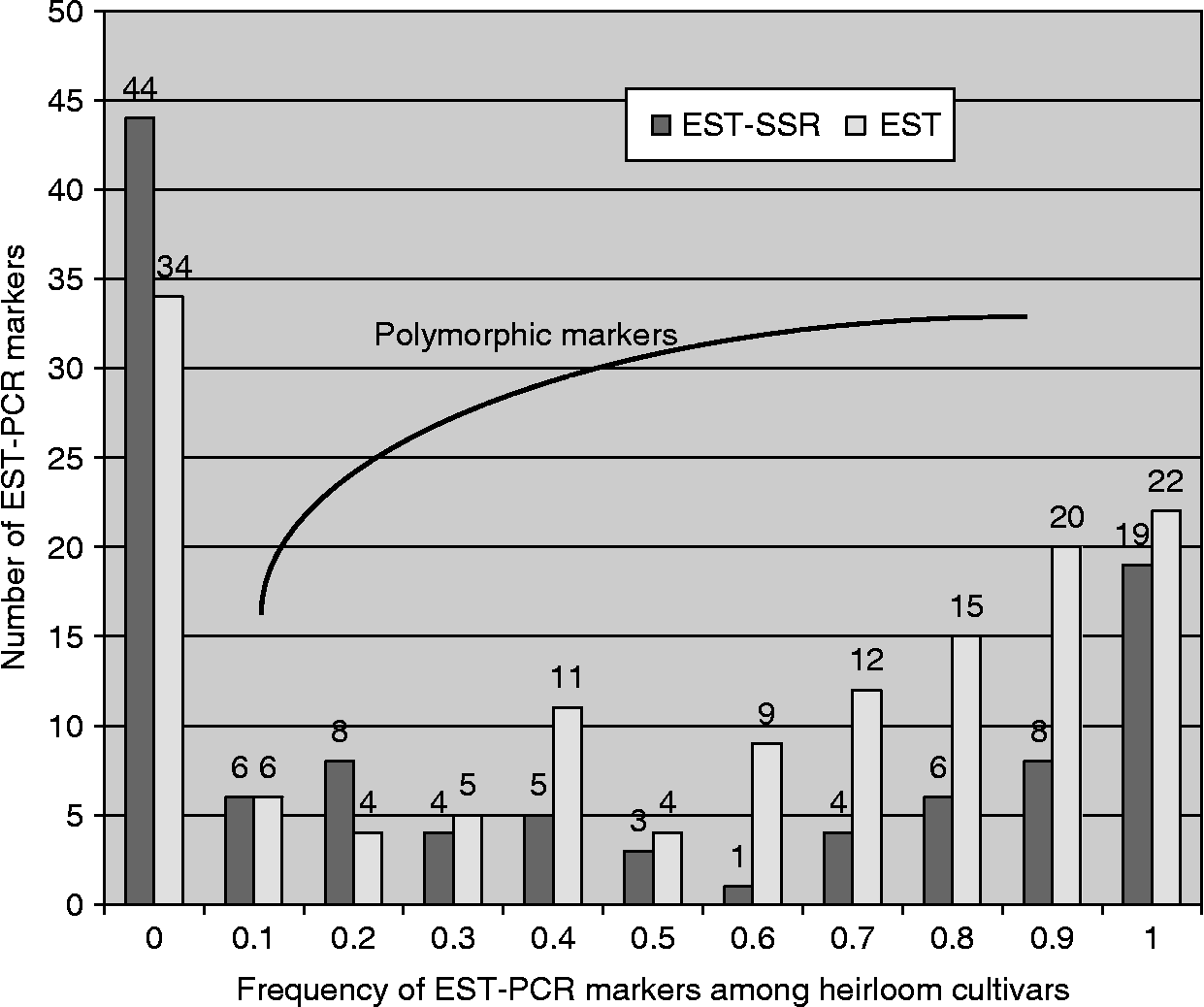
The 40 primer pairs associated with EST-SSRs (Table 1) and the 60 primer pairs associated with customary ESTs (Table 2) produced a total of 108 and 142 markers, respectively, with each primer pair generating one to eight markers among the Citrullus PIs and watermelon cultivars (Tables 3 and 4). Of the 108 EST-PCR markers associated with EST-SSRs, 103 exist in the Citrullus PIs and 64 exist in the cultivars. Of these 64 markers, 45 (70.3%) are polymorphic among cultivars (Table 3; Fig. 1). However, at this stage, sequence analysis has not been performed to determine whether the EST-SSR polymorphisms are due to differences in the SSR motives or in the regions neighbouring the SSR motives. Of the 142 EST-PCR markers representing customary ESTs, 134 exist in the Citrullus PIs and 108 exist in the cultivars. Of these 108 markers, 86 (79.6%) are polymorphic among cultivars (Table 4; Fig. 1). The 45 EST-SSR and 86 EST-PCR markers that are polymorphic among the heirloom cultivars (are designated as ‘P’ in Tables 3 and 4) can be useful for distinguishing among closely related genotypes of watermelon.
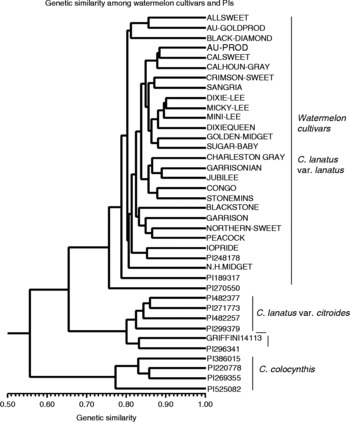
The 250 EST-PCR markers were used for evaluating genetic similarity among the cultivars and PIs and could distinguish among the three major Citrullus groups examined in this study (Fig. 2). The four C. colocynthis PIs appeared to be distinct, while the C. lanatus var. citroides PIs exhibited closer distance to the C. lanatus var. lanatus PIs and cultivars (Fig. 2). The EST-PCR markers could distinguish among the 25 watermelon cultivars and the C. lanatus var. lanatus PIs. The cultivars ‘Allsweet’, ‘AU-Golden Producer’ and ‘Black Diamond’ appeared to be clustered together and have wider genetic distance from all other heirloom cultivars (Fig. 2), indicating that they are divergent from other cultivars in genes expressed in watermelon fruit.

Discussion
This study shows that PCR-base primer pairs derived from watermelon fruit ESTs [representing genes that are putatively associated with development and ripening of watermelon fruit (http://www.icugi.org; Levi et al., Reference Levi, Davis, Hernandez, Wechter, Thimmapuram, Trebitsh, Tadmor, Katzir, Portnoy and King2006a)] are useful in identifying polymorphism among watermelon cultivars known to share a narrow genetic base. The customary EST-PCR primers produced higher polymorphisms among the watermelon cultivars (79.6% of markers were polymorphic among cultivars; Fig. 1) compared with the EST-SSR primers (70.3% of markers were polymorphic among the cultivars; Fig. 1). These results indicate that in watermelon the EST-SSRs may not be a primary source of polymorphisms in coding regions (ESTs). On the other hand, customary EST-PCR primers may be useful in detecting differences (and in the development of single nucleotide polymorphism; SNP markers) in coding regions (ESTs) known to be conserved regions. Studies with different plant species, including strawberry (Fragaria vesca) (Bassil et al., Reference Bassil, Njuguna and Slovin2006) and forage grass species (Festuca arundinacea) (Saha et al., Reference Saha, Rouf Mian, Eujayl, Zwonitzer, Wang and May2004) showed that EST-SSR markers were highly polymorphic among species of the same genera, but were conserved within the species. On the other hand, ESTs proved to be useful for the identification and development of SNP markers (Soleimani et al., Reference Soleimani, Baum and Johnson2003; Lai et al., Reference Lai, Livingstone, Zou, Church, Knapp, Andrews and Rieseberg2005).
Previous studies using isozyme or RAPD markers indicated that although a wide phenotypic diversity exists in fruit qualities (shape, size rind and flesh colour, texture thickness, aroma and sugar contents), watermelon heirloom cultivars appear to share low genetic polymorphism (Levi et al., Reference Levi, Thomas, Wehner and Zhang2001b). However, the study reported here showed that the majority (75.6%) of coding regions (ESTs) of the watermelon fruit genes analysed are polymorphic among the 25 heirloom cultivars. The polymorphism in expressed genes (much of which appeared to be in coding regions, as most of the amplified fragments were not large enough to include introns; Tables 3 and 4) may be associated with the wide diversity that exists in fruits of watermelon cultivars. The polymorphic EST-PCR markers (a number of them are putatively co-dominant markers; Tables 3 and 4) identified in this study should be useful in DNA fingerprinting of watermelon breeding lines and cultivars.
In previous studies, using wide genetic crosses (between watermelon cultivars and C. lanatus var. citroides PIs) for mapping of the watermelon genome (Levi et al., Reference Levi, Thomas, Joobeur, Zhang and Davis2002, Reference Levi, Thomas, Trebitsh, Salman, King, Karalius, Newman, Reddy, Xu and Zhang2006b), we found that most of the markers (RAPD, ISSR, AFLP and SSR markers) (~80% of markers) preferentially segregated in an F 2 population, resulting in linkage disequilibrium for many markers and consequently in limited genetic maps. Thus, there is a need to construct a genetic linkage map for watermelon based on genetic populations derived from closely related genotypes. Utilized as sequenced-tagged site (STS) markers, some of the EST-PCR markers identified in this study may be valuable in constructing a genetic linkage map using populations derived from a cross between closely related heirloom cultivars. However, the challenge in using closely related genotypes is in finding sufficient numbers of polymorphic markers suitable for mapping. Here, the EST-PCR markers appeared to be valuable in identifying the watermelon cultivars with the highest polymorphism in their coding regions. These cultivars can be used as parental lines for the development of mapping populations and for the discovery and mapping of single nucleotide polymorphism (SNP) markers (as has been shown in recent studies of SNP discovery using the pyrosequencing technology; Barbazuk et al., Reference Barbazuk, Emrich, Chen, Li and Schnable2007). The genetic relationships among cultivars based on the fruit EST-PCR markers (Fig. 2) are consistent in large part with the results based on the RAPD markers (Levi et al., Reference Levi, Thomas, Wehner and Zhang2001b). The cultivars ‘Allsweet’, ‘AU-Golden Producer’ and ‘Black Diamond’, which showed wider genetic distance from the other 22 heirloom cultivars studied, should be useful as a parent in crosses with any of the 22 other cultivars (Fig. 2). Crosses between these groups would be preferable for generating populations used in genetic mapping of watermelon.
Some of the cultivars that have similar fruit characteristics also show close genetic similarity based on the EST-PCR markers (Fig. 2). For example, the cultivars ‘Mickylee’, ‘Minilee’ and ‘Dixilee’ appeared to be closely related (Fig. 2). These three cultivars have small–midsize, globular fruit and dark red flesh. They are derived from the same parents (Texas W5, Peacock, Fairfax, Summit and Graybelle) (as described by Wehner; http://cuke.hort.ncsu.edu). On the other hand, some of the cultivars that appeared to be closely related based on the EST-PCR markers have different fruit characteristics. For example, the cultivars ‘Allsweet’, ‘AU-Golden Producer’ and ‘Black Diamond’ appeared to be closely related based on the EST-PCR markers (Fig. 2), but have different fruit characteristics. Allsweet has an elongated oval-shaped fruit with irregular green broken stripe markings on its rind, and has firm, red flesh and small dark brown seeds [Parentage: (Miles × Peacock) × Charleston Gray]. AU-Golden Producer has a globular fruit with medium–wide dark green stripes on a light green background and has a firm flesh with yellow orange colouration (Parentage: Crimson Sweet × PI 189225). Black Diamond has a globular fruit with dark green rind and bright red flesh (Parentage: information not provided) (http://cuke.hort.ncsu.edu). Similarly, the cultivars ‘AU-Producer’, ‘Calsweet’ and ‘Calhoun-Gray’ appeared to have close genetic similarity based on the EST-PCR markers (Fig. 2), but have different fruit characteristics. AU-Producer has globular fruit with medium-wide dark green stripes on a light green background and has a firm red flesh (Parentage: Crimson Sweet × PI 189225). Calsweet has an oblong fruit shape with green rind and deep green stripes and has firm deep red flesh [Parentage: (Miles × Peacock) × Charleston Gray, the same parents as Allsweet and Crimson Sweet]. On the other hand, Calhoun Gray has an elongated fruit with light green rind background with green strips and has a light red flesh (Parentage: Calhoun Sweet × Charleston Gray) (as described by Wehner; http://cuke.hort.ncsu.edu).
The major fruit qualities of watermelon are controlled by a single or a few gene mutations (watermelon gene list edited by Wehner at http://cuke.hort.ncsu.edu). Thus, these fruit qualities could not be reflected by genetic similarity values based on a large number of gene-related markers. For example, fruit shape in watermelon was reported to be controlled by a single incomplete dominant gene, resulting in elongate (OO), oval (Oo) or globular fruit (oo) (Weetman, Reference Weetman1937). A single gene controls furrowed (f) versus smooth (F) fruit surface (Poole, Reference Poole1944). Likewise, a single gene (e) controls rind explosiveness (Porter, Reference Porter1937). Different genes control rind and flesh colours. For example, a single gene determines the intensity of the rind green colour, while a solid light green (g) rind colour is recessive to solid dark green (G) (Weetman, Reference Weetman1937). Green striped skin is controlled by a single gene g-s (Weetman, Reference Weetman1937) that is recessive to dark green but dominant to light green. Watermelon flesh colour is also controlled by several genes resulting in red, orange, salmon yellow, canary yellow or white flesh. The canary yellow (C) flesh colour is dominant to red flesh (c), while red flesh (Y) is dominant to salmon yellow (y). The orange flesh (y-o) is controlled by multiple alleles on the same locus, while the red flesh allele (Y) is dominant to the orange flesh (y-o) and to the salmon yellow(y). The orange flesh (y-o) is dominant to salmon yellow (y) (as described by Wehner; http://cuke.hort.ncsu.edu). The ESTs that are being developed for watermelon fruit (http://www.icugi.org) should be useful for targeting and mapping of genes controlling watermelon fruit quality.
C. colocynthis, which has bitter fruits and does not possess the qualities of watermelon fruit cultivars (Whitaker and Davis, Reference Whitaker and Davis1962), appeared to have a large number of unique ESTs. The implication of this is that C. colocynthis may offer a plethora of alleles that can be useful in the development of introgression lines [containing chromosomal segments of C. colocynthis in the background of cultivated watermelon (C. lanatus var. lanatus)], that could be used in advanced backcross analysis for identifying and mapping genes controlling watermelon fruit quality, as has been shown in tomato (Eshed et al., Reference Eshed, Abu-Abied, Saranga and Zamir1992; Eshed and Zamir, Reference Eshed and Zamir1995). In our recent study (data unpublished), sequence-related amplified polymorphism (SRAP) markers proved to be useful in distinguishing and mapping genomic segments from a wild-type PI (donor parent) that were introgressed into the ‘Crimson Sweet’ cultivar (recurrent parent) genomic background through repeated backcrosses (data unpublished).
Here we show, although a narrow genetic base among heirloom cultivars is evident, considerable polymorphism exists in and around coding regions of watermelon fruit genes. EST-PCR markers should be valuable for genetic analysis because they represent distinct coding sequences from target genes. Most of the polymorphic EST-PCR markers in this study (Tables 3 and 4) are the result of a difference(s) in a few base pairs that may not be detected using conventional gel electrophoresis systems. These minute differences could be readily detected in this study using the advanced capillary electrophoresis technology employed in DNA sequencing and genotyping (Futian et al., Reference Futian, Bryan, Yinfa and Bingcheng1999). Still, additional sequencing analysis is needed to determine whether the polymorphisms identified with the EST-SSR markers here is the result of differences in the SSR motives or the result of insertion or deletion of a nucleotide(s) in the EST regions neighbouring the SSR motives.
It has been shown in a previous study that EST-PCR markers are more effective than RAPD markers because they amplify distinct gene sequences using specific primer pairs (Rowland et al., Reference Rowland, Mehra, Dhanaraj, Ogden, Slovin and Ehlenfeldt2003). The EST-PCR markers in this study should be useful in DNA fingerprinting and in differentiating among breeding lines and cultivars, as indicated in studies with wheat, blueberry and Norway spruce (Schubert et al., Reference Schubert, Mueller-Starck and Riegel2001; Rowland et al., Reference Rowland, Mehra, Dhanaraj, Ogden, Slovin and Ehlenfeldt2003; Ishikawa et al., Reference Ishikawa, Yonemaru, Saito and Nakamura2007). Furthermore, these markers can be useful in assessing genetic diversity in coding regions, and may provide valuable information for choosing genotype pairs for use in genetic mapping and single nucleotide polymorphism (SNP) discovery in watermelon. In a recent study (Wechter et al., Reference Wechter, Levi, Harris, Davis, Fei, Katzir, Giovannoni, Salman-Minkov, Hernandez, Thimmapuram, Tadmor, Portnoy and Trebitsh2008), we examined the expression of 832 EST unigenes, including all 100 EST unigenes used for primer construction in this study. The EST expression data may complement the polymorphism data in this study, and be useful in future studies in determining if differences in fruit quality between watermelon cultivars are the result of differences in gene expression or differences in gene property (resulting from EST polymorphism).
Acknowledgements
The authors gratefully acknowledge the technical assistance of Laura Pence in developing and analysing the molecular markers in this study.
The use of trade names in this publication does not imply endorsement by the USDA of the products named, or criticism of similar ones not mentioned.