Polysyllabic shortening refers to the phenomenon in which syllables are produced more rapidly as words become longer. For example, the syllables in sleepiness are produced more rapidly than the syllables in sleepy, which are produced more rapidly than the syllable in sleep (Lehiste, Reference Lehiste1972). It has been proposed that this phenomenon maintains the perception of a relatively fixed amount of time between stressed syllables in speech (Lehiste, Reference Lehiste1977), which contributes to the maintenance of rhythm in languages like English and German, which are said to be stress-timed. Other languages, like French and Spanish, are treated as syllable-timed rhythms because similar levels of stress are placed on each syllable, resulting in what has been described as a staccato rhythm (Abercrombie, Reference Abercrombie1967; Pike, Reference Pike1945).
Perceptual studies have consistently categorized languages like English and German as stress-timed. Despite this perception, instrumental measurements attempting to identify acoustic correlates of stress timing in these types of languages have been largely unsuccessful (Lea, Reference Lea1974; Pointon, Reference Pointon1980; Roach, Reference Roach and Crystal1982). Dauer (Reference Dauer1983) proposed that the perception of stress-timed rhythm was due to cross-linguistic differences in syllable structure and vowel reduction. In her framework, Dauer (Reference Dauer1983) argued that instead of categorical differences between rhythmic classes, languages lie on a continuum between stress-timed and syllable-timed. According to this approach, one should anticipate more polysyllabic shortening in English, which lies toward the stress-timed end of the continuum, than in Spanish, which lies toward the syllable-timed end of the continuum.
Transfer across rhythmic classes in bilinguals
The bilingual phenomenon in which one language influences the perception and/or use of a speaker's other language is known as transfer (e.g., using a sound from one's first language [L1] when saying a word from one's second language [L2]). In his Unified Competition Model (UCM), MacWhinney (Reference MacWhinney, Kroll and de Groot2005) proposed that “whatever can transfer will” (p. 55). According to this model, early-learned speech motor plans are native-like, so when adults learn an L2, they transfer their old L1 motor plans to the new L2. It is as if they were learning new words “composed of strings of L1 articulatory units” (MacWhinney, Reference MacWhinney, Kroll and de Groot2005, p. 55), resulting in significant degrees of transfer from L1 to L2 (Flege & Davidian, Reference Flege and Davidian1984; Hancin-Bhatt, Reference Hancin-Bhatt1994). The degree of transfer in this model is related to speakers’ language experience and proficiency. As experience and proficiency increase, individuals rewire their L1 motor plans to accommodate the new L2 articulatory units (Flege, Takagi & Mann, Reference Flege, Takagi and Mann1995). This makes the L2 speech motor plans less susceptible to influence from L1, thus blocking transfer. Additionally, because early-learned speech motor plans are native-like, they, too, can block transfer (i.e., if the individual learned L2 speech motor plans sufficiently early in life, these motor plans should block transfer from the L1; MacWhinney, Reference MacWhinney, Kroll and de Groot2005).
Other models of bilingual speech production have been proposed. For example, de Bot (Reference de Bot1992; Reference de Bot2004), like Levelt (Reference Levelt, Blanken, Dittman, Grimm, Marshall and Wallesch1993), proposed that articulatory units are stored principally not as single phonemes but as syllables. de Bot (Reference de Bot2004) argued that speakers in the early stages of learning an L2 must newly construct each syllable as they speak (de Bot, Reference de Bot2004) until these syllables become automatized. If the syllable for L1 and L2 are the same, they are not stored twice, but once. For speakers who are highly proficient in both languages, there is likely one large set of syllables shared between the two languages (de Bot, Reference de Bot1992). Cross-linguistic phonological influence occurs when the automatized L1 phonological representation is maintained during the production of the L2. Like the UCM, the quality of L2 phonological representations is dependent on language experience and proficiency.
Kormos (Reference Kormos2006) also proposed a speech production model based on Levelt (Reference Levelt, Blanken, Dittman, Grimm, Marshall and Wallesch1993). She argued, like de Bot (Reference de Bot1992), that phonological representations in L1 and L2 are shared, but that the primary unit of representation is not the syllable but the phoneme. In her model, L1 influences L2 for two reasons. First, the speaker might indeed possess the L2 phonological representation but because the L1 and L2 representations compete for selection, the L1 representation might be erroneously selected. When speakers are more dominant in one language than the other, the activation level for the dominant language is higher, making it easier to access and increasing the likelihood of a selection error in the non-dominant language. Second, the speaker might simply lack competence in L2 and rely on L1 knowledge to transmit information.
The models of bilingual speech production presented by MacWhinney (Reference MacWhinney, Kroll and de Groot2005), de Bot (Reference de Bot1992, Reference de Bot2004), and Kormos (Reference Kormos2006) are similar in that they recognize the impact of practice on cross-linguistic influence. That is, extended practice results in the automaticity of L2 production, which itself minimizes the influence of the non-target L1. MacWhinney's UCM, however, is unique in that it provides special consideration for those speech motor patterns that are learned early in life.
Several studies have investigated acoustic measures of speech rhythm in L2 without focusing on polysyllabic shortening per se, and their results appear consistent with the models of bilingual speech production presented above. Bilingual individuals with high proficiency in the target language appear to block transfer. For example, Lin and Wang (Reference Lin and Wang2005) analyzed connected speech in Chinese and English for Chinese–English bilingual university students with high English (L2) proficiency. Chinese is a syllable-timed language, and participants applied syllable-timed rhythm to their Chinese speech but stress-timed rhythm to their English speech, indicating a lack of transfer between languages. Carter (Reference Carter, Randall and Edwards2005) found a similar absence of transfer for Spanish–English balanced bilingual speakers (i.e., they had high proficiency in both Spanish and English) living in Raleigh, North Carolina. Gut and Pillai (Reference Gut and Pillai2014) tested adult learners of German (L2; a stress-timed language) who spoke a variety of syllable-timed languages for their L1. Analysis of connected speech tasks showed that the influence of L1 on L2 rhythm diminished as proficiency in L2 grew, indicating that transfer was mediated by language proficiency, consistent with the UCM.
To our knowledge, only one study has investigated bilingual polysyllabic shortening specifically. Krivokapić (Reference Krivokapić2013) compared four monolingual speakers of American English to four speakers of Indian English (i.e., the English spoken by Indians who learned English as an L2; Indian English typically is treated as syllable-timed). Speakers of Indian English produced polysyllabic shortening in English similar to monolingual speakers of English during reading tasks, indicating a lack of transfer between languages. This was consistent with the UCM because the Indian participants were described by the authors as lifetime speakers of English. Knowledge of bilingual speakers’ language histories is important because of the tight link between language experience and proficiency.
Increases in language experience are associated with increases in language proficiency, even for monolingual speakers. Hart and Risley (Reference Hart and Risley1995) found that the vocabularies of monolingual English-speaking children whose mothers spoke to them frequently were larger than those of children whose mothers spoke to them less frequently. Not dissimilarly, Hammer, Lawrence, and Miccio (Reference Hammer, Lawrence and Miccio2008) found that Spanish–English bilingual children's standardized receptive English scores improved upon entering an English-speaking school system. Similar patterns were found for Spanish–English bilingual children in Miami (Oller & Eilers, Reference Oller and Eilers2002). Indeed, children who speak Spanish upon arrival at kindergarten typically switch dominance to English over the course of their elementary and secondary education (Kohnert, Bates & Hernandez, Reference Kohnert, Bates and Hernandez1999). The shift toward English can be seen even in very young children (Place & Hoff, Reference Place and Hoff2011). Using U.S. Census data, Hakuta and D'Andrea (Reference Hakuta and D'Andrea1992) found that for Spanish-speaking individuals living in the US, there was a trend toward English with a concomitant attrition of Spanish.
The reason for this shift is not solely based on the quantity of L2 experience but also on motivations to learn the L2. For example, Gibson, Peña and Bedore (Reference Gibson, Peña and Bedore2014) administered a standardized semantics test in English and Spanish to Spanish (L1)-English (L2) bilingual children living in the U.S. Children with 20% or less daily experience in Spanish scored 69 standard points on the Spanish test (M =100, SD = 15), while children with 20% or less daily experience in English (L2) scored 84 standard points on the English test. Despite having similar quantities of target-language daily experience, the children with limited English experience scored a full standard deviation higher in English than the children with limited Spanish experience scored in Spanish. This was interpreted to mean that even children with limited English experience were directing their attention to learning English to a greater degree than their peers with limited Spanish experience were directing their attention to learning Spanish. This occurred presumably because of an awareness of the need for English more than Spanish outside of the home. Such an awareness has been at least partially attributed to the effect of peers and the need to ‘fit in’ (Gibson, Oller, Jarmulowicz & Ethington, Reference Gibson, Oller, Jarmulowicz and Ethington2012). Spoken language is a cue to many social categories like ethnicity, social class, nationality, and region (Labov, Reference Labov2006), and children speaking a minority language signal that they are not a part of the majority social group. Indeed, Spanish-accented English compared to American-accented English has been associated with less preferable personality characteristic both by White and Hispanic individuals living in the U.S. (Dailey, Giles & Jansma, Reference Dailey, Giles and Jansma2005). Therefore, individuals might be highly motivated to use target-language speech rhythms, including polysyllabic shortening, beyond what mere quantity of language experience might indicate.
Language experience and proficiency are important to studies on the topic of bilingual speech rhythm because they typically have analyzed connected speech either from conversational or reading tasks. To successfully perform such tasks, bilingual participants must have some reasonable level of proficiency in both their languages. Because they likely would be excluded from such testing, it is not known how individuals with some limited exposure to but also limited proficiency in a language might apply polysyllabic shortening. Many individuals in the US fit a profile in which they are exposed to a language they do not speak well if at all. Therefore, it is important to understand the interaction of languages to which speakers are exposed, even if they lack proficiency in that language. An investigation of polysyllabic shortening affords an opportunity to further this understanding.
Research questions
To overcome the problem of limited Spanish proficiency for individuals with at least some experience in Spanish, the current study asked participants to repeat nonwords in English and Spanish, independent of their proficiency in either language. This allowed us to ask the following questions. Do English-speaking individuals with limited experience in Spanish transfer their English polysyllabic shortening patterns to Spanish? And do speakers with relatively balanced Spanish–English experience adopt the polysyllabic shortening of the targeted languages?
Predictions
Based on the UCM, we predicted that functionally monolingual English (FME) speakers would transfer a stress-timed rhythm to their Spanish productions and thus produce polysyllabic shortening to similar degrees in both English and Spanish. On the other hand, we predicted that balanced bilingual (BL) speakers would apply the appropriate rhythm to each of the targeted languages and thus produce more polysyllabic shortening in English than in Spanish.
Methods
Participants
The present study reports on a subset of 80 individuals who repeated nonwords in English and Spanish as part of a study on bilingual working memory. All participants lived in a large US/Mexico border city. Therefore, it was likely that FME speakers were exposed to Spanish in the community (e.g., the supermarket, radio, television). We categorized individuals as FME or BL using a common approach in which individuals whose current language experience is dominated by one language are treated as functionally monolingual in that language (Gibson et al., Reference Gibson, Peña and Bedore2014; Gibson, Summers, Peña, Bedore, Gillam & Bohman, Reference Gibson, Summers, Peña, Bedore, Gillam and Bohman2015). This is especially important in contexts in which individuals have been exposed to an L2 and thus are not purely monolingual. In the current study, individuals with 70% daily English experience or greater and less than 30% Spanish daily experience were treated as FME (Gibson, Summers & Walls, Reference Gibson, Summers and Walls2017). Participants were categorized as BL if their daily English experience was between 31% and 69% with the rest being in Spanish. No other languages were spoken.
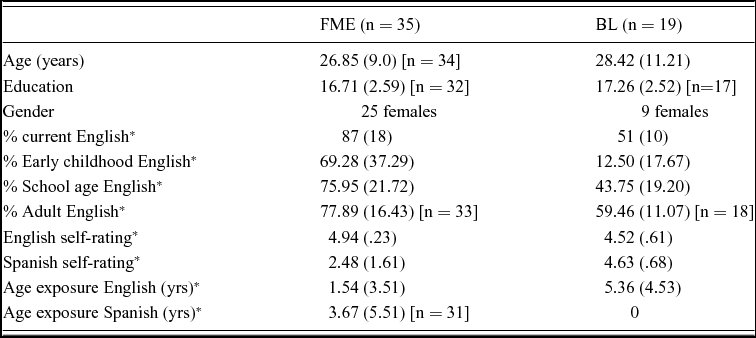
This resulted in 35 FME speakers and 19 BL speakers. (A group of 26 speakers who were functionally monolingual in Spanish were not included in the current analysis because they differed significantly from the FME and BL groups in age and education level.) To determine the appropriateness of this categorization, we compared English and Spanish self-ratings for the two groups. Using a scale from 0 to 5, individuals in the FME group rated themselves significantly better in English than Spanish, t(34) = 8.62, p < .001, while there was no statistically significant difference between English and Spanish self-ratings for the BL group, t(18) = .41, p = .68 (see Table 1).
Demographic and language history information is reported in Table 1. There were statistically significant differences in measures of language exposure between the FME and BL groups but no statistically significant differences in age, education, or gender.
Demographic data by language experience group, Means (standard deviations).

Notes: In some instances, participants did not provide some demographic data. In these cases, the number of subjects for which we have data is provided in brackets. Age and Age of exposure are presented as years. Education is years of formal education. % English is the average current daily percentage of English experience. % Early childhood English is based on age 0 to 6 years. % School age English is based on age 6 to 18 years. % Adult English is based on age 18 years and older. English and Spanish self-ratings based on a scale of 0 to 5, with 5 being native proficiency. * = a statistically significant difference between groups on that variable based on one way ANOVA with p < .05.
Materials
Language history questionnaire
We used a language history questionnaire adapted from the Bilingual English Spanish Assessment (Peña, Gutiérrez-Clellen, Iglesias, Goldstein & Bedore, Reference Peña, Gutiérrez-Clellen, Iglesias, Goldstein and Bedore2014). The questionnaire captured demographic information (age, gender, education), current and past language exposure, and current language proficiency. For past language exposure, participants were given 3-year age intervals (e.g., 0 to 3 years, 3 to 6 years, and so on) and asked whether they were exposed to 100, 75, 50, 25 or 0 percent English during each interval. For current exposure, participants were asked about average weekday and weekend language routines on an hour-by-hour basis. For example, participants reported what language they heard and produced on an average weekday at 9am, 10am, 11am, etc. Participants rated their own language proficiency on a scale from 1 to 5, with one reflecting non-fluent (described as knowing only several words or a few simple sentences) and five reflecting native fluency (described as being completely comfortable with skills like those of native speakers).
Nonwords
Nonwords were the same as those reported in Gibson et al. (Reference Gibson, Summers, Peña, Bedore, Gillam and Bohman2015). Participants repeated nonwords in English and Spanish. Nonwords are syllables that could be words in a language but are not. English nonwords were taken from Dollaghan and Campbell (Reference Dollaghan and Campbell1998), and Spanish nonwords were adapted from Gutiérrez-Clellen and Simon-Cereijido (Reference Gutiérrez-Clellen and Simon-Cereijido2010). English and Spanish nonwords were constructed to be similarly non-wordlike (i.e., no isolated syllable was a real word, and phonemes were drawn from those that appear later in development). All nonwords had a syllable that carried primary stress but no syllable carried secondary stress. English nonwords contained one- through four-syllable lengths, and Spanish contained two- through five-syllable lengths. There were four tokens at each length in both languages. In order to compare languages and maximize the likelihood of identifying polysyllabic shortening, the current study analyzed only two- and four-syllable nonwords from each language.
Stimuli were produced by a 28-year-old male with native level proficiency in English and Spanish. To determine whether participants mimicked polysyllabic shortening from the stimuli, we calculated the average syllables-per-second (SPS) for two- and four-syllable stimuli in English and Spanish (SPS for the stimuli was calculated in the same manner as for participants’ repetitions of the stimuli, detailed below). The stimuli reflected slightly more polysyllabic shortening in Spanish (4-syllable SPS faster than 2-syllable SPS by 321.02 milliseconds) than in English (4-syllable SPS faster than 2-syllable SPS by 212.68 milliseconds).
Syllables per second
We used spectrograms generated from the acoustic software TF32 (Milenkovic, Reference Milenkovic2001) to measure the duration of each participant's nonword repetitions. Determining nonword borders was influenced by Flipsen (Reference Flipsen2002). All nonwords began with a consonant. The beginning of the nonword was considered the onset of a burst release for plosives, onset of broadband noise for fricatives, and first glottal pulse for sonorants. Because of the difficulty in marking word-final boundaries when the final phone was a fricative or plosive, we followed procedures similar to Flipsen's (Reference Flipsen2002) and ignored final plosives and fricatives and instead treated the moment immediately before the burst release or broadband noise as the end of the nonword. Otherwise, the final glottal pulse of the final sonorant or vowel marked the final boundary. False starts were not included in the measures.
SPS was calculated by dividing the number of syllables in the nonword by the duration of the production. Infrequently, participants omitted syllables (there were no occasions of syllables being added). Because they could skew results, nonwords with omitted syllables were not included in the analysis.
Reliability
Duration measurements were made by two research assistants who were communication sciences and disorders undergraduates trained by the first author. In order to determine reliability, twenty percent of the participants’ productions were measured independently by both of the research assistants. Reliability was good, r = .94, p < .01.
Procedures
While seated in a quiet room in a university's speech and hearing clinic, participants repeated nonwords presented through over-the-ear headphones. For the BL participants, the English and Spanish stimuli were presented on different days, while the FME participants completed the tasks in one session. Stimuli were provided in the same order for all participants. Shorter nonwords appeared before longer nonwords. Participants received instructions in their preferred language. Digital audio recordings were made with a sampling rate of 41 kHz for high quality resolution. The recording device rested on a table in front of participants who had lapel microphones positioned 10 cm at an oblique angle from their mouths.
Results
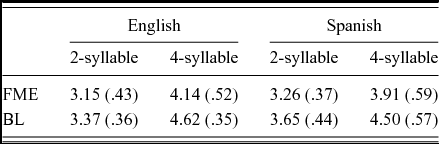
We performed four comparisons using paired samples t-tests. To control for family-wise error due to multiple comparisons, we used a Bonferonni corrected alpha of .01. For the FME group, there were statistically significant differences in SPS between two- and four-syllable nonwords in English, t(34) = 11.94, p < .001, and in Spanish, t(34) = 6.70, p < .001, indicating polysyllabic shortening in both languages (see Table 2 for descriptive statistics). For the BL group, there was also polysyllabic shortening in both English, t(18) = 17.87, p < .001, and Spanish, t(18) = 5.51, p < .001. To determine if these discrepancies differed across groups, we followed up with one-way analysis of variance (ANOVA). There was no statistically significant difference between groups in Spanish polysyllabic shortening, F(1, 52) = 1.32, p = .25, but there was a statistically significant difference in English, F(1, 52) = 4.76, p = .03.
Means (standard deviations) of English and Spanish syllables per second by length.

Note: FME = Functionally Monolingual in English. BL = Bilingual.
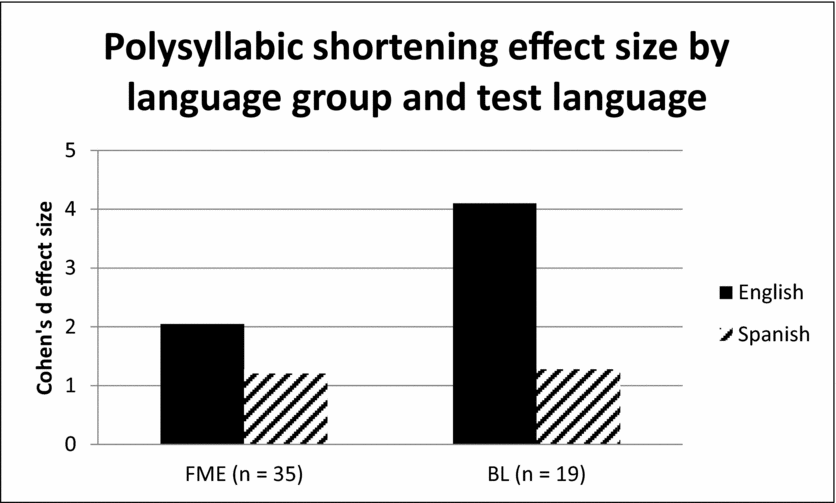
To identify the magnitude of these differences, we calculated the Cohen's d for within-subjects design for each comparison. These are illustrated in Figure 1. The magnitude of polysyllabic shortening was greater in English than Spanish for both the FME and BL groups. For the FME group, the effect size for polysyllabic shortening was 1.71 times greater in English than Spanish. For the BL group, however, the effect size was 3.21 times greater in English than Spanish. Both groups had nearly identical magnitudes of polysyllabic shortening in Spanish, but the magnitude of polysyllabic shortening in English for the BL group was much larger, exactly double, that of the FME group.
Histograms of the effect sizes representing the within-language difference between two- and four-syllable nonword repetition articulation rates. FME = functionally monolingual in English; BL = bilingual.

Discussion
We sought to explore the impact of language experience and proficiency on the use of polysyllabic shortening in individuals exposed to two languages. Toward this end, we compared polysyllabic shortening between a group of participants with high levels of experience and proficiency in English but not Spanish (functionally monolingual in English or FME) and a second group that had high levels of experience and proficiency in both English and Spanish (balanced bilinguals or BL). As per the UCM, we predicted that the FME group would transfer their English polysyllabic shortening patterns to Spanish, but the BL group would apply the appropriate pattern to each of their languages. Although the second prediction was borne out, the first was not.
The findings here are consistent with the literature showing distinct rhythm patterns for English and Spanish. Although participants produced polysyllabic shortening in both languages, both groups produced more polysyllabic shortening in English than in Spanish. Furthermore, participants were not merely mimicking the rhythm patterns that they heard in the stimuli items because stimuli items actually contained slightly more polysyllabic shortening in Spanish than in English.
Because the FME group rated themselves low in Spanish proficiency, we had anticipated, in accordance with the UCM, that transfer from English to Spanish would not be blocked, and this would result in similar magnitudes of polysyllabic shortening in the two languages. However, this was not the case. Results indicate that these individuals can apply polysyllabic shortening appropriately to each of their languages (i.e., more in English and less in Spanish). We can think of at least three reasons for this outcome. First, it might be the case that the proficiency threshold for blocking transfer of language-specific speech rhythm patterns is low, and these speakers surpassed the threshold. Second, it may have been the case that participants systematically underrated their Spanish language abilities and thus were able to block negative transfer due to relatively high levels of Spanish proficiency that were not captured by the questionnaire. However, we posit that a third explanation is the most likely. Although the UCM proposes that high proficiency blocks language transfer but low proficiency does not, the model also proposes that possession of L2 motor plans developed in childhood can block transfer from a non-target language. Individuals in the FME group had been exposed to Spanish at an early age (M = 3.67 years), despite having limited exposure to Spanish as adults and possessing weak Spanish language abilities. For this group, it appears that they were introduced to Spanish sufficiently early in life to acquire motor plans that could have blocked transfer of polysyllabic shortening from English, despite the fact that their current proficiency and experience with Spanish was limited.
Our prediction for the performance of BL participants was borne out. These individuals had both early exposure and high proficiency in both of their languages. Consistent with the UCM, they did not transfer polysyllabic shortening patterns between their languages. However, while the magnitude of their polysyllabic shortening in Spanish was similar to that of the FME group, their polysyllabic shortening in English was twice the magnitude as that of the FME group.
The very large magnitude of polysyllabic shortening in English for the BL group was not anticipated. We speculate that this outcome is related to sociolinguistic factors. Studies of Spanish–English bilingual children have shown a shift toward English in the English-majority context of the US (Kohnert et al., Reference Kohnert, Bates and Hernandez1999), even in places like Miami, Florida (Oller & Eilers, Reference Oller and Eilers2002). Indeed, this shift has been identified for Spanish–English bilingual children with very little exposure to English (Gibson et al., Reference Gibson, Oller, Jarmulowicz and Ethington2012; Gibson et al., Reference Gibson, Peña and Bedore2014). Whether consciously applied or not, spoken language can be treated as a signal of membership in the majority group. Perhaps speakers from the BL group were trying to signal majority-group membership.
Conclusion
The pattern of use of polysyllabic shortening by individuals exposed to two languages is consistent with the Unified Competition Model (MacWhinney, Reference MacWhinney, Kroll and de Groot2005). The influence on polysyllabic shortening from L1 to L2 appears to be blocked when L2 speech motor patterns are learned early in life, even if L2 proficiency and experience is minimal as adults. Bilingual adults with high proficiency and extended experience in both of their languages apply more polysyllabic shortening to the majority language than do their functionally monolingual peers; we propose that this is a way to signal membership in the majority language group.