Introduction
Enhanced recovery after surgery is not a new concept. Initial studies focused exclusively on early extubation, sometimes referred to as “fast track.”Reference Ljungqvist, Scott and Fearon1 This approach was demonstrated in paediatric congenital cardiac surgery as early as 1980.Reference Barash, Lescovich, Katz, Talner and Stansel2 While early extubation studies demonstrated safety, they failed to consistently show a reduction in hospital length of stay.Reference Alghamdi, Singh and Hamilton3–Reference Mittnacht and Hollinger7 Additionally, when applied to neonates undergoing congenital cardiac surgery, a database review suggested no benefit to early extubation and pointed towards potential risks.Reference Thompson and Wakeham8
Contemporary enhanced recovery after surgery programmes seek to optimise several aspects of peri-operative medical care, including early extubation, early mobilisation and removal of drains, multimodal opioid-sparing analgesia, delirium prevention and early enteral feeding, among other interventions.Reference Roy, Parra and Brown9 Data published by numerous centres have shown enhanced recovery after surgery programme’s ability to reduce both critical care unit and hospital length of stay for patients undergoing congenital cardiac surgery without additional complications.Reference Howard, Brown, Garside, Walker and Elliott4,Reference Roy, Parra and Brown9,Reference Andugala, McIntosh and Orchard10
Given the success of this approach, it is important to ask why every cardiac surgical programme does not implement an enhanced recovery approach. A recent review across European cardiac surgical centres assessed how many centres followed an enhanced recovery after surgery programme. The survey revealed that just 7% of responding centres had a written document detailing their enhanced recovery after surgery programme, while 35% followed an enhanced recovery after surgery concept.Reference Meier, Borzel and Hellner11 In our own centre, to date, we have not implemented a formal enhanced recovery after surgery programme, although many children undergoing cardiac surgery experience components of the approach.
Before implementing an enhanced recovery after surgery programme, we wished to assess our current performance, to provide a reference level with which we could benchmark ourselves. There may be challenges with implementing certain components of enhanced recovery after surgery in some centres that are less applicable to others, especially those centres outside of North America, where most literature stems from. In addition, most studies reporting on enhanced recovery after surgery outcomes do not provide a breakdown of timeframes for the various components of their programme. We believe a comprehensive understanding of each aspect of current practice is key prior to implementation. Therefore, the aim of this study was to assess how children with CHD progress after surgery under “status quo” conditions at our institution. As our initial enhanced recovery after surgery programme will target children with lower medical and surgical risk, we restricted our review to children with this profile.
Materials and methods
The study received approval from the ethics and research board of Children’s Health Ireland (REC-279-23). We performed a retrospective observational cohort study.
Study design and definitions
Eligibility criteria were chosen based on a literature review and kept narrow for our initial assessment. This was to target patients most likely to succeed on an enhanced recovery after surgery programme. The primary criteria were adopted from a study by Howard et al., published in 2009.Reference Howard, Brown, Garside, Walker and Elliott4 As such, we included patients undergoing the following: atrial septal defect closure, ventricular septal defect closure, isolated relief of right or left ventricular outflow tract obstruction, and isolated mitral valve repair. We included patients older than six months without a pre-operative ventilation requirement or other significant conditions of the respiratory or neurological systems likely to interfere with early extubation (see Figure 1). We excluded patients with any of the following documented on intensive care or pre-operative admission documents: Trisomy 21, “pulmonary hypertension”, airway abnormalities, or other genetic syndromes likely to impede early extubation. We excluded children on significant vasoactive support at the admission to the critical care unit. It is common practice in our institution for patients to arrive back to the critical care unit following cardiopulmonary bypass on milrinone 0.5mcg/kg/min, and these patients were included. Patients may also transfer to a critical care unit on adrenaline and noradrenaline infusions of 0.01mcg/kg/min; these patients were also included if escalation in dose was not required. Patients with significant bleeding on arrival in the critical care unit as defined by administration of blood products were excluded. “Early extubation” was defined as occurring on the operating table or within six hours of transfer to the critical care unit. Regarding analgesics, regular paracetamol was defined as four doses per 24 hours, and regular non-steroidal anti-inflammatory drugs were defined as three doses of ibuprofen per 24 hours or appropriate dosing of intravenous equivalent.
Eligibility criteria and methods.

Figure 1. Long description
The flowchart describes the steps and criteria used to identify patients for analysis of perioperative course in a medical study. Panel 1: The process begins with a NICOR search from January 2017 to April 2023, identifying patients who underwent VSD closure (408), ASD closure (452), MV repair (96), and LVOT/RVOT relief (86). Panel 2: A manual review of operative descriptions is conducted, resulting in VSD closure (188), ASD closure (44), MV repair (22), and LVOT/RVOT relief (27). Panel 3: A chart review is performed to identify exclusion criteria, leading to VSD closure (34), ASD closure (23), MV repair (10), and LVOT/RVOT relief (6). Panel 4: The final step is the analysis of the perioperative course for 73 patients. Exclusion criteria include age less than 6 months, Trisomy 21, significant vaso-active support on arrival to CCU, significant neurological disorder, significant respiratory or airway abnormality, documented pulmonary hypertension, pre-op mechanical ventilation, uncontrolled bleeding on arrival to ICU, and other factors.
Data extraction and analysis
An automated search of the hospital’s National Institute for Cardiovascular Outcomes Research database was performed for operations with the search terms atrial septal defect closure, ventricular septal defect closure, mitral valve repair, relief of right ventricular outflow tract obstruction, and relief of left ventricular outflow tract obstruction from January 2017 until April 2023. The list of operative descriptions was reviewed by LH, and where an operation met the above criteria, electronic ICU records were reviewed to determine if the patient met criteria for eligibility for our proposed target enhanced recovery after surgery population (see Figure 1). The operation selection was reviewed by CB. The post-operative course of included patients was then analysed in the ICU and cardiology ward until discharge home by LH and SD. Critical care unit notes are maintained in an electronic database (IntelliSpace Critical Care and Anaesthesia-Philips), while ward-level notes are paper-based. Where a data point was unclear (for example, location or number of drains), it was excluded. We attempted to clarify when a patient was medically fit for transfer to the ward, compared to when they were physically discharged, but this was not possible.
Data were entered in Microsoft Excel and analysed with R Studio 2024.04.2+764. Where relevant, data were assessed for normality using the Kruskal–Wallis test and reported using parametric (mean, standard deviation) or non-parametric (median, interquartile range) statistics as appropriate. Missing data were reported as such and excluded from descriptive statistics.
Results
Patients and eligibility
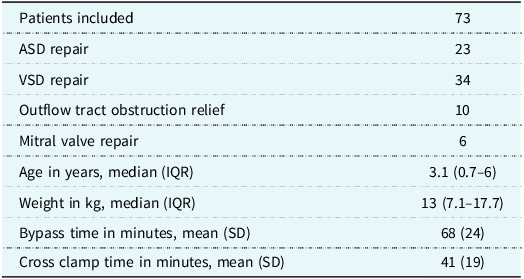
The National Institute for Cardiovascular Outcomes Research database search for the operation terms listed search terms yielded 1042 operation description results from a six-year and three-month period from January 2017 until March 2023. After review of the operative description, 281 patients met the eligibility criteria. On review of the medical notes for exclusion criteria, a further 208 patients were excluded. This left 73 patients, and their medical notes were assessed in detail (Table 1). Figure One details the frequency of exclusion criteria among the 208 patients. Many patients met multiple exclusion criteria. The commonest single exclusion criteria were age less than six months (66/208, 32%) and having Trisomy 21 (25/208, 12%). Of the patients included, median age was 3.1 years, median weight was 13 kg and mean cardiopulmonary bypass and cross-clamp times were 68 and 41 minutes, respectively (Table 2).
Demographic data for the cohort

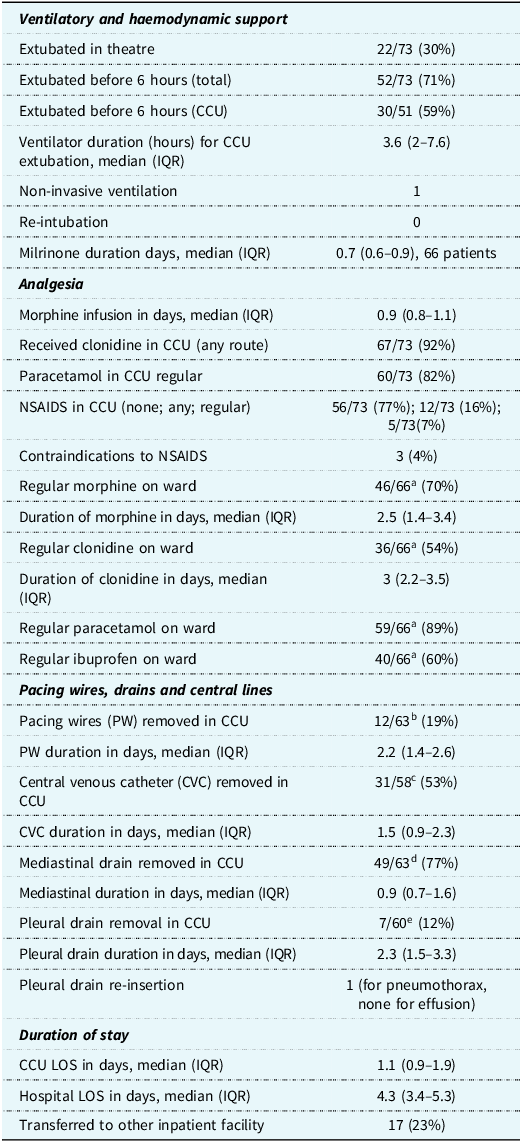
Postoperative Course of 73 low-risk patients undergoing cardiac surgery

aData missing on 7 patients.
bData missing for 10 patients.
cData missing for 15 patients, 1 patient transferred to other facility with CVC in situ.
dData missing for 9 patients, 1 patient no mediastinal drain.
eData missing for 4 patients, 9 patients no pleural drain.
Respiratory and haemodynamic support
Thirty percent of patients were extubated on the operating table, with 59% of the remaining patients extubated within 6 hours of transfer to the critical care unit. As such, 71% of all patients underwent early extubation. One patient was placed on non-invasive ventilation for two hours, although their total critical care unit length of stay was less than 24 hours. No patients were re-intubated during the admission, and there were no re-admissions to PICU. All patients, bar seven, who underwent atrial septal defect closure were on a milrinone infusion on arrival to the critical care unit with a median duration of 0.7 days.
Analgesia
All patients were on an intravenous morphine infusion in the critical care unit, with a median duration of 0.9 days (Table 2). Ninety-two per cent of patients received some clonidine in the critical care unit. Eighty-two per cent of patients received regular paracetamol in the critical care unit; the rest received it less frequently. Twenty-three per cent of patients received non-steroidal anti-inflammatory drugs in the critical care unit. On the ward, 70% of patients received regular morphine, 49% regular clonidine, 89% regular paracetamol, and 60% regular ibuprofen. The duration of analgesic agents is provided in the table. Three patients (4%) had a documented contraindication to non-steroidal anti-inflammatory drug use.
Duration of invasive devices
Twelve (20%) patients had pacing wires removed in the critical care unit; 49 (77%) had a mediastinal drain removed in the critical care unit; seven (12%) had a pleural drain removed in the critical care unit, and 31 (53%) had a central venous catheter removed in the critical care unit. Some data were missing for these devices as shown in Table 2, along with the median duration of each device. There was one pleural drain re-insertion for a case of pneumothorax and no cases of re-intervention for bleeding.
Duration of stay
The median critical care unit stay was 0.9 days and the hospital stay 4.3 days. Seventeen patients (23%) were transferred to another facility to continue care, and the duration at this facility is not known. This often occurs because patients travelling from Northern Ireland to the Republic of Ireland for congenital cardiac surgery will travel back to Northern Ireland to continue post-operative care. There were no patient deaths during any of the admissions reviewed and no cases of re-operation during the stay.
Discussion
This study describes the hospital course for a low-risk population after cardiac surgery at our centre. The duration of critical care unit stay for our cohort was similar to the recently reported critical care unit length of stay for patients undergoing STAT-1 risk procedures in a centre with a well-established enhanced recovery after surgery programme, albeit their population included more patients with co-morbidities.Reference Roy, Parra and Brown9 Rates of early extubation were also similar. Hospital length of stay for our cohort was a median of four days, compared to three days for the Howard et al. cohort on whom we based our inclusion criteria.Reference Howard, Brown, Garside, Walker and Elliott4 Recognising that enhanced recovery after surgery outcomes depend on more than length of stay and extubation, we provided a relatively high level of granularity regarding duration of invasive devices but could not find data for comparison on the latter in many available reports.Reference Howard, Brown, Garside, Walker and Elliott4,Reference Roy, Parra and Brown9,Reference Andugala, McIntosh and Orchard10 We believe that centres should ascertain their own data on current outcomes and practices prior to introducing an enhanced recovery after surgery programme to provide a reference level. This will help to highlight improvements and complications related to any changes in care.
In this study, we kept the inclusion criteria narrow to best identify a cohort who should succeed by selecting low-risk patients. We opted for this approach to ensure buy in from all stakeholders and minimise patient risk during the implementation of new practices. It may be possible for other centres with different resources to incorporate a broader group while initiating an enhanced recovery after surgery programme. Most patients excluded from analysis were under six months of age or had trisomy 21. While it is prudent to progress a patient with documented pulmonary hypertension or pre-operative mechanical ventilation more slowly, otherwise healthy patients less than six months of age or those with Trisomy 21 are a group we would aim to incorporate once enhanced recovery after surgery is established. Enhanced recovery after surgery is also frequently implemented and has been shown to be safe and desirable for patients following bilateral cavopulmonary anastomosis or a Fontan procedure.Reference Morales, Carberry, Heinle, McKenzie, Fraser and Diaz12 In these conditions, physiological benefits on pulmonary blood flow exist from the negative intrathoracic pressure associated with early extubation and the increase in systemic vascular resistance associated with a reduction in sedation.Reference Gewillig, Salaets, van de Bruaene, van den Eynde and Brown13
Regarding other enhanced recovery after surgery initiatives, we identified several areas for improvement in our practice. Firstly, relating to analgesia, use of simple analgesics was suboptimal compared to a recently established programme that reported 100% adherence to paracetamol administration and 89% for non-steroidal anti-inflammatory drugs.Reference Roy, Parra and Brown9 Traditionally, our centre does not administer intravenous non-steroidal anti-inflammatory drugs in the early post-operative period as may be practised elsewhere. Use of intravenous or per-rectum non-steroidal anti-inflammatory drugs could be considered early, and oral non-steroidal anti-inflammatory drugs should be utilised as soon as feeding is established, provided no contraindications exist. Only 60% received ibuprofen regularly following discharge from the PICU. Early use of non-steroidal anti-inflammatory drugs may help limit the need for opioids, reducing sedation and improving bowel movement. All patients at our centre received a morphine infusion in the critical care unit, and after critical care unit discharge, 70% were still receiving regular oral morphine on the ward. The duration of invasive devices was potentially longer than necessary in this cohort. One major challenge at our centre is that limited access to theatre (one dedicated cardiac theatre) and a critical care unit capacity that frequently is at 100 % has made us hesitant in removing chest drains promptly, as re-inserting drains may impact other surgical cases. However, early removal minimises post-operative pain, allowing reduction in sedation and improved early mobilisation. Protocols and algorithms for early removal of chest tubes have been shown to be safe and effective, as well as associated with reduced hospital length of stay.Reference Bertrandt, Saudek and Scott14,Reference Bates, Connelly and Khadr15 Half of our patients had their central venous catheter removed before leaving the critical care unit. Given the low-risk population, it is likely that a larger number could have had their central venous catheter removed earlier. The retention of a central venous catheter following transfer may provide a level of comfort to clinicians and nurses on the ward, but it should not be required in low-risk patients and does carry an infection risk, in addition to being uncomfortable for patients. Furthermore, 90% of the cohort received milrinone, which may be unnecessary in this low-risk population but falls in line with current practice at our centre.
When comparing enhanced recovery after surgery data between different centres, it is important to note that fundamental variations in practice may exist. The inclusion criteria from our study were based on a study from Great Ormond Street Children’s Hospital, London, United Kingdom, published in 2009.Reference Howard, Brown, Garside, Walker and Elliott4 However, the number of eligible patients at our centre based on inclusion criteria was relatively small compared to GOSH. From 2020 to 2023, 79% of cardiac procedures at Great Ormond Street Hospital were performed by surgery (2232 cases) versus cardiac intervention (606 cases). This compares with only 49% of procedures at our centre performed by cardiac surgery (1370 cases) as opposed to cardiac intervention (1421 cases). The significantly heavier weighting to an interventional approach in our centre reduces the number of available patients who would meet enhanced recovery after surgery criteria. This may be reflected by the younger age (3.1 v 6.2 years) and lower weight (13 v 23.1 kg) in our study compared to the GOSH group. This may result in slightly longer times for our enhanced recovery after surgery group when comparing with centres performing fewer cardiac interventions. Although this reduces the enhanced recovery after surgery patient pool, patients undergoing an interventional approach routinely have an expedited recovery course due to the minimally invasive nature of their procedure. In addition to variation across centres, practices may also evolve over time as cardiac interventional numbers have dramatically increased over the last two decades globally. This is important when comparing data in different epochs and should be accounted for.
Limitations of this study include its retrospective nature. This resulted in some missing data and may have also resulted in unidentified bias in our data. The strict inclusion and exclusion criteria of patients meant that our patient numbers were relatively small. We hope to expand on this with further reviews of other patient cohorts. We did not look at practices occurring during the operation, such as use of regional anaesthesia or intraoperative opiate use, nor did we evaluate perfusion practice. In addition, it was not possible to accurately ascertain the exact opiate dose at the time of extubation. However, patients routinely return from theatre on to the PICU critical care unit on morphine doses of 20 mcg/kg/hour, weaning to 10 mcg/kg/hour prior to extubation. This is then converted to an PO enteral equivalent dose the following morning prior to transfer to the ward. One of the key elements in any enhanced recovery after surgery programme is the impact on the patient and family experience. Given the retrospective nature of the study, this was not possible to assess but should be followed closely when implementing an enhanced recovery after surgery programme. Future directions include the establishment of an enhanced recovery after surgery programme at our centre and a follow-up report on outcomes of the programme.
Conclusions
We describe baseline data on a well cohort of post-operative patients undergoing low-complexity cardiac surgery. This data information is the first step in implementing a formal enhanced recovery after surgery guideline in our institution. Areas to improve going forward include ensuring adequate multimodal analgesia, limiting the duration of invasive devices and reducing administration of vasoactive infusions such as milrinone unless specifically indicated. Challenges include changing established cultural practice and limited resources compared to other contexts. Given the number of areas in which improvement is possible, we believe that a formal enhanced recovery after surgery programme may have the ability to reduce length of stay in this low-risk population. Once the protocol is implemented for low-risk patients, we hope to extend it to procedures and patients with a higher risk profile, lowering overall patient length of stay and improving patient and caregiver experience. A centre’s specific context must be considered when implementing aspects of an enhanced recovery after surgery programme.
Acknowledgements
None.
Author contributions
All authors contributed to the study conception and design. Material preparation and data collection were performed by LH and SD. LH performed analysis and prepared Figure 1. The first draft of the manuscript was written by LH and CRB, and all authors commented on previous versions of the manuscript. All authors read and approved the final manuscript.
Financial support
The authors have no financial or non-financial interests that are directly or indirectly related to the work submitted for publication.
Competing interests
The authors have no conflicts of interest to disclose.
Ethical standard
This work did not involve any human or animal experimentation.