I. INTRODUCTION
The proton exchange membrane fuel cell (PEMFC) is one of the most promising power sources for residential and mobile application due to its attractive features such as high power density, relatively low operating temperature, convenient fuel supply, long life time, etc.Reference Chalk, Miller and Wagner1 Despite these advantages, commercialization of PEMFC is delayed mainly due to the high fabrication cost. Bipolar plate is most commonly used among the PEMFC components, and high cost of bipolar plate prevents significantly current economic feasibility of fuel cells. During the successful research and development on low temperature PEMFC, different types of graphite-based separator plates or bipolar plates are used. Bipolar plates must have high electrical conductivity, sufficient mechanical integrity, corrosion resistance, low gas permeability, and low cost as a result of both material selection and processing methodology if they are to be widely used in the automotive industry.Reference Busick, Wilson, Doughty, Nazar, Arakawa, Brack and Naoi2
Historically graphite bipolar plates have been used in PEMFCs for space missions, military, and other special applications. The advantages of graphite plates are excellent corrosion resistance and low bulk density and resistivity. On the other hand, the disadvantages are difficulties in machining and its brittleness,Reference Larminie and Dicks3–Reference Wilson and Busick5 due to which bipolar plate requires a thickness of the order of several millimeters, and the fuel cell stack will be massive and voluminous.Reference Bisaria, Andrin, Abdou and Cai6 Thin metal sheet is also a good material for the bipolar plate. Materials for metallic plates include stainless steel, titanium, and aluminum with stainless steel being considered most promising for commercialization.Reference Wind, LaCroix, Braeuninger, Hedrich, Heller, Study, Vielstich, Gasteiger and Lamm7 It offers the attributes of good electrical conductivity, low cost, excellent mechanical strength, and ease to fabricate but low corrosion resistance, a conductive and low cost coating must be applied to the surfaces of the plates to form a protective layer, which has been found to be very difficult to accomplish. In addition, the weight of metal plates is a disadvantage, especially in transportation applications.Reference Wind, Spah, Kaiser and Bohm8–Reference Makkus, Janssen, de Bruijn and Mallant12 A composite bipolar plate is a promising alternative to graphite and has the advantages of low cost, ease in machining, good corrosion resistance, and lightweight.Reference Zheng13 In this direction in the present investigation, instead of using only graphite resin composite plate, some other filler constituents are used in addition to natural graphite (NG) to improve overall performance of composite bipolar plate prepared by compression molding technique for being used in the PEMFC.Reference Dweiri and Sahari14–Reference Dhakate, Mathur and Kakati17 They are also light in weight compared to metallic and graphite plates. The gas flow channels can be molded directly into the plate, eliminating the need for the costly machining step. Both thermoplastic and thermosetting resins have been used to fabricate the plate. Various mechanical properties have been reported for composites which depend on the type of polymer resins and reinforcing fibers used.Reference Mepsted, Moore, Vielstich, Gasteiger and Lamm18–Reference Haack, Torre and Butcher20
The graphite/phenol formaldehyde (PF) and graphite/novolac epoxy (NE) composite bipolar plates have been developed by compression molding technique. The effects of different resin type (PF and NE) were discussed firstly on the electrical conductivity, mechanical property, and corrosion performance of the composite bipolar plates. The objective of this work is to find a way to choose the polymer and to know how the binder affects the properties of composite bipolar plate.
II. EXPERIMENTAL
A. Materials
NG powder, with a purity of 99.9% and particle size less than 74 μm, was obtained from Qingdao Guyu Graphite Company, Qingdao, People's Republic of China. The polymers were phenolic resin (PF purchased from Changsha Zhida Insulation Chemical Industrial Co. Ltd., Changsha, People's Republic of China) and NE (manufactured in our laboratory). Carbon black was supplied by China Oak Group Carbon Black Chemical Engineering Design Academy, Chen Du, People's Republic of China (particle size less than 20 μm).
B. Preparation of the composite bipolar plate
The bulk molding compounds were prepared by mixing the polymer, NG, and other additives (carbon black and alcohol) in a blender for 2 h. Then the compounds were dried at 40 °C and shattered before the mold pressing process. The processing temperature was 25 °C, molding pressure was 10 MPa, and the processing time was 3 min. Then the plate sandwiched in two pieces of iron plates was cured in oven according to some procedure. The procedure is 60 °C 2 hours, 80 °C 2 hours, 100 °C 2 hours, 120 °C 1 hour, 140 °C 1 hour, 160 °C 1 hour, 180 °C 2 hours.
C. Characterization of composite bipolar plate
The electrical resistance (ρ) of composite bipolar plate was measured using SX1934 four-point probe instrument (Suzhou Telecommunication Motor Factory Co. Ltd., Suzhou, People’s Republic of China). From the value of electrical resistance, electrical conductivity is calculated. An average of about 10–12 readings on each plate (in x–y plane) is reported in the text.
The flexural strength of composite bipolar plates of size 60 mm × 5 mm × 2 mm was measured by three-point bending technique based on the procedure of ASTM D-790 with a universal testing machine (Instron WDW-E200 Jinan Huage Instruments Ltd., Shan Dong, Jinan, People's Republic of China). The supporting span is 40 mm at a constant crosshead speed of 0.5 mm/min. It is an average value of five samples.
The porosity and absorbing water rate of each sample was determined according to the ASTM C20 test procedure. The specimen was weighed in air after drying in oven at 100 °C for 2 h, and the value was recorded as M1. The specimen was then completely immersed in water at a temperature of 100 °C for 2 h and cooled in water for 12 h. The specimen was weighed in the water and recorded as M2. The specimen was taken out of water, after the beads on the specimen surface were scraped and then the specimen was weighed as M3. The absorbing water rate W a was calculated as follows:

The porosity P a was calculated as follows:


Some of the prepared composite bipolar plates were characterized in a unit cell assembly for their I–V characteristics (A current–voltage characteristic is a relationship between an electric current and a corresponding voltage.) and I–P characteristics (A current–power characteristic is a relationship between an electric current and a corresponding power.). In the unit cell assembly (25 cm2 active area), Nafion is used as polymer electrolyte membrane and platinum catalyst and porous conducting carbon paper is used as diffusion layer. The following operating conditions were used in all experiments: temperature 65 °C, atmospheric pressure, relative humidity 100%, and the flow rate of H2 and O2 300 mL·min−1 and 1.5 L·min−1, respectively.
III. RESULTS AND DISCUSSION
A. Bulk density of composite bipolar plate
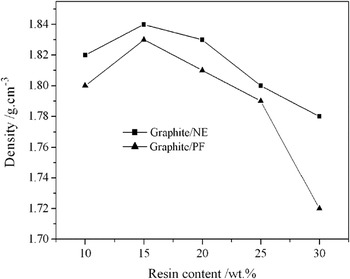
Bulk density of graphite/PF and graphite/NE composite bipolar plates was measured, and the result was shown in Fig. 1. It is clear that variation tendency in bulk density is the same for graphite/PF and graphite/NE composite bipolar plates, and the bulk density of graphite/NE plate is bigger than that of graphite/PF plate. It is because of the different curing reactions as follows:


Variation in the density of the composite bipolar plate with increasing resin content.

The curing mechanism of PF resin and NE can be explained as reactions a and b, respectively. The water was produced in the curing reaction of PF but not in the curing reaction of NE. So the mass loss of PF is more than that of NE, moreover crosslinking density is less and volume shrinkage factor is smaller.
B. Electrical conductivity of composite bipolar plate
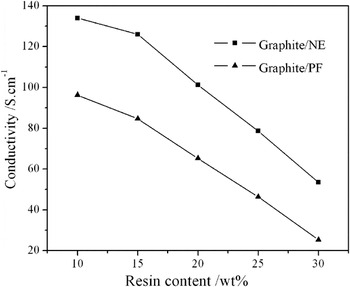
Electrical conductivity is one of the most important properties of bipolar plates. It was influenced by resin content, filler particle size, molding pressure, and curing temperature. The influence of the resin content and resin type was mainly discussed in this section. The electrical conductivity of graphite/NE composite bipolar plates is higher than that of graphite/PF at the same conditions and the variational tendency of the electrical conductivity is the same as shown in Fig. 2.
Variation in the conductivity of the composite bipolar plate with increasing resin content.

The conductivity of composite bipolar plates decreases with increasing resin content as shown in Fig. 2. The conductivity of the composites results from a conductive network formed by the fillers. When the resin content is low, the composites containing a large quantity of conductive fillers, the graphite particles are connected to neighboring graphite particles and generally form surface-to-surface contacts.Reference Yan-wen, Jie and Jun21 So the conductive network in the composites has been formed and the density of the conductive network increases with the increase of conductive fillers, which results in higher conductivity of composite bipolar plate. On the other hand, polymer mainly plays a binder role in the bipolar plate fabrication process. The crosslinking density after NE curing is bigger so when the resin and conductive fillers content is same, the graphite/NE composite bipolar plate is compact and the bulk density is bigger. It leads to the conductivity of graphite/NE which is higher than that of graphite/PF.
C. Mechanical property of composite bipolar plate
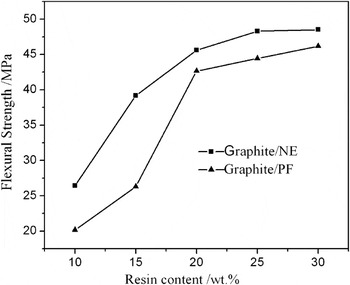
Bipolar plates must possess good mechanical properties to support thin membranes and electrodes and to withstand high clamping forces for the stack assembly. Flexural strength is an important factor for the bipolar plates of a PEMFC, which should remain unbroken when cell stake was assembled. For example, the target value in literatures indicates the requirement.Reference Cho, Jeon, Ha, Hong and Oh22, Reference Huang, Baird and McGrath23 However, the polymer composites doped with high graphite powder loadings are difficult to reach high conductivity and sufficient mechanical properties at the same time. As a result, the mechanical properties (such as flexural strengths) of composite bipolar plates available so far are still significantly lower than the target values. Two types of resin were used in this study. The results were shown in Fig. 3.
Variation in the flexural strength of the composite bipolar plate with increasing resin content.

Figure 3 indicates that the flexural strength of the composite plate increases with increasing resin content. As the resin content is increased, the graphite particles can be well wetted by the resin. Hence, the adhesion between resin and graphite become stronger. Consequently, the flexural strength of composite bipolar plate increases. On the other hand, the graphite/NE composite bipolar plate has higher flexural strength due to the more compact three-dimensionally crosslinked network structure formed in the curing reaction between NE and PF as the curing agent.Reference Thomas, Durix, Sinturel, Omonov, Goossensd, Groeninckxd, Moldenaersc and Thomas24 Since the NE has a low shrinkage rate, it reduces the formation of cracks in the finally bipolar plate. It contributes to improving the flexural strength of the plate.
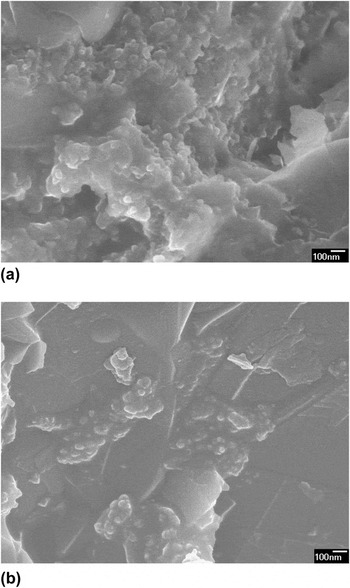
It can be seen from Fig. 4 that there were many cracks in the resole-based plate [Fig. 4(a)], but almost none in the novolac type phenolic resin-based composite [Fig. 4(b)]. It results in the porosity of graphite/PF plate which is higher than that of graphite/NE plate. The relationship between the flexural strength and porosity can be expressed as the following equation:

Scanning electron microscopy fracture micrographs of composite bipolar plate prepared with different resin (a) graphite/PF, (b) graphite/NE. PF, phenol formaldehyde; NE, novolac epoxy.

where k and b are experimental constants; D and Pa are the maximum diameter of grains, porosity, respectively; and σ is flexural strength. It can be seen that the σ increases with the decrease of Pa at the same D from the equation. So the flexural strength of the graphite/NE plate is higher than that of graphite/PF plate.
D. Corrosion performance of composite bipolar plate
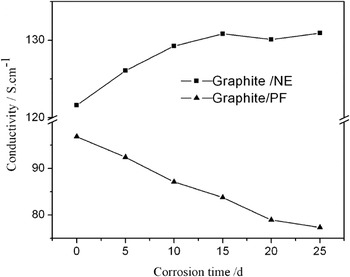
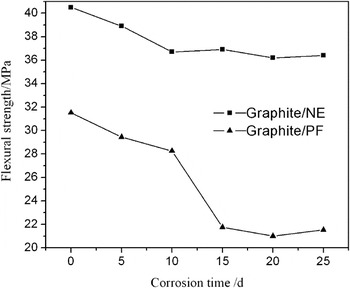
The most direct way to assess corrosion is to expose the material for a suitable time to an appropriate solution/pH/temperature and then measure the rate of corrosion by weight change, conductivity, and flexural strength before and after corrosion.Reference Maheshwari, Mathur and Dhami15 The different bipolar plate samples were conditioned by drying the samples at 80 °C and their weight were noted. These were completely immersed in 0.5 mol/L H2SO4 solution at 80 °C (PEMFC operating temperature). The samples were reconditioned and were found to have nearly the same weight as before. There was most no reduction in weight that discards the possibility of any dissolution of the plate material in the acid solution. The changes of conductivity and flexural strength were shown in the Figs. 5 and 6.
Conductivity of composite bipolar plate with corrosion time.

Flexural strength of composite bipolar plate with corrosion time.

From Fig. 5, it can be seen that the conductivity of graphite/NE composite bipolar plate increases with the corrosion time, but after 15 days, there is no change in the conductivity. It is because the polymer on the surface of plate is dissolved in the H2SO4 solution and the surface resistance decreases, which results in an increase of the conductivity.Reference Butler25 The NE is a modified polymer, which has many functional groups to form complicated three-dimensional reticulated structures in the curing reaction. So the binding strength between NE and graphite becomes stronger. The flexural strength of graphite/NE composite plates is higher than that of graphite/PF as shown in Fig. 6. Since the graphite/NE bipolar plate is very compact and water cannot infiltrate composite plate, the structure of bipolar plate remains unchanged, which results in a slight decrease in the flexural strength of graphite/NE composite plate, and there is also very little change in the conductivity and flexural strength after 10 days. For the graphite/PF composite plate, both the conductivity and flexural strength decrease with corrosion time. Water can infiltrate a composite plate and may affect the structure of the plate.
E. Water adsorption and porosity of composite bipolar plate
Since water is the by-product of the fuel cell reaction which is carried out of the cell via the flow channels of the bipolar plate, it might affect the properties of the latter and hence the performance of the fuel cell during prolonged operation. In our present study we have also carried out the water adsorption studies on several composite samples. The specimen was completely immersed in water at a temperature of 100 °C for 2 h and cooled in distilled water for 12 h. The absorbing water rate W a was calculated as formula 1, and the data are reported in Table I, respectively.
Water absorption, porosity, conductivity, and flexural strength of the different composite bipolar plate.

PF, phenol formaldehyde; NE, novolac epoxy.
The amount of water adsorbed by the graphite/NE and graphite/PF composite bipolar plates was too small, and there is no significant change in conductivity and flexural strength of composite bipolar plates before and after water adsorption due to the small water adsorbed. It also can be seen that the conductivity and flexural strength of graphite/NE are higher than those of graphite/PF composite bipolar plate. It is because the porosity of graphite/NE is smaller than that of graphite/PF. It is illustrated in Fig. 4 and Table I.
F. Single-cell performance of composite bipolar plate
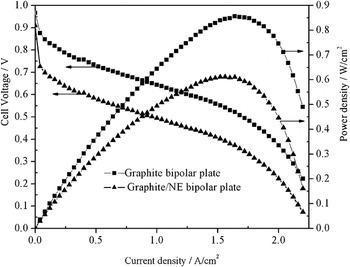
Considering that the properties of graphite/NE bipolar plate are better than those of graphite/PF plate, the bipolar plate sample with 15 wt.% NE, 4 wt.% carbon black, and NG particle size of 74 μm was further evaluated for single-cell test. Figure 7 shows the comparative performance of the fuel cell with NE composite bipolar plate and graphite bipolar plate. Same material and method were used to prepare the membrane electrode assembles to display the difference between the composite plate and the graphite plate.
I–V and I–P curves of cells with graphite/NE and graphite plates.

From I–V and I–P characteristics, it is observed that the power density of the cell with composite plate continuously increased up to the current density 1.56 A·cm−2 corresponding to the maximum power density of 611 mW·cm−2. The maximal power density of the cell with graphite plate was 856 mW·cm−2 at the current density of 1.64 A·cm−2. This effect can be explained with the help of porosity which has direct effect on concentration polarization.Reference Kakati and Deka26 Porosity in composites is higher than that of graphite bipolar plate, which leads to lower power density. Since the concentration polarization is more serious, the current density and power density of composite bipolar plates are less than those of graphite plate. The polarization curve variation tendency of the cell with composite plate was similar to that of the cell with graphite plate. However, the cell with graphite plate provided higher voltage than the cell with composite plate as the current density increased. The results suggested that the graphite/NE composite bipolar plate can be successfully used as a bipolar plate in a PEMFC.
IV. CONCLUSIONS
A novel composite bipolar plate composed of PF or NE, NG, and carbon black has been successfully prepared by the compression molding technique. The properties of graphite/NE plate are all better than that of graphite/PF plate due to the more compact three-dimensional reticulate structures formed in the curing reaction of NE. The amount of water adsorbed by the two types of composite bipolar plates was too small, and there is no significant change in conductivity and flexural strength of composite bipolar plates before and after water adsorption. The polarization curve variation tendency of the cell with composite plate was similar to that of the cell with graphite plate. To obtain higher current density and power density, the concentration polarization of bipolar plate must be reduced. All those results show that most of the properties, such as electrical conductivity, flexural strength, water adsorption, porosity, and so on, are affected by the properties of the polymer. It is most important to choose a kind of appropriate polymer as a binder in the bipolar plate study. The effect of other resin on composite bipolar plate should be studied further.
ACKNOWLEDGMENTS
The authors gratefully acknowledge the funding provided by the Ministry of Science and Technology through a National Key Technology R&D Program in the 11th Five Year Plan of China (No. 2008BAE60B08) and by the Hunan University “basic scientific research operating expenses in the Central colleges and universities and the planned science and technology project of Hunan province (2011FJ3205).”