I. INTRODUCTION
For Ni-base alloys, the presence of γ′-phase, a stable ternary Ni3Al compound with an L12 structure, allows precipitation strengthening to provide superior high temperature strength. As a result, Ni-base alloys are widely used in modern gas turbines industries and in vanes and blades in aircraft engines. Reference Webler, Ziener, Neumeier, Terberger, Vaßen and Göken1,Reference Pollock and Tin2 In contrast to Ni-base alloys, conventional Co-base alloys are utilized mostly in mechanically low loaded parts of turbines or corrosive environment, and they usually exhibit superior corrosion resistance but poor mechanical properties due to the lack of high temperature strength. Reference Ruan, Wang, Zhao, Yang, Yang and Liu3
In 2006, Sato et al. discovered a new ternary inter-metallic compound phase in the Co–Al–W system, i.e., Co3(Al,W), which precipitates in the matrix with an L12 structure. Reference Sato, Omori, Oikawa, Ohnuma, Kainuma and Ishida4 Therefore, this exciting discovery makes γ/γ′-strengthening in Co-based alloys possible, which is similar to the Ni3Al phase in Ni-base alloys and provides a new research path for the development of novel Co-based alloys. In addition to high temperature strength, the oxidation resistance is another essential and important property for this new alloy in many industrial applications.
Furthermore, it is reported that the oxidation of these Co-base alloys at high temperatures leads to the formation of a thin inner Al2O3 layer in addition to cobalt oxides and other oxides. This Al2O3 layer has the potential to improve the oxidation behavior considerably. Reference Pollock, Dibbern and Tsunekane5,Reference Klein, Bauer and Neumeier6
In isothermal tests at high temperatures, Klein et al. found that additions of boron (0.12 at.%) and silicon were beneficial for the formation of inner protective Al2O3 due to the enhanced selective Al-oxidation effect. Although Si-containing phases improved the oxidation resistance, they also decreased the mechanical properties of the alloy. Reference Klein, Shen, Killian and Virtanen7,Reference Klein, Killian and Virtanen8 The addition of a little rare earth elements (RE), such as yttrium, is known to enhance the adhesion of oxide layers, especially under cyclic conditions, and to promote the oxidation resistance of the base alloy. Reference Coutsouradis, Davin and Lamberigts9–Reference Coutsouradis, Davin and Lamberigts13 Vermaak et al. also studied the effect of MCrAlY coatings on cyclic high-temperature oxidation behavior for two separate Co-base alloys, and found that MCrAlY systems could be promising candidates as protective coatings for these novel materials. Meanwhile, it exhibited a superior adherence during the thermal corrosion process. Reference Vermaak, Mottura and Pollock14 Chromium was expected to improve the oxidation behavior considerably for most metallic materials. Previous studies of Yan et al. indicated that addition of 13 at.%Cr added to Co–7Al–7W alloy could improve the oxidation resistance by over 40 times at 800 °C. Reference Yan, Vorontsov and Dye15
However, few studies have been carried out on the oxidation behavior of this novel γ/γ′-strengthened alloy system by the combined additions of Cr and rare elements and the high temperature oxidation mechanism is unclear. In this work, the high temperature oxidation behaviors of those Co–9Al–10W–4Cr–0.02X (X = La, Dy, Ce, Y) alloys were investigated at 800 and 900 °C. In addition to oxidation kinetics, the microstructure, chemical composition, and phase of oxide layers were characterized, to develop deeper insights into the oxidation process and mechanism. Moreover, the combined influence of Cr and rare elements on oxidation resistance was also investigated, in more detail.
II. EXPERIMENTAL PROCEDURE
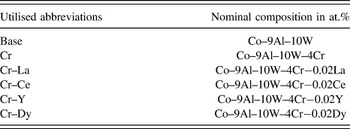
The nominal compositions of the investigated six Co-base alloys were listed in Table I. In the course of this work, only the abbreviations given in Table I were used to name the alloys. The as-cast alloy was heat treated in a vertical furnace at 1300 °C for 4 h in an Ar-atmosphere and aged for 24 h at 900 °C in the air, with the purpose of obtaining the desired microstructure. The generated oxide layer on the sample surface was completely removed and then the alloy was aged in the air.
Compositions of the investigated alloys and utilised abbreviations.

Cut from the cylindrical bar by electro-discharge machining, the rod samples (diameter of 8 mm and length of 30 mm) were cleaned and degreased, after which wet grinding and polishing was performed using SiC grinding paper (280#, 500#, 800#, 1200#) and different diamond suspensions (up to a grain size of 1 μm), respectively. All these were performed before isothermal oxidation experiments in the air.
Flat-bottomed alumina crucibles were used to contain these samples, which were subjected to oxidation tests in the air. Reference Yan, Vorontsov and Dye16 To hold any spallation products, lids were placed on the crucibles during the periodic specimen removal and air cooling prior to the weighing of the crucibles and specimens.
Oxidation tests were carried out for 500 h to determine the oxidation process with increasing oxidation time in a vertical tube furnace under atmospheric conditions. RE elements such as La, Ce, Dy, Y were added to original Cr-containing alloy (see Table I), to explore their influence on the oxidation resistance. And the results were compared and analyzed.
To observe the microstructure, the prepared cross-sections morphology of the oxide layer was investigated by Scanning Electron Microscopy. Energy dispersive x-ray spectroscopy was carried out to determine the chemical composition. The qualitative and quantitative analyses were performed by EDX mappings and EDX point scans, respectively. Then the crystalline phase identification in the oxide layers was detected by using x-ray diffraction with Cu Kα radiation over a range of 2θ from 10° to 70°.
III. RESULTS
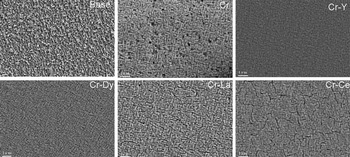
Due to the specific heat treatment process consisting of homogenization and aging, those different investigated alloy establishes the desired γ/γ′-microstructure. In Fig. 1, six representative SEM images of the etched metal surface (Base, Cr, Cr–La, Cr–Ce, Cr–Y, Cr–Dy alloys) were given. With the addition of 4 at.% Cr and 0.02 at.% rare elements to the base alloy, the γ′-phases seem to grow together. The growth of these grains seems to be very neat, and their shape was similar to the different formative strip, and width range was about 80∼100 nm.
Microstructures of the alloys Base, Cr, Cr–Y, Cr–Dy, Cr–La and Cr–Ce in etched condition.

A. Oxidation kinetics results analysis
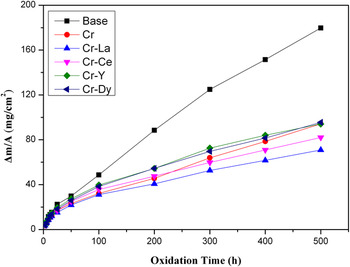
Figure 2 shows the oxidation kinetics results with representative curves of these alloys at 900 °C. And Cr–La and Cr–Ce were less oxidized than the Cr alloy, for instance, the Cr–La alloy got the least (70.870 mg/cm2) mass gain. Compared to those cobalt alloys without doping chromium, these average oxidation weight decreased by nearly half at present. A lower mass gain per area exhibits better oxidation resistances.
Mass gain (Δm/A) of six Co-base alloys oxidised for 500 h at 900 °C.

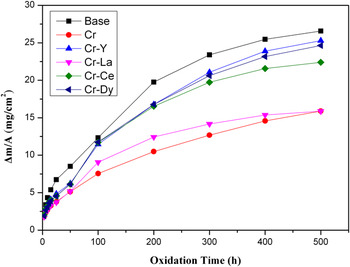
Figure 3 shows the corresponding oxidation kinetics results at 800 °C. The Cr–La alloy got the least (15.872 mg/cm2) mass gain, while the base alloy got the most. As shown in the data, the oxidation weight of Cr–La alloy and Cr alloy had little difference at 800 °C from the result.
Mass gain (Δm/A) of six Co-base alloys oxidised for 500 h at 800 °C.

From those figures it is found that oxidation at 900 °C leads to a higher mass gain per area, Δm/A, than oxidation at 800 °C. Figure 2 displays approximately a linear growth behavior, of continuous mass gains, because the spallation products are retained. A ranking from best to worst is obtained as follows: Cr–La > Cr–Ce > Cr–Y > Cr > Cr–Dy > Base. After a long period, an approximate parabolic time dependency was exhibited at 800 °C (as shown in Fig. 3), after running the experiment longer than approximately 380 h.
It thus appears that after adding Cr element, the oxidation properties got a significant improvement at a higher temperature. During the oxidation process at 900 °C, oxidation kinetics was more rapid and then more weight gain could be measured compared to that at 800 °C.
During the different oxidation experiments process, peeling and spallation occurred at the specimen surface for all alloys, these phenomena may happen during the cooling period time, which may lead to the decreasing of the weight of the specimen with increasing oxidation time. However, the total mass of these specimens and crucibles increased with prolonged exposure time in this work, since the spallation products were always contained inside the crucibles. Reference Hebsur and Miner17
B. Morphology and chemical composition analysis at 900 °C
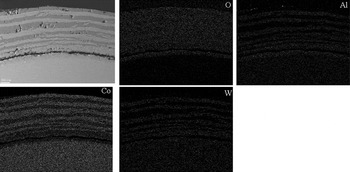
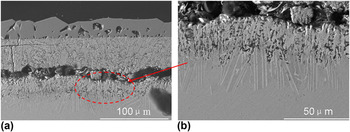
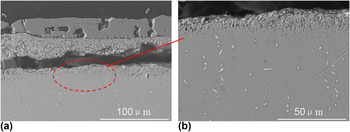
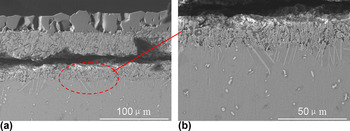
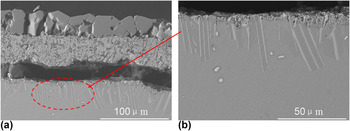
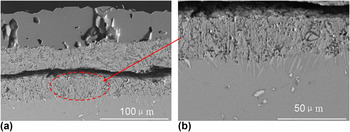
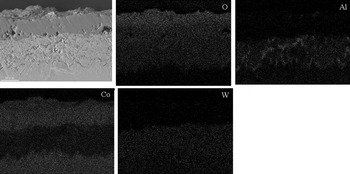
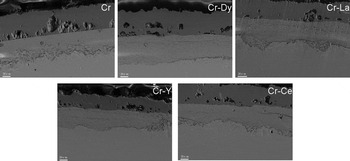
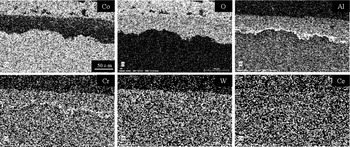
A cross-sections SEM micrographs and corresponding EDX mappings was shown for Base alloy without Cr at 900 °C in Fig. 4. The result shows that the base alloy had large oxidation weight and very thick oxide film, thus had a poor oxidation resistance. Figures 5–9 show a series of cross-section SEM micrographs and partially enlarged pictures of these Co-base alloys with Cr doping at 900 °C in the air. After a long term oxidation process for 500 h, the oxide layers for all Cr-containing alloys show a similar morphology and comparable structure, where a three-layered distinctive oxide structure is established on the alloy surface, as illustrated in Figs. 5(a)–9(a). Furthermore, wide cracks could be observed near the oxide/alloy interface, while the width was within a certain range 10∼20 μm. This was mainly due to release of thermal stresses during the cooling period after taking the samples out of the furnace. Then Figs. 5(b)–9(b) display partially enlarged details of the red elliptic area, and they were located below these cracks and adjacent to the substrate.
Back scattered electron images of the oxide film on base alloy and corresponding EDX mapping at 900 °C.

(a) Back scattered electron images of the oxide scale formed on the Cr alloy surface after 500 h isothermal oxidation at 900 °C, (b) SEM micrographs about partial enlarged details of the red elliptic area.

(a) Back scattered electron images of the oxide scale formed on the Cr–La alloy surface after 500 h isothermal oxidation at 900 °C, (b) SEM micrographs about partial enlarged details of the red elliptic area.

(a) Back scattered electron images of the oxide scale formed on the Cr–Ce alloy surface after 500 h isothermal oxidation at 900 °C, (b) SEM micrographs about partial enlarged details of the red elliptic area.

(a) Back scattered electron images of the oxide scale formed on the Cr–Y alloy surface after 500 h isothermal oxidation at 900 °C, (b) SEM micrographs about partial enlarged details of the red elliptic area.

(a) Back scattered electron images of the oxide scale formed on the Cr–Dy alloy surface after 500 h isothermal oxidation at 900 °C, (b) SEM micrographs about partial enlarged details of the red elliptic area.

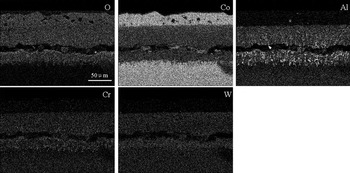
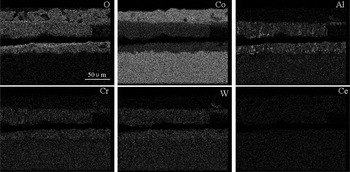
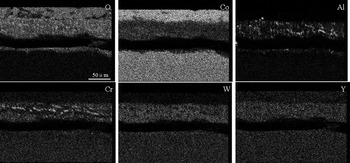
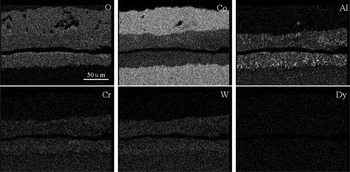
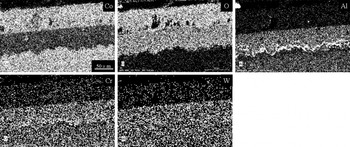
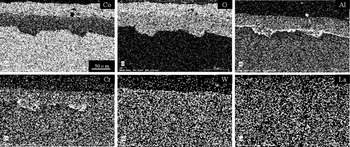
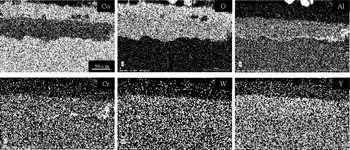
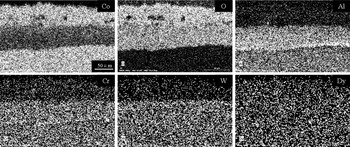
Figures 10–14 show a comparison of EDX mappings of above Cr-containing samples oxidized at 900 °C for 500 h. It shows the distribution of main elements in the multilayer structure, which includes Co, Al, W, O, and Cr, and that oxygen element concentrates in the above the substrate.
EDX mappings of the elements present, obtained in the oxide scale formed on the Cr alloy at 900 °C.

EDX mappings of the elements present, obtained in the oxide scale formed on the Cr–La alloy at 900 °C.

EDX mappings of the elements present, obtained in the oxide scale formed on the Cr–Ce alloy at 900 °C.

EDX mappings of the elements present, obtained in the oxide scale formed on the Cr–Y alloy at 900 °C.

EDX mappings of the elements present, obtained in the oxide scale formed on the Cr–Dy alloy at 900 °C.

Surface scanning distribution of these main elements was noticeable, but their distribution was not completely consistent. The outermost darker part was mainly cobalt oxide (e.g., CoWO4 or CoAl2O4), outer mottled layer which was next to the outermost layer was a mixture of various oxides including Al-rich, Cr-rich oxides, and so on, at the same time there existed a small amount of oxide at the inner side of crack.
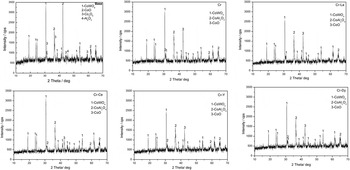
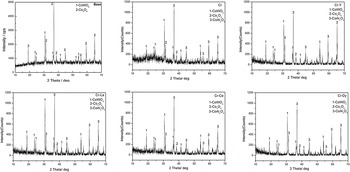
Figure 15 shows a comparison of XRD results of six system alloys at 900 °C for 500 h and it mainly consists of CoWO4 and CoO phases for alloy without Cr. It indicates the primary presence of CoWO4 and CoAl2O4 phases, meanwhile accompanied with few CoO for the other five alloys.
Oxide productions detected by XRD after oxidising at 900 °C for 500 h in air.

The outermost dark layer mainly consists of CoWO4 and CoAl2O4 oxide, whereas the second light layer consists of mixed oxides containing Al, W, and Cr. Chromium oxides have different valence states, i.e., CrO2 and Cr2O3. Some pores were also found in the outermost dark layer simultaneously. This was suggestive of a vacancy formation mechanism. Whereas the innermost layer consists of little discontinuous oxides, no distinctive Al2O3-rich zone could be observed, few needlelike Co3W compound was proved to exist between the oxide layer and the alloy substrate by scanning results. As a consequence of that outward Al-diffusion during the oxidation process, the γ/γ′- microstructure becomes instable and transforms into γ-Co and elongated Co3W precipitates. Reference Klein, Bauer and Neumeier6 By mapping and point data, it was found that the middle layer consists of some chromium oxide, which might be Cr2O3 and could effectively prevent the oxygen from diffusing into alloy substrate; then oxidation weight gain was reduced and the oxidation film thickness decreased at the same time.
C. Morphology and chemical composition analysis at 800 °C
Figure 16 shows a cross-sections SEM micrographs and corresponding EDX mappings for Base alloy without Cr at 800 °C. And from the above results, it indicates that the oxidation weight was slightly more than the other five alloys. A relatively simple and thin three-layered structure established on the surface of those five Cr-containing cobalt-base alloy systems after long term oxidation for 500 h, as illustrated in Fig. 17. They displayed a very similar morphology and comparable adhesion between the oxide film and alloy. Nevertheless, the structure had no crack at 800 °C, and that oxide film thickness was within a certain range of 70∼110 μm.
Back scattered electron images of the oxide film on base alloy and corresponding EDX mapping at 800 °C.

Back scattered electron images of the oxide scale formed on the alloy surface after 500 h isothermal oxidation at 800 °C.

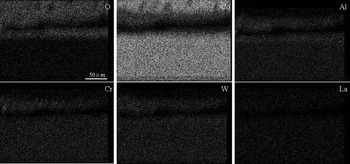
Figures 18–22 show the above corresponding EDX mappings data. Oxygen mainly distributes in the two upper layers of oxide film, and does not exist at the inner layer basically. Cobalt element is mainly distributed in the outermost layer, the other three main elements mainly exists in the other layers.
EDX mappings of the elements present, obtained in the oxide scale formed on the Cr alloy at 800 °C.

EDX mappings of the elements present, obtained in the oxide scale formed on the Cr–La alloy at 800 °C.

EDX mappings of the elements present, obtained in the oxide scale formed on the Cr–Ce alloy at 800 °C.

EDX mappings of the elements present, obtained in the oxide scale formed on the Cr–Y alloy at 800 °C.

EDX mappings of the elements present, obtained in the oxide scale formed on the Cr–Dy alloy at 800 °C.

Figure 23 shows those XRD patterns of these Co-base alloys at 800 °C for 500 h. And it indicates that the primary presence of CoWO4 and CoAl2O4 phases, meanwhile accompanied with little Co3O4 phase for Cr-containing alloys. And it only includes CoWO4 and Co3O4 for that without Cr. The crystal structure of Co3O4 and CoAl2O4 are quite similar, with similar lattice constant. Their peak may produce partial overlap.
Oxide productions detected by XRD after oxidising at 800 °C for 500 h in air.

Through the above data for Cr-containing alloys, it comes to the conclusion that the outermost layer is confirmed to be mostly CoWO4 and CoAl2O4 and then the middle oxide layer consists of various oxides containing Co, Al, W, and Cr (e.g., Cr2O3), whereas the thin innermost layer includes some visible Al2O3 oxide, as indicated by the results of EDX mappings. Cr2O3 and Al2O3 are effective oxides to hinder the diffusion of the oxygen outside. Compared to that at 900 °C, those Al2O3 oxides content was more significant at 800 °C. At the same time, the combination between oxide layer and alloy substrate was tighter while the phenomenon such as cracks was not observed. As oxidation weight became smaller, the improvement was more obvious.
Between the alloy substrate and oxide layer, a phase transformation could also be observed and needle shaped intermetallic precipitate of Co3W was found, which was characterized by a γ′-depleted region containing the γ-matrix and elongated Co3W-phases (Fig. 17). Those Co3W-precipitates composition was determined by EDX point scans. Recent studies confirm this phase transformation in the ternary Co–Al–W system. Reference Tsukamoto, Kobayashi and Takasugi18
IV. DISCUSSION
In this work, we mainly compared and analyzed different oxidation behaviors of novel Cr-containing cobalt-base alloys in detail. For the alloy without Cr, it had a lager oxidation weight and thicker oxide film at two different temperatures, which led to a poor oxidation resistance. Two oxidation kinetic curves show the same trend for certain rare elements. The effect of lanthanum was particularly significant and superior at 800 and 900 °C.
As shown in Fig. 2, it always indicates a linear upward trend at 900 °C, while an approximate parabolic time dependence growth tendency at 800 °C. The growth of oxidation weight was nearly four times than that at 800 °C, which was consistent with the two oxidation curves in Figs. 2 and 3.
At the beginning of oxidation process, firstly oxygen diffused inwards through the alloy. With the high Co content in the alloy, Co-oxides first developed which leads to a Co-depleted zone in the adjacent area, and the increase in the oxidation weight was manifested on the kinetic curve, as shown in Figs. 2 and 3. Reference Klein, Bauer and Neumeier6 Moreover, it could cause the enrichment of Al and W in these areas, then these grains were surrounded by Co-oxides and then to form composite spinel phase CoWO4 or CoAl2O4 by solid phase reaction eventually, just as proved by the above data.
Co can form different valence oxides at different temperatures. CoO has cubic rock salt structure with a lattice constant of 4.26 Å and is stable above 900 °C. Reference Kannan and Seehra19,Reference Brauer20 Co3O4 is another stable oxide that has a cubic spinel structure with a lattice constant of 8.15 Å. Under readily attainable oxygen partial pressures, it is thermodynamically favorable to form Co3O4. Reference Liu and Prewitt21,Reference Petitto, Marsh, Carson and Langel22 But the CoO phase could form at 900 °C, which exceeds the decomposition temperature of Co3O4. Reference Ito, Ikeda and Tanaka23 Thus it mainly leads to the formation of CoWO4 and CoAl2O4 accompanied with few CoO at 900 °C, without Co3O4 at 900 °C. At 800 °C this leads to the formation of CoAl2O4, CoWO4, and a little Co3O4 oxides eventually.
It was also found that a suitable amount of Cr (4 at.%) as additional alloying element resulted in improved oxidation resistance due to the promotion of the formation of protective Cr2O3 and Al2O3 oxide scales at both conditions. Reference Neumeier, Freund and Goken24–Reference Giggins and Pettit26 Then the oxidation product changed after adding chromium, which made the final oxide film containing CoAl2O4. CoAl2O4 phase has a cubic spinel structure with lattice constant of 8.11 Å. Reference O'Neill27 A possible reason could be that during the early stages of oxidation Co and Al reacts with oxygen, leading to the formation of Co3O4 and Al2O3. Thus, Cr in the alloy promoted a synthesis by a solid state reaction between them, which was thermally stable.
Therefore, except for cobalt in the alloy, the other elements with low concentration still induce selective oxidation at inner sides. Outer Co-oxides formation could lower the activity of oxygen. Underneath the outermost layer exists the mixture oxides, the oxidation of chromium also produced a Cr-rich oxide scales, which may also contain Cr2O3. The middle layer contains another oxide-Cr2O3, which has a trigonal structure with lattice constants of a = 4.96 Å, c = 13.60 Å. Reference Neumeier, Freund and Goken24,Reference Kubota28,Reference Newnham and De Haan29 It has a low diffusivity for oxygen and improves its oxidation resistance. Meanwhile it seems to have a benefit for the formation of a continuous Al2O3 scale. After that, the interface between the middle oxide layer and matrix gathers certain Al2O3 oxide. Then it could effectively prevent the proliferation of O element, reducing the oxidation rate. After the whole oxidation, the outermost layer has holes and defects, which is mainly due to the large oxidation stress in the film and has to be released by spalling and distortion.
As a consequence, predominantly cobalt oxides were formed in the oxide film. During this process, those effective alumina and chromium oxides were also formed, and then occurred a microstructure transformation from γ/γ′-matrix to γ/Co3W at the interface between the oxide film and alloy matrix (including adding specific rare earth elements) at 800 and 900 °C. Due to decreasing Al content of the matrix during oxidation, the Al-depleted zone [c(Al) less than 7 at.%] transformed from a two-phase γ/γ′ to γ/Co3W microstructure. Partial phase diagrams of the ternary Co–Al–W system illustrate this process. Recent studies of Tsukamoto et al. have already reported the mentioned phase transformation in the ternary Co–Al–W system. Reference Tsukamoto, Kobayashi and Takasugi18
At the same time, an apparent aluminum oxide layer was not found at 900 °C with only sporadic alumina products, leading to the weak protective effect. Unlike that at 900 °C, a more obvious Al2O3 layer is formed at 800 °C after 500 h exposure. This alumina layer has a slow growth rate, high stability, and a compact structure with few defects. A slower growth rate of Al2O3 may be the reason for lower reaction kinetics. Reference Nicholls30 Furthermore, five Co-base alloys did not form cracks at the alloy/oxide layer interface at 800 °C. Depending on different oxidation temperature, the Al2O3 layer could be different, but they similarly generated Cr2O3, it had lower diffusivity for O, which further slowed the migration of reactive species through the oxide scale and protected the alloy.
Between the matrix and oxide film, some cracks were formed at 900 °C, which made oxygen to penetrate the substrate easily. During the oxidation process, oxygen intrusion to the alloy surface was severe, due to the fact that the base alloy and oxide scales had different thermal expansion coefficients, then generated large stresses during the cooling period and ultimately caused cracking and spallation on the surfaces.
Moreover adding RE elements (Y, Dy, Ce, and La) to the alloy, the weight gain differ significantly, which leads to distinctive effect to the material oxidation performance, especially the La shows the best oxidation resistance at 900 °C.
Its original morphology was usually changed after doping rare elements and Cr, these grains growth seems to be neat, which was different from those samples without doping chromium. Then some main alloy elements segregated or gathered, which was conducive to form certain protective layer, or prevent the entry of oxygen and make crack become narrower, making the material suitable for service under the high temperature environment.
The research on oxygen solubility and diffusivity in Co-based quaternary system is limited so far. The effect of chromium and specific rare earth elements on the oxidation resistance is too complicated to predict. Reference Li, Qiu, Qiu, Zhao, Bai and Sun31–Reference Panwar, Prasad, Umasankar Patro, Balasubramanian and Venkataraman33 Therefore, only the Cr and Cr–La alloys were discussed here.
Lanthanum element acts as the purifying agent for deoxidizing and desulfurizing, to reduce the harmful effects of oxygen and sulfur in the grain boundary. The addition of these atoms could increase the fluidity of liquid metal combined with the capillary effect between these particles, which could prompt the particle matter to fill the pore area, reducing the defects such as loose structure and holes. The purifying effect makes the structure to be more compact and improve the bonding strength between these atoms and surface stability. In addition, they may serve as catalyst and enhance the dendrite formation, promoting its fusing and decrease the gap. Then they segregate in the grain boundary as micro alloying elements, strengthening the grain boundary effect. Their atomic radius are greater than these matrix elements, which will cause the lattice distortion, lower the diffusion activation energy and thus increase the diffusion coefficient, finally resulting in the decrease of the oxidation rate and film thickness.
Rare earth oxide formed in the process of oxidation reduced the stress concentration on the pore edge and maintained a stable chemical property at high temperature. Due to the strong chemical activity, these rare earth oxides could easily react with other elements, and form a stable, high melting point compound, becoming crystal nucleus and increase the nucleation number of particles. And they were easy to gather beside the grain boundary and to hinder the abnormal grain growth at high temperature, leading to a fine and uniform grain size, especially La at 900 and 800 °C. Mainly due to their larger ion radius, the partial concentration was higher at the grain boundary, which could more effectively prevent main grains from growing, making the oxidation growth process restrained. Also they gathered in those dislocation and defects areas, so as to produce large numbers of distortion zone, making the system energetically unfavorable. By the spontaneous action, the system tended to become stable and attract a large number of small atoms partially segregate in the distorted zone, leading to the solid solution strengthening effect.
In addition, they led to lower dislocation density, which reduced the stress concentration, slowed the rate of crack nucleation and propagation. At the same time, the grain boundaries area increased and improved the crack propagation resistance, which strengthened the film adhesion, and hindered the oxidation process. The elements addition caused the cationic vacancy in original oxide film layer to disappear. Due to the defects, the dislocation or other short diffusion path was blocked by rare earth atoms and metal ions were stopped from spreading through the oxide layer by the generated dense oxide film, then diffusion rate was reduced, thus slowing down the oxidation process.
V. CONCLUSION
Isothermal oxidation was carried out on several novel Co-base super-alloys of the system Co–9Al–10W–4Cr in the air for 500 h. An appropriate content of Cr as additional alloying element significantly improves the oxidation resistance compared to those without Cr, leading to significant decrease of the oxidation weight. This is due to the formation of self-protective Cr2O3 and Al2O3 layers after oxidizing Cr-containing samples at 800 and 900 °C. The protective Al2O3 layer is more obvious at 800 °C. Besides, rare earth elements addition produced several distinct results. The common effect of chromium and rare earth elements was more superior at 900 °C while it was inferior at 800 °C. Meanwhile, samples with La shows the best oxidation resistance at two conditions particularly. Then after adding chromium, a new phase CoAl2O4 was found in the oxidation products. According to SEM and EDS measurements, Co3W precipitates between the inner oxide layer and the γ/γ′-matrix.
In addition, the γ/γ′-microstructure of chromium containing alloys has to be stabilized to maintain the desired high temperature strength. This may lead to the development of new γ/γ′-strengthened Co-base super-alloys with superior oxidation resistance and high temperature strength compared to conventional Co-base super-alloys.
ACKNOWLEDGMENTS
The authors gratefully acknowledge the financial support from the National Science Foundation of China (Grant No. 51201074). Useful discussions with Dr. Kang Wang (Northwestern Polytechnical University) are also acknowledged.