INTRODUCTION
Climate change models predict decreased precipitation in many of the world's cropping regions and, as a result, the substantial land area devoted to rainfed agriculture is likely to become less productive, unless there are major changes in the geographical locations where major crops are grown. Such reductions in productivity may be minimized by novel crop management techniques and the introduction of improved genotypes with enhanced resilience to abiotic stresses. Although irrigated agriculture is used on only about 0·17 of the land area devoted to food production, this produces more than 0·40 of the world's food (Fereres & Connor Reference Fereres, Connor, Cabrera and Cobacho2004). Due to climate change and competition for water with industrial and domestic users, irrigated agriculture will increasingly take place under water scarcity (e.g. Fereres & Soriano Reference Fereres and Soriano2007). Thus, management techniques that can deliver ‘more crop per drop’ will assume increased importance. The present review highlights specific areas of agronomic endeavour that can increase productivity per unit of land area in both irrigated and rainfed agriculture.
CROPPING SYSTEMS, CROP AND SOIL MANAGEMENT
Farmers rely on plant breeders to supply productive new varieties that are adapted to their local environmental conditions and historic increases in crop yields show how successful breeders have been in this regard. In addition to this, agronomic manipulations will impact significantly on crop productivity. Because of restrictions in the availability of water and fertilizer in many parts of the world, productivity increases must be accompanied by increases in resource use efficiency. The impact of several low-technology management systems are considered in the current review.
Conservation agriculture
Conservation agriculture (CA) aims to minimize both mechanical soil tillage using heavy machinery and the application of agrochemicals, while retaining permanent organic soil cover to minimize soil evaporation. This approach can decrease damaging soil compaction, reduce the loss of soil carbon and minimize disturbance in soil biology while reducing fuel use and labour costs (Dumanski et al. Reference Dumanski, Peiretti, Benites, McGarry and Pieri2006). Commonly, crops are planted or sown directly into untilled soil that may retain residues from the previous crop or a cover crop. Appropriate cover crops can fix nitrogen (N). Increasingly it is suggested that these treatments can have beneficial effects on soil water status, although effects on greenhouse gas emissions may be less desirable (Rochette Reference Rochette2008). The build-up of plant pathogens in the rhizosphere can be another potentially damaging effect of residue retention in CA (Cook Reference Cook2006). The increased strength of untilled soil can slow root elongation and shoot growth (Masle & Passioura Reference Masle and Passioura1987).
Identifying the cause(s) of shoot growth reduction when plants are grown in strong soil (e.g. soil which is compacted by vehicular traffic or soil that has a low water content) has proved elusive, although both hydraulic and chemical signalling may limit growth (Hartung et al. Reference Hartung, Zhang and Davies1994). The interacting negative effects of soil microbiology and physical properties may be overcome using varieties with more vigorous root growth, thereby attenuating root accumulation of inhibitory pseudomonad bacteria (Watt et al. Reference Watt, Kirkegaard and Rebetzke2005). Since biological and chemical signalling impacts of soil strength are not always easy to predict or control, exploiting genetic variation in plant response to soil strength (Masle & Passioura Reference Masle and Passioura1987) may be the best approach to overcome limitations imposed by strong soil.
Mulching
Covering the soil with organic/inorganic materials (mulching) can minimize soil evaporative losses, suppress weeds and increase soil temperature, which may speed crop development (Nelson & Mele Reference Nelson and Mele2006). Many organic mulches are locally sourced (commonly by-products from other industries such as farmyard manure, olive press residues and almond shells) and can be seasonal in their availability. For example, non-flooded wheat/rice straw mulching cultivation has been developed as a new rice production technique in the Yangtze River Basin (China), where a major challenge is disposal of the wheat residue preceding a rice crop (Yang & Zhang Reference Yang and Zhang2010).
Plastic mulches can be easily rolled onto fields using commercially available equipment ‘on-demand’, although energy costs of plastic production may be substantial. Plastic reflectivity (determined by colour) can change mean soil temperatures by up to 4°C (Diaz-Perez & Batal Reference Diaz-Perez and Batal2002) and directly impact on plant growth and water use via altered hydraulic and chemical root-to-shoot signalling (Dodd et al. Reference Dodd, He, Turnball, Lee and Critchley2000), and influence the progression of plant disease, with different pathogens being favoured by specific rootzone temperatures. Plastic mulch has improved rice grain yield in China in regions where water shortage and low-temperature limit production, but has decreased grain yield in other regions when soil temperatures became inhibitory to root growth (Yang & Zhang Reference Yang and Zhang2010).
Using plastic mulch on fallow land during summer (termed solarization), when surface soil temperatures can exceed 40°C, can inhibit fungal pathogens and is increasingly used to decrease (root) disease pressures, as part of a crop rotation. Solarization has been used prior to transplanting high-value vegetable crops, along with transplant inoculation with plant growth promoting rhizobacteria (PGPR) known to antagonise soil-borne pathogens (Kokakalis-Burelle et al. Reference Kokakalis-Burelle, Vavrina, Rosskopf and Shelby2002).
Crop rotation
Rotation of crops on a given piece of land can be beneficial when soils have become inhibitory to plant growth, perhaps because of the negative microbiological impacts of continuous cropping (and residue retention). Crop rotation can increase yield by up to 20% or more, via a variety of mechanisms including improved N nutrition (often by incorporating legumes within a crop rotation to fix atmospheric N) and water supply (Kirkegaard et al. Reference Kirkegaard, Christen, Krupinski and Layzell2008). Although the impact of legumes is usually interpreted in terms of root nodule N fixation, legumes and their microsymbionts also produce other chemicals (phytohormones, nodulation factors and lumichrome) that beneficially modify plant growth when crops are rotated (Dakora Reference Dakora2003).
Intercropping
The cultivation of two or more species in the same field at the same time (intercropping) can boost productivity per unit land area. Intercropping systems comprising a cereal/legume association aim to boost cereal yields via biological N fixation by the legume, or by increasing phosphorous bioavailability (Li et al. Reference Li, Li, Sun, Zhou, Bao, Zhang and Zhang2007). Companion crops are grown so that resource capture can be offset in space or time (e.g. root systems distribution in maize/faba bean). Another aim is to use a companion crop to decrease pest or pathogen pressure on the other crop (Trenbath Reference Trenbath1993).
Skip rows
In areas with very limited water availability, skip rows (decreasing planting density by omitting rows) can increase water availability to individual rows and thereby increase yield (Whish et al. Reference Whish, Butler, Castor, Cawthray, Broad, Carberry, Hammer, McLean, Routley and Yeates2005). In contrast to intercropping, where crops with different temporal patterns of resource use minimize competition, skip rows permit a monoculture.
Protected cropping
Enclosing the aerial environment of the crop under glass, plastic or netting (protected cropping) is used extensively in many parts of the world for high-value crops (e.g. summer vegetables). There are multiple justifications for this but, importantly, these include the resuction of plant water use in areas where vapour pressure deficits (VPDs) and temperatures are excessively high. Very high efficiency of water use can be achieved in a completely sealed house where climate control is delivered via evaporative cooling of water. Rainwater harvesting from the roofs enclosing protected crops can also decrease the environmental footprint of these production systems. In areas with insufficient fresh water supplies, sea water can also be distilled using solar energy to achieve effective, low-cost climate control and significant amounts of freshwater for plant culture.
PLANT IMPROVEMENT FOR COPING UNDER WATER SCARCITY
Classical plant breeding has made significant strides in producing crop genotypes with some capacity to sustain yield in water-scarce environments. However, there is still uncertainty over the plant traits which will be advantageous in particular environments. There is also an inherent conflict between two variables (biomass accumulation and stress avoidance via restricting water loss) which seem most important to sustain yields when water availability is limited. Biomass accumulation and yield can be maintained under drought by maintaining or even increasing transpiration rate (via enhanced leaf area development or stomatal conductance), but this increases the risk of crop failure. Decreasing cumulative water loss (e.g. by reducing stomatal conductance, leaf growth or the length of the cropping cycle) to increase water use efficiency (WUE; biomass accumulation per unit of transpired water) is a more conservative strategy which generally restricts yield. As a consequence of this complexity it should not be surprising that any individual physiological or developmental trait can have a positive, negative or neutral effect on yield, depending on the timing, duration and severity of the drought experienced. Predicting phenotype from genotype is complicated by interactions between genetic controls (of functioning, growth and development) and the environment, but modelling can help navigate a path through this complexity. Combining field studies and genetic analyses, modelling allows the prediction of different effects of an allele at different sites (Chenu et al. Reference Chenu, Chapman, Tardieu, McLean, Welcker and Hammer2009).
In recent years, much effort has been dedicated to identify single genes that might confer drought tolerance, via any one of a very wide range of mechanisms. Some spectacular claims have been made for the significance of effects generated in rather specific conditions (usually controlled environments), but usually there has been no subsequent development and release of transgenics that maintain high and stable yields under water scarcity in real environments. This should not be surprising, as drought tolerance has been defined in many cases by survival under very severe stresses. There is little evidence that characteristics enabling survival will provide any yield advantage (except in perennial crops) under the stress conditions usually experienced in productive field situations. In fact, the converse may be true.
One impressive success in conventional breeding by selecting for a high WUE trait, has been the development of wheat lines where genomic regions which confer high WUE (but sustained assimilation rates) have been introgressed into elite material (Rebetzke et al. Reference Rebetzke, Condon, Richards and Farquhar2002). Carbon isotope discrimination (the discrimination (Δ13C) of the two stable isotopes of carbon, 12C and 13C, measured using a mass spectrometer) has been used as a convenient surrogate for estimating WUE. This novel plant science has culminated in the commercial release of wheat genotypes with a 10–15% yield advantage in dryland, low-yielding environments. Significantly, there is no yield penalty in higher-yielding environments.
So-called staygreen varieties, with delayed leaf senescence, will allow more root growth, better access to water and therefore extra carbon gain and seed yield in some crops (e.g. Borrell et al. Reference Borrell, Hammer and Henzella2000). It has been suggested that biotechnological manipulation of genes controlling the hormones impacting seed yield (Rivero et al. Reference Rivero, Kojima, Gepstein, Sakikibara, Mittler, Gepstein and Blumwald2007) can achieve this end. Extra carbon availability (perhaps as a result of staygreen) can make an important contribution to early maize seed growth, by decreasing seed abortion (McLaughlin & Boyer Reference McLaughlin and Boyer2004) Similarly, shortening the anthesis to silking interval in maize can also have a major effect on abortion and seed number, decreasing the drought sensitivity of the maize crop by shifting crop phenology so that the life cycle is completed prior to terminal drought stress (Bolanos & Edmeades Reference Bolanos and Edmeades1996).
Genetic variation in root traits (e.g. basal root gravitropism, root angle and branching and adventitious root formation) can have significant impacts on crop productivity when water and nutrient availability is low (Lynch Reference Lynch2007). Interestingly, genetic variation in root cortical aerenchyma formation can decrease the metabolic costs of root growth and soil exploration (Fan et al. Reference Fan, Zhu, Richards, Brown and Lynch2003). While deeper roots can enhance drought tolerance by increasing water access, enhanced topsoil foraging is important to acquire nutrients from infertile soils. Since the uptake of immobile nutrients such as phosphorus can be limited by the development of depletion zones around roots, genetic variation in root growth rates and the length and density of root hairs are important. Genetic variation in rhizosphere modification through the efflux of acids and enzymes is important to mobilize nutrients such as phosphorus (P) and transition metals. However, there can be trade-offs between different root morphologies for water and P acquisition (Ho et al. Reference Ho, Rosas, Brown and Lynch2005), which may be problematic for plant improvement since crops are usually impacted by complex stresses rather than by single environmental variables (e.g. soil drying will reduce both water and nutrient availability to roots). Where the distribution of rainfall is unpredictable and soil nutrient status varies across a field, sowing a mixture of lines (multiline) having shallow and deep root types might produce more resilient and stable crop yields. The most appropriate mixture of root types for a particular geographic or climatic region might depend on soil fertility and the likelihood of drought.
Lynch (Reference Lynch2007) and others have argued that in breeding crops for soils with low fertility and water availability, selection for specific root traits through direct phenotypic evaluation or molecular markers is likely to be more productive than conventional field screening. Crop genotypes with greater yield in infertile, dry soils will substantially improve the productivity and sustainability of low-input agroecosystems, and importantly, in high-input agroecosystems will reduce the environmental impacts of intensive fertilization.
IRRIGATION AND WATER-SAVING AGRICULTURE
When water is applied to crops most is lost to the atmosphere, some from evaporation from the soil surface and some from the loss through the stomata (transpiration). There will also be other losses as a result of poor distribution of water to the crop, excessive runoff and weed transpiration. ‘Water saving agriculture’ can involve reducing unproductive water loss from bare soil and weeds, either by mulching with plastics or by leaving crop residues in the field after harvest. Planting/sowing dates can also be altered with respect to the rainy season such that the canopy covers the ground while the soil is still moist, and evapotranspirational loss is minimized because leaf-air VPD is less during early crop development. This can ensure that a greater proportion of soil water goes through the plant and contributes to crop productivity. Such practices as planting the Australian wheat crop in autumn when atmospheric evaporative demand is least, has tripled yields over a period while water available for production has declined (Turner Reference Turner2004) – an impressive increase in water productivity.
In irrigated agriculture, additional water losses include evaporation and leakage from reservoirs, and during water movement to the field through canals and channels. When water is in relatively plentiful supply, irrigation is applied widely using rain guns and other overhead systems, where water is lost through evaporation or is applied to roads, field margins and other non-productive areas. Shrinking water resources have prompted a move towards micro-irrigation methods, including such techniques as sub-surface drippers and drip lines or trickle tape located below plastic mulches, techniques which substantially increase water productivity. In both developed and developing countries, many fields have traditionally used flood or furrow irrigation. Furrow irrigation of rice can increase WUE by c. 50%, but may reduce grain yield by 10–20%, when compared with the continuously flooded crop (Vories et al. Reference Vories, Counce and Keisling2002).
Deficit irrigation
Insufficient water supply for irrigation is now the norm rather than the exception in many regions of the world. This means that irrigation management that has previously focused on maximizing production per unit area must now focus on maximizing crop production (yield) per unit of water applied. This is often termed as the ‘water productivity’ of a cropping system. When supplies of water are scarce, so-called deficit irrigation, defined as the application of water below full crop-water requirement, is an important means of increasing water productivity and ideally sustaining crop productivity (or financial return) under water scarcity.
Soil drying will almost inevitably reduce crop production and we now have a good understanding of why this happens (e.g. Wilkinson & Davies Reference Wilkinson and Davies2002). Irrigation can overcome many of the limitations on growth and functioning caused by soil drying, but partially replenishing the soil volume may not completely eliminate stress. The hope is that irrigation techniques may be designed to minimize this yield penalty but some difficulties are not easy to avoid. For example, partial wetting of the root zone, particularly with poor-quality water, will concentrate salts in the root zone. Since nearly all crops are intolerant of salt accumulation, this must be leached from the root zone before salts reach a concentration that limits crop production. Salt leaching is achieved by the movement of water applied in excess of evapotranspiration (ET). If this is not done, land will have to be taken out of production and this has happened, for example, with large areas of previously productive citrus orchard in California. Thus, in dryland irrigation, some water losses from the system are unavoidable.
Reducing ET without decreasing crop production is difficult because evaporation from crop canopies is tightly coupled with the assimilation of carbon. A limitation in water supply that decreases transpiration below the rate dictated by the evaporative demand of the environment will dry the soil water reservoir and limit biomass production.
The following identity, defined by Passioura (Reference Passioura1977) shows the direct link between water transpired (W) and yield (Y):

The relationship between biomass produced and water applied (BWR) is variable depending on growing conditions and genotype and even more importantly, if the economic yield from crop production is grain, then the yield can be increased for a given quantity of water applied by increasing the harvest index (HI) of the crop (as the proportion of total (above-ground) biomass that is grain). Drought or deficit irrigation can increase HI: a useful tool to allow farmers to sustain production and profitability.
The amount of water needed to ensure maximum yields also depends on the uniformity of irrigation and enhancing this variable is a major aim for most irrigators. While the crop is under deficit, a more uniform irrigation system will reduce the impact of more severe deficits in parts of the field. Uniformity of application can be enhanced by sophisticated sensing of plant water deficit (e.g. thermal imaging of crop temperature combined with precision (potentially automated) delivery of water where it is actually required. Several approaches to deficit irrigation have been successful in a range of crops (see e.g. Chaves et al. Reference Chaves, Santos, Sousa, Ortuno, Rodrigues, Lopes, Maroco and Pereira2007; Fereres & Soriano Reference Fereres and Soriano2007). In China in particular, these techniques have impacted very positively on water productivity and on catchment hydrology and ecosystem services (Kang et al. Reference Kang, Su, Tong, Zhang, Zhang and Davies2008).
One particular advantage of controlled water deficit, as discussed above, is the capacity to regulate excessive vegetative vigour and shift the balance between grain/fruit and vegetative growth towards the sustained production of high-quality grain/fruit, thereby increasing HI and delivering a substantial dividend in terms of crop value (e.g. Davies et al. Reference Davies, Wilkinson and Loveys2002). Grain filling is the final stage of growth in cereals where fertilized ovaries develop into caryopses. The extent of filling depends on carbon from two sources: current assimilates and assimilates redistributed from reserve pools in vegetative tissues. Remobilization of leaf sheath and stem reserves to the grain is estimated to contribute as much as 0·40 of the final rice yield. High N applications can sometimes delay senescence and prevent remobilization from stems to grains thereby reducing grain yield. By stimulating senescence, a mild post-anthesis water deficit can enhance resource remobilization, to increase HI and grain yield (Yang & Zhang, Reference Yang and Zhang2010).
Partial rootzone drying
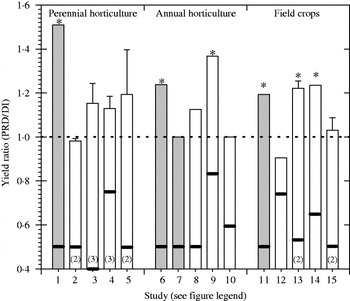
Several recent reviews and commentaries have emphasized the importance of exploiting the novel understanding of plant biology to optimize resource use efficiency and crop production in agriculture. One technique that aims to do this by exploiting the science of plant root-to-shoot signalling is partial rootzone drying (PRD) (Stoll et al. Reference Stoll, Loveys and Dry2000), which deliberately aims to impose soil moisture heterogeneity by independently watering different parts of the rootzone (for example, one side of the row) to manipulate root-to-shoot signalling to restrict crop water use. Recent meta-analyses of the agronomic impacts of PRD have focused attention on the need to understand the basis of the plant's yield response to drought stress. In one analysis, which focuses on field-grown, mainly woody perennial crops (Sadras Reference Sadras2009), there is little difference reported in the effects of reduced amounts of water applied as conventional deficit irrigation or as PRD. Consideration of a broader range of annual and perennial crops, grown both in containers and in the field, showed that in 0·40 of the cases, plants irrigated using PRD techniques had statistically higher water productivities (Dodd Reference Dodd2009) (Fig. 1). In some cases, economic productivity may be even higher due to increased crop quality under PRD (dos Santos et al. Reference Dos Santos, Lopes, Rodrigues, De Sousa, Maroco, Pereira, Silva and Chaves2003) and/or an earlier harvest decreasing the likelihood of frost damage in certain annual crops. Likely explanations for yield gains under PRD include the stimulation of organic N and P mineralization by cycles of soil drying/rewetting, increased biomass allocation to the roots promoting resource capture (Mingo et al. Reference Mingo, Theobald, Bacon, Davies and Dodd2004) and alterations in root-to-shoot signalling such as increased delivery of the plant hormone abscisic acid (ABA) from roots into shoots to increase WUE (Dodd Reference Dodd2009).
Crop yield ratio of PRD to deficit irrigation (DI) at similar irrigation volumes (a ratio of 1 indicates that yield with both techniques is equivalent). The fraction of full irrigation is given as a thick line in each column. Columns are means (±s.e.) of the number of experiments/seasons given in parentheses at the base of each column. Shaded columns denote pot experiments where the root system was confined. Significant (P<0·05) differences between PRD and DI are indicated with an asterisk (*). For (reference and species) details of the original studies, refer to Dodd Reference Dodd2009. Reproduced with permission of Oxford University Press.

Despite intensive research, it is not clear whether PRD has been adopted widely by farmers. In drip-irrigated crops, costs associated with the installation of additional irrigation lines (relative to perceived additional benefits compared to traditional deficit irrigation) may deter the application of PRD. However, the application of PRD to furrow-irrigated crops results in both labour and water savings (decreasing costs). Consequently, there has been considerable uptake of PRD in certain agricultural regions in field crops.
Alternate wetting and drying of soil in rice production
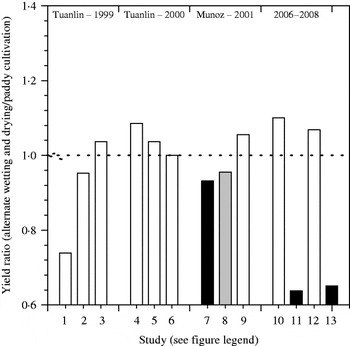
Paddy rice production in Asia is demanding on water use and can often also lead to excessive vegetative vigour and a lower HI (Zhang & Yang Reference Zhang, Yang and Bacon2004). To reduce water use in irrigated rice, alternate wetting and drying irrigation (AWD) has been developed, but its impacts on yield depend on variations in soil hydrological conditions and irrigation timing (Belder et al. Reference Belder, Bouman, Cabangong, Guoan, Quilang, Li, Spiertz and Tuong2004). Increased grain yield and WUE under AWD could be attributed to improved canopy structure and reduction of excessive vegetative growth (Yang & Zhang Reference Yang and Zhang2010). Alternate wetting and drying reduced tiller number and total leaf area but the number of productive tillers and effective leaf area (leaf area of productive tillers) showed no significant difference between the two regimes. It seems that improved canopy quality decreased the water used in production of unproductive tillers and transpiration from redundant leaf area (Yang & Zhang Reference Yang and Zhang2010). Furthermore, AWD significantly reduced the leaf angle (from the vertical) of the top three leaves at heading time, allowing more radiation to penetrate the canopy, which is important to maximize canopy functioning during grain filling. Furthermore, the activities of three key enzymes involved in starch synthesis in grains during grain filling were maintained or increased during soil drying, and markedly enhanced when plants were re-watered. The increased sink strength through the enhancement of these enzyme activities under AWD may contribute to a greater percentage of filled grains and higher grain weight, and consequently to higher grain yield. It seems likely that dynamic changes in root-to-shoot signalling during the alternate wetting and drying cycles are partially responsible for these developmental and physiological changes (Fig. 2), and effects are analogous to the effects of irrigation placement (PRD) on yield of irrigated crops (Dodd Reference Dodd2009) (see Fig. 1).
Yield ratio of rice crops comparing alternate wetting and drying to paddy cultivation (a ratio of 1 indicates that yield with both techniques is equivalent). Each column (studies 1–9) indicates a separate experiment where darker columns indicate decreased N fertilization as reported in Belder et al. (Reference Belder, Bouman, Cabangong, Guoan, Quilang, Li, Spiertz and Tuong2004) or (studies 10–13) the mean of 3 years of experiments with cv. Zhendao 88 (10, 11) or Liangyoupeiju (12, 13) where filled and hollow bars indicate severe and moderate soil drying as reported in Yang & Zhang (Reference Yang and Zhang2010).

EXPLOITING SOIL BIOLOGY TO IMPROVE DROUGHT TOLERANCE
Rhizobia
The ability of legumes to form symbiotic relationships with certain bacterial genera (principally Rhizobium, Bradyrhizobium spp.) that can fix atmospheric N makes them an attractive crop component within crop rotations. Although N fixation accounts for c. 0·20 of the N needed for world grain and oilseed production, there has been little success in plant breeding for variation in N fixation (Herridge & Rose Reference Herridge and Rose2000). Instead, a much-prosecuted goal has been to introduce efficient rhizobial strains (tailored to the crop genotype) at seed planting, even though N-fixing bacteria may already be present within the soil (especially if previous native or crop legumes have been grown).
Typically, nodulated plants are more sensitive to high temperature and drought stresses than are plants growing on mineral N. This is due to the vulnerability of the symbiosis and N fixation is in fact among the most sensitive of plant processes to soil drying, with localized decreases in nodule water potential decreasing nitrogenase activity, even while leaf water potential of these plants was equivalent to well-watered plants (Marino et al. Reference Marino, Frendo, Ladrera, Zabalza, Puppo, Arrese-Igor and Gonzalez2007). Nodulation also seems responsive to drought-induced changes in plant-growth regulators, although further work is required to understand the role of plant hormones in regulating nodulation responses to drought.
Co-inoculation of rhizobia with certain PGPR can ameliorate the negative impacts of soil drying on nodulation (Belimov et al. Reference Belimov, Dodd, Hontzeas, Theobald, Safronova and Davies2009). Certain bacteria can promote root branching (allowing more sites for nodulation), stimulate exudation of compounds that induce nod genes thus priming nodulation (Dardanelli et al. Reference Dardanelli, De Cordoba, Espuny, Carvajal, Diaz, Serrano, Okon and Megias2008) and decrease root production of the nodulation-inhibitory phytohormone ethylene (Belimov et al. Reference Belimov, Dodd, Hontzeas, Theobald, Safronova and Davies2009). Identification of stress-tolerant rhizobial strains in conjunction with their host legumes remains another attractive option to remediate soils in arid regions.
Mycorrhizae
Association of mycorrhizal fungi with plant roots has most commonly been linked to improved uptake of phosphorous and other relatively immobile nutrients, but there is increasing evidence that mycorrhizal plants are more effectively able to maintain their water relations as the soil dries, independently of altered P status (Auge Reference Auge2001). Despite these benefits, there has been little adoption of mycorrhizal inoculation for drought amelioration. The progressive introduction of alternative cropping systems with minimum tillage, cover crops or intercrops, and decreased P fertilizer application could provide conditions more suited to the exploitation of properties of mycorrhiza.
PGPR
PGPR are commonly found in the rhizosphere and promote plant growth via several diverse mechanisms (Lugtenberg & Kamilova Reference Lugtenberg and Kamilova2009). Of these, the production or metabolism of chemical signalling compounds that impact on plant growth and functioning are perhaps most relevant to dryland agriculture (Arshad & Frankenburger Reference Arshad and Frankenburger1991). Although rhizobacteria that impact on plant hormone signalling pathways do not directly improve plant–water relations and nutrition, promotion of root and/or shoot growth can make more resources available to the plant (exploitation of greater soil volumes) or decrease stress-induced growth limitations. Much recent attention has been focused on rhizobacteria containing the enzyme 1-aminocyclopropane-1-carboxylate (ACC) deaminase (ACCd), that take up rhizospheric ACC (as a carbon (C) and N source), decreasing root ACC concentration and accumulation of root ethylene (a potent plant stress hormone), thus increasing root growth (Glick et al. Reference Glick, Penrose and Li1998) and attenuating long-distance ACC signalling, thus generating a systemic effect on plant growth and functioning (Belimov et al. Reference Belimov, Dodd, Hontzeas, Theobald, Safronova and Davies2009). To date, PGPR that act principally by altering plant hormone status have received comparatively little commercial attention.
CONCLUSIONS
Arid environments pose particular challenges for crop growth and production, since mechanisms allowing crop survival are not usually compatible with high yields. Exploitation of the novel science described above can provide opportunities to increase yield and resource efficiency. There are both genetic opportunities to tackle some grand challenges and management options which can now be applied to address significant yield limitations which are now common in many regions of the world. It is clear that if we are to enhance food security for the many millions of people who already do not have enough to eat, then no potential solution should be ruled out.
W.J.D. and I.C.D. thank DEFRA (WU0121) and the EU (DROPS) Framework VII project for research support.