Occupational blood and body fluid exposures (BBFE) to bloodborne pathogens (BBP) remain a serious public health concern. 1 More than 50 pathogens have been documented to cause infection following BBFE to healthcare personnel (HCP).Reference Tarantola, Abiteboul and Rachline 2 However, the most important BBP are hepatitis B virus (HBV), hepatitis C virus (HCV), and human immunodeficiency virus (HIV).Reference Tarantola, Abiteboul and Rachline 2 , Reference Deuffic-Burban, Delarocque-Astagneau, Abiteboul, Bouvet and Yazdanpanah 3 Percutaneous injuries are the most frequent cause of occupationally acquired HBV, HCV, and HIV. It has been estimated that approximately 385,000 percutaneous injuries occurred annually among HCP in the United States in the period of 1997 to 1998. 1 , Reference Panlilio, Orelien and Srivastava 4 Direct costs of follow-up for HCP with percutaneous injuries have ranged from $500 to $3,000. 5 , Reference Phillips, Conaway, Parker, Perry and Jagger 6
The Needlestick Safety and Prevention Act was enacted in the United States in 2001 and requires employers to provide HCP with safety-engineered devices and to document needlestick injuries. 7 Legislative actions and advanced technologies, especially dissemination of safety-engineered devices, have aided in protecting HCP from occupational exposures to BBP.Reference Jagger, Perry, Gomaa and Phillips 8 , Reference Jagger and Perry 9 Currently, a variety of safety-engineered devices are commercially available, including more than 300 safety-engineered devices on the US market and more than 1,700 needlestick prevention devices with US patents.Reference Jagger and Perry 9 During an 11-year period (1995–2005), percutaneous injuries were estimated to be reduced by approximately 40% as a result of implementation in 2001 of the Needlestick Safety and Prevention Act.Reference Phillips, Conaway and Jagger 10 However, injuries associated with safety-engineered devices now account for a substantial proportion of percutaneous injuries.Reference Tosini, Ciotti and Goyer 11 , Reference Black 12
Because few data are available on the overall reduction in BBFE since 2006, we undertook the following study whose goals were as follows: (1) to examine the trends in BBFE by nature of injury among HCP at University of North Carolina (UNC) Hospitals over the past 15 years and the relationship between exposures, sources positive for BBP, and infections in HCP; (2) to investigate the impact of safety-engineered devices on the incidence of percutaneous injuries; and (3) to analyze percutaneous injuries associated with safety-engineered and conventional devices by selected variables.
METHODS
This investigation was conducted at UNC Hospitals, an 853-bed tertiary care academic facility. Data on BBFE in HCP were extracted from Occupational Health Service records during the 15-year period (2000–2014) and were analyzed retrospectively. Data on sources positive for pathogens (HBV, HCV, HIV) and infections in HCP during 2000–2014 were also analyzed. Variables (occupational group, location, device type, nature of injury, activity, and personal protective equipment) that were entered into the electronic database during 2004–2014 were used for this study. All physicians in our Occupational Health Service database were residents or fellows. Attending physicians were excluded from this study since they were captured in another database. Safety-engineered devices included safety syringes (1 mL and ≥3 mL), introducers (central line, intravenous, and arterial), butterfly-winged steel protected needles, Mylar-coated capillary tubes, blunted sutures, insulin safety syringes, scalpel safety blades, vacutainer push button collection sets, safety needles, safety-holder blood culture devices, and retractable lancets. The mean number of full-time equivalents at UNC Hospitals per year was obtained from the UNC Hospitals Department of Human Resources. Annual rates of BBFE or percutaneous injuries were calculated as exposures or injuries per 100 full-time equivalent employees.
Statistical analysis was performed using SAS, version 9.3 (SAS Institute). We applied generalized linear models to measure the annual incidence rate difference (IRD) by exposure type over time. Statistical significance and confidence intervals were calculated by comparing these regression lines to a line with a zero slope. A value of P<.05 was considered statistically significant. This study was approved by the UNC Institutional Review Board.
RESULTS
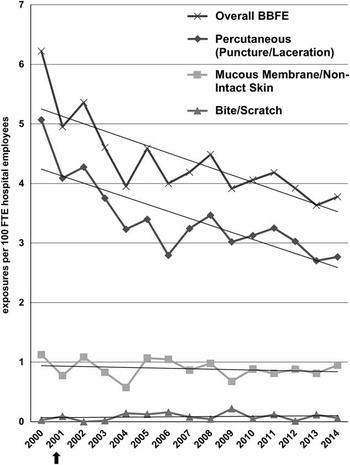
A total of 4,300 BBFE were reported during the 15-year period (2000–2014) and included 3,318 percutaneous injuries (77.2%), 894 exposures to mucous membrane/non-intact skin (20.8%), and 88 injuries due to bite/scratch (2.0%). The incidence rates for overall BBFE and percutaneous injuries were significantly reduced (IRD, 1.72, P=.0003; and IRD, 1.65, P=.0002, respectively) (Figure 1), but exposures to mucous membrane/non-intact skin and to bite/scratch remained unchanged. Furthermore, the incidence rate for percutaneous injuries was dramatically reduced during 2001–2006 (IRD, 1.37, P=.0079), compared with the rate reduction observed during 2006–2014 (IRD, 0.32, P=.2383). The annual frequency of percutaneous injuries accounted for most blood and body fluid exposures during the study period (relative mean [SD] percentage of BBFE: percutaneous injuries, 77.5% [3.6%]; mucous membrane/non-intact skin, 20.5% [3.3%]; bite/scratch, 2.0% [1.6%]).
Incidences of blood and body fluid exposures (BBFE) by nature of injury among healthcare personnel, University of North Carolina Hospitals, 2000–2014. Arrow shows the year 2001 of the Needlestick Safety and Prevention Act. FTE, full-time equivalents.

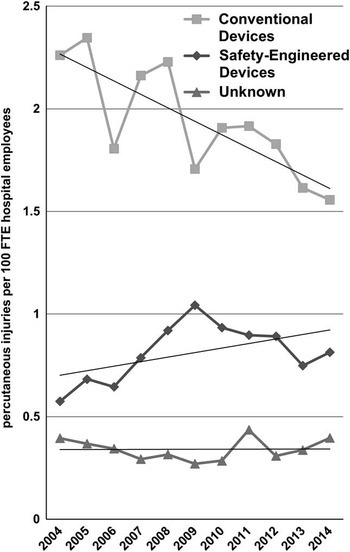
During 2004–2014, the 2,545 percutaneous injuries included 683 cases associated with safety-engineered devices (26.8%) and 1,578 cases with conventional devices (62.0%). There were 722 exposures to mucous membrane/non-intact skin, which included 61 cases associated with safety-engineered devices (8.4%) and 81 cases with conventional devices (11.2%), but 580 cases (80.3%) were exposures of unknown mechanism. The incidence rate for percutaneous injuries associated with conventional devices was significantly reduced (IRD, 0.65, P=.003) (Figure 2). Percutaneous injuries associated with safety-engineered devices increased (IRD, 0.22, P=.1065) over the study period, though the trend was not statistically significant. From 2004 to 2014, the relative proportion of percutaneous injuries associated with conventional devices decreased by 14%, but that of percutaneous injuries associated with safety-engineered devices increased by 12% (relative mean [SD] percentage of percutaneous injuries: conventional devices, 62.5% [4.8%]; safety-engineered devices, 26.4% [4.8%]; unknown, 11.1% [2.0%]). In 2014, of 272 percutaneous injuries reported at UNC Hospitals, 80 (29.4%) were associated with safety-engineered devices.
Incidences of percutaneous injuries associated with safety-engineered devices among healthcare personnel, University of North Carolina Hospitals, 2004–2014. FTE, full-time equivalents.

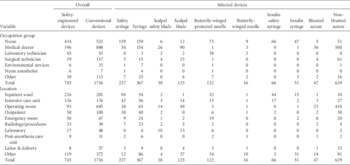
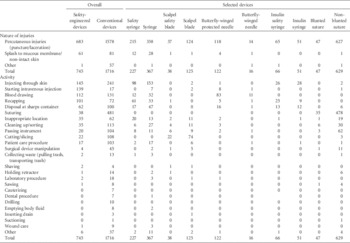
BBFE associated with safety-engineered devices included cases with safety syringes (n=227), introducers (n=222), butterfly-winged steel protected needles (n=122), insulin safety syringes (n=66), blunted sutures (n=47), scalpel safety blades (n=38), vacutainer push button collection sets (n=9), safety needles (n=6), safety-holder blood culture devices (n=4), Mylar-coated capillary tubes (n=2), and retractable lancets (n=2). All types of safety-engineered devices that led to BBFE in this study were user-activated devices. Characteristics of BBFE associated with safety-engineered devices and conventional devices are summarized in Tables 1 and 2. BBFE associated with safety-engineered devices were more likely to occur in nurses and inpatient wards, whereas BBFE associated with conventional devices were in physicians and operating rooms. The frequency of percutaneous injuries associated with safety-engineered devices was 91.7%, whereas that of splash to mucous membrane/non-intact skin was 8.2%. The most frequent activities as a cause of BBFE associated with safety-engineered devices (selected devices per overall devices for each activity) were injecting through skin (safety syringe, 67.6%; insulin safety syringe, 17.9%), followed by starting an intravenous line (introducer, 94.2%) and blood drawing (butterfly-winged steel protected needle, 74.1%), whereas suturing (non-blunted suture, 99.4%) was the most common percutaneous injury associated with conventional devices. Recapping (safety syringe, 60.4%; insulin safety syringe, 24.8%) was observed at a higher proportion of 13.6% in safety-engineered device-associated percutaneous injuries. A total of 5.5% of HCP who had BBFE associated with safety-engineered devices did not use gloves, whereas 92.6% of HCP used gloves when exposures occurred.
Blood and Body Fluid Exposures Associated With Safety-Engineered Devices and Conventional Devices by Occupational Group or Location, University of North Carolina Hospitals, 2004–2014

Blood and Body Fluid Exposures Associated With Safety-Engineered Devices and Conventional Devices by Nature of Injury or Activity, University of North Carolina Hospitals, 2004–2014

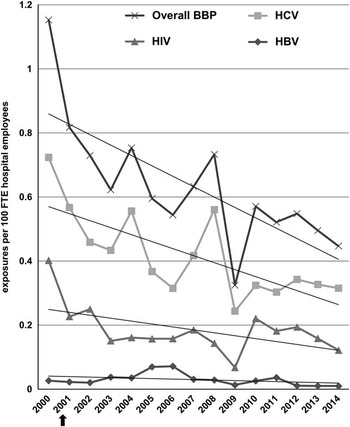
Of the 4,300 BBFE during the 15-year period, there were 603 sources positive for BBP (14.0%), including 29 (0.7%) for HBV, 397 (9.2%) for HCV, and 177 (4.1%) for HIV, whereas there were 3,697 sources negative for a BBP (86.0%). The incidence rate for overall BBP was significantly reduced (IRD, 0.45, P=.0011) (Figure 3). Of BBP, the incidence for HCV and HIV was also significantly reduced (IRD, 0.31, P=.0017; and IRD, 0.13, P=.034, respectively). However, the incidence for HBV was not significantly reduced (IRD, 0.021, P=.1828), although the incidence was low at less than 0.1 exposure per 100 full-time equivalents. The relative proportion of each BBP fluctuated annually over the study period (relative mean [SD] percentage of BBP: HBV, 5.0% [3.4%]; HCV, 66.0% [6.3%]; HIV, 29.1% [5.9%]). One healthcare provider contracted HCV infection (0.25% in HCV exposures), although no infections with HBV or HIV occurred.
Incidences of blood and body fluid exposures by source positive for bloodborne pathogens (BBP) among healthcare personnel, University of North Carolina Hospitals, 2000–2014. Arrow shows the year 2001 of the Needlestick Safety and Prevention Act. FTE, full-time equivalents. HBV, hepatitis B virus; HCV, hepatitis C virus; HIV, human immunodeficiency virus.

DISCUSSION
Data from the Exposure Prevention Information Network suggested that the estimated 385,000 percutaneous injuries among HCP in the United States during 1997–1998 can be reduced, as sharps-related injuries in nonsurgical hospital settings decreased 31.6% during 2001–2006. 13 Our work extends previous work by evaluating the period from 2000 to 2014. We demonstrated significant overall reduction in BBFE and percutaneous injuries that may be in part due to the impact of safety-engineered devices and supported previous studies showing successful reduction of overall percutaneous injuries.Reference Tosini, Ciotti and Goyer 11 , Reference Tuma and Sepkowitz 14 , Reference Tarigan, Cifuentes, Quinn and Kriebel 15 Notably, safety-engineered devices worked well to decrease the incidence of percutaneous injuries from the 2001 Act to 2006, but this positive impact of safety-engineered devices stabilized after 2006. Therefore, we need new interventions aimed at further reducing the injuries among HCP in addition to using safety-engineered devices. Through a multidisciplinary Needlestick Prevention Working Group, UNC Hospitals is working toward eliminating needlestick injuries via yearly education, placement of needle disposal devices in every room, improved practices (no passing sharp instruments directly person-to-person in the operating room), double-gloving for high-risk surgical procedures that might lead to damage to gloves (eg, orthopedic surgery), use of needleless connectors for intravenous lines, and availability of blunted suture needles in the operating room. Unfortunately, our data demonstrated that many injuries in the operating room still result from suture needles. Although blunted suture needles are available, they cannot be used in all cases (eg, skin sutures) and many surgeons choose not to use them even when indicated. A previous article described substantial decreases in percutaneous injuries after implementation of safety-engineered devices, ranging 22%-100%.Reference Tuma and Sepkowitz 14 According to a recent meta-analysis, training, safety-engineered devices, and training combined with safety-engineered devices reduced the rate of needlestick injuries by 34%, 49%, and 62%, respectively.Reference Tarigan, Cifuentes, Quinn and Kriebel 15 Our study identified that a considerable proportion of percutaneous injuries are now associated with safety-engineered devices. Further, the frequency of percutaneous injuries associated with safety-engineered devices is now similar to the level of overall exposures to mucous membrane/non-intact skin, suggesting the necessity for improving measures to prevent exposures from the use of HCP-activated safety-engineered devices as well as conventional devices. A retrospective review of percutaneous injuries from hollow bore safety-engineered devices in the United States described that approximately 75% of exposures occurred when the safety function was not appropriately activated.Reference Black 12 In a French multicenter study, the use of passive safety-engineered devices was related to the lowest needlestick injuries rate.Reference Tosini, Ciotti and Goyer 11 Percutaneous injuries associated with safety-engineered devices may be caused by poor knowledge and instruction, improper use of devices by HCP, mechanical failure of safety function, and incomplete activation of the safety-engineered devices,Reference Tosini, Ciotti and Goyer 11 , Reference Black 12 , Reference Floret, Ali-Brandmeyer and L’Hériteau 16 suggesting that proper training is required since engineering controls alone would not solve this issue.
In our study, there was also a concern for safety-engineered device-associated exposures to mucous membrane/non-intact skin as well as that most device types resulting in exposures to mucous membrane/non-intact skin were unknown. Experimental studies have described that macroscopic and microscopic blood splatter from retractable intravenous devices or spatter contamination due to manually activated safety-engineered devices after syringe discharge and safety activation can occur, although the risk for acquiring BBP from surface contamination with blood and body fluids in healthcare settings is not well known.Reference Haiduven, Applegarth and Shroff 17 – Reference Roff, Basu and Adisesh 19 More than 90% of HCP in our study used gloves when exposures occurred, but the minority of BBFE was also observed owing to failure to wear gloves and nonadherence to personal protective equipment. Proper use of personal protective equipment should be maintained since splashing may not be detected. Safe work practices (eg, keeping contaminated hands away from face; positioning patients) as well as rigorous compliance with standard precautions are necessary to protect mucous membranes/non-intact skin from BBFE.Reference Siegel, Rhinehart, Jackson and Chiarello 20
Our data showed that 3 major activities of safety-engineered device-associated percutaneous injuries were injecting through skin, placing intravenous catheters, and blood drawing, accounting for half of all cases in this study. Recapping was also found even when using safety-engineered devices. When safety-engineered devices are newly adopted or percutaneous injuries associated with specific type of safety-engineered devices are found in healthcare facilities, enhanced education and training program should focus on appropriate use of safety-engineered devices as well as implementation of rigorous standard precautions and other prevention measures against percutaneous injuries (eg, double-gloving). Because BBFE remain a major problem in operating rooms, continual education and training of surgeons, introduction of passive safety-engineered devices whenever possible, and further development of safety-engineered devices in surgical fields are needed. Unfortunately, safety-engineered devices cannot be used in all circumstances (eg, skin incisions); therefore, strict adherence to proper management of sharp instruments must continue to be taught.
The incidence rate for BBFE to overall BBP was also reduced in our study period. Importantly, the significant reduction in BBFE to HCV among HCP should be noted since pre- or postexposure prophylaxis against HCV infections is currently unavailable. Our data demonstrated that a reduction in the incidence of exposure of our employees to a BBP via a sharps injury was due to the decrease in the incidence of such injuries, not to a change in the frequency of BBP among source patients. The risk of exposures to BBP can be reduced by thorough adherence to the administrative, engineering, and work practice controls.
There are several limitations for this study. First, our results at single tertiary care academic facility may not be generalizable but have been obtained on the basis of longitudinal trends. Second, we captured only physicians who were residents or fellows, although this group had 1,084 BBFE associated with safety-engineered devices and conventional devices during 2004–2014. However, at any given time there were many more residents/fellows providing direct patient care than attending physicians. These trainees might have had a higher rate of injuries than more experienced physicians. Also, the absolute number of injuries among physicians is lower than the actual number since attending physicians were not included in the database. Third, the number of BBFE as a numerator may be affected by underreporting, but our reporting system has been maintained in a consistent manner during the study period. We evaluated the annual incidence rates of BBFE by using full-time equivalents as denominators, similar to the methods used by other authors,Reference Phillips, Conaway, Parker, Perry and Jagger 6 , Reference Tarigan, Cifuentes, Quinn and Kriebel 15 but non-nursing occupation groups may have a higher rate of exposures. 1 Even if the limitations stated above are considered, our data demonstrated that significant reductions in BBFE among HCP after introduction of safety-engineered devices occurred over the past 15 years. Additional efforts are needed to further reduce percutaneous injuries and improve the design of safety-engineered devices.
ACKNOWLEDGMENTS
We thank David Williams for his assistance in data collection.
Financial support. UNC Health Care; and Japan Society for the Promotion of Science (JSPS) Postdoctoral Fellowship for Research Abroad (to H.K.).
Potential conflicts of interest. All authors report no conflicts of interest relevant to this article.