Introduction
Though numerous public health initiatives have led to a significant decline in tobacco use prevalence over the past decade, this effect has not been reflected in all segments of the population. Low income populations comprise a disproportionate percentage of the remaining smokers. In the United States, the percentage of smoking among adults with incomes below the federal poverty level is significantly higher than those with incomes at or above (28.8% vs 20.3%) (‘Cigarette smoking among adults’, 2007). For instance, 34.5% of Pennsylvania's adults with income levels below $15,000 report being current smokers, compared to 15.5% of those who earn $50,000 or more (Behavioral Risk Factor Surveillance System, 2007). While there is no simple explanation for this difference, the disparity does not appear to be due to a lack of willingness or motivation in the lower Socio-Economic Status (SES) group. In fact, low SES smokers express significant interest in quitting and appear to benefit from treatment (Jaén et al., Reference Jaén, Cummings, Shah and Aungst1997).
A small task force was convened by the Pennsylvania Department of Health in 2010 to find ways to ameliorate this disparity. The clinic visit was identified as an important intervention point for this group. Evidence suggests that automated screening systems, electronic reminders and computerised decision support (CDS) can significantly improve preventive care and chronic disease management (Fiore et al., Reference Fiore, Jaén and Baker2008). Though electronic health record (EHR) guides have been shown to be modestly effective for smoking cessation in the past, the overall effectiveness of a multi-faceted approach to tobacco use treatment that includes diagnosis, treatment and follow-up had not been evaluated (Dexheimer et al., Reference Dexheimer, Talbot, Sanders, Rosenbloom and Aronsky2008). Specifically, the feasibility of developing, implementing and evaluating such a comprehensive tobacco-EHR approach within diverse practice environments, each with idiosyncratic EHR platforms, in the service of high-risk, high-prevalence, low SES populations of smokers, remained unclear.
Methods
The Southeastern Pennsylvania (SEPA) Tobacco Control Project is a group of tobacco prevention and cessation service providers derived from the seven counties of the Southeast public health district of Pennsylvania. The project represents a public-private partnership between the state and representatives from a diverse set of backgrounds, including healthcare, education, patient advocacy and law enforcement. Project staff convened a small workgroup of local experts from a number of related healthcare disciplines, and tasked them with identifying a universally applicable, evidence-based, Tobacco-EHR strategy that would be useful in reducing the prevalence of tobacco use in this high priority population. Through a series of in-person and telephone meetings between July 2011 and June 2012, group leaders completed a literature review in order to identify gaps in understanding, and to provide context for ethnographic interviews and site visits that followed later. Iterations of the resulting framework were repeatedly assessed for feasibility by group members until the refined output satisfactorily codified the minimum set of functionalities that would maximise the effectiveness of an EHR approach to tobacco. Analysis of interview results were also used to formulate a set of ‘lessons learned’ that would be useful for identifying potential obstacles to maximising the impact of Tobacco-EHR in this population. The resulting observations were organised thematically, and are presented in context. Though the SEPA Tobacco Control Project is funded through Pennsylvania's Master Settlement Agreement, workgroup members volunteered their time in the conduct of this exercise, and declared no conflict of interest.
Results/Findings
Framework for Facilitating Tobacco Treatment Behaviours using EHR
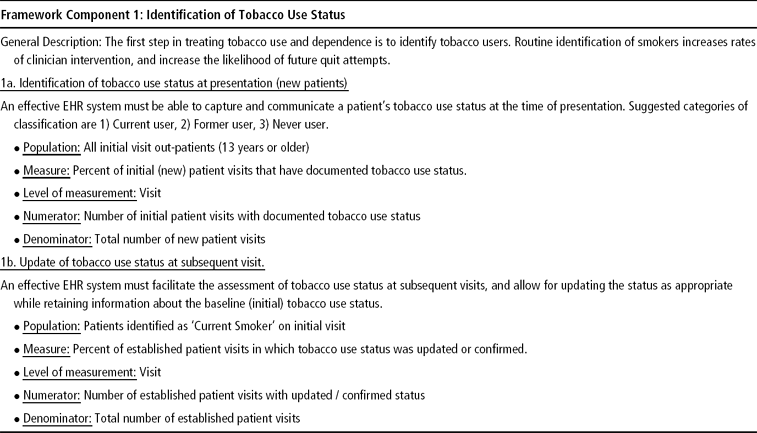
One important core function of tobacco-EHR is the capacity to systematically capture and record the smoking status of patients. Implementing clinic systems designed to increase the assessment and documentation of tobacco use status markedly increases the rate at which clinicians intervene with their patients who smoke, but does not by itself produce significantly higher rates of smoking cessation (Fiore et al., Reference Fiore, Jaén and Baker2008). Traditionally, smoking status is treated as a static component of the social history, on a par with marital status or occupational history. Envisioned this way, the recorded smoking status is unlikely to serve as a visible influence on physician behaviour. As social history, it is also unlikely to serve as a meaningful metric of dynamic treatment decision making. Maximising the potential of tobacco-EHR requires repeated and consistent updating of a patient's smoking status in order to capitalise on the impact of clinician advice to quit, as well as to monitor response to therapy in patients being treated, and lost therapeutic control in those who have quit.
Smoking status identification and update.

Clinical Decision Support
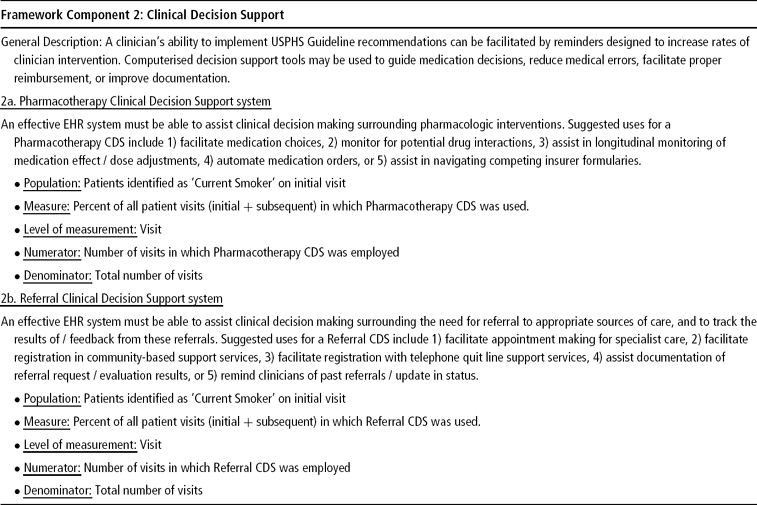
Tobacco-EHR offers the capacity to incorporate effective clinical decision support (CDS) rules into treatment practice. CDS rules may be specialty-specific (e.g. integrated into pulmonary practice tools), or relevant to high clinical priority conditions (e.g. chronic obstructive pulmonary disease clinical pathways), but in all cases be consistent with principles of good practice (Bates et al., Reference Bates, Kuperman, Wang, Gandhi, Kittler, Volk and Middleton2003; McGreevey, Reference McGreevey2013). CDS systems should incorporate the ability to track usage and compliance. US Public Health Service guidelines recommend that healthcare systems ensure that clinicians have sufficient training to treat tobacco dependence, and are given feedback about their tobacco dependence treatment practices (Fiore et al., Reference Fiore, Jaén and Baker2008). Feedback about pharmacotherapeutic decision-making and facilitation of referrals to outside treatment services have both resulted in modest improvements in guideline-recommended physician behaviours (Boyle et al., Reference Boyle, Solberg and Fiore2010). Pharmacotherapy CDS rules should not only guide medication choices, but should facilitate monitoring of therapeutic effect, correct misinformation regarding medication usage, and help to automate medication ordering. Comprehensive therapeutic CDS rules should incorporate support for referrals to outside treatment services into automated routines.
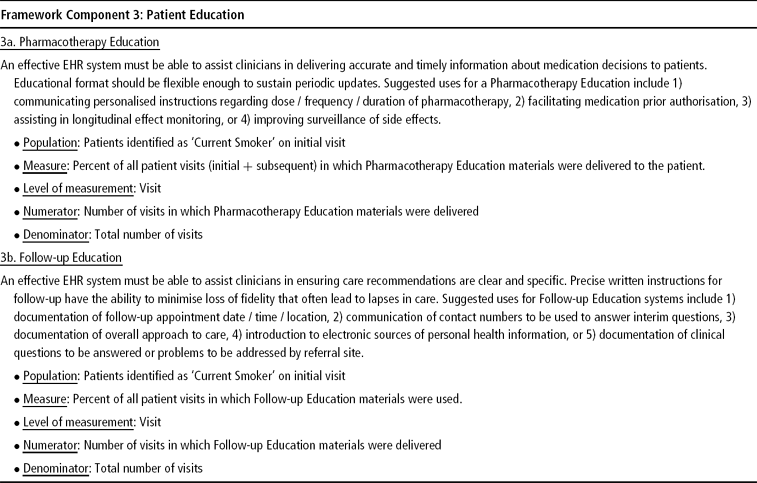
The chronic disease model of tobacco use treatment relies on effective patient education and counselling over time. For this reason, an important goal of a tobacco-EHR system is to encourage both patient empowerment and continuity of care through communication. Educating patients about options for tobacco use treatment generally leads to greater satisfaction with their healthcare. Although most clinicians are comfortable in counselling their patients about other chronic diseases, many believe they are less effective in providing counselling to patients who use tobacco (McIlvain et al., Reference McIlvain, Backer, Crabtree and Lacy2002). Traditional approaches to electronic patient education regarding tobacco use focus on the reasons to quit, rather than on a fuller discussion of the problem, intervention steps, therapeutic expectations, follow-up instructions, etc. The full potential of tobacco-EHR systems might be realised by integrating critical patient information regarding treatment choices and the process of care into the global summary of their care goals.
Patient education metrics
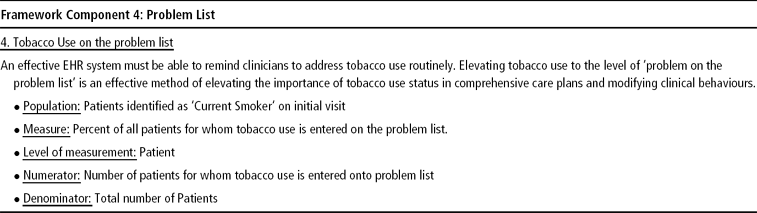
Using the problem list to improve tobacco use treatment
Validation of data
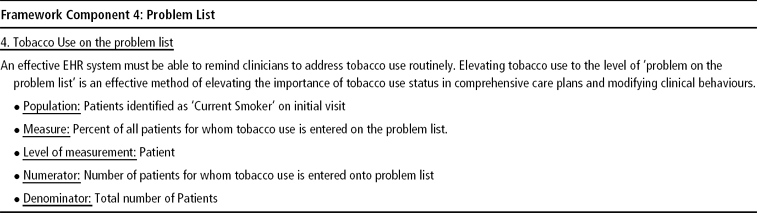
Maintaining an up-to-date problem list of active diagnoses is an excellent way to organise the approach to care, and functions as a ‘list of things to do’ for the patient. Because tobacco use had traditionally been construed as a risk factor for illness, rather than a chronic illness in its own right, clinicians have not been sufficiently conditioned to include an indication of tobacco use directly on the problem list. For example, clinicians may choose Toxic Effects of Tobacco (989.84) to reflect the clinical consequences of tobacco use, or Tobacco Use Disorder (305.1) to reflect the behavioural features of dependence (Sachs et al., n.d.). In this context, using the problem list is an easy way to promote a chronic illness paradigm of tobacco use treatment, with the added bonus that, once on the problem list, tobacco use treatment represents a reimbursable service (Sachs et al., n.d.).
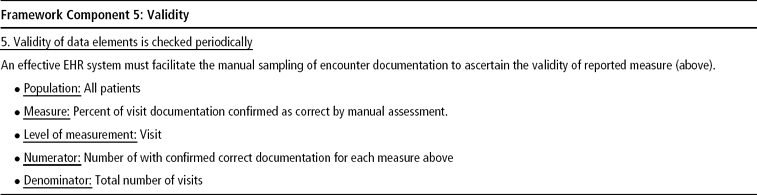
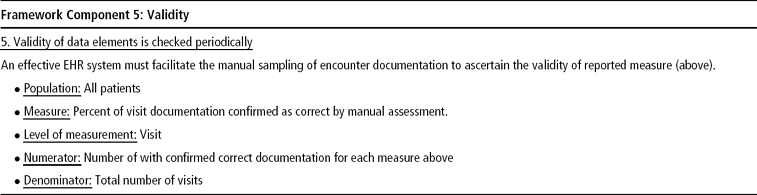
Feedback is a critical component of professionalism, and is a necessary part of behaviour change. Key clinical performance measures, such as rates of referral for treatment, appear to be particularly sensitive to periodic feedback (Boyle et al., Reference Boyle, Solberg and Fiore2010; Boyle et al., Reference Boyle, Solberg and Fiore2011). Ensuring maximum effectiveness of a tobacco-EHR system requires periodic audits to ensure the accuracy of performance metrics and provide the confidence necessary to judiciously guide behaviour change.
Lessons Learned while Implementing Tobacco Treatment EHR
The evidence that the advice and support given to smokers by healthcare professionals in primary care settings can achieve abstinence rates of 5–10% with minimal interventions, and 15–30% with more intense interventions, is well established (Fiore et al., Reference Fiore, Jaén and Baker2008) and has been available for several decades (Kottke et al., Reference Kottke, Battista, DeFriese and Brekke1988; Russell et al., Reference Russell, Wilson, Taylor and Baker1979). Given that nearly 80% of adults have contact with the primary care setting each year, the potential public health impact of integrating sophisticated tobacco use treatment into the primary care context is enormous (Ashenden et al., Reference Ashenden, Silagy and Weller1997; Silagy et al., Reference Silagy, Muir, Coulter, Thorogood, Yudkin and Roe1992). However, the degree to which physicians accept and adopt these recommendations remains substantially less clear (McEwen et al., Reference McEwen, Akotia and West2001; McEwen et al., Reference McEwen, Akotia and West2001; Mowat et al., Reference Mowat, Mecredy, Lee, Hajela and Wilson1996; Wechsler et al., Reference Wechsler, Levine, Idelson, Schor and Coakley1996). For example, physicians clearly understand tobacco use to be a significant contributor to disease and disability, and recognise their unique role in promoting abstinence (Evers-Casey, Reference Evers-Casey2004; McIlvain et al., Reference McIlvain, Backer, Crabtree and Lacy2002). Primary care physicians self-report high adherence rates for ‘Ask’ and ‘Advise’ behaviours (Evers-Casey, Reference Evers-Casey2004; Salsberg et al., Reference Salsberg2007), yet the number of patients who recall having received such advice from their physicians is disappointingly low (‘Physician and other health-care professional counseling of smokers to quit’, 1993; Silagy et al., Reference Silagy, Muir, Coulter, Thorogood, Yudkin and Roe1992). Even when high rates of Ask and Advise behaviours are confirmed, physicians do not generally engage in the ‘next steps’ consistent with sophisticated management of chronic illness (An, Reference An2004). This observation has remained relatively stable across the past several decades despite policy and education efforts aimed at modifying this pattern (Thorndike et al., Reference Thorndike, Rigotti, Stafford and Singer1998; Thorndike et al., Reference Thorndike, Stafford and Rigotti2001; Thorndike et al., Reference Thorndike, Regan and Rigotti2007). This paradox is not confined to primary care; efforts to define brief interventions as requiring as little as three minutes have had only minimal impact on the practice patterns of oncologists and cardiologists, practitioners profoundly and proximally affected by continued tobacco use (Erhardt, Reference Erhardt2009; Weaver et al., Reference Weaver, Danhauer, Tooze, Blackstock, Spangler, Thomas and Sutfin2012).
Several potential social and organisational barriers to the uptake of evidence-based recommendations were identified by the group. For example, a number of negative attitudes toward tobacco use treatment have been reported by physicians, and have been accepted as explanatory barriers to physician behaviour change (Vogt et al., Reference Vogt, Hall and Marteau2005). Physicians have claimed prohibitive time requirements, treatment ineffectiveness, disinterest among patients, lack of reimbursement, and lack of self-efficacy, as rationales for non-engagement (Park et al., Reference Park, Eaton, Goldstein, DePue, Niaura, Guadagnoli and Dube2001; Vogt et al., Reference Vogt, Hall and Marteau2005). It is logical to assume that policy initiatives aimed at minimising these barriers, for example increasing payment for counselling services or improving coverage for cessation medication, would result in systematic increases in target behaviours. However, some physician behaviours have remained intransigent, despite well-organised guidelines and motivational approaches (Thorndike et al., Reference Thorndike, Rigotti, Stafford and Singer1998; Thorndike et al., Reference Thorndike, Regan and Rigotti2007).
One possible explanation for this observation relates to the tendency of people and organisations under uncertain or difficult conditions to identify only a satisfactory solution to a complex problem, not necessarily the optimum one. This principle, termed ‘satisficing’, has been identified as the dominant process at play in response to a number of implementation challenges. For example, it is clear that managers who work in publicly funded healthcare institutions first consider their first-hand knowledge of organisational idiosyncrasies, and only later integrate external knowledge such as research and guidelines. Discrepancies between these two sources of information are frequently resolved through satisficing (Bate et al., Reference Bate, Hutchinson, Underhill and Maskrey2012; Macdonald et al., Reference Macdonald, Bath and Booth2008). Far from faulty reasoning, satisficing is often a reliable design strategy when exclusively considering efficiency. However, satisficed solutions encourage continuation of behaviours that fall short of optimal effectiveness (Ben-Haim, Reference Ben-Haim2012).
Stagnant clinical behaviour in the face of persuasive policies might also be understood within the context of implicit social cognition. This theoretical framework is based on the idea that traces of past experiences affect aspects of current behaviour, even though the influential earlier experience is not remembered (Graf and Schacter, Reference Graf and Schacter1985; Greenwald, Reference Greenwald1990; Jacoby and Witherspoon, Reference Jacoby and Witherspoon1982). Implicit attitudes are manifest as judgements, not introspectively known to the subject, and without the subject's awareness of causation. As a result, people do not always have control over the processes of social perception, impression formation and judgement that motivates their persistent inaction (Greenwald and Krieger, Reference Greenwald and Krieger2006). These biases are unconscious, and often produce behaviours that diverge from a person's endorsed beliefs or principles. In this manner, a lifetime of cues suggesting ‘smokers are not going to be able to quit’ is likely to leave traces behind that influence a clinician's behaviours in imperceptible ways. These discordant orientations may result in observable inconsistencies between the clinician's acknowledged professional responsibility to intervene, and their lacklustre systematic uptake of tobacco treatment routines in the clinic. Implicit biases have been documented among physicians relative to race/gender/ethnicity (Dovidio and Fiske, Reference Dovidio and Fiske2012; Moskowitz et al., Reference Moskowitz, Stone and Childs2012; Sabin et al., Reference Sabin, Rivara and Greenwald2008; Sabin et al., Reference Sabin, Nosek, Greenwald and Rivara2009), obesity (Andrade et al., Reference Andrade, Ruiz, Mintzer, Cifuentes, Anam, Diem and Roos2012; Edelstein et al., Reference Edelstein, Silva and Mancini2009; Roddy et al., Reference Roddy, Stewart and Barnes-Holmes2010; Schwartz et al., Reference Schwartz, Chambliss, Brownell, Blair and Billington2003), substance abuse (Brener et al., Reference Brener, Hippel and Kippax2007; von Hippel et al., Reference Von Hippel, Brener and Von Hippel2008), and HIV (Mawar et al., Reference Mawar, Saha, Pandit and Mahajan2005). It remains unknown whether stigmatisation also applies specifically to tobacco use, whether the influence of stigmatisation is exclusive to physicians, or whether shared cultural norms within a system impact decisions about the EHR approach to treating nicotine dependence.
The United States is undergoing an era of rapidly changing healthcare structure. A number of policy initiatives scheduled to go into effect over the next several years promise to strain the system's approach to tobacco use treatment. Upcoming systems-level changes rely on enhancing the rate of tobacco use identification as the primary means of increasing the likelihood of clinical intervention. The current leading proposal for the future of tobacco treatment advocates for fuller integration into the mainstream of general healthcare. In addition to expanding the role of primary care practitioners, services would be shifted away from traditional standalone behavioural programmes, toward more vertically and horizontally integrated systems of care (Buck, Reference Buck2011; McLellan and Meyers, Reference McLellan and Meyers2004). For example, the Centers for Medicare and Medicaid Services (CMS) and the Joint Commission (JCAHO) have begun aligning common national hospital performance measures related to tobacco, requiring an unprecedented level of integration of services across disparate care settings. (‘Specifications Manual for National Hospital Inpatient Quality Measures’ n.d.) The result is a blurring of traditional inpatient vs. outpatient boundaries, and a requirement for more efficient sharing of common documentation standards. Similarly, with the passage of the Affordable Care Act, unprecedented priority has been placed on preventive medical services in an attempt to de-emphasise the system's traditional focus on illness-oriented acute care. (‘Preventive Services Covered Under the Affordable Care Act,’ n.d.) Fundamental process restructuring such as this represents a significant logic challenge for complex, multi-faceted tobacco-EHR systems. That is to say that, while care goals of these system changes moving forward may be complimentary, the relative inflexibility of computerised systems may strain their capacity to provide solutions for such disparate needs, within disparate environments, in the service of disparate care processes (Schenarts et al., Reference Schenarts, Goettler, White and Waibel2012; Tundia et al., Reference Tundia, Kelton, Cavanaugh, Guo, Hanseman and Heaton2013). Finally, an aggressive implementation timeline, and significant financial penalty for non-compliance, are likely to result in a substantial motivation to put systems into practice before they are adequately evaluated or assessed for their clinical effectiveness.
Conclusions
Taking advantage of EHR systems’ potential for substantially improving outcomes, while meeting disparate healthcare policy requirements, is challenging. Several variables specific to tobacco use, such as the disproportionate concentration in low SES communities, the need for flexibility and relevance of recommendations, and a prerequisite preservation of efficiency in workflow, amplify these implementation challenges when considering tobacco-EHR systems change. The resulting complexity and uncertainty appear to encourage adoption of potentially sub-optimal, satisficed solutions. Avoiding ineffective and costly tobacco-EHR implementation mistakes requires the development of a clear framework that facilitates guideline-driven standards of care, while remaining consistent with the ideals of meaningful use. We present one such empirically derived framework.
Addressing the known obstacles to optimisation of local policy decisions prior to the implementation of tobacco-EHR increases the likelihood of substantive change in rates of more sophisticated and long-term physicians’ tobacco use treatment practices. Systems designed for maximum clinical impact must include more sophisticated CDS systems, such as managing a patient's reluctance to quit, making complex pharmacotherapy decisions, and reducing relapse risk (Boyle et al., Reference Boyle, Solberg and Fiore2010; Boyle et al., Reference Boyle, Solberg and Fiore2011). Willingness to adopt such complex process changes may be influenced by the social norms of the institution, as well as the cognitive biases affecting individual decisions. Implementation approaches should anticipate the tendency for satisficing, and take steps to explicitly state the clinical objectives prior to finalising implementation decisions. It appears that adoption of computerised systems are most likely to improve the delivery of tobacco use treatment if the message is effectively delivered to the appropriate decision maker, at the right time, and in a format that respects the process of patient care.
Acknowledgements
The SEPA Tobacco Control Project identified a small workgroup of volunteers, without whom very few of these insights would have been possible. We remain indebted to these people for their continued efforts at making EHR and Meaningful Use as meaningful as possible to the disadvantaged patients in Pennsylvania. The EHR workgroup members included: Sally Fabian, Lynn Martinsen (Bucks County Health Improvement Partnership); Donald Wilson, Anita Somplasky (Pennsylvania Regional Extension & Assistance Centers for HIT); Gale Thomason (Water Street Health Services); Karen Breitmayer, Mike Lucas, Mike Barnard (ChesPenn Health Services); Mary LeVasseur, Jennifer Barney (Lancaster General Hospital); and Keith Weigand (President, Datanet Solutions, Cleveland, OH).
The SEPA Tobacco Control Project remains grateful to Ms. Judy Ochs, Director, Division of Tobacco Prevention and Control, Pennsylvania Department of Health and Ms. Vanessa Briggs, Executive Director of the Health Promotion Council for their leadership and support of the SEPA Tobacco Control Project Coalition's activities.
Financial Support
This work was supported in part by grants derived from Pennsylvania's Master Settlement Agreement through the PA Department of Health, as well as grants from the National Institutes of Health (RO1 CA136888-01A1 and RC2-CA148310-01).
Conflict of Interest
None.
Ethical Standards
The authors assert that all procedures contributing to this work comply with the ethical standards of the relevant national and institutional committees on human experimentation and with the Helsinki Declaration of 1975, as revised in 2008.