In 1850, the German legal historian Paul Roth published his Geschichte des Beneficialwesens, one of the seminal works on the origins of feudalism, which, for him, lay in the secularisation of ecclesiastical land by the early Carolingians.Footnote 1 In order to justify this claim he set about estimating the amount of land held by the Frankish church at the start of the eighth century; his conclusion was that around a third of Francia was in ecclesiastical hands at the end of the Merovingian period.Footnote 2 It is an estimate that was questioned in 1911 by Emile Lesne in the first volume of his great study of ecclesiastical property in France, although the Frenchman was prepared to accept that the church held a third of the land that was under cultivation.Footnote 3 Fifty years later, in 1961, David Herlihy attempted to reconcile this figure with his own view that the period between 751 and 825 saw the church's possessions increase from 10 to 30 per cent of the Christian West, by arguing that different kinds of ownership were involved.Footnote 4 Perhaps a more significant difference between the two figures is the fact that Roth was talking about Francia alone, whereas Herlihy was talking about Western Europe – and there are extensive areas even within and on the fringes of the Merovingian world, including parts of the Rhineland and Bavaria, where the transfer of land to the church was more a feature of the eighth and ninth centuries than of an earlier period.Footnote 5
Roth's book has been largely forgotten,Footnote 6 and his argument about the origins of feudalism has been rendered obsolete by the vast discussion of that subject that has followed.Footnote 7 It may well be that he had been oversensitised to the fate of church land as a result of the Napoleonic secularisations, which had been introduced into Germany following the Treaty of Luneville in 1801. Coming from Catholic Munich, this was an issue of which he must have been keenly aware. It may be, however, that Roth's observations on ecclesiastical property-holding have been unjustly neglected, and that they might tell us more about general European developments than has been acknowledged. Indeed, it is possible that his conclusions on the extent of church land might be rather more important than his own argument recognised, for the transfer of a third of the land mass of Francia could have had implications far beyond the issue of the questionable origins of feudal tenure; the entrusting of so large a part of the late and post-Roman world could have amounted to a social and economic, as well as a religious, revolution.
I shall, therefore, begin by reassessing the evidence for the amount of property transferred to God and the saints, which is how contemporaries would have understood ecclesiastical institutions, in Gaul and Francia from the fifth to the eighth centuries, before looking at the information from other parts of Western Europe in the post-Roman period. Having attempted a very rough estimate of the scale of church landholding up to the early eighth century (and, given the nature of the evidence, which is extremely patchy, and often comes from biased sources, anything other than a rough estimate is impossible), I shall look at what the transfer of land to churches might actually have entailed, and ask what that might imply for early medieval society and its economy – and thus I shall try to explore the extent to which Christianisation should be seen as affecting the development of Europe outside what is frequently cordoned off as the religious sphere.Footnote 8 I shall also attempt to provide some explanation for the tendency among historians, from the nineteenth century down to the present day, to leave the church out of discussions of the early medieval economy, despite Roth and the arguments he engendered, for the problem is historiographical as much as historical. I shall say little about politics, although the period from the fourth to the eighth centuries witnessed a transformation of politics, and not just because of the break-up of the Roman Empire into the successor states, but also because of the increasing involvement of the aristocracy in the church hierarchy and the developing political influence of bishops, abbots and holy men.Footnote 9 This undoubtedly had a major impact on many aspects of life in Western Europe, and is not unrelated to the question of the transfer of land. The rising political power of the church has, however, been rather more fully recognised than has the acquisition of property, and it is land that forms the core of the present argument.
In making his assessment, Roth cited the evidence of a number of leading monasteries. He reckoned St Denis to be the richest church in Francia – although the fragmentary state of its charters means that this is no more than a hypothesis. There are plausible records for the donation of 36 villae to the monastery between 625 and 726,Footnote 10 and 46 loca were restored to the abbey by Pippin III in 751.Footnote 11 These can only have been a fraction of the total holdings. For Roth, St Wandrille had 4,288 mansi, or estates, after the secularisations of the eighth century, leading him to estimate its earlier holdings at 7,000 mansi. St Germain-des-Près held 8,000 mansi at the start of the ninth century – amounting, according to Guérard, the editor of the monastery's polyptych, to 429,987 hectares (not much short of 1 per cent of the present extent of France); St Riquier, Roth thought, must have been comparable; Luxeuil held 15,000 hectares in the time of Charlemagne; and Fulda owned 15,000 Hufen (villae).Footnote 12 Not all of these figures will stand up to scrutiny; for instance, St Wandrille would seem only to have held 3,964 mansi, including those that had been alienated as precaria to secular figures.Footnote 13
Yet, if we have to downgrade some of Roth's figures, there are others to be added. In addition to the group of monasteries he looked at, there were a number of other well-endowed houses, among them Chelles, Faremoutiers and Corbie, which was granted a considerable amount of forest land at its foundation, and continued to receive benefactions.Footnote 14 In 739, the Provençal aristocrat Abbo gave an enormous amount of property, made up of estates of all sizes, scattered through much of Francia, to his new foundation of Novalesa, now within the borders of Italy, but then in the Frankish kingdom.Footnote 15 He had amassed this from thirty-four different people.Footnote 16
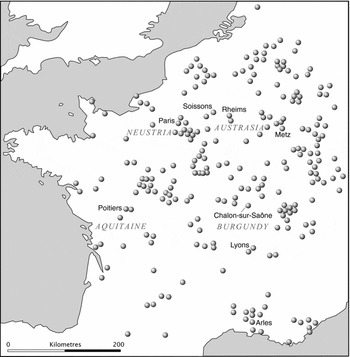
Alongside the rich foundations, we need to factor in the numerous small communities. The number of Merovingian monasteries was considerable (Figure 1). In 1976, Hartmut Atsma estimated that there were around 220 in Gaul at the end of the sixth century, divided evenly between the north and south of the region; he reckoned that by the early eighth century there were around 550, of which over 330 were in the north, meaning that the seventh century had seen around 230 new foundations in the north and 90 in the south.Footnote 17 Moreover, in general, northern foundations tended to be very much more lavishly endowed than their southern counterparts.Footnote 18 And not only were they well endowed at the moment of foundation, but the cartularies of such houses as St Gallen, Wissembourg and Fulda show that they continued to attract donations, not least from laymen and women. The transfer of land to monastic houses in the Merovingian period must, therefore, have been very sizeable.
Distribution of ascetic communities in Merovingian Francia

But it is the episcopal holdings that radically strengthen Roth's case. Indeed, in merely noting that there were 112 bishoprics in Francia, he rather undersold his hand, and not just because Louis Duchesne reckoned there were 130 dioceses in l'ancienne Gaule.Footnote 19 Every bishop controlled a substantial amount of land that had been given to the church, much of it no doubt in small bequests.Footnote 20 Charters and wills, almost all of them, admittedly, preserved in later copies, and episcopal Gesta, or diocesan histories, give us some indication of the possible scale of episcopal donations to churches, some of which, of course, were monastic. There are twelve wills of the Merovingian period, all of which transfer land to one church or another. Four of them, those of Caesarius,Footnote 21 Remigius of Rheims and Bertram and Hadoind of Le Mans, are episcopal.Footnote 22 Three of these were preserved in diocesan histories dealing with the Merovingian and Carolingian periods, which provide crucial evidence, depicting, as they do, the steady build up (and loss) of ecclesiastical land. For instance, Flodoard's tenth-century History of the Church of Rheims includes a version of the will of Remigius, although a more authentic text, listing fewer properties, is contained in Hincmar's ninth-century vita of the saint.Footnote 23 Remigius, as the bishop who baptised the Merovingian King Clovis, has a particular historical importance, but he appears not to have been especially wealthy.Footnote 24 Certainly, his wealth does not compare with that of Bertram, whose testament, along with that of Hadoind, is conserved in the Actus pontificum Cenomannis in urbe degentium.Footnote 25 The extraordinary will of Bertram, from 616, disposes of around 120 units of property, including 74 villae and 45 smaller settlements, scattered across most of the length and breadth of the Merovingian kingdom, amounting in all, in the estimate of Cabrol and Leclerq, to some 300,000 hectares;Footnote 26 that would seem to be a little over a half of 1 per cent of the land mass of Francia. Even in the Roman period, there had been vast disparities in the wealth of individual dioceses;Footnote 27 gifts such as Bertram's must have led to yet more inequality.
The scale of Bertram's landholdings far exceeds that set out in any other surviving Merovingian will, even though he was not a member of the highest aristocracy; much of his wealth derived from his loyalty to Chlothar II.Footnote 28 One cannot regard his endowment of the church of Le Mans as being in any way ordinary, though he was surely not the only churchman to be rewarded for loyalty to a king. More important, we should remember that bishops were expected to give property to the churches over which they presided. This is most apparent from a tale in Gregory of Tours, who recalls that his uncle, Nicetius of Lyons, left nothing to the basilica in which he was buried, much to the disgust of the priest, who complained bitterly when the deceased bishop's will was made public. Shortly after, the dead saint appeared, explained that in bequeathing his body to the church he had given his most valuable possession, and, having pummelled the priest's throat, vanished.Footnote 29 Clearly there was an expectation that bishops would endow their funerary churches, even if they left nothing to any other church.
We can get some impression of the bequests not only from the diplomatic evidence, but also from various saints’ Lives and diocesan histories. In addition to those already mentioned, there is the Gesta Pontificum Autissiodorensium which provides particularly detailed descriptions of the property and goods left to the church by Bishops Desiderius and Hainmar.Footnote 30 It also provides an account of the secularisation of the property of the church of Auxerre under Charles Martel and Pippin III, as a result of which the bishop was left with only a hundred mansi.Footnote 31 The Life of Desiderius of Cahors contains both a citation of part of the saint's will, and also the text of a donatio, which conferred 91 villae or portions of them (a figure similar to that of Bertram's donation) to various churches, including the monastery in which the bishop wished to be buried.Footnote 32
Once again, however, we are not just dealing with the property conveyed by two or three remarkably rich individuals. To judge from the twenty-three Frankish dioceses for which we have episcopal lists, the average number of bishops per diocese in the period from the mid-fifth to the mid-eighth century was around twenty, which at 130 dioceses makes more than 2,500 appointments.Footnote 33 If every bishop left even a small number of estates to his church, that would have added up to a considerable amount of property. While some bishops may, like Nicetius, have left little or nothing (though he may well have endowed churches other than that where he was buried), the Life of Desiderius of Cahors shows that Bertram of Le Mans was not unique in his generosity.
In addition to the land held by the bishops and monasteries of Merovingian Francia, there was also the apparently extensive patrimony held by the papacy in southern Gaul. We learn of this particularly from Gregory the Great's dealings with his agents in Provence, Candidus and the patricius Dynamius, who was specifically entrusted with oversight of the papal estates of the region, and who is known to have sent 400 solidi raised from those estates to the pope.Footnote 34 This is a considerable sum, and suggests that the bishops of Rome held a sizeable amount of land in the region.
These details imply extensive ecclesiastical landholding, and they do so without reference to the problematic issue of the private churches, oratoria in agro proprio, which should no doubt be understood as the property of the estate owners, but which were also dedicated to God.Footnote 35 Yet, even without including the proprietary churches, it is clear that the Frankish church was very well endowed. If the assessments of the holdings of St Germain and Bertram of Le Mans are correctly calculated as constituting respectively 1 and 0.5 per cent of France, it is difficult to see how Roth's estimate of 30 per cent of Francia being in the hands of the church by the start of the eighth century can be an exaggeration; Lesne's modification, that Roth's assessment could be correct if one limited the calculation to the cultivated area of the kingdom, looks conservative (and in any case one type of land which was held extensively by the northern monasteries was forest).Footnote 36 At least for the heartlands of Francia, Roth's estimate looks more likely than Herlihy's.
We can get a glimpse of what this meant for one diocese, if we look back from the Carolingian period. Between 809 and 812, archbishop Leidradus of Lyons wrote to Charlemagne to tell him of his achievements since his appointment in 797; he had restored the cathedral and the episcopal churches as well as the monasteries of his see – for as bishop he was responsible for them all, except for those which held specific exemptions. In so doing, he had left the religious free to carry out their duty of performing the divine serviceFootnote 37 – for the churches, monastic and secular, were above all powerhouses of prayer.Footnote 38 The liturgy was new, reflecting the Carolingian reforms, but the majority of the houses were old, having been conveyed to God and his saints before the days of Charles Martel. The same must have been true of the forty-three churches to be found in Metz in the days of Chrodegang.Footnote 39 Charlemagne's state relied upon the likes of Leidradus, for its administration, its armies and for its religion; underpinning them all was the transfer of property and wealth to the church in the previous 300 years.Footnote 40
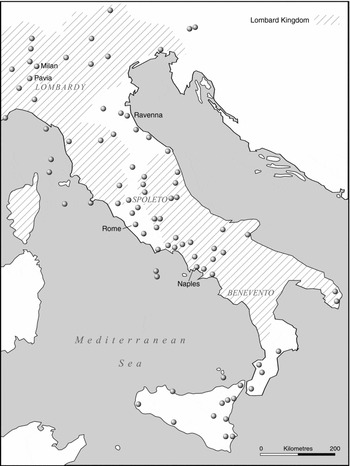
A more challenging question is whether the extent of ecclesiastical landholding in any other part of western Europe was remotely comparable to that in the Merovingian kingdom. Nowhere else provides us with documentation as rich for the period before the mid-eighth century. One might have expected the church in Italy to have been rather better endowed than that in Francia. The surviving evidence, however, suggests otherwise. By comparison with Atsma's figure of 220 monasteries in Gaul by the end of the sixth century, Jenal knew of only 100 in Italy (Figure 2).Footnote 41 At the same time, the evidence implies considerable regional variation.Footnote 42 Church holdings were extensive in Rome and in those areas of Italy dominated by the papacy. Whereas elsewhere in Western Europe the churches took some time to acquire substantial estates, the sizeable property-holdings of the papacy began in the reign of Constantine.Footnote 43 Although even the papacy lacks a collection of early charters, there is a wealth of evidence in the Liber Pontificalis and in papal letters as well as diplomatic texts. In particular, we get a clear impression of the estates held by the popes in the south of Italy and in Sicily (as well as Provence) in the correspondence of Gregory the Great.Footnote 44 What is revealed there can only be the tip of an iceberg, for we have no more than a selection of his letters.Footnote 45 The patrimony of St Peter in the South has, not surprisingly, been the subject of intensive study.Footnote 46 The revenues raised from the papal estates confiscated by the emperor Leo in 731–2, that is those estates which lay within Byzantine Italy, apparently amounted to 113.4 kilogrammes of gold annually.Footnote 47 In addition, we hear of presumably extensive estates in the Cottian Alps which were returned to the papacy in the time of the Lombard King Aistulf.Footnote 48
Distribution of ascetic communities in Italy before ad 615

Lagging some way behind the papal see, but nevertheless with extensive landholdings, was the church of Ravenna. Agnellus, writing in the ninth century, cited a letter of Pope Felix IV which implies that its annual income in around 525 was 54 kilogrammes of gold, or 3,000 solidi,Footnote 49 that is approximately half of what the papacy's confiscated estates yielded two centuries later. Ravenna churches gained considerable amounts of property during the period of Byzantine rule.Footnote 50 Among the surviving Ravenna papyri for the period between 476 and c. 700 there are two wills and eleven charters which convey property to the churches in Ravenna, and one charter in favour of Santa Maria Maggiore in Rome.Footnote 51 Of these, the most striking is a grant of money and estates made in 553 to the Ravenna church. The property lay as far afield as Urbino and Lucca, and produced an annual income of 100 solidi.Footnote 52 The donors, Ranilo and Felithanc, would seem to have been trying to secure a place in the society of the Exarchate after the failure of the Ostrogothic kingdom.Footnote 53 If this explanation for their gift is correct, one might guess that Ravenna's churches gained a good deal from likeminded benefactors as a result of the Byzantine conquest, but they may also have lost substantial amounts of property following the Lombard invasion.
For the Lombard area before the eighth century, the evidence is consistently poor. Bobbio, the most important monastery of the Lombard kingdom, boasts a handful of early charters that are accepted as largely authentic, but which do not give us much detail on the scale of the monastery's holdings,Footnote 54 although it has been argued that the estates listed in the Adbrevationes of 862 and 883 were predominantly endowments of the Lombard period.Footnote 55 By the late ninth century, Bobbio held fifty-six economic units amounting to around 11,605 hectares,Footnote 56 which is paltry compared with the holdings of St Germain, which would seem to have been forty times greater. The other great Lombard monasteries, Farfa, Nonantola and Brescia, are eighth-century foundations,Footnote 57 and fit Herlihy's model of an expansion of ecclesiastical property-holding after 750. In general, early monastic foundations in Lombard Italy seem to have been relatively poor and small scale;Footnote 58 a monastery might boast no more than one mass priest and a clerk,Footnote 59 which perhaps indicates a proprietary foundation, though there certainly were larger institutions, since a law of Aistulf talks of monasteries with more than fifty monks.Footnote 60 One such may have been the monastery of Mezzano, which was powerful enough to challenge Bobbio over the ownership of land.Footnote 61 Perhaps more important, there were clearly a number of smaller institutions, many of which would be transferred to larger houses or bishoprics in the eighth century.Footnote 62 We may get some idea of these from the growing record of early medieval sculpture noted in Italian churches, for this points to numbers of endowments that are otherwise unattested in our sources.Footnote 63 It can be no more than a guess, but in the seventh century while the church may well have held a high percentage of the territory of Byzantine Italy, it would seem to have owned a much smaller proportion of the land of the Lombard kingdom and duchies. Information relating to the monasteries of Farfa, Brescia, Nonantola and Montecassino, as well as the charters from Lucca, suggest a significant increase in the eighth.
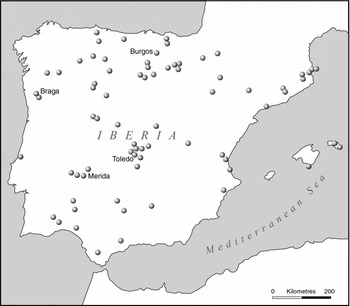
The evidence for Visigothic Spain is less satisfactory than for Lombard Italy, although it has been claimed that the seventh century marked the flowering of Spanish monasticism.Footnote 64 The most recent study of early medieval monasticism in the peninsula, which is concerned with surviving architecture, lists a mere eighty-six sites (Figure 3),Footnote 65 not all of which were in operation before the eighth century, although, equally, there were plenty of monasteries which have left no archaeological trace. Beyond the monastic source material, there is a fascinating parish list from the Suevic region of the north-west,Footnote 66 and councils do give an indication of parish funding.Footnote 67 Some of the pizarras visigodas, Visigothic slate documents, may well relate to ecclesiastical estates,Footnote 68 but there are no early charters to help us understand the scale of ecclesiastical holdings. The absence of documentation for much of the peninsula can, of course, be linked to the disruption caused by the long period of Islamic rule, although this did not lead to the total collapse of monasticism in the south,Footnote 69 and it scarcely explains the lack of information for a northern diocese like Lugo. Visigothic law, secular and ecclesiastical, sheds light on some property issues, but for the most part the land that attracted the attention of the legislators was fiscal rather than ecclesiastical.Footnote 70 There are, however, some indications that ecclesiastical land was substantial enough to be under threat. Thus, the provincial Council of Lérida in 546 legislated against laymen attempting to withdraw from episcopal jurisdiction monasteries which they had founded, suggesting some battle over proprietary rights.Footnote 71
Distribution of ascetic communities in Visigothic Spain

A further issue gives us a different perspective on the donation of land to God and his saints. The first two clauses of the Regula communis, composed around 660, either by Fructuosus of Braga or possibly in his circle, talk of family monasteries and communities made up of bands of serfs, lacking episcopal control.Footnote 72 A text from around the same time, Valerius of Bierzo's De genere monachorum, refers to monasteries that were little more than peasant communes.Footnote 73 The houses mentioned in the Regula communis would seem to be proprietary churches, which we left to one side in Francia. The peasant communes may be a rather different matter. Even so, the evidence of the Regula communis and the De genere monachorum appears to suggest the dedication of land to God, but not, apparently, under the control of the established church.
More orthodox were the foundations of Fructuosus himself, recorded in his vita, which was once attributed to Valerius. Among them were Compludo, near Astorga, and Nono, in the region of Cadiz. The latter was apparently of unusual size, and was so popular that the local military commanders had to intervene to prevent the area from being denuded of potential soldiers.Footnote 74 There would seem to be an allusion here to the explicit exemption from military service granted to monks by Visigothic law.Footnote 75 We can, therefore, be sure that there were sizeable monasteries, but unfortunately for any detail we can only turn to the Life of Fructuosus. We even lack source material for the monastic foundations of the capital Toledo.
Nor do we know much about the wealth of the great episcopal churches of Toledo or Seville, but for that of Mérida we have the evidence of the Vitas Patrum Emeretensium, which explains at considerable length how the diocese became the wealthiest in Spain. This came down to the medical skills of Bishop Paul, who removed a dead foetus from the womb of a senator's wife, thus saving her life; the couple, the richest in Lusitania, were so grateful that they conveyed all their wealth to the bishop, who in turn left it to his nephew and successor, Fidelis, who eventually conferred the complete estate to the church of Mérida.Footnote 76 This single benefaction was supposedly greater than all the rest of the ecclesiastical property of the city.
The Vitas Patrum Emeretensium does not allow us to quantify the scale of the possessions of the diocese, although it indicates that the territory left by Paul and Fidelis was very considerable. Perhaps more important, the text draws attention to the extent to which church landholding in Spain (as indeed elsewhere)Footnote 77 varied from region to region, while the evidence of the Vita Fructuosi and the Regula communis shows that while there may have been a considerable number of monasteries in the north, they were not necessarily under the control of the bishop.
The evidence for Anglo-Saxon England presents a picture that in some ways is similar to Spain; indeed, the critical picture of monasticism to be found in the Regula communis has been compared with certain aspects of English monasticism.Footnote 78 In other respects, however, the image presented by the Anglo-Saxon material recalls the situtation in Francia, which is all the more surprising given that the Christianisation of the Anglo-Saxon kingdoms essentially began with the arrival of Augustine in Kent, meaning that (while there may have been some continuity in ecclesiastical landholding in the West)Footnote 79 the history of the English church really begins a good two and a half centuries after that of Gaul. In addition, because of the collapse of Roman traditions of property-holding, the permanent endowment of churches involved a change in land tenure.Footnote 80 Yet there are intriguing parallels between Francia and Anglo-Saxon England, not least because secularisation was an issue in both regions in the early eighth century.Footnote 81 Not that England seems to have experienced anything like the secularisation of ecclesiastical property witnessed in Francia in the days of Charles Martel. Even so, Bede claimed that too much property had been transferred to monasteries (many of which he regarded as bogus), with the result that the Northumbrian kingdom was in danger of not being able to provide for its warriorsFootnote 82 – a parallel complaint to that raised against Fructuosus's foundation of Nono. That a cleric, and one of Bede's stature, could make such a claim is a clear indication that a considerable amount of land had been donated to the church, although particularly to proprietary churches – for Bede thought that the episcopal church was under-endowed to carry out its pastoral duties.Footnote 83
For the endowment of Northumbrian monasteries, our evidence is almost exclusively to be found in the narrative sources. Wearmouth's original landholdings amounted to 70 hides, according to Bede, and 50 according to the author of the anonymous Life of Ceolfrid.Footnote 84 Jarrow was founded with 40 hides.Footnote 85 By the time that Abbot Ceolfrid retired and set off for Rome in 716, the joint-monastery possessed 150 hides.Footnote 86 The hide, which varied in actual acreage, was supposedly enough land to support one family.Footnote 87 This was a sizeable and well-endowed community, although its landholdings were not remotely comparable with those of the more important Frankish monasteries that we have considered.Footnote 88 Ripon initially received the rather smaller amount of 30 hides,Footnote 89 though this was subsequently increased by a major grant of territory around the Ribble, Ingaedyne (perhaps the area round Yeadon), Dent and Catlow.Footnote 90 But even the initial endowment of Ripon was a good deal larger than the 10 hides of Wilfrid's first foundation at Ætstanford,Footnote 91 though this was the same amount as that allocated by Oswiu to each of the twelve monasteries he founded as a thank-offering following his victory over Penda at the battle of the Winwæd.Footnote 92 Unfortunately, Bede does not comment on the endowment of Lindisfarne. Later sources indicate that the community of St Cuthbert had very extensive landholdings, but how much of this had been acquired before the Viking period is unclear.Footnote 93 Equally, we do not have any idea of the scale of the early endowment of Whitby, or even Wilfrid's Hexham, although it was founded on a portion of the dowry of Queen Æthelthryth.Footnote 94
As in Francia, ecclesiastical property should not just be assessed in terms of the wealth of the great monasteries and bishoprics. Indeed, Bede's Letter to Ecgbert implies that it was not the endowments of these that had depleted the resources available to the king and his warriors, but rather small family communities, essentially proprietary foundations. For the numbers of minor houses and their whereabouts, we rarely have documentary evidence, although it has been suggested that early Anglo-Saxon sculpture may be monastic, and it has, indeed, been taken as an indication of the distribution of Anglian monasteries. Certainly, the sculpture is ecclesiastical, and therefore gives us some sense of the spread of church institutions.Footnote 95 Ultimately, however, for Northumbria, Bede's statement about the over-endowment of monasteries (and the under-endowment of bishoprics) is our most precious piece of information.
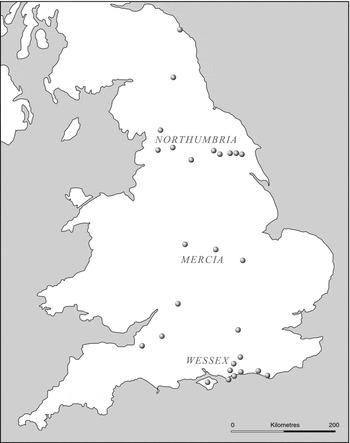
Wilfrid provides a point of entry for the ecclesiastical landholding throughout the Anglo-Saxon world (Figure 4). Apart from his foundations of Ætstanforda, Ripon and Hexham, he appears to have been given Ingetlingum and Poppleton in Northumbria,Footnote 96 as well as holding the dioceses of York, and briefly Lindisfarne. In Mercia he received property, notably at Oundle,Footnote 97 and at various times he held the sees of Lichfield and Leicester.Footnote 98 In Wessex, he is supposed to have been given 71 hides at Wedmore and Clewer, estates that he conveyed to Glastonbury. Among other sites he is said to have held in the south-west is Withington. In the kingdom of the South Saxons he held 87 hides at Selsey, as well as Lidsey, Aldingbourne, Westergate and Northmundham, which were given to him by Nothgitha, sister of King Nothelm. After the conquest of the South Saxons by the West Saxon King Cædwalla his right to Selsey was confirmed and he received in addition 70 hides at Pagham and 10 at Tangmere, both of which he passed to Archbishop Theodore. Cædwalla also gave him a quarter of the Isle of Wight, which amounted to 300 hides.Footnote 99 Wilfrid may also have been given Seaford.Footnote 100 Although he did not control all of this at any one time, far in excess of 500 hides must have passed through his hands, for Stephanus talks of numerous other donations without providing details. The amount of land held throughout England by Wilfrid at some time in his career (all of which passed to the church) might well have constituted as large a proportion of the territory controlled by the Anglo-Saxons as Bertram held of Francia.
Properties held by Bishop Wilfrid

For no other ecclesiastic are we so well informed, though Bede also tells us that the Mercian King Wulfhere gave 50 hides at Barrow to Chad, who took over the see of Lichfield from Wilfrid.Footnote 101 Further south, charters provide some evidence. The monastery of Hanbury acquired 50 hides of land,Footnote 102 Farnham 60, Bradfield 120 and Minster-in-Thanet 124.Footnote 103 In addition, the later evidence of the Liber Eliensis suggests that the original endowment of Ely was very substantial, perhaps as much as 600 hides.Footnote 104 Unfortunately, we know little about the early landholdings of such major foundations as Peterborough, Malmesbury and Glastonbury,Footnote 105 let alone the episcopal church of Wessex, Canterbury or YorkFootnote 106 – though according to Bede the secular clergy of Northumbria were under-endowed. One would be hard pressed to argue from this that the proportion of land in the hands of the church was as high in England as it was in Francia. However, in 1086 the English church received approximately a quarter of the kingdom's land rents;Footnote 107 and while it accumulated considerable amounts of property in the tenth and early eleventh centuries, it had surely lost large numbers of estates in the previous Viking period, when numerous proprietary churches in particular must have fallen by the wayside. The proportion of territory held by ecclesiastical institutions in England before the Viking invasions may not have been radically less than what they held in 1086. What early evidence there is at least implies that they were as well endowed in the south as in the north. It is not therefore surprising that secularisation of church property was every bit as much of an issue in Mercia as it was in Northumbria,Footnote 108 and indeed that it would become an issue in Alfredian Wessex.Footnote 109
This very brief tour of ecclesiastical landholding from the fifth to the early eighth centuries has not trespassed into Wales or Ireland, for the simple reason that figures for the period in question are effectively non-existent (although we do know that the original endowment of Iona was reputed to be a paltry 5 hides).Footnote 110 For Francia, what evidence there is allows us to conclude that Roth's estimate of Merovingian ecclesiastical landholding may not be wide of the mark; if anything, it is likely to be an underestimate. Churches may have held a comparable, perhaps even larger, proportion of the lands of Byzantine Italy (which included the core territories of the papacy), but ecclesiastical holdings in Lombard Italy, Spain and England were probably on a lesser scale. In considering developments in the ninth century and beyond, one should probably bear these differences in mind. Even so, in Anglo-Saxon England, as in Francia, the amount of property held by ecclesiastical institutions was extensive enough to present a major political problem in terms of ensuring adequate territorial support to maintain an army. In other words, a significant proportion of Western Europe was entrusted to God and his saints in the pre-Carolingian era. Further, much of that land was conferred to the church after the disruption occasioned by the settlement of the barbarians, which had caused huge changes in property ownership, rather than in the Roman period.Footnote 111
The build-up of ecclesiastical property has not gone unremarked. In a challenging book published in 1983, Jack Goody not only drew attention to the fact that the church acquired very substantial property holdings in the early Middle Ages, but he also argued that this resulted from a deliberate ecclesiastical policy. According to Goody, the church's definition of the family, marriage and incest challenged previous marital traditions, which had often seen marriage between close kin, with the result and perhaps the intention that land had been kept within confined kin groups; the fact that such unions were now branded as incestuous undermined the associated patterns of inheritance and facilitated the ecclesiastical acquisition of land.Footnote 112 That donations to the church did affect patterns of inheritance is clear; although biological heirs were not ignored, the portion of parental property (perhaps acquired rather than family property) which they inherited was frequently reduced by gifts to God and his saints. However, although ecclesiastical councils have much to say about the acquisition and protection of church property,Footnote 113 Goody's explanation for the accumulation of church land attributed far too much intentionality to the process.Footnote 114 More significant than the legal restriction of strategies of inheritance was the positive drive to donate to the sacred.Footnote 115 Indeed, as Régine Le Jan has argued, the upper classes developed a strategy ‘de fonder dans le sacré le pouvoir familial’.Footnote 116 At the same time, the fact that Goody traced the development from the Christianisation of the Roman Empire down to the Reformation rather obscured the extent to which the change he documented took place in the pre-Carolingian period. Crucially, however, he put ecclesiastical land at the centre of an interpretation of early European history.
Yet this should not lull us into believing that there was an unregulated transfer of property to churches. There were limitations on how much could be alienated from the family. A quarter of a man's property had to be passed on to his direct heirs, according to the Theodosian Code.Footnote 117 Visigothic law protected the family a good deal more, limiting the disposable part of an estate to a fifth, which surely restricted the scale of ecclesiastical property in Spain.Footnote 118 Nor did land always remain in the hands of a church, as can be seen from a comparison between the surviving Merovingian charters for St Germain, and the evidence of the monastery's possessions in the Polyptych of Irminon.Footnote 119 Biological heirs could and did challenge grants made by their parents to the church;Footnote 120 the brother-in-law of Fructuosus asked the Visigothic king, probably Reccared, to give him some property from one of the saint's monasteries so that he could carry out his military obligations;Footnote 121 the community of Wearmouth seems to have been terrified that its property would be claimed by the brother of its founder Benedict Biscop.Footnote 122 There were, indeed, numerous potential threats to the possession of land once it had been passed to the church. Estates could be transferred from ecclesiastical possession in a variety of different legal ways, as Caesarius of Arles remarked in a letter to Pope Symmachus.Footnote 123 As the early sixth-century Council of Clermont complained, men petitioned the king for church property,Footnote 124 while a generation later at the third Council of Paris the bishops reiterated their fears about the threats to church land.Footnote 125 In addition, there were plenty of threats from hostile neighbours in times of unrest.Footnote 126
In fact it is by no means clear that the church's ownership of the gifts it received was anything like as secure as the conciliar acta would have us believe. Shortly after 500, Avitus, bishop of Vienne, wrote to the Burgundian ruler Gundobad, saying ‘Whatever my small church has, nay all of our churches, is yours in its substance, since up to now you have either guarded it or given it.’Footnote 127 At the time he wrote these words, Avitus was caught up in an awkward legal dispute which was being looked into by Gundobad, and which may well have put him on the defensive; even so it is clear that certain kings and rulers regarded ecclesiastical land as being subject to royal demands and to being redistributed by royal command, despite the views expressed by bishops in council.Footnote 128
The best-known example of secularisation is that carried out by the early Carolingians. The seizure of church property is already portrayed as a major issue in sources of the eighth and ninth centuries, not least in a number of visionary texts which present Charles Martel as suffering in hell.Footnote 129 It is true that these and other texts, including what is usually thought to be an interpolated version of a letter of Boniface,Footnote 130 were intended to warn later Carolingians against taking over ecclesiastical property, and that they therefore reveal as much about late eighth- and ninth-century concerns as they tell us about how much land actually was returned to secular use by Charles Martel.Footnote 131 Even so, the evidence from St Wandrille and AuxerreFootnote 132 proves that secularisation was a very significant issue.Footnote 133 And one may wonder whether in rejecting Roth's figures, Herlihy did not pay enough attention to the reclamation of land from the church in the early eighth century.
Although the age of Charles Martel would seem to have constituted the first great period of secularisation of church property, Boniface, in his denunciation of the policies of the maior palatii, makes it clear that he thought the evil had begun a good deal earlier.Footnote 134 Lesne acknowledged that secularisation had occurred in the days of Ebroin, Childebert III and Grimoald, in other words throughout much of the late seventh century; and Michel Rouche, citing the Chronicle of Fredegar, pushed the challenge to ecclesiastical property rights further back, to the reigns of Dagobert I and his son Clovis II (thus from the 620s onwards).Footnote 135 He even argued that Merovingian kings essentially treated ecclesiastical land in the same manner as fiscal land: ‘ils sont des terres publiques’, and that was enough to justify Dagobert's secularisations.Footnote 136 Moreover, for Rouche, this attitude could be found in Visigothic Spain around the year 600,Footnote 137 and he suggested, less convincingly, that it derived ultimately from Roman law.Footnote 138
Some kings felt they could make heavy tax demands on church property; already before 561 Chlothar I demanded a third of all ecclesiastical revenue.Footnote 139 There were also plenty of royal complaints about how much the church had amassed, even in the sixth century. One of Chothar's sons, Chramn, had an adviser, Leo, who argued that Saints Martial and Martin (that is their churches) had denuded the royal treasury; another son, Chilperic, who succeeded to the kingdom of Soissons, argued, infamously, that ‘my treasury is always empty. All our wealth has fallen into the hands of the church. There is no one with any power left except the bishops. Nobody respects me as king: all respect has passed to the bishops in their cities.’Footnote 140 That Chilperic did not embark on a policy of secularisation suggests that not everyone saw church property as being so open to royal or mayoral exploitation as did Dagobert, Clovis II and Charles Martel. Just as their actions, like those of later Anglo-Saxon rulers, do suggest that ecclesiastical land might be brought back into secular use in certain circumstances, the words of Chilperic, and the opinions of Leo, as retold by Gregory of Tours, underline the fact that massive amounts of property had already been conveyed to the church even by the second half of the sixth century.Footnote 141
What is perhaps most difficult to grasp is the relationship between the alienation of land to the church and the desire of family members and of rulers to bring that land back into secular use. At times, we seem to be watching an extraordinarily complicated dance in which the partners move in one direction and then another, and not always the same direction at the same time, yet they continue to hold on to one another. Families, in giving to the church, did not see their gift as a finite act, but rather as one element in a series of negotiations,Footnote 142 as has been shown most fully by Barbara Rosenwein in her study of the tenth-century charters of Cluny, where families and individuals deliberately set out to establish themselves as neighbours of St Peter.Footnote 143 To give was to invest in the church, but a donation was also an investment for the souls of the donor and his or her family.Footnote 144 At the same time, there could be more immediate benefits: positions for sons and daughters, even a continuing, and secure, land bank on which the family could draw, especially if it negotiated the usufruct of the estate or its use under a tenancy agreement, such as those made in precaria. The establishment of a proprietary church was just one of a number of possible channels for giving to God while retaining a major stake in the gift offered. Even if they claimed their land back, as some Merovingian and Anglo-Saxon families did, in making a bequest to the church they had entered into a relationship which placed demands on both sides, drawing together spiritual and economic investment, which also had political ramifications.Footnote 145 Secularisation could be structured so as not to break the relationship; there was no need to take land away from a church in perpetuity, but rather bishops and abbots could be persuaded to grant out their property in precaria or as benefices (which takes us back to the arguments of Roth), so that the new holder of the property was himself drawn into the patronage networks of a church and its patron saint.Footnote 146 The challenges made by kings, kinsmen and by men hostile to the original benefactors ultimately did not check the transfer of property to churches for the simple reason that almost everyone wished to have a favourable relationship with God and his saints.
The endowment of churches, and indeed the subsequent secularisations, are clearly an aspect of church history. These developments have, however, rarely been presented as a significant aspect of the socio-economic history of the early Middle Ages. In 1963, Arnaldo Momigliano commented that Pirenne, Dopsch and Rostovtzeff had written about the social changes of the late Roman period ‘without even discussing the most important of all social changes – the rise of Christianity’.Footnote 147 He could have looked further back; Fustel de Coulanges, who placed religion right at the centre of his understanding of the Ancient City, ignored it almost entirely in his study of the early development of French political institutions.Footnote 148 Indeed, with few exceptions, there had been a long-standing exclusion of religion from socio-economic studies of the post-Roman period.Footnote 149 Some explanation for this may be provided by the lines of development within the relevant historiographies. The seminal French debates of the eighteenth century, which were concerned largely with social structures (which had implications for an understanding of the France of the Ancien Régime), almost all ignored religious issues – and the Enlightenment did not encourage the integration of religion into historical study. An economic dimension was developed by Sismondi in the first half of the following century, but, perhaps not surprisingly, as a Genevan Calvinist he had little to say about early medieval Christianity, something which drew the ire of Alessandro Manzoni. Among secular historians, Italians more than most did emphasise the significance of the church, not least because the papacy was a major factor in debates about the unification of Italy. Yet the main advocates of religious history were to be found in France, and for them – notably Chateaubriand, Ozanam, Montalembert and Broglie – the history of the early Middle Ages was important above all for the models of spirituality it had to offer to a world recovering from the secularism of the Enlightenment and the Revolution. This was a reading that tended not to pause over the social and economic considerations of church history. By contrast, the Germans in the nineteenth century saw the early Middle Ages as providing material for understanding and promoting their own national unity and their primordial constitution; Roth was unusual in placing the church firmly within a debate about supposedly secular issues.
It was the German tradition that won out, not least because it was most deeply embedded in the universities. In the second and third decades of the twentieth century Alfons Dopsch situated his work in a line of German scholarship, though he also acknowledged the overwhelming importance of Fustel. It is perhaps more surprising that Henri Pirenne left the church to one side; although a Protestant, he had studied with Godefroid Kurth, a deeply committed Catholic.Footnote 150 Yet Kurth himself separated his study of settlement from his more pious investigations of Merovingian saints and politics. Despite the influence of Kurth, Pirenne looked up, above all, to the Germans, especially Karl Lamprecht, that is until the impact of the First World War led him (like Fustel after 1870) to want to cut them down to size. There were still scholars who concentrated on the church, again Frenchmen like Henri-Irenée Marrou, but also Christopher Dawson, who in many ways was an heir to the French Catholics of the nineteenth century. However, insofar as anyone attempted to integrate religious and secular narratives, it was the heirs of Gibbon: Bury and Hodgkin. Yet Bury's interests were more political and cultural than economic – and while Hodgkin did discuss religion as a factor in the Fall of Rome (modifying Gibbon's view of the church, and emphasising God's hand in events), and while he also looked at economic factors (as one would expect from a banker), he did not pause to consider the economic impact of Christianity.Footnote 151 Momigliano, then, was commenting on a lacuna which had essentially become ingrained in the study of the early Middle Ages; the study of the economy and society did not involve that of religion, and vice versa.
Among social and economic historians’ writing, even after Momigliano's comment, there has been a tendency to avoid discussing Christianisation,Footnote 152 although religious historians have been rather more inclined to keep an eye on the social (though rarely the more purely economic) aspects of their subject.Footnote 153 Political historians have continued to note the impact of doctrinal debate,Footnote 154 but Gibbon, for all his anti-clericalism, still stands relatively isolated among secular historians for his attempt to place the development of the church at the heart of a totalising narrative.Footnote 155 Gibbon saw Christianisation as a negative force, sapping the vitality of the Roman state. Leaving aside the judgemental aspect of his argument, it is worth returning to the question of the effect of Christianisation on society. In other words, it is worth returning to Momigliano's observation. Since, as we have seen, a substantial proportion of the landed resources of Western Europe was entrusted to God and his saints in the course of the fifth, sixth and seventh centuries, we need to ask whether this had any significant social or economic impact, or whether it simply marked the transfer of land from one owner to another.
One would like to know whether the needs of the church led to any reorganisation of agricultural production, such as has been argued for early medieval Ireland.Footnote 156 Given the fact that monasticism in mainland Europe evolved in part on late Roman villas, abbots may well have simply followed established practice.Footnote 157 Unfortunately, for the Merovingian period we are largely dependent on the remarkable Tours documents,Footnote 158 and we lack any earlier point of comparison for the West other than the theoretical comments of the agrimensores. We do know that churches kept a close eye on their tenants,Footnote 159 and legal formulae may shed light on some changing tenurial practices,Footnote 160 but evidence that allows a detailed reconstruction of estate organisation largely begins in the Carolingian period, by which time developments in the demesne system were underway.Footnote 161 In addition to the organisation of individual estates, the richer churches would have been concerned with the management of a very dispersed range of holdings, and here abbots could well have looked to the practices of the late Roman senatorial aristocracy, whose property was even more far-flung.Footnote 162 The dispersed nature of the properties of bishops and monasteries must have meant that ecclesiastical institutions needed to transport goods, and we get some glimpse of this in charters, above all those granted to Corbie in 661 and 716.Footnote 163 Yet one would like to know whether the involvement of churches in the transportation of goods led to any specific developments in trade and exchange.Footnote 164 We can be sure that bishops and monasteries were responsible for minting coin,Footnote 165 and also that religious establishments were heavily involved in the economy; it is less easy to say whether this prompted any change in its organisation.
What we can be sure about is that some of the wealth of the church was directed into new channels. Churches would seem to have constituted the major stone constructions of the post-Roman era, however small those of the seventh and eighth centuries were in comparison with what had been erected previously.Footnote 166 Among some Germanic groups, wealth which might once have gone into a great potlach burial, like those at Sutton Hoo, seems to have been channelled into churches which could act as mausolea.Footnote 167 Once built, there was the matter of their upkeep, to which a quarter of ecclesiastical income was dedicated in Italy.Footnote 168 The performance of the liturgy also required substantial funding. Paul Fouracre has brought home to us the extent to which the need for lighting materials is addressed in charters and immunities of the Merovingian period.Footnote 169 Nor should we forget the resources required for the production of major manuscripts: 1,545 high-quality animal skins were needed simply for the three Pandects of the Bible produced at Wearmouth-Jarrow.Footnote 170
More important, however, is the question of human numbers. Gibbon envisaged the east Roman Empire in the fourth century as being swamped by a ‘swarm of fanatics’, claiming that in Egypt there was even a hope ‘that the number of monks was equal to the remainder of the people’.Footnote 171 In his considerations of the causes of the Decline and Fall, he claimed that ‘the sacred indolence of the monks was devoutly embraced by an effeminate age’, while he also claimed that ‘the bishops, from eighteen hundred pulpits, inculcated the duty of passive obedience to a lawful and orthodox sovereign’.Footnote 172 Nobody would argue that monasticism in the West was anywhere near as popular as Gibbon envisaged it to have been in the East, and Gaul's 130 bishopricsFootnote 173 are a small percentage of the overall number of dioceses in the empire.Footnote 174 Nevertheless, a significant number of people entered the church. We have a few indications of the numbers of monks in individual communities. The Vita Clari lists 1,525 monks divided between twelve communities in the city of Vienne in the seventh century, and claims there were sixty other houses in the diocese.Footnote 175 Certainly, there are problems with this text, which was apparently written in the context of the reforming episcopate of bishop Leodegarius (1025–69).Footnote 176 The numbers of religious would seem to represent a remarkably high percentage of the total population of the city – especially if we assume that they only include the monks and nuns, and leave out their servants, agents and tenants. Yet, so precise are the figures that it is difficult to think where they originated, if not in some early survey. Nor are they out of line with those that we have for other foundations. Writing in the late 1920s, Ulrich Berlière gathered a good deal of evidence relating to the size of monastic communities.Footnote 177 Several of them were in the 200s or above: Lérins supposedly held 500 and Jumièges 900!Footnote 178 Most of Berlière's figures come from late sources, but there is some early evidence. Jonas of Bobbio states that there were 60 monks at Fontaines, one of the least significant of Columbanus's foundations,Footnote 179 which makes the 220 monks ascribed to Luxeuil in the Vita Walarici plausible.Footnote 180 Then there are the early Carolingian figures for Merovingian houses: Angilbert talks of 300 monks and 100 pueri at St. Riquier;Footnote 181 Adalhard prescribed that there should be between 300 and 400 at Corbie;Footnote 182 while Irminon lists 212 at St Germain.Footnote 183 All these we may compare with those in the dossier on the Holy Land drawn up for Charlemagne in the early ninth century, which talks of 725 religious in cenobitic institutions. The region, of course, was under Islamic control and this must therefore represent a very much smaller number than there had been in the fifth and sixth centuries.Footnote 184 The Frankish figures allow us to say no more than that a sizeable number of people entered the church. Much the same can be argued for England, where we know that the community of Wearmouth-Jarrow numbered 600 in 716 (though this figure, unlike those for Frankish houses, would seem to include servants and labourers as well as monks).Footnote 185 For Spain, we have comments on the crowds of monks at the monasteries of Fructuosus, above all Compludo with its army of ascetics drawn from all over the peninsula, and Nono, which led the local duces to worry whether they could still staff the army.Footnote 186 While some Lombard monasteries seem to have been very small, Bobbio is said to have housed 150 monks in 643,Footnote 187 and we have Aistulf's law referring to communities of over 50 monks.Footnote 188
Nor do such figures include the secular clergy. In any diocesan centre, there would have been a bishop, priests, deacons, subdeacons, exorcists, acolytes and lectors; and then there were priests in subordinate settlements.Footnote 189 It would be difficult to guess the numbers involved, but the figures from the diocese of Le Mans suggest that on average just short of ten priests and seven deacons were ordained each year.Footnote 190 A priest might well hold office for twenty years or more; multiply that by the 130 dioceses of Gaul, and one is dealing with tens of thousands of clergy in Francia at any one moment. The picture would be replicated in Spain and Italy, if not in England. Thus, a significant minority of the population entered the church. At least part of the revenues and yields of the estates conveyed to God and his saints must have been devoted to feed these men and women.Footnote 191 Indeed, a quarter of the wealth of the Italian church was supposedly earmarked for the clergy.Footnote 192 Gibbon's sacred indolents are a significant issue.
In addition, the cost of support for the poor, the widows, the orphans and the sick, that fell on the churches of the early Middle Ages, is almost incalculable, although we know from a ruling of Pope Simplicius in 465 that a quarter of the income of Italian bishops was supposed to be devoted to such causes.Footnote 193 Elsewhere, the regulations of episcopal expenditure were not so clear, but there was an assumption that a bishop should look after his flock.Footnote 194 Julianus Pomerius, writing around 500, saw donations to the church as being primarily intended for the poor, and it was they who were defrauded, in the eyes of the church councils, by those who stole ecclesiastical property.Footnote 195 We do, however, get a very rough indication of one group who would need care in a time of crisis from the statement in John the Deacon's Life of Gregory the Great, that 3,000 refugee nuns were registered on the matricula, poor lists, of the churches of Rome.Footnote 196 Hospitals, which were religious institutions, could be very generously endowed, as in the case of Childebert's xenodochium at Lyons.Footnote 197 Essentially, a whole range of social services became part of the ecclesiastical budget. In Peter Brown's words, there was a shift ‘from “Lover of the City” to “Lover of the Poor”’.Footnote 198 To love one's city, and to be its most outstanding patron – the French rather more than the English use the classically derived word evergetismFootnote 199 – was a virtue in classical Antiquity; the social demands of the Gospels led to a new set of priorities, effectively moral imperitives, with an eschatalogical backing,Footnote 200 the costs of dealing with which fell above all to bishops. This was already true by 450, but the growing benefactions to the church, and the fact that a bishop was expected to set aside a quarter of his revenue for such philanthropy, must have had an increasing impact on the structures of society.
Alongside the religious and pastoral duties of bishops and abbots, one should set the claims of some churches to exemption from taxation, which recur on a number of occasions in the Histories of Gregory of Tours.Footnote 201 Although the precise chronology of the collapse of the tax system in the post-Roman world is still a matter for debate,Footnote 202 the collapse itself has plausibly been presented as one of the central developments of the period.Footnote 203 Among the forces undermining the old fiscal regime, the claims to exemption made by leading clergy, as they represented the demands of their communities, may well have been significant.
While there was an undoubted change between the fourth and the eighth centuries, it is by looking back to the pagan period that one can most appreciate its scale. The church's acquisition of property and wealth not only expanded from a very low base, but pagan religious centres were in no sense comparable to the Christian churches and monasteries that followed. Roman temples may have been rich in gold, silver and precious objects, but they were rarely endowed with vast estates.Footnote 204 Egyptian temples had possessed extensive properties at the time of the Roman conquest, but these were taken over by the state; likewise, Hellenistic Asia Minor originally boasted some temples well endowed with land, but their endowments were either confiscated or directed to new uses after the Roman take-over. In Italy, temples did not have significant landed endowments, and the same was true in Gaul.Footnote 205 One may guess that this was the case for the whole of the West. For the Germanic world we do know of sacred groves, though their extent is far from clear, and there is nothing to suggest the existence of major temples.Footnote 206 In the late nineteenth century, Ulrich Stutz argued that the supposed temporal property of Germanic temples provided a background for the development of the Eigenkirche, proprietary churches, a Germanist reading that had its adherents before 1939. Its appeal to an archaic Germanic past was less attractive after 1945 for ideological reasons, but in any case it had never been underpinned by any evidence.Footnote 207 The transfer of property to the church thus constituted a tenurial revolution, much as Goody argued. Pagan priesthoods in the Classical world, moreover, were primarily civic offices, usually held for a short period of time, and most certainly not a full-time occupation.Footnote 208 The one major exception, the druids, were suppressed at the time of the conquests of Gaul and Britain. As for the Germanic world, there is no evidence for an organised priesthood.Footnote 209 There had been provision for the poor in some cities of the Roman Empire (and in Rome and Constantinople on a colossal scale), but previously it had fallen to the state or to individuals with a strong sense of civic pride, and not the temples, to address the problem.Footnote 210
The transfer of land to God and his saints was, therefore, a major social and economic development, which frequently ran alongside the religious and spiritual change entailed by Christianisation, and not just in Anglo-Saxon England, where the question of the development of the charter, and the impact of the church on land tenure, has already attracted the attention of early medievalists.Footnote 211 Some religious historians of late Antiquity and the early Middle Ages have been fully aware of the social implications of their subject, and have rightly stressed the extent to which the lands converted to Christianity became ‘a wholly sacral world’Footnote 212 – a world that might be better understood in terms of temple-building societies studied by social anthropologists than of more modern patterns of production and distribution.Footnote 213 Yet this social and economic revolution has scarcely been registered by socio-economic historians.Footnote 214 And some of those who have been aware of the scale of the change have, like Roth, seen it as a preliminary to a wider set of changes, which they call the rise of feudalism. I would suggest that the transfer of vast amounts of Western Europe in the pre-Carolingian period has been underestimated, perhaps because of the secularisations of the eighth century – and one concomitant of my argument must be that we should take those secularisations very seriously indeed. The pre-Carolingian benefaction of the church constitutes, I would argue, an important phase in the social and economic history of Western Europe in its own right. It provides a key to the development of Europe as a Christian society, which is every bit as much a social and economic issue as a religious one, although its significance has been obscured by the compartmentalisation of ecclesiastical and secular history.