It was obvious to contemporaries—among them John Maynard Keynes—that membership in the British Empire gave poor countries access to the British capital market at lower interest rates than would have been required had they been politically independent. For liberal critics of the empire, this “empire effect” seemed detrimental to the economic health of the British Isles, which might otherwise have attracted a higher proportion of aggregate investment. Later historians agreed that this was one of the ways in which, by the later nineteenth century, the empire had become a drain on British resources. From the point of the view of the colonies, on the other hand, the ability to raise funds in London at relatively low interest rates must surely have been a benefit—a point seldom acknowledged by critics of imperialism.
But did the empire effect actually exist other than in contemporary imaginations? Recent econometric studies of financial markets before the First World War have pointed instead to the gold standard as conferring a “good housekeeping seal of approval,” which lowered the borrowing costs of the governments of poorer countries regardless of whether they were colonies or not. An alternative hypothesis that has been advanced is that the sustainability of a country's fiscal policy was the prime determinant of market assessments of creditworthiness. Were institutions and investors in the City of London primarily interested in a country's monetary and fiscal policy, regardless of its degree of political dependence? Or did colonial status have an additional effect on market confidence?
It will be seen at once that these things are not easily disentangled because British rule generally implied both currency stability and balanced budgets, among other things. This article therefore seeks to reassess the importance of colonial status in the eyes of investors before the First World War by means of multivariable regression analysis. We use a new and substantially larger sample of data than previous scholars have used. At the same time, we give priority to variables that we know were available to and heeded by contemporary investors. We show that even when monetary, fiscal, and trade policies are controlled for, there was still a marked difference between the spreads on colonial bonds and those on the bonds issued by independent countries. The main inference we draw is that the empire effect reflected the confidence of investors that British-governed countries would maintain sound fiscal, monetary, and trade policies. We also suggest that British rule may have reduced the endemic contract enforcement problems associated with cross-border lending. Investing in Calcutta was not so different from investing in Liverpool, because both transactions took place within a common legal and political framework that served to protect investors' rights. Sovereign states, by contrast (and indeed by definition), could not be held to account under English law. This has important implications in the context of the emerging consensus among economists that defective political and legal institutions are one of the major barriers to large, sustained, and productive capital flows from rich to poor countries.1
See, for example, World Bank, World Development Report 2005.
BRITISH IMPERIALISM AND FINANCIAL GLOBALIZATION BEFORE 1914
Between 1865 and 1914 more than £4 billion flowed from Britain to the rest of the world, giving the country a historically unprecedented and since unequalled position as a global net creditor—“the world's banker” indeed; or, to be exact, the world's bond market. By 1914 total British assets overseas amounted to somewhere between £3.1 and £4.5 billion, as against British GDP of £2.5 billion.2
Cain and Hopkins, British Imperialism, pp. 161–63.
Maddison, World Economy, table 2–26a.
Davis and Huttenback, Mammon, p. 46.
It has been claimed by Michael Clemens and Jeffrey Williamson that there was something of a “Lucas effect” in the period between 1880 and 1914, in other words that British capital tended to gravitate towards wealthy countries rather than relatively poor countries.5
According to Clemens and Williamson, “about two-thirds of British foreign investment went to the labor-scarce New World where only a tenth of the world's population lived, and only about a quarter of it went to labor-abundant Asia and Africa where almost two-thirds of the world's population lived”: Clemens and Williamson, “Wealth Bias,” p. 305. However, see also the different findings in Schularick, “Two Globalizations.”
Obstfeld and Taylor, “Globalization and Capital Markets,” p. 60, figure 10.
Schularick, “Two Globalizations,” table 3.
Similarly, Schularick and Steger, “Does Financial Integration,” find that financial integration had a positive impact on growth in developing countries before World War I, but not after 1990.
How important was the empire as a destination for British capital? According to the best available estimates, more than two-fifths (42 percent) of the cumulative flows of portfolio investment from Britain to the rest of the world went to British possessions.9
The authoritative source for the distribution of British capital exports is Stone, Global Export. See also Schularick, “Two Globalizations,” table 3.
Did membership of the British Empire give countries access to the British capital market at lower interest rates than they would have paid as independent states? Contemporaries and an older historical literature had little doubt that it did. Writing in 1924, Keynes noted that “Southern Rhodesia—a place in the middle of Africa with a few thousand white inhabitants and less than a million black ones—can place an unguaranteed loan on terms not very different from our own [British] War Loan.” It seemed equally “strange” to him that “there should be investors who prefer[ed] … Nigeria stock (which has no British Government guarantee) [to] … London and North-Eastern Railway debentures.”10
Keynes, “Advice,” pp. 204f.
Edelstein, “Imperialism,” p. 205.
Ibid., p. 206.
Even when London backing and oversight were absent from colonial government issues … the British capital market charged lower interest rates than comparable securities from independent nations at similar levels of economic development…. The strong inference is that colonial status, apart from the direct guarantees, lowered whatever risk there was in an overseas investment and that investors were therefore willing to accept a lower return.13
Ibid., pp. 206–07.
Another explanation may lie in the effect of legislation specifically calculated to encourage investors to buy colonial bonds. At the turn of the century, two laws were passed, the Colonial Loans Act (1899) and the Colonial Stock Act (1900), which gave colonial bonds the same “trustee status” as the benchmark British government perpetual bond, the “consol.”14
Cain and Hopkins, British Imperialism, pp. 439, 570. See for a detailed discussion, Keynes, “Foreign Investment,” pp. 275–84.
MacDonald, Free Nation, p. 380.
It was only after the war that the Treasury and the Bank of England began systematically to give preference to new bond issues by British possessions over new issues by independent foreign states: see Atkin, “Official Regulation,” pp. 324–35.
There are, however, other, less formal reasons why prewar investors may have incorporated an imperial discount when pricing bonds. The Victorians imposed a distinctive set of institutions on their colonies that very likely enhanced their appeal to investors. These extended beyond the Gladstonian trinity of sound money, balanced budgets, and free trade to include the rule of law (specifically, British style property rights) and relatively noncorrupt administration—among the most important “public goods” of late-nineteenth-century liberal imperialism.17
Ferguson, Empire, especially chapter 4. A modern survey of 49 countries concluded that common-law countries offered “the strongest legal protections of investors.” The fact that 18 of the countries in the sample have the common law system is, of course, almost entirely due to their having been at one time or another under British rule: La Porta et al., “Law and Finance.” See Rostowski and Stacescu, “Wig.”
For a number of reasons, then, it is possible that the imposition of British rule practically amounted to a “no default” guarantee; the only uncertainty investors had to face concerned the expected duration of British rule. Before 1914, despite the growth of nationalist movements in possessions as different as Ireland and India, political independence still seemed a fairly remote prospect for most subject peoples. At this point even the major colonies of white settlement had been granted only a limited political autonomy. Thus, in the words of P. J. Cain and A. G. Hopkins: “One of the key reasons why the colonies could borrow cheaply [was that] they offered almost complete safety.”18
Cain and Hopkins, British Imperialism, p. 240.
DETERMINANTS OF BOND SPREADS
The possibility exists, nevertheless, that other considerations mattered more to investors than the extent to which a country's sovereignty had been reduced by imperialism. The recent literature on the determinants of risk premia has centered on these other factors.
An alternative approach focuses on monetary policy rather than colonial status. Michael Bordo and Hugh Rockoff argued that adherence to the gold standard worked as a credible “commitment mechanism,” reassuring investors that governments would not pursue time-inconsistent fiscal and monetary policies.19
Bordo and Kydland, “Commitment Mechanism,” p. 56; and Bordo and Schwartz, “Monetary Policy Regimes,” p. 10.
Bordo and Rockoff, “Gold Standard,” p. 327.
Obstfeld and Taylor, “Sovereign Risk,” p. 253.
Obstfeld and Taylor, “Sovereign Risk,” p. 265.
As a contingent commitment, however, membership in the gold standard was nothing more than a promise of self-restraint under certain circumstances. Independent countries on gold were not members of some kind of monetary union. They retained the right to suspend convertibility in the event of an emergency such as a war, revolution, or a sudden deterioration in the terms of trade. Such emergencies were in fact quite common before 1914. Argentina, Brazil, and Chile all experienced serious financial and monetary crises between 1880 and 1914. By 1895 the currencies of all three had depreciated by around 60 percent against sterling. This had serious implications for their ability to service their external debt, which was denominated in hard currency (usually sterling) rather than domestic currency.
A second hypothesis is that investors were primarily interested in the fiscal policies of borrowing countries. Marc Flandreau and Frédéric Zumer have recently suggested that the most important risk factors were public debts, the corresponding amount of debt service, and the relation between these burdens and tax revenues.23
Flandreau and Zumer, Making of Global Finance; see also Flandreau et al., “Stability.”
Unfortunately, it cannot be excluded that different gold coding is responsible for the incompatible results. Flandreau and Zumer, Making of Global Finance, used a de facto criterion, i.e., exchange rate stability over a couple of years, whereas Obstfeld and Taylor, “Sovereign Risk,” looked both at de jure and de facto criteria, following Meissner, “New World Order.”
A third determinant of risk premia may simply have been political events. According to Ferguson, revolutions, governmental crises and wars were regarded by nineteenth-century investors as increasing the likelihood of defaults by the countries affected.25
See Ferguson, Cash Nexus and “Political Risk.”
Clemens and Williamson, “Wealth Bias,” table 7, p. 322. The authors see colonial status as significant but less important than these nonpolitical variables. Ibid., p. 319, regressions 6 to 8.
To determine whether or not membership in the British Empire genuinely lowered borrowing costs, it is therefore imperative to control for these and other factors. British colonies may simply have been able to borrow at lower rates than other foreign countries because they were on the gold standard, had more sustainable fiscal policies, were less susceptible to political crises, or were simply better situated relative to trade routes and temperate climatic zones.
YIELD DATA AND ECONOMIC CONTROL VARIABLES
We constructed the largest possible sovereign bond database for the period 1880–1913. Price data for government bonds quoted and traded in the London market were copied by hand from the leading financial publication of the time, the Investor's Monthly Manual. Some additional quotations were taken from the London Stock Exchange Weekly Intelligence, the London Stock Exchange's official weekly gazette. The bonds chosen had to pass three strict criteria to qualify as benchmark issues. First, they had to be payable in London in either sterling or gold, enabling us to focus exclusively on country risk and to ignore the currency risk inherent in bonds denominated in other currencies.27
This forced us to eliminate France and Germany as well as some smaller European economies that issued debt in domestic currency only. The (in)ability of countries to borrow internationally in domestic currency has been explored in detail in the “original sin” literature; see Bordo, Meissner, and Redish, “Original Sin”; and Flandreau and Sussman, “Old Sins.” For the United States we followed Bordo and Rockoff, “Gold Standard,” by using gold equivalent yields instead of dollar yields. The terms of repayment of U.S. government debt were in doubt: after 1879, all government debt was to be payable in coin—technically silver or gold, but in practice gold. It was not until 1910 that gold was legally declared the only medium of repayment in the United States.
The resulting dataset includes securities from 57 independent countries, colonies, and self-governing parts of the British Empire: in other words, almost the entire universe of foreign borrowing in the London market, reaching not only “from the Cape to Cairo” but also from Boston to Buenos Aires and from Budapest to Beijing.28
The complete list of countries and colonies can be found in the data appendix. The countries that were excluded despite the availability of loan quotations fulfilling our criteria were Bolivia, Costa Rica, Paraguay, Honduras, and Cuba as well as some small island empire borrowers such as Barbados and Trinidad, mostly for lack of economic control variables.
Bordo and Rockoff, “Gold Standard.”
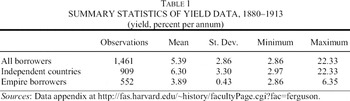
Table 1 shows the summary statistics for our current yield series.30
We decided to exclude about 20 observations with yields of more than 20 percent, virtually all these refer to Latin American loans that had been in full default for many years. The Annual Reports of the Corporation of Foreign Bondholders indicated that investors reckoned that full repayment was most unlikely in these cases.

Older research on financial investment in the age of high imperialism looked only at raw yield data, thus leaving open the possibility that lower colonial spreads were a function of better economic “fundamentals” rather than the explicit or implicit guarantees to investors stemming from empire membership.31
See Davis and Huttenback, Mammon; and Edelstein, Overseas Investment and “Imperialism.”
Bordo and Rockoff, “Gold Standard”; and Obstfeld and Taylor, “Sovereign Risk.”
This point was advanced in Ferguson and Batley, “Event Risk”; and in Ferguson, Cash Nexus, pp. 285f. For a more recent development of this theme, see Flandreau and Zumer, Making of Global Finance, pp. 30–35.
This is a practical as well as methodological issue. A lot of financial investment went to countries for which no modern GDP reconstructions exist. A more practical problem discussed in greater detail in Schularick, “Two Globalizations,” is the limited comparability of the GDP reconstructions.
The economic data were collected from primary and secondary sources.35
Special gratitude is due to Trish Kelly, Peabody College, Vanderbilt University, for sharing unpublished data collected from the Corporation of Foreign Bondholders' Annual Reports. Additional data were gathered from historical collections, mainly from the three volumes by Mitchell, Historical Statistics, if the figures were also available to historical investors. For some indicators, we made use of Arthur Banks's Cross-National Time Series Database. Professor Banks confirmed to us in mail correspondence that all pre-1913 indicators we used for our study were originally collected from The Statesman's Yearbook. For some countries, we were happy to rely on material collected by Michael Bordo, Chris Meissner, Maurice Obstfeld, Hugh Rockoff, Nathan Sussman, and Alan Taylor. Despite this collective effort, some gaps in the dataset remained.
Having spent considerable time on the collection of late-nineteenth and early-twentieth-century economic data, we found the quantity of indicators available to contemporary investors to be less of a problem than their mixed quality. Indeed, for most countries we found more than one series for the same indicator. Although it was rare that two series turned out to be completely incompatible, differences of the order of 10 percent were not uncommon. The story the sources tell is that of a market driven not so much by short-term economic information, but by knowledge of long-term structural trends supplemented by short-term political news from which investors apparently inferred fiscal and monetary policy changes.
The subtitle of the 1898 edition of Fenn's Compendium, the self-proclaimed “doyen of all financial books of reference,” neatly summarizes what economic indicators the City of London had access to: it was “a handbook of public debts containing details and histories of debts, budgets and foreign trade of all nations, together with statistics elucidating the financial and economic progress and position of various countries.”37
Fenn's Compendium is probably the best overall source for country-risk indicators. Revised editions of Fenn's Compendium were published in 1883, 1889, 1893, and 1898. Unfortunately, the series was then discontinued, apparently because the main contributor, Robert Nash, emigrated to Australia.
For a further discussion of contemporary risk analysis see Flandreau and Zumer, Making of Global Finance.
Drawing on the records of the Service d'Études Financières of the Crédit Lyonnais, Flandreau and Zumer have suggested that debt service to revenue was the contemporary indicator that best measured the creditworthiness of borrowers.39
Flandreau and Zumer, Making of Global Finance, p. 31.
Another indicator watched by contemporaries was the budget deficit to revenue ratio. As Cain and Hopkins have argued, the principles of “Gladstonian finance”—which aimed at budget surpluses during peacetime in order to repay existing public debt—were all but sacrosanct in the eyes of the “gentlemanly capitalists” of the City of London.40
Cain and Hopkins, “Gentlemanly Capitalism,” p. 7.
For a detailed discussion see Flandreau and Zumer, Making of Global Finance, p. 38.
Apart from public debt data, the second class of economic statistics readily available to late-nineteenth-century investors related to foreign trade. That there was a link between trade and creditworthiness was obvious to contemporaries because countries needed to earn foreign exchange in order to service their external debts. Export capacity was also seen as a proxy for wealth and the state of economic development. Because we wanted to capture the risks stemming from both large external deficits and low levels of international trade, we collected data for both the trade deficit and the sterling value of exports per capita. Modern studies of country risk tend to use GDP per capita as a proxy for risk-reducing factors such as more stable politics or better institutions. The City of London had to settle for something less than that before the First World War, but it was looking for analogous information.
Given the importance attributed by some scholars to gold standard adherence, we also wished to control for the positive effects of being on gold. The question of whether or not a country's currency was—de facto or de jure—convertible into gold is in itself a difficult issue; indeed, it is far from clear-cut even for well-researched economies such as Austria and Italy, both of which “shadowed” the gold standard without officially having fully convertible currencies.42
A more detailed account of the problems involved can be found in Bordo and Kydland, “Gold Standard as a Rule”; Obstfeld and Taylor, “Sovereign Risk”; and Meissner, “New World Order.”
See Meissner, “New World Order”; and Obstfeld and Taylor, “Sovereign Risk”: essentially, a combination of “de jure and de facto” criteria, as opposed to the somewhat more flexible “de facto” test employed by Flandreau and Zumer, Making of Global Finance. For the countries not classified in prior studies, we coded only those countries on gold that passed both de facto and de jure test. Colonies without their own currencies, thus being in a currency union with the United Kingdom, were also coded on gold.
Obstfeld and Taylor, “Sovereign Risk,” p. 249. In order to obtain comparable results, we followed their example by including two gold dummy variables, one for nondefaulters and one for defaulters.
Ferguson, “Political Risk.”
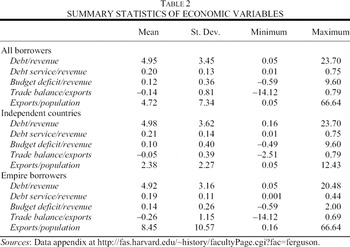
Table 2 summarizes the core economic control variables used in the statistical analyses. It will be seen that they are comparable, though not identical, to the variables used by Flandreau and Zumer.46
Flandreau and Zumer use the ratio of debt charges to tax revenue, the ratio of central bank reserves to banknote circulation, the ratio of exports to population, the ratio of the budget deficit to tax revenue, the record of default, the exchange rate (presence or absence of a peg to gold) as well as two political variables: the extent of the franchise and “political crises” (a selection of wars and revolutions). For a detailed critique of their methodology see Ferguson, “Political Risk.”
See, on this point, Mitchener and Weidenmier, “Trade.”

ESTIMATING THE EMPIRE EFFECT
In order to gauge the size of the empire effect on country risk premia, we first investigated the relationship between the spread over consols, i.e., the difference between the yield on a country's bonds and the yield on consols, and the economic control variables discussed previously. We look to the coefficient of the empire dummy (coded 1 if a borrower was a British possession) for an estimate of the empire effect.
The estimation of panel or time-series cross-section data has become a standard method of exploring large datasets in economic history. Pooling enables us to increase the amount of informative data, through combining variation across countries with variation over time. It also makes it possible to control for exogenous events affecting all units at a point in time, thus to control for time effects—a crucial advantage here because we need to take account of global interest rate shocks affecting all countries in a specific year.48
In our benchmark regressions we opted for simple time-dummies. As part of the sensitivity checks we also included country specific betas following the logic of the capital asset pricing model; see the discussion in what follows.
This method was made popular by Nathaniel Beck and Jonathan Katz: see Beck and Katz, “What to do (and not to do) with time-series.” In a different article the same authors have shown that the PCSE method is not only better than FGLS but also superior to Kmenta's “cross-sectionally heteroskedastic and timewise autocorrelated model” in research applications such as ours; Beck and Katz, “Nuisance vs. Substance.”
Also, clustered robust standard errors would be an alternative given the panel-heteroskedastic setting. We experimented with this method, but the results were very similar. See comments below.
Our research agenda is complicated by the fact that we are interested in coefficient estimates for a largely time-invariant variable. There are only three borrowers in our sample which became (de facto or de jure) colonies within the period: Egypt in 1882, and the Transvaal and the Orange Free State after the Boer War in 1900. As case studies their experiences are instructive. Spreads on Egyptian bonds were as high as 500 basis points in 1880. After the imposition of British rule and the restructuring of public finances and public debts, they fell to 270 basis points in 1882 and declined further to about 130 by the end of the 1880s.51
See Ferguson, “City of London and British Imperialism.” Spread reductions could also be observed in other countries as a consequence of the imposition of international financial control in the wake of a debt default, e.g., in the Ottoman Empire and in Greece. The reduction of financial sovereignty was typically associated with gains in market confidence, even in the absence of direct financial guarantees by the Powers.
The main implication of this limited time-variation of empire membership is that there are two ways to get a reliable estimate of the financing advantage of colonial borrowers. In a standard fixed-effects model the empire effect would appear in the country fixed-effects. The estimated unit effects of the model would show whether or not empire issuers had on average lower overall spread levels than independent borrowers.52
This is what Obstfeld and Taylor, “Sovereign Risk,” do in their “empire test.” To check the robustness of our results we apply the same methodology. A random-effects model would technically work with time-invariant variables, but random-unit effects are not a plausible assumption.
Haussmann and Taylor have proposed identifying and consistently estimating the coefficients of the time-invariant variables through a two-stage procedure; see Haussmann and Taylor, “Panel Data.”
Oaxaca and Geisler, “Fixed Effect Models.” To test the proposition that the unit effects are accounted for by a linear combination of the time-invariant regressors, we first ran a fixed effects model and regressed the estimated unit effects on the time-invariant variables including the empire dummy. We found that about 75 percent of the variance of the fixed effects is accounted for by colonial status and the geographical controls. We also tested whether or not the coefficient of the time-variant variables from the fixed-effects model changes once the unit effects are taken as regressors in an identical specification without fixed effects, but the coefficients hardly changed.
THE EVIDENCE
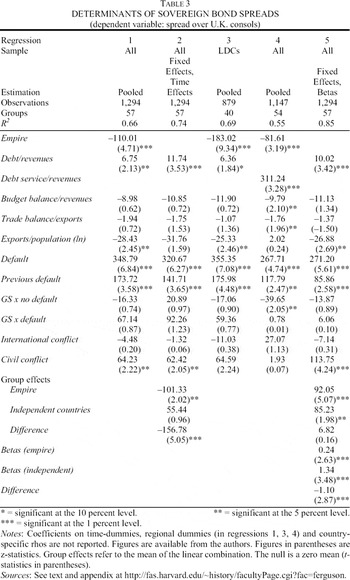
The results of our benchmark regression, 1, lend strong support to the idea of an empire effect. All other things being equal, the yield on a bond would be about 100 basis points lower if the issuer came from the British Empire.55
It can be argued that the autocorrelation could also be forced to be the same across all groups. This would increase the empire effect to about 120 basis points in our benchmark regression.
Repeating our benchmark regression with a different estimator, namely feasible generalized least squares (FGLS), produced the expected overconfident test statistics, but the empire effect remained the same. We obtain virtually the same result—a 100 basis point reduction—if we estimate the model by OLS but use the clustered Huber-White-sandwich estimates of variance (and standard errors).
See the data appendix for the country list; we coded all economies of Africa, Asia, Latin America, and peripheral Europe as developing countries.
But can we be sure this is truly an empire effect? Could there be a third factor (correlated with, but independent of, colonial status) that increased market confidence? Obviously, it was not the geographic position, measured by distance from the core or climatic conditions. British colonies were spread over all continents and climate zones. Nor can empire be considered a proxy for the impact of European settlement or the introduction of liberal parliamentary institutions, because the extent of settlement and political representation varied greatly across the empire, yet the exceptionally low country-effects apply equally to the dependent empire and the more autonomous dominions.58
The inclusion of regional dummy variables or other geographical controls has become common in quantitative explorations of cross-country spreads in order to account for the various economic effects associated with geography such as common shocks, records of regional political stability, or culture (See Eichengreen and Mody, “Changing Spreads”; Clemens and Williamson, “Wealth Bias”; Kamin and Kleist, “Credit Spreads”; and Cline and Barnes, “Spreads”). If we omit geographical controls altogether, the empire effect actually grows even stronger, to more than 150 basis points. We obtain similar results if we substitute the regional dummies for a geographic constant—the pre–Panama canal shipping distance from London. The results are available from the authors on request.
What about the macroeconomic control variables? Our results support Flandreau and Zumer's emphasis on public finance as a determinant of pre-1914 bond spreads: the debt to revenue ratio is correctly signed and significant in all regressions. As noted, Flandreau and Zumer have argued that contemporary investors paid more heed to the ratio of debt service to public revenues. It is obvious that, by virtue of their lower spreads, British colonies had to pay less interest on their debt than independent countries. We would therefore expect the empire effect to get weaker if one relies exclusively on the debt service ratio—but not to disappear. Regression 4 provides the corresponding empirical test. It demonstrates that the empire effect does not depend on the choice of the debt indicator. The empire effect remains highly significant. Only its size is, unsurprisingly, somewhat smaller if the debt service serves as the only debt control—about 82 basis points in this specification.59
In a FGLS regression and using clustered robust standard errors, the effect is again close to 100 basis points. In a PCSE fixed-effects model in which the debt service ratio is the only debt indicator, a statistically highly significant mean difference of 160 basis points appears between the fixed-effects of colonies and independent countries.
Further sensitivity tests involved the estimation of a log-linear model, the inclusion of lagged independent variables, debt and revenues per capita, the growth rate of exports and of the population, the terms of trade, the share of natural resource exports in total exports, and the regression of end-of-period spreads (in other words, spreads calculated at December closing prices). We also tested a dynamic panel specification and ran pure cross-sections for period averages. None of this changed our main finding on the size and significance of empire membership, which was worth about 100 basis points, often more, especially when we compared poor colonies with poor independent countries.
As for gold standard adherence, our results provide mixed evidence and point to the need for further analysis. Although the gold standard variable (conditional on no default) is correctly signed and has the expected effect of a 15 to 40 basis point reduction in spreads, it passes the significance test only in some regressions. Moreover, we found that, unlike the debt to revenue ratio, the gold standard dummy is rather sensitive to changes in the estimation specification, to influential observations, and to differences in the coding criteria.61
It is important to note that not all colonies were also on the gold standard. Some joined relatively late, some colonies never did adhere. The different effects of gold standard membership and colonial status can thus be econometrically separated. This was confirmed when we introduced a separate variable for noncolonial gold standard members. Arguably, endogeneity of the exchange rate regime could be a problem, but it is unlikely to influence the estimation of the empire effect. For a more detailed discussion see Obstfeld and Taylor, “Sovereign Risk,” p. 244.
As expected, both defaulters and previous defaulters were heavily penalized by the City, but the budget deficit seems to have had no significant effect on spreads. (One possible explanation is that investors did not regularly follow the budget balances of various countries, but concentrated on debt indicators instead as an excess of expenditure over revenues would show up in the debt figures.) The picture is different for the external trade indicators. Richer countries (measured by exports per capita) paid less interest and, other things being equal, a country that ran an export surplus would have lower borrowing costs. Our estimations also lend some support to the argument that current political factors were important spread determinants: any incidence of internal political conflict raised spreads by as much as 70 basis points (see Table 3).

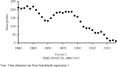
Why do we find strong evidence for an empire effect of about 100 basis points, where Obstfeld and Taylor concluded it did not exist? Apart from the bigger sample, different controls for time-specific asset market shifts could drive the result. Such shifts can be controlled for by using time-dummies (or any other market-wide measure) that affect all borrowers in a given year, which is what we opted for in the benchmark regression. The time dummies from our regression show a clear downward trend over the period, briefly interrupted in the crisis years of the early 1890s (Figure 1). The picture mirrors the general trend towards spread convergence discussed by Obstfeld and Taylor as well as Flandreau and Zumer.

FIGURE 1 TIME EFFECTS, 1880–1913
However, Bordo and Rockoff as well as Obstfeld and Taylor took a different track. They included a measure of systematic risk—a weighted “world spread” over consols in every year with country-specific slopes or “betas”—following the capital asset pricing model (CAPM) and its predictions about pricing of assets according to systematic risk.62
It is well known that the empirical support for the CAPM is rather weak. Flandreau and Zumer, Making of Global Finance, reject this approach and underline the dangers of anachronistic modelling, pointing out that CAPM had not been invented by 1913. However, on an “as-if” basis this approach could remain valuable. It should also be noted that many well-known contemporary studies do not employ country-specific betas, but control for asset market shifts and investor's risk aversion using a common control variable such as time-dummies or the spread between low and high risk assets. See Cantor and Packer “Determinants”; Eichengreen and Mody, “What Explains Changing Spreads”; and Kamin and Kleist, “Evolution.”
To test this, we constructed a debt-weighted world spread for any given year.63
We also tried an unweighted and a GDP-weighted world spread for a subsample, but none of this changed our findings.
Why does the empire effect fade once one switches to CAPM-style controls? Our large sample enables us to identify the underlying causes with great certainty: the key driver for the different findings is the much lower covariance of colonial interest rates with the average risk of foreign bonds (or significantly lower individual betas in CAPM-language).64
We are especially indebted to Alan Taylor for helpful comments on this point.
The lower sensitivity of colonial assets to market risk actually confirms the empire effect hypothesis. Investors treated colonial bonds differently, as reflected in the exceptionally low betas.65
Obstfeld and Taylor, “Sovereign Risk,” p. 255 (footnote 13). They call it the “strong empire test.”
BOND SPREADS WITHIN THE BRITISH EMPIRE
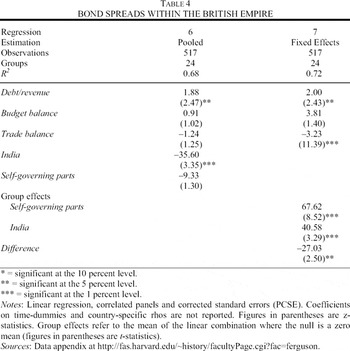
The last part of our analysis of spread determinants is devoted to an equally old question in the study of the British Empire: Who profited most from preferential access to the London capital market—the dependent empire, the Dominions, or India? Ceteris paribus, which did investors see as the safest place to put their money? Looking in detail at loan issues in the period under investigation, Lance Davis and Robert Huttenback concluded that “within the British Empire, India consistently paid less for capital than either the dependent colonies or those with responsible government.”66
Ibid., p. 174.
Regressions 6 and 7 exploit our dataset to give a more comprehensive answer (see Table 4). They essentially confirm the conclusions of Davis and Huttenback; Indian bonds had a distinctly lower risk premium than either dependent or self-governing borrowers within the empire. In both estimations, we found India's financing advantage to have been worth about 30 basis points. This result is not surprising because, unlike some other colonial bonds, “Indian government bonds carried the backing of the British government and were listed in the official rosters of the London stock exchange with ‘British funds’.”67
Edelstein, “Imperialism,” p. 206.

COUNTRY RISK AND CAPITAL FLOWS
The City of London viewed British possessions as safe places to invest. As a result, distant colonies gained access to the London capital market at cheaper rates than comparable sovereign states. But what implications did this have for the amounts of capital that flowed from Britain to her empire? In other words, did the empire effect mean more capital as well as lower interest rates? Any answer to this question depends both on counterfactual argumentation and ceteris paribus assumptions and must therefore remain highly speculative. Nevertheless, such questions have been raised before and played an important role in the debate on the costs and benefits of British imperialism, and we cannot therefore ignore them.68
See Davis and Huttenback, Mammon, p. 174; and Edelstein, “Imperialism,” pp. 207–10.
Edelstein, “Imperialism,” p. 209.
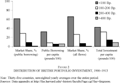
Figure 2 allows a first visual impression of the patterns of international borrowing in the London capital market, and underlines the risk aversion of British financial investors. More than 60 percent of aggregate public borrowing in the boom years between 1900 and 1913 was concentrated in the low-risk segment of the market (spreads of less than 100 basis points), while another 30 percent went to public borrowers whose spreads were less than 200 basis points above the British consol. This tendency looks even more pronounced if borrowing is denominated by population. It therefore seems reasonable to assume that, if the colonies suddenly had gained their independence, capital flows would have fallen rather substantially. Higher default risks would have depressed the expected return for investors, rendering foreign investment less attractive and drying up the supply of capital.

FIGURE 2 DISTRIBUTION OF BRITISH PORTFOLIO INVESTMENT, 1900–1913
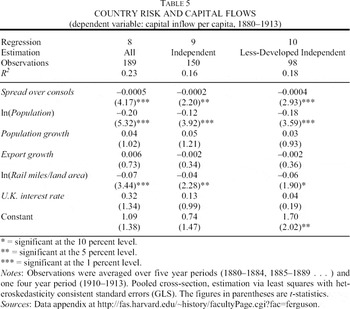
To illustrate these considerations in an empirical framework, we can try to estimate the relationship between the amount of foreign borrowing in London and risk premia. We would expect to find that capital flows decreased with higher country risks, because investors tend to limit their exposure to high-risk assets.70
For theoretical aspects of international lending and sovereign risk, see Eaton et. al., “Theory”; and Hermalin and Rose, “Risks.” An application is Taylor and Sarno, “Capital Flows.”
A much more comprehensive attempt to estimate the determinants of capital flows from Great Britain was recently made by Clemens and Williamson, “Wealth Bias.” The authors also report that country risk mattered for the amount of capital countries attracted. Detailed analysis of British financial investment is possible since the publication of the flow data in Stone, Global Export.
First, we use five-year averages to level out cyclical effects, reduce the impact of outliers, and get a reliable picture of the underlying factors. Second, we control for a number of other plausible determinants, regressing the yearly average capital inflows per capita not only on spreads, but also on population (to control for country size), the period average of population and export growth (for demographic and growth trends), and on the ratio of rail miles in operation to country size (as a proxy for opportunities for “reproductive investment”). Finally, we include U.K. interest rates as a “push” factor.
Regression 8 includes the full sample of British investment, while regression 9 limits the sample to independent countries and regression 10 to the less developed independent countries outside Western Europe and North America (see Table 5). The main finding that runs through all regressions is that higher risk premia were indeed associated with lower flows. The elasticity of flows to independent countries in relation to the risk premium, about 0.3 at average regressor values, was also substantial. For the less developed countries in our sample, the impact was even greater. Other things being equal, a country received more than twice as much capital per capita if its risk premium was only half of the developing country average. And cutting risk premia by half is what empire membership probably implied for the poor African and Asian colonies. In view of the highly exploratory character of the estimation, we are inclined not to read too much into these results. However, the significance of market size and the positive sign on population growth are in line with previous studies.72
Clemens and Williamson, “Wealth Bias”; Kelly, “Ability”; and Fishlow, “Lessons.”

At the very least, it seems legitimate to conclude that the higher country risks that would have been consequent on an “Edwardian decolonization” would, in turn, have reduced capital flows to Britain's former possessions. For British investors did not place voluminous bets on risky governments; they extended relatively more credit to the low-risk segment of the market. Given this preference, the appeal of investing in the empire is obvious.
CONCLUSIONS
Our findings indicate that the empire effect observed by contemporaries a century ago was no optical illusion. Even when—using information that was available to contemporaries—we allow for differences in monetary and fiscal policy, openness to trade, political stability, as well as geographical location and level of economic development, we find that a country that was a part of the British Empire was still able to borrow at significantly lower interest rates than one that was not. Although this is true for all colonies, the main beneficiaries were the poor and underdeveloped parts of the British Empire. For these economies, the empire effect cut risk premia by more than 150 basis points, or by about 60 percent compared to the average spread charged to developing countries between 1890 and 1913.
As it turned out, the interwar period confirmed what pre-1914 investors had rightly suspected: it was indeed riskier to invest in sovereign foreign states than to lend to comparable colonial economies. There were defaults by numerous independent debtor countries including Argentina, Brazil, Chile, Mexico, Japan, Russia, and Turkey.73
Lindert and Morton, “Sovereign Debt.”
Cain and Hopkins, British Imperialism, p. 439.
When Keynes criticized the low yields on colonial loans in the 1920s, his point was that this state of affairs was not in the economic interests of Britain herself. With unemployment stubbornly stuck above prewar levels and mounting evidence of industrial stagnation, capital export seemed like a misallocation of resources. But Keynes did not consider the benefits reaped by colonial economies from cheap access to British savings. From an imperial rather than a narrowly national point of view, it was highly desirable that capital from the wealthy metropolis be encouraged to flow to the developing periphery. Besides ensuring that British investors got their interest paid regularly and their principal paid back, the imperial system was conducive to global economic growth—more so, certainly, than an alternative policy of the sort Keynes had in mind, which would have prioritized the industrial production and employment of the United Kingdom.
This conclusion has wider implications for historical debates about imperialism and modern debates about economic development. Whatever the impact on Britain of large-scale overseas investment, it can hardly have been disadvantageous to British colonies that they could raise capital in London at rates up to 60 percent lower than comparably endowed sovereign states, or that they were able to attract more British capital than otherwise comparably situated but independent countries. To be sure, indigenous peoples by and large had little say over the ways in which the capital so raised was invested. Conceivably, independent governments might have invested it in ways better calculated to foster economic growth. Yet the record of most postcolonial governments, especially in sub-Saharan Africa, strongly suggests otherwise. The inability of so many former colonies today to attract foreign investment—other than in the form of credits or aid from noncommercial lenders and donors—suggests that there may be a trade-off for poor countries between political sovereignty and creditworthiness.75
See Krasner, Organized Hypocrisy.
We are grateful to Nitin Malla for research assistance. We would also like to thank Michael Bordo, Michael Clemens, Warren Coats, Marc Flandreau, Carl-Ludwig Holtfrerich, Trish Kelly, Chris Meissner, Ronald Oaxaca, Thomas Pluemper, Hugh Rockoff, Martin Schueler, Irving Stone, Nathan Sussman, Alan Taylor, Adrian Tschoegl, Marc Weidenmier, and Jeffrey Williamson for comments or assistance with the construction of the dataset. Three anonymous referees provided helpful suggestions.