Introduction
Allergic rhinitis is a common disease with increasing prevalence worldwide.Reference Asher, Montefort, Björkstén, Lai, Strachan and Weiland1, Reference Bousquet, Khaltaev, Cruz, Denburg, Fokkens and Togias2 It is a significant medical and social burden.Reference Canonica, Bousquet, Mullol, Scadding and Virchow3 Allergic rhinitis does not remit easily,Reference Wahn4 and if the disease develops in childhood it may impair quality of life and school performance for many years.Reference Gelfand5–Reference Craig, Sherkat and Safaee7 Immunotherapy holds great promise in the management of allergic conditions, where the current mainstay of treatment is patient education, allergen avoidance and symptomatic relief using medications. These measures are difficult to implement on a daily basis, especially for perennial allergens such as house dust mites.
Subcutaneous immunotherapy has been shown to be effective in reducing symptoms.Reference Bousquet, Lockey and Malling8 However, uncommon but severe fatal systemic reactions have begun to worry physicians, and repeated injections have led to complaints, especially among children.Reference Passalacqua, Guerra, Pasquali, Lombardi and Canonica9 In view of this, alternative routes of immunotherapy have been explored. Among these, sublingual immunotherapy, by which oral tolerance is induced at mucosal surfaces, has emerged as a treatment option because of its clinical efficacy and safety.Reference Bousquet10
The improved safety and tolerability of sublingual immunotherapy over subcutaneous immunotherapy makes the former an attractive option, but the efficacy of sublingual immunotherapy in paediatric and adult patients with house dust mite allergic rhinitis remains controversial.Reference Roder, Berger, de Groot and van Wijk11–Reference Wilson, Lima and Durham13 Furthermore, although Blomia tropicalis is a common cause of dust mite allergy in the tropics and subtropics worldwide,Reference Arlian, Vyszenski-Moher and Fernandez-Caldas14–Reference Fernández-Caldas, Puerta and Caraballo16 it has little cross-reactivity with Dermatophagoides pteronyssinus and Dermatophagoides farinae, which are the only dust mites where the effects of sublingual immunotherapy have been studied.
Thus, our objective was to evaluate the efficacy of sublingual immunotherapy with house dust mite extracts of D pteronyssinus, D farinae and B tropicalis on nasal symptoms and quality of life, in children and adults with house dust mite allergic rhinitis, over a period of two years.
Materials and methods
This study was a prospective observational study of patients treated in the Department of Otolaryngology at the National University Hospital, Singapore. The subjects were children and adults diagnosed with house dust mite allergic rhinitis who were started on treatment with sublingual immunotherapy (with house dust mite extracts) from 2008 to 2012 and followed up for two years.
Patient characteristics
All patients had persistent allergic rhinitis as per the Allergic Rhinitis and its Impact on Asthma classification; specifically, symptoms had lasted for more than 4 days per week and had persisted for more than 4 weeks (regardless of the number of days that symptoms were experienced per week). Diagnosis of house dust mite allergic rhinitis required the typical features on clinical history (symptoms of rhinitis, such as stuffiness, rhinorrhoea and sneezing for more than 1 hour per day on most days of the week) and a positive allergen-specific skin prick test reaction (wheal diameter of more than 3 mm) to extracts from any of the following house dust mites: D pteronyssinus, D farinae and B tropicalis.
Treatment
Patients were treated with standardised Staloral® house dust mite extract (D pteronyssinus, D farinae and/or B tropicalis) as per their sensitisation pattern. The initiation and build-up phase of treatment followed the manufacturer's specifications; it comprised a gradual escalation of doses over an 11-day period, followed by maintenance treatment of 1200 index of reactivity daily, over a 24-month period.
Most patients were on conventional pharmacotherapy (antihistamines and/or intranasal steroids) on a daily basis; a minority took medications on an as-needed basis prior to commencing sublingual immunotherapy. All patients had already been advised as to house dust mite avoidance, prior to the commencement of sublingual immunotherapy.
Outcome assessment
Symptom severity and quality of life outcomes were assessed prospectively during sublingual immunotherapy. The symptom severity questionnaire, the Total Nasal Symptom Score, was based on a modified visual analogue scale by Juniper et al.Reference Juniper, Guyatt, Andersson and Ferrie17 Quality of life was assessed using the Mini Rhinoconjunctivitis Quality of Life Questionnaire.Reference Juniper, Thompson, Ferrie and Roberts18 Patients were asked to rate each questionnaire item for the previous 7-day period on a 0–6-point scale. Symptom severity and quality of life were assessed at commencement (baseline scores), and after three months, six months, one year and two years of therapy.
Patients were also asked about medication usage; scores for this were obtained at baseline, and after three months, six months, one year and two years of therapy. Medication usage was scored from 1–5 as follows, with 1 representing the least change in medication use and 5 reflecting the greatest reduction in medication usage: 1 = no change, 2 = reduced by 50 per cent, 3 = reduced by 50–75 per cent, 4 = reduced by more than 75 per cent and 5 = medication only as needed.
Statistical analysis
SPSS® software, version 19.0, was used to carry out the analysis. Total Nasal Symptom Scores and Mini Rhinoconjunctivitis Quality of Life Questionnaire scores were compared at different time points using the Wilcoxon signed-rank sum test. A p-value of less than 0.05 was considered significant. Medication usage scores at baseline and at one year into sublingual immunotherapy were compared using the Wilcoxon signed-rank sum test.
Results
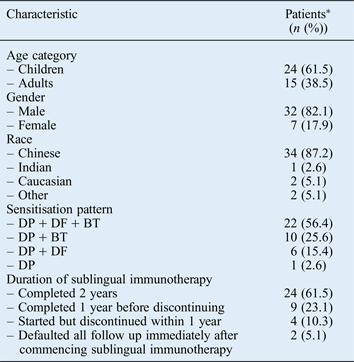
The records of 39 patients were studied. Demographic and treatment duration data are shown in Table I.
Characteristics of study cohort

*Total n = 39. DP = Dermatophagoides pteronyssinus; DF = Dermatophagoides farinae; BT = Blomia tropicalis
Based on patient age at commencement of sublingual immunotherapy, there were 24 children (age range, 7–18 years) and 15 adults (age range, 19–72 years). Almost all subjects were Chinese (87.2 per cent) and male (82.1 per cent).
Twenty-four patients completed at least two years of sublingual immunotherapy. Of the remainder, two patients defaulted follow up immediately after commencing sublingual immunotherapy and remained uncontactable. Four patients discontinued sublingual immunotherapy within the first year; one claimed that the treatment caused diarrhoea, whilst the other three were uncontactable. Nine patients discontinued sublingual immunotherapy between one and two years of treatment; one cited financial constraints, one cited worsening symptoms of allergic rhinitis and the other seven were uncontactable. There were no significant differences in baseline characteristics between those who were lost to follow up and those who completed the study.
Symptom severity
Table II shows the Total Nasal Symptom Scores for the whole cohort, the D pteronyssinus plus D farinae plus B tropicalis subgroup, and the children-only subgroup. Results in the other subgroups were not significant, owing to the low number of patients.
Total nasal symptom scores by sublingual immunotherapy time point
*Compared with baseline. NA = not applicable; DP = Dermatophagoides pteronyssinus; DF = Dermatophagoides farinae; BT = Blomia tropicalis
For the cohort as a whole (n = 39), the pre-treatment mean score was 8.41. This dropped significantly at all time points compared to the baseline, to a lowest score of 4.25 at two years into therapy (p = 0.008).
Similar results were seen in the children-only subgroup (n = 24). With a baseline score of 8.38, there was a significant reduction in scores at all time points, with a lowest score of 4.80 at two years (p = 0.02).
For the D pteronyssinus plus D farinae plus B tropicalis subgroup (n = 22), the pre-treatment mean score was 8.73. There was significant reduction in Total Nasal Symptom Scores at one year only (mean score = 5.54), compared to baseline (p = 0.024). The score dropped further to 4.71 at two years, but this decrease was not significant.
Subjects in the D pteronyssinus plus D farinae (n = 6) and D pteronyssinus plus B tropicalis (n = 10) treatment groups showed decreases in Total Nasal Symptom Scores similar to that in the whole cohort, but none of the decreases were statistically significant, likely owing to the small numbers of respondents.
There was only one subject in the D pteronyssinus treatment group, making analysis impossible for this subgroup.
Analysis in the adult subgroup did not yield significant results, owing to the low number of respondents.
Quality of life
The Mini Rhinoconjunctivitis Quality of Life Questionnaire scores for the whole cohort, the D pteronyssinus plus D farinae plus B tropicalis subgroup, and children-only subgroup are shown in Table III.
Mini rhinoconjunctivitis quality of life questionnaire scores by sublingual immunotherapy time point
*Compared with baseline. NA = not applicable; DP = Dermatophagoides pteronyssinus; DF = Dermatophagoides farinae; BT = Blomia tropicalis
The total scores for the whole cohort (n = 39) dropped steadily as treatment continued; this reduction was statistically significant when the baseline scores were compared to the scores at all time points during sublingual immunotherapy. The pre-treatment baseline mean score was 34.69, which dropped to a lowest score of 10.55 at two years of treatment (p = 0.012).
With regard to the subgroup analysis, subjects treated with D pteronyssinus plus D farinae plus B tropicalis allergen (n = 22) had a pre-treatment mean score of 36.95. There was a significant reduction in scores at one year only (mean score = 9.00) compared to baseline (p = 0.016). At two years, the mean score increased to 14.71, but this change was not significant.
Subjects in the D pteronyssinus plus D farinae (n = 6) and D pteronyssinus plus B tropicalis (n = 10) treatment groups had decreases in scores similar to that in the whole cohort, but none of the decreases were statistically significant, likely owing to the small numbers of respondents. There was only one subject in the D pteronyssinus treatment group, making analysis impossible for this subgroup.
In the children-only subgroup (n = 24), the baseline Mini Rhinoconjunctivitis Quality of Life Questionnaire score was 33.79. There was a significant reduction in scores at all time points, with a lowest score of 11.60 at two years (p = 0.02).
Analysis in the adult subgroup did not yield significant results, owing to the low number of respondents.
Medication usage
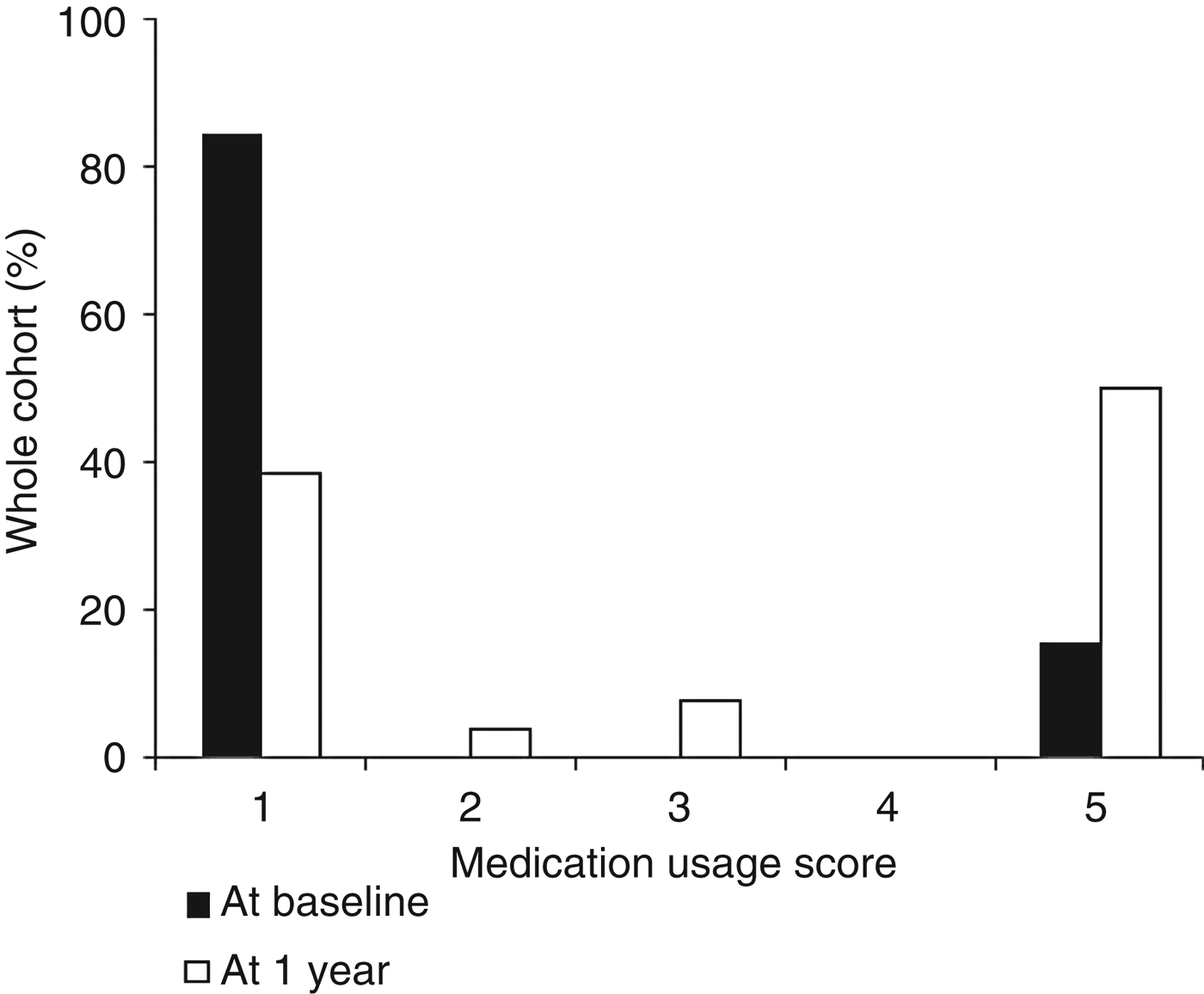
As sublingual immunotherapy continued, the proportion of patients who could reduce their conventional medication usage, and the amount of medication reduction, increased (Figure 1).
Medication usage scores for whole cohort, at baseline and one year into treatment. Scoring: 1 = no change, 2 = reduced by 50 per cent, 3 = reduced by 50–75 per cent, 4 = reduced by more than 75 per cent and 5 = medication only as needed.
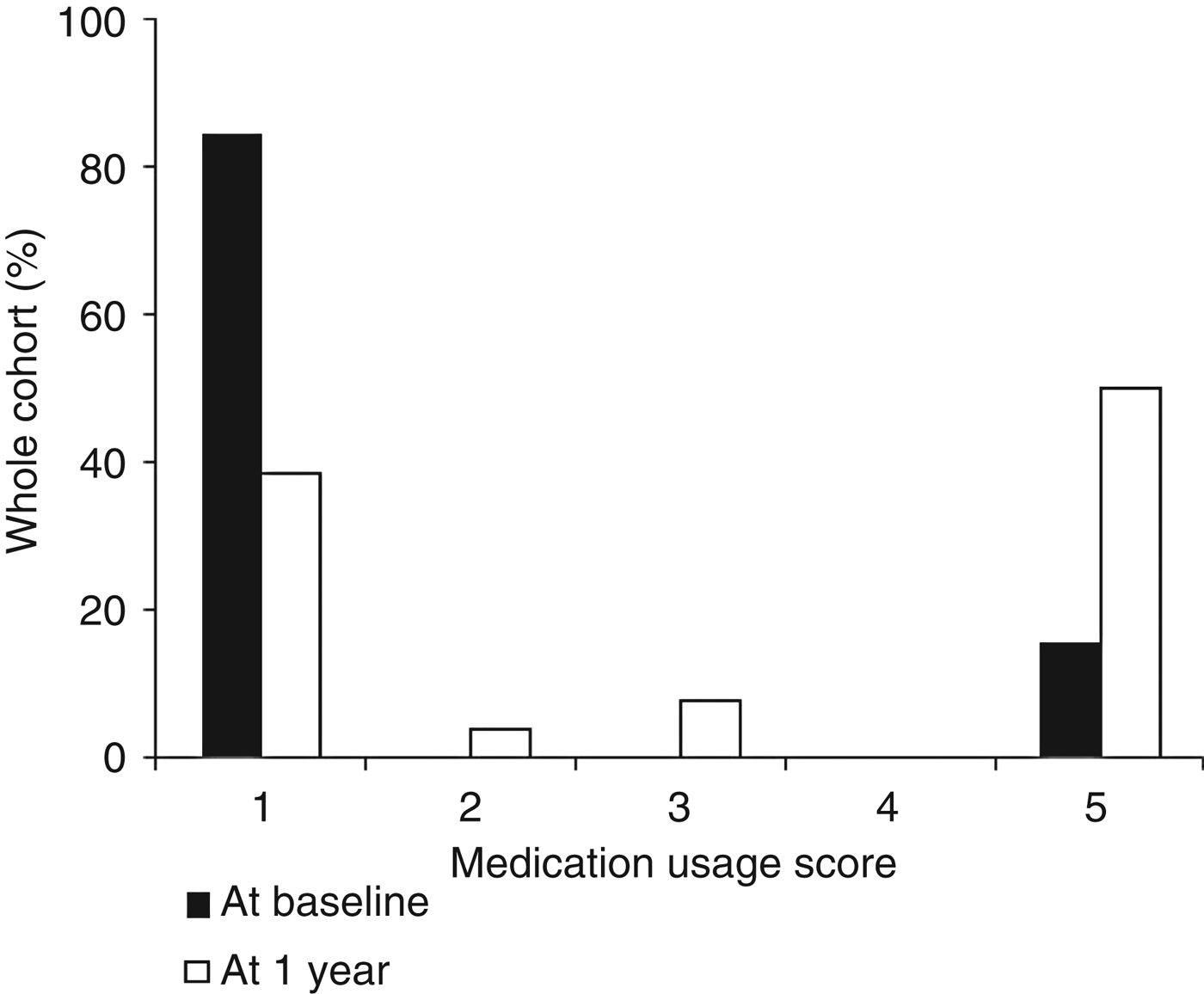
At 1 year into therapy, 26 respondents provided medication usage scores. Ten of these patients (38.5 per cent) were still using medications daily, 1 patient (3.8 per cent) had a 50 per cent reduction in medication usage, 2 patients (7.7 per cent) had a 50–75 per cent reduction in medication usage and the remaining 13 patients (50 per cent) were using medications on an as-needed basis. These findings demonstrated a significant improvement in medication usage compared to baseline (p = 0.004) (at baseline, 22 of the 26 patients (84.6 per cent) were on daily medication, with the remaining 4 patients using medication on an as-needed basis).
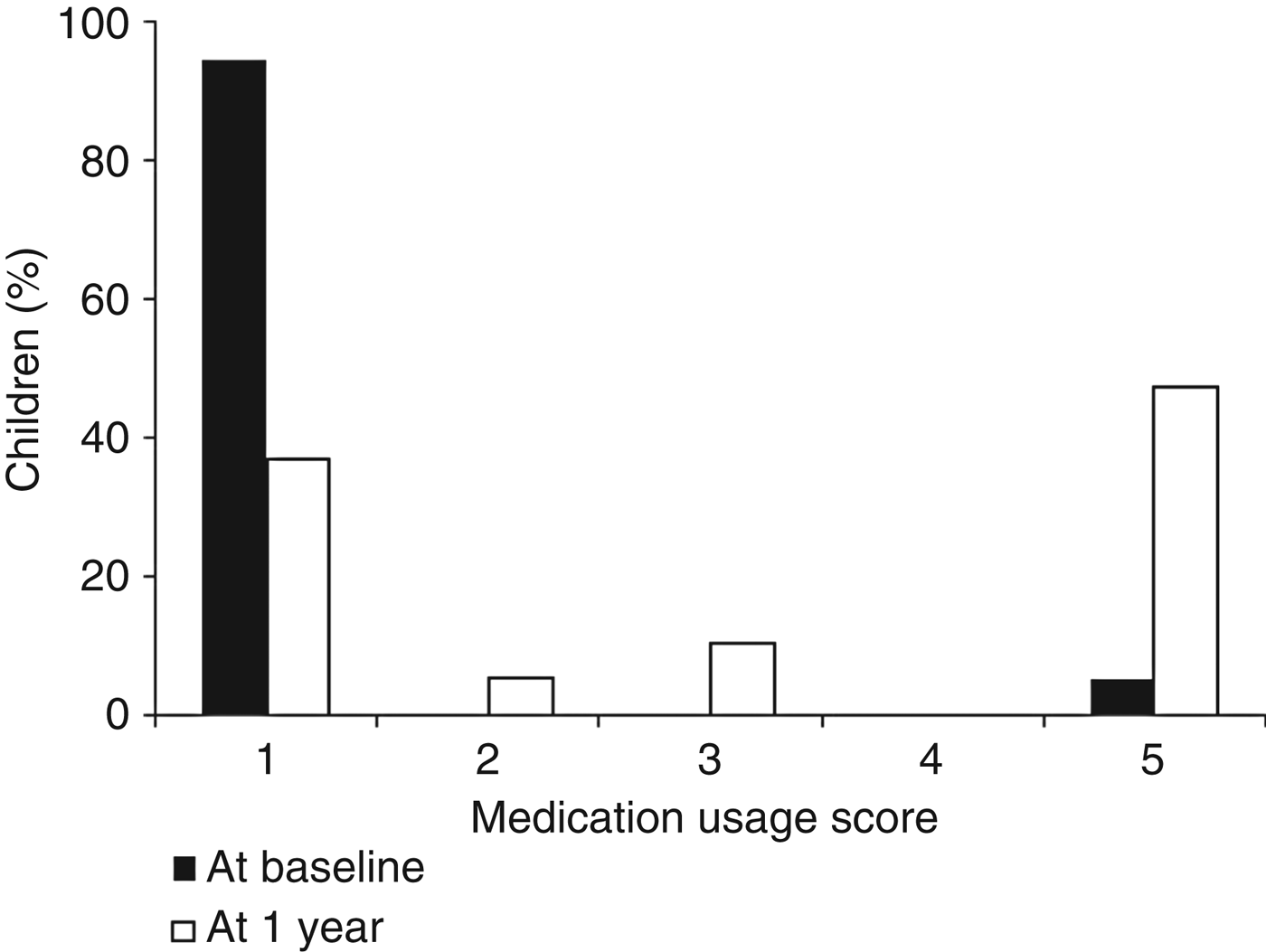
There were 19 child respondents at 1 year into sublingual immunotherapy (Figure 2). Seven of the 19 children (36.8 per cent) were using medication daily, 1 (5.3 per cent) had a 50 per cent reduction in medication usage, 2 (10.5 per cent) had a 50–75 per cent reduction in medication usage and 9 (47.4 per cent) were using medications on an as-needed basis. This demonstrates a significant improvement compared to baseline (p = 0.002) (at baseline, 18 of the 19 children (94.7 per cent) were on medication daily and the 1 remaining child (5.3 per cent) was on medication on an as-needed basis).
Medication usage scores for children, at baseline and one year into treatment. Scoring: 1 = no change, 2 = reduced by 50 per cent, 3 = reduced by 50–75 per cent, 4 = reduced by more than 75 per cent and 5 = medication only as needed.
Analysis of the adult subgroup and of treatment subgroups did not yield significant results, owing to the insufficient numbers of respondents.
Discussion
Our findings suggest that sublingual immunotherapy is efficacious at providing symptomatic relief and improving quality of life in patients with house dust mite allergic rhinitis. Most patients demonstrated significant improvements in Total Nasal Symptom Scores and Mini Rhinoconjunctivitis Quality of Life Questionnaire scores, with Total Nasal Symptom Scores showing significant improvement as early as three months into treatment and continuing to improve through to two years into treatment. This benefit was also seen in the children-only subgroup that underwent sublingual immunotherapy.
These findings are in line with evidence from several other studies of allergic rhinitis patients who were sensitised to house dust mites.Reference Lee, Choi, Kim, Han, Rhee and Lee19–Reference Wang, Chen, Cheng, Li, Yuan and Lu25 Total Nasal Symptom Scores have shown decreases as early as six months into treatment.Reference Kim, Han, Moon, Lee, Min and Rhee21–Reference Wang, Chen, Cheng, Li, Yuan and Lu25 One study found sublingual immunotherapy to be effective as early as 14 weeks after commencing therapy, a finding close to our own at 3 months into treatment.Reference Wang, Chen, Cheng, Li, Yuan and Lu25
A strength of this study was the inclusion of patients sensitised to B tropicalis and their treatment with the corresponding extract. Most of the patients were sensitised to B tropicalis. B tropicalis is an important source of allergens in the tropics and subtropics worldwide, but its allergens have little cross-reactivity with D pteronyssinus and D farinae. To date, previous studies examining the effect of sublingual immunotherapy on patients with allergic rhinitis have used extracts of D pteronyssinus and/or D farinae only.Reference Lee, Choi, Kim, Han, Rhee and Lee19, Reference Kim, Han, Moon, Lee, Min and Rhee21–Reference Wang, Chen, Cheng, Li, Yuan and Lu25
One limitation we faced was the large proportion of patients who did not provide Total Nasal Symptom Scores or Mini Rhinoconjunctivitis Quality of Life Questionnaire scores (non-responders). This was because some patients did not turn up at the appointed follow-up times when the questionnaires would have been administered. This rendered most of the differences in scores insignificant on analysis of the subgroups, even though the mean scores were clearly decreasing. These decreases were most evident when looking at the cohort as a whole – only by pooling all patient data were there sufficient respondents for the differences to be statistically significant. There was a significant dropout rate, especially after the initial clinic visit. Kim et al. found that most patients who dropped out after six months of treatment did so because of symptom improvements.Reference Kim, Mun, Han, Kim, Kim and Rhee26 In our cohort, we were not able to verify this explanation, as the majority of these patients were uncontactable.
It is a concern that randomised, placebo-controlled trials of sublingual immunotherapy with house dust mite extract for children with allergic rhinitis did not show convincing evidence of benefit.Reference de Bot, Moed, Berger, Röder, Hop and de Groot27–Reference Aydogan, Eifan, Keles, Akkoc, Nursoy and Bahceciler29 de Bot et al. suggested that this may have been attributable to a lower cumulative dose of dust mite extract relative to other studies, or to a twice-weekly dosing regimen during the maintenance phase.Reference de Bot, Moed, Berger, Röder, Hop and de Groot27 Other potentially confounding factors are the different compounds used for sublingual immunotherapy (which are made by different manufacturers) and the different dosing regimens used for each trial. The dosing regimen in this study was in accordance with the manufacturer's recommendations: the total cumulative dose was 6610 index of reactivity during the build-up phase, followed by 1200 index of reactivity daily. As this was not a randomised, placebo-controlled trial, there was no control group with which to compare the results showing benefit from sublingual immunotherapy.
The proportion of patients who had reduced medication usage, and the proportion who could reduce medication to an as-needed basis, increased over time as sublingual immunotherapy was continued. There were two limitations to this finding: one was the fact that not all patients provided medication usage scores, so it is possible that the non-respondents might not have had any reduction in medication usage, in addition to the respondents who stated the same. However, it is promising that more patients provided scores as therapy continued. The second limitation was the poor number of respondents at two years into therapy. Though the proportion of respondents who had reduced medication usage, or reduced medication to an as-needed basis, increased compared to previous time points, the absolute number of patients who could claim this at two years was less than that at one year into therapy.
Another limitation of the study is the absence of a placebo arm. This makes it difficult to ascertain how much of the improvement in any of the scores may have been a result of other factors, such as avoidance measures aimed at house dust mites or spontaneous improvement in the patients’ symptoms. However, all patients had been advised on house dust mite avoidance prior to commencing sublingual immunotherapy, so house dust mite avoidance is unlikely to account for the differences in the results.
Another question that remains unanswered is the optimal length of treatment necessary to induce long-term tolerance. Tahamiler et al.Reference Tahamiler, Saritzali and Canakcioglu30 and Marcucci et al.Reference Marcucci, Sensi, Di Cara, Salvatori, Bernini and Pecora31 followed up patients with house dust mite allergic rhinitis for three years, following treatment with either two or three years of sublingual immunotherapy, with the results supportive of a longer duration of treatment. More recently, Marogna et al. found that a four-year course of sublingual immunotherapy appeared to be the most optimal treatment length in patients with house dust mite allergic rhinitis, with outcomes similar to those following a five-year course of treatment and superior to those following a three-year course of treatment.Reference Marogna, Spadolini, Massolo, Canonica and Passalacqua32 Further research needs to be done in this area, especially in Asians where the evidence for sublingual immunotherapy remains scarce.
• Sublingual immunotherapy is a treatment option in children and adults with house dust mite allergic rhinitis
• Unblinded studies suggest treatment efficacy, generally starting at six months into therapy
• Previous sublingual immunotherapy studies have used D pteronyssinus and D farinae dust mite extracts only
• B tropicalis is another dust mite to which allergy is common in the tropics, with little cross-reactivity to D pteronyssinus and D farinae
• Sublingual immunotherapy in house dust mite allergic rhinitis patients shows benefit as early as three months into therapy
• Sublingual immunotherapy with the inclusion of B tropicalis demonstrates efficacy in patients
In conclusion, sublingual immunotherapy with house dust mite extracts is efficacious as a treatment for patients with house dust mite allergic rhinitis, with early improvements in symptom scores and quality of life, and a significant reduction in the usage of other conventional medications.
Acknowledgement
The authors thank Professor Chan Yiong Huak for his advice on the statistics.